
Module F 211 1 2 1 Exchange surfaces



- Slides: 28
Module F 211 1. 2. 1 Exchange surfaces and breathing EXCHANGE SURFACES Lesson objectives: To describe the features of an efficient exchange surface Describe the diffusion of oxygen and carbon dioxide across an alveolus.
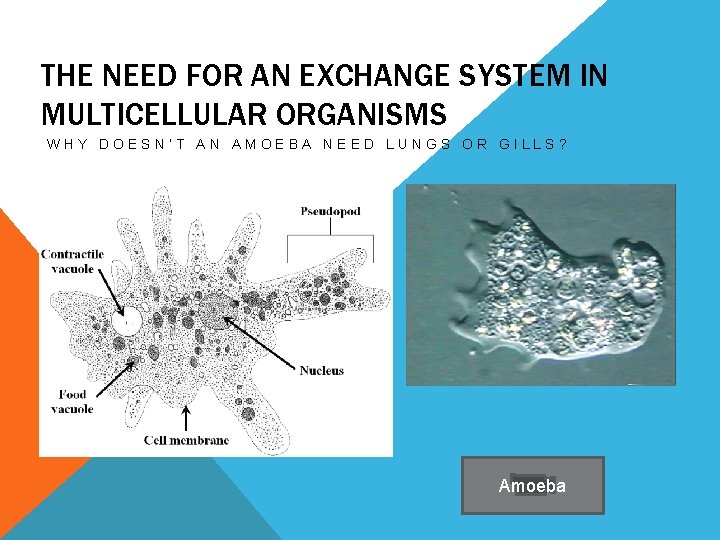
THE NEED FOR AN EXCHANGE SYSTEM IN MULTICELLULAR ORGANISMS WHY DOESN’T AN AMOEBA NEED LUNGS OR GILLS? Amoeba
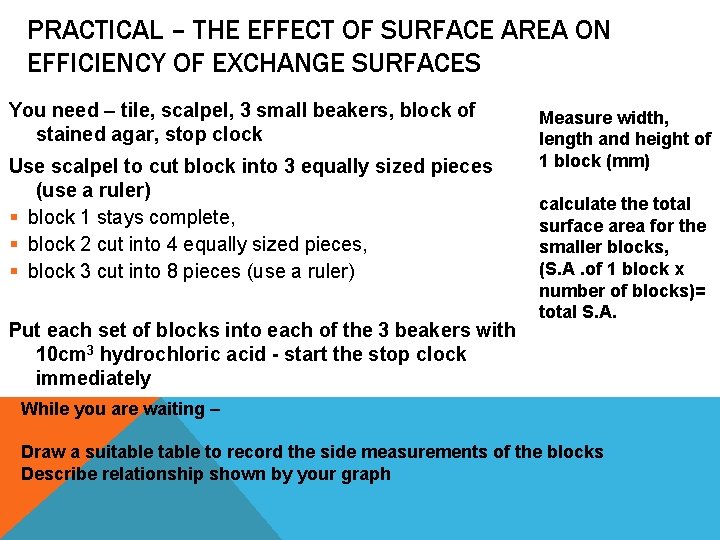
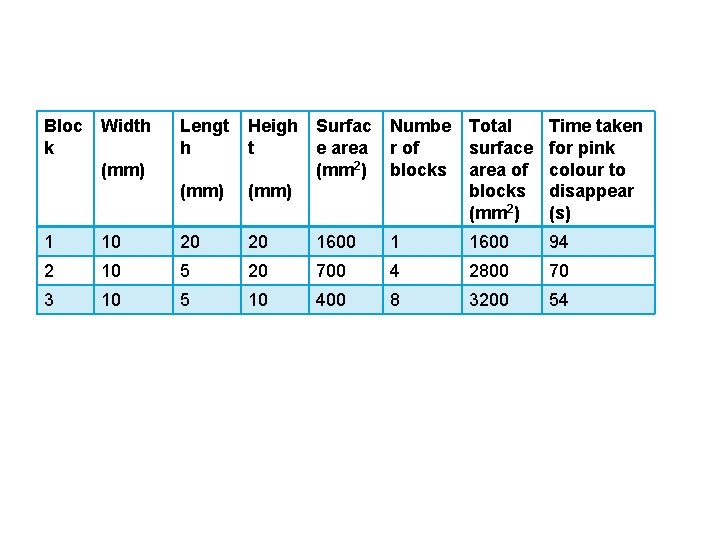
PRACTICAL – THE EFFECT OF SURFACE AREA ON EFFICIENCY OF EXCHANGE SURFACES You need – tile, scalpel, 3 small beakers, block of stained agar, stop clock Use scalpel to cut block into 3 equally sized pieces (use a ruler) § block 1 stays complete, § block 2 cut into 4 equally sized pieces, § block 3 cut into 8 pieces (use a ruler) Put each set of blocks into each of the 3 beakers with 10 cm 3 hydrochloric acid - start the stop clock immediately Measure width, length and height of 1 block (mm) calculate the total surface area for the smaller blocks, (S. A. of 1 block x number of blocks)= total S. A. While you are waiting – Draw a suitable to record the side measurements of the blocks Describe relationship shown by your graph
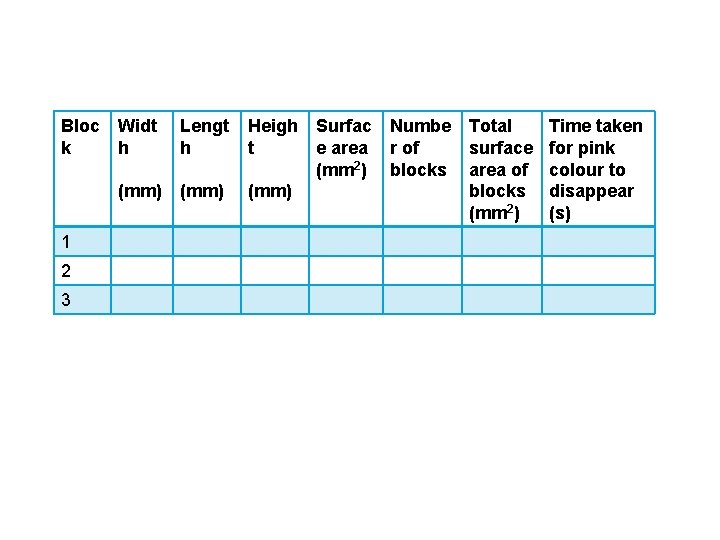
Bloc Widt k h Lengt h Heigh t (mm) 1 2 3 Surfac Numbe e area r of (mm 2) blocks Total surface area of blocks (mm 2) Time taken for pink colour to disappear (s)
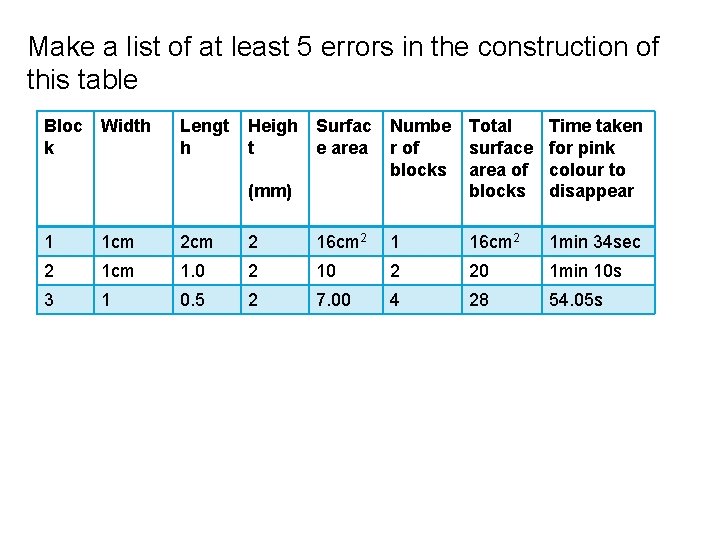
Make a list of at least 5 errors in the construction of this table Bloc Width k Lengt h Heigh t Surfac Numbe e area r of blocks Total surface area of blocks Time taken for pink colour to disappear (mm) 1 1 cm 2 16 cm 2 1 min 34 sec 2 1 cm 1. 0 2 10 2 20 1 min 10 s 3 1 0. 5 2 7. 00 4 28 54. 05 s
Bloc Width k (mm) Lengt h Heigh t (mm) Surfac Numbe e area r of (mm 2) blocks Total surface area of blocks (mm 2) Time taken for pink colour to disappear (s) 1 10 20 20 1600 1 1600 94 2 10 5 20 700 4 2800 70 3 10 5 10 400 8 3200 54
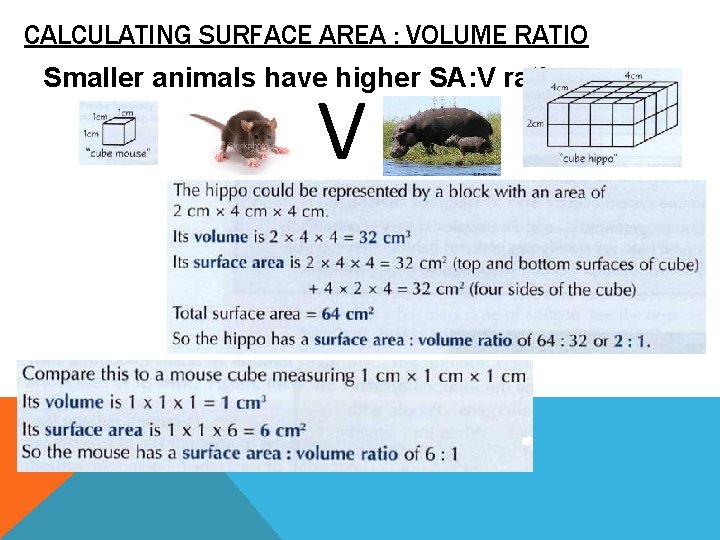
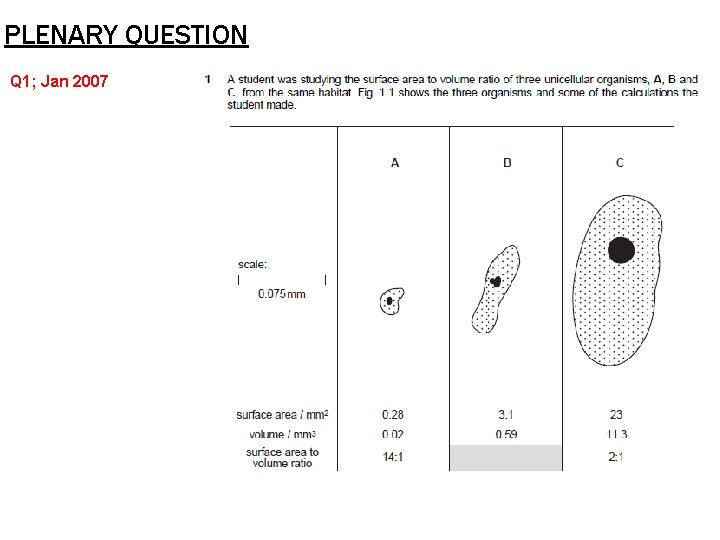
CALCULATING SURFACE AREA : VOLUME RATIO Smaller animals have higher SA: V ratios V
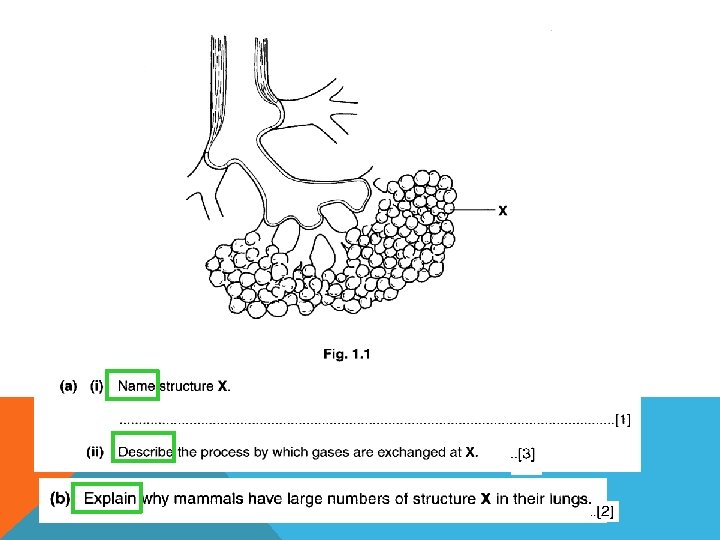
PLENARY QUESTION Q 1; Jan 2007
PLENARY QUESTION Q 1; Jan 2007
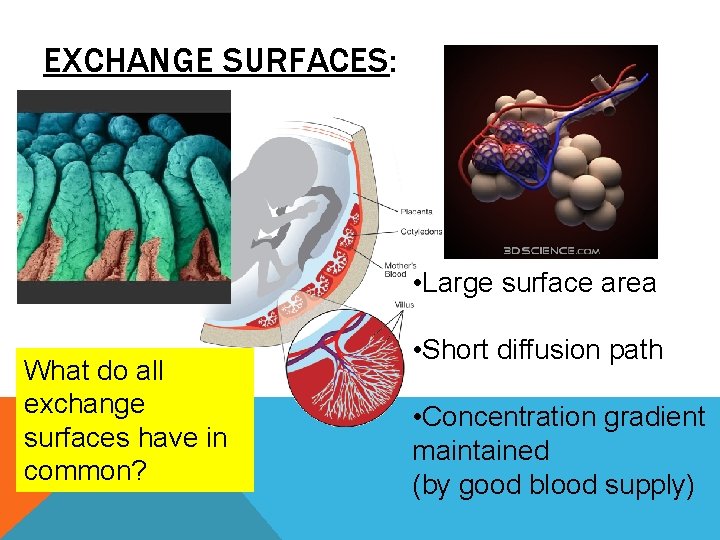
EXCHANGE SURFACES: • Large surface area What do all exchange surfaces have in common? • Short diffusion path • Concentration gradient maintained (by good blood supply)
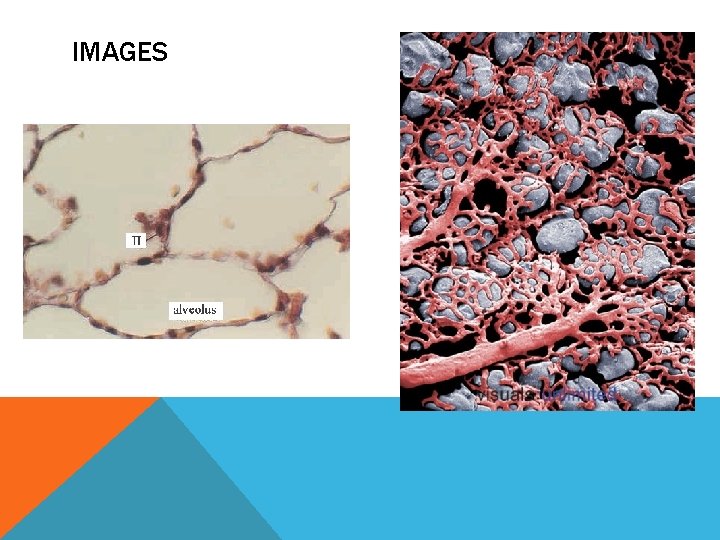
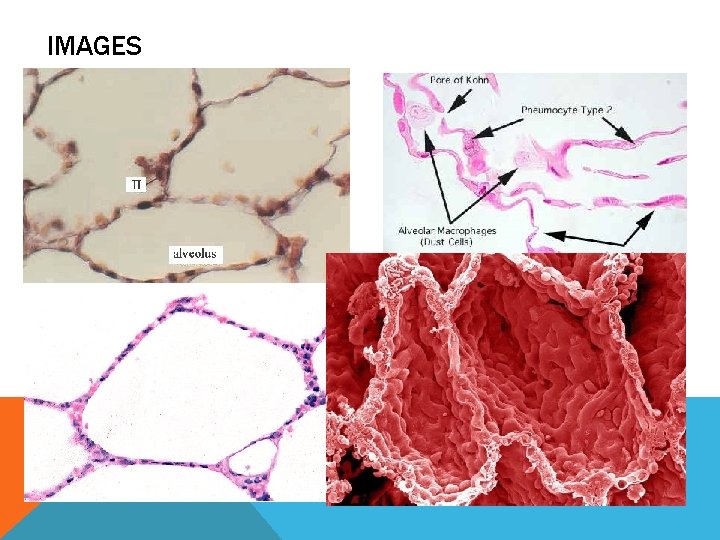
IMAGES
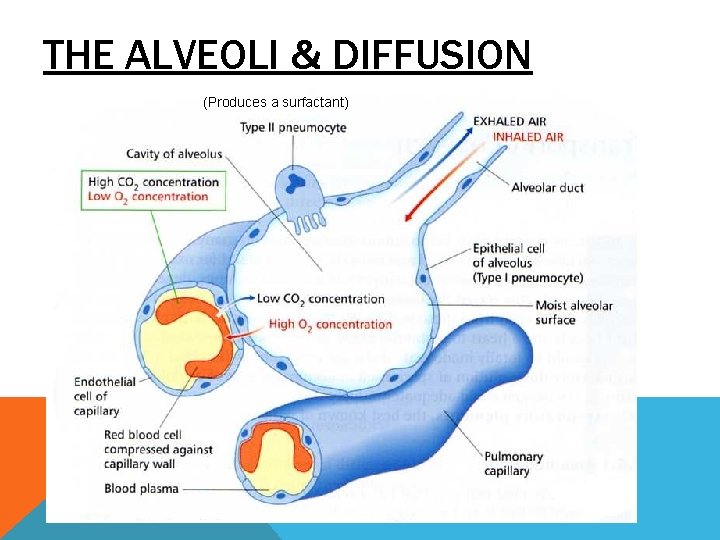
THE ALVEOLI & DIFFUSION (Produces a surfactant)
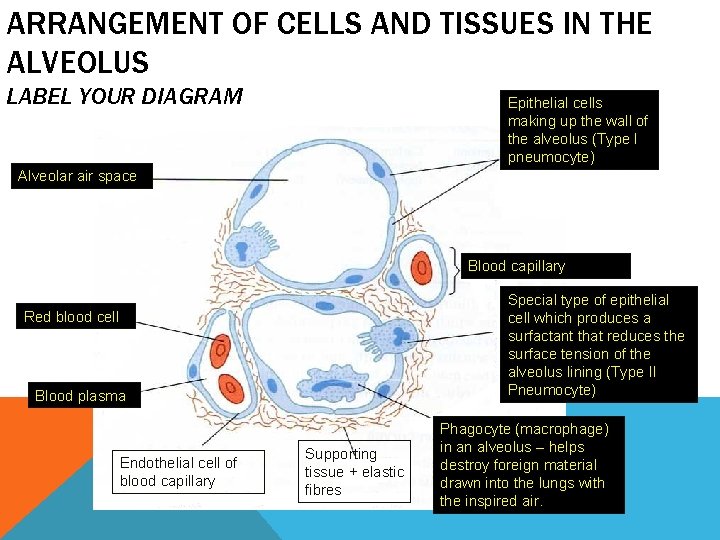
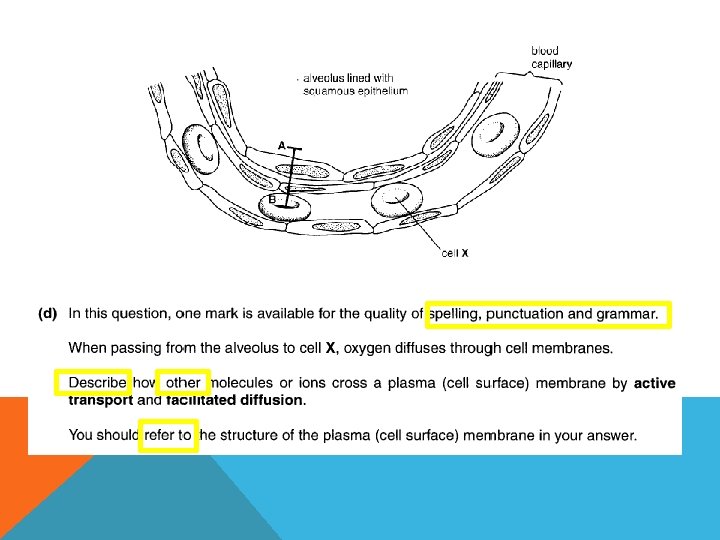
ARRANGEMENT OF CELLS AND TISSUES IN THE ALVEOLUS LABEL YOUR DIAGRAM Epithelial cells making up the wall of the alveolus (Type I pneumocyte) Alveolar air space Blood capillary Special type of epithelial cell which produces a surfactant that reduces the surface tension of the alveolus lining (Type II Pneumocyte) Red blood cell Blood plasma Endothelial cell of blood capillary Supporting tissue + elastic fibres Phagocyte (macrophage) in an alveolus – helps destroy foreign material drawn into the lungs with the inspired air.
IMAGES
TASK: Fill in your sheet for the adaptations of the alveoli for gas exchange.
ADAPTATIONS FOR EFFICIENT GAS EXCHANGE Feature Structure / Adaptation Short diffusion path • Thin walls ( one cell thick) of alveoli and capillaries • Made from tissue called squamous epithelium) • Capillaries close to alveoli walls Large surface area • Large numbers of alveoli • Vast capillary network • Folded surface of alveoli Concentration gradient (big difference in concentration either side of surface ) • Concentration gradient maintained as fluid is moved away from exchange surface by circulation • Ventilation (breathing) removes stale air and fills lungs with fresh air
Name E Grade Describe D, E Grades Explain B, C, D Grades Lisa Simpson Female Young Red dress Yellow skin Sister of Bart Cartoon character Suggest, with reasons, which parent has influenced her development the most ( A*, A , B grades)
TASKS: Fill in your sheet for the adaptations of the alveoli for gas exchange. Highlight key terms on worksheet “Fine structure of the lung”
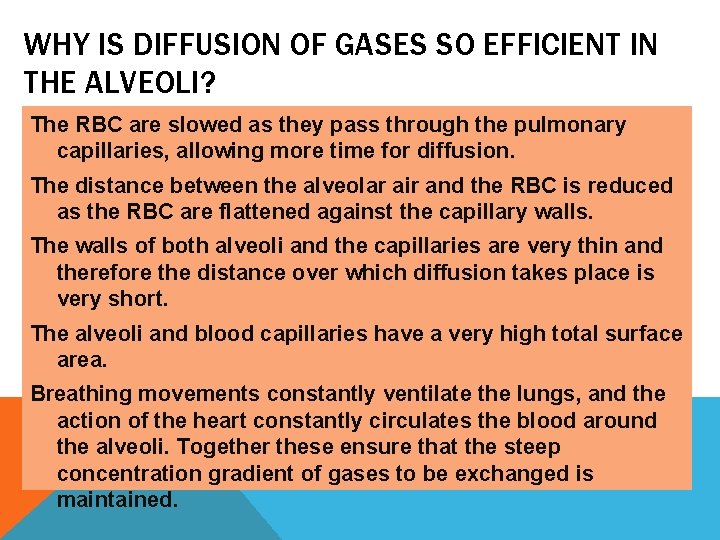
WHY IS DIFFUSION OF GASES SO EFFICIENT IN THE ALVEOLI? The RBC are slowed as they pass through the pulmonary capillaries, allowing more time for diffusion. The distance between the alveolar air and the RBC is reduced as the RBC are flattened against the capillary walls. The walls of both alveoli and the capillaries are very thin and therefore the distance over which diffusion takes place is very short. The alveoli and blood capillaries have a very high total surface area. Breathing movements constantly ventilate the lungs, and the action of the heart constantly circulates the blood around the alveoli. Together these ensure that the steep concentration gradient of gases to be exchanged is maintained.
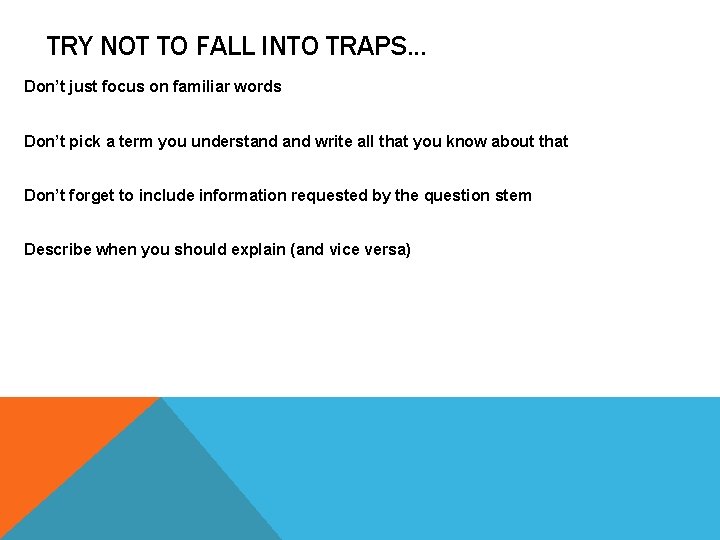
TRY NOT TO FALL INTO TRAPS. . . Don’t just focus on familiar words Don’t pick a term you understand write all that you know about that Don’t forget to include information requested by the question stem Describe when you should explain (and vice versa)
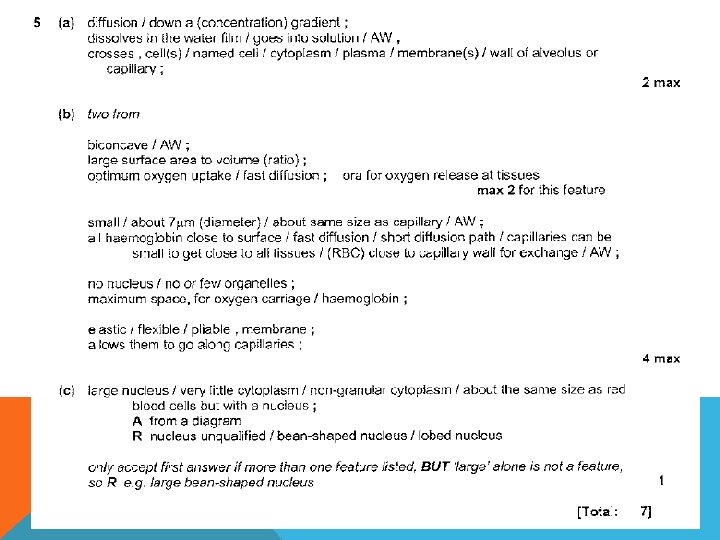
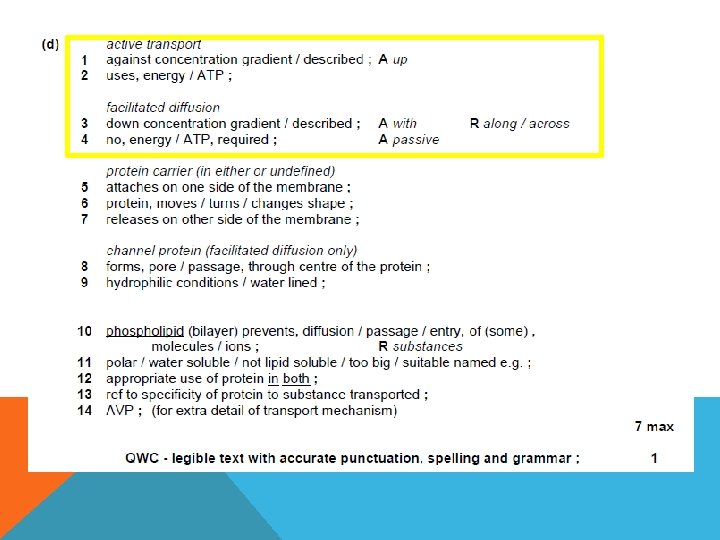
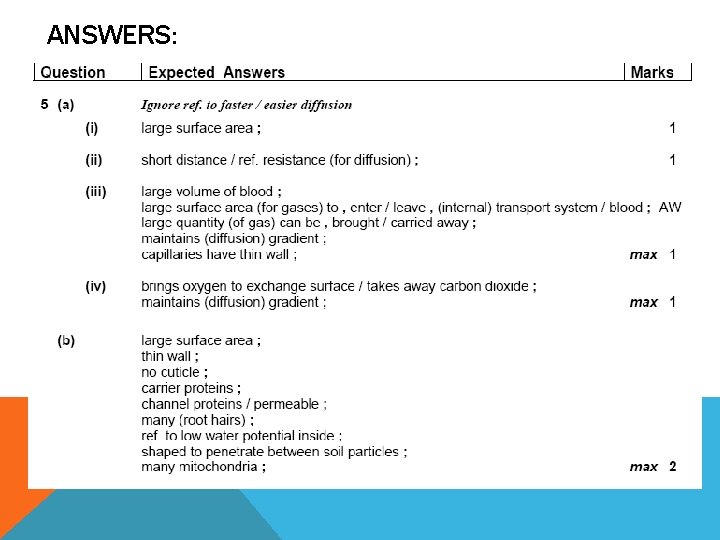
ANSWERS:
PLENARY TASK: Exam question 5 parts a & b (6 mins)