
Module Emotional Disorders Disability Categories Specific Learning Disability
Module: Emotional Disorders
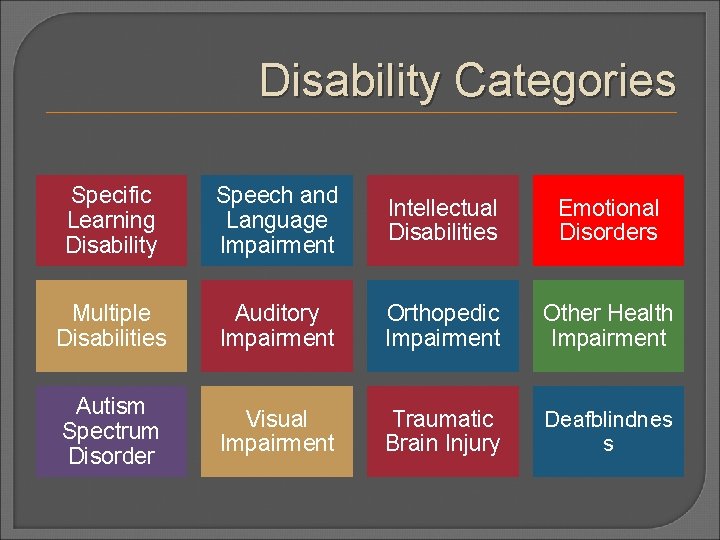
Disability Categories Specific Learning Disability Speech and Language Impairment Intellectual Disabilities Emotional Disorders Multiple Disabilities Auditory Impairment Orthopedic Impairment Other Health Impairment Autism Spectrum Disorder Visual Impairment Traumatic Brain Injury Deafblindnes s
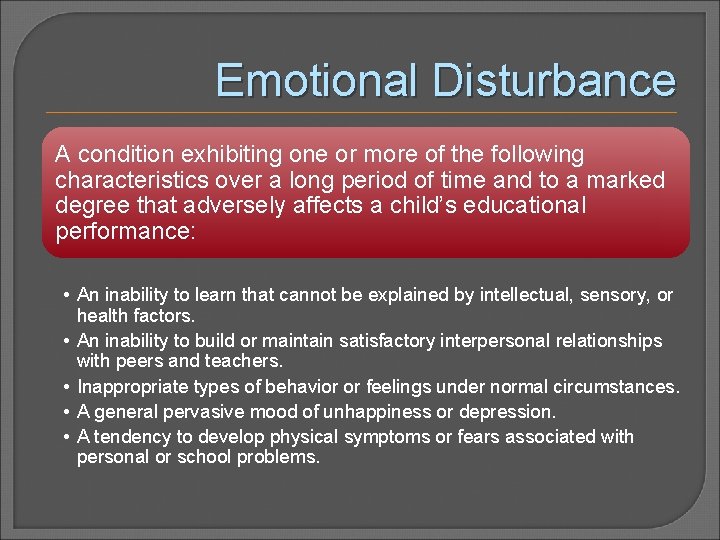
Emotional Disturbance A condition exhibiting one or more of the following characteristics over a long period of time and to a marked degree that adversely affects a child’s educational performance: • An inability to learn that cannot be explained by intellectual, sensory, or health factors. • An inability to build or maintain satisfactory interpersonal relationships with peers and teachers. • Inappropriate types of behavior or feelings under normal circumstances. • A general pervasive mood of unhappiness or depression. • A tendency to develop physical symptoms or fears associated with personal or school problems.
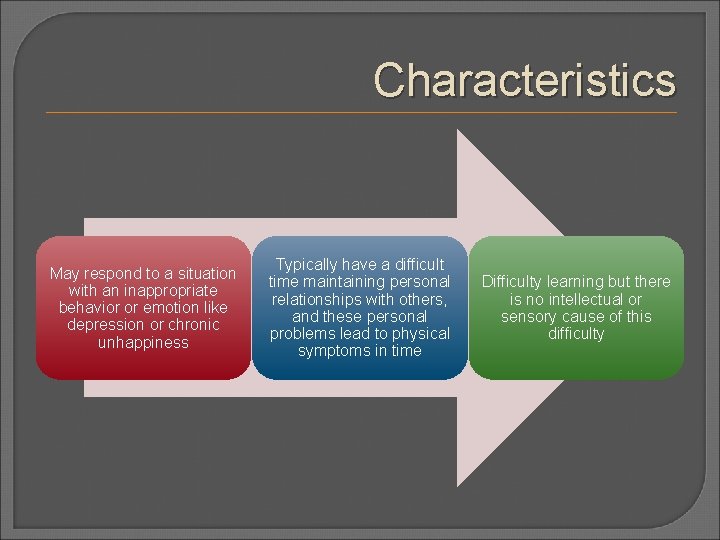
Characteristics May respond to a situation with an inappropriate behavior or emotion like depression or chronic unhappiness Typically have a difficult time maintaining personal relationships with others, and these personal problems lead to physical symptoms in time Difficulty learning but there is no intellectual or sensory cause of this difficulty
Awareness Signs of an emotional disorder need to be taken seriously, as they can lead to physical aggression and self-injurious behavior.
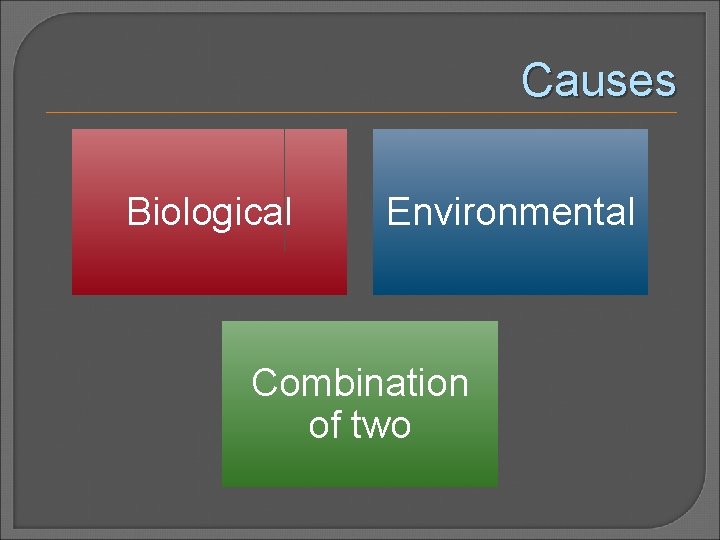
Causes Biological Environmental Combination of two
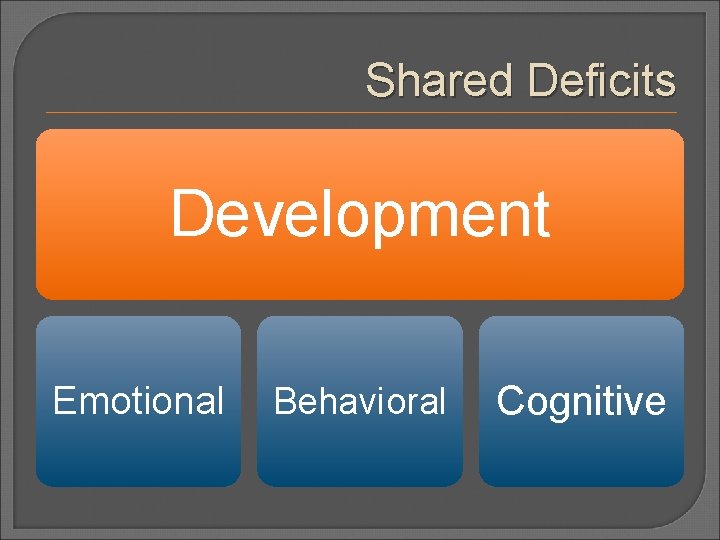
Shared Deficits Development Emotional Behavioral Cognitive
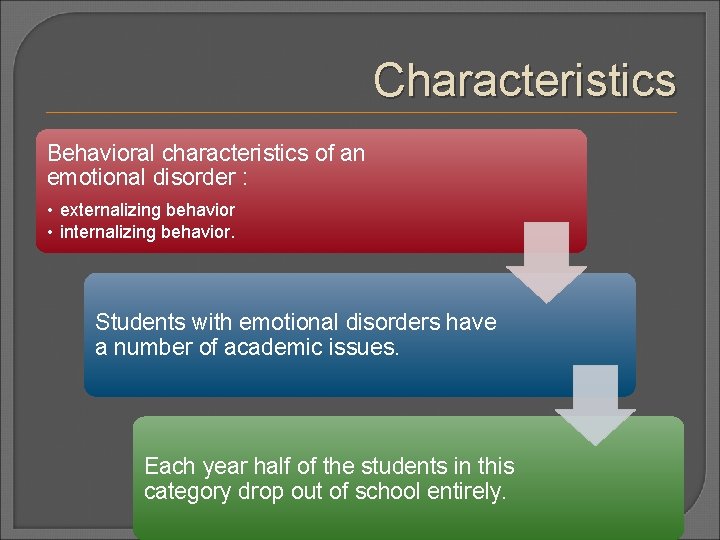
Characteristics Behavioral characteristics of an emotional disorder : • externalizing behavior • internalizing behavior. Students with emotional disorders have a number of academic issues. Each year half of the students in this category drop out of school entirely.
Impact on Learning Students with emotional disorders can be found at every level of cognitive functioning. Students with emotional disorders are less likely to attend post-secondary school than students in many other disability categories.
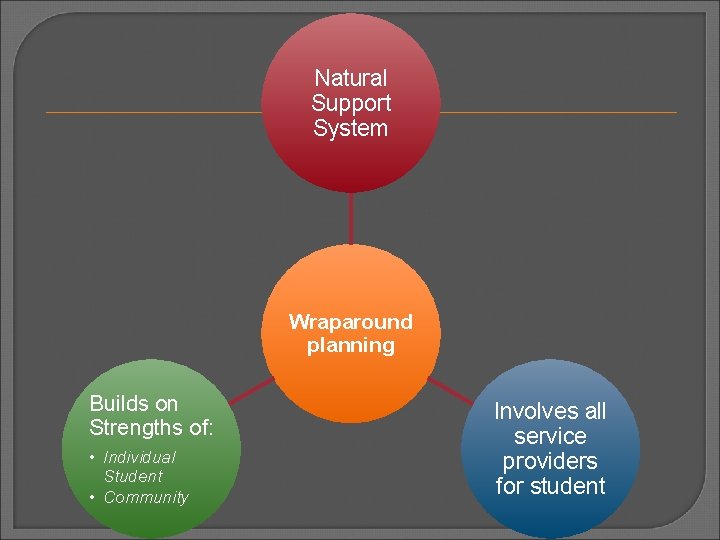
Natural Support System Wraparound planning Builds on Strengths of: • Individual Student • Community Involves all service providers for student
Impact on Learning An effective educational program for students with emotional disorders will provide emotional and behavioral supports that foster the replacement of problem behaviors with more appropriate behaviors. Positive behavior support systems are one especially effective strategy to achieve this goal, as are the implementation of wraparound services.
Teaching Strategies Supporting the academic performance of these students has the added benefit of decreasing behaviors. • Modifications • Accommodations Remember: Best practices for students with emotional disorders are often best practices for all students. Consistent and specific praise is also a great technique to utilize with all students in the classroom especially students with behavior problems.
Issues Trust can be a very large issue for these children. Forming a relationship with these students that is built on empathy, trust, and mutual respect can often be the solution to many problem behaviors, and can have a lasting impact of the emotional development of the child.
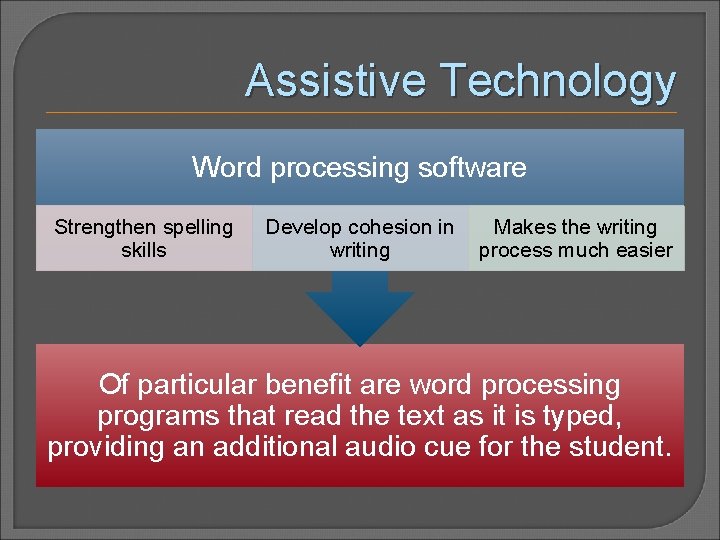
Assistive Technology Word processing software Strengthen spelling skills Develop cohesion in writing Makes the writing process much easier Of particular benefit are word processing programs that read the text as it is typed, providing an additional audio cue for the student.
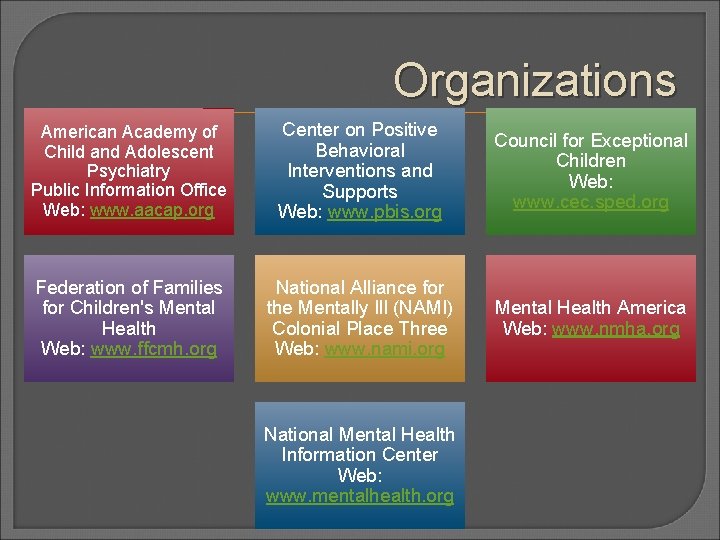
Organizations American Academy of Child and Adolescent Psychiatry Public Information Office Web: www. aacap. org Center on Positive Behavioral Interventions and Supports Web: www. pbis. org Council for Exceptional Children Web: www. cec. sped. org Federation of Families for Children's Mental Health Web: www. ffcmh. org National Alliance for the Mentally Ill (NAMI) Colonial Place Three Web: www. nami. org Mental Health America Web: www. nmha. org National Mental Health Information Center Web: www. mentalhealth. org
- Slides: 15