
Module E The Abstract LC1320 Thesis Writing for
Module E: The Abstract LC-1320 Thesis Writing for Engineers Aalto University Language Centre / © 2019 Ken Pennington This work is licensed under a Creative Commons Attribution. Non. Commercial-Share. Alike 4. 0 International License
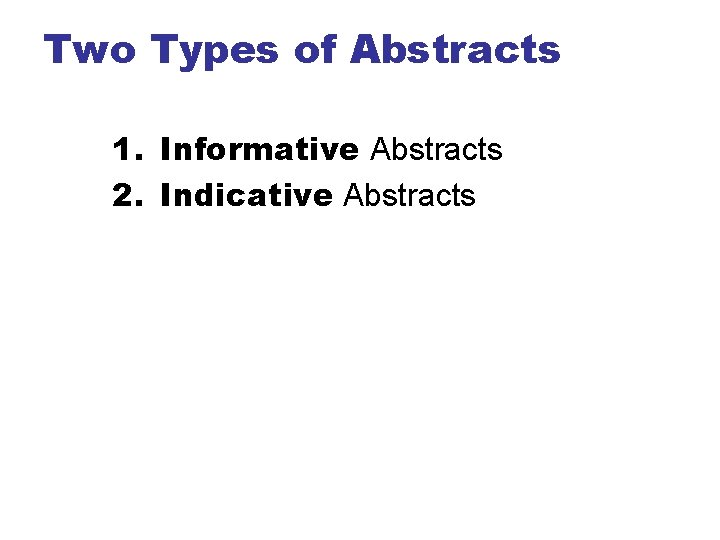
Two Types of Abstracts 1. Informative Abstracts 2. Indicative Abstracts
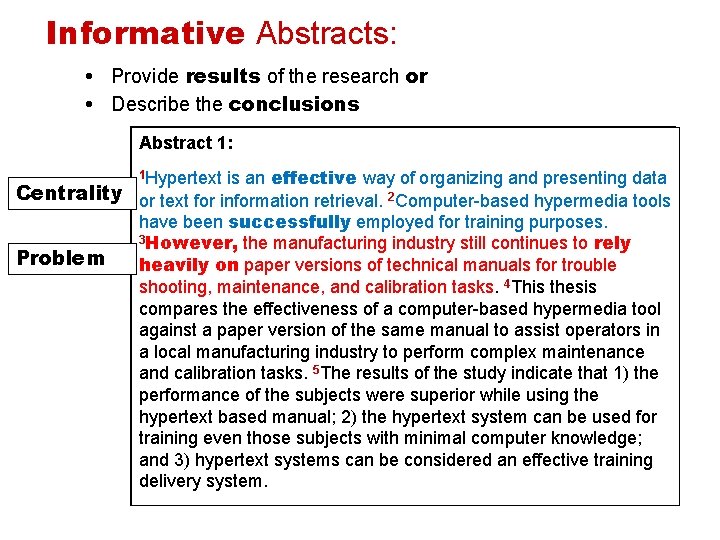
Informative Abstracts: • Provide results of the research or • Describe the conclusions Abstract 1: 1 Hypertext is an effective way of organizing and presenting data or Centrality text 2 Computer-based hypermedia 2 Computer-based or text information retrieval. tools for information retrieval. hypermedia tools Problem 3 However, tools successfully employed forpurposes. training purposes. have been successfully employed for training purposes. successfully employed for training 3 However, thethe manufacturing still to to rely heavily However, manufacturing industry continues the manufacturing industry stillindustry continues tocontinues rely heavily onrely paper on paperof versions technical manuals troublefor shooting, heavily on paperofversions offor technical manuals trouble versions technical manuals troublefor shooting, maintenance, 4 This thesis 4 This maintenance, and calibration tasks. compares shooting, maintenance, andthesis calibration tasks. thesis the of a and calibration tasks. compares effectiveness ahypermedia computer-based hypermedia tool against compares theof effectiveness oftool a computer-based hypermedia tool computer-based against a paper version of athe paper version of version the same manual assist operators in a industry local in against a paper of the same to assist operators same manual to assist operators intoamanual local manufacturing 5 The manufacturing industry to perform complex maintenance and a local manufacturing industry to perform complex maintenance and calibration tasks. 5 The 5 results of the study indicate that 1) the calibration tasks. and calibration tasks. The results study indicate thatsubjects 1) the results of the study indicate that 1) of thethe performance of the performance the subjects superior while using the were superiorofwhile using thewere hypertext based manual; 2) thefor hypertext can subjects be used for hypertext system can be used training system even those with training even thoseknowledge; subjects with computer knowledge; minimal computer andminimal 3) hypertext systems can be and 3) hypertext systems can bedelivery considered an effective training system. delivery system.
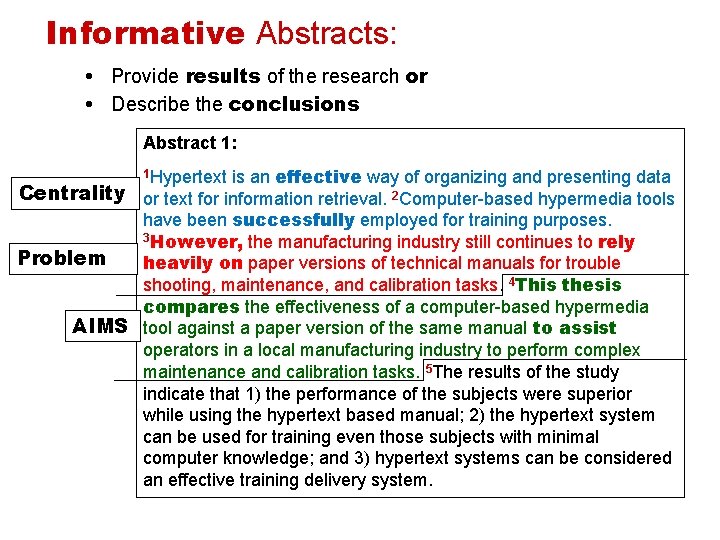
Informative Abstracts: • Provide results of the research or • Describe the conclusions Abstract 1: is an effective way of organizing and presenting data Centrality or text for information retrieval. 2 Computer-based hypermedia tools have been successfully employed for training purposes. 3 However, the manufacturing industry still continues to rely Problem heavily on paper versions of technical manuals for trouble shooting, maintenance, and calibration tasks. 4 This thesis compares the effectiveness of a computer-based hypermedia AIMS tool against a paper version of the same manual to assist operators in a local manufacturing industry to perform complex maintenance and calibration tasks. 5 The results of the study indicate that 1) the performance of the subjects were superior while using the hypertext based manual; 2) the hypertext system can be used for training even those subjects with minimal computer knowledge; and 3) hypertext systems can be considered an effective training delivery system. 1 Hypertext

Informative Abstracts: • Provide results of the research or • Describe the conclusions Abstract 1: is an effective way of organizing and presenting data Centrality or text for information retrieval. 2 Computer-based hypermedia tools have been successfully employed for training purposes. . 3 However, the manufacturing industry still continues to rely Problem heavily on paper versions of technical manuals for trouble shooting, maintenance, and calibration tasks. 4 This thesis compares the effectiveness of a computer-based hypermedia AIMS tool against a paper version of the same manual to assist operators in a local manufacturing industry to perform complex maintenance and calibration tasks. 5 The results of the study indicate that 1) the performance of the subjects were Conclusions superior while using the hypertext based manual; 2) the hypertext system can be used for training even those subjects with minimal computer knowledge; and 3) hypertext systems can be considered an effective training delivery system. 1 Hypertext
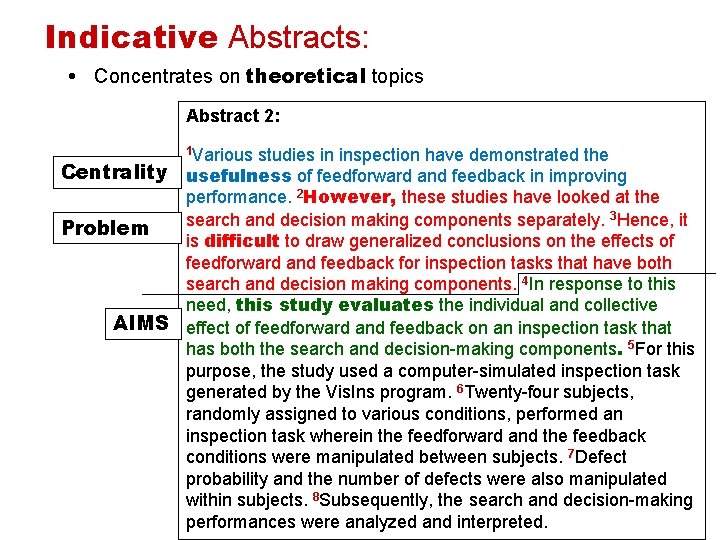
Indicative Abstracts: • Concentrates on theoretical topics Abstract 2: 1 Various studies in inspection have demonstrated the Centrality usefulness of feedforward and feedback in improving However, these studies have looked performance. 2 However, these studies have looked at at thethe search and decision making components separately. 3 Hence, it Problem difficult to draw generalized conclusions effects is difficult to draw generalized conclusions onon thethe effects of of feedforward and feedback for inspection tasks that have both search and decision making components. 4 In response to thisstudy evaluates the individual and collective need, this evaluates the individual and collective effect of AIMS feedforward effect of feedforward and feedback on an inspection task that task has that both 5 For this purpose, has search both the search and decision-making components. the and decision-making components. purpose, study used a computer-simulated task the study the used a computer-simulated inspection task generated by program. the Vis. Ins 6 Twenty-four program. 6 Twenty-four subjects, by the Vis. Ins subjects, randomly assigned various to conditions, performed an inspection randomly to assigned various conditions, an task inspection wherein the and the feedback wherein thetask feedforward andfeedforward the feedback conditions were 7 Defectsubjects. conditions were manipulated between subjects. probability and the were number defects werewithin also manipulated number of defects alsoofmanipulated subjects. 8 Subsequently, 8 within subjects. the search and decision-making Subsequently, search and decision-making performances were analyzedwere and interpreted. performances analyzed and interpreted.

Indicative Abstracts: • Concentrates on theoretical topics Abstract 2: 1 Various studies in inspection have demonstrated the Centrality usefulness of feedforward and feedback in improving performance. 2 However, these studies have looked at the search and decision making components separately. 3 Hence, it is Problem difficult to draw generalized conclusions on the effects of feedforward and feedback for inspection tasks that have both search and decision making components. 4 In response to this need, this study evaluates the individual and collective AIMS effect of feedforward and feedback on an inspection task that has both the search and decision-making components. 5 For this purpose, the study used a computer-simulated inspection task generated by the Vis. Ins program. 6 Twenty-four subjects, Procedures randomly assigned to various conditions, performed an inspection task wherein the feedforward and the feedback conditions were manipulated between subjects. 7 Defect probability and the number of defects were also manipulated within subjects. 8 Subsequently, the search and decision-making performances were analyzed and interpreted.
Two Types of Abstracts 1. Informative Abstracts 2. Indicative Abstracts Which should be used for a Master’s thesis?
Task 1: Informative or Indicative? Look at the abstracts of the articles and theses that you collected for this class. Are they informative or indicative?
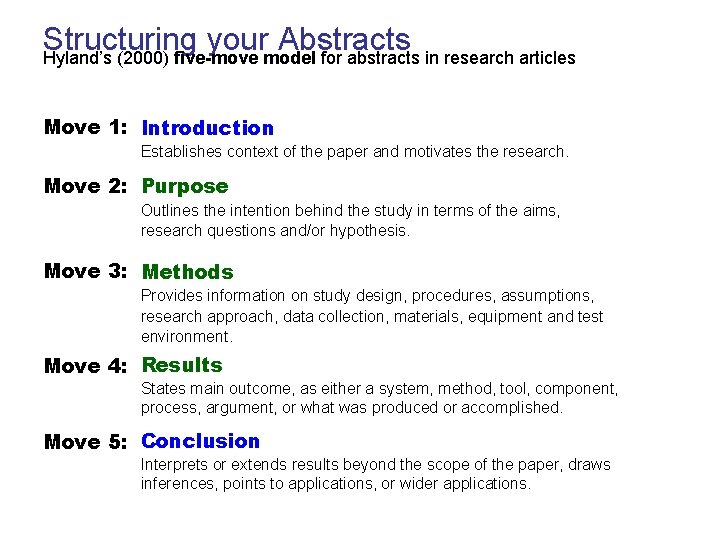
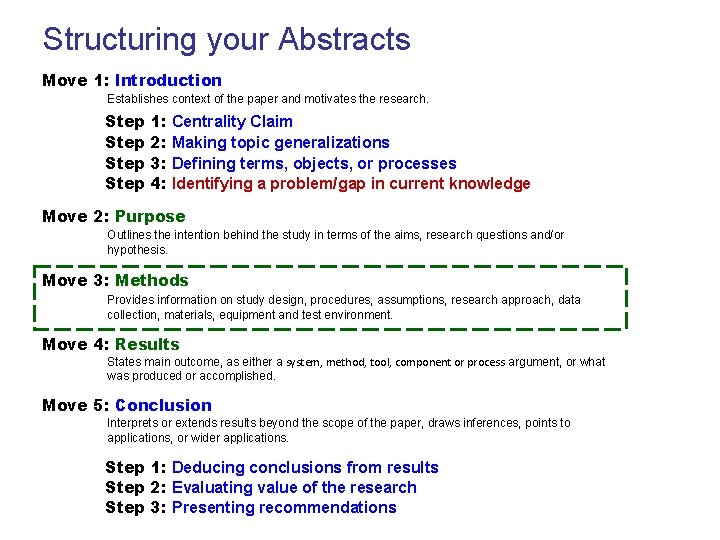
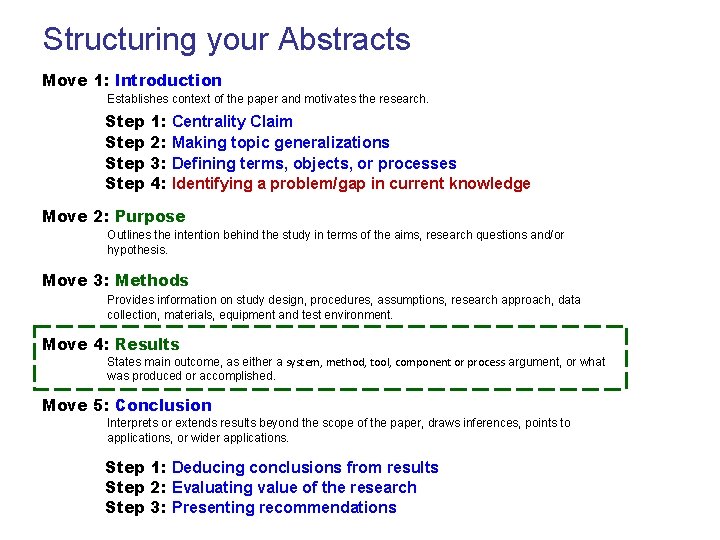
Structuring your Abstracts Hyland’s (2000) five-move model for abstracts in research articles Move 1: Introduction Establishes context of the paper and motivates the research. Move 2: Purpose Outlines the intention behind the study in terms of the aims, research questions and/or hypothesis. Move 3: Methods Provides information on study design, procedures, assumptions, research approach, data collection, materials, equipment and test environment. Move 4: Results States main outcome, as either a system, method, tool, component, process, argument, or what was produced or accomplished. Move 5: Conclusion Interprets or extends results beyond the scope of the paper, draws inferences, points to applications, or wider applications.
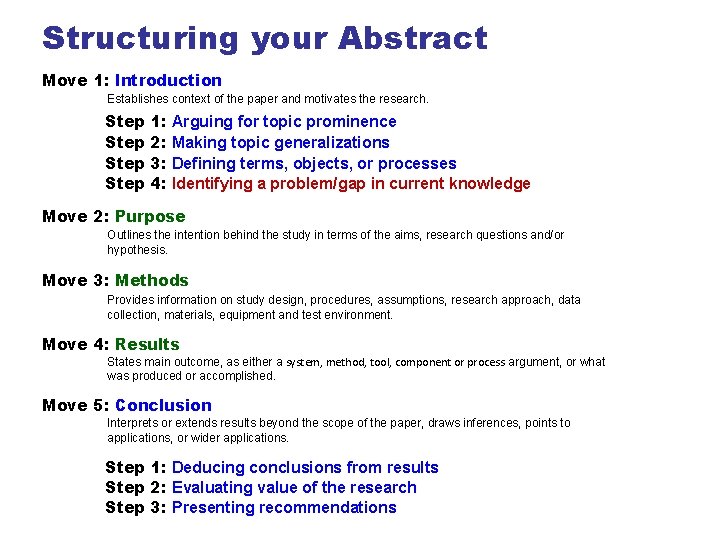
Structuring your Abstract Move 1: Introduction Establishes context of the paper and motivates the research. Step 1: 2: 3: 4: Arguing for topic prominence Making topic generalizations Defining terms, objects, or processes Identifying a problem/gap in current knowledge Move 2: Purpose Outlines the intention behind the study in terms of the aims, research questions and/or hypothesis. Move 3: Methods Provides information on study design, procedures, assumptions, research approach, data collection, materials, equipment and test environment. Move 4: Results States main outcome, as either a system, method, tool, component or process argument, or what was produced or accomplished. Move 5: Conclusion Interprets or extends results beyond the scope of the paper, draws inferences, points to applications, or wider applications. Step 1: Deducing conclusions from results Step 2: Evaluating value of the research Step 3: Presenting recommendations
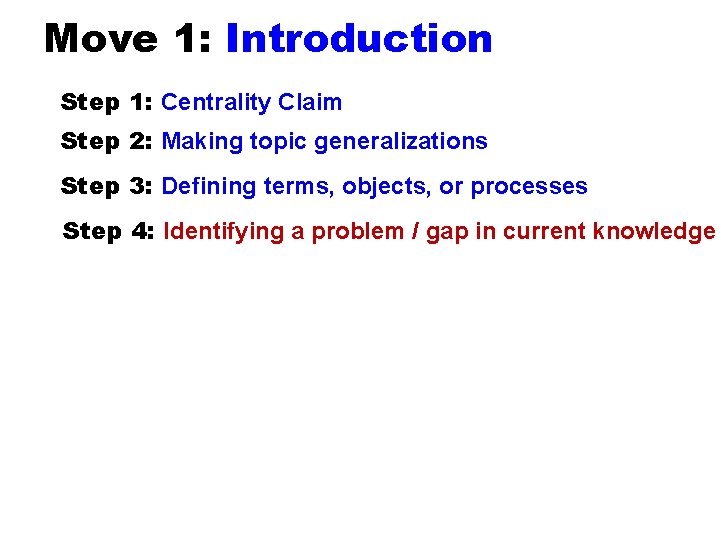
Move 1: Introduction Arguing for topic prominence Step 1: Centrality Claim Step 2: Making topic generalizations Step 3: Defining terms, objects, or processes Step 4: Identifying a problem / gap in current knowledge
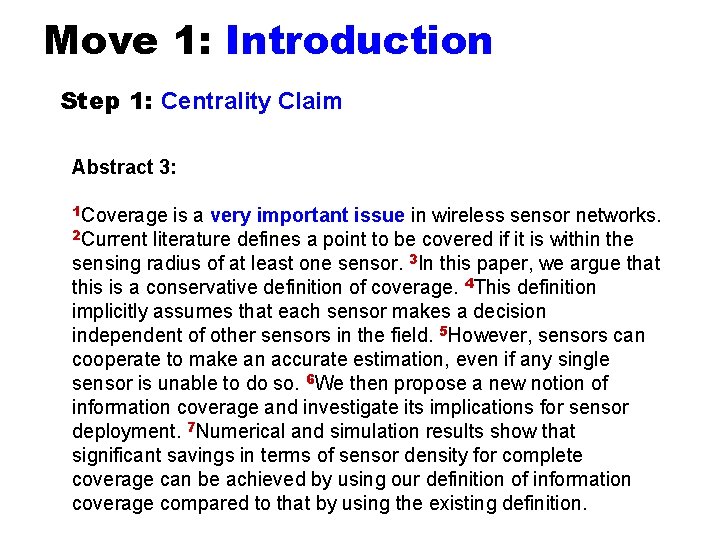
Move 1: Introduction Step 1: Centrality Claim Arguing for topic prominence Abstract 3: 1 Coverage is a very important issue in wireless sensor networks. 2 Current literature defines a point to be covered if it is within the sensing radius of at least one sensor. 3 In this paper, we argue that this is a conservative definition of coverage. 4 This definition implicitly assumes that each sensor makes a decision independent of other sensors in the field. 5 However, sensors can cooperate to make an accurate estimation, even if any single sensor is unable to do so. 6 We then propose a new notion of information coverage and investigate its implications for sensor deployment. 7 Numerical and simulation results show that significant savings in terms of sensor density for complete coverage can be achieved by using our definition of information coverage compared to that by using the existing definition.
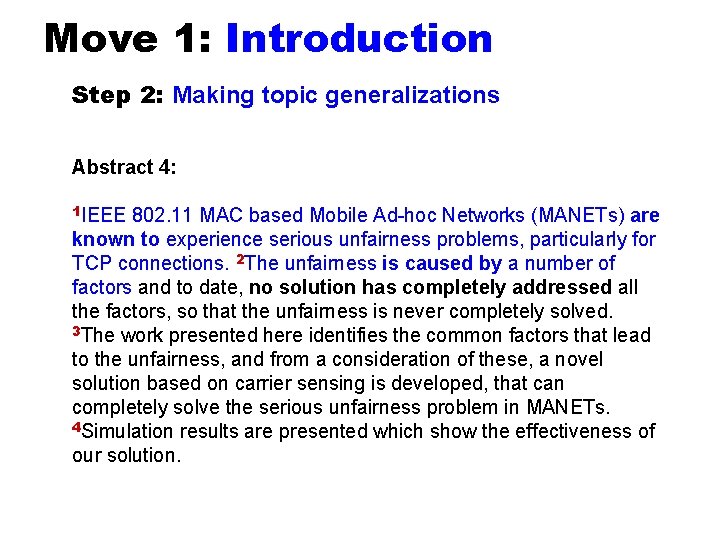
Move 1: Introduction Step 2: Making topic generalizations Abstract 4: 1 IEEE 802. 11 MAC based Mobile Ad-hoc Networks (MANETs) are known to experience serious unfairness problems, particularly for TCP connections. 2 The unfairness is caused by a number of factors and to date, no solution has completely addressed all the factors, so that the unfairness is never completely solved. 3 The work presented here identifies the common factors that lead to the unfairness, and from a consideration of these, a novel solution based on carrier sensing is developed, that can completely solve the serious unfairness problem in MANETs. 4 Simulation results are presented which show the effectiveness of our solution.
Move 1: Introduction Step 3: Defining terms, objects, or processes Abstract 5: 1 This paper presents POLUS, a software maintenance tool capable of iteratively evolving running software into newer versions. 2 POLUS's primary goal is to increase the dependability of contemporary server software, which is frequently disrupted either by external attacks or by scheduled upgrades. 3 To render POLUS both practical and powerful, we design and implement POLUS aiming to retain backward binary compatibility, support for multithreaded software and recover already tainted state of running software, yet with good usability and very low runtime overhead. 4 To demonstrate the applicability of POLUS, we report our experience in using POLUS to dynamically update three prevalent server applications: vsftpd, sshd and apache HTTP server. 5 Performance measurements show that POLUS incurs negligible runtime overhead: a less than 1% performance degradation (but 5% for one case). 6 The time to apply an update is also minimal.
Move 1: Introduction strategy Step 3: Defining terms, objects, or This processes typically precedes and anticipates an Abstract 6: evaluation 1 This paper proposes a method for recognizing scene categories based on approximate global geometric correspondence. 2 This technique works by partitioning the image into increasingly fine subregions and computing histograms of local features found inside each sub-region. 3 The resulting "spatial pyramid" is a simple and computationally efficient extension of an orderless bag-of-features image representation, and it shows significantly improved performance on challenging scene categorization tasks. 4 Specifically, our proposed method exceeds the state of the art on the Caltech-101 database and achieves high accuracy on a large database of fifteen natural scene categories. 5 The spatial pyramid framework also offers insights into the success of several recently proposed image descriptions, including Torralba’s "gist" and Lowe’s SIFT descriptors.
Move 1: Introduction Step 4: Identifying a gap in current knowledge Abstract 7: 1 The modeling of TCP transfer latency has received significant attention in the last decade. 2 Several models have been proposed for TCP performance under various conditions. 3 All the available models predict TCP performance for a single link. 4 Furthermore, all models relate timeouts to packet drops either due to congestion or due to transmission errors. 5 However, TCP connections may be running over a multilink connection that aggregates the bandwidth of multiple links into a single logical pipe using the multilink point-to-point protocol (MLPPP). 6 In such aggregate links, packet drops occur if any of the individual links experience a call drop. 7 None of the available models account for call drops as a possible source of performance degradation. 8 In this paper, we study the call drop phenomenon under MLPPP and incorporate our results into a method that predicts TCP latency for a long transfer. 9 The performance model is experimentally evaluated by running TCP over MLPPP over multiple Iridium satellite links.
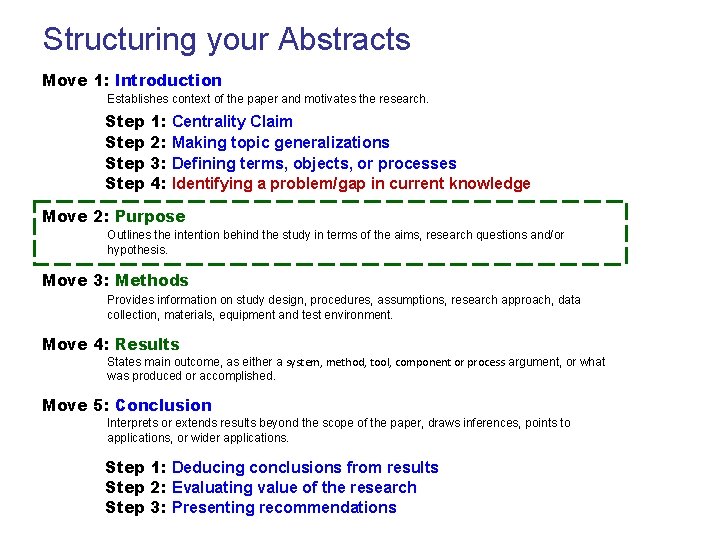
Structuring your Abstracts Move 1: Introduction Establishes context of the paper and motivates the research. Step 1: 2: 3: 4: Centrality Claim Making topic generalizations Defining terms, objects, or processes Identifying a problem/gap in current knowledge Move 2: Purpose Outlines the intention behind the study in terms of the aims, research questions and/or hypothesis. Move 3: Methods Provides information on study design, procedures, assumptions, research approach, data collection, materials, equipment and test environment. Move 4: Results States main outcome, as either a system, method, tool, component or process argument, or what was produced or accomplished. Move 5: Conclusion Interprets or extends results beyond the scope of the paper, draws inferences, points to applications, or wider applications. Step 1: Deducing conclusions from results Step 2: Evaluating value of the research Step 3: Presenting recommendations
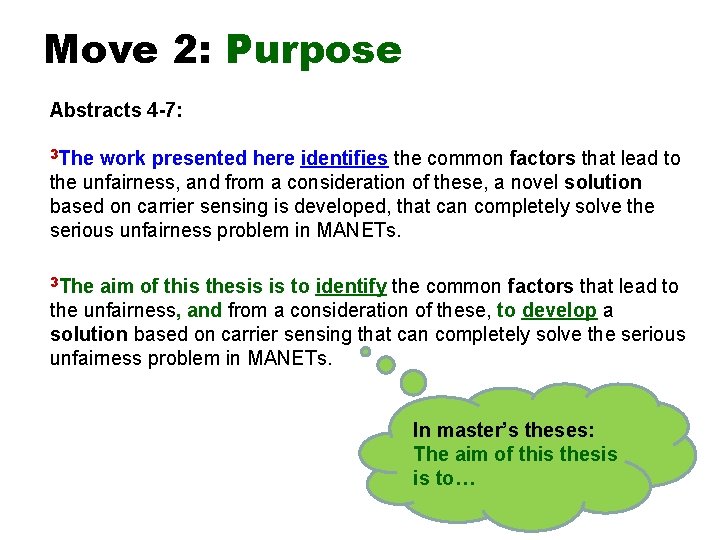
Move 2: Purpose Abstracts 4 -7: 3 The work presented here identifies the common factors that lead to the unfairness, and from a consideration of these, a novel solution based on carrier sensing is developed, that can completely solve the serious unfairness problem in MANETs. 3 The aim of this thesis is to identify the common factors that lead to the unfairness, and from a consideration of these, to develop a solution based on carrier sensing that can completely solve the serious unfairness problem in MANETs. In master’s theses: The aim of this thesis is to…
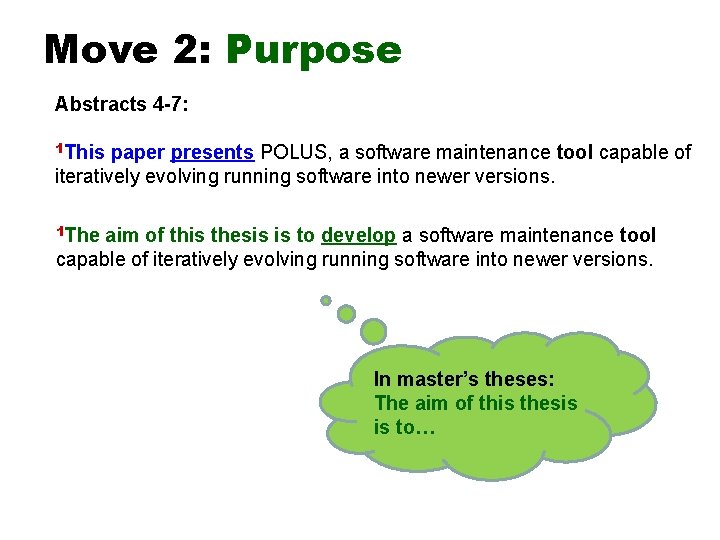
Move 2: Purpose Abstracts 4 -7: 1 This paper presents POLUS, a software maintenance tool capable of iteratively evolving running software into newer versions. 1 The aim of this thesis is to develop a software maintenance tool capable of iteratively evolving running software into newer versions. In master’s theses: The aim of this thesis is to…
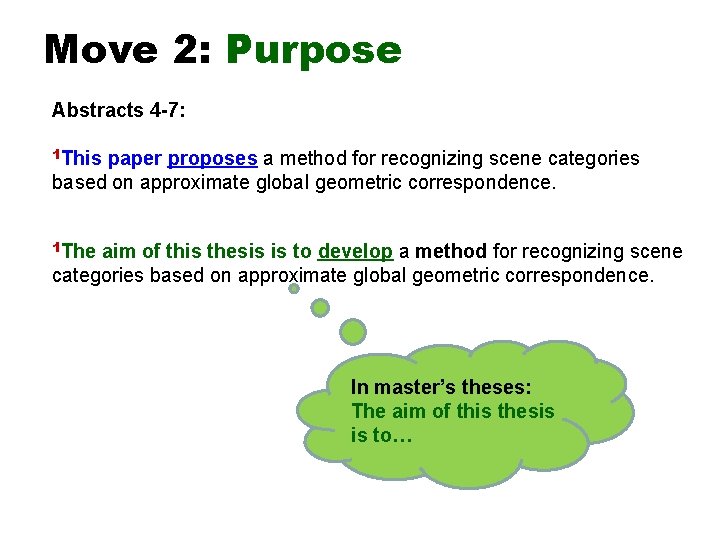
Move 2: Purpose Abstracts 4 -7: 1 This paper proposes a method for recognizing scene categories based on approximate global geometric correspondence. 1 The aim of this thesis is to develop a method for recognizing scene categories based on approximate global geometric correspondence. In master’s theses: The aim of this thesis is to…
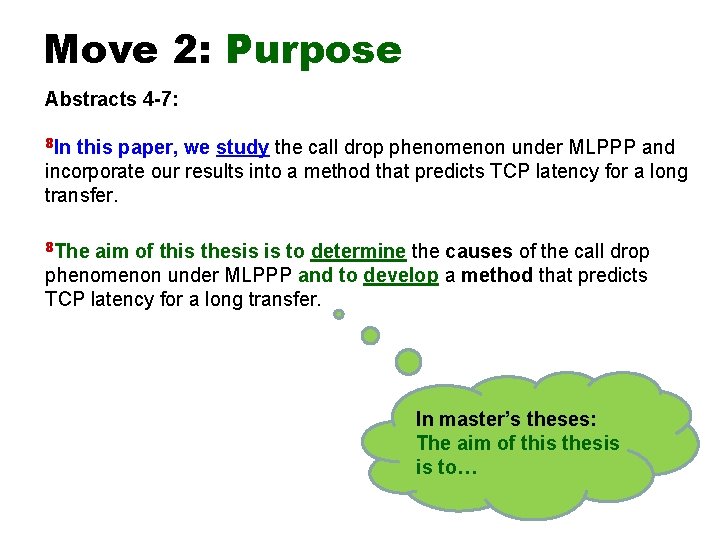
Move 2: Purpose Abstracts 4 -7: 8 In this paper, we study the call drop phenomenon under MLPPP and incorporate our results into a method that predicts TCP latency for a long transfer. 8 The aim of this thesis is to determine the causes of the call drop phenomenon under MLPPP and to develop a method that predicts TCP latency for a long transfer. In master’s theses: The aim of this thesis is to…
Structuring your Abstracts Move 1: Introduction Establishes context of the paper and motivates the research. Step 1: 2: 3: 4: Centrality Claim Making topic generalizations Defining terms, objects, or processes Identifying a problem/gap in current knowledge Move 2: Purpose Outlines the intention behind the study in terms of the aims, research questions and/or hypothesis. Move 3: Methods Provides information on study design, procedures, assumptions, research approach, data collection, materials, equipment and test environment. Move 4: Results States main outcome, as either a system, method, tool, component or process argument, or what was produced or accomplished. Move 5: Conclusion Interprets or extends results beyond the scope of the paper, draws inferences, points to applications, or wider applications. Step 1: Deducing conclusions from results Step 2: Evaluating value of the research Step 3: Presenting recommendations
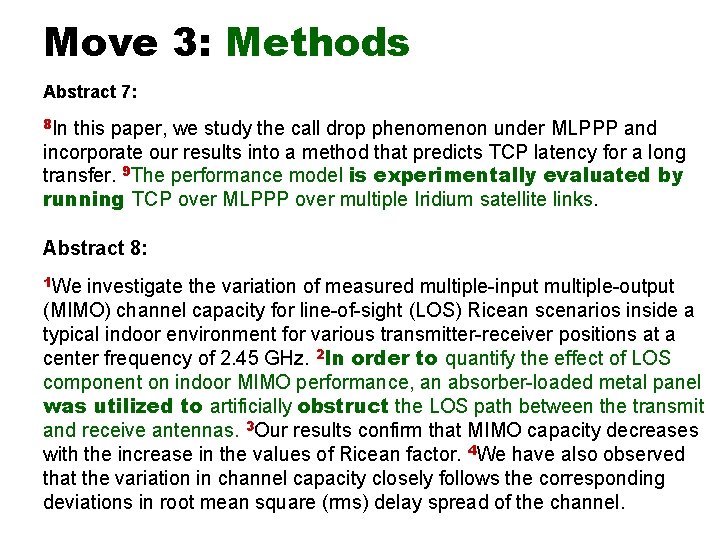
Move 3: Methods Abstract 7: 8 In this paper, we study the call drop phenomenon under MLPPP and incorporate our results into a method that predicts TCP latency for a long transfer. 9 The performance model is experimentally evaluated by running TCP over MLPPP over multiple Iridium satellite links. Abstract 8: 1 We investigate the variation of measured multiple-input multiple-output (MIMO) channel capacity for line-of-sight (LOS) Ricean scenarios inside a typical indoor environment for various transmitter-receiver positions at a center frequency of 2. 45 GHz. 2 In order to quantify the effect of LOS component on indoor MIMO performance, an absorber-loaded metal panel was utilized to artificially obstruct the LOS path between the transmit and receive antennas. 3 Our results confirm that MIMO capacity decreases with the increase in the values of Ricean factor. 4 We have also observed that the variation in channel capacity closely follows the corresponding deviations in root mean square (rms) delay spread of the channel.
Structuring your Abstracts Move 1: Introduction Establishes context of the paper and motivates the research. Step 1: 2: 3: 4: Centrality Claim Making topic generalizations Defining terms, objects, or processes Identifying a problem/gap in current knowledge Move 2: Purpose Outlines the intention behind the study in terms of the aims, research questions and/or hypothesis. Move 3: Methods Provides information on study design, procedures, assumptions, research approach, data collection, materials, equipment and test environment. Move 4: Results States main outcome, as either a system, method, tool, component or process argument, or what was produced or accomplished. Move 5: Conclusion Interprets or extends results beyond the scope of the paper, draws inferences, points to applications, or wider applications. Step 1: Deducing conclusions from results Step 2: Evaluating value of the research Step 3: Presenting recommendations
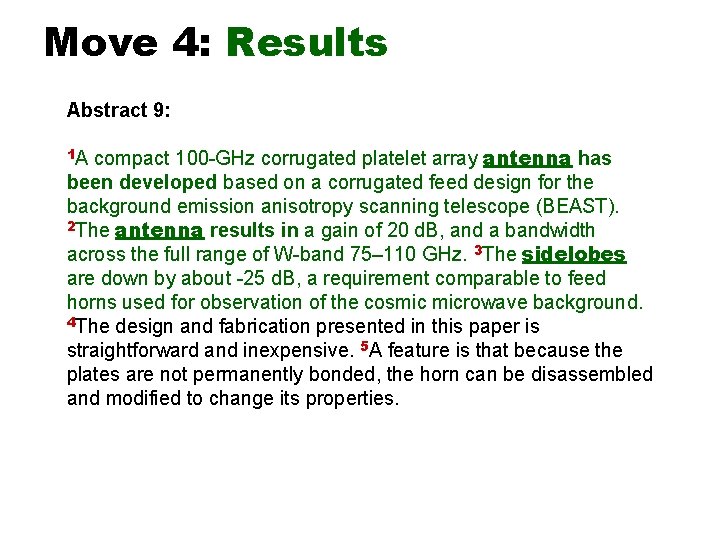
Move 4: Results Abstract 9: compact 100 -GHz corrugated platelet array antenna has been developed based on a corrugated feed design for the background emission anisotropy scanning telescope (BEAST). 2 The antenna results in a gain of 20 d. B, and a bandwidth across the full range of W-band 75– 110 GHz. 3 The sidelobes are down by about -25 d. B, a requirement comparable to feed horns used for observation of the cosmic microwave background. 4 The design and fabrication presented in this paper is straightforward and inexpensive. 5 A feature is that because the plates are not permanently bonded, the horn can be disassembled and modified to change its properties. 1 A
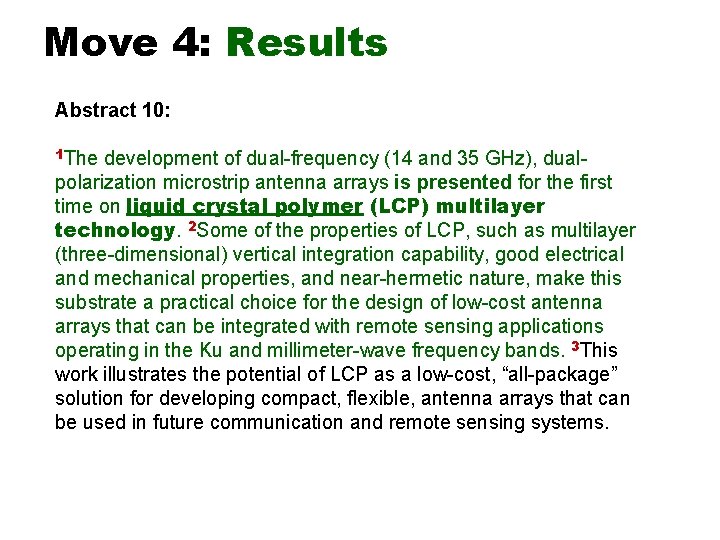
Move 4: Results Abstract 10: 1 The development of dual-frequency (14 and 35 GHz), dualpolarization microstrip antenna arrays is presented for the first time on liquid crystal polymer (LCP) multilayer technology. 2 Some of the properties of LCP, such as multilayer (three-dimensional) vertical integration capability, good electrical and mechanical properties, and near-hermetic nature, make this substrate a practical choice for the design of low-cost antenna arrays that can be integrated with remote sensing applications operating in the Ku and millimeter-wave frequency bands. 3 This work illustrates the potential of LCP as a low-cost, “all-package” solution for developing compact, flexible, antenna arrays that can be used in future communication and remote sensing systems.
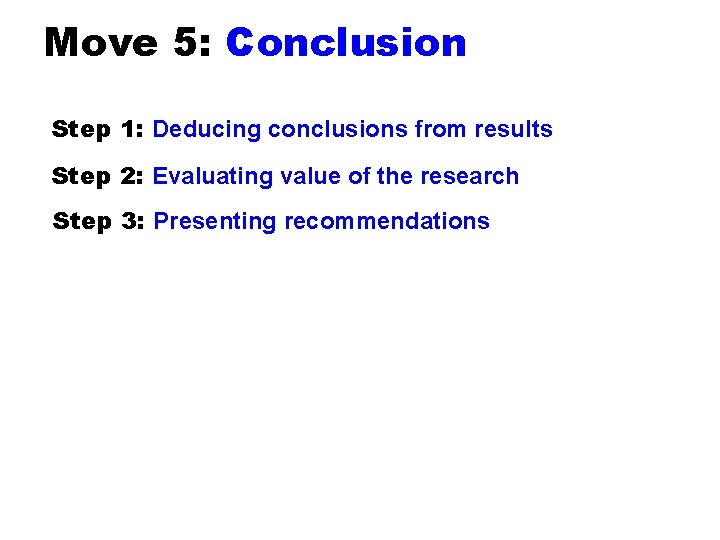
Move 5: Conclusion Step 1: Deducing conclusions from results Step 2: Evaluating value of the research Step 3: Presenting recommendations
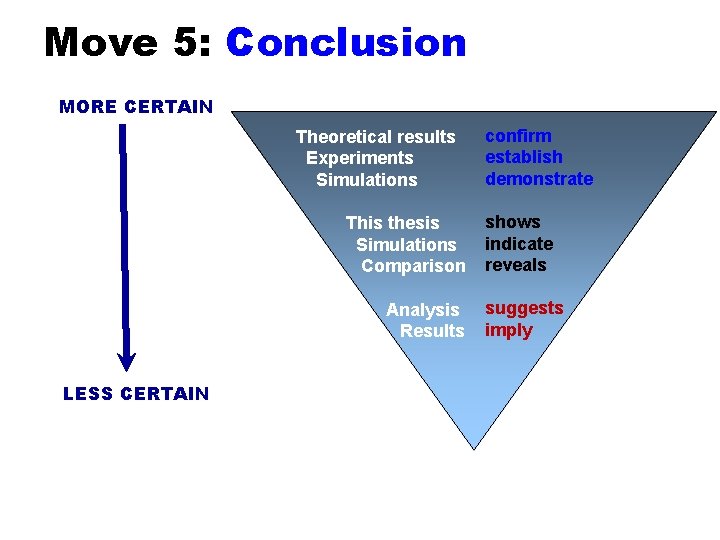
Move 5: Conclusion MORE CERTAIN Theoretical results Experiments Simulations This thesis Simulations Comparison Data LESS CERTAIN Analysis Results confirm establish demonstrate shows indicate reveals suggests imply
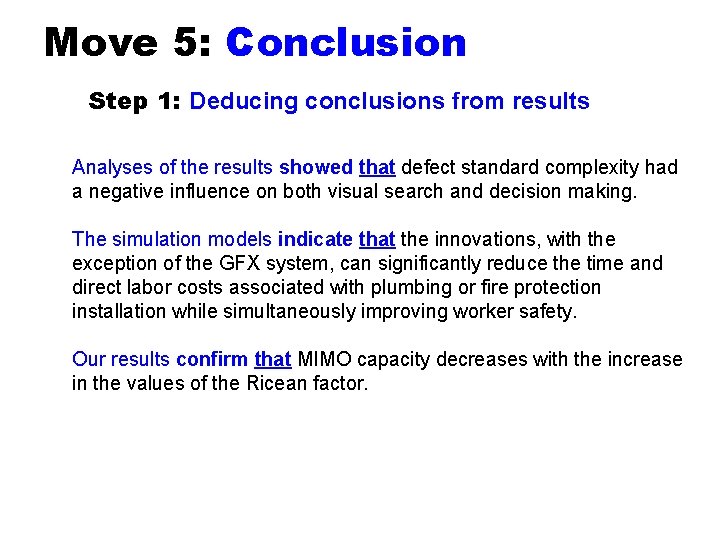
Move 5: Conclusion Step 1: Deducing conclusions from results Analyses of the results showed that defect standard complexity had a negative influence on both visual search and decision making. The simulation models indicate that the innovations, with the exception of the GFX system, can significantly reduce the time and direct labor costs associated with plumbing or fire protection installation while simultaneously improving worker safety. Our results confirm that MIMO capacity decreases with the increase in the values of the Ricean factor.
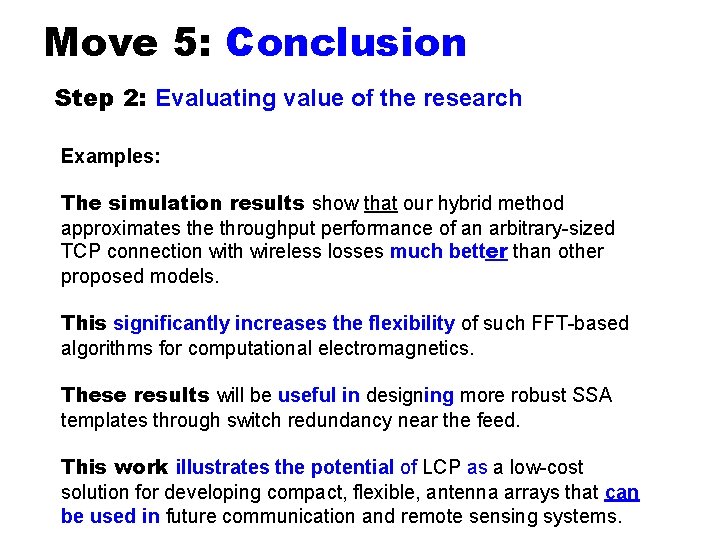
Move 5: Conclusion Step 2: Evaluating value of the research Examples: The simulation results show that our hybrid method approximates the throughput performance of an arbitrary-sized TCP connection with wireless losses much better than other proposed models. This significantly increases the flexibility of such FFT-based algorithms for computational electromagnetics. These results will be useful in designing more robust SSA templates through switch redundancy near the feed. This work illustrates the potential of LCP as a low-cost solution for developing compact, flexible, antenna arrays that can be used in future communication and remote sensing systems.
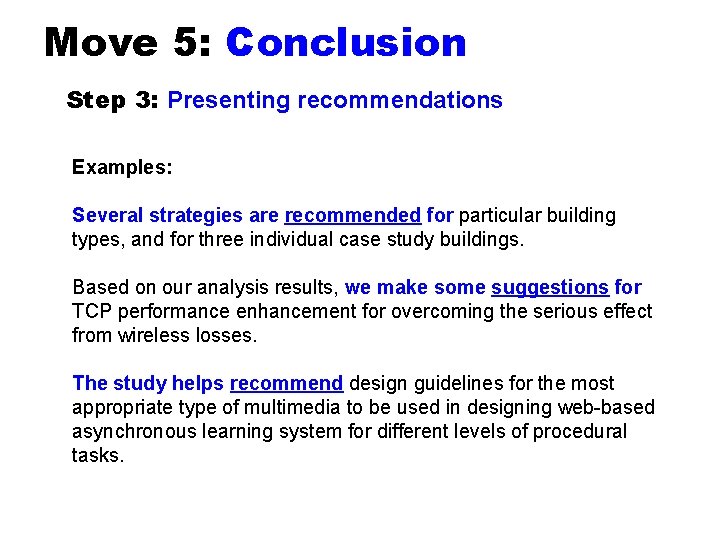
Move 5: Conclusion Step 3: Presenting recommendations Examples: Several strategies are recommended for particular building types, and for three individual case study buildings. Based on our analysis results, we make some suggestions for TCP performance enhancement for overcoming the serious effect from wireless losses. The study helps recommend design guidelines for the most appropriate type of multimedia to be used in designing web-based asynchronous learning system for different levels of procedural tasks.
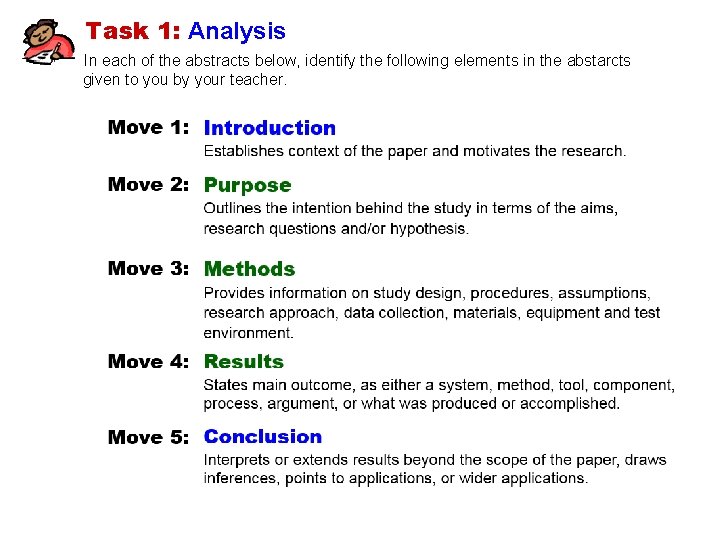
Task 1: Analysis In each of the abstracts below, identify the following elements in the abstarcts given to you by your teacher.
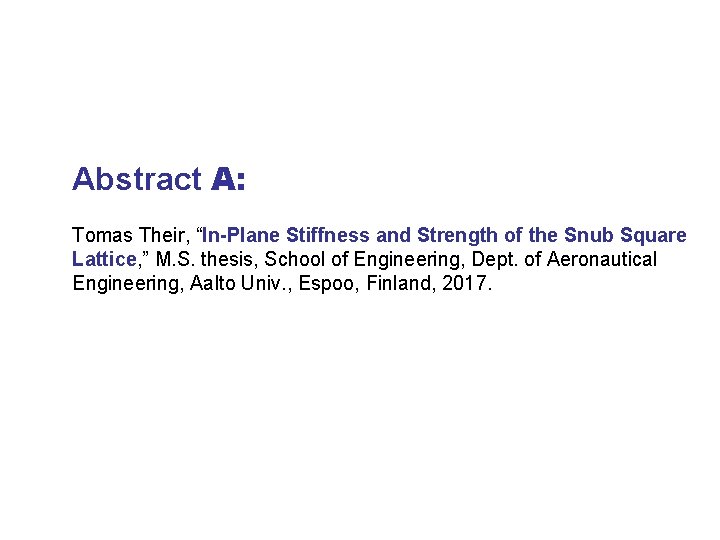
Abstract A: Tomas Their, “In-Plane Stiffness and Strength of the Snub Square Lattice, ” M. S. thesis, School of Engineering, Dept. of Aeronautical Engineering, Aalto Univ. , Espoo, Finland, 2017.
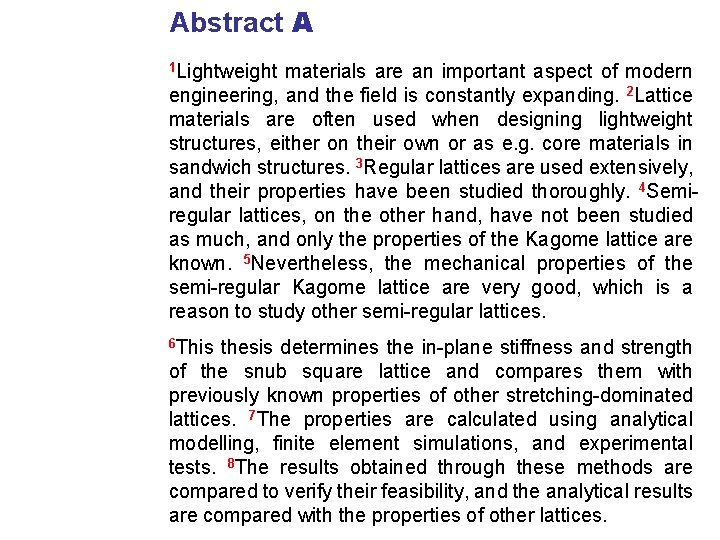
Abstract A 1 Lightweight materials are an important aspect of modern engineering, and the field is constantly expanding. 2 Lattice materials are often used when designing lightweight structures, either on their own or as e. g. core materials in sandwich structures. 3 Regular lattices are used extensively, and their properties have been studied thoroughly. 4 Semiregular lattices, on the other hand, have not been studied as much, and only the properties of the Kagome lattice are known. 5 Nevertheless, the mechanical properties of the semi-regular Kagome lattice are very good, which is a reason to study other semi-regular lattices. 6 This thesis determines the in-plane stiffness and strength of the snub square lattice and compares them with previously known properties of other stretching-dominated lattices. 7 The properties are calculated using analytical modelling, finite element simulations, and experimental tests. 8 The results obtained through these methods are compared to verify their feasibility, and the analytical results are compared with the properties of other lattices.
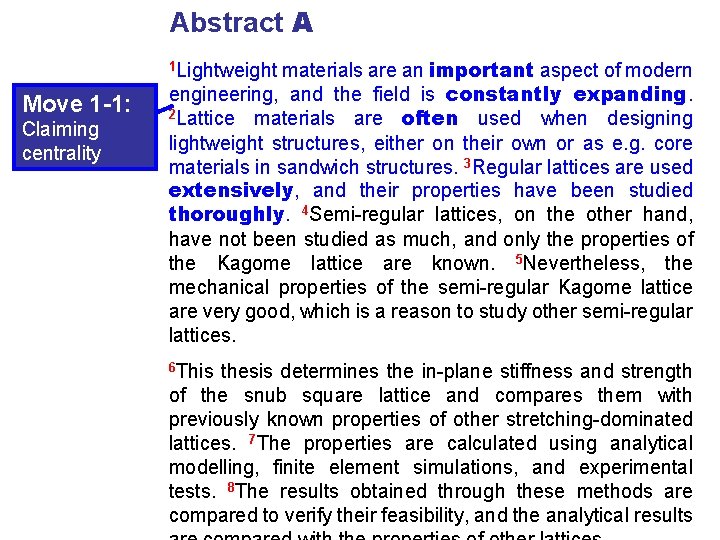
Abstract A materials are an important aspect of modern engineering, and the field is constantly expanding. 2 Lattice materials are often used when designing lightweight structures, either on their own or as e. g. core materials in sandwich structures. 3 Regular lattices are used extensively, and their properties have been studied thoroughly. 4 Semi-regular lattices, on the other hand, have not been studied as much, and only the properties of the Kagome lattice are known. 5 Nevertheless, the mechanical properties of the semi-regular Kagome lattice are very good, which is a reason to study other semi-regular lattices. 1 Lightweight Move 1 -1: Claiming centrality 6 This thesis determines the in-plane stiffness and strength of the snub square lattice and compares them with previously known properties of other stretching-dominated lattices. 7 The properties are calculated using analytical modelling, finite element simulations, and experimental tests. 8 The results obtained through these methods are compared to verify their feasibility, and the analytical results
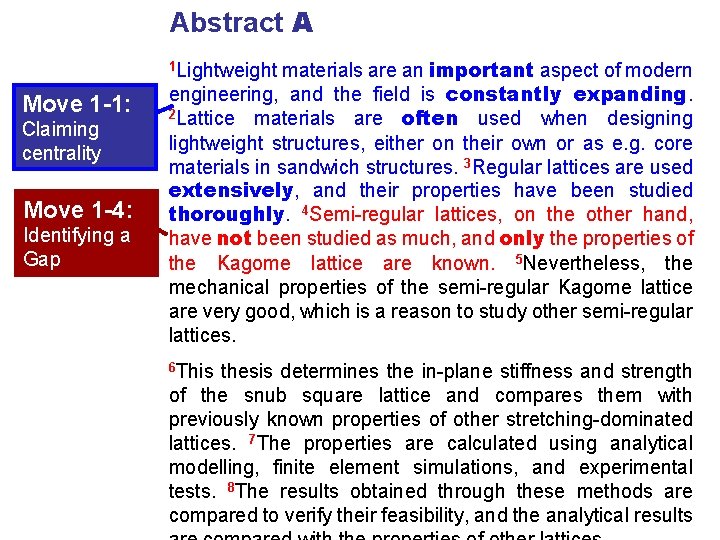
Abstract A materials are an important aspect of modern engineering, and the field is constantly expanding. 2 Lattice materials are often used when designing lightweight structures, either on their own or as e. g. core materials in sandwich structures. 3 Regular lattices are used extensively, and their properties have been studied thoroughly. 4 Semi-regular lattices, on the other hand, have not been studied as much, and only the properties of the Kagome lattice are known. 5 Nevertheless, the mechanical properties of the semi-regular Kagome lattice are very good, which is a reason to study other semi-regular lattices. 1 Lightweight Move 1 -1: Claiming centrality Move 1 -4: Identifying a Gap 6 This thesis determines the in-plane stiffness and strength of the snub square lattice and compares them with previously known properties of other stretching-dominated lattices. 7 The properties are calculated using analytical modelling, finite element simulations, and experimental tests. 8 The results obtained through these methods are compared to verify their feasibility, and the analytical results
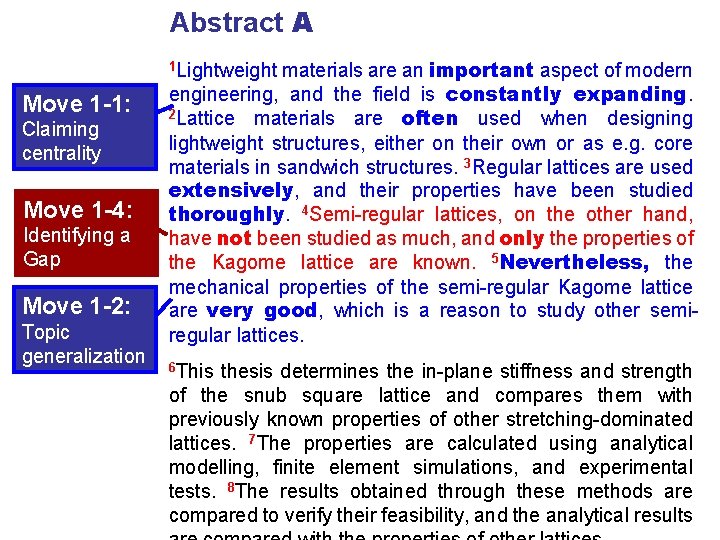
Abstract A materials are an important aspect of modern engineering, and the field is constantly expanding. 2 Lattice materials are often used when designing lightweight structures, either on their own or as e. g. core materials in sandwich structures. 3 Regular lattices are used extensively, and their properties have been studied thoroughly. 4 Semi-regular lattices, on the other hand, have not been studied as much, and only the properties of the Kagome lattice are known. 5 Nevertheless, the mechanical properties of the semi-regular Kagome lattice are very good, which is a reason to study other semiregular lattices. 1 Lightweight Move 1 -1: Claiming centrality Move 1 -4: Identifying a Gap Move 1 -2: Topic generalization 6 This thesis determines the in-plane stiffness and strength of the snub square lattice and compares them with previously known properties of other stretching-dominated lattices. 7 The properties are calculated using analytical modelling, finite element simulations, and experimental tests. 8 The results obtained through these methods are compared to verify their feasibility, and the analytical results
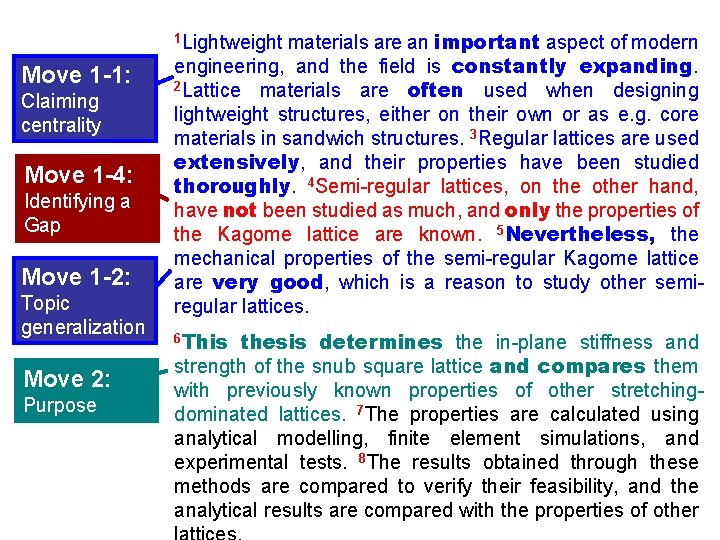
materials are an important aspect of modern engineering, and the field is constantly expanding. 2 Lattice materials are often used when designing lightweight structures, either on their own or as e. g. core materials in sandwich structures. 3 Regular lattices are used extensively, and their properties have been studied thoroughly. 4 Semi-regular lattices, on the other hand, have not been studied as much, and only the properties of the Kagome lattice are known. 5 Nevertheless, the mechanical properties of the semi-regular Kagome lattice are very good, which is a reason to study other semiregular lattices. 1 Lightweight Move 1 -1: Claiming centrality Move 1 -4: Identifying a Gap Move 1 -2: Topic generalization Move 2: Purpose 6 This thesis determines the in-plane stiffness and strength of the snub square lattice and compares them with previously known properties of other stretchingdominated lattices. 7 The properties are calculated using analytical modelling, finite element simulations, and experimental tests. 8 The results obtained through these methods are compared to verify their feasibility, and the analytical results are compared with the properties of other
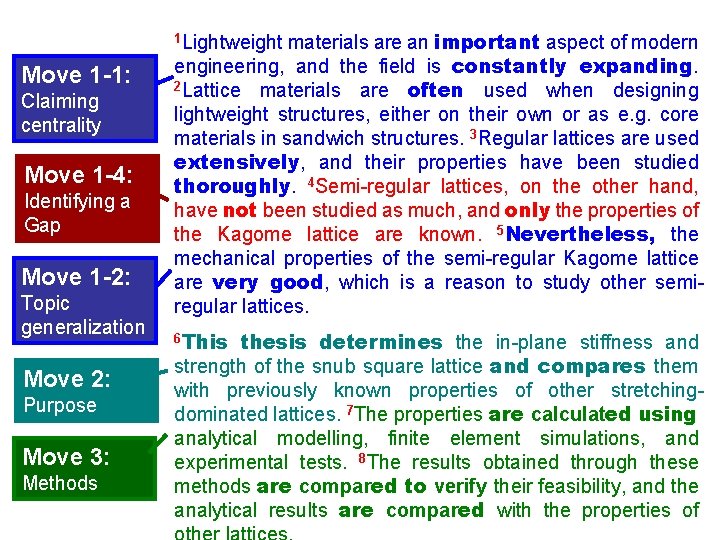
materials are an important aspect of modern engineering, and the field is constantly expanding. 2 Lattice materials are often used when designing lightweight structures, either on their own or as e. g. core materials in sandwich structures. 3 Regular lattices are used extensively, and their properties have been studied thoroughly. 4 Semi-regular lattices, on the other hand, have not been studied as much, and only the properties of the Kagome lattice are known. 5 Nevertheless, the mechanical properties of the semi-regular Kagome lattice are very good, which is a reason to study other semiregular lattices. 1 Lightweight Move 1 -1: Claiming centrality Move 1 -4: Identifying a Gap Move 1 -2: Topic generalization Move 2: Purpose Move 3: Methods 6 This thesis determines the in-plane stiffness and strength of the snub square lattice and compares them with previously known properties of other stretchingdominated lattices. 7 The properties are calculated using analytical modelling, finite element simulations, and experimental tests. 8 The results obtained through these methods are compared to verify their feasibility, and the analytical results are compared with the properties of
Abstract A 9 The results show that the applied methods are feasible. 10 The finite element simulations and experimental tests also show that imperfections in the lattice result in a lower buckling strength, and that the lattice is very sensitive to imperfections near the critical relative density where the collapse mode changes from elastic buckling to yielding. 11 When comparing the mechanical properties of the snub square lattice with those of other lattices, the snub square lattice has an inferior stiffness and yield strength, but a favorable buckling strength. 12 The buckling strength is material specific, so the snub square lattice would be a feasible solution when stiffness is not important and the solid material has a high yield strain, thus resulting in a higher critical relative density. 13 In addition, the positive results are seen as motivation to study further properties of the snub square lattice, as well as other semi-regular lattices.
Abstract A Move 4: Result 9 The results show that the applied methods are feasible. 10 The finite element simulations and experimental tests also show that imperfections in the lattice result in a lower buckling strength, and that the lattice is very sensitive to imperfections near the critical relative density where the collapse mode changes from elastic buckling to yielding. 11 When comparing the mechanical properties of the snub square lattice with those of other lattices, the snub square lattice has an inferior stiffness and yield strength, but a favorable buckling strength. 12 The buckling strength is material specific, so the snub square lattice would be a feasible solution when stiffness is not important and the solid material has a high yield strain, thus resulting in a higher critical relative density. 13 In addition, the positive results are seen as motivation to study further properties of the snub square lattice, as well as other semi-regular lattices.
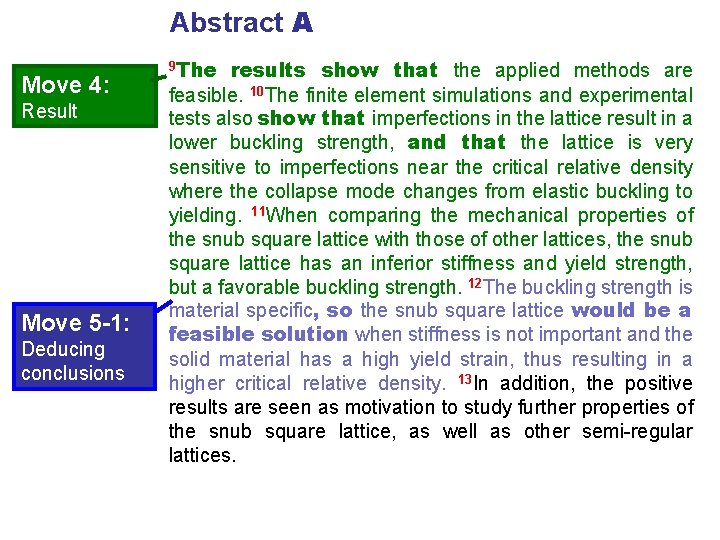
Abstract A Move 4: Result Move 5 -1: Deducing conclusions 9 The results show that the applied methods are feasible. 10 The finite element simulations and experimental tests also show that imperfections in the lattice result in a lower buckling strength, and that the lattice is very sensitive to imperfections near the critical relative density where the collapse mode changes from elastic buckling to yielding. 11 When comparing the mechanical properties of the snub square lattice with those of other lattices, the snub square lattice has an inferior stiffness and yield strength, but a favorable buckling strength. 12 The buckling strength is material specific, so the snub square lattice would be a feasible solution when stiffness is not important and the solid material has a high yield strain, thus resulting in a higher critical relative density. 13 In addition, the positive results are seen as motivation to study further properties of the snub square lattice, as well as other semi-regular lattices.
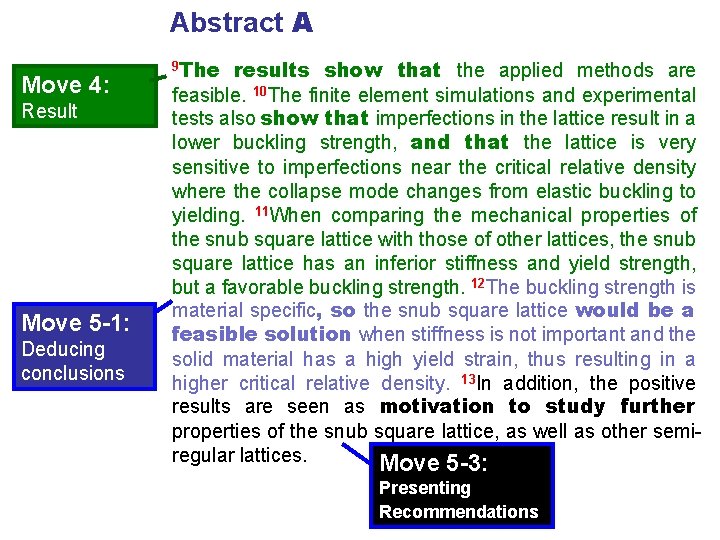
Abstract A Move 4: Result Move 5 -1: Deducing conclusions 9 The results show that the applied methods are feasible. 10 The finite element simulations and experimental tests also show that imperfections in the lattice result in a lower buckling strength, and that the lattice is very sensitive to imperfections near the critical relative density where the collapse mode changes from elastic buckling to yielding. 11 When comparing the mechanical properties of the snub square lattice with those of other lattices, the snub square lattice has an inferior stiffness and yield strength, but a favorable buckling strength. 12 The buckling strength is material specific, so the snub square lattice would be a feasible solution when stiffness is not important and the solid material has a high yield strain, thus resulting in a higher critical relative density. 13 In addition, the positive results are seen as motivation to study further properties of the snub square lattice, as well as other semiregular lattices. Move 5 -3: Presenting Recommendations
Abstract B: Bijan Bayat Mokhtari, “Development of an Intelligent Safety Gear System for High-Rise Elevators, ” M. S. thesis, School of Engineering, Dept. of Mechanical Engineering, Aalto Univ. , Espoo, Finland, 2017.
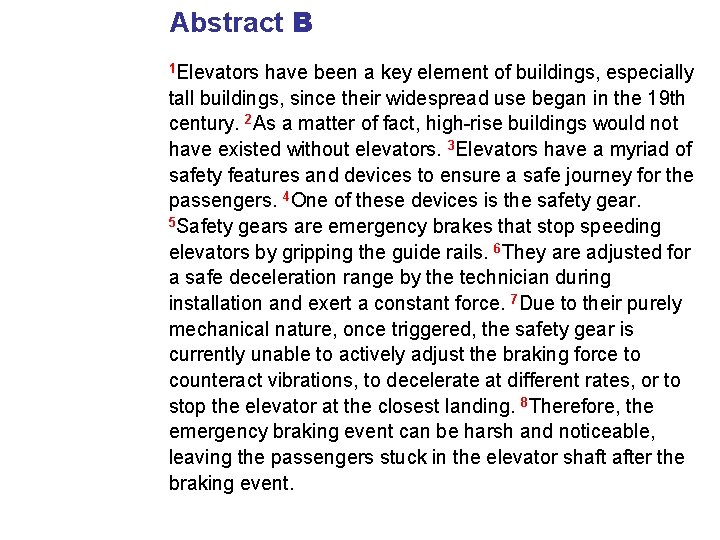
Abstract B 1 Elevators have been a key element of buildings, especially tall buildings, since their widespread use began in the 19 th century. 2 As a matter of fact, high-rise buildings would not have existed without elevators. 3 Elevators have a myriad of safety features and devices to ensure a safe journey for the passengers. 4 One of these devices is the safety gear. 5 Safety gears are emergency brakes that stop speeding elevators by gripping the guide rails. 6 They are adjusted for a safe deceleration range by the technician during installation and exert a constant force. 7 Due to their purely mechanical nature, once triggered, the safety gear is currently unable to actively adjust the braking force to counteract vibrations, to decelerate at different rates, or to stop the elevator at the closest landing. 8 Therefore, the emergency braking event can be harsh and noticeable, leaving the passengers stuck in the elevator shaft after the braking event.
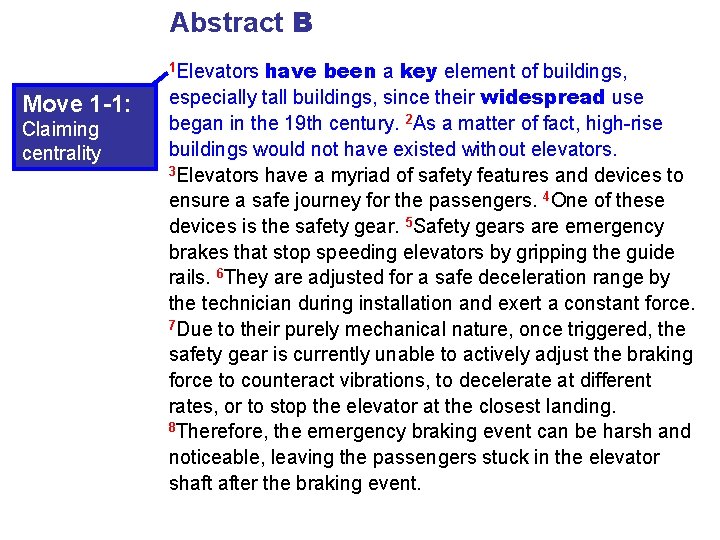
Abstract B have been a key element of buildings, especially tall buildings, since their widespread use began in the 19 th century. 2 As a matter of fact, high-rise buildings would not have existed without elevators. 3 Elevators have a myriad of safety features and devices to ensure a safe journey for the passengers. 4 One of these devices is the safety gear. 5 Safety gears are emergency brakes that stop speeding elevators by gripping the guide rails. 6 They are adjusted for a safe deceleration range by the technician during installation and exert a constant force. 7 Due to their purely mechanical nature, once triggered, the safety gear is currently unable to actively adjust the braking force to counteract vibrations, to decelerate at different rates, or to stop the elevator at the closest landing. 8 Therefore, the emergency braking event can be harsh and noticeable, leaving the passengers stuck in the elevator shaft after the braking event. 1 Elevators Move 1 -1: Claiming centrality
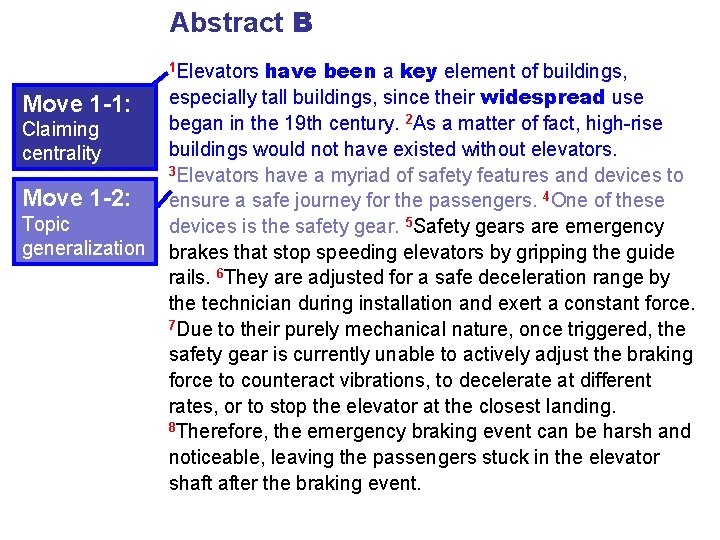
Abstract B have been a key element of buildings, especially tall buildings, since their widespread use began in the 19 th century. 2 As a matter of fact, high-rise buildings would not have existed without elevators. 3 Elevators have a myriad of safety features and devices to ensure a safe journey for the passengers. 4 One of these devices is the safety gear. 5 Safety gears are emergency brakes that stop speeding elevators by gripping the guide rails. 6 They are adjusted for a safe deceleration range by the technician during installation and exert a constant force. 7 Due to their purely mechanical nature, once triggered, the safety gear is currently unable to actively adjust the braking force to counteract vibrations, to decelerate at different rates, or to stop the elevator at the closest landing. 8 Therefore, the emergency braking event can be harsh and noticeable, leaving the passengers stuck in the elevator shaft after the braking event. 1 Elevators Move 1 -1: Claiming centrality Move 1 -2: Topic generalization
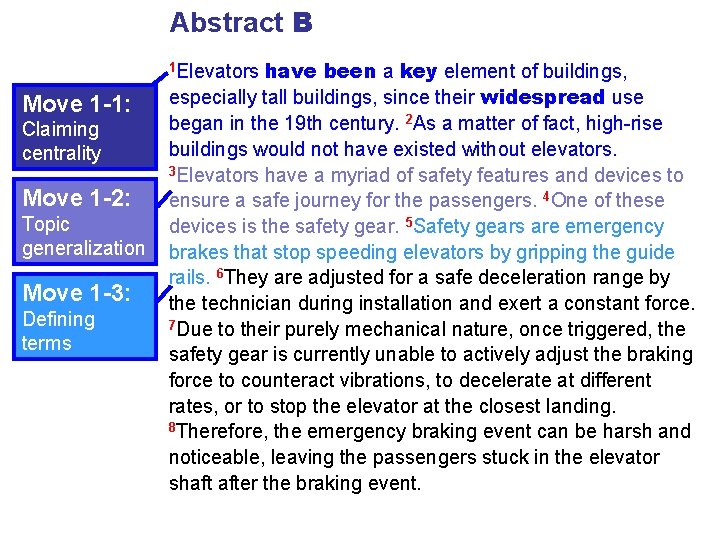
Abstract B have been a key element of buildings, especially tall buildings, since their widespread use began in the 19 th century. 2 As a matter of fact, high-rise buildings would not have existed without elevators. 3 Elevators have a myriad of safety features and devices to ensure a safe journey for the passengers. 4 One of these devices is the safety gear. 5 Safety gears are emergency brakes that stop speeding elevators by gripping the guide rails. 6 They are adjusted for a safe deceleration range by the technician during installation and exert a constant force. 7 Due to their purely mechanical nature, once triggered, the safety gear is currently unable to actively adjust the braking force to counteract vibrations, to decelerate at different rates, or to stop the elevator at the closest landing. 8 Therefore, the emergency braking event can be harsh and noticeable, leaving the passengers stuck in the elevator shaft after the braking event. 1 Elevators Move 1 -1: Claiming centrality Move 1 -2: Topic generalization Move 1 -3: Defining terms
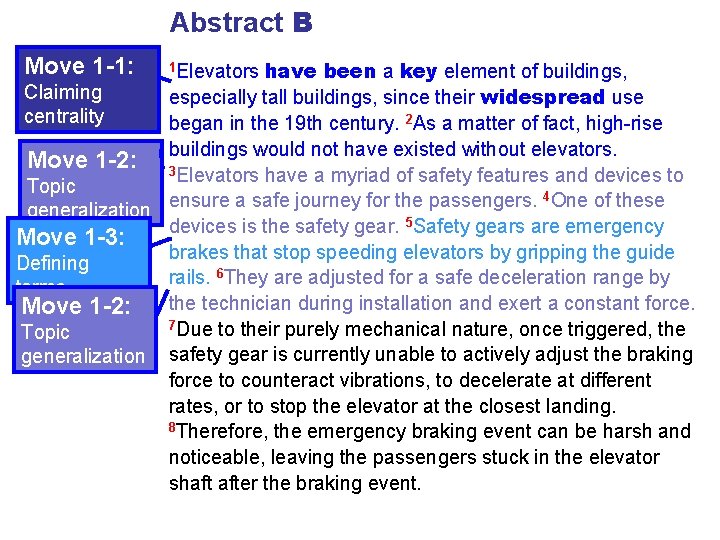
Abstract B Move 1 -1: have been a key element of buildings, Claiming especially tall buildings, since their widespread use centrality began in the 19 th century. 2 As a matter of fact, high-rise would not have existed without elevators. Move 1 -2: buildings 3 Elevators have a myriad of safety features and devices to Topic 4 One of these ensure a safe journey for the passengers. generalization devices is the safety gear. 5 Safety gears are emergency Move 1 -3: brakes that stop speeding elevators by gripping the guide Defining 6 They are adjusted for a safe deceleration range by rails. terms the technician during installation and exert a constant force. Move 1 -2: 7 Due to their purely mechanical nature, once triggered, the Topic generalization safety gear is currently unable to actively adjust the braking force to counteract vibrations, to decelerate at different rates, or to stop the elevator at the closest landing. 8 Therefore, the emergency braking event can be harsh and noticeable, leaving the passengers stuck in the elevator shaft after the braking event. 1 Elevators
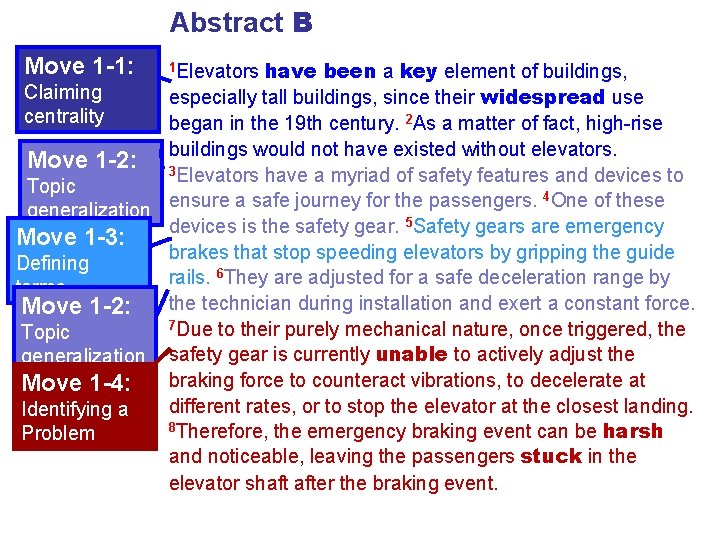
Abstract B Move 1 -1: have been a key element of buildings, Claiming especially tall buildings, since their widespread use centrality began in the 19 th century. 2 As a matter of fact, high-rise would not have existed without elevators. Move 1 -2: buildings 3 Elevators have a myriad of safety features and devices to Topic 4 One of these ensure a safe journey for the passengers. generalization devices is the safety gear. 5 Safety gears are emergency Move 1 -3: brakes that stop speeding elevators by gripping the guide Defining 6 They are adjusted for a safe deceleration range by rails. terms the technician during installation and exert a constant force. Move 1 -2: 7 Due to their purely mechanical nature, once triggered, the Topic generalization safety gear is currently unable to actively adjust the braking force to counteract vibrations, to decelerate at Move 1 -4: different rates, or to stop the elevator at the closest landing. Identifying a 8 Therefore, the emergency braking event can be harsh Problem and noticeable, leaving the passengers stuck in the elevator shaft after the braking event. 1 Elevators
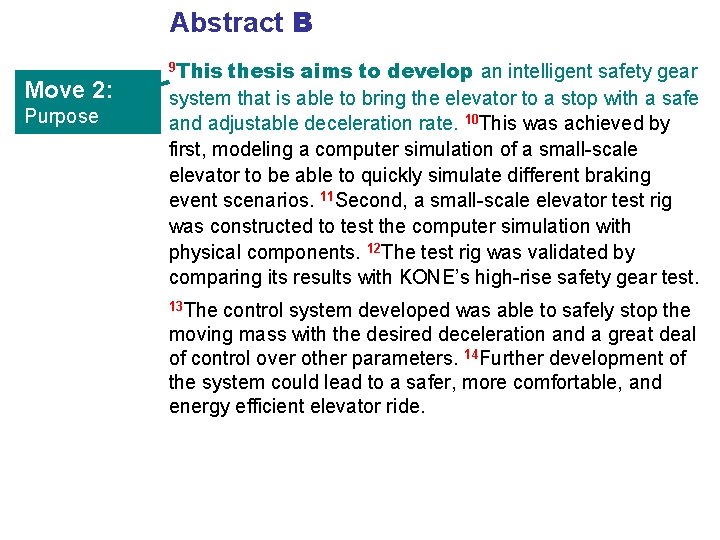
Abstract B Move 2: Purpose 9 This thesis aims to develop an intelligent safety gear system that is able to bring the elevator to a stop with a safe and adjustable deceleration rate. 10 This was achieved by first, modeling a computer simulation of a small-scale elevator to be able to quickly simulate different braking event scenarios. 11 Second, a small-scale elevator test rig was constructed to test the computer simulation with physical components. 12 The test rig was validated by comparing its results with KONE’s high-rise safety gear test. 13 The control system developed was able to safely stop the moving mass with the desired deceleration and a great deal of control over other parameters. 14 Further development of the system could lead to a safer, more comfortable, and energy efficient elevator ride.
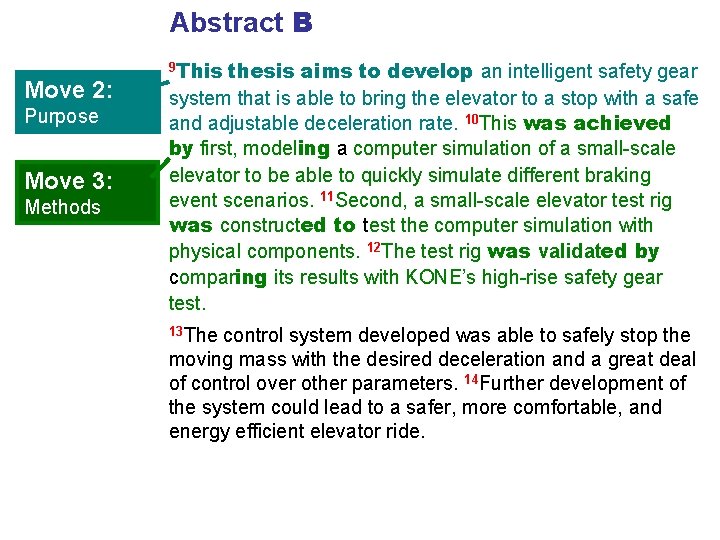
Abstract B Move 2: Purpose Move 3: Methods 9 This thesis aims to develop an intelligent safety gear system that is able to bring the elevator to a stop with a safe and adjustable deceleration rate. 10 This was achieved by first, modeling a computer simulation of a small-scale elevator to be able to quickly simulate different braking event scenarios. 11 Second, a small-scale elevator test rig was constructed to test the computer simulation with physical components. 12 The test rig was validated by comparing its results with KONE’s high-rise safety gear test. 13 The control system developed was able to safely stop the moving mass with the desired deceleration and a great deal of control over other parameters. 14 Further development of the system could lead to a safer, more comfortable, and energy efficient elevator ride.
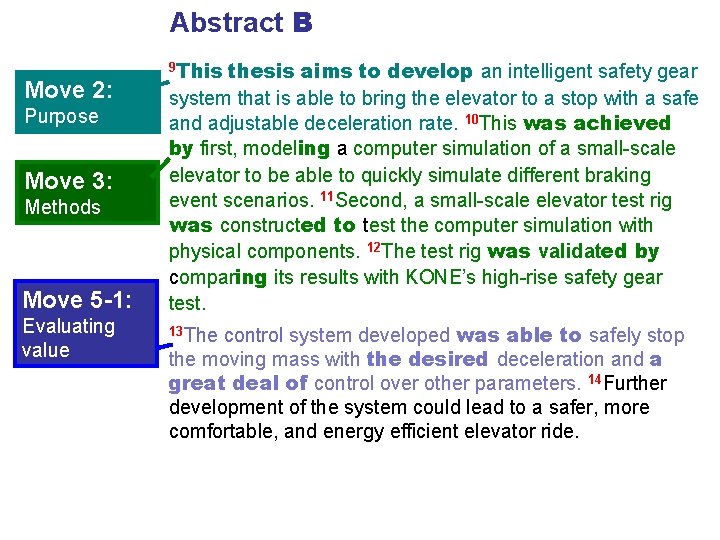
Abstract B Move 2: Purpose Move 3: Methods Move 5 -1: Evaluating value 9 This thesis aims to develop an intelligent safety gear system that is able to bring the elevator to a stop with a safe and adjustable deceleration rate. 10 This was achieved by first, modeling a computer simulation of a small-scale elevator to be able to quickly simulate different braking event scenarios. 11 Second, a small-scale elevator test rig was constructed to test the computer simulation with physical components. 12 The test rig was validated by comparing its results with KONE’s high-rise safety gear test. control system developed was able to safely stop the moving mass with the desired deceleration and a great deal of control over other parameters. 14 Further development of the system could lead to a safer, more comfortable, and energy efficient elevator ride. 13 The
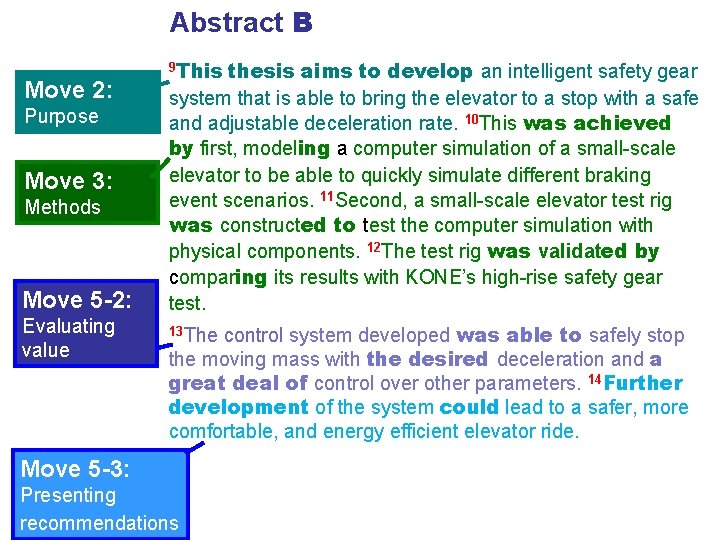
Abstract B Move 2: Purpose Move 3: Methods Move 5 -2: Evaluating value 9 This thesis aims to develop an intelligent safety gear system that is able to bring the elevator to a stop with a safe and adjustable deceleration rate. 10 This was achieved by first, modeling a computer simulation of a small-scale elevator to be able to quickly simulate different braking event scenarios. 11 Second, a small-scale elevator test rig was constructed to test the computer simulation with physical components. 12 The test rig was validated by comparing its results with KONE’s high-rise safety gear test. control system developed was able to safely stop the moving mass with the desired deceleration and a great deal of control over other parameters. 14 Further development of the system could lead to a safer, more comfortable, and energy efficient elevator ride. 13 The Move 5 -3: Presenting recommendations
Abstract C: Topi Hirvonen, “Thermal paper reuse in thermal paper base paper manufacture, ” M. S. thesis, School of Chemical Technology, Helsinki University of Technology, Espoo, Finland, 2007.
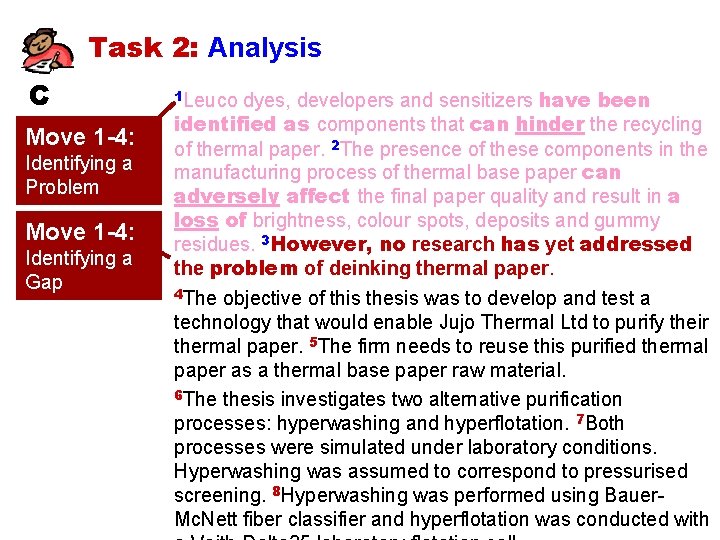
Task 2: Analysis C Move 1 -4: Identifying a Problem Move 1 -4: Identifying a Gap 1 1 Leuco dyes, developersand sensitizers have been Leuco dyes, sensitizers have been identified components thatcan canhinder therecycling identified as as components that can hinder the recycling of components the 2 The recycling ofpaper. thermal paper. of these in thermal paper. presence of presence these components of thermal presence of these components in the components the manufacturing process of thermal manufacturinginprocess of thermal base paper can adversely can base paper can adversely affect the paperin a affect the final paper quality result in a final loss result of adversely affect the finaland paper quality and quality resultspots, incolour a loss of brightness, spots, brightness, colour deposits and gummy residues. loss ofand brightness, spots, deposits andcolour gummy 3 However, 3 deposits gummy no residues. research However, 3 and no research hasresearch yet addressed theno problem of residues. However, has yet addressed the problem of deinking thermal the problem of paper. deinking thermal paper. 4 4 The objective of this thesis was to develop and test a technology that would enable Jujo Thermal Ltd to purify their thermal paper. 55 The firm needs to reuse this purified thermal paper as a thermal base paper raw material. 6 6 The thesis investigates two alternative purification processes: hyperwashing and hyperflotation. 77 Both processes were simulated under laboratory conditions. Hyperwashing was assumed to correspond to pressurised screening. 88 Hyperwashing was performed using Bauer. Mc. Nett fiber classifier and hyperflotation was conducted with
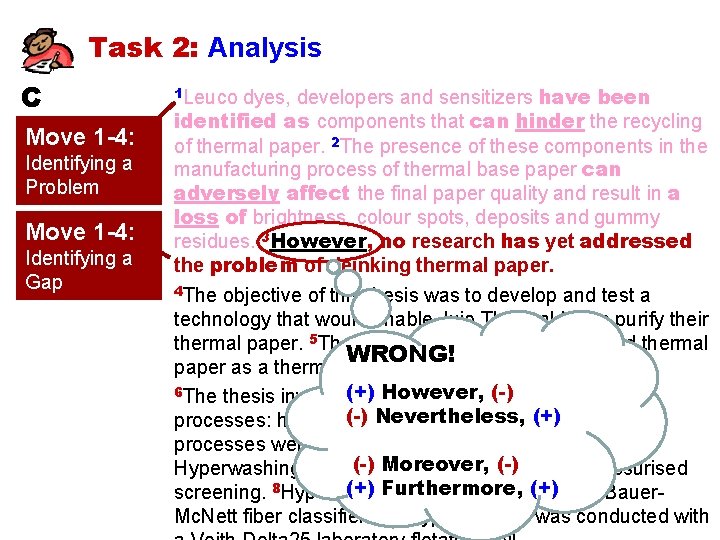
Task 2: Analysis C Move 1 -4: Identifying a Problem Move 1 -4: Identifying a Gap dyes, developers and sensitizers have been identified as components that can hinder the recycling of thermal paper. 2 The presence of these components in the manufacturing process of thermal base paper can adversely affect the final paper quality and result in a loss of brightness, colour spots, deposits and gummy residues. 3 However, no research has yet addressed the problem of deinking thermal paper. 4 The objective of this thesis was to develop and test a technology that would enable Jujo Thermal Ltd to purify their thermal paper. 5 The firm needs to reuse this purified thermal WRONG! paper as a thermal base paper raw material. 6 The thesis investigates (+) However, (-) purification two alternative (-) Nevertheless, (+) 7 Both processes: hyperwashing and hyperflotation. processes were simulated under laboratory conditions. (-) Moreover, (-) Hyperwashing was assumed to correspond to pressurised (+) Furthermore, (+)using Bauerscreening. 8 Hyperwashing was performed Mc. Nett fiber classifier and hyperflotation was conducted with 1 Leuco
dyes, developers and sensitizers have been identified as components that can hinder the recycling of thermal paper. 2 The presence of these components in the manufacturing process of thermal base paper can adversely affect the final paper quality and result in a loss of brightness, colour spots, deposits and gummy residues. 3 Moreover, no research has yet addressed the problem of deinking thermal paper. 4 The objective of this thesis was to develop and test a technology that would enable Jujo Thermal Ltd to purify their WRONG! thermal paper. 5 The firm needs to reuse this purified thermal paper as a thermal(+) base paper raw(-) material. However, 6 The thesis investigates two alternative purification (-) Nevertheless, (+) processes: hyperwashing and hyperflotation. 7 Both processes were simulated under laboratory conditions. (-) Moreover, (-) Hyperwashing was(+) assumed to correspond Furthermore, (+) to pressurised screening. 8 Hyperwashing was performed using Bauer. Mc. Nett fiber classifier and hyperflotation was conducted with 1 Leuco Move 1 -4: Identifying a Problem Move 1 -4: Identifying a Gap
Task 2: Analysis C Move 1 -4: Identifying a Problem Move 1 -4: Identifying a Gap Move 2: Purpose dyes, developers and sensitizers have been identified as components that can hinder the recycling of thermal paper. 2 The presence of these components in the manufacturing process of thermal base paper can adversely affect the final paper quality and result in a loss of brightness, colour spots, deposits and gummy residues. 3 Moreover, no research has yet addressed the problem of deinking thermal paper. 4 The objective of this thesis was to develop and test a technology that would enable Jujo Thermal Ltd to purify their thermal paper. 5 The firm needs to reuse this purified thermal paper as a thermal base paper raw material. 6 The thesis investigates two alternative purification processes: hyperwashing and hyperflotation. 7 Both processes were simulated under laboratory conditions. Hyperwashing was assumed to correspond to pressurised screening. 8 Hyperwashing was performed using Bauer. Mc. Nett fiber classifier and hyperflotation was conducted with 1 Leuco
Task 2: Analysis C Move 1 -4: Identifying a Problem Move 1 -4: Identifying a Gap Move 2: Purpose dyes, developers and sensitizers have been identified as components that can hinder the recycling of thermal paper. 2 The presence of these components in the manufacturing process of thermal base paper can adversely affect the final paper quality and result in a loss of brightness, colour spots, deposits and gummy residues. 3 Moreover, no research has yet addressed the problem of deinking thermal paper. 4 The objective of this thesis was to develop and test a technology that would enable Jujo Thermal Ltd to purify their thermal paper. 5 The firm needs to reuse this purified thermal paper as a thermal base paper raw material. 6 The thesis investigates two alternative purification 7 processes: hyperwashing and hyperflotation. What is. Both the processes were simulated under laboratory conditions. function of this Hyperwashing was assumed to correspond to pressurised sentence? ! screening. 8 Hyperwashing was performed using Bauer 1 Leuco
Task 2: Analysis C Move 2: Purpose objective of this thesis was to develop and test a technology that would enable Jujo Thermal Ltd to purify their thermal paper, as/since the firm needs to reuse this purified thermal paper as a thermal base paper raw material. 6 The thesis investigates two alternative purification processes: hyperwashing and hyperflotation. 7 Both processes were simulated under laboratory conditions. reason Hyperwashing was assumed to The correspond to pressurised screening. 8 Hyperwashing was performed why? !using Bauer. Mc. Nett fiber classifier and hyperflotation was conducted with a Voith Delta 25 laboratory flotation cell. 9 In both processes, washing and flotation were found to be effective in purifying the stock. 10 Hyperwashing was able to remove 85 % of the leuco dyes, with a yield ranging from 60 % to 65 %. 11 In contrast, Hyperflotation was less effective than hyperwashing in removing small leuco dye particles, though it yielded higher ash concentrations. 12 The 4 The
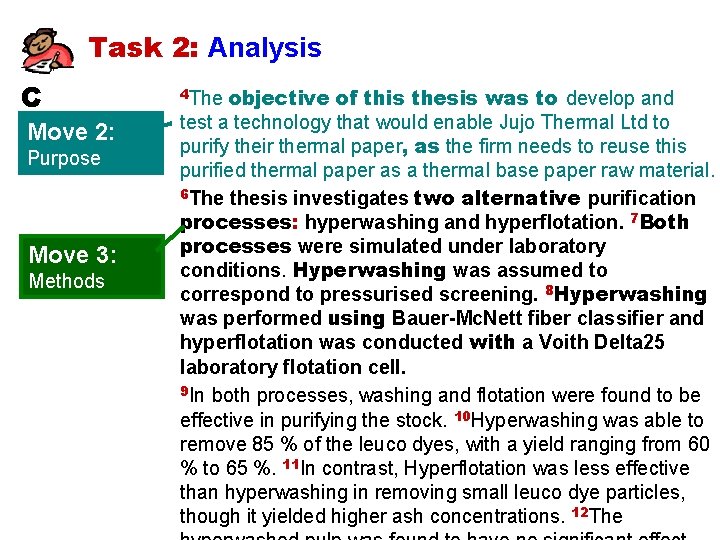
Task 2: Analysis C Move 2: Purpose Move 3: Methods objective of this thesis was to develop and test a technology that would enable Jujo Thermal Ltd to purify their thermal paper, as the firm needs to reuse this purified thermal paper as a thermal base paper raw material. 6 The thesis investigates two alternative purification processes: hyperwashing and hyperflotation. 7 Both processes were simulated under laboratory conditions. Hyperwashing was assumed to correspond to pressurised screening. 8 Hyperwashing was performed using Bauer-Mc. Nett fiber classifier and hyperflotation was conducted with a Voith Delta 25 laboratory flotation cell. 9 In both processes, washing and flotation were found to be effective in purifying the stock. 10 Hyperwashing was able to remove 85 % of the leuco dyes, with a yield ranging from 60 % to 65 %. 11 In contrast, Hyperflotation was less effective than hyperwashing in removing small leuco dye particles, though it yielded higher ash concentrations. 12 The 4 The
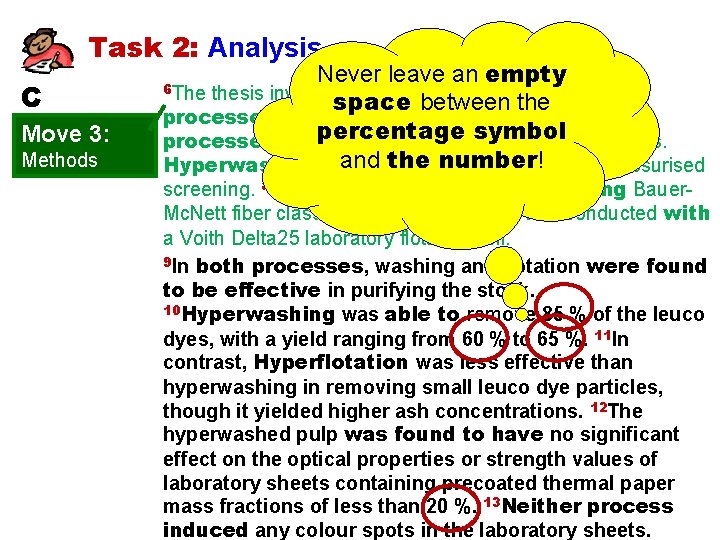
Task 2: Analysis C Move 3: Methods Never leave an empty thesis two alternative thesisinvestigates two alternative purification space between the purification 7 Both processes: hyperwashingand andhyperflotation. percentage symbol processes were simulated under Move 4: processes were simulated under laboratory conditions. and the number! Hyperwashing was assumed to to correspond to to pressurised 6 6 The Product (outcome) 8 screening. 8 Hyperwashing was performed using Bauer. Mc. Nett fiber classifier and hyperflotation was conducted with a a Voith Delta 25 laboratory flotation cell. 9 9 In In both processes, washing and flotation were found to to be be effective in in purifying the stock. 10 10 Hyperwashing was able to to remove 85 85 % % of of the leuco 11 dyes, with a a yield ranging from 60 60 % % to to 65 65 %. %. 11 In In contrast, Hyperflotation was less effective than hyperwashing in in removing small leuco dye particles, 12 though it it yielded higher ash concentrations. 12 The hyperwashed pulp was found to to have no no significant effect on on the optical properties or or strength values of of laboratory sheets containing precoated thermal paper 13 mass fractions of of less than 20 20 %. %. 13 Neither process induced any colour spots in the laboratory sheets.
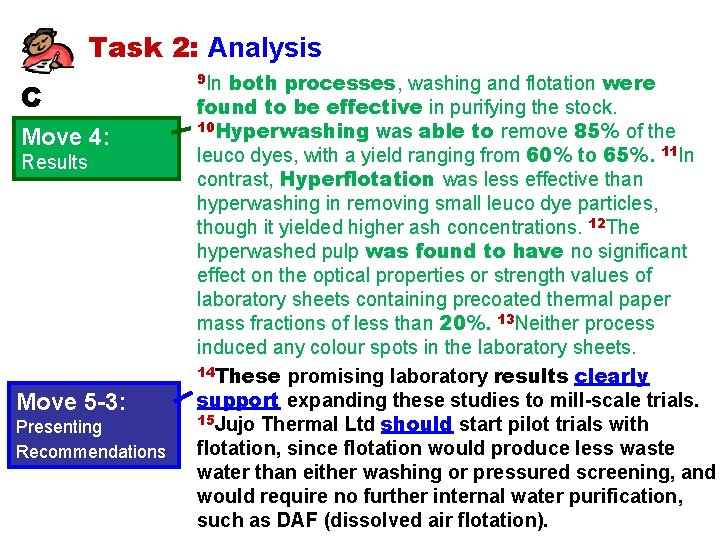
Task 2: Analysis C Move 4: Results Move 5 -3: Presenting Recommendations both processes, washing and flotation were found to be effective in purifying the stock. 10 Hyperwashing was able to remove 85% of the leuco dyes, with a yield ranging from 60% to 65%. 11 In contrast, Hyperflotation was less effective than hyperwashing in removing small leuco dye particles, though it yielded higher ash concentrations. 12 The hyperwashed pulp was found to have no significant effect on the optical properties or strength values of laboratory sheets containing precoated thermal paper mass fractions of less than 20%. 13 Neither process induced any colour spots in the laboratory sheets. 14 These promising laboratory results clearly support expanding these studies to mill-scale trials. 15 Jujo Thermal Ltd should start pilot trials with flotation, since flotation would produce less waste water than either washing or pressured screening, and would require no further internal water purification, such as DAF (dissolved air flotation). 9 In
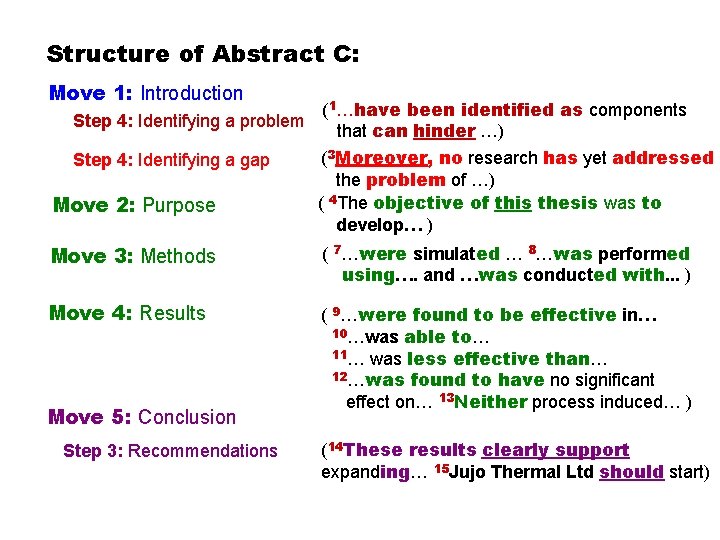
Structure of Abstract C: Move 1: Introduction (1…have been identified as components Step 4: Identifying a problem that can hinder …) (3 Moreover, no research has yet addressed Step 4: Identifying a gap the problem of …) ( 4 The objective of this thesis was to Move 2: Purpose develop… ) Move 3: Methods ( 7…were simulated … 8…was performed using…. and …was conducted with. . . ) Move 4: Results ( 9…were found to be effective in… 10…was able to… 11… was less effective than… 12…was found to have no significant effect on… 13 Neither process induced… ) Move 5: Conclusion Step 3: Recommendations (14 These results clearly support expanding… 15 Jujo Thermal Ltd should start)
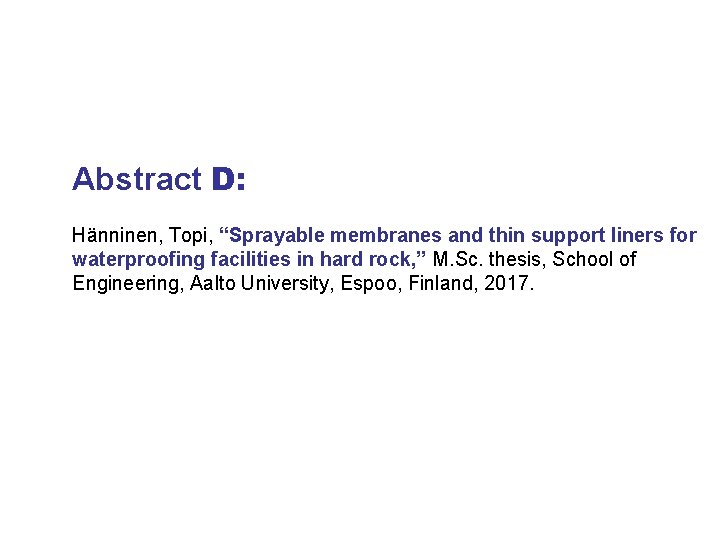
Abstract D: Hänninen, Topi, “Sprayable membranes and thin support liners for waterproofing facilities in hard rock, ” M. Sc. thesis, School of Engineering, Aalto University, Espoo, Finland, 2017.
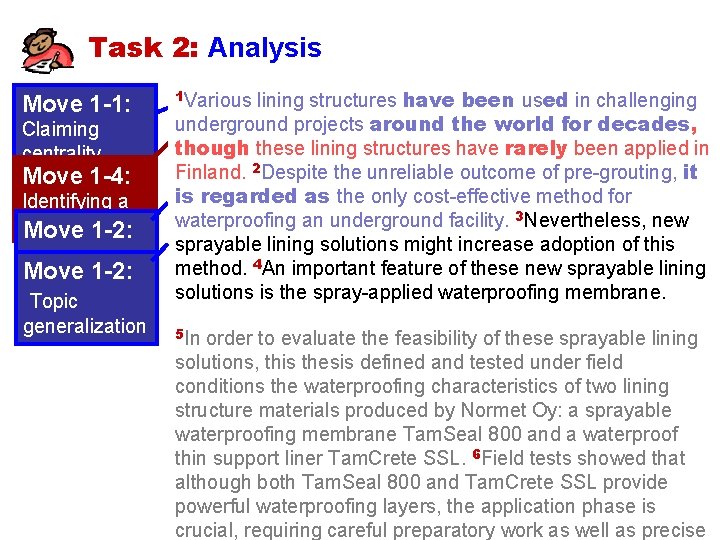
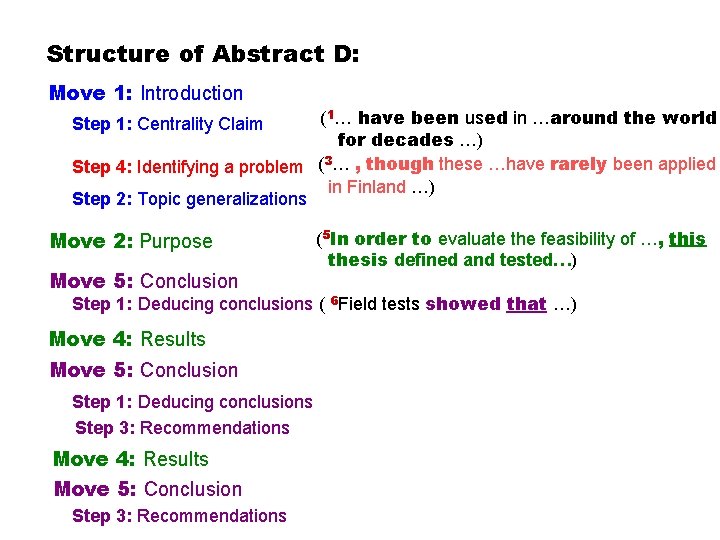
Task 2: Analysis D 1 -1: Move Claiming centrality Move 1 -4: Identifying a Problem Move 1 -2: Topic generalization Move 1 -2: have in in challenging havebeenused challenging underground projects around forfor decades, aroundthe theworld decades, though been applied in in thoughtheseliningstructureshaverarely been applied Finland. 22 Despite the unreliable outcome of pre-grouting, ititis regarded as theas only method for waterproofing is regarded thecost-effective only cost-effective method for 3 3 Nevertheless, 3 new sprayable lining an underground waterproofing anfacility. underground facility. Nevertheless, new solutions of this method. Anthis sprayablemight liningincrease solutionsadoption might increase adoption 44 of important feature of these new of sprayable lining solutions is method. 4 An important feature these new sprayable lining the spray-applied waterproofing membrane. solutions is the spray-applied waterproofing 1 1 Various lining structures 5 5 In order to evaluate the feasibility of these sprayable lining solutions, this thesis defined and tested under field conditions the waterproofing characteristics of two lining structure materials produced by Normet Oy: a sprayable waterproofing membrane Tam. Seal 800 and a waterproof thin support liner Tam. Crete SSL. 66 Field tests showed that although both Tam. Seal 800 and Tam. Crete SSL provide powerful waterproofing layers, the application phase is crucial, requiring careful preparatory work as well as precise
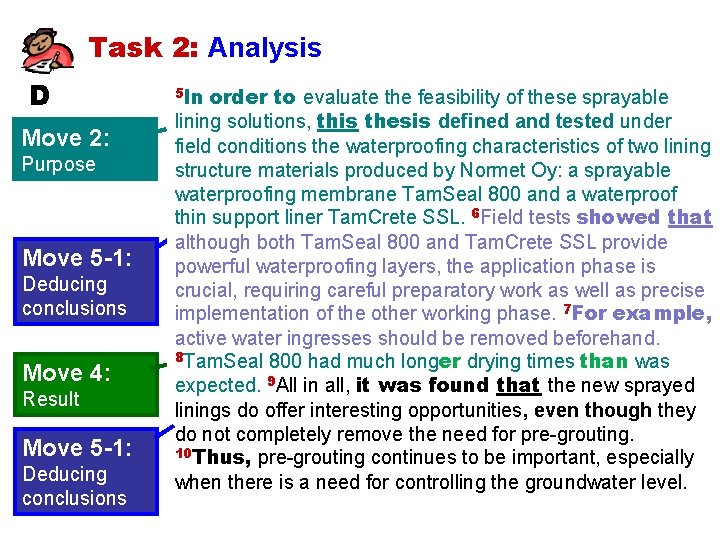
Task 2: Analysis D Move 2: Purpose Move 5 -1: Deducing conclusions Move 4: Result Move 5 -1: Deducing conclusions 5 In order to evaluate the feasibility of these sprayable lining solutions, this thesis defined and tested under field conditions the waterproofing characteristics of two lining structure materials produced by Normet Oy: a sprayable waterproofing membrane Tam. Seal 800 and a waterproof thin support liner Tam. Crete SSL. 6 Field tests showedthat although both Tam. Seal 800 and Tam. Crete SSL provide powerful waterproofing layers, the application phase is crucial, requiring careful preparatory work as well as precise implementation of the other working phase. 7 For example, active water ingresses should be removed beforehand. 8 Tam. Seal 800 had much longer drying thanwas drying times than was found the new sprayed expected. 9 All in all, ititwas found that the new sprayed linings do offer interesting opportunities, even thoughthey do not completely remove the need for pre-grouting. 10 Thus, pre-grouting continues to be important, especially when there when is there a need is a for need controlling for controlling the groundwater level.
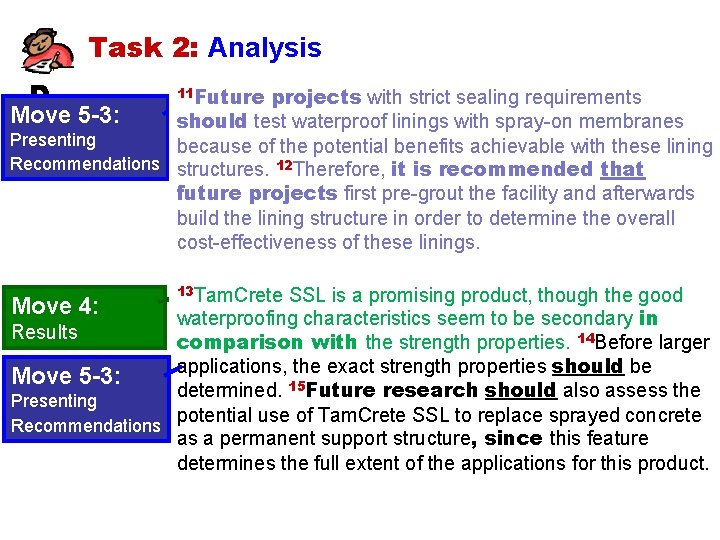
Task 2: Analysis D projects with strict sealing requirements Move 5 -3: should test waterproof linings with spray-on membranes Presenting because of of the potential benefits achievable with these lining Recommendations structures. 12 Therefore, structures. 12 Therefore, it it is is recommended that future projects first pre-grout the facility and afterwards build the lining structure in in order to to determine the overall cost-effectiveness of of these linings. Move 4: 11 11 Future 13 13 Tam. Crete SSL is is aa promising product, though the good waterproofing characteristics seem to to be be secondary in in waterproofing 14 14 Before comparison with the strength properties. larger the strength properties. Before larger applications, the exact strength properties should applications, be should bebe Move 5 -3: 15 Future research should also assess the determined. 15 determined. Future research should also assess the Presenting potential use of of Tam. Crete SSL to to replace sprayed concrete Recommendations as aa permanent support structure, since this feature as this feature since this feature determines the full extent of of the applications for this product. Results
Structure of Abstract D: Move 1: Introduction (1… have been used in …around the world for decades …) Step 4: Identifying a problem (3… , though these …have rarely been applied in Finland …) Step 2: Topic generalizations Step 1: Centrality Claim Move 2: Purpose Move 5: Conclusion (5 In order to evaluate the feasibility of …, this thesis defined and tested…) Step 1: Deducing conclusions ( 6 Field tests showed that …) Move 4: Results Move 5: Conclusion Step 1: Deducing conclusions Step 3: Recommendations Move 4: Results Move 5: Conclusion Step 3: Recommendations
Abstract E: Bock, Wilfried, “Lead User Analysis for the Development of Shape Changing Interfaces, ” M. Sc. thesis, School of Engineering, Aalto University, Espoo, Finland, 2017.
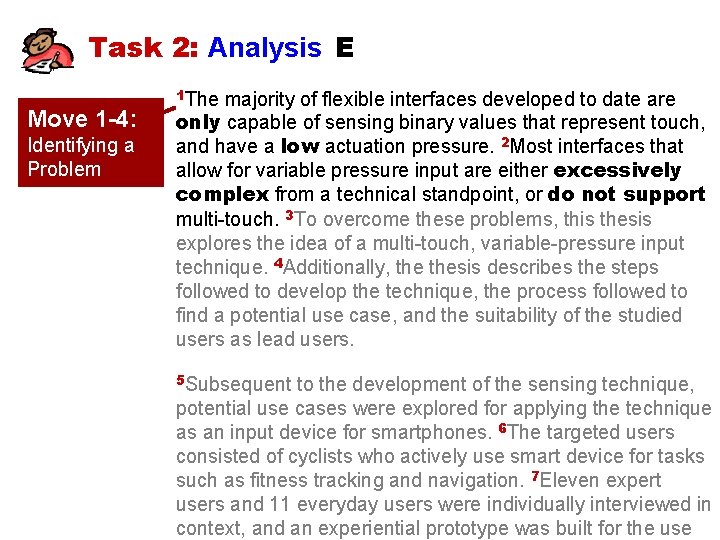
Task 2: Analysis E Move 1 -4: Identifying a Problem 1 The majority of flexible interfaces developed to date are only capable of sensing binary values that represent touch, and have a low actuation pressure. 2 Most interfaces that allow for variable pressure input are either excessively complex from a technical standpoint, or do not support multi-touch. 3 To overcome these problems, this thesis explores the idea of a multi-touch, variable-pressure input technique. 4 Additionally, thesis describes the steps followed to develop the technique, the process followed to find a potential use case, and the suitability of the studied users as lead users. 5 Subsequent to the development of the sensing technique, potential use cases were explored for applying the technique as an input device for smartphones. 6 The targeted users consisted of cyclists who actively use smart device for tasks such as fitness tracking and navigation. 7 Eleven expert users and 11 everyday users were individually interviewed in context, and an experiential prototype was built for the use
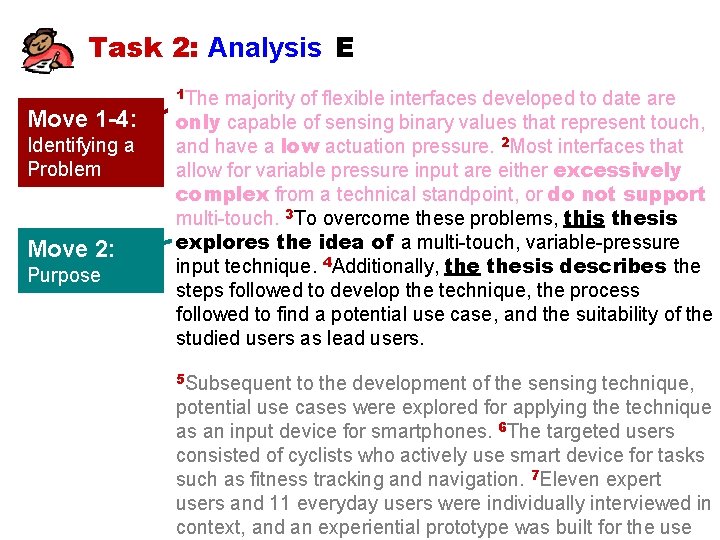
Task 2: Analysis E Move 1 -4: Identifying a Problem Move 2: Purpose 1 The majority of flexible interfaces developed to date are only capable of sensing binary values that represent touch, and have a low actuation pressure. 2 Most interfaces that allow for variable pressure input are either excessively complex from a technical standpoint, or do not support multi-touch. 3 To overcome these problems, thisthesis explores a multi-touch, variable-pressure explores thethe idea of multi-touch, variable-pressure input 4 Additionally, thesis describes the 4 Additionally, input technique. thesis describes the steps followed to develop the technique, the process followed to find use a potential usethe case, and theofsuitability of the find a potential case, and suitability the studied lead users asusers lead as users. 5 Subsequent to the development of the sensing technique, potential use cases were explored for applying the technique as an input device for smartphones. 6 The targeted users consisted of cyclists who actively use smart device for tasks such as fitness tracking and navigation. 7 Eleven expert users and 11 everyday users were individually interviewed in context, and an experiential prototype was built for the use
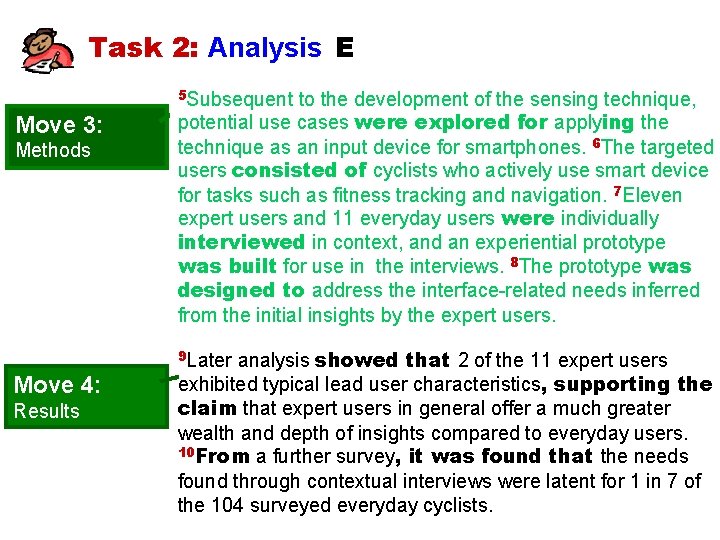
Task 2: Analysis E 5 5 Subsequent Move 3: Methods Move 4: Results to the development of the sensing technique, potential use cases were explored for applying the technique as an input device for smartphones. 66 The targeted users consisted of cyclists who actively use smart device for tasks such as fitness tracking and navigation. 77 Eleven expert users and 11 everyday users were individually interviewed in context, and an experiential prototype was built for use in the interviews. 88 The prototype was designed to address the interface-related needs inferred from the initial insights by the expert users. 9 Later analysis showed that 2 of the 11 expert users 9 showed that 2 of the 11 expert users exhibited typical lead user characteristics, supporting thethe claimthatexpertusersiningeneraloffera amuchgreater claim wealth and depth of insights compared to everyday users. 10 From a further survey, it was found that the needs 10 From a further survey, it was found that the needs found through contextual interviews were latent were for latent 1 infor 7 of 1 in the 7 of 104 the 104 surveyed everyday cyclists.
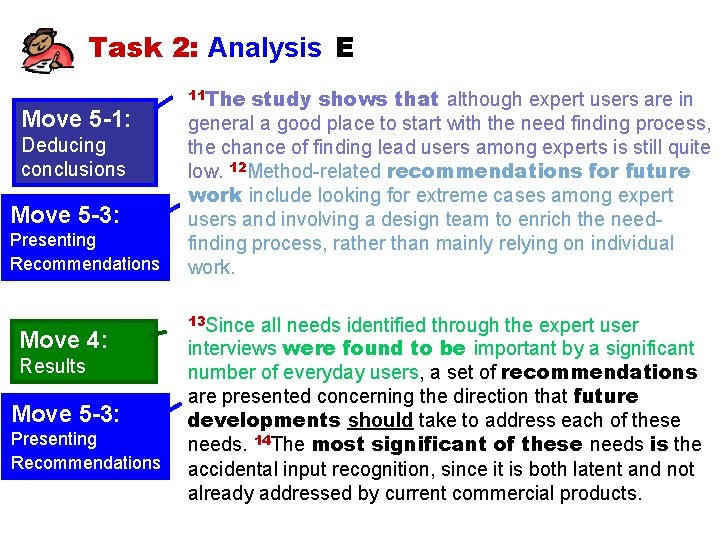
Task 2: Analysis E Move 5 -1: Deducing conclusions Move 5 -3: Presenting Recommendations 11 The study shows that although expert users are in general a good place to start with the need finding process, the chance of finding lead users among experts is still quite low. 12 Method-related recommendations for future work for extreme cases among include looking for extreme cases among expert users, and involving design team to enrich need-finding process, users andainvolving a design teamthe to enrich the needrather than mainly relying onmainly individual work. finding process, rather than relying on individual work. 13 Since Move 4: Results Move 5 -3: Presenting Recommendations all needs identified through the expert user 13 interviews to be through important a significant Since all were needsfound identified thebyexpert user interviews found toaimportant be a significant number of were everyday users, setimportant of recommendations are were found to be by aby significant number of concerning everyday users, recommendations presented the direction future a set of that recommendations are presented concerning the direction that future developments should take to address of these needs. presented concerning the direction thateach future 14 developments should take to address each of these The most significant of these needs is the accidental developments should take to address each of these needs. 14 The most 14 needs. significant of these needs is the input since is bothneeds latent already Therecognition, most significant ofit these isand thenot accidental addressed by current commercial products. input accidental recognition, input recognition, since it is both since latent it is both and not latent already and not addressed already addressed by current by commercial current commercial products.
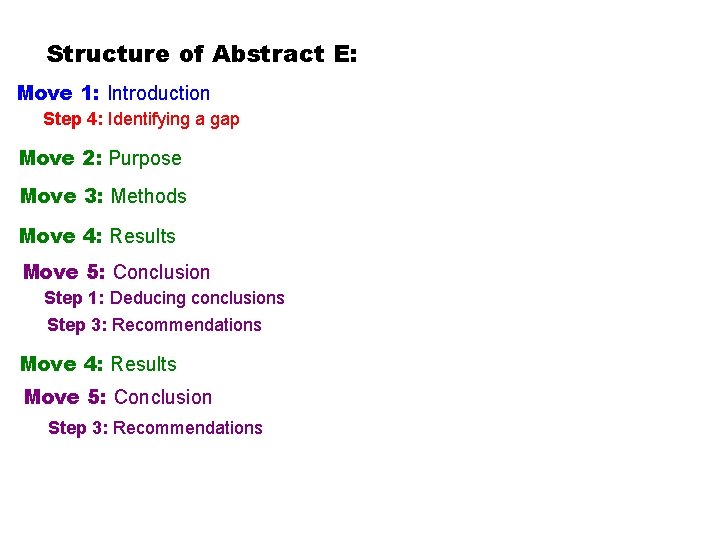
Structure of Abstract E: Move 1: Introduction Step 4: Identifying a gap Move 2: Purpose Move 3: Methods Move 4: Results Move 5: Conclusion Step 1: Deducing conclusions Step 3: Recommendations Move 4: Results Move 5: Conclusion Step 3: Recommendations
- Slides: 77