
MODULE CODE FBE 06 BUILT ENVIRONMENT ECONOMICS OVERALL
MODULE CODE FBE 06 BUILT ENVIRONMENT ECONOMICS
OVERALL OBJECTIVES To enable the students to : �Understand basic economic principles and concepts relating to the construction and built environment �Apply what is learned in class to real world situations in the economy particularly the Built Environment Sector
FBE 06: BUILT ENVIRONMENT ECONOMICS CONTENT UNIT 1 UNIT 2 UNIT 3 UNIT 4 UNIT 5 UNIT 6 UNIT 7 UNIT 8 UNIT 9 UNIT 10 CENTRAL ECONOMIC PROBLEM : SCARCITY RENTAL MARKET IN ACTION : DEMAND SUPPLY PRODUCTION COST REVENUE, PROFIT MAXIMISATION & LOSS MINIMISATION ELASTICITIES THE CONSTRUCTION SECTOR AS PART OF THE OVERALL ECONOMY INFLATION ECONOMICS OF THE ENVIRONMENT ECONOMIC SUSTAINABILITY REVISION AND EXAMINATION PREPARATION
UNIT 1 �THE CENTRAL ECONOMIC PROBLEM: �SCARCITY, CHOICE AND OPPORTUNITY COST
OBJECTIVES AND OUTCOMES �Learning Objectives �Explain that the central economic problem that all economies face is scarcity. �Link scarcity to the need to make choices and to face trade-offs. �Use the production possibilities frontier (PPF) to illustrate scarcity, choice, opportunity cost. �Explain the significance of an outward and inward shift of the PPF and discuss the factors that can cause these shifts.
UNIT 1: THE CENTRAL ECONOMIC PROBLEM: �INTRODUCTION TO ECONOMICS FOR BUILT ENVIRONMENT �MEANING OF ECONOMICS �WHY ECONOMICS PLAYS A VITAL ROLE IN OUR PROGRAMME AND OUR LIVES �OVERALL VIEW OF THE ECONOMICS COURSE �Q & A
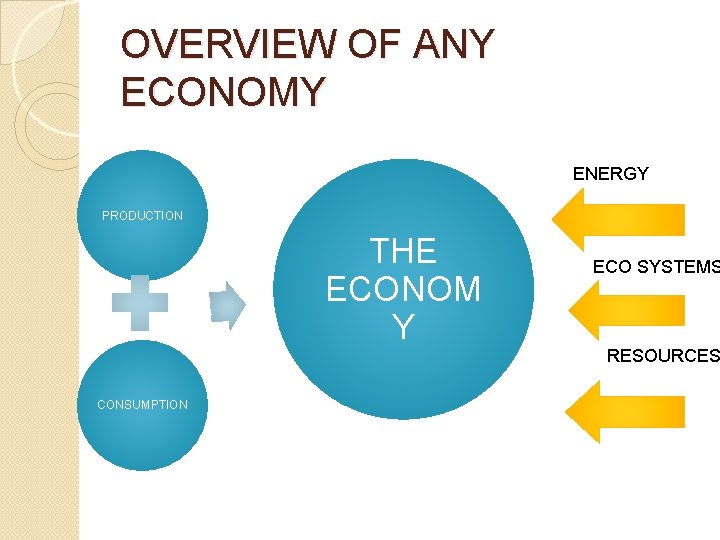
OVERVIEW OF ANY ECONOMY ENERGY PRODUCTION THE ECONOM Y CONSUMPTION ECO SYSTEMS RESOURCES
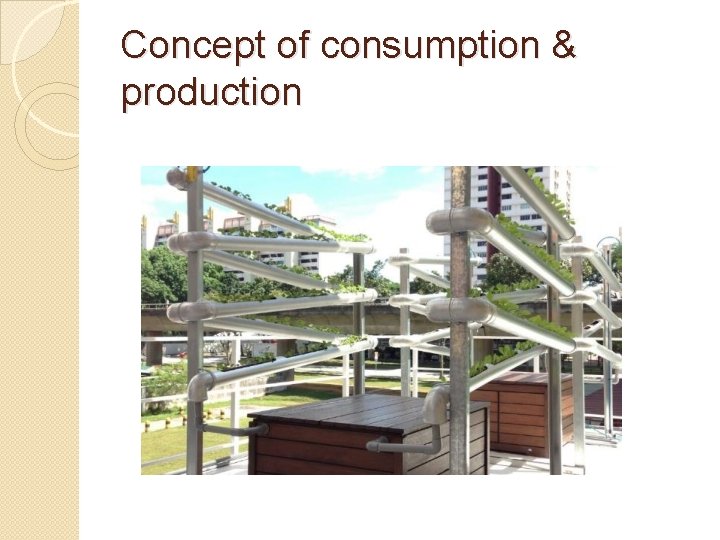
Introduction to Economics Basically all economies are concerned with production and consumption of goods and services. • Where the resources, energy and eco systems are channelled into various goods and services for the population based on demand supply • The roles played by individuals, firms/businesses and the government are such that they support one another in order to grow the economy or the community • How to allocate resources and how to ensure the distribution of such are done in a equitable way. •
Concept of consumption & production
1. 1 SCARCITY, CHOICE AND OPPORTUNITY COST DEFINITION: The study of ECONOMICS is the science of choice and how we behave based on the choices we made due to scarcity of resources and our unlimited wants. Thus, the central economic problem can be summed up in three related words: scarcity, choice and opportunity cost (or trade-off). Scarcity is the result of having unlimited wants but limited means to satisfy them. Our ability to generate new or more wants is endless.
1. 1 SCARCITY, CHOICE AND OPPORTUNITY COST Examples: If you eat the first cone of your favourite ice cream, you may feel very satisfied and happy but after continuing to the 4 th ice cream, what do you think happens to your satisfaction or utility? Also even if you have a billion dollars, it is still limited by that amount and it cannot satisfy all the wants you have in the world. Because our ability to satisfy them is limited as our resources are limited. With limited land, labour, capital and entrepreneurship we cannot produce all the things we want.
PRODUCTION POSSIBILITY FRONTIER OR PPF �We therefore have to choose. We have to decide three basic questions: �What to produce? �How to produce? �For whom to produce?
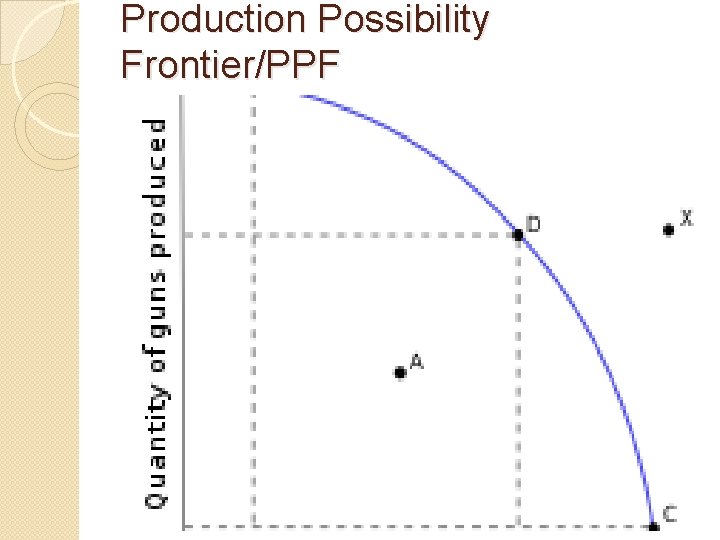
PRODUCTION POSSIBILITY FRONTIER �The PPF is a curve which illustrates the concepts of scarcity, choice and opportunity cost. It can also be used to illustrate production efficiency and unemployment.
Production Possibility Frontier/PPF
PPF �In choosing we are faced with opportunity cost (trade-off): More X means less Y. �These three terms can be graphically illustrated using the production possibilities frontier.
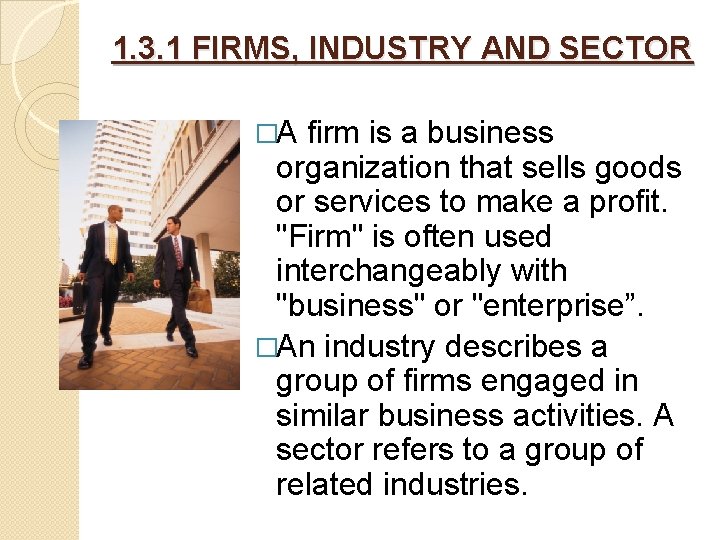
1. 3. 1 FIRMS, INDUSTRY AND SECTOR �A firm is a business organization that sells goods or services to make a profit. "Firm" is often used interchangeably with "business" or "enterprise”. �An industry describes a group of firms engaged in similar business activities. A sector refers to a group of related industries.
1. 3. 1. 1 Classification of Firms �We can study firms under two major areas: the types of business organisations they operate in and the degree of competition they face (their market structure).
1. 4 MARKET STRUCTURE �The study of market structure classifies firms according to the degree of competition they face. �The degree of competition indicates their market control or control over price which can range from 0% to 100%. �Traditionally, there are four main types of market structure: perfect competition, monopolistic competition, oligopoly and monopoly.
Firms can be run by �One sole trader or proprietor �Two or more partners –partnership �Limited Companies by individual owners &/or �Public corporation with shareholders
Markets are mainly about competition: Four main types of market structure: perfect competition, monopolistic competition, oligopoly and monopoly.
Assignment and Review 1. In which market structures are the following firms: Sing. Tel, Sing. Post, OCBC Bank, Ah Huat Provision shop, Hup. Steel Ltd and the firm you are working in. Justify your classification. 2. Some market structures are more likely to be tightly regulated by the government than others. Do you agree? Explain.
- Slides: 21