
Module C Diffusion MODULE C DIFFUSION OF GASES

- Slides: 39
Module C: Diffusion
MODULE C – DIFFUSION OF GASES l Dalton’s Law Partial Pressure of Gas n. Atmospheric pressure n. Fractional Concentration n. Water Vapor Pressure n l Alveolar-Capillary (A-C) structure l Alveolar Gas Equation l Gas Diffusion across A-C membrane Fick’s Law n. Henry’s Law n. Graham’s Law n l Perfusion-Limit and Diffusion-Limit to gas transfer l Diffusing Capacity of the Lung (DLCO)
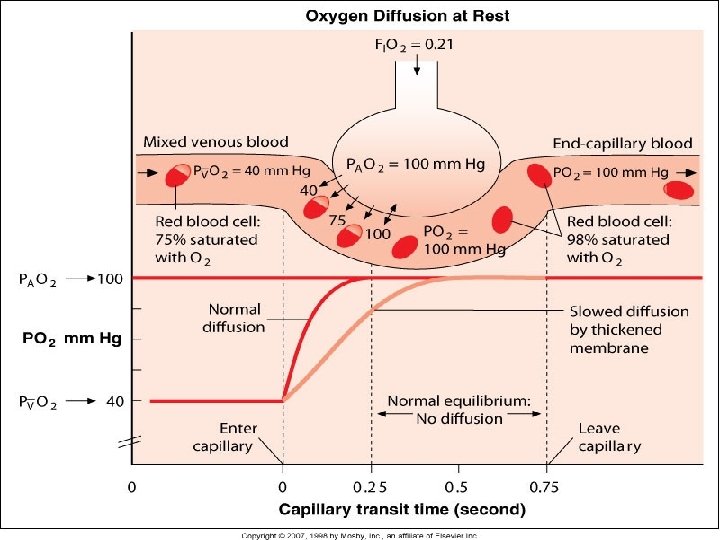
Objectives Diagram the alveolar-capillary membrane showing partial pressures of PO 2, PCO 2, & PH 2 O at the following locations: n n Atmosphere Alveoli Venous blood Arterial blood Given a barometric pressure, FIO 2, Pa. CO 2, calculate the PAO 2 (Alveolar-Air Equation). Diagram the pathway of gas diffusion across the alveolar capillary membrane. Describe the pressure gradients for O 2 and CO 2, responsible for gas diffusion, across the A-C membrane. Describe the total transit time for gas diffusion across the lung and the amount of time needed for diffusion in a normal individual. State how exercise affects the total transit time.
Objectives State Fick’s Law of diffusion and describe how the diffusion constant is calculated. n n Explain Henry’s law. Explain Graham’s Law. Compare and contrast the rate of diffusion across the A-C membrane between CO 2 and O 2. Describe the clinical applications of Fick’s Law. State the test used to determine the DLCO and state the normal value. Describe how the DLCO is affected with obstructive lung diseases and other clinical conditions that decrease the rate of diffusion in the lung.
Readings Beachey: Chapter 4 (pp. 80 -81) & 7 Egan: Chapter 5 (pp. 101 -102) & 10 (230234)
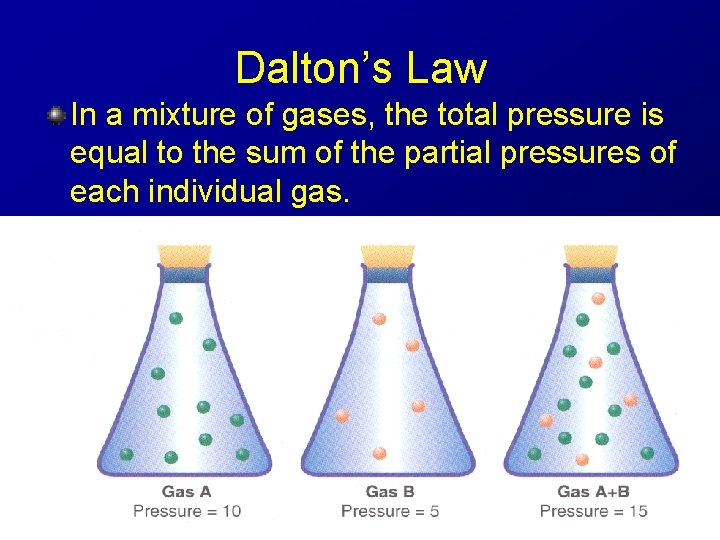
Dalton’s Law In a mixture of gases, the total pressure is equal to the sum of the partial pressures of each individual gas.
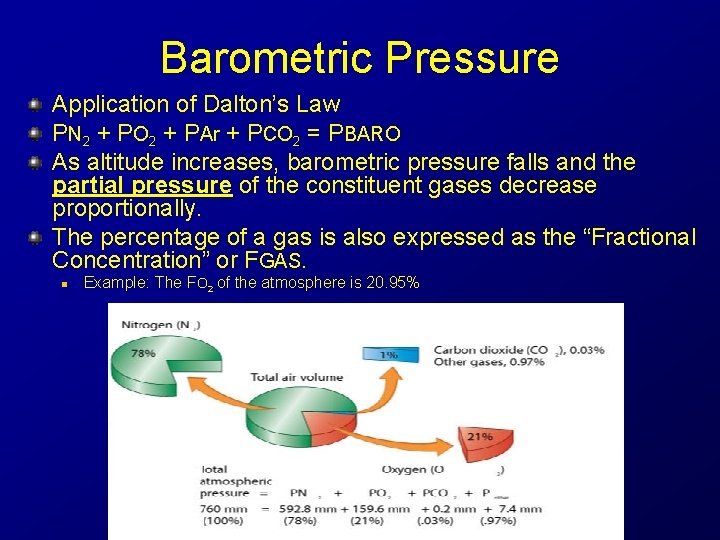
Partial Pressure Def: The pressure exerted by an individual gas in a mixture of gases. n n Designated by PGAS To determine the partial pressure of any gas, multiply the percentage of that gas by the total pressure. Example: Oxygen occupies 21% of the atmosphere. If the total pressure of the atmosphere (i. e. Barometric Pressure) is 760 mm. Hg, the PO 2 of the atmosphere is 159. 6 mm. Hg (760 x. 21).
Barometric Pressure Application of Dalton’s Law PN 2 + PO 2 + PAr + PCO 2 = PBARO As altitude increases, barometric pressure falls and the partial pressure of the constituent gases decrease proportionally. The percentage of a gas is also expressed as the “Fractional Concentration” or FGAS. n Example: The FO 2 of the atmosphere is 20. 95%
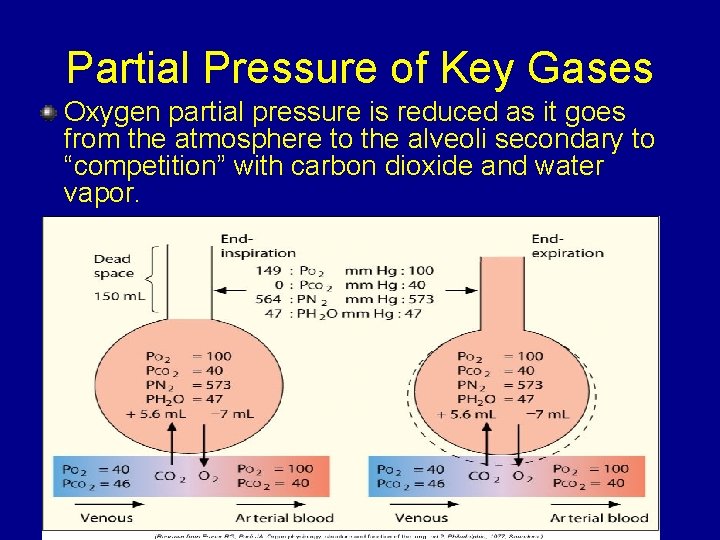
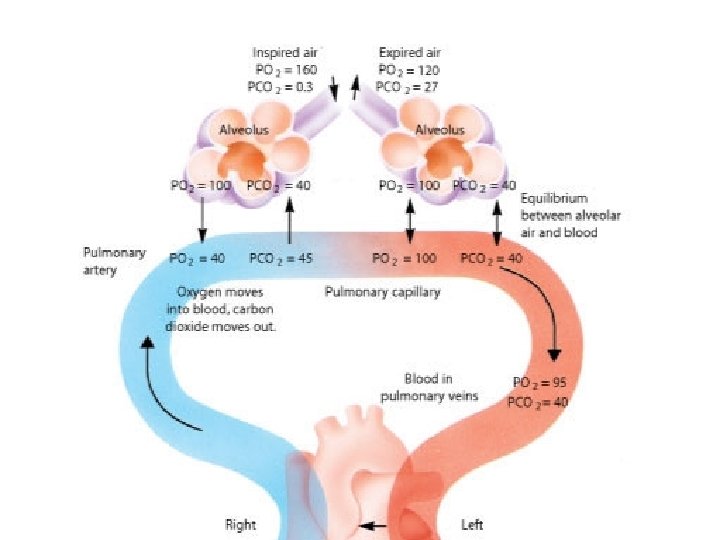
Partial Pressure of Key Gases Oxygen partial pressure is reduced as it goes from the atmosphere to the alveoli secondary to “competition” with carbon dioxide and water vapor.
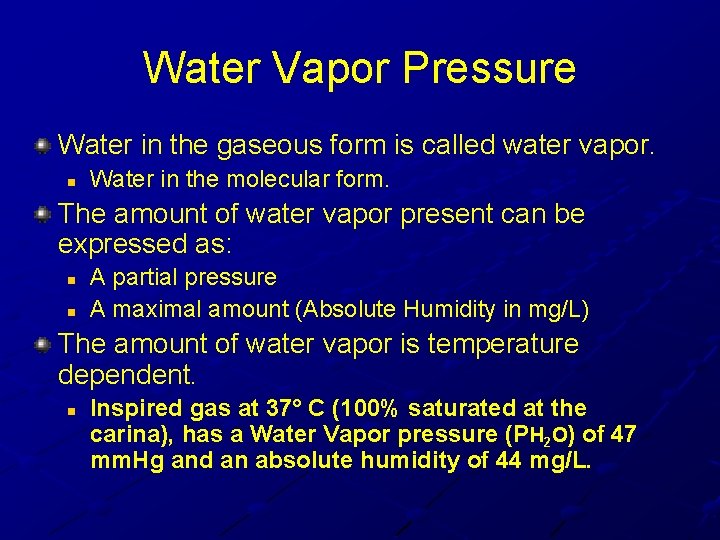
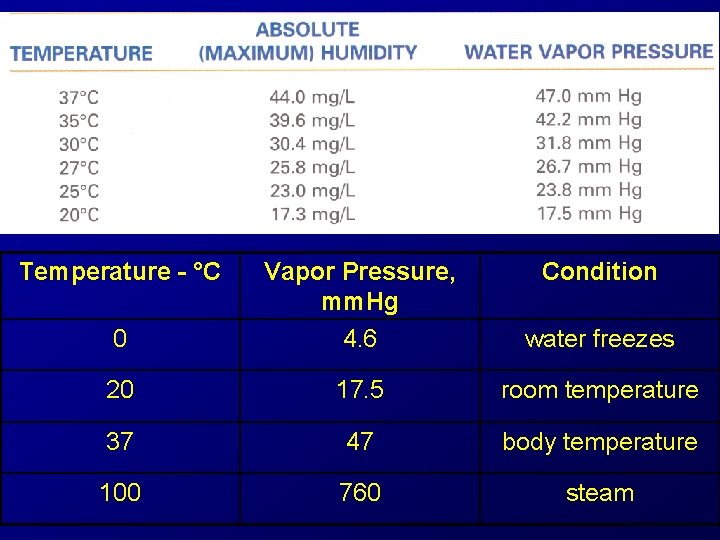
Water Vapor Pressure Water in the gaseous form is called water vapor. n Water in the molecular form. The amount of water vapor present can be expressed as: n n A partial pressure A maximal amount (Absolute Humidity in mg/L) The amount of water vapor is temperature dependent. n Inspired gas at 37° C (100% saturated at the carina), has a Water Vapor pressure (PH 2 O) of 47 mm. Hg and an absolute humidity of 44 mg/L.
Temperature - °C 0 Vapor Pressure, mm. Hg 4. 6 Condition water freezes 20 17. 5 room temperature 37 47 body temperature 100 760 steam
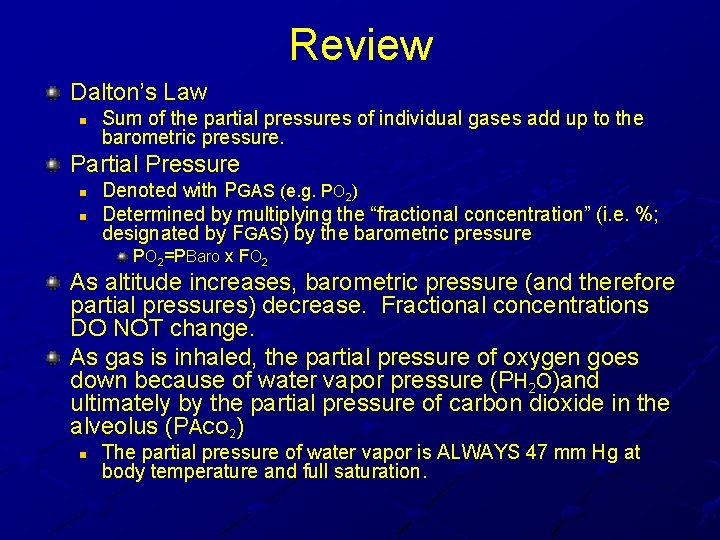
Review Dalton’s Law n Sum of the partial pressures of individual gases add up to the barometric pressure. Partial Pressure n n Denoted with PGAS (e. g. PO 2) Determined by multiplying the “fractional concentration” (i. e. %; designated by FGAS) by the barometric pressure PO 2=PBaro x FO 2 As altitude increases, barometric pressure (and therefore partial pressures) decrease. Fractional concentrations DO NOT change. As gas is inhaled, the partial pressure of oxygen goes down because of water vapor pressure (PH 2 O)and ultimately by the partial pressure of carbon dioxide in the alveolus (PACO 2) n The partial pressure of water vapor is ALWAYS 47 mm Hg at body temperature and full saturation.
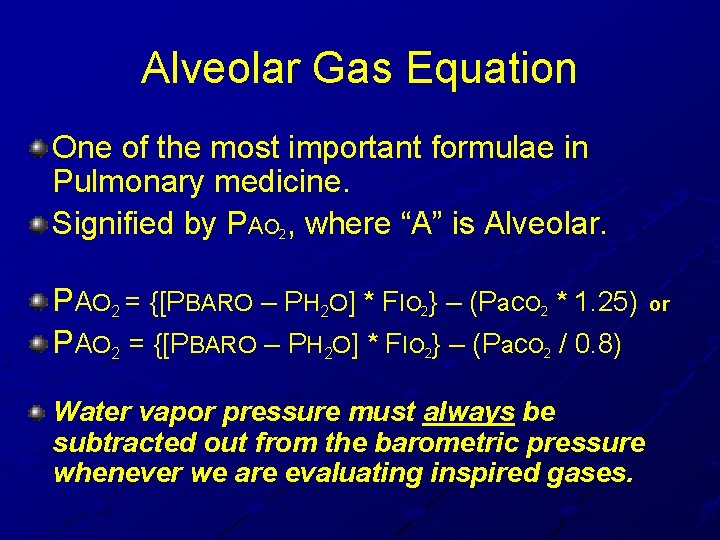
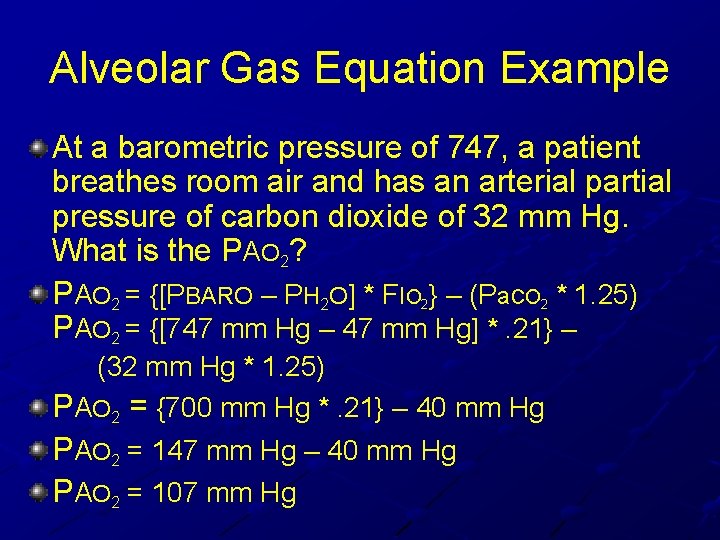
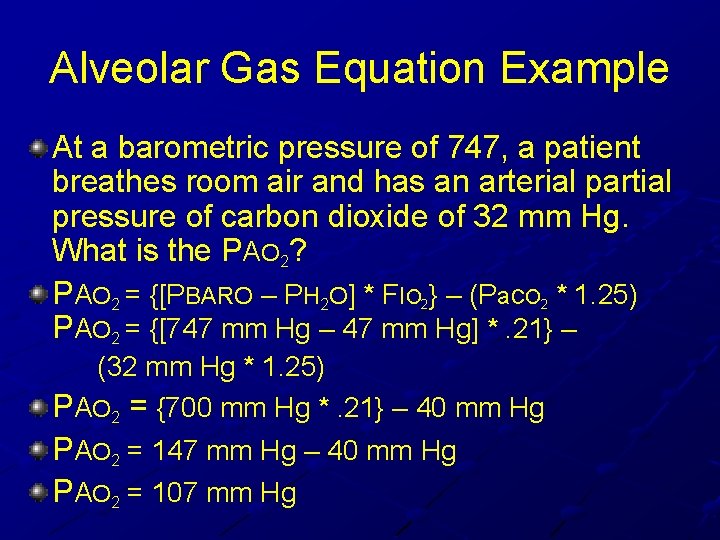
Alveolar Gas Equation One of the most important formulae in Pulmonary medicine. Signified by PAO 2, where “A” is Alveolar. PAO 2 = {[PBARO – PH 2 O] * FIO 2} – (Pa. CO 2 * 1. 25) PAO 2 = {[PBARO – PH 2 O] * FIO 2} – (Pa. CO 2 / 0. 8) Water vapor pressure must always be subtracted out from the barometric pressure whenever we are evaluating inspired gases. or
Alveolar Gas Equation Example At a barometric pressure of 747, a patient breathes room air and has an arterial partial pressure of carbon dioxide of 32 mm Hg. What is the PAO 2? PAO 2 = {[PBARO – PH 2 O] * FIO 2} – (Pa. CO 2 * 1. 25) PAO 2 = {[747 mm Hg – 47 mm Hg] *. 21} – (32 mm Hg * 1. 25) PAO 2 = {700 mm Hg *. 21} – 40 mm Hg PAO 2 = 147 mm Hg – 40 mm Hg PAO 2 = 107 mm Hg
Diffusion – Part II
Alveolar Gas Equation Example At a barometric pressure of 747, a patient breathes room air and has an arterial partial pressure of carbon dioxide of 32 mm Hg. What is the PAO 2? PAO 2 = {[PBARO – PH 2 O] * FIO 2} – (Pa. CO 2 * 1. 25) PAO 2 = {[747 mm Hg – 47 mm Hg] *. 21} – (32 mm Hg * 1. 25) PAO 2 = {700 mm Hg *. 21} – 40 mm Hg PAO 2 = 147 mm Hg – 40 mm Hg PAO 2 = 107 mm Hg
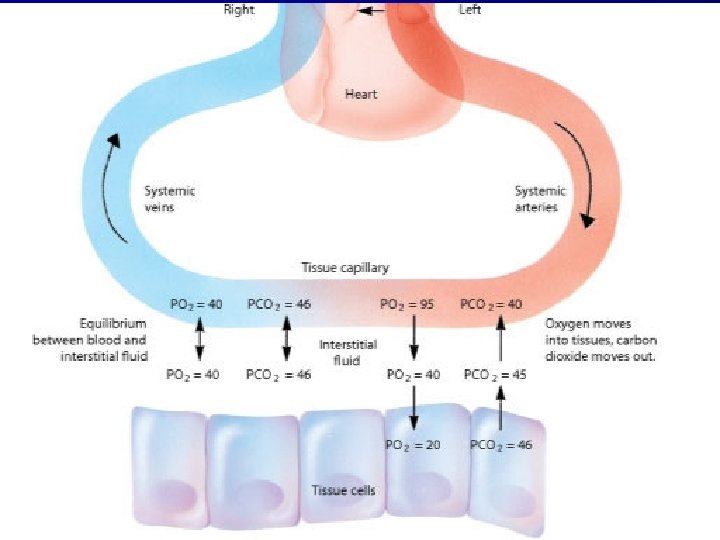
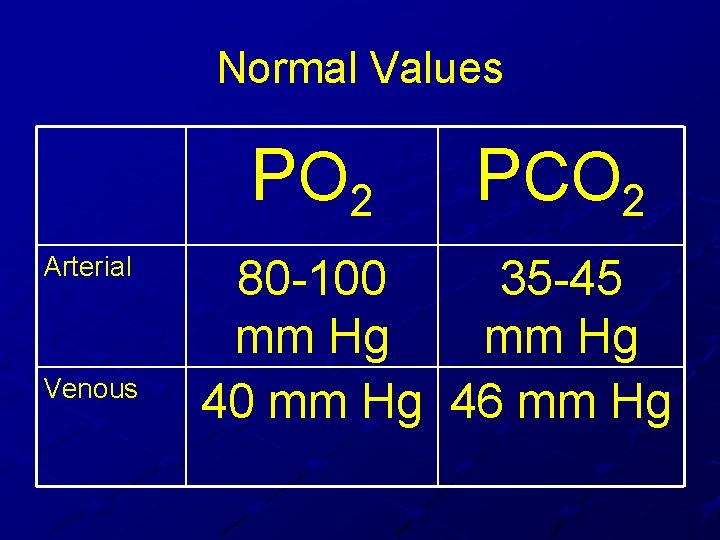
Normal Values P O 2 Arterial Venous PCO 2 80 -100 35 -45 mm Hg 40 mm Hg 46 mm Hg
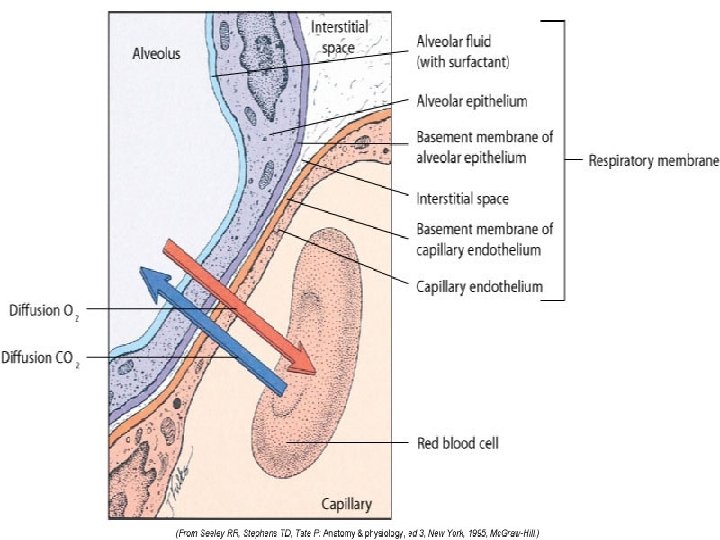
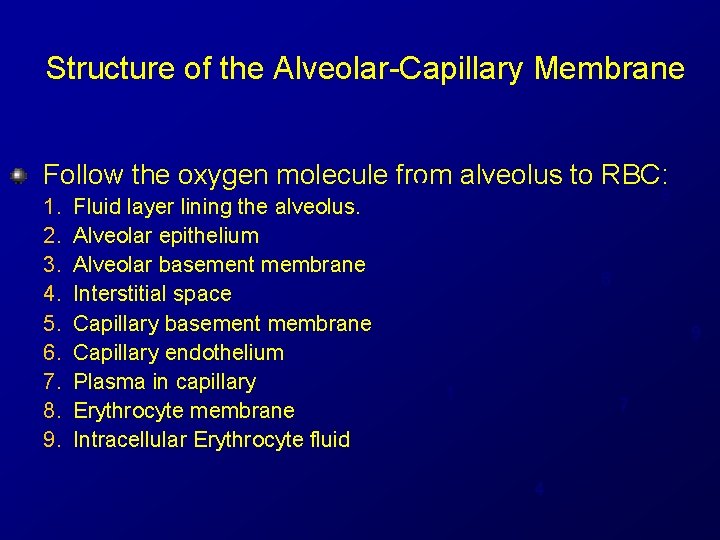
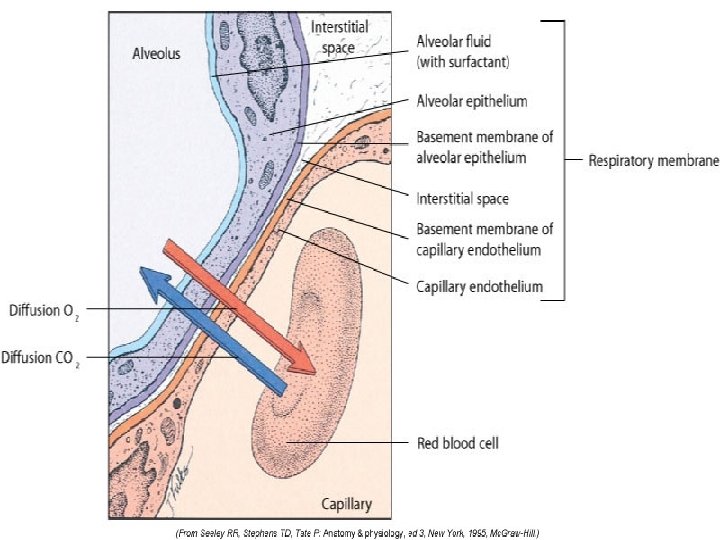
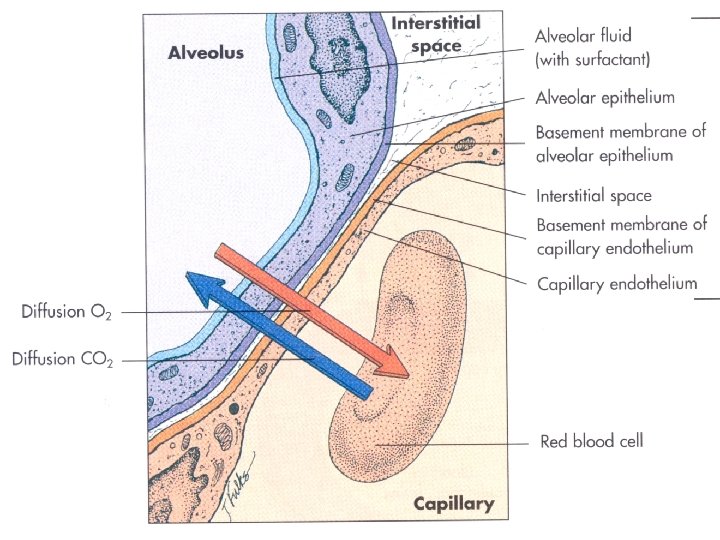
Structure of the Alveolar-Capillary Membrane 5 Follow the oxygen molecule from alveolus to RBC: 2 1. 2. 3. 4. 5. 6. 7. 8. 9. Fluid layer lining the alveolus. Alveolar epithelium Alveolar basement membrane 3 Interstitial space Capillary basement membrane Capillary endothelium Plasma in capillary Erythrocyte membrane Intracellular Erythrocyte fluid 6 8 9 1 7 4
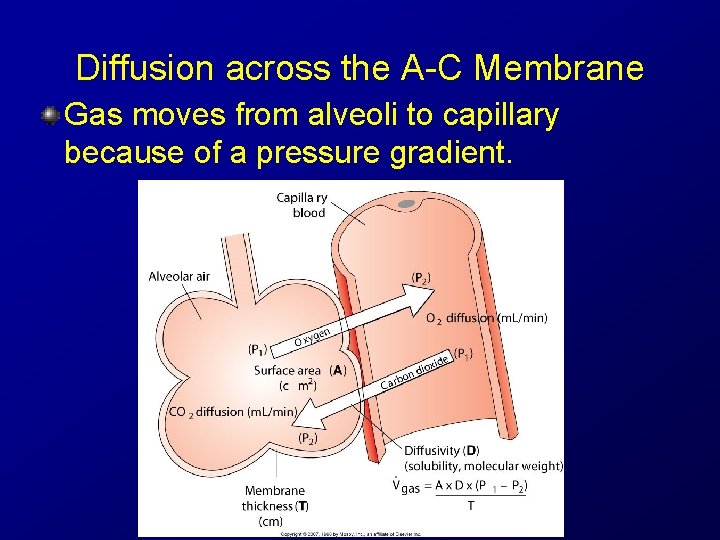
Diffusion across the A-C Membrane Gas moves from alveoli to capillary because of a pressure gradient.
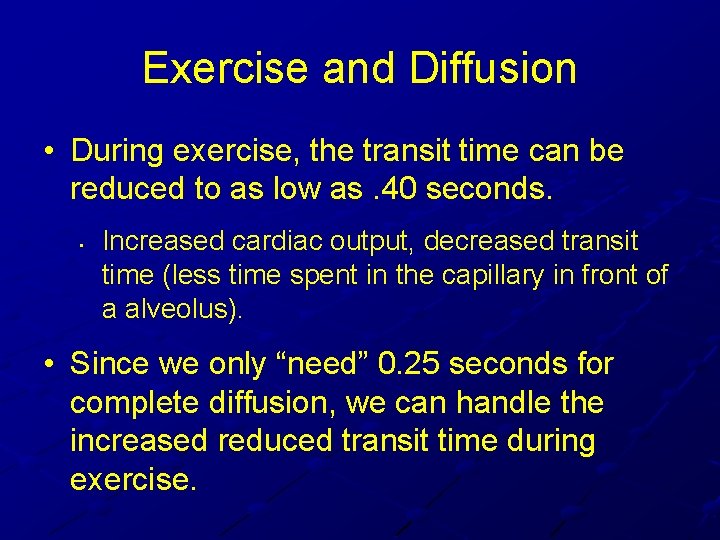
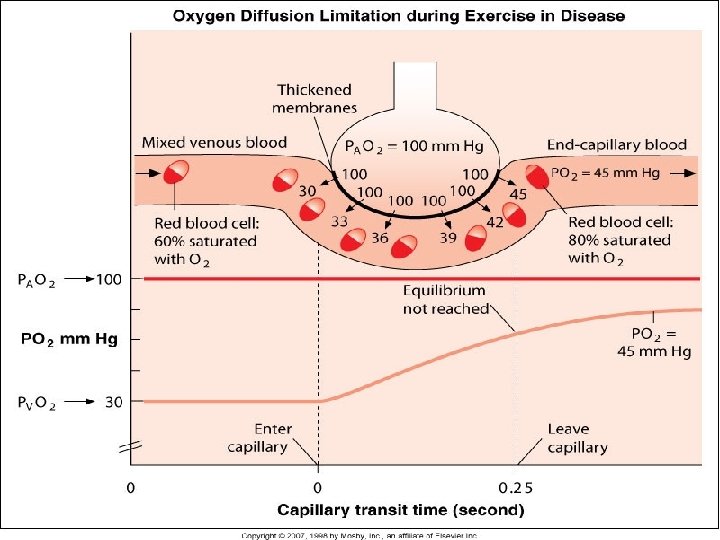
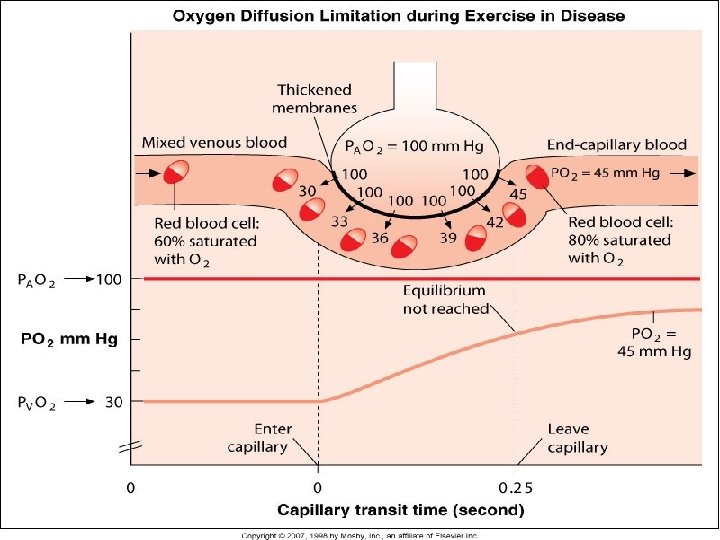
Exercise and Diffusion • During exercise, the transit time can be reduced to as low as. 40 seconds. • Increased cardiac output, decreased transit time (less time spent in the capillary in front of a alveolus). • Since we only “need” 0. 25 seconds for complete diffusion, we can handle the increased reduced transit time during exercise.
Demonstration
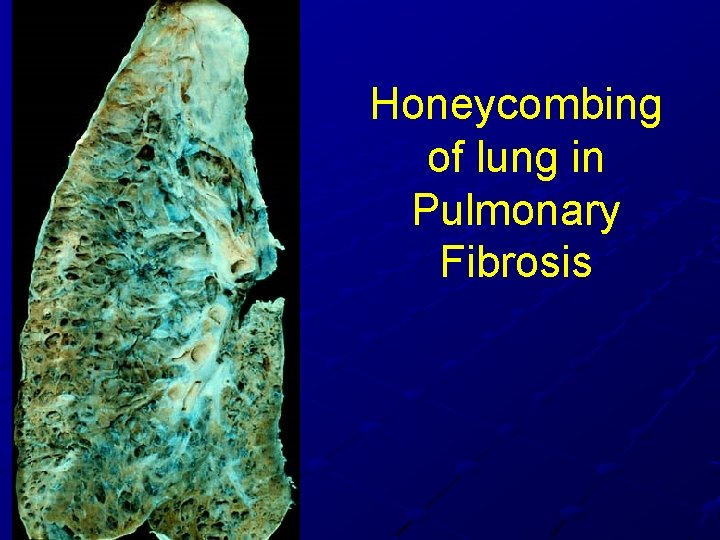
Honeycombing of lung in Pulmonary Fibrosis
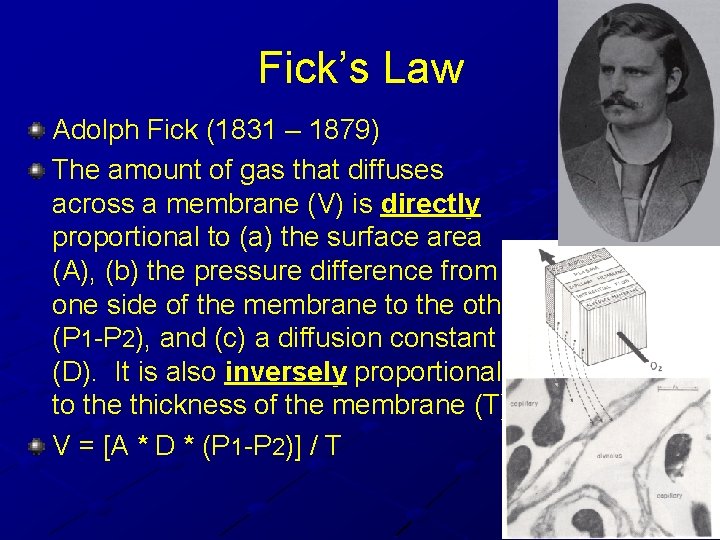
Fick’s Law Adolph Fick (1831 – 1879) The amount of gas that diffuses across a membrane (V) is directly proportional to (a) the surface area (A), (b) the pressure difference from one side of the membrane to the other (P 1 -P 2), and (c) a diffusion constant (D). It is also inversely proportional to the thickness of the membrane (T). V = [A * D * (P 1 -P 2)] / T
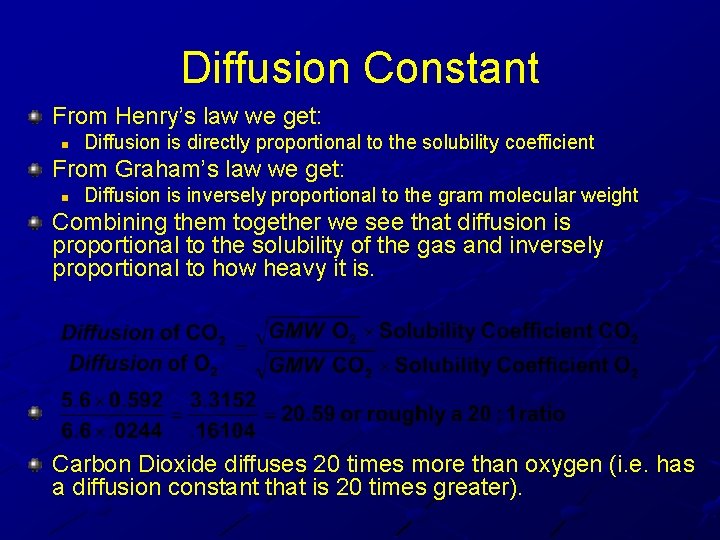
Diffusion Constant (D) As the gas crosses from a gaseous environment (the alveolus) to a liquid one (everything after that), it has to first dissolve into the liquid and then move through the liquid to the hemoglobin in the RBC. The Diffusion Constant (D) in Fick’s law describes both of these and is determined by two other laws: n n Henry’s Law – How much can be dissolved. Graham’s Law – The rate gas can move through a liquid.
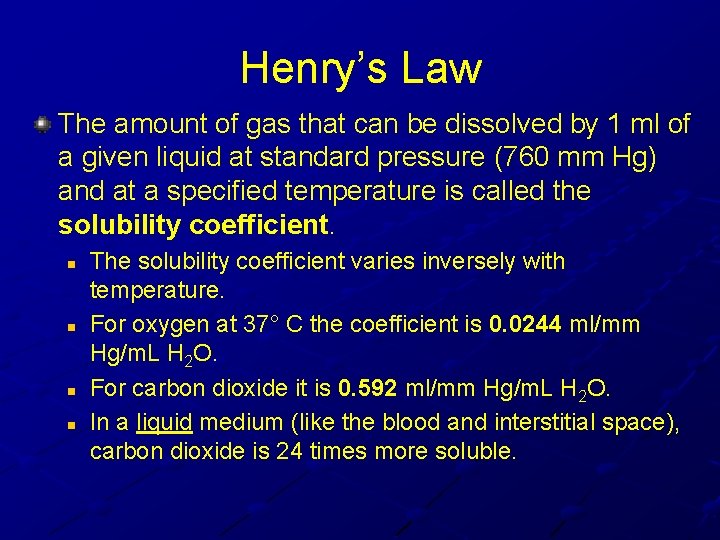
Henry’s Law A chemical law stating that the amount of a gas that dissolves in a liquid is proportional to the partial pressure of the gas over the liquid, provided no chemical reaction takes place between the liquid and the gas. It is named after William Henry (1774– 1836), the English chemist who first reported the relationship.
Henry’s Law The amount of gas that can be dissolved by 1 ml of a given liquid at standard pressure (760 mm Hg) and at a specified temperature is called the solubility coefficient. n n The solubility coefficient varies inversely with temperature. For oxygen at 37° C the coefficient is 0. 0244 ml/mm Hg/m. L H 2 O. For carbon dioxide it is 0. 592 ml/mm Hg/m. L H 2 O. In a liquid medium (like the blood and interstitial space), carbon dioxide is 24 times more soluble.
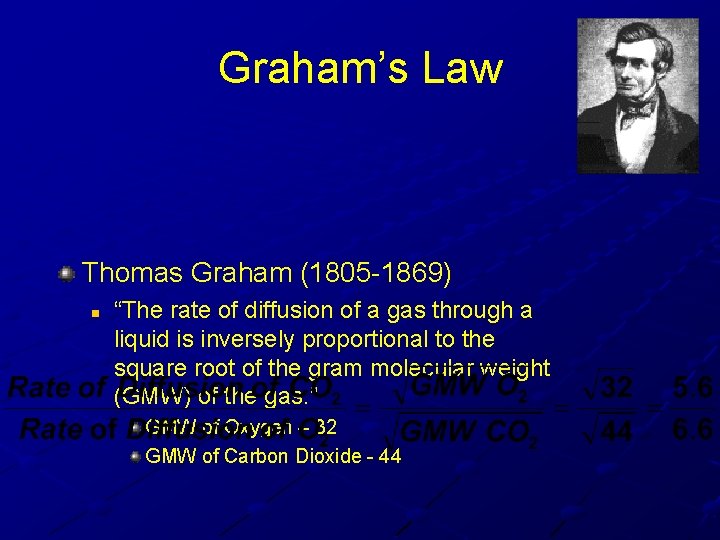
Graham’s Law Thomas Graham (1805 -1869) n “The rate of diffusion of a gas through a liquid is inversely proportional to the square root of the gram molecular weight (GMW) of the gas. ” GMW of Oxygen – 32 GMW of Carbon Dioxide - 44
Diffusion Constant From Henry’s law we get: n Diffusion is directly proportional to the solubility coefficient From Graham’s law we get: n Diffusion is inversely proportional to the gram molecular weight Combining them together we see that diffusion is proportional to the solubility of the gas and inversely proportional to how heavy it is. Carbon Dioxide diffuses 20 times more than oxygen (i. e. has a diffusion constant that is 20 times greater).
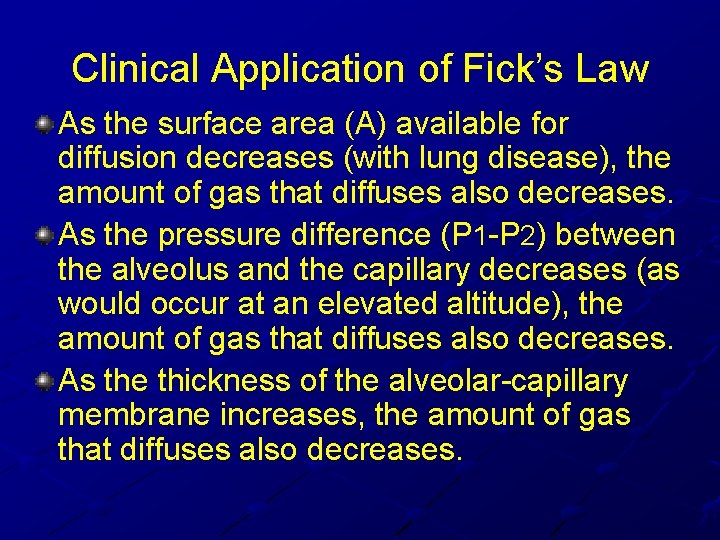
Clinical Application of Fick’s Law As the surface area (A) available for diffusion decreases (with lung disease), the amount of gas that diffuses also decreases. As the pressure difference (P 1 -P 2) between the alveolus and the capillary decreases (as would occur at an elevated altitude), the amount of gas that diffuses also decreases. As the thickness of the alveolar-capillary membrane increases, the amount of gas that diffuses also decreases.
Perfusion & Diffusion Limiting When the amount of oxygen that is diffused across the A-C membrane is restricted by the amount of blood flow present (only so much blood can be oxygenated) we say this is a perfusion limitation. n This is what occurs in normal individuals. When the amount of diffused is limited by the thickness of the A-C membrane or the loss of alveolar surface area (as occurs in lung disease) we say this is a diffusion limitation.
Diffusing Capacity of the Lung The DLCO measures the amount of carbon monoxide (CO) that moves across the alveolar-capillary membrane. n Carbon monoxide is an ideal tracer gas. Normal DLCO for healthy adults is 25 (20 -30) ml/min/mm. Hg Measurement affected by body size, age, lung volume, exercise, body position, and hemoglobin concentration. Decreased if: n Lung surface area is reduced Emphysema n Alveolar-capillary distance is increased Pulmonary Fibrosis Congestive Heart Failure