
Module assembly Status in Japan Together with Univ
Module assembly Status in Japan (Together with Univ. Geneva) Y. Unno, Y. Ikegami, S. Terada, S. Mitsui, R. Hori (KEK) KEK status, 2012/5/16, Y. Unno 1
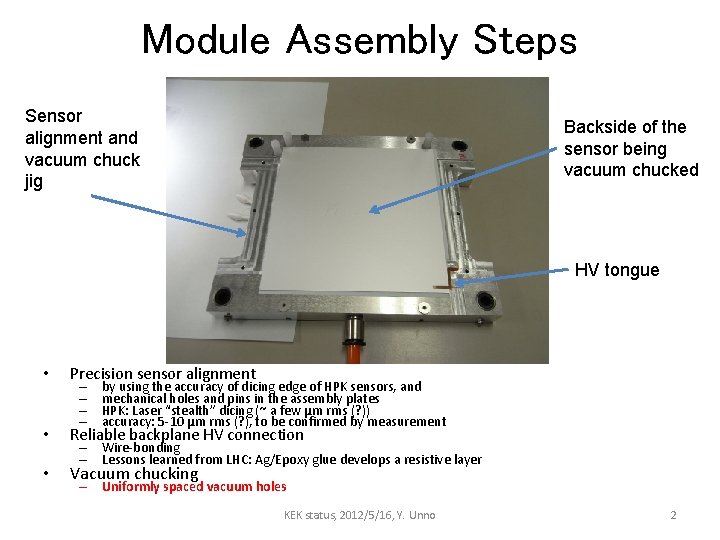
Module Assembly Steps Sensor alignment and vacuum chuck jig Backside of the sensor being vacuum chucked HV tongue • Precision sensor alignment • Reliable backplane HV connection • Vacuum chucking – – by using the accuracy of dicing edge of HPK sensors, and mechanical holes and pins in the assembly plates HPK: Laser “stealth” dicing (~ a few µm rms (? )) accuracy: 5 -10 µm rms (? ), to be confirmed by measurement – Wire-bonding – Lessons learned from LHC: Ag/Epoxy glue develops a resistive layer – Uniformly spaced vacuum holes KEK status, 2012/5/16, Y. Unno 2
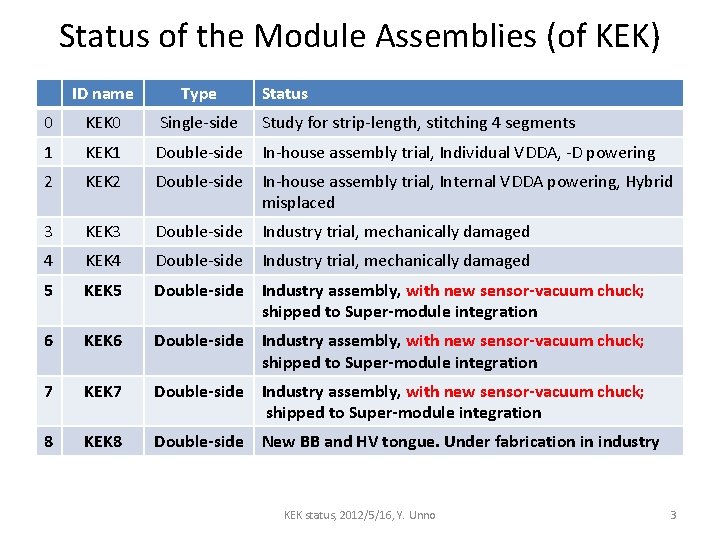
Status of the Module Assemblies (of KEK) ID name Type Status 0 KEK 0 Single-side Study for strip-length, stitching 4 segments 1 KEK 1 Double-side In-house assembly trial, Individual VDDA, -D powering 2 KEK 2 Double-side In-house assembly trial, Internal VDDA powering, Hybrid misplaced 3 KEK 3 Double-side Industry trial, mechanically damaged 4 KEK 4 Double-side Industry trial, mechanically damaged 5 KEK 5 Double-side Industry assembly, with new sensor-vacuum chuck; shipped to Super-module integration 6 KEK 6 Double-side Industry assembly, with new sensor-vacuum chuck; shipped to Super-module integration 7 KEK 7 Double-side Industry assembly, with new sensor-vacuum chuck; shipped to Super-module integration 8 KEK 8 Double-side New BB and HV tongue. Under fabrication in industry KEK status, 2012/5/16, Y. Unno 3
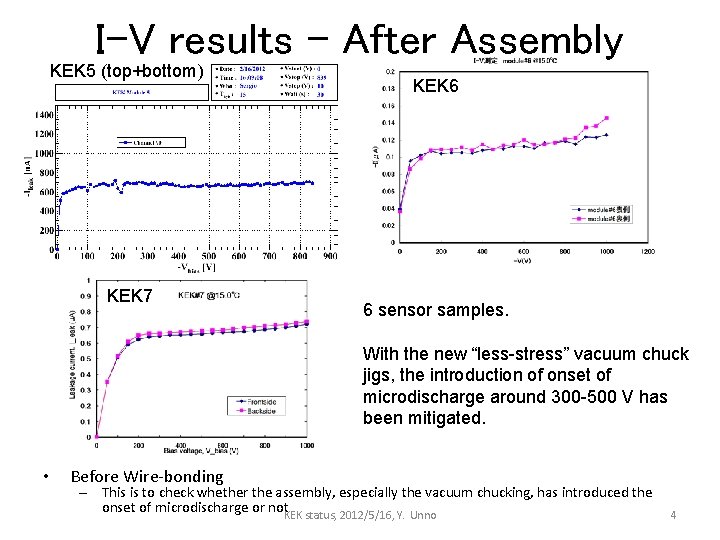
I-V results – After Assembly KEK 5 (top+bottom) KEK 7 KEK 6 6 sensor samples. With the new “less-stress” vacuum chuck jigs, the introduction of onset of microdischarge around 300 -500 V has been mitigated. • Before Wire-bonding – This is to check whether the assembly, especially the vacuum chucking, has introduced the onset of microdischarge or not. KEK status, 2012/5/16, Y. Unno 4

Super-Module Testing • 7 double-sided modules are in the supermodule frame at CERN – The slot #7 is open for the last module (KEK 8) which is under fabrication. • The supermodule is being used to study the (electrical) performance in detail. KEK status, 2012/5/16, Y. Unno 5
Backup slides KEK status, 2012/5/16, Y. Unno 6
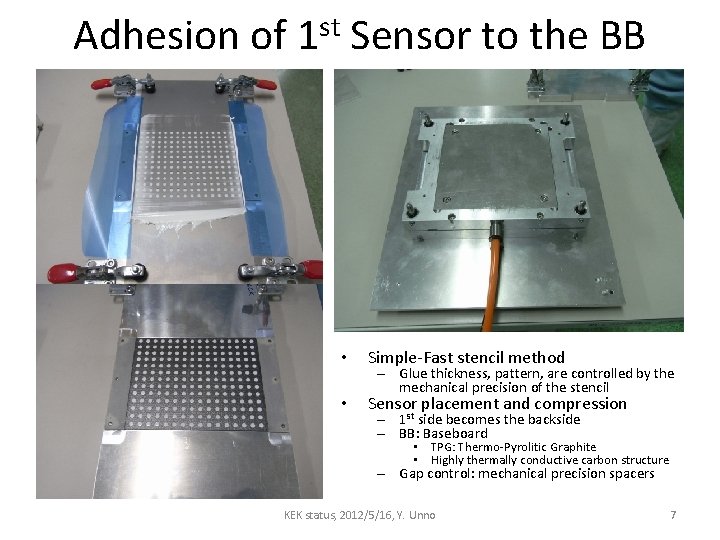
Adhesion of 1 st Sensor to the BB • Simple-Fast stencil method • Sensor placement and compression – Glue thickness, pattern, are controlled by the mechanical precision of the stencil – 1 st side becomes the backside – BB: Baseboard • TPG: Thermo-Pyrolitic Graphite • Highly thermally conductive carbon structure – Gap control: mechanical precision spacers KEK status, 2012/5/16, Y. Unno 7
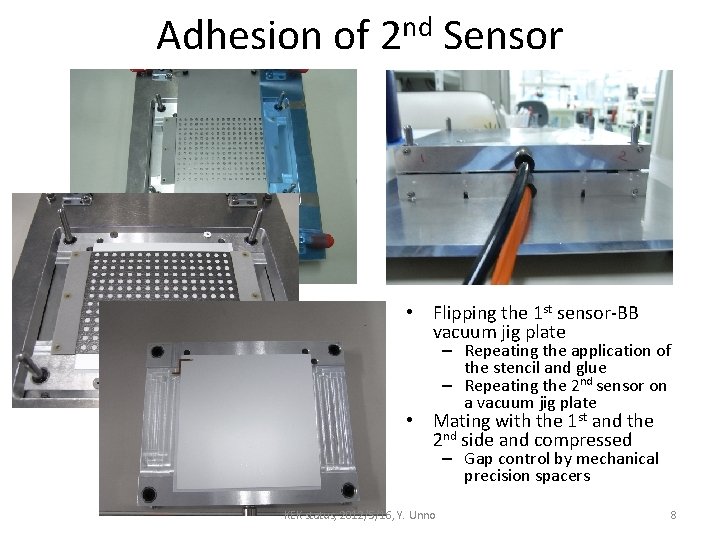
Adhesion of 2 nd Sensor • Flipping the 1 st sensor-BB vacuum jig plate – Repeating the application of the stencil and glue – Repeating the 2 nd sensor on a vacuum jig plate • Mating with the 1 st and the 2 nd side and compressed – Gap control by mechanical precision spacers KEK status, 2012/5/16, Y. Unno 8
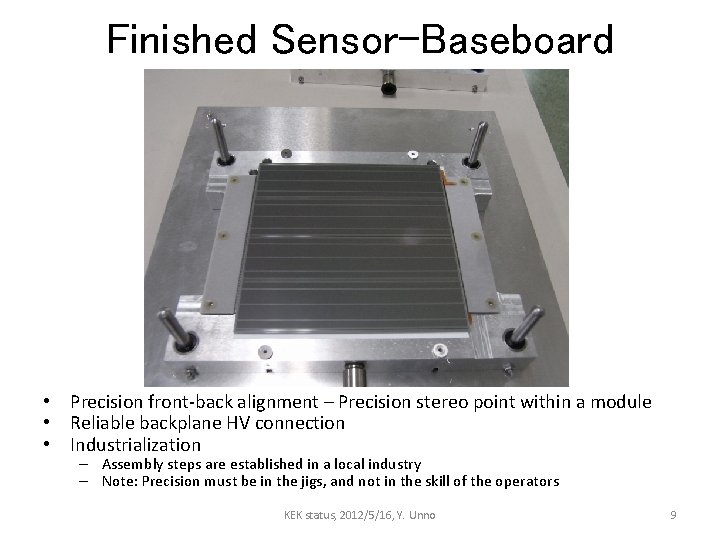
Finished Sensor-Baseboard • Precision front-back alignment – Precision stereo point within a module • Reliable backplane HV connection • Industrialization – Assembly steps are established in a local industry – Note: Precision must be in the jigs, and not in the skill of the operators KEK status, 2012/5/16, Y. Unno 9
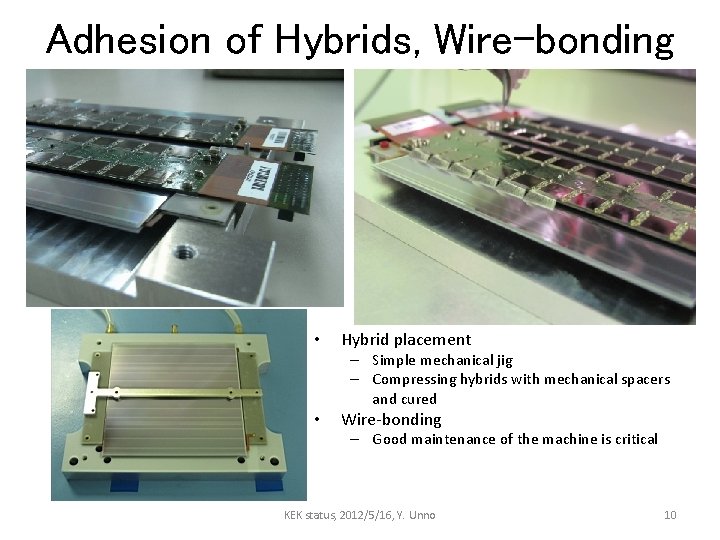
Adhesion of Hybrids, Wire-bonding • Hybrid placement – Simple mechanical jig – Compressing hybrids with mechanical spacers and cured • Wire-bonding – Good maintenance of the machine is critical KEK status, 2012/5/16, Y. Unno 10
- Slides: 10