
Module 9 Number Theory Module 9 Basic Number
Module #9 – Number Theory Module #9: Basic Number Theory 9/18/2020 1
Module #9 – Number Theory 3. 1 The Integers and Division • Of course you already know what the integers are, and what division is… • But: There are some specific notations, terminology, and theorems associated with these concepts which you may not know. • These form the basics of number theory. – Vital in many important algorithms today (hash functions, cryptography, digital signatures). 9/18/2020 2

Module #9 – Number Theory Divides, Factor, Multiple • Let a, b Z with a 0. • a|b “a divides b” : “ c Z: b=ac” “There is an integer c such that c times a equals b. ” – Example: 3 12 True, but 3 7 False. • Iff a divides b, then we say a is a factor or a divisor of b, and b is a multiple of a. • “b is even” : ≡ 2|b. Is 0 even? Is − 4? 9/18/2020 3
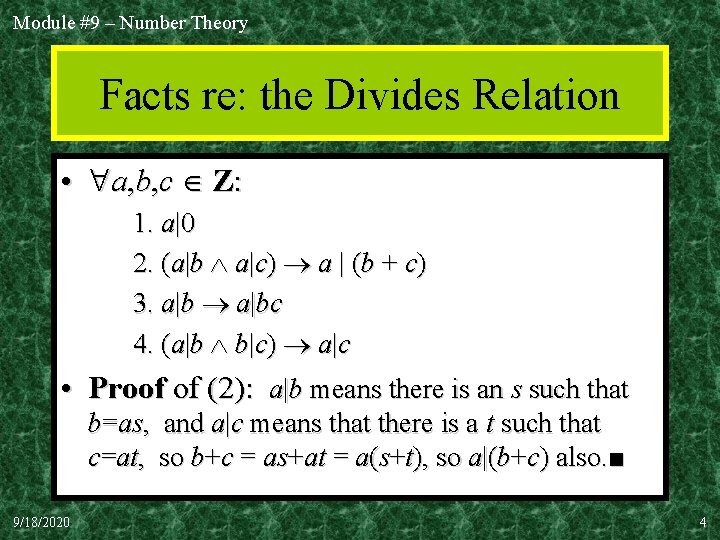
Module #9 – Number Theory Facts re: the Divides Relation • a, b, c Z: 1. a|0 2. (a|b a|c) a | (b + c) 3. a|bc 4. (a|b b|c) a|c • Proof of (2): a|b means there is an s such that b=as, and a|c means that there is a t such that c=at, so b+c = as+at = a(s+t), so a|(b+c) also. ■ 9/18/2020 4
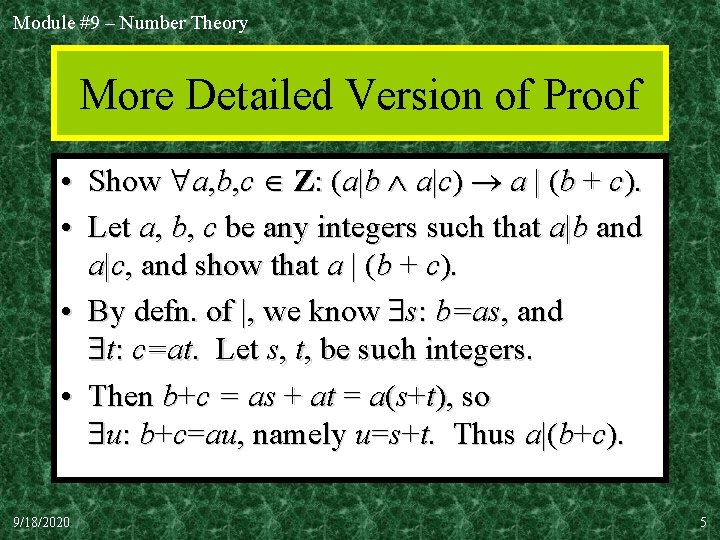
Module #9 – Number Theory More Detailed Version of Proof • Show a, b, c Z: (a|b a|c) a | (b + c). • Let a, b, c be any integers such that a|b and a|c, and show that a | (b + c). • By defn. of |, we know s: b=as, and t: c=at. Let s, t, be such integers. • Then b+c = as + at = a(s+t), so u: b+c=au, namely u=s+t. Thus a|(b+c). 9/18/2020 5
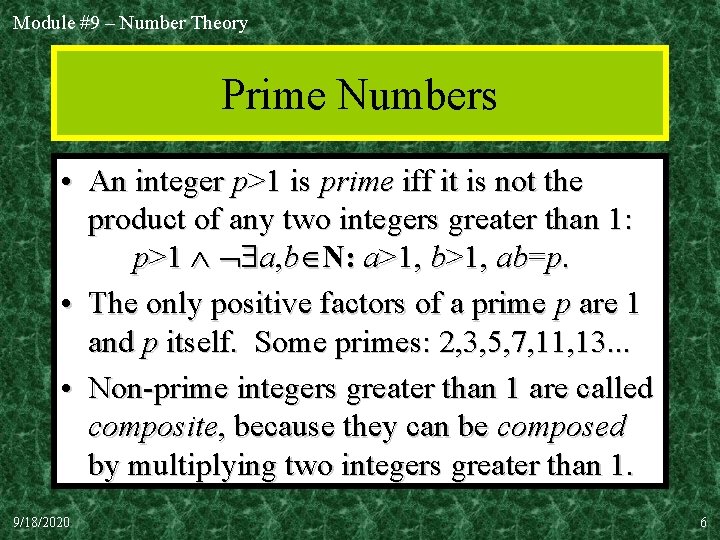
Module #9 – Number Theory Prime Numbers • An integer p>1 is prime iff it is not the product of any two integers greater than 1: p>1 a, b N: a>1, b>1, ab=p. • The only positive factors of a prime p are 1 and p itself. Some primes: 2, 3, 5, 7, 11, 13. . . • Non-prime integers greater than 1 are called composite, because they can be composed by multiplying two integers greater than 1. 9/18/2020 6

Module #9 – Number Theory Review • a|b “a divides b” c Z: b=ac • “p is prime” p>1 a N: (1 < a < p a|p) • Terms factor, divisor, multiple, composite. 9/18/2020 7

Module #9 – Number Theory Fundamental Theorem of Arithmetic • Every positive integer has a unique representation as the product of a nondecreasing series of zero or more primes. – 1 = (product of empty series) = 1 – 2 = 2 (product of series with one element 2) – 4 = 2· 2 (product of series 2, 2) – 2000 = 2· 2· 5· 5· 5; 2001 = 3· 29; 2002 = 2· 7· 11· 13; 2003 = 2003 9/18/2020 8

Module #9 – Number Theory Theorem: • Every positive integer greater than one can be uniquely written by one or more prime numbers. • If n is composite integer, then n has prime divisor less than or equal to • There are infinitely number of primes 9/18/2020 9

Module #9 – Number Theory • To find the prime factor of an integer n: 1 - find 2 - list all primes <= 2, 3, 5, 7, …root of n 3 - find all prime factors that divides n. 9/18/2020 10

Module #9 – Number Theory 9/18/2020 11
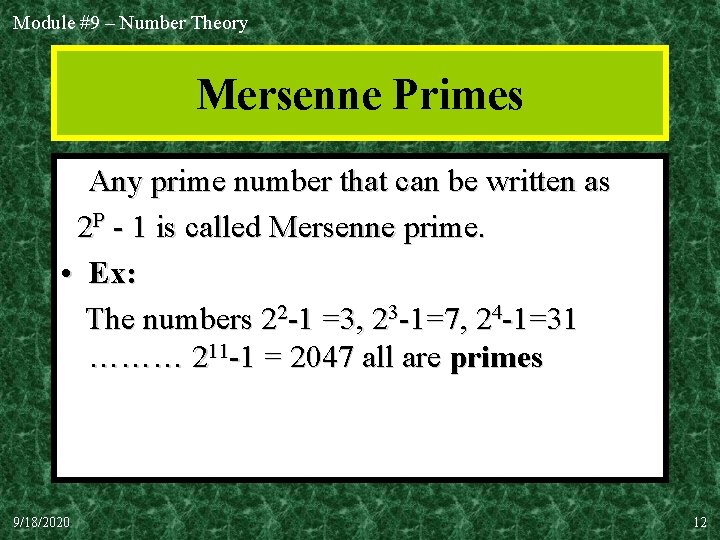
Module #9 – Number Theory Mersenne Primes Any prime number that can be written as 2 P - 1 is called Mersenne prime. • Ex: The numbers 22 -1 =3, 23 -1=7, 24 -1=31 ……… 211 -1 = 2047 all are primes 9/18/2020 12

Module #9 – Number Theory An Application of Primes • When you visit a secure web site (https: … address, indicated by padlock icon in IE, key icon in Netscape), the browser and web site may be using a technology called RSA encryption. • This public-key cryptography scheme involves exchanging public keys containing the product pq of two random large primes p and q (a private key) which must be kept secret by a given party. • So, the security of your day-to-day web transactions depends critically on the fact that all known factoring algorithms are intractable! – Note: There is a tractable quantum algorithm for factoring; so if we can ever build big quantum computers, RSA will be insecure. 9/18/2020 13
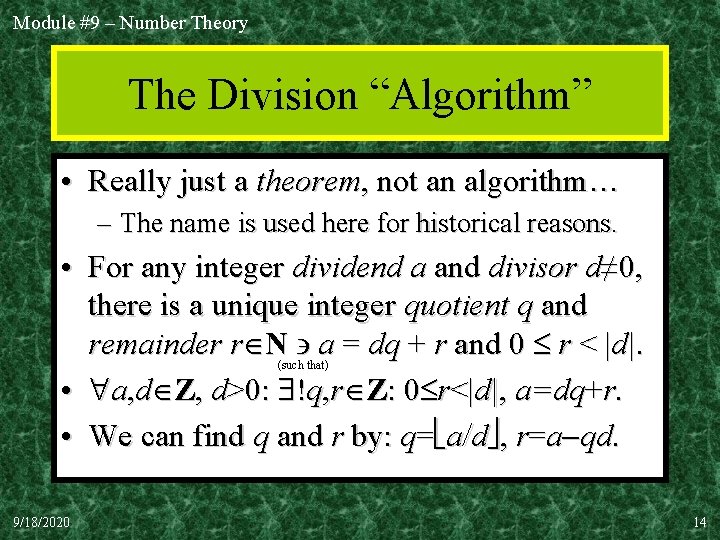
Module #9 – Number Theory The Division “Algorithm” • Really just a theorem, not an algorithm… – The name is used here for historical reasons. • For any integer dividend a and divisor d≠ 0, there is a unique integer quotient q and remainder r N a = dq + r and 0 r < |d|. • a, d Z, d>0: !q, r Z: 0 r<|d|, a=dq+r. • We can find q and r by: q= a d , r=a qd. (such that) 9/18/2020 14

Module #9 – Number Theory The mod operator • An integer “division remainder” operator. • Let a, d Z with d>1. Then a mod d denotes the remainder r from the division “algorithm” with dividend a and divisor d; i. e. the remainder when a is divided by d. (Using e. g. long division. ) • We can compute (a mod d) by: a d· a/d. • In C programming language, “%” = mod. 9/18/2020 15
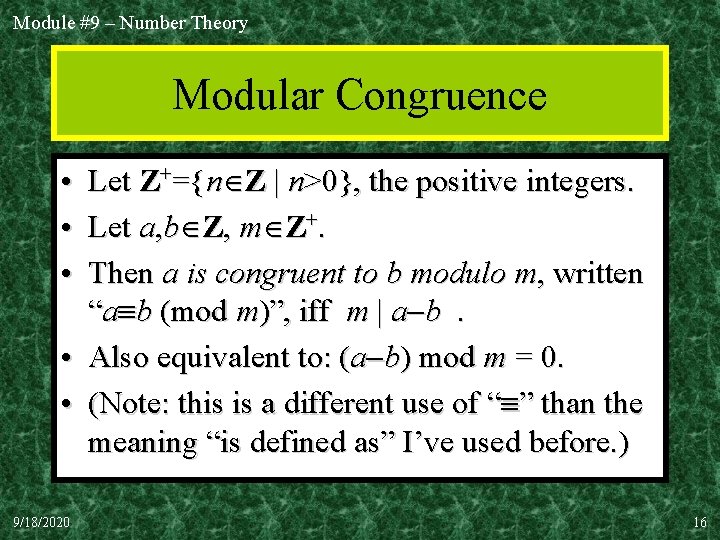
Module #9 – Number Theory Modular Congruence • Let Z+={n Z | n>0}, the positive integers. • Let a, b Z, m Z+. • Then a is congruent to b modulo m, written “a b (mod m)”, iff m | a b. • Also equivalent to: (a b) mod m = 0. • (Note: this is a different use of “ ” than the meaning “is defined as” I’ve used before. ) 9/18/2020 16
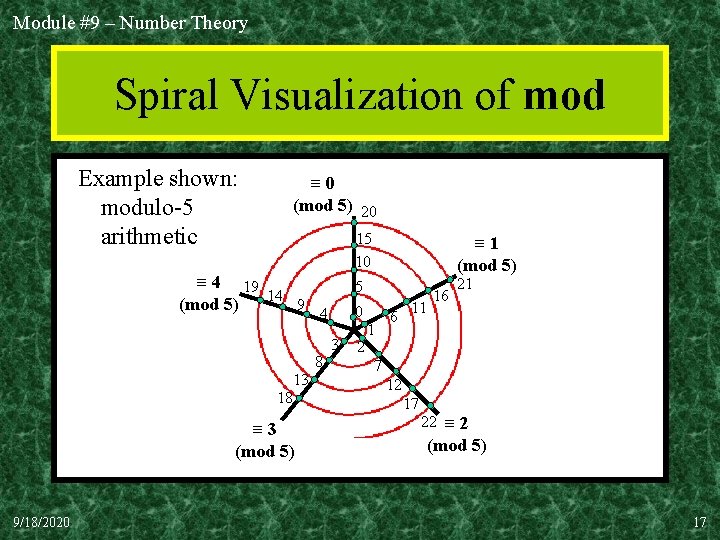
Module #9 – Number Theory Spiral Visualization of mod Example shown: modulo-5 arithmetic ≡ 0 (mod 5) 20 15 10 ≡ 4 19 14 9 (mod 5) 4 8 13 18 ≡ 3 (mod 5) 9/18/2020 ≡ 1 (mod 5) 5 0 3 2 1 6 11 16 21 7 12 17 22 ≡ 2 (mod 5) 17

Module #9 – Number Theory Useful Congruence Theorems • Let a, b, c, d Z, m Z+. Then if a b (mod m) and c d (mod m), then: ▪ a+c b+d (mod m), and ▪ ac bd (mod m) 9/18/2020 18
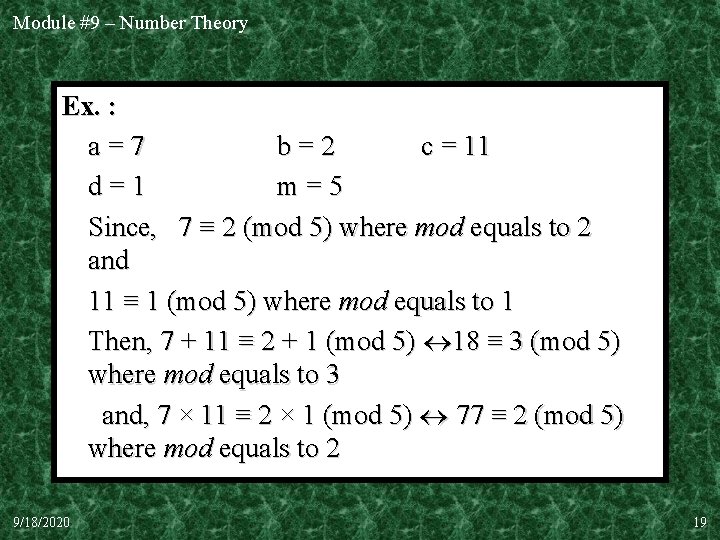
Module #9 – Number Theory Ex. : a=7 b=2 c = 11 d=1 m=5 Since, 7 ≡ 2 (mod 5) where mod equals to 2 and 11 ≡ 1 (mod 5) where mod equals to 1 Then, 7 + 11 ≡ 2 + 1 (mod 5) 18 ≡ 3 (mod 5) where mod equals to 3 and, 7 × 11 ≡ 2 × 1 (mod 5) 77 ≡ 2 (mod 5) where mod equals to 2 9/18/2020 19
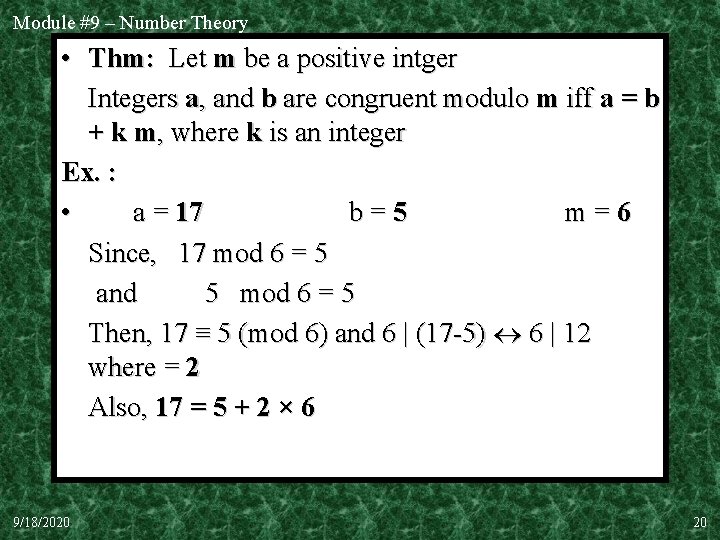
Module #9 – Number Theory • Thm: Let m be a positive intger Integers a, and b are congruent modulo m iff a = b + k m, where k is an integer Ex. : • a = 17 b=5 m=6 Since, 17 mod 6 = 5 and 5 mod 6 = 5 Then, 17 ≡ 5 (mod 6) and 6 | (17 -5) 6 | 12 where = 2 Also, 17 = 5 + 2 × 6 9/18/2020 20
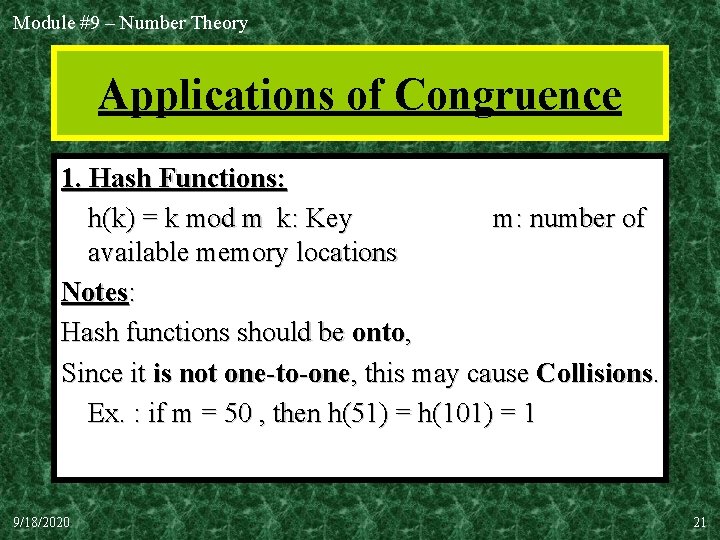
Module #9 – Number Theory Applications of Congruence 1. Hash Functions: h(k) = k mod m k: Key m: number of available memory locations Notes: Hash functions should be onto, Since it is not one-to-one, this may cause Collisions. Ex. : if m = 50 , then h(51) = h(101) = 1 9/18/2020 21
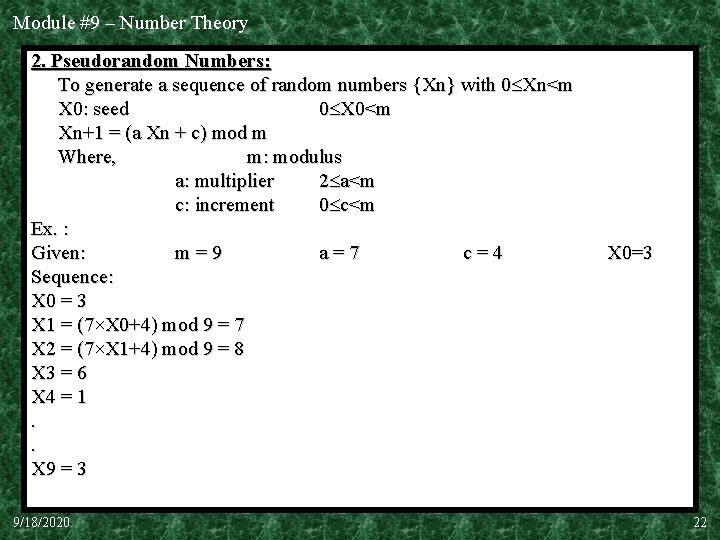
Module #9 – Number Theory 2. Pseudorandom Numbers: To generate a sequence of random numbers {Xn} with 0 Xn<m X 0: seed 0 X 0<m Xn+1 = (a Xn + c) mod m Where, m: modulus a: multiplier 2 a<m c: increment 0 c<m Ex. : Given: m=9 a=7 c=4 Sequence: X 0 = 3 X 1 = (7×X 0+4) mod 9 = 7 X 2 = (7×X 1+4) mod 9 = 8 X 3 = 6 X 4 = 1. . X 9 = 3 9/18/2020 X 0=3 22
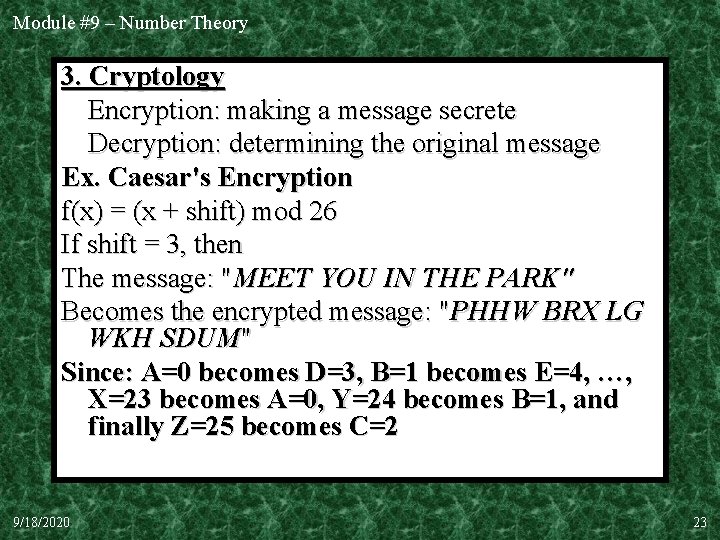
Module #9 – Number Theory 3. Cryptology Encryption: making a message secrete Decryption: determining the original message Ex. Caesar's Encryption f(x) = (x + shift) mod 26 If shift = 3, then The message: "MEET YOU IN THE PARK" Becomes the encrypted message: "PHHW BRX LG WKH SDUM" Since: A=0 becomes D=3, B=1 becomes E=4, …, X=23 becomes A=0, Y=24 becomes B=1, and finally Z=25 becomes C=2 9/18/2020 23
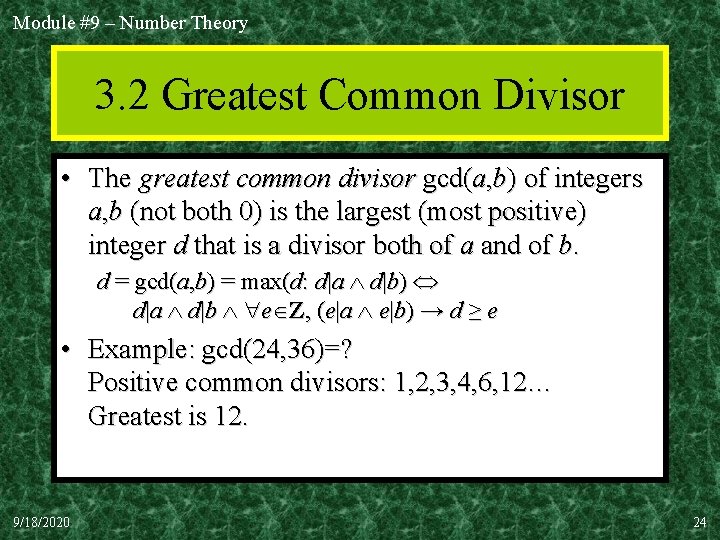
Module #9 – Number Theory 3. 2 Greatest Common Divisor • The greatest common divisor gcd(a, b) of integers a, b (not both 0) is the largest (most positive) integer d that is a divisor both of a and of b. d = gcd(a, b) = max(d: d|a d|b) d|a d|b e Z, (e|a e|b) → d ≥ e • Example: gcd(24, 36)=? Positive common divisors: 1, 2, 3, 4, 6, 12… Greatest is 12. 9/18/2020 24
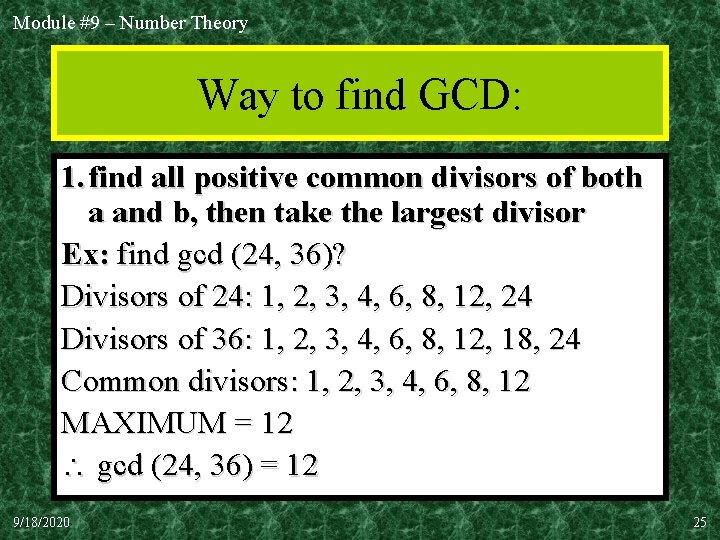
Module #9 – Number Theory Way to find GCD: 1. find all positive common divisors of both a and b, then take the largest divisor Ex: find gcd (24, 36)? Divisors of 24: 1, 2, 3, 4, 6, 8, 12, 24 Divisors of 36: 1, 2, 3, 4, 6, 8, 12, 18, 24 Common divisors: 1, 2, 3, 4, 6, 8, 12 MAXIMUM = 12 gcd (24, 36) = 12 9/18/2020 25
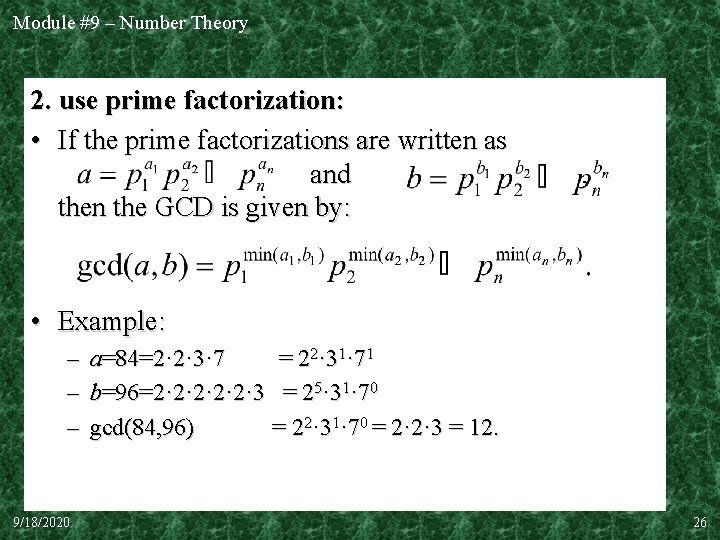
Module #9 – Number Theory 2. use prime factorization: • If the prime factorizations are written as and then the GCD is given by: , • Example: – a=84=2· 2· 3· 7 = 22· 31· 71 – b=96=2· 2· 2· 3 = 25· 31· 70 – gcd(84, 96) = 22· 31· 70 = 2· 2· 3 = 12. 9/18/2020 26
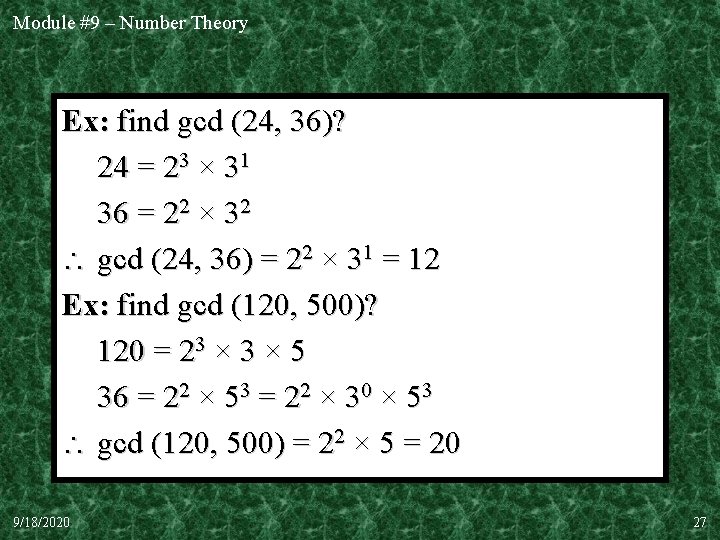
Module #9 – Number Theory Ex: find gcd (24, 36)? 24 = 23 × 31 36 = 22 × 32 gcd (24, 36) = 22 × 31 = 12 Ex: find gcd (120, 500)? 120 = 23 × 5 36 = 22 × 53 = 22 × 30 × 53 gcd (120, 500) = 22 × 5 = 20 9/18/2020 27
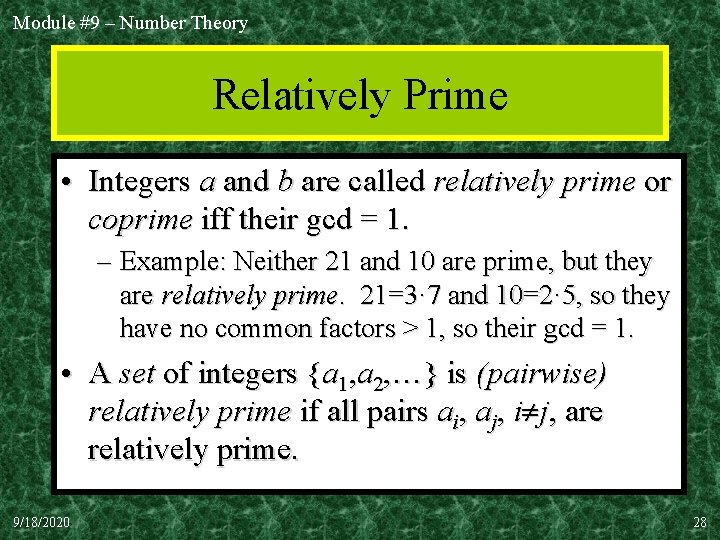
Module #9 – Number Theory Relatively Prime • Integers a and b are called relatively prime or coprime iff their gcd = 1. – Example: Neither 21 and 10 are prime, but they are relatively prime. 21=3· 7 and 10=2· 5, so they have no common factors > 1, so their gcd = 1. • A set of integers {a 1, a 2, …} is (pairwise) relatively prime if all pairs ai, aj, i j, are relatively prime. 9/18/2020 28
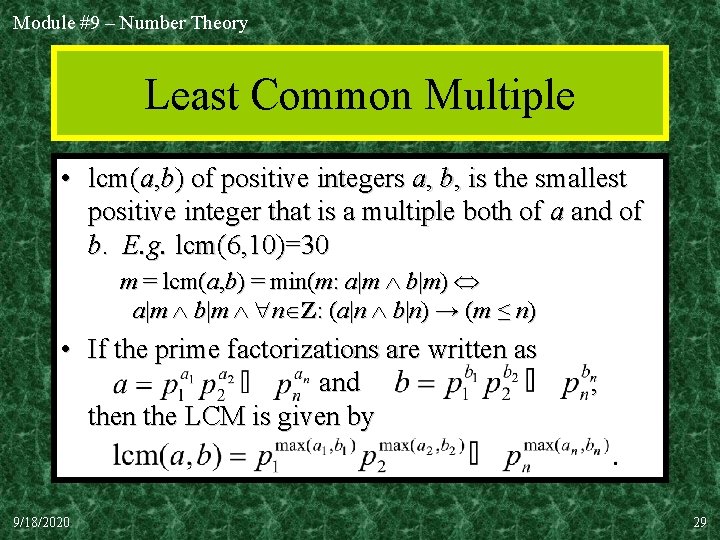
Module #9 – Number Theory Least Common Multiple • lcm(a, b) of positive integers a, b, is the smallest positive integer that is a multiple both of a and of b. E. g. lcm(6, 10)=30 m = lcm(a, b) = min(m: a|m b|m) a|m b|m n Z: (a|n b|n) → (m ≤ n) • If the prime factorizations are written as and then the LCM is given by 9/18/2020 , 29
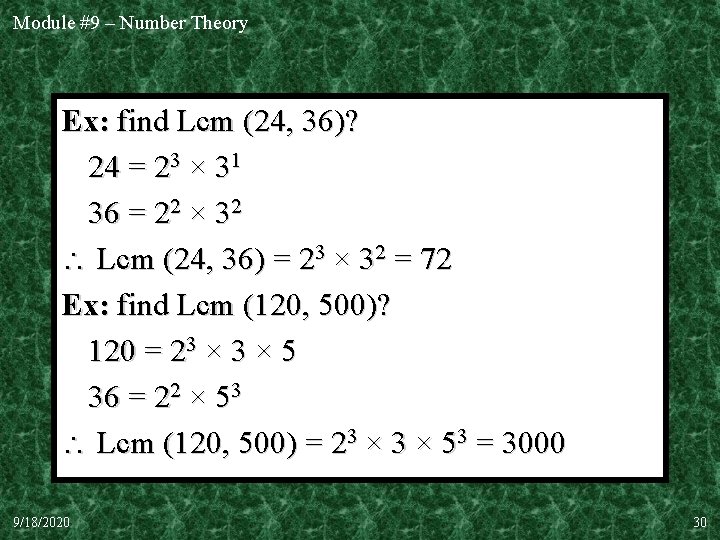
Module #9 – Number Theory Ex: find Lcm (24, 36)? 24 = 23 × 31 36 = 22 × 32 Lcm (24, 36) = 23 × 32 = 72 Ex: find Lcm (120, 500)? 120 = 23 × 5 36 = 22 × 53 Lcm (120, 500) = 23 × 53 = 3000 9/18/2020 30
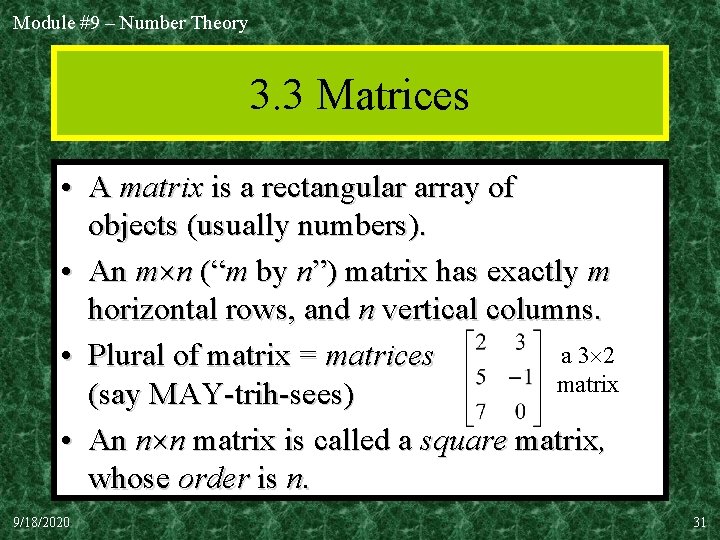
Module #9 – Number Theory 3. 3 Matrices • A matrix is a rectangular array of objects (usually numbers). • An m n (“m by n”) matrix has exactly m horizontal rows, and n vertical columns. a 3 2 • Plural of matrix = matrices matrix (say MAY-trih-sees) • An n n matrix is called a square matrix, whose order is n. 9/18/2020 31
Module #9 – Number Theory Applications of Matrices Tons of applications, including: • Solving systems of linear equations • Computer Graphics, Image Processing • Models within many areas of Computational Science & Engineering • Quantum Mechanics, Quantum Computing • Many, many more… 9/18/2020 32
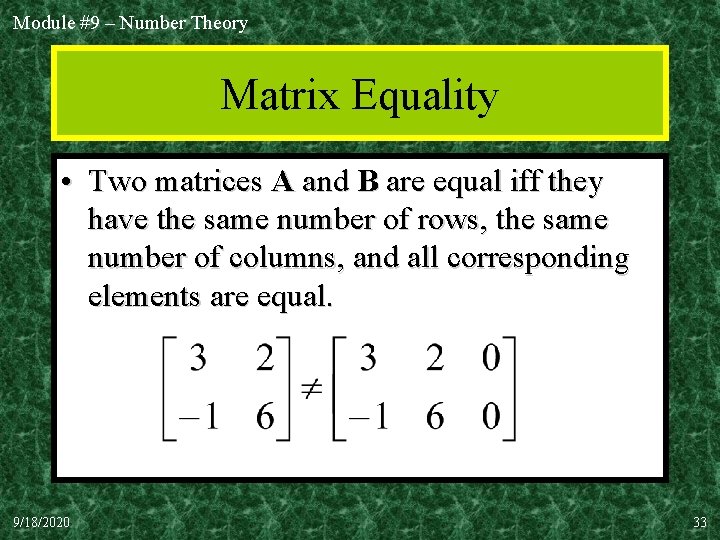
Module #9 – Number Theory Matrix Equality • Two matrices A and B are equal iff they have the same number of rows, the same number of columns, and all corresponding elements are equal. 9/18/2020 33
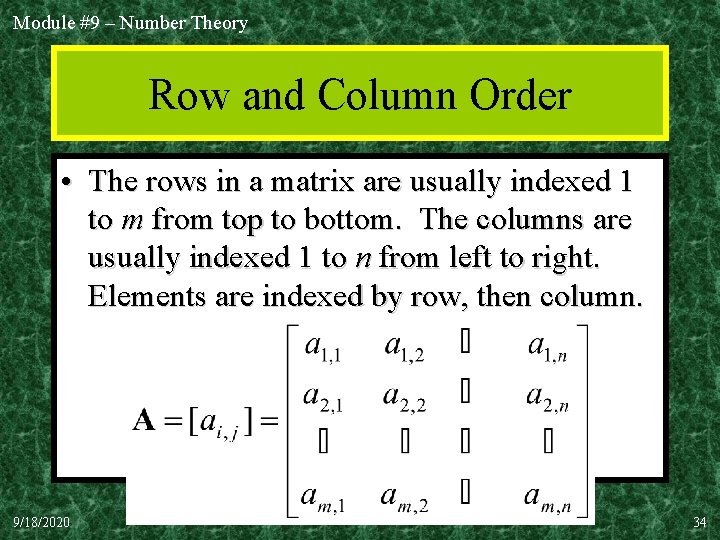
Module #9 – Number Theory Row and Column Order • The rows in a matrix are usually indexed 1 to m from top to bottom. The columns are usually indexed 1 to n from left to right. Elements are indexed by row, then column. 9/18/2020 34
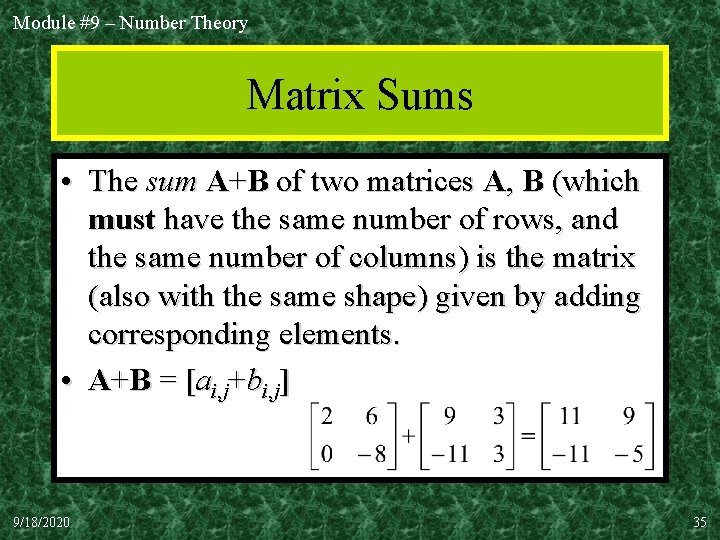
Module #9 – Number Theory Matrix Sums • The sum A+B of two matrices A, B (which must have the same number of rows, and the same number of columns) is the matrix (also with the same shape) given by adding corresponding elements. • A+B = [ai, j+bi, j] 9/18/2020 35
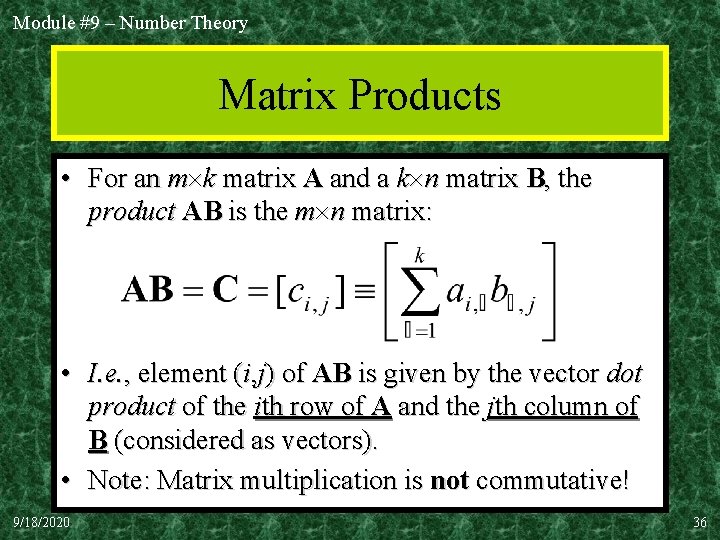
Module #9 – Number Theory Matrix Products • For an m k matrix A and a k n matrix B, the product AB is the m n matrix: • I. e. , element (i, j) of AB is given by the vector dot product of the ith row of A and the jth column of B (considered as vectors). • Note: Matrix multiplication is not commutative! 9/18/2020 36
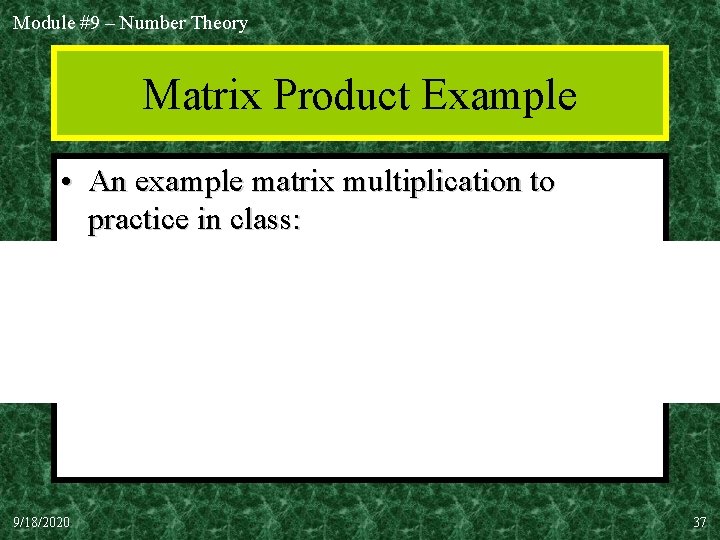
Module #9 – Number Theory Matrix Product Example • An example matrix multiplication to practice in class: 9/18/2020 37
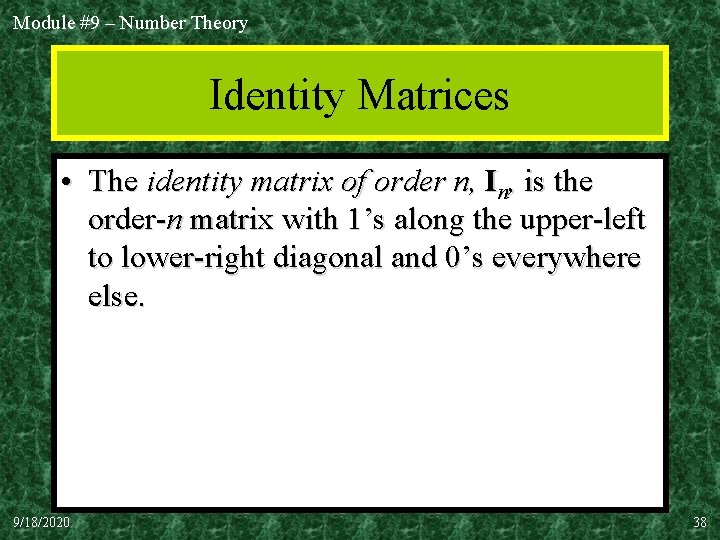
Module #9 – Number Theory Identity Matrices • The identity matrix of order n, In, is the order-n matrix with 1’s along the upper-left to lower-right diagonal and 0’s everywhere else. 9/18/2020 38
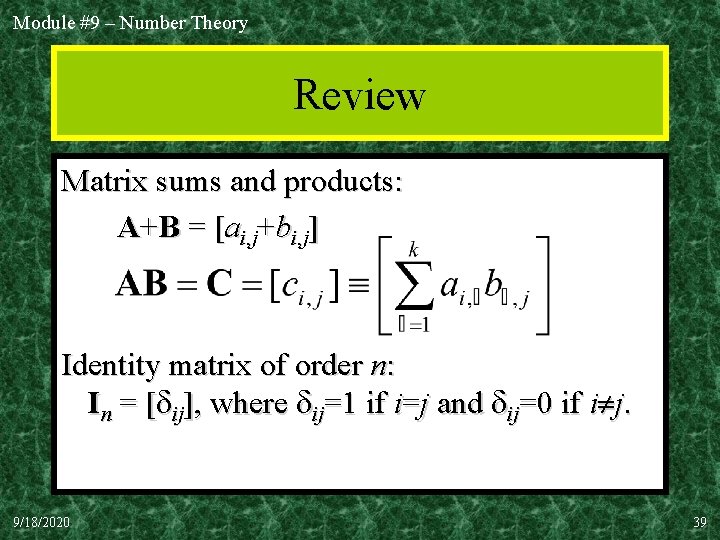
Module #9 – Number Theory Review Matrix sums and products: A+B = [ai, j+bi, j] Identity matrix of order n: In = [ ij], where ij=1 if i=j and ij=0 if i j. 9/18/2020 39
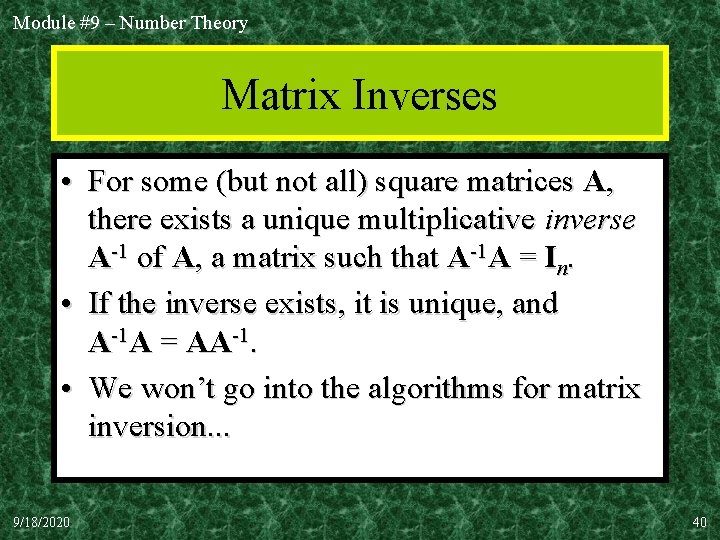
Module #9 – Number Theory Matrix Inverses • For some (but not all) square matrices A, there exists a unique multiplicative inverse A-1 of A, a matrix such that A-1 A = In. • If the inverse exists, it is unique, and A-1 A = AA-1. • We won’t go into the algorithms for matrix inversion. . . 9/18/2020 40
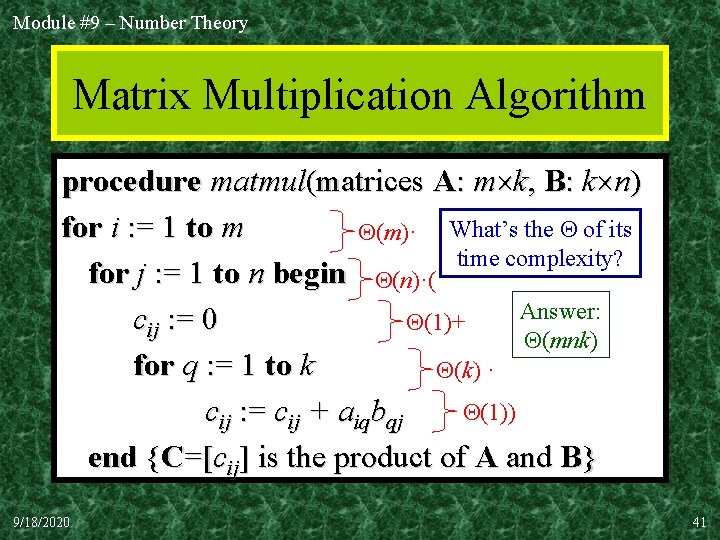
Module #9 – Number Theory Matrix Multiplication Algorithm procedure matmul(matrices A: m k, B: k n) for i : = 1 to m (m)· What’s the of its time complexity? for j : = 1 to n begin (n)·( Answer: cij : = 0 (1)+ (mnk) for q : = 1 to k (k) · (1)) cij : = cij + aiqbqj end {C=[cij] is the product of A and B} 9/18/2020 41
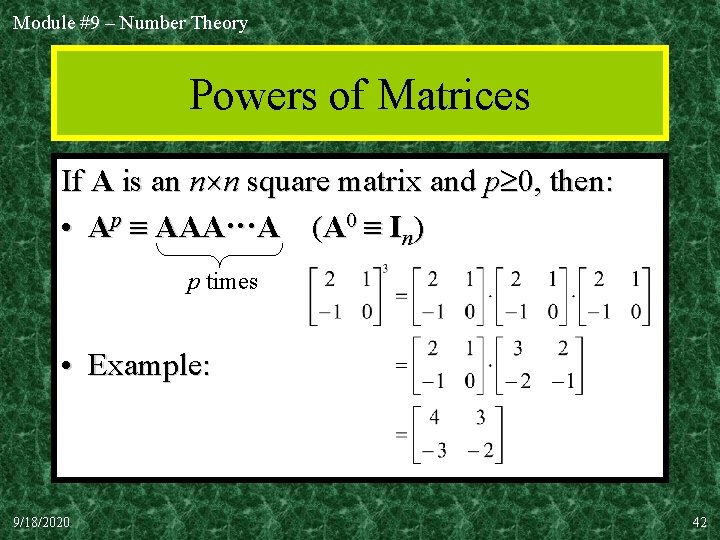
Module #9 – Number Theory Powers of Matrices If A is an n n square matrix and p 0, then: • Ap AAA···A (A 0 In) p times • Example: 9/18/2020 42
![Module #9 – Number Theory Matrix Transposition • If A=[aij] is an m n](http://slidetodoc.com/presentation_image/641a9f1b93773fb2708eafb778ee3089/image-43.jpg "Module #9 – Number Theory Matrix Transposition • If A=[aij] is an m n")
Module #9 – Number Theory Matrix Transposition • If A=[aij] is an m n matrix, the transpose of A (often written At or AT) is the n m matrix given by At = B = [bij] = [aji] (1 i n, 1 j m) 9/18/2020 Flip across diagonal 43
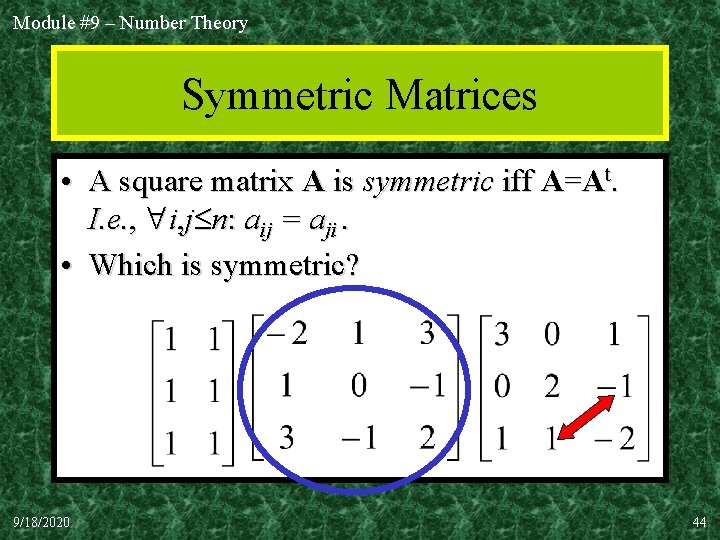
Module #9 – Number Theory Symmetric Matrices • A square matrix A is symmetric iff A=At. I. e. , i, j n: aij = aji. • Which is symmetric? 9/18/2020 44
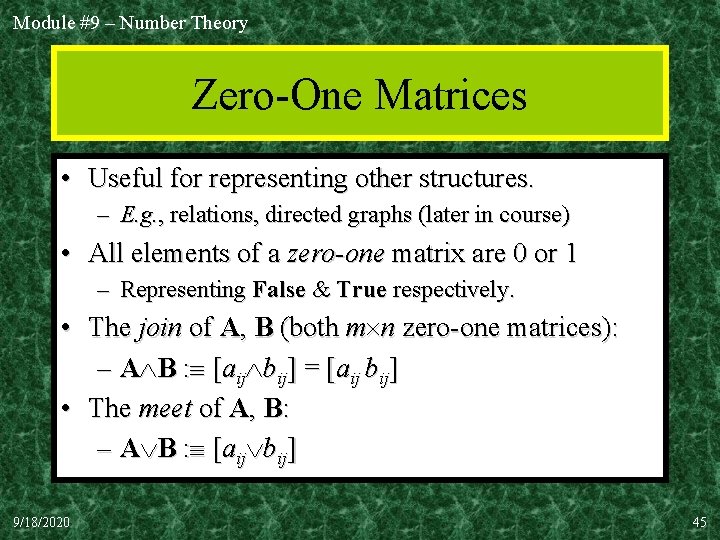
Module #9 – Number Theory Zero-One Matrices • Useful for representing other structures. – E. g. , relations, directed graphs (later in course) • All elements of a zero-one matrix are 0 or 1 – Representing False & True respectively. • The join of A, B (both m n zero-one matrices): – A B : [aij bij] = [aij bij] • The meet of A, B: – A B : [aij bij] 9/18/2020 45
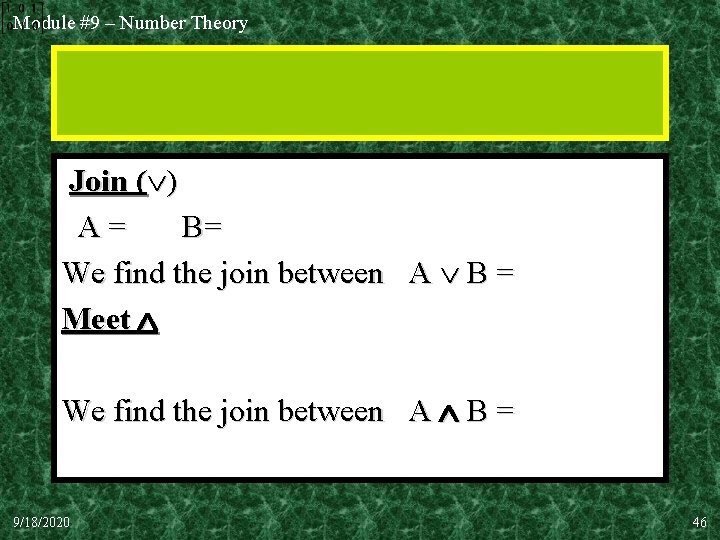
Module #9 – Number Theory Join ( ) A= B= We find the join between A B = Meet We find the join between A B = 9/18/2020 46
![Module #9 – Number Theory Boolean Products • Let A=[aij] be an m k](http://slidetodoc.com/presentation_image/641a9f1b93773fb2708eafb778ee3089/image-47.jpg "Module #9 – Number Theory Boolean Products • Let A=[aij] be an m k")
Module #9 – Number Theory Boolean Products • Let A=[aij] be an m k zero-one matrix, & let B=[bij] be a k n zero-one matrix, • The boolean product of A and B is like normal matrix , but using instead + in the row-column “vector dot product. ” A⊙B 9/18/2020 47
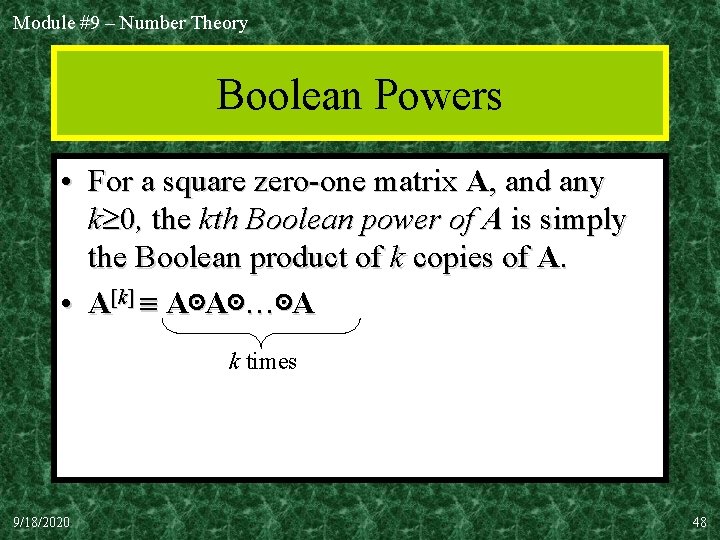
Module #9 – Number Theory Boolean Powers • For a square zero-one matrix A, and any k 0, the kth Boolean power of A is simply the Boolean product of k copies of A. • A[k] A⊙A⊙…⊙A k times 9/18/2020 48
- Slides: 48