
Module 9 Managing conflict of interest Toolkit on

- Slides: 46
Module 9 – Managing conflict of interest Toolkit on Transparency, Accountability and Ethics in Public Institutions
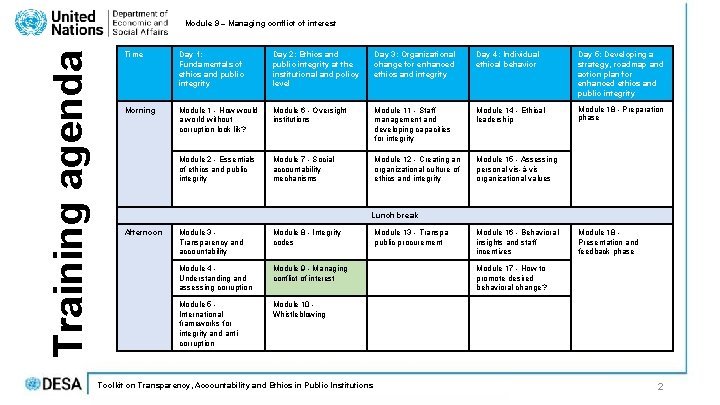
Training agenda Module 9 – Managing conflict of interest Time Day 1: Fundamentals of ethics and public integrity Day 2: Ethics and public integrity at the institutional and policy level Day 3: Organizational change for enhanced ethics and integrity Day 4: Individual ethical behavior Day 5: Developing a strategy, roadmap and action plan for enhanced ethics and public integrity Morning Module 1 - How would a world without corruption look lik? Module 6 - Oversight institutions Module 11 - Staff management and developing capacities for integrity Module 14 - Ethical leadership Module 18 - Preparation phase Module 2 - Essentials of ethics and public integrity Module 7 - Social accountability mechanisms Module 12 - Creating an organizational culture of ethics and integrity Module 15 - Assessing personal vis-à-vis organizational values Lunch break Afternoon Module 3 Transparency and accountability Module 8 - Integrity codes Module 4 Understanding and assessing corruption Module 9 - Managing conflict of interest Module 5 International frameworks for integrity and anticorruption Module 10 Whistleblowing Toolkit on Transparency, Accountability and Ethics in Public Institutions Module 13 - Transpa public procurement Module 16 - Behavioral insights and staff incentives Module 18 Presentation and feedback phase Module 17 - How to promote desired behavioral change? 2
Module agenda Module 9 – Managing conflict of interest 01 Key terminology 02 Why is managing conflict of interest important? 03 Good practices for: 04 Practical examples 05 Activity: Case studies – Conflict of interest or not? 1. 2. 3. Legislation Interest and asset declarations Resolutions UN Photo/Stuart Price Toolkit on Transparency, Accountability and Ethics in Public Institutions 3
Learning objectives Module 9 – Managing conflict of interest In this module you will learn: • What conflicts of interests are, why are they risky and need to be managed; • What the key components of an interest and asset declaration system are and where challenges may exist; • How countries across the globe are managing conflicts of interest through information disclosure policies; • Through case studies, how to determine whether a situation is a conflict of interest or not. Toolkit on Transparency, Accountability and Ethics in Public Institutions 4
Module agenda Module 9 – Managing conflict of interest 01 Key terminology 02 Why is managing conflict of interest important? 03 Good practices for: 04 Practical examples 05 Activity: Case studies – Conflict of interest or not? 1. 2. 3. Legislation Interest and asset declarations Resolutions UN Photo/Stuart Price Toolkit on Transparency, Accountability and Ethics in Public Institutions 5
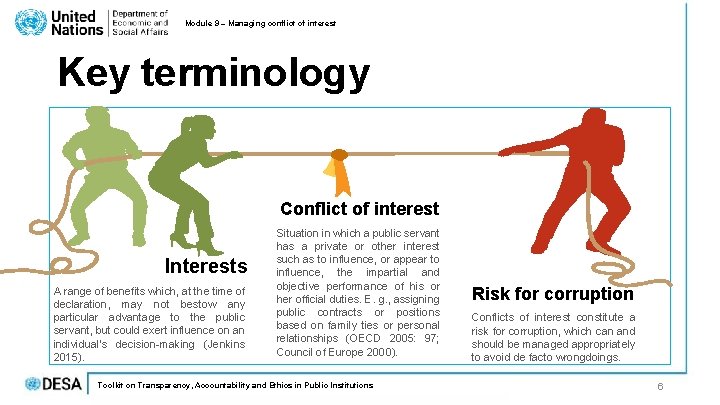
Module 9 – Managing conflict of interest Key terminology Conflict of interest Interests A range of benefits which, at the time of declaration, may not bestow any particular advantage to the public servant, but could exert influence on an individual's decision-making (Jenkins 2015). Situation in which a public servant has a private or other interest such as to influence, or appear to influence, the impartial and objective performance of his or her official duties. E. g. , assigning public contracts or positions based on family ties or personal relationships (OECD 2005: 97; Council of Europe 2000). Toolkit on Transparency, Accountability and Ethics in Public Institutions Risk for corruption Conflicts of interest constitute a risk for corruption, which can and should be managed appropriately to avoid de facto wrongdoings. 6
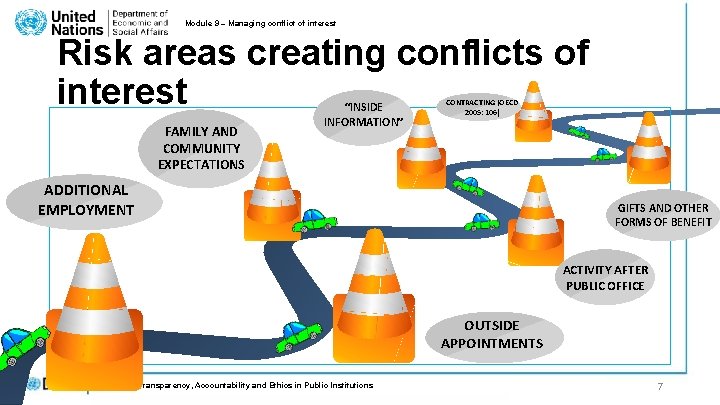
Module 9 – Managing conflict of interest Risk areas creating conflicts of interest FAMILY AND COMMUNITY EXPECTATIONS “INSIDE INFORMATION” CONTRACTING (OECD 2005: 106) ADDITIONAL EMPLOYMENT GIFTS AND OTHER FORMS OF BENEFIT ACTIVITY AFTER PUBLIC OFFICE OUTSIDE APPOINTMENTS Toolkit on Transparency, Accountability and Ethics in Public Institutions 7
Module agenda Module 9 – Managing conflict of interest 01 Key terminology 02 Why is managing conflict of interest important? 03 Good practices for: 04 Practical examples 05 Activity: Case studies – Conflict of interest or not? 1. 2. 3. Legislation Interest and asset declarations Resolutions UN Photo/Stuart Price Toolkit on Transparency, Accountability and Ethics in Public Institutions 8
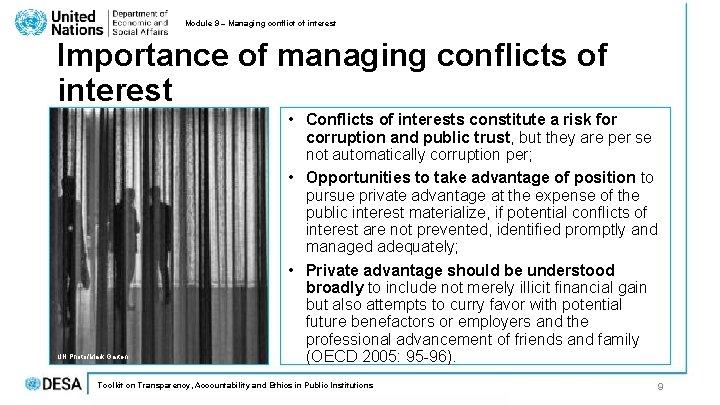
Module 9 – Managing conflict of interest Importance of managing conflicts of interest UN Photo/Mark Garten • Conflicts of interests constitute a risk for corruption and public trust, but they are per se not automatically corruption per; • Opportunities to take advantage of position to pursue private advantage at the expense of the public interest materialize, if potential conflicts of interest are not prevented, identified promptly and managed adequately; • Private advantage should be understood broadly to include not merely illicit financial gain but also attempts to curry favor with potential future benefactors or employers and the professional advancement of friends and family (OECD 2005: 95 -96). Toolkit on Transparency, Accountability and Ethics in Public Institutions 9
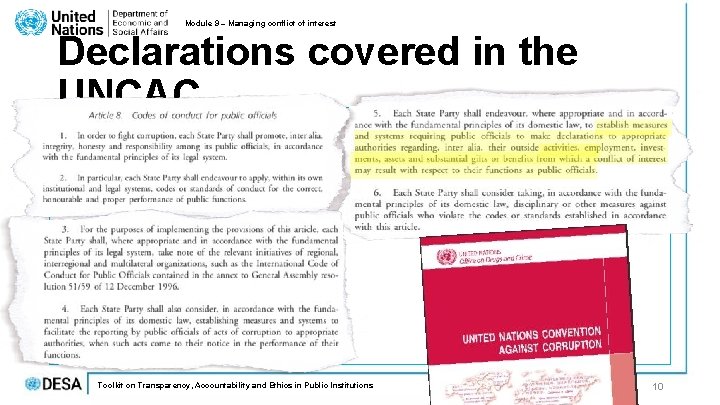
Module 9 – Managing conflict of interest Declarations covered in the UNCAC Toolkit on Transparency, Accountability and Ethics in Public Institutions 10
Module agenda Module 9 – Managing conflict of interest 01 Key terminology 02 Why is managing conflict of interest important? 03 Good practices for: 04 Practical examples 05 Activity: Case studies – Conflict of interest or not? 1. 2. 3. Legislation Interest and asset declarations Resolutions UN Photo/Stuart Price Toolkit on Transparency, Accountability and Ethics in Public Institutions 11
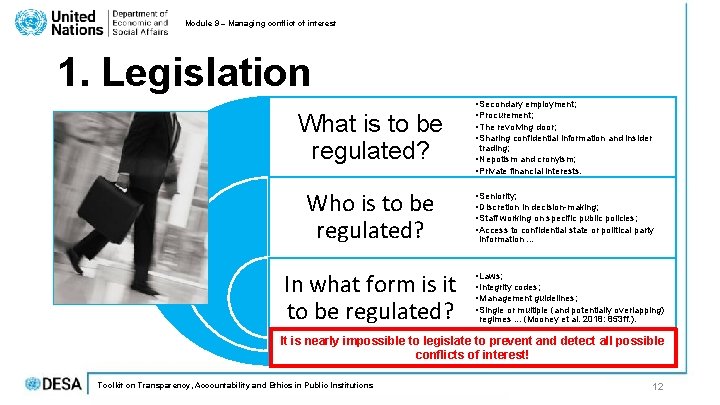
Module 9 – Managing conflict of interest 1. Legislation What is to be regulated? Who is to be regulated? In what form is it to be regulated? • Secondary employment; • Procurement; • The revolving door; • Sharing confidential information and insider trading; • Nepotism and cronyism; • Private financial interests. • Seniority; • Discretion in decision-making; • Staff working on specific public policies; • Access to confidential state or political party information. . . • Laws; • Integrity codes; • Management guidelines; • Single or multiple (and potentially overlapping) regimes. . . (Mooney et al. 2018: 853 ff. ). It is nearly impossible to legislate to prevent and detect all possible conflicts of interest! Toolkit on Transparency, Accountability and Ethics in Public Institutions 12
Module agenda Module 9 – Managing conflict of interest 01 Key terminology 02 Why is managing conflict of interest important? 03 Good practices for: 04 Practical examples 05 Activity: Case studies – Conflict of interest or not? 1. 2. 3. Legislation Interest and asset declarations Resolutions UN Photo/Stuart Price Toolkit on Transparency, Accountability and Ethics in Public Institutions 13
Module 9 – Managing conflict of interest 2. Interest and asset declaration • Disclosing the value of assets and liabilities and sources of income; • Deterrent against graft, collusion and patronage in the public sector; • Key instrument to prevent conflicts of interest and uncover illicit enrichment; • The effectiveness and credibility of a system of disclosures is only as good as its ability to detect violations and penalize wrongdoing (Jenkins 2015; Martini 2013). Toolkit on Transparency, Accountability and Ethics in Public Institutions 14
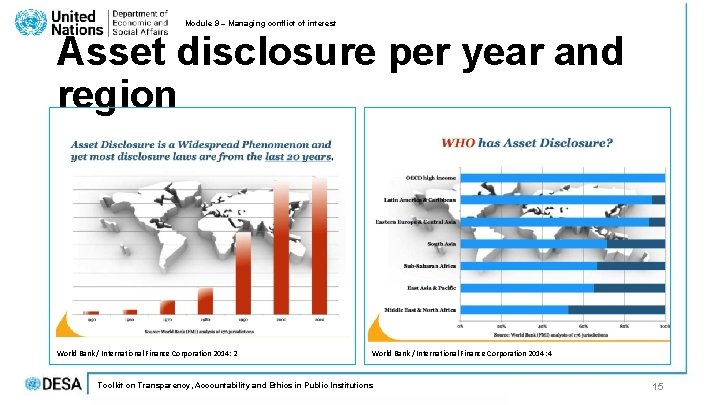
Module 9 – Managing conflict of interest Asset disclosure per year and region World Bank / International Finance Corporation 2014: 2 World Bank / International Finance Corporation 2014: 4 Toolkit on Transparency, Accountability and Ethics in Public Institutions 15
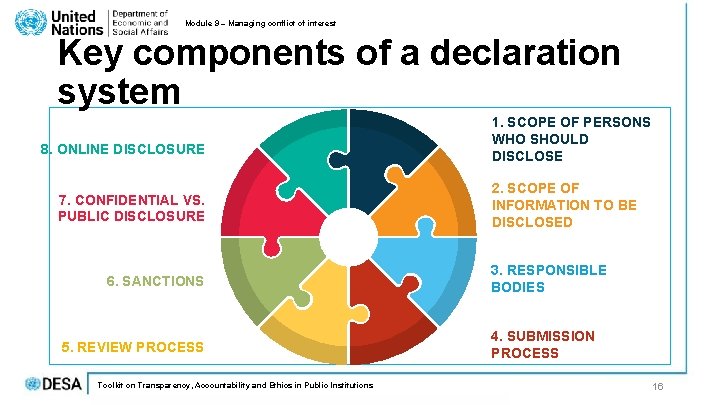
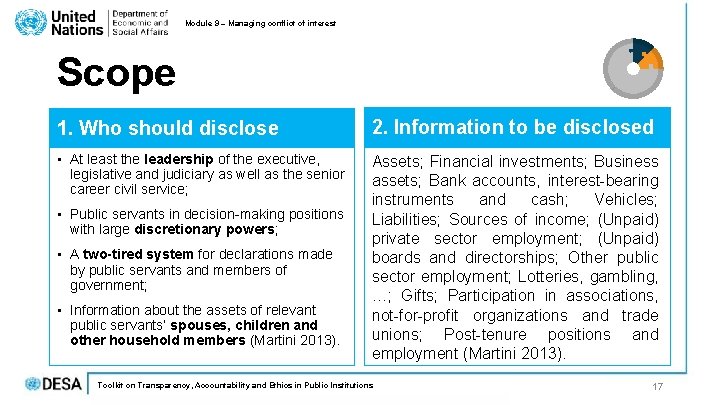
Module 9 – Managing conflict of interest Key components of a declaration system 8. ONLINE DISCLOSURE 7. CONFIDENTIAL VS. PUBLIC DISCLOSURE 6. SANCTIONS 5. REVIEW PROCESS Toolkit on Transparency, Accountability and Ethics in Public Institutions 1. SCOPE OF PERSONS WHO SHOULD DISCLOSE 2. SCOPE OF INFORMATION TO BE DISCLOSED 3. RESPONSIBLE BODIES 4. SUBMISSION PROCESS 16
Module 9 – Managing conflict of interest Scope 1. Who should disclose 2. Information to be disclosed • At least the leadership of the executive, legislative and judiciary as well as the senior career civil service; Assets; Financial investments; Business assets; Bank accounts, interest-bearing instruments and cash; Vehicles; Liabilities; Sources of income; (Unpaid) private sector employment; (Unpaid) boards and directorships; Other public sector employment; Lotteries, gambling, …; Gifts; Participation in associations, not-for-profit organizations and trade unions; Post-tenure positions and employment (Martini 2013). • Public servants in decision-making positions with large discretionary powers; • A two-tired system for declarations made by public servants and members of government; • Information about the assets of relevant public servants’ spouses, children and other household members (Martini 2013). Toolkit on Transparency, Accountability and Ethics in Public Institutions 17
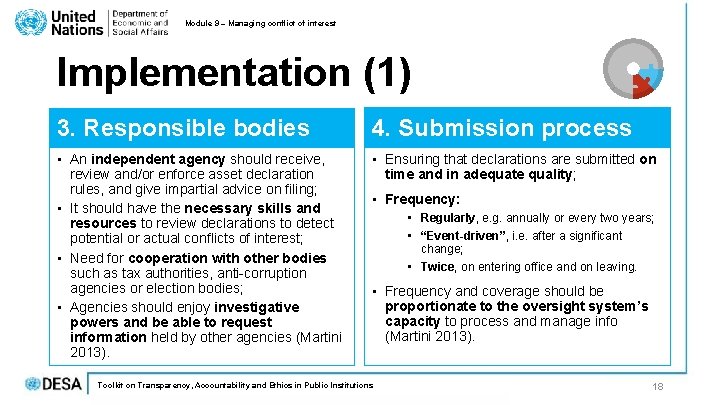
Module 9 – Managing conflict of interest Implementation (1) 3. Responsible bodies 4. Submission process • An independent agency should receive, review and/or enforce asset declaration rules, and give impartial advice on filing; • It should have the necessary skills and resources to review declarations to detect potential or actual conflicts of interest; • Need for cooperation with other bodies such as tax authorities, anti-corruption agencies or election bodies; • Agencies should enjoy investigative powers and be able to request information held by other agencies (Martini 2013). • Ensuring that declarations are submitted on time and in adequate quality; • Frequency: • Regularly, e. g. annually or every two years; • “Event-driven”, i. e. after a significant change; • Twice, on entering office and on leaving. • Frequency and coverage should be proportionate to the oversight system’s capacity to process and manage info (Martini 2013). Toolkit on Transparency, Accountability and Ethics in Public Institutions 18
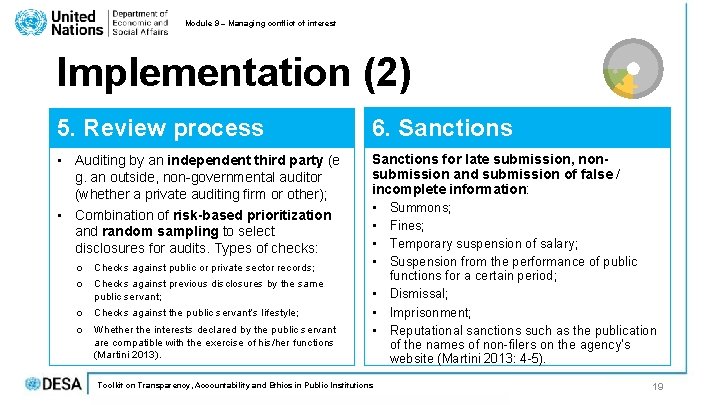
Module 9 – Managing conflict of interest Implementation (2) 5. Review process 6. Sanctions • Auditing by an independent third party (e g. an outside, non-governmental auditor (whether a private auditing firm or other); • Combination of risk-based prioritization and random sampling to select disclosures for audits. Types of checks: Sanctions for late submission, nonsubmission and submission of false / incomplete information: • Summons; • Fines; • Temporary suspension of salary; • Suspension from the performance of public o Checks against public or private sector records; o Checks against previous disclosures by the same public servant; o Checks against the public servant’s lifestyle; o Whether the interests declared by the public servant are compatible with the exercise of his/her functions (Martini 2013). • • • Toolkit on Transparency, Accountability and Ethics in Public Institutions functions for a certain period; Dismissal; Imprisonment; Reputational sanctions such as the publication of the names of non-filers on the agency’s website (Martini 2013: 4 -5). 19
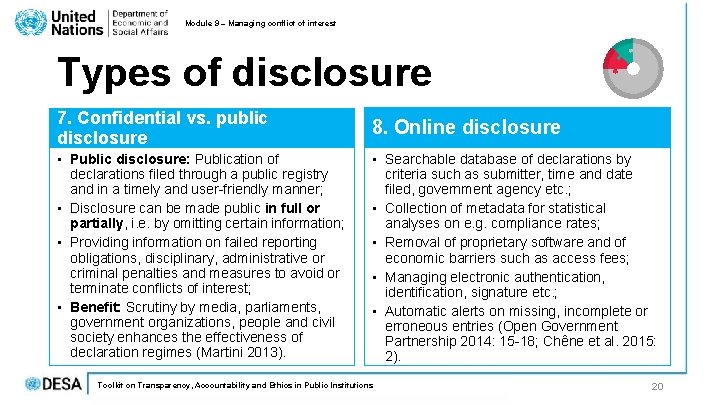
Module 9 – Managing conflict of interest Types of disclosure 7. Confidential vs. public disclosure 8. Online disclosure • Public disclosure: Publication of declarations filed through a public registry and in a timely and user-friendly manner; • Disclosure can be made public in full or partially, i. e. by omitting certain information; • Providing information on failed reporting obligations, disciplinary, administrative or criminal penalties and measures to avoid or terminate conflicts of interest; • Benefit: Scrutiny by media, parliaments, government organizations, people and civil society enhances the effectiveness of declaration regimes (Martini 2013). • Searchable database of declarations by criteria such as submitter, time and date filed, government agency etc. ; • Collection of metadata for statistical analyses on e. g. compliance rates; • Removal of proprietary software and of economic barriers such as access fees; • Managing electronic authentication, identification, signature etc. ; • Automatic alerts on missing, incomplete or erroneous entries (Open Government Partnership 2014: 15 -18; Chêne et al. 2015: 2). Toolkit on Transparency, Accountability and Ethics in Public Institutions 20
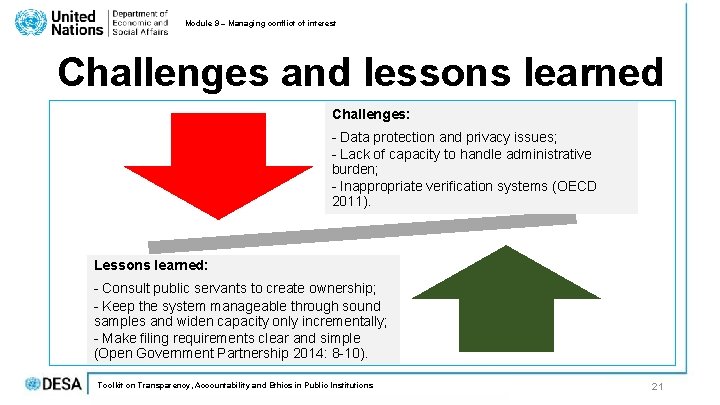
Module 9 – Managing conflict of interest Challenges and lessons learned Challenges: - Data protection and privacy issues; - Lack of capacity to handle administrative burden; - Inappropriate verification systems (OECD 2011). Lessons learned: - Consult public servants to create ownership; - Keep the system manageable through sound samples and widen capacity only incrementally; - Make filing requirements clear and simple (Open Government Partnership 2014: 8 -10). Toolkit on Transparency, Accountability and Ethics in Public Institutions 21
Module agenda Module 9 – Managing conflict of interest 01 Key terminology 02 Why is managing conflict of interest important? 03 Good practices for: 04 Practical examples 05 Activity: Case studies – Conflict of interest or not? 1. 2. 3. Legislation Interest and asset declarations Resolutions UN Photo/Stuart Price Toolkit on Transparency, Accountability and Ethics in Public Institutions 22
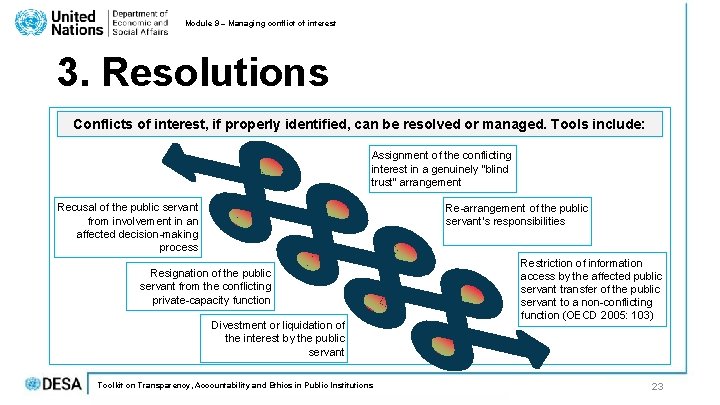
Module 9 – Managing conflict of interest 3. Resolutions Conflicts of interest, if properly identified, can be resolved or managed. Tools include: Assignment of the conflicting interest in a genuinely “blind trust” arrangement Recusal of the public servant from involvement in an affected decision-making process Re-arrangement of the public servant’s responsibilities Resignation of the public servant from the conflicting private-capacity function Divestment or liquidation of the interest by the public servant Toolkit on Transparency, Accountability and Ethics in Public Institutions Restriction of information access by the affected public servant transfer of the public servant to a non-conflicting function (OECD 2005: 103) 23
Module agenda Module 9 – Managing conflict of interest 01 Key terminology 02 Why is managing conflict of interest important? 03 Good practices for: 04 Practical examples 05 Activity: Case studies – Conflict of interest or not? 1. 2. 3. Legislation Interest and asset declarations Resolutions UN Photo/Stuart Price Toolkit on Transparency, Accountability and Ethics in Public Institutions 24
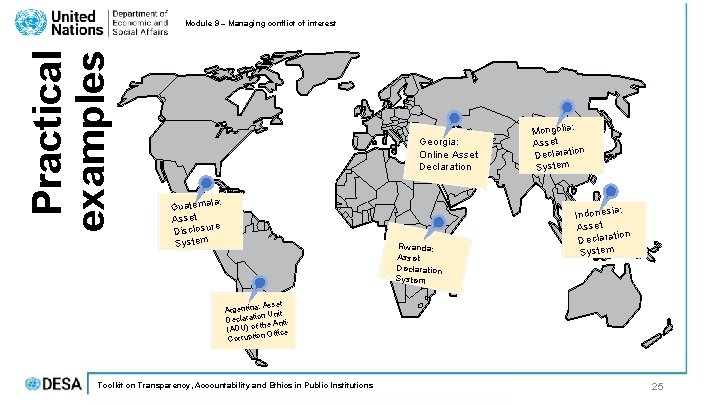
Practical examples Module 9 – Managing conflict of interest Georgia: Online Asset Declaration la: Guatema Asset Disclosure System Rwanda: Asset Declaration System : Mongolia Asset on Declarati m Syste : Indonesia Asset on Declarati System : Asset Argentina Unit n o ti Declara the Antif o ) U D (A n Office Corruptio Toolkit on Transparency, Accountability and Ethics in Public Institutions 25
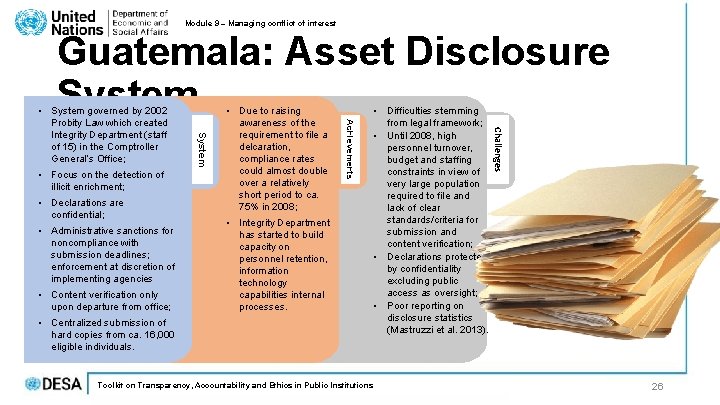
Module 9 – Managing conflict of interest Guatemala: Asset Disclosure System • Administrative sanctions for noncompliance with submission deadlines; enforcement at discretion of implementing agencies • Content verification only upon departure from office; • Centralized submission of hard copies from ca. 16, 000 eligible individuals. • Integrity Department has started to build capacity on personnel retention, information technology capabilities internal processes. • Difficulties stemming from legal framework; • Until 2008, high personnel turnover, budget and staffing constraints in view of very large population required to file and lack of clear standards/criteria for submission and content verification; • Declarations protected by confidentiality excluding public access as oversight; • Poor reporting on disclosure statistics (Mastruzzi et al. 2013). Toolkit on Transparency, Accountability and Ethics in Public Institutions Challenges • Declarations are confidential; • Due to raising awareness of the requirement to file a delcaration, compliance rates could almost double over a relatively short period to ca. 75% in 2008; Achievements • Focus on the detection of illicit enrichment; System • System governed by 2002 Probity Law which created Integrity Department (staff of 15) in the Comptroller General’s Office; 26
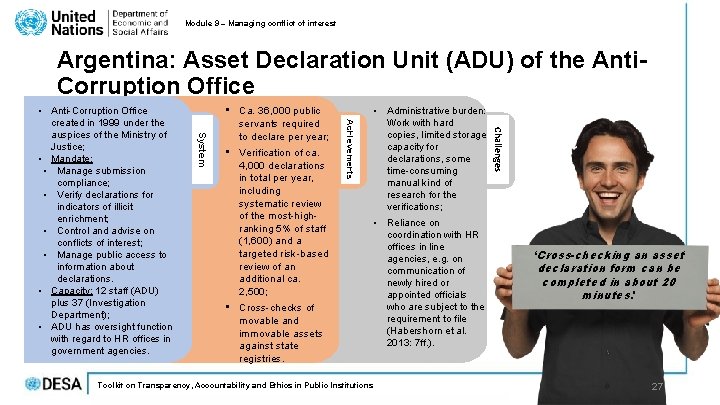
Module 9 – Managing conflict of interest Argentina: Asset Declaration Unit (ADU) of the Anti. Corruption Office • Verification of ca. 4, 000 declarations in total per year, including systematic review of the most-highranking 5% of staff (1, 600) and a targeted risk-based review of an additional ca. 2, 500; • Cross-checks of movable and immovable assets against state registries. • Administrative burden: Work with hard copies, limited storage capacity for declarations, some time-consuming manual kind of research for the verifications; • Reliance on coordination with HR offices in line agencies, e. g. on communication of newly hired or appointed officials who are subject to the requirement to file (Habershorn et al. 2013: 7 ff. ). Toolkit on Transparency, Accountability and Ethics in Public Institutions Challenges • Ca. 36, 000 public servants required to declare per year; Achievements System • Anti-Corruption Office created in 1999 under the auspices of the Ministry of Justice; • Mandate: • Manage submission compliance; • Verify declarations for indicators of illicit enrichment; • Control and advise on conflicts of interest; • Manage public access to information about declarations. • Capacity: 12 staff (ADU) plus 37 (Investigation Department); • ADU has oversight function with regard to HR offices in government agencies. ‘Cross-checking an asset declaration form can be completed in about 20 minutes. ' 27
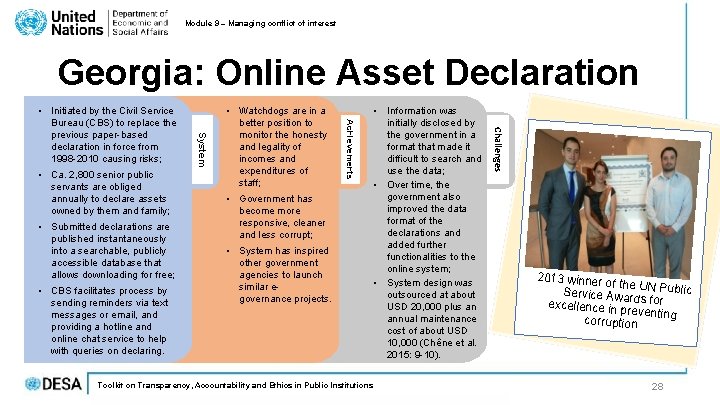
Module 9 – Managing conflict of interest Georgia: Online Asset Declaration • CBS facilitates process by sending reminders via text messages or email, and providing a hotline and online chat service to help with queries on declaring. • Government has become more responsive, cleaner and less corrupt; • System has inspired other government agencies to launch similar egovernance projects. • Information was initially disclosed by the government in a format that made it difficult to search and use the data; • Over time, the government also improved the data format of the declarations and added further functionalities to the online system; • System design was outsourced at about USD 20, 000 plus an annual maintenance cost of about USD 10, 000 (Chêne et al. 2015: 9 -10). Toolkit on Transparency, Accountability and Ethics in Public Institutions Challenges • Submitted declarations are published instantaneously into a searchable, publicly accessible database that allows downloading for free; • Watchdogs are in a better position to monitor the honesty and legality of incomes and expenditures of staff; Achievements • Ca. 2, 800 senior public servants are obliged annually to declare assets owned by them and family; System • Initiated by the Civil Service Bureau (CBS) to replace the previous paper-based declaration in force from 1998 -2010 causing risks; 2013 winner of the U Service Award N Public s for excellence in preventing corruption 28
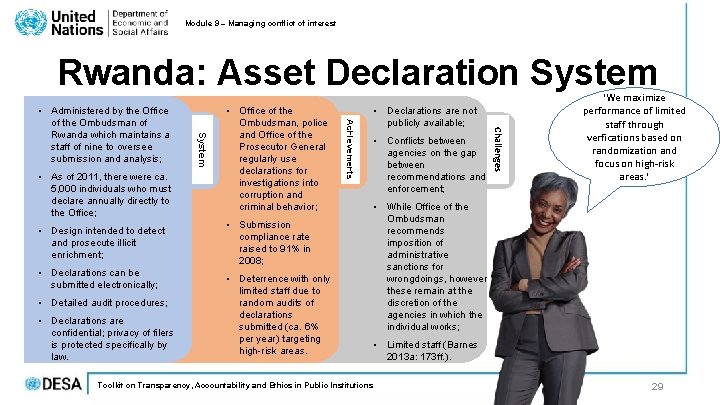
Module 9 – Managing conflict of interest Rwanda: Asset Declaration System • Declarations can be submitted electronically; • Detailed audit procedures; • Declarations are confidential; privacy of filers is protected specifically by law. • Submission compliance rate raised to 91% in 2008; • Deterrence with only limited staff due to random audits of declarations submitted (ca. 6% per year) targeting high-risk areas. • Declarations are not publicly available; • Conflicts between agencies on the gap between recommendations and enforcement; Challenges • Design intended to detect and prosecute illicit enrichment; • Office of the Ombudsman, police and Office of the Prosecutor General regularly use declarations for investigations into corruption and criminal behavior; Achievements • As of 2011, there were ca. 5, 000 individuals who must declare annually directly to the Office; System • Administered by the Office of the Ombudsman of Rwanda which maintains a staff of nine to oversee submission and analysis; ‘We maximize performance of limited staff through verfications based on randomization and focus on high-risk areas. ‘ • While Office of the Ombudsman recommends imposition of administrative sanctions for wrongdoings, however these remain at the discretion of the agencies in which the individual works; • Limited staff (Barnes 2013 a: 173 ff. ). Toolkit on Transparency, Accountability and Ethics in Public Institutions 29
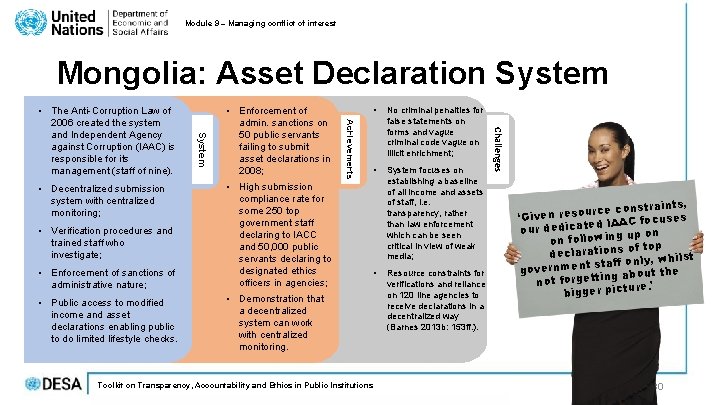
Module 9 – Managing conflict of interest Mongolia: Asset Declaration System • Enforcement of sanctions of administrative nature; • Public access to modified income and asset declarations enabling public to do limited lifestyle checks. • High submission compliance rate for some 250 top government staff declaring to IACC and 50, 000 public servants declaring to designated ethics officers in agencies; • No criminal penalties for false statements on forms and vague criminal code vague on illicit enrichment; • System focuses on establishing a baseline of all income and assets of staff, i. e. transparency, rather than law enforcement which can be seen critical in view of weak media; • • Demonstration that a decentralized system can work with centralized monitoring. Toolkit on Transparency, Accountability and Ethics in Public Institutions Resource constraints for verifications and reliance on 120 line agencies to receive declarations in a decentralized way (Barnes 2013 b: 153 ff. ). Challenges • Verification procedures and trained staff who investigate; • Enforcement of admin. sanctions on 50 public servants failing to submit asset declarations in 2008; Achievements • Decentralized submission system with centralized monitoring; System • The Anti-Corruption Law of 2006 created the system and Independent Agency against Corruption (IAAC) is responsible for its management (staff of nine). ints, rce constra u o s re n e iv ‘G ses d IAAC focu our dedicate up on on following s of top declaration st ff only, whil ta s t n e m rn e gov g about the not forgettin re. ' bigger pictu 30
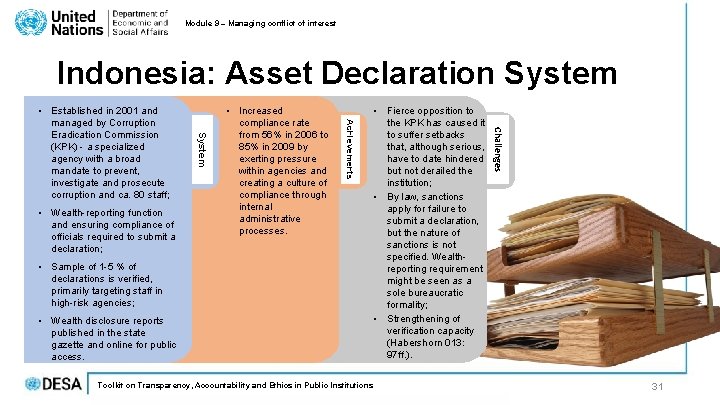
Module 9 – Managing conflict of interest Indonesia: Asset Declaration System • Wealth disclosure reports published in the state gazette and online for public access. • Fierce opposition to the KPK has caused it to suffer setbacks that, although serious, have to date hindered but not derailed the institution; • By law, sanctions apply for failure to submit a declaration, but the nature of sanctions is not specified. Wealthreporting requirement might be seen as a sole bureaucratic formality; • Strengthening of verification capacity (Habershorn 013: 97 ff. ). Toolkit on Transparency, Accountability and Ethics in Public Institutions Challenges • Sample of 1 -5 % of declarations is verified, primarily targeting staff in high-risk agencies; • Increased compliance rate from 56% in 2006 to 85% in 2009 by exerting pressure within agencies and creating a culture of compliance through internal administrative processes. Achievements • Wealth-reporting function and ensuring compliance of officials required to submit a declaration; System • Established in 2001 and managed by Corruption Eradication Commission (KPK) - a specialized agency with a broad mandate to prevent, investigate and prosecute corruption and ca. 80 staff; 31
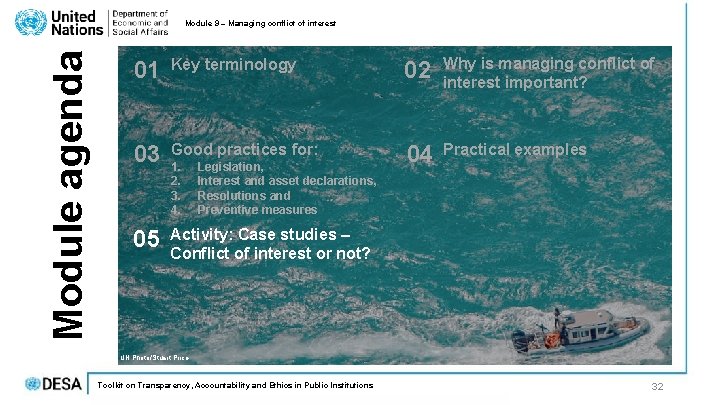
Module agenda Module 9 – Managing conflict of interest 01 Key terminology 02 Why is managing conflict of interest important? 03 Good practices for: 04 Practical examples 05 Activity: Case studies – Conflict of interest or not? 1. 2. 3. 4. Legislation, Interest and asset declarations, Resolutions and Preventive measures UN Photo/Stuart Price Toolkit on Transparency, Accountability and Ethics in Public Institutions 32
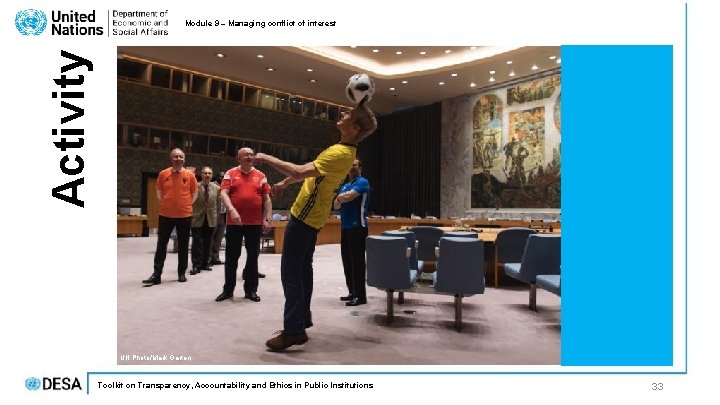
Activity Module 9 – Managing conflict of interest UN Photo/Mark Garten Toolkit on Transparency, Accountability and Ethics in Public Institutions 33
Module 9 – Managing conflict of interest Case studies – Conflict of interest or not? What? Why? The purpose of this activity is to assist participants to develop practical skills in recognizing conflict-of-interest problems and in applying a sound decision-making procedure in a process of ethical reasoning. - On the following pages, you find a number of case studies that may (or not) constitute conflict-of-interest situations; - Identify whether situations presented constitute a real conflict of interest or not, give reasons for your decision and, if applicable, propose how the conflict of interest could be resolved. Time - Reserve ca. 30 minutes for this exercise and adapt the number of cases to be examined to this time limit; - You may for example select five cases and discuss each for 5 minutes; - Discussion can happen with the full group of participants or participants can discuss with each other in small groups and present their resolution of the cases to the others. Resources - Versions of the case studies can be made available to participants on paper or digitally. OECD 2005: 75 ff. Toolkit on Transparency, Accountability and Ethics in Public Institutions 34
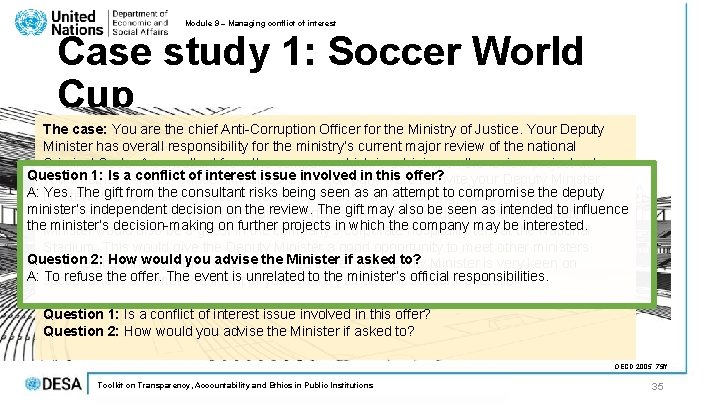
Module 9 – Managing conflict of interest Case study 1: Soccer World Cup The case: You are the chief Anti-Corruption Officer for the Ministry of Justice. Your Deputy Minister has overall responsibility for the ministry’s current major review of the national Criminal Code. A consultant from the company which is advising on the review project asks Question 1: Is a conflict of interest issueif involved in this offer? you whether it would “cause difficulties” the company were to invite your Deputy Minister A: to Yes. The gift from the consultant risks being seen as an attempt to compromise deputy attend the forthcoming Soccer World Cup finals in a neighboring country. The the consultant minister’s independent decision the review. The gift may also be seen as intended to influence says that the company would on provide the airfares and accommodation, and the Deputy the. Minister minister’s decision-making on in further projects incorporate which thehospitality company may bethe interested. would also be a guest the company’s tent at National Stadium. This would give the Deputy Minister a good opportunity to meet other ministers Question 2: How would you who advise asked to? Minister is very keen on from neighboring countries willthe also. Minister be there. if The Deputy A: soccer To refuse offer. The. President event is unrelated to the minister’s official responsibilities. andthe is a former of your country’s national Soccer Federation. Question 1: Is a conflict of interest issue involved in this offer? Question 2: How would you advise the Minister if asked to? OECD 2005: 75 ff. Toolkit on Transparency, Accountability and Ethics in Public Institutions 35
Module 9 – Managing conflict of interest Case study 2: The lunch The case: On occasions, and often in their own time, the most senior public servants of a Question: What are the integrity here? government agency (the Ministryissues of Infrastructure Development) attend lunches or dinners A: While some social contact between public servants and representatives of the private sector is with a wide range of business people, including representatives of schools, churches, the inevitable, and may often be desirable, the provision and timing manufacturers of the (reportedly) local newspapers and TV, property developers, consultants, and“lavish” lunch is likely to raise suspicions about integrity of the publicpart servants involved the decision, and the construction companies. Thisthe has been understood of senior publicin servants’ activities integrity the contract process ofno thefee ministry. The lunchinvolved. also creates, minimum, an apparent in thisofministry, and as there is or other money Theseatactivities have never conflict of interest for the public servants. In this example, it is irrelevant that the lunch occurred been seen as a problem for the Ministry. during theirrecent free time (they cannot claim to public be present in a attended “private capacity”). On one occasion, three of these servants what was reported in a Thenewspaper ministry must be able to demonstrate that the contracting process wasconstruction appropriately free of the next day as a “lavish” lunch hosted by a prominent local improper or corrupt influences. If it cannot, thisministry situationdecided may befinally an example of a form of “state company. This occurred a week before the on awarding a number capture” – obtaining a favorable official decision bythat covert public servants of major construction contracts. It was reported the influence companyof which had hostedthrough the corrupt methods and should be investigated. lunch won the majority of the contracts. Question: What are the integrity issues here? OECD 2005: 75 ff. Toolkit on Transparency, Accountability and Ethics in Public Institutions 36
Module 9 – Managing conflict of interest Case study 3: The recruitment The case: A middle-level a public refuses to Question: Is there a seriousmanager conflict employed of interestby here, or isauthority it just a repeatedly matter of personal recruit, or to select for training opportunities, staff from a particular religious and ethnic preference? background, even when individuals are and wellactual qualified andof skilled, as of heself-dealing. says, A: This is an example of a serious conflict, abuse office, because, in the form people nothinghis/her but trouble”. The“those manager usesare indulges personal prejudice against the ethnic group concerned, at the expense of the employer’s interests [in obtaining trained staff, and in having a reputation as a good Question: Is thereall a serious conflict interest here, or is it just a matter of personal employer, for treating staff equally andoffairly]. preference? Of course, the legitimate interests of those staff who are excluded from training are also being denied. The community at large may also be seen as disadvantaged, in that equal access to public employment opportunities for all qualified people is being prevented by this manager’s conduct. The manager’s conduct may also cause the organization to breach applicable anti-discrimination/equal opportunity law(s), potentially exposing the organization (and the government) to penalties, including the payment of compensation. OECD 2005: 75 ff. Toolkit on Transparency, Accountability and Ethics in Public Institutions 37
Module 9 – Managing conflict of interest Case study 4: The driver The case: part of his official driver required to use the Question: Is it. Asacceptable for theduties, driver an to official carry out hisisprivate business in ministry’s the ministry’s vehicle. Or to is deliver and to carry out official errands. His job, which not well paid, vehicle? this amessages case of corruption? requires him to be may “on call” and away from the ministry lengthy periods days, andthere A: This arrangement be seen as “reasonable” if otherfor official business is on notmost delayed, hesignificant is trusted to carry outcost his or duties supervision. The driver has been with the is no additional risk with to theminimal organization. for many years has never been any trouble. and Because of the Butministry it may also be seen as and an apparent conflict of interest, favoritism of flexibility the individual driver’s work finds servant it very useful out personal such as concerned: The arrangements, appearance of he a public usingto a carry government vehiclebusiness, for private purposes shopping, or taking his children to school, during the working day. may also be problematic. Using the ministry vehicle for private purposes is not “corrupt” provided that the ministry knows of, acceptable driver to arrangements carry out his private business in the and. Question: approves Is of, itthe practice. for Butthe “personal” (e. g. tacit approval by ministry’s a local manager, vehicle? Or documentation) is this a case of can corruption? without formal be misunderstood, and may be unlawful. OECD 2005: 75 ff. Toolkit on Transparency, Accountability and Ethics in Public Institutions 38
Module 9 – Managing conflict of interest Case study 5: The market The case: Your Office issues licenses to traders who have restaurants and food stalls in the Question: What are the ethical issues here? town. Your job is to process the license applications. One day a popular food stall operator, A: The offer of a valuable gift in these circumstances creates a conflict of interest. Mr A, comes to your office to seek urgent renewal of his business license, which expires Unwarranted delay in processing the applications of those traders who had applied in time is also an tomorrow. He says he has been away on urgent business and did notice the renewal issue. date. It normally takes a week in total for your Office to process a license application through The claim that the trader will be offended if you refuse his “gift” is irrelevant. The gift offered is the various steps. Your Office has a strict policy of prosecuting unlicensed traders: if Mr A is actually a bribe to influence you to not apply the office’s administration procedures in this case, that caught trading without a license he could be disqualified from holding a license and lose his is, to treat him more favorably than other traders. place in the Market. To show his appreciation for helping him, Mr A offers to provide you and your family with free meals for a month if you will agree to process his license renewal application today. This is a valuable offer, amounting to a week’s salary for you. He will be very offended if you refuse his gift. The Office has a strict anti-bribery rule, but you know that the rule does not prohibit gifts of food. If you agree to do as he asks, it is inevitable that approval of several other applications will be delayed by three days, as today is Friday and Monday is a religious holiday. Question: What are the ethical issues here? Toolkit on Transparency, Accountability and Ethics in Public Institutions OECD 2005: 75 ff. 39
Module 9 – Managing conflict of interest Case study 6: The survey Question 1: Is. A the public servant actingtowrongly in this The case: public servant is directed summarize the example? public’s responses to his ministry’s A: Yes. This is an actual conflict of interest. recent survey on the Government’s proposed changes to the laws regulating environmental protection in the forestry industry. The public servant secretly discards those survey Question 2: What wrong with putting your own views, as long asabout you have a clear responses whichisare in conflict with her forward / his well-considered personal beliefs the need conscience that you are right? for stronger government protection of the environment, and forests in particular. The public A: The public servant is “putting her / his views” in this example: S/he is secretly distorting servant is a well-qualified andforward experienced forestry scientist. the survey by destroying government information to advance a personal objective. This is in a strict sense, corrupt 1: conduct – i. e. servant acting dishonestly, or ininbreach of trust, as a public servant and gaining Question Is the public acting wrongly this example? an Question advantage 2: for. What a private interest so doing. is wrong within putting forward your own views, as long as you have a clear Theconscience fact that protecting forests generally might be argued to be “in the public interest” does not that you are right? remove the conflict of interest in this case. OECD 2005: 75 ff. Toolkit on Transparency, Accountability and Ethics in Public Institutions 40
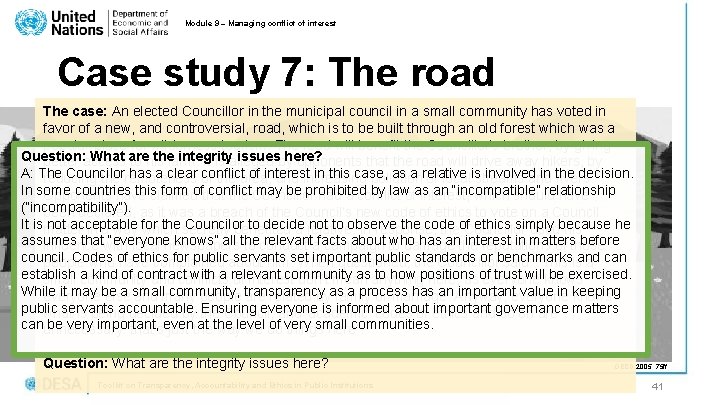
Module 9 – Managing conflict of interest Case study 7: The road The case: An elected Councillor in the municipal council in a small community has voted in favor of a new, and controversial, road, which is to be built through an old forest which was a popular place for wilderness tourism. The road will benefit the Councillor’s brother, by giving Question: What are thefarm. integrity issuesby here? better access to his It is alleged opponents that the road will drive away hikers, by A: The Councilor has a clear conflict of interest in this case, as a relative involved in the decision. reducing the remoteness of the area, and increasing pollution of localisstreams and rivers. In some countries this form ofthat conflict may be prohibited by lawofas an “incompatible” relationship Opponents have claimed the Councillor had a conflict interest, which should have (“incompatibility”). been declared, as it was a breach of the Council’s new code of ethics to vote on a Council It is matter not acceptable the secretly Councilor to decide not to observe the code ethics simply he in a way for which benefited a relative. In response, theof. Councillor usedbecause his assumes thatwith “everyone knows” all the relevantafacts about to who has anthe interest in matters before influence local newspapers to conduct campaign damage reputations of those council. Codes ethics for publicabout servants important public the standards or benchmarks people who of have complained him. set When questioned, Councillor said: “This isand a can establish a kind of contract with a relevant community as anything to how positions trust willknows be exercised. small community and conflicts of interest don’t mean here, asof everyone While it may be a small community, a process has an Anyway, importanteveryone value in keeping everyone else and many people transparency are related byas family or marriage. knows public servants accountable. Ensuring everyone is informed about important governance matters what is being decided by the Council, and ‘academic’ codes of ethics and so on are canunnecessary: be very important, at the of very small communities. that’seven just the waylevel we do things here”. Question: What are the integrity issues here? Toolkit on Transparency, Accountability and Ethics in Public Institutions OECD 2005: 75 ff. 41
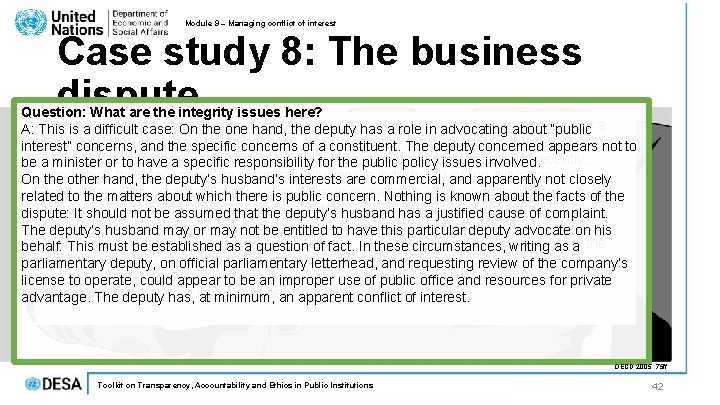
Module 9 – Managing conflict of interest Case study 8: The business dispute Question: What are the integrity issues here? Theiscase: The husband a Parliamentary Deputy has is involved a businessabout dispute over a A: This a difficult case: Onof the one hand, the deputy a role ininadvocating “public contract with a private company to provide security services including armed guards. not to interest” concerns, and thesector specific concerns of a constituent. The deputy concerned appears hasor been considerable debate in newspapers and TV recently, be a. There minister to have a specificpublic responsibility forthe thenational public policy issues involved. the need for reform of the security service industry, involving allegations On concerning the other hand, the deputy’s husband’s interests are commercial, and apparently notofclosely connections with organized crime, using illegalconcern. immigrants as employees, failurethe to facts perform related to the matters about which there is public Nothing is known about of the services contracted for, tax evasion, and trafficking in drugs and illegal weapons. The dispute: It should not be assumed that the deputy’s husband has a justified cause of complaint. Deputy writes on not parliamentary the head deputy of the ministry which The. Parliamentary deputy’s husband may or may be entitled letterhead to have thistoparticular advocate on his licenses companies who provide security services: She complains about the conduct of behalf: This must be established as a question of fact. In these circumstances, writing as a the company and askson forofficial their business licenseletterhead, to be reviewed. parliamentary deputy, parliamentary and requesting review of the company’s license to operate, could appear to be an improper use of public office and resources for private Question: arehas, the integrity issues advantage. The. What deputy at minimum, anhere? apparent conflict of interest. OECD 2005: 75 ff. Toolkit on Transparency, Accountability and Ethics in Public Institutions 42
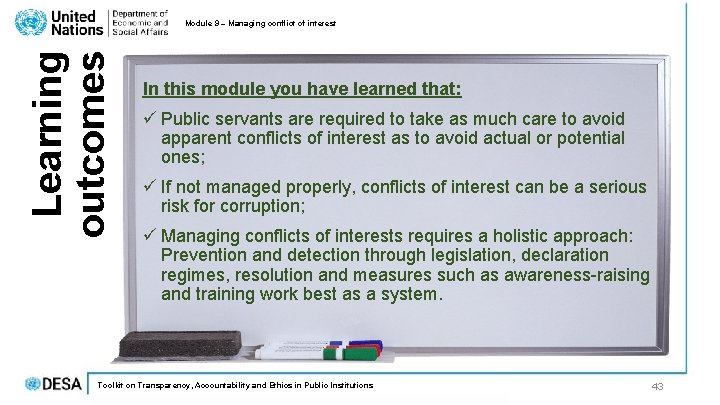
Learning outcomes Module 9 – Managing conflict of interest In this module you have learned that: ü Public servants are required to take as much care to avoid apparent conflicts of interest as to avoid actual or potential ones; ü If not managed properly, conflicts of interest can be a serious risk for corruption; ü Managing conflicts of interests requires a holistic approach: Prevention and detection through legislation, declaration regimes, resolution and measures such as awareness-raising and training work best as a system. Toolkit on Transparency, Accountability and Ethics in Public Institutions 43
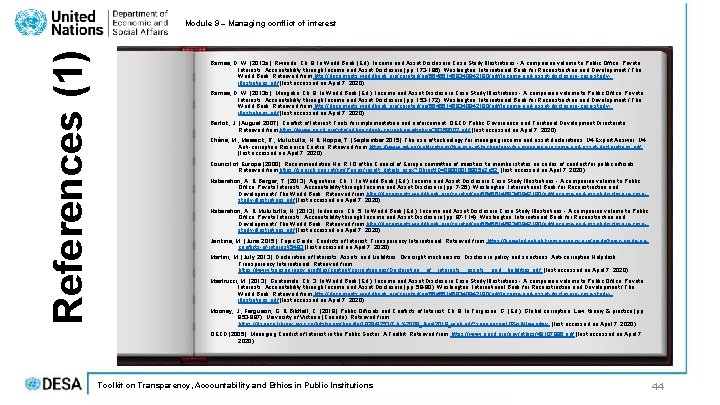
References (1) Module 9 – Managing conflict of interest Barnes, D. W. (2013 a). Rwanda, Ch. 9. In World Bank (Ed. ). Income and Asset Disclosure Case Study Illustrations - A companion volume to Public Office, Private Interests: Accountability through Income and Asset Disclosure (pp. 173 -186). Washington: International Bank for Reconstruction and Development / The World Bank. Retrieved from http: //documents. worldbank. org/curated/en/664561468340842190/pdf/Income-and-asset-disclosure-case-studyillustrations. pdf (last accessed on April 7, 2020). Barnes, D. W. (2013 b). Mongolia, Ch. 8. In World Bank (Ed. ). Income and Asset Disclosure Case Study Illustrations - A companion volume to Public Office, Private Interests: Accountability through Income and Asset Disclosure (pp. 153 -172). Washington: International Bank for Reconstruction and Development / The World Bank. Retrieved from http: //documents. worldbank. org/curated/en/664561468340842190/pdf/Income-and-asset-disclosure-case-studyillustrations. pdf (last accessed on April 7, 2020). Bertók, J. (August 2007). Conflict of Interest: Tools for implementation and enforcement. OECD Public Governance and Territorial Development Directorate. Retrieved from https: //www. oecd. org/site/adboecdanti-corruptioninitiative/39368002. pdf (last accessed on April 7, 2020). Chêne, M. , Messick, R. , Mulukutla, H. & Hoppe, T. (September 2015). The use of technology for managing income and asset declarations. U 4 Expert Answer. U 4 Anti-corruption Resource Centre. Retrieved from https: //www. u 4. no/publications/the-use-of-technology-for-managing-income-and-asset-declarations. pdf (last accessed on April 7, 2020). Council of Europe (2000). Recommendation No. R 10 of the Council of Europe committee of ministers to member states on codes of conduct for public officials. Retrieved from https: //search. coe. int/cm/Pages/result_details. aspx? Object. ID=09000016805 e 2 e 52 (last accessed on April 7, 2020). Habershon, A. & Berger, T. (2013). Argentinia, Ch. 1. In World Bank (Ed. ). Income and Asset Disclosure Case Study Illustrations - A companion volume to Public Office, Private Interests: Accountability through Income and Asset Disclosure (pp. 7 -26). Washington: International Bank for Reconstruction and Development / The World Bank. Retrieved from http: //documents. worldbank. org/curated/en/664561468340842190/pdf/Income-and-asset-disclosure-casestudy-illustrations. pdf (last accessed on April 7, 2020). Habershon, A. & Mulukutla, H. (2013). Indonesia, Ch. 5. In World Bank (Ed. ). Income and Asset Disclosure Case Study Illustrations - A companion volume to Public Office, Private Interests: Accountability through Income and Asset Disclosure (pp. 97 -114). Washington: International Bank for Reconstruction and Development / The World Bank. Retrieved from http: //documents. worldbank. org/curated/en/664561468340842190/pdf/Income-and-asset-disclosure-casestudy-illustrations. pdf (last accessed on April 7, 2020). Jenkins, M. (June 2015). Topic Guide: Conflicts of Interest. Transparency International. Retrieved from https: //knowledgehub. transparency. org/guide/topic-guide-onconflicts-of-interest/5483 (last accessed on April 7, 2020). Martini, M. (July 2013). Declaration of Interests, Assets and Liabilities: Oversight mechnaisms, Disclosure policy and sanctions. Anti-corruption Helpdesk. Transparency International. Retrieved from https: //www. transparency. org/files/content/corruptionqas/Declaration__of__interests__assets__and__liabilities. pdf (last accessed on April 7, 2020). Mastruzzi, M. (2013). Guatemala, Ch. 3. In World Bank (Ed. ). Income and Asset Disclosure Case Study Illustrations - A companion volume to Public Office, Private Interests: Accountability through Income and Asset Disclosure (pp. 59 -80). Washington: International Bank for Reconstruction and Development / The World Bank. Retrieved from http: //documents. worldbank. org/curated/en/664561468340842190/pdf/Income-and-asset-disclosure-case-studyillustrations. pdf (last accessed on April 7, 2020). Mooney, J. , Ferguson, G. & Bildfell, C. (2018). Public Officials and Conflicts of Interest, Ch. 9. In Ferguson, G. (Ed. ). Global corruption: Law, theory & practice (pp. 853 -887). University of Victoria (Canada). Retrieved from https: //dspace. library. uvic. ca/bitstream/handle/1828/9253/Ch. %2009_April 2018_web. pdf? sequence=10&is. Allowed=y (last accessed on April 7, 2020). OECD (2005). Managing Conflict of Interest in the Public Sector: A Toolkit. Retrieved from https: //www. oecd. org/gov/ethics/49107986. pdf (last accessed on April 7, 2020). Toolkit on Transparency, Accountability and Ethics in Public Institutions 44
References (2) Module 9 – Managing conflict of interest OECD (2011). Asset Declarations for Public Officials: A Tool to Prevent Corruption, Paris: OECD Publishing. Retrieved from http: //www. oecd. org/daf/antibribery/47489446. pdf (last accessed on April 7, 2020). Open Government Partnership (November 2014). Open Government Guide. Cross Cutting Topics. Customised Report. Assets disclosure and conflicts of interests (authored by Global Integrity in lead). Retrieved from https: //www. opengovpartnership. org/wp-content/uploads/2019/06/open-gov-guide_summary_crosscutting-topics. pdf (last accessed on April 7, 2020). United Nations Convention against Corruption. Adopted by the UN General Assembly on 31 October 2003, by resolution 58/4. Retrieved from https: //www. unodc. org/documents/treaties/UNCAC/Publications/Convention/08 -50026_E. pdf (last accessed on April 7, 2020). World Bank / International Finance Corporation (April 2014). Asset Declaration Systems. Panel 1: Introduction to Asset Disclosure. Presentation held at MENA Regional Conference. Retrieved from http: //siteresources. worldbank. org/PUBLICSECTORANDGOVERNANCE/Resources/2857411233946247437/5810405 -1399294268994/AD-International-and-Regional-Trends. pdf (last accessed on April 7, 2020). Toolkit on Transparency, Accountability and Ethics in Public Institutions 45
Thank you.