
Module 8 Cleaning and Sanitizing Case Study What

- Slides: 46
Module 8: Cleaning and Sanitizing
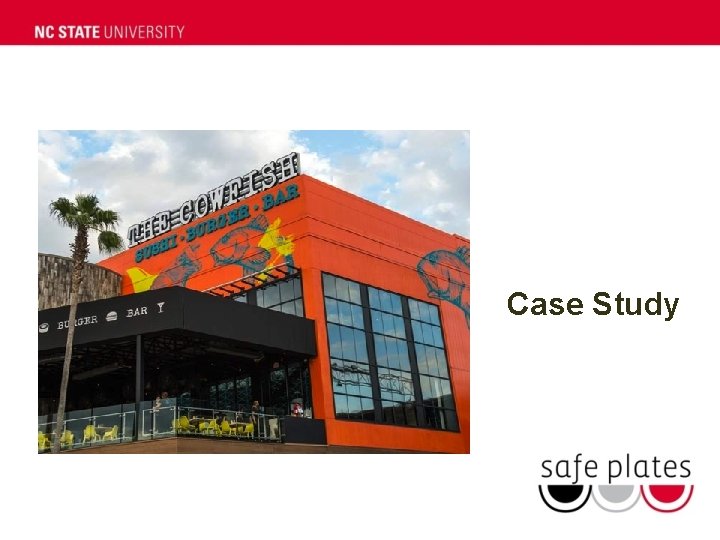
Case Study
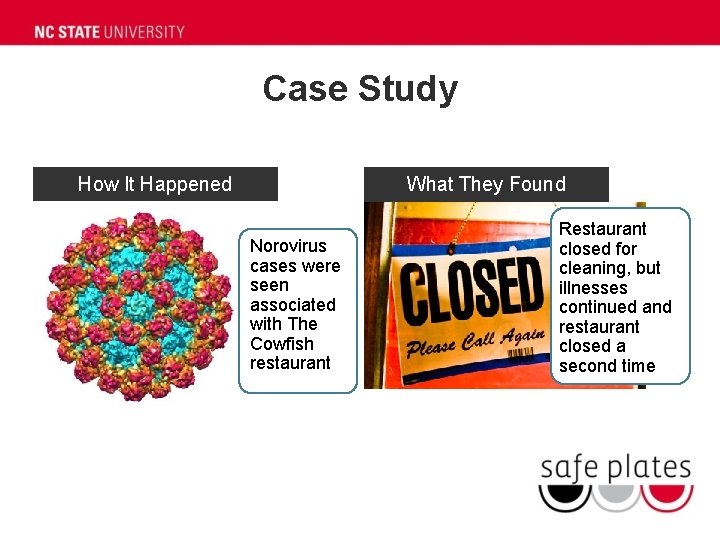
What Happened June 2015, Charlotte, NC • The Cowfish restaurant experienced an outbreak of Norovirus that sickened at least 96 people • Restaurant received several illness reports and closed on Friday, June 5 for cleaning • After investigating, they learned 9 of the 140 employees were sick, but many hadn’t reported illness because they weren’t scheduled to work
What Happened • Restaurant spent June 6 cleaning and reopened on June 7 • Illnesses continued to pop up, the restaurant closed again on June 10 and hired professional cleaning companies • Restaurant reopened on June 16
What They Found • Cowfish noticed more illnesses after first closing of the restaurant • Initial cleaning and sanitizing was not thorough enough • Location closed for further, more thorough cleaning • Restaurant realized the gravity of the outbreak and took action
Discussion Considering what you know about Norovirus, what could have gone wrong during Cowfish’s first cleaning attempt?
Learning Objectives • Describe the process for proper cleaning and sanitizing • Identify the methods of sanitizing and how to measure sanitizer concentration • Explain cross-contamination and how it affects food safety • Explain the importance of Safety Data Sheet (SDS) materials • Explain the use of a master cleaning schedule to reduce foodborne illness
Key Terms • Clean – make something free from dirt, food soil or residue • Sanitize – reduce number of pathogens to safe levels • Sterilize – process of killing all microorganisms • Master Cleaning Schedule – details of cleaning to be carried out by specified people at specified intervals and times
Key Terms • Detergent – chemical that helps dissolve grease and remove dirt • Sanitizer – heat or chemical that destroys pathogenic microorganisms to safe levels • Contact (exposure) time - period of time sanitizer must be in contact to work properly • Test strips – used to monitor concentration of chemical sanitizer and p. H
Key Terms • Clean-as-you-go - cleaning procedures carried out as you work • Food-contact surface – anything foods touch • Hand-contact surface – anything hands touch • Impervious – does not allow water to pass through • Durable – does not wear or damage easily over time
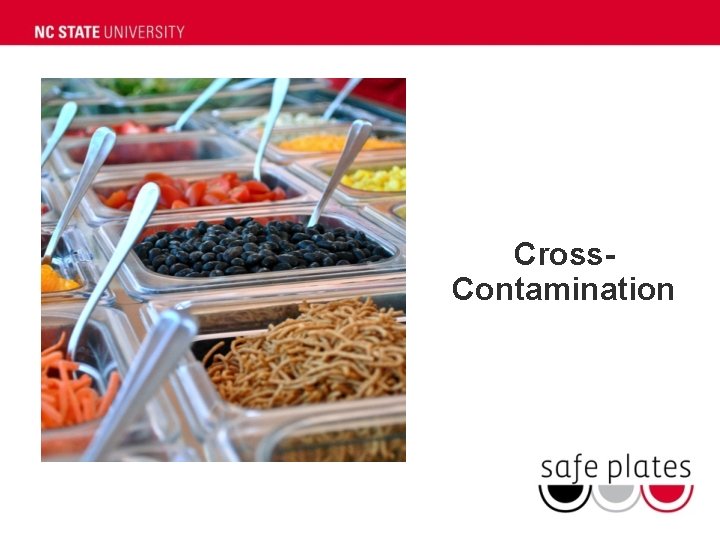
Cross. Contamination
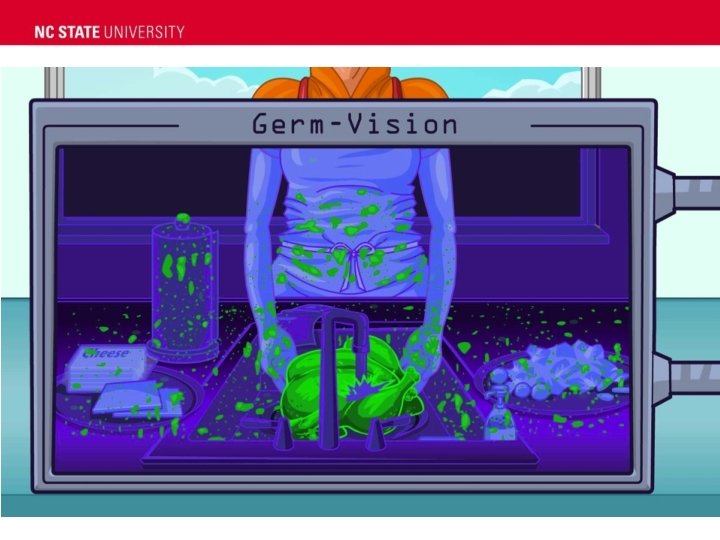
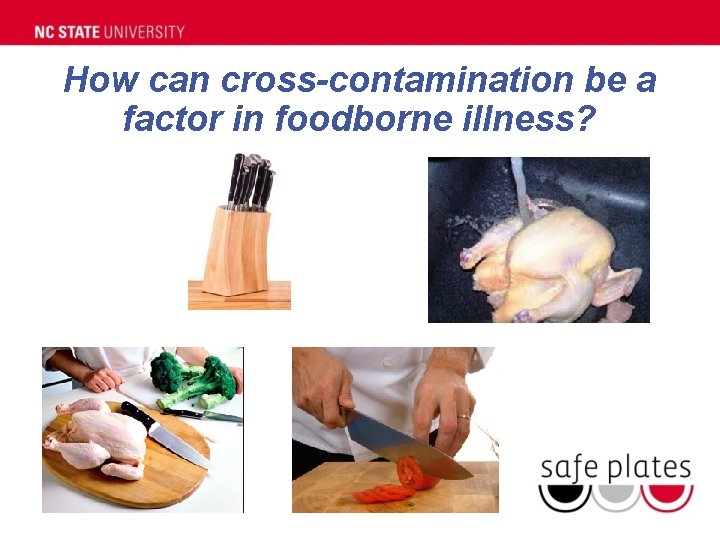
Cross-Contamination • Contamination is the presence of substances or conditions in food that can be harmful to humans. • Cross-contamination is the transfer of a harmful substance from one food item to another, usually from raw to cooked or ready-to-eat food. – Can be transferred by anything food contacts: hands, prep tables, equipment, utensils, cutting boards, standing or dripping water
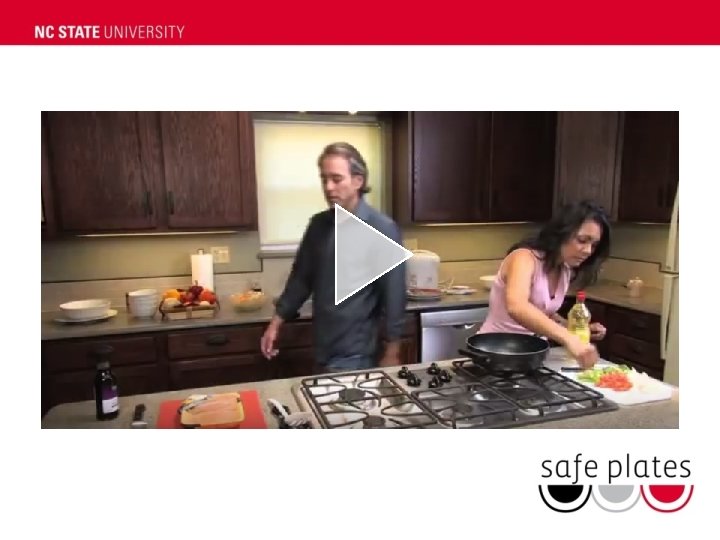
How can cross-contamination be a factor in foodborne illness?
Cross-Contamination • Hands are the most common vehicle for crosscontamination • Storage and preparation are also factors • Think about the simplest dish you prepare. – How many steps are involved from delivery to service? – How many opportunities are there for crosscontamination?
Cleaning and Sanitizing
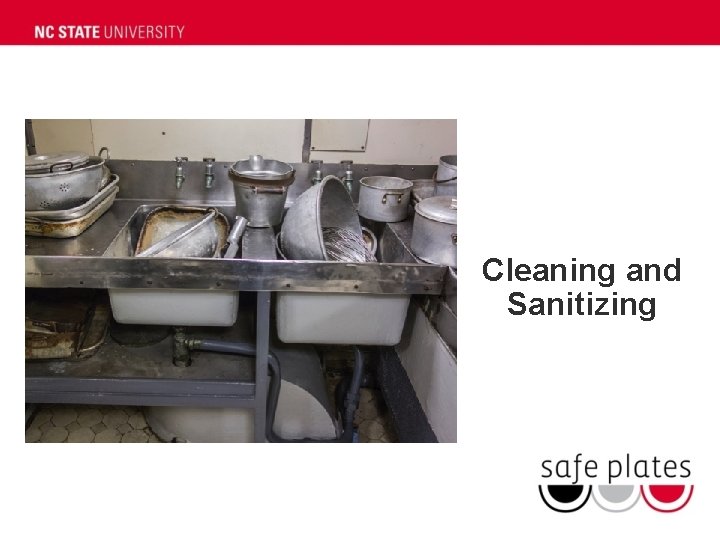
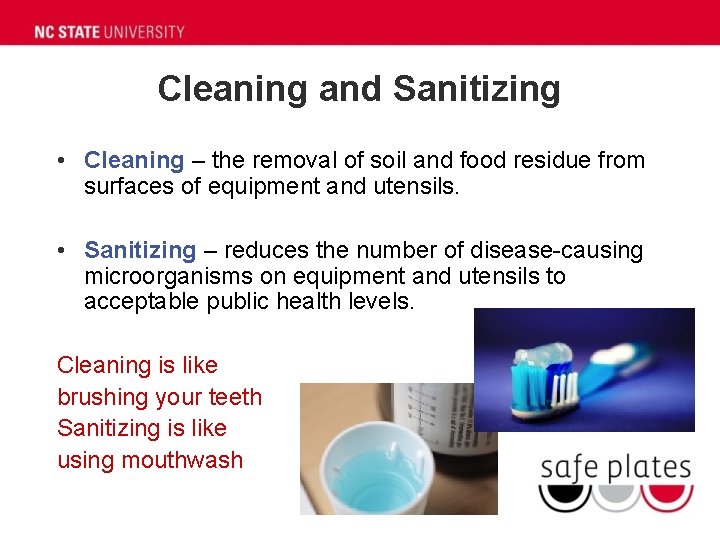
Cleaning and Sanitizing • Cleaning – the removal of soil and food residue from surfaces of equipment and utensils. • Sanitizing – reduces the number of disease-causing microorganisms on equipment and utensils to acceptable public health levels. Cleaning is like brushing your teeth Sanitizing is like using mouthwash
Why Clean and Sanitize? • To reduce risk of biological contamination • To reduce bacterial multiplication by removing food particles • To protect food from physical or chemical contamination • To help avoid attracting pests • To maintain safe environment (ex. slippery floors)
Five-Step Process 1. Pre-flush, pre-scrape or scrub to remove food residue 2. Wash at temperature of 110°F or follow manufacturer instructions 3. Rinse well to remove all food and detergent residue 4. Sanitize at contact time, concentration and temperature according to manufacturer instructions 5. Air dry, never towel dry
How Cleaning and Sanitizing Can Be Done • Manual Process – Use a 3 - or 4 - compartment sink – Test sanitizer concentration frequently – Use five step process • Mechanical Process – Use a dishwashing machine – Test sanitizer concentration per manufacturer instruction • Cleaning Fixed Equipment – Use a combination of manual and in-place cleaning procedures
What to Clean? What to Clean and Sanitize? • Clean and rinse – all surfaces, hand food contact • Clean and sanitize – all food-contact surfaces
Clean and Rinse Hand Contact Surfaces • Handles – Doors, refrigeration equipment, freezers, cupboards and drawers • Faucets, soap and paper towel dispensers • Switches • Wiping cloths, brushes, scrubbers and mops • Trash containers and lids
Clean, Rinse and Sanitize Food contact surfaces • Food preparation surfaces: – Preparation boards, cutting boards – Multi-use utensils – Tables and work surfaces • Food processing surfaces: – Machinery and equipment – Utensils (spatulas, mixers, mincers, knives, tongs, slicers) • Containers and service items
When to Clean and Sanitize • Create a master cleaning schedule with details about cleaning procedures • Equipment and utensils must be cleaned throughout the day (clean-as-you-go) • The FDA Model Food Code requires equipment used with time/temperature control for safety foods (TCS) to be cleaned at least every 4 hours when used at room temperature
When to Clean and Sanitize • Before using equipment or utensils • Before switching to another type of food • As frequently as possible during shift (minimum every 4 hours if in constant use) • Immediately after use • End of shift • Anytime there is risk of contamination (e. g. , leaving task temporarily)
Communication • Inform - Master Cleaning Schedule – Keep workers informed about what to clean, how to clean it, and what tools and supplies are required to conduct cleaning activities. • Share – “I’ll be back… This area is dirty” – “I’m handling meat. Could you do salads? ” • Correct – “Wait, you’re using the raw meat knife!” – “Why did you put the lettuce by the hand wash sink? ”
Sanitizers
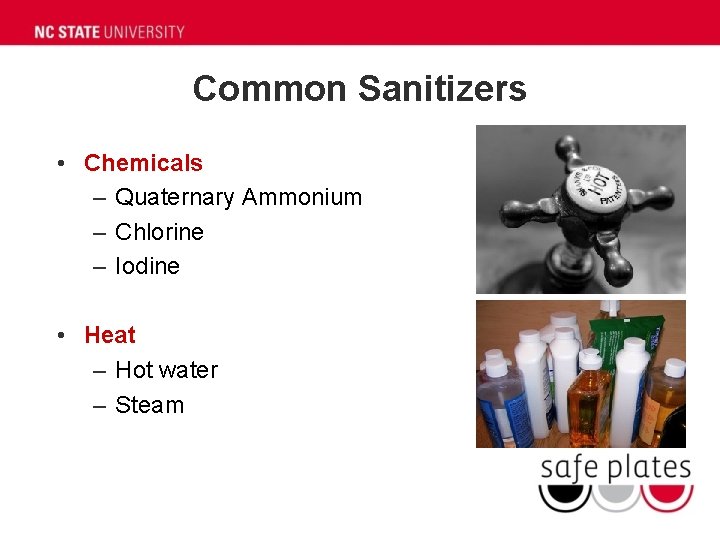
Common Sanitizers • Chemicals – Quaternary Ammonium – Chlorine – Iodine • Heat – Hot water – Steam
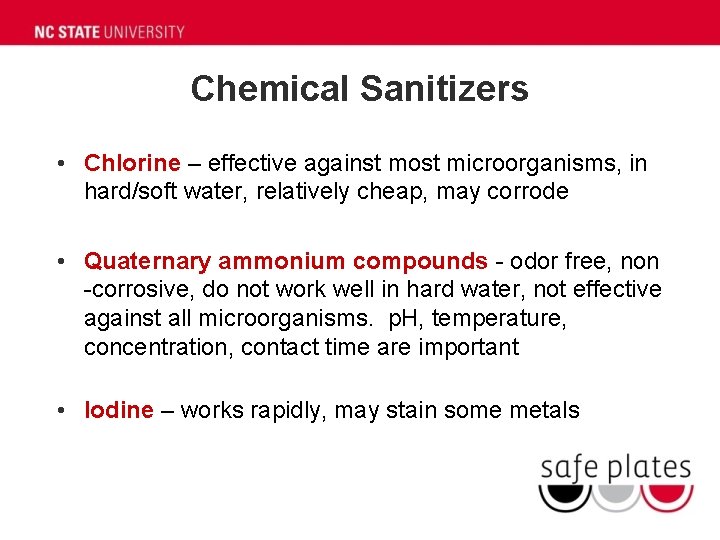
Chemical Sanitizers • Chlorine – effective against most microorganisms, in hard/soft water, relatively cheap, may corrode • Quaternary ammonium compounds - odor free, non -corrosive, do not work well in hard water, not effective against all microorganisms. p. H, temperature, concentration, contact time are important • Iodine – works rapidly, may stain some metals
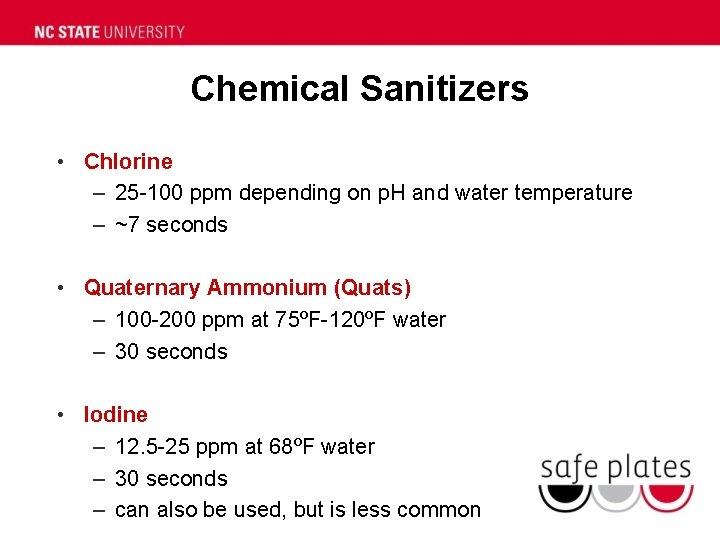
Chemical Sanitizers • Chlorine – 25 -100 ppm depending on p. H and water temperature – ~7 seconds • Quaternary Ammonium (Quats) – 100 -200 ppm at 75ºF-120ºF water – 30 seconds • Iodine – 12. 5 -25 ppm at 68ºF water – 30 seconds – can also be used, but is less common
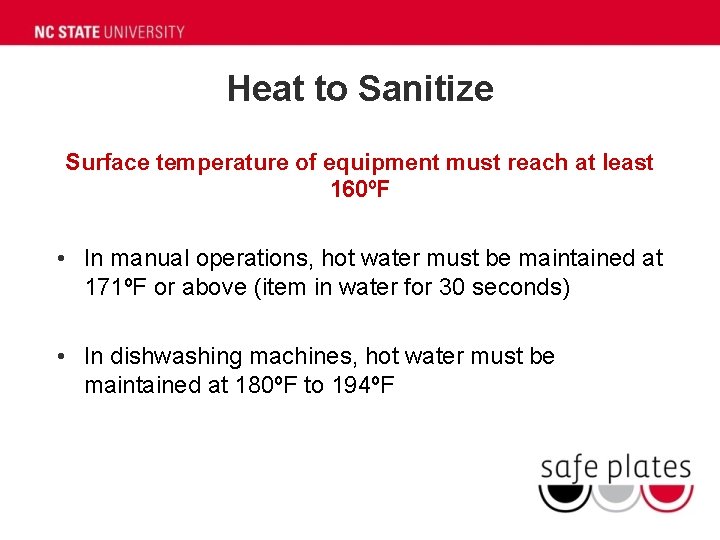
Heat to Sanitize Surface temperature of equipment must reach at least 160ºF • In manual operations, hot water must be maintained at 171ºF or above (item in water for 30 seconds) • In dishwashing machines, hot water must be maintained at 180ºF to 194ºF
Safety Precautions
Safety Precautions • Dry hands before cleaning electrical equipment • Switch off power/ safety/ breaker switch • Do not use chemical unless trained • Never mix chemicals together
Safety Precautions • Use personal protective equipment (PPE) – gloves, aprons, goggles • Use rack or basket to immerse items in hot water for sanitizing • Follow manufacturer’s instructions, contact supplier with questions • Wash hands after cleaning
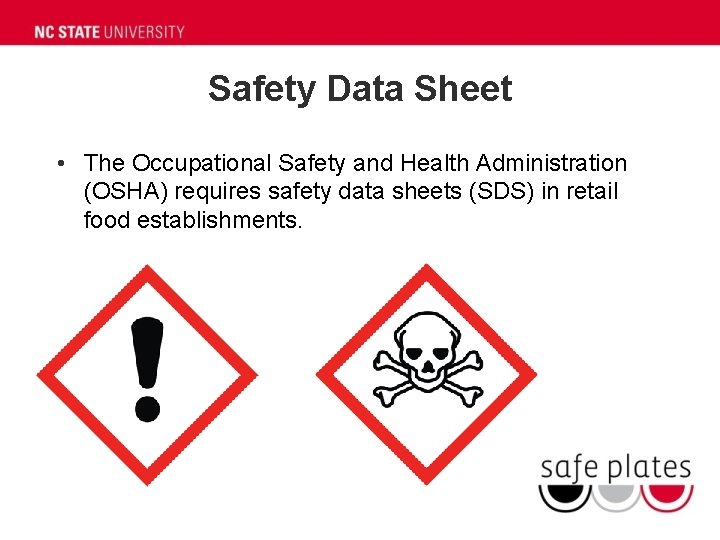
Safety Data Sheet • The Occupational Safety and Health Administration (OSHA) requires safety data sheets (SDS) in retail food establishments.
Safety Data Sheet • SDS provide workers information about: – The characteristics of hazardous substances present in the workplace – Personal protective equipment – Emergency first-aid procedures, and – Spill, leak, and disposal procedures. • Don’t let cleaner and sanitizers become a source of chemical contamination!
Case Study How It Happened What They Found Norovirus cases were seen associated with The Cowfish restaurant Restaurant closed for cleaning, but illnesses continued and restaurant closed a second time
Case Study What Went Wrong Cleaning and sanitizing efforts for the Norovirus outbreak were inadequate Prevention Proper cleaning and sanitizing Prevent cross contamination
Quiz Which of the following are the correct steps to follow when using your manual 3 compartment sink to wash dishes and utensils? a) pre-scrape and pre-flush, wash, rinse, sanitize, and air dry b) pre-scrape and pre-flush, rinse, wash, sanitize, and air dry c) pre-scrape and pre-flush, wash, rinse, sanitize, and towel dry d) pre-scrape and pre-flush, rinse, wash, sanitize, and towel dry
Quiz Which of the following are the correct steps to follow when using your manual 3 compartment sink to wash dishes and utensils? a) pre-scrape and pre-flush, wash, rinse, sanitize, and air dry b) pre-scrape and pre-flush, rinse, wash, sanitize, and air dry c) pre-scrape and pre-flush, wash, rinse, sanitize, and towel dry d) pre-scrape and pre-flush, rinse, wash, sanitize, and towel dry
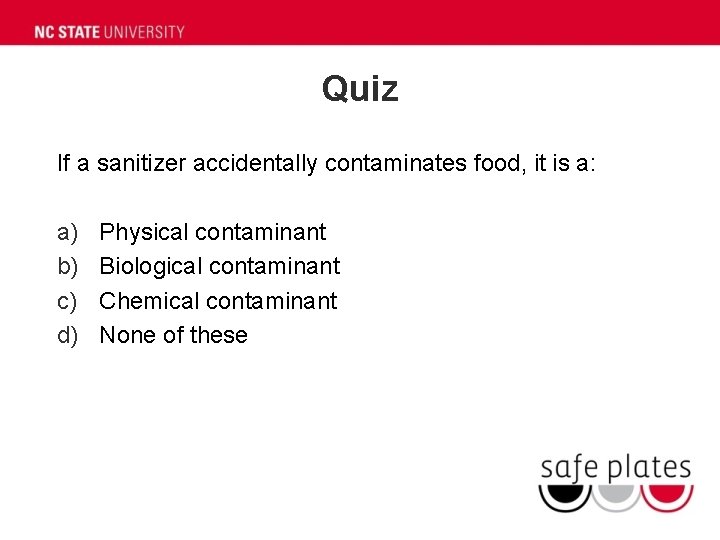
Quiz If a sanitizer accidentally contaminates food, it is a: a) b) c) d) Physical contaminant Biological contaminant Chemical contaminant None of these
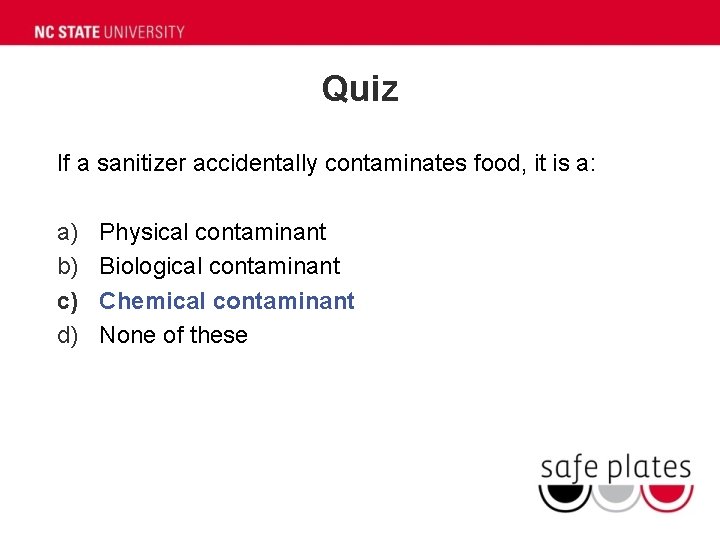
Quiz If a sanitizer accidentally contaminates food, it is a: a) b) c) d) Physical contaminant Biological contaminant Chemical contaminant None of these
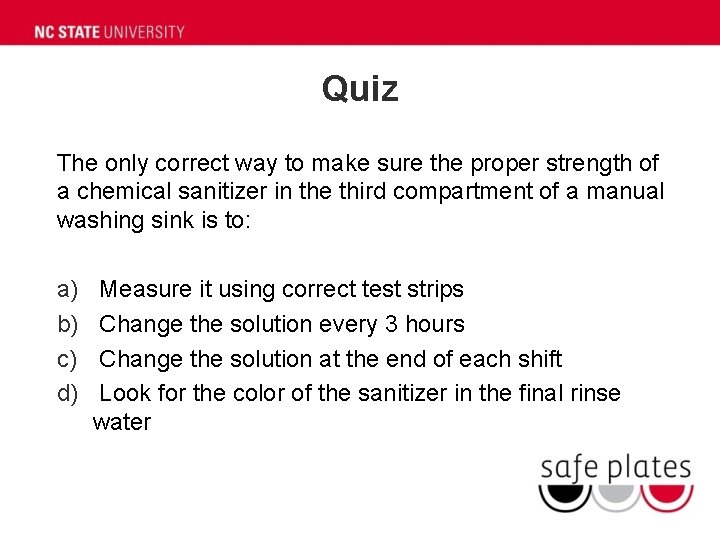
Quiz The only correct way to make sure the proper strength of a chemical sanitizer in the third compartment of a manual washing sink is to: a) b) c) d) Measure it using correct test strips Change the solution every 3 hours Change the solution at the end of each shift Look for the color of the sanitizer in the final rinse water
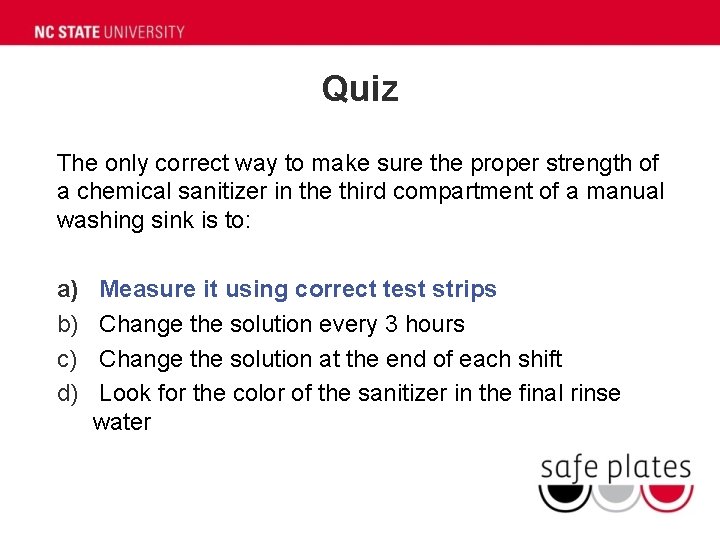
Quiz The only correct way to make sure the proper strength of a chemical sanitizer in the third compartment of a manual washing sink is to: a) b) c) d) Measure it using correct test strips Change the solution every 3 hours Change the solution at the end of each shift Look for the color of the sanitizer in the final rinse water
Review • Cross-Contamination • Cleaning and sanitizing • Master cleaning schedule