
Module 7 Process Synchronization Background The CriticalSection Problem
Module 7: Process Synchronization • • • Background The Critical-Section Problem Synchronization Hardware Semaphores Classical Problems of Synchronization Monitors Java Synchronization in Solaris 2 Synchronization in Windows NT Applied Operating System Concepts 7. 1 Silberschatz, Galvin, and Gagne 1999

Background • Concurrent access to shared data may result in data inconsistency. • Maintaining data consistency requires mechanisms to ensure the orderly execution of cooperating processes. • Shared-memory solution to bounded-butter problem (Chapter 4) has a race condition on the class data count Applied Operating System Concepts 7. 2 Silberschatz, Galvin, and Gagne 1999
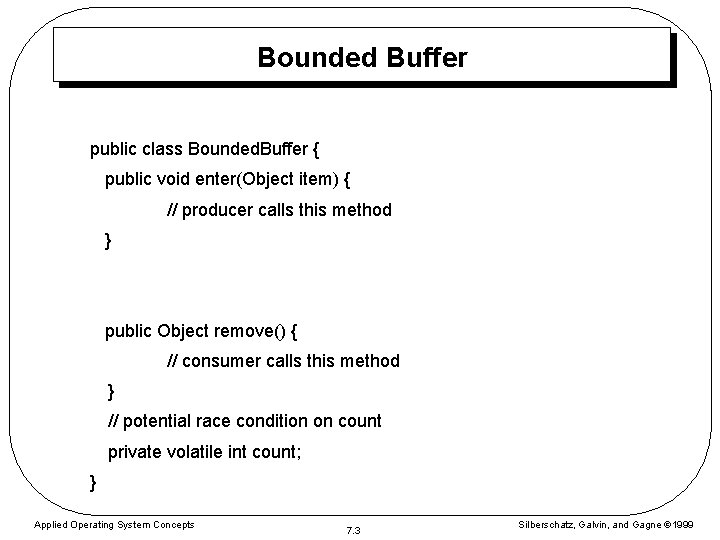
Bounded Buffer public class Bounded. Buffer { public void enter(Object item) { // producer calls this method } public Object remove() { // consumer calls this method } // potential race condition on count private volatile int count; } Applied Operating System Concepts 7. 3 Silberschatz, Galvin, and Gagne 1999
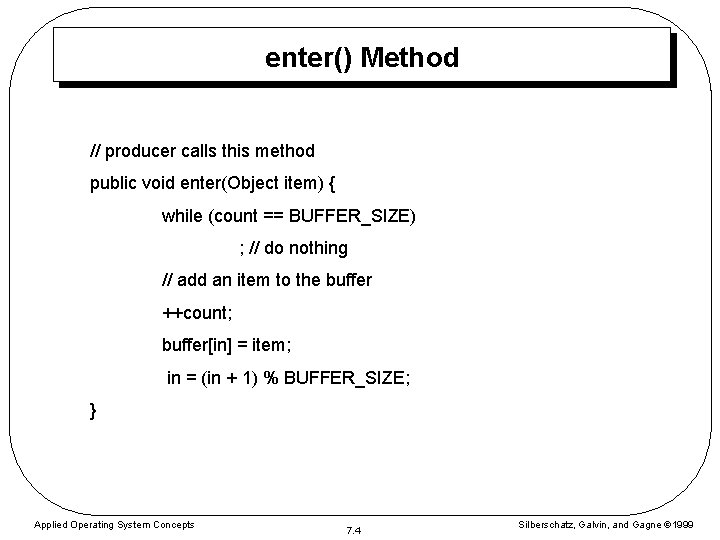
enter() Method // producer calls this method public void enter(Object item) { while (count == BUFFER_SIZE) ; // do nothing // add an item to the buffer ++count; buffer[in] = item; in = (in + 1) % BUFFER_SIZE; } Applied Operating System Concepts 7. 4 Silberschatz, Galvin, and Gagne 1999
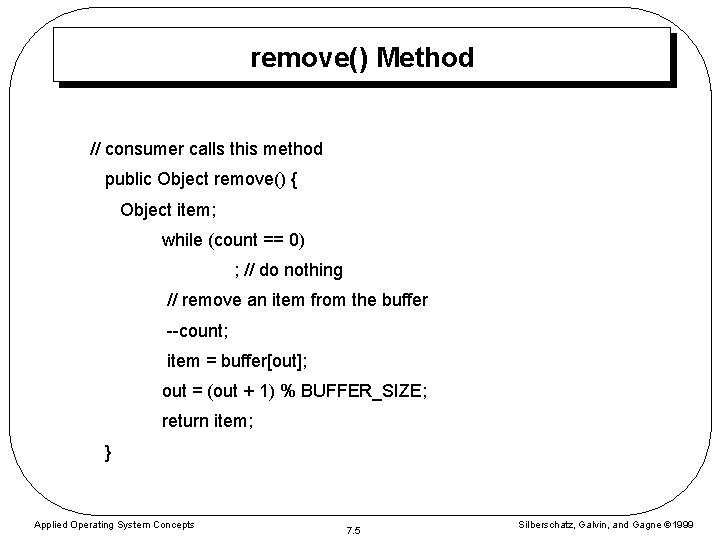
remove() Method // consumer calls this method public Object remove() { Object item; while (count == 0) ; // do nothing // remove an item from the buffer --count; item = buffer[out]; out = (out + 1) % BUFFER_SIZE; return item; } Applied Operating System Concepts 7. 5 Silberschatz, Galvin, and Gagne 1999
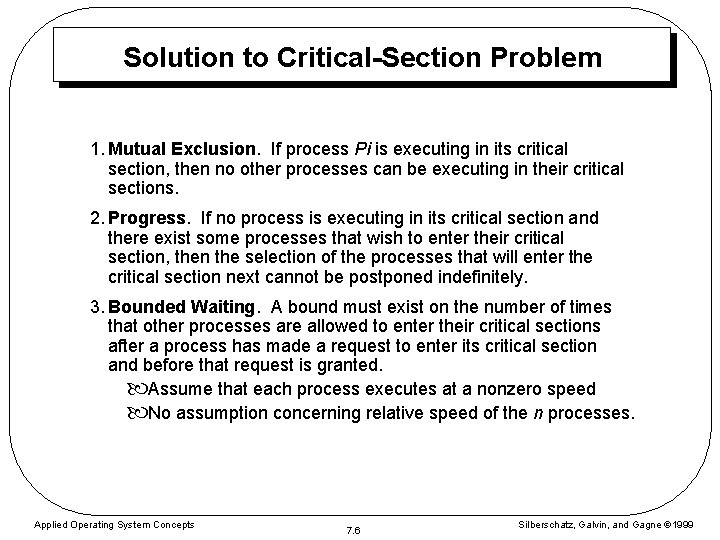
Solution to Critical-Section Problem 1. Mutual Exclusion. If process Pi is executing in its critical section, then no other processes can be executing in their critical sections. 2. Progress. If no process is executing in its critical section and there exist some processes that wish to enter their critical section, then the selection of the processes that will enter the critical section next cannot be postponed indefinitely. 3. Bounded Waiting. A bound must exist on the number of times that other processes are allowed to enter their critical sections after a process has made a request to enter its critical section and before that request is granted. Assume that each process executes at a nonzero speed No assumption concerning relative speed of the n processes. Applied Operating System Concepts 7. 6 Silberschatz, Galvin, and Gagne 1999
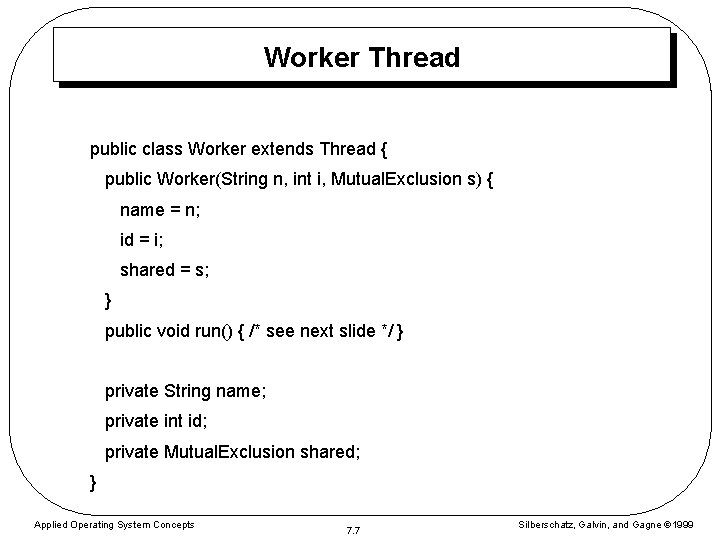
Worker Thread public class Worker extends Thread { public Worker(String n, int i, Mutual. Exclusion s) { name = n; id = i; shared = s; } public void run() { /* see next slide */ } private String name; private int id; private Mutual. Exclusion shared; } Applied Operating System Concepts 7. 7 Silberschatz, Galvin, and Gagne 1999
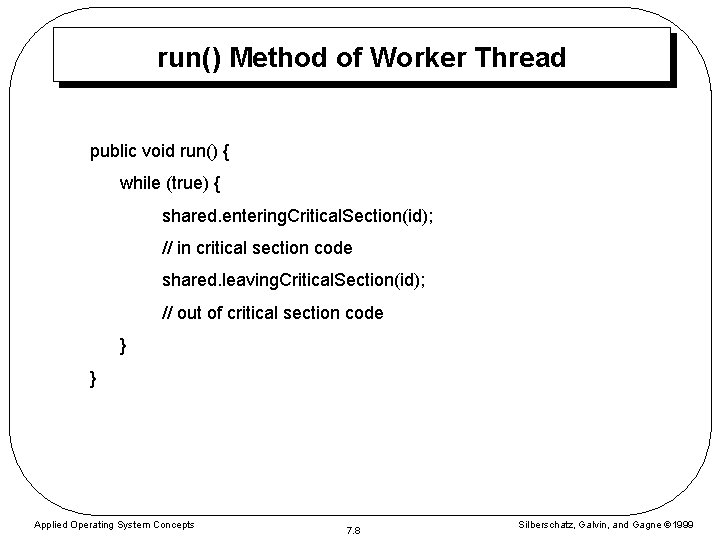
run() Method of Worker Thread public void run() { while (true) { shared. entering. Critical. Section(id); // in critical section code shared. leaving. Critical. Section(id); // out of critical section code } } Applied Operating System Concepts 7. 8 Silberschatz, Galvin, and Gagne 1999
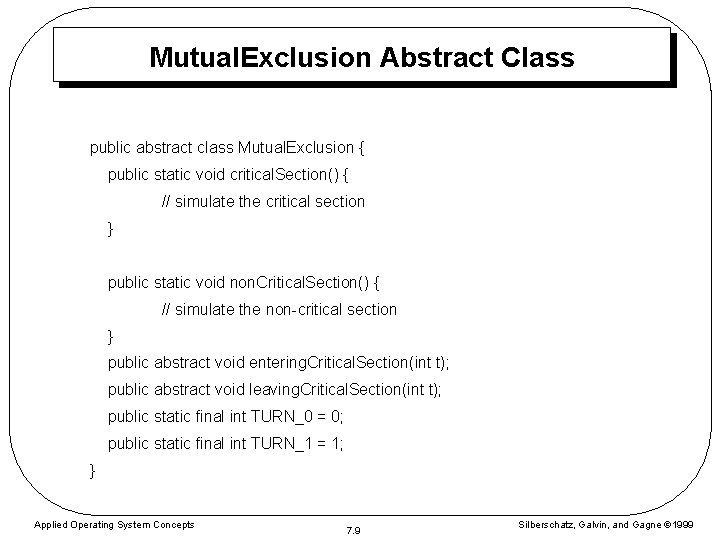
Mutual. Exclusion Abstract Class public abstract class Mutual. Exclusion { public static void critical. Section() { // simulate the critical section } public static void non. Critical. Section() { // simulate the non-critical section } public abstract void entering. Critical. Section(int t); public abstract void leaving. Critical. Section(int t); public static final int TURN_0 = 0; public static final int TURN_1 = 1; } Applied Operating System Concepts 7. 9 Silberschatz, Galvin, and Gagne 1999
![Testing Each Algorithm public class Test. Algorithm { public static void main(String args[]) {](http://slidetodoc.com/presentation_image_h2/178f0f84fba8305780c8cf0e583dd6ee/image-10.jpg "Testing Each Algorithm public class Test. Algorithm { public static void main(String args[]) {")
Testing Each Algorithm public class Test. Algorithm { public static void main(String args[]) { Mutual. Exclusion alg = new Algorithm_1(); Worker first = new Worker("Runner 0", 0, alg); Worker second = new Worker("Runner 1", 1, alg); first. start(); second. start(); } } Applied Operating System Concepts 7. 10 Silberschatz, Galvin, and Gagne 1999
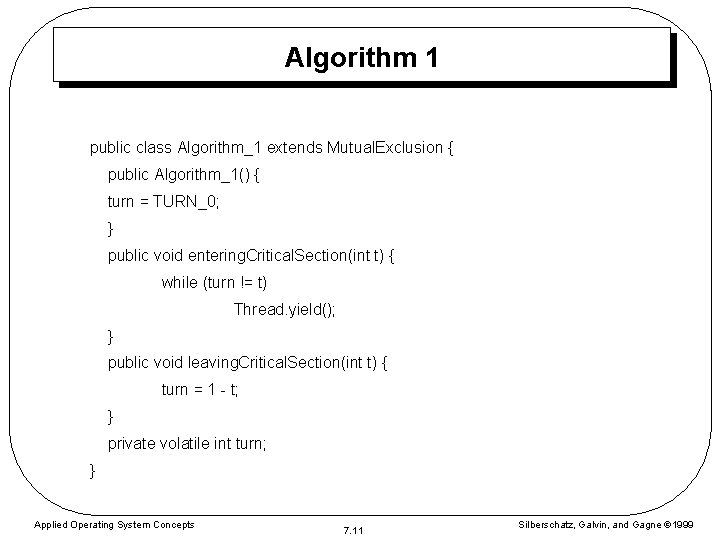
Algorithm 1 public class Algorithm_1 extends Mutual. Exclusion { public Algorithm_1() { turn = TURN_0; } public void entering. Critical. Section(int t) { while (turn != t) Thread. yield(); } public void leaving. Critical. Section(int t) { turn = 1 - t; } private volatile int turn; } Applied Operating System Concepts 7. 11 Silberschatz, Galvin, and Gagne 1999
![Algorithm 2 public class Algorithm_2 extends Mutual. Exclusion { public Algorithm_2() { flag[0] =](http://slidetodoc.com/presentation_image_h2/178f0f84fba8305780c8cf0e583dd6ee/image-12.jpg "Algorithm 2 public class Algorithm_2 extends Mutual. Exclusion { public Algorithm_2() { flag[0] =")
Algorithm 2 public class Algorithm_2 extends Mutual. Exclusion { public Algorithm_2() { flag[0] = false; flag[1] = false; } public void entering. Critical. Section(int t) { // see next slide } public void leaving. Critical. Section(int t) { flag[t] = false; } private volatile boolean[] flag = new boolean[2]; } Applied Operating System Concepts 7. 12 Silberschatz, Galvin, and Gagne 1999
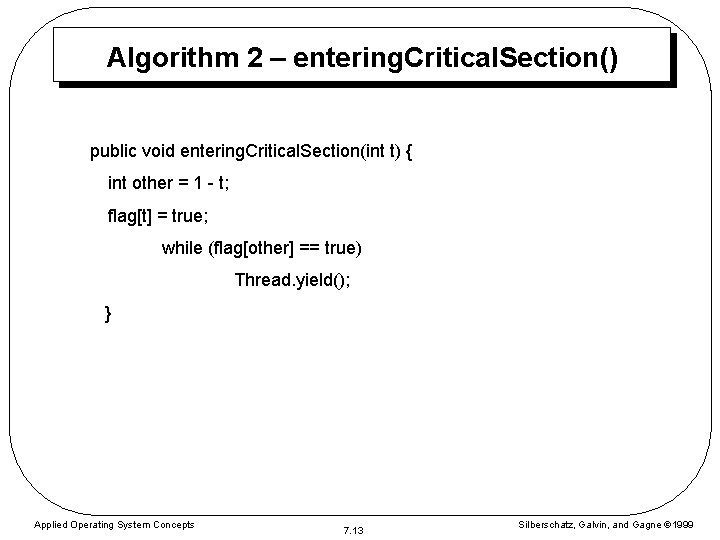
Algorithm 2 – entering. Critical. Section() public void entering. Critical. Section(int t) { int other = 1 - t; flag[t] = true; while (flag[other] == true) Thread. yield(); } Applied Operating System Concepts 7. 13 Silberschatz, Galvin, and Gagne 1999
![Algorithm 3 public class Algorithm_3 extends Mutual. Exclusion { public Algorithm_3() { flag[0] =](http://slidetodoc.com/presentation_image_h2/178f0f84fba8305780c8cf0e583dd6ee/image-14.jpg "Algorithm 3 public class Algorithm_3 extends Mutual. Exclusion { public Algorithm_3() { flag[0] =")
Algorithm 3 public class Algorithm_3 extends Mutual. Exclusion { public Algorithm_3() { flag[0] = false; flag[1] = false; turn = TURN_0; } public void entering. Critical. Section(int t) {/* see next slides */ } public void leaving. Critical. Section(int t) {{/* see next slides */ } private volatile int turn; private volatile boolean[] flag = new boolean[2]; } Applied Operating System Concepts 7. 14 Silberschatz, Galvin, and Gagne 1999
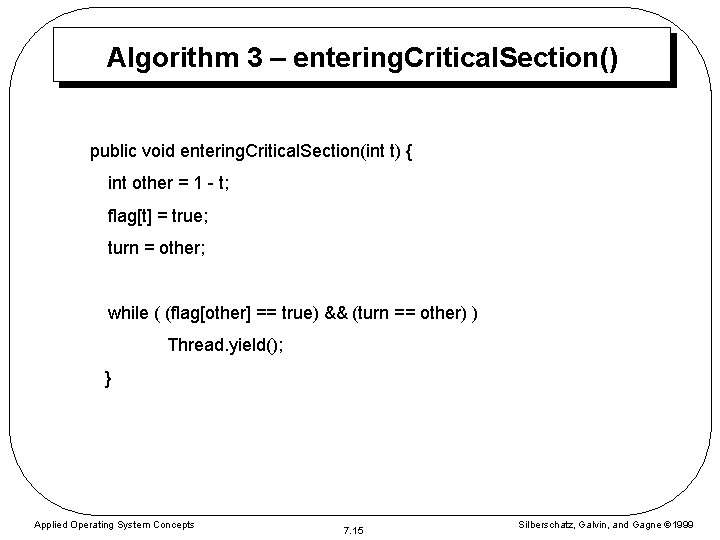
Algorithm 3 – entering. Critical. Section() public void entering. Critical. Section(int t) { int other = 1 - t; flag[t] = true; turn = other; while ( (flag[other] == true) && (turn == other) ) Thread. yield(); } Applied Operating System Concepts 7. 15 Silberschatz, Galvin, and Gagne 1999
![Algo. 3 – leavinging. Critical. Section() public void leaving. Critical. Section(int t) { flag[t]](http://slidetodoc.com/presentation_image_h2/178f0f84fba8305780c8cf0e583dd6ee/image-16.jpg "Algo. 3 – leavinging. Critical. Section() public void leaving. Critical. Section(int t) { flag[t]")
Algo. 3 – leavinging. Critical. Section() public void leaving. Critical. Section(int t) { flag[t] = false; } Applied Operating System Concepts 7. 16 Silberschatz, Galvin, and Gagne 1999
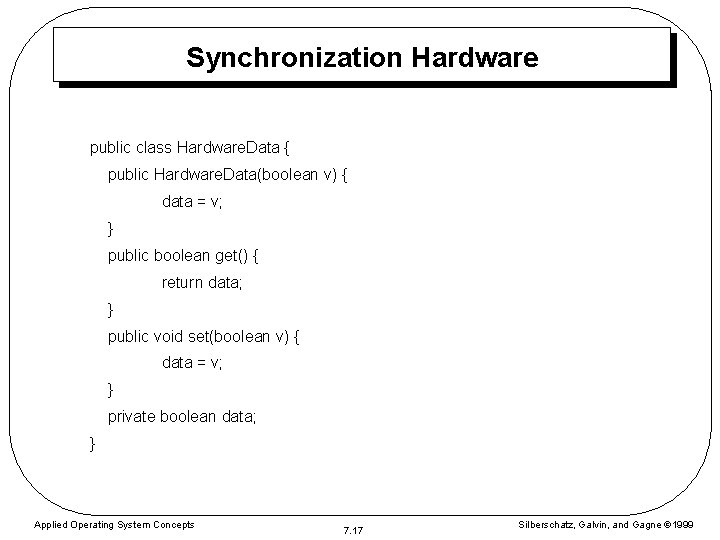
Synchronization Hardware public class Hardware. Data { public Hardware. Data(boolean v) { data = v; } public boolean get() { return data; } public void set(boolean v) { data = v; } private boolean data; } Applied Operating System Concepts 7. 17 Silberschatz, Galvin, and Gagne 1999
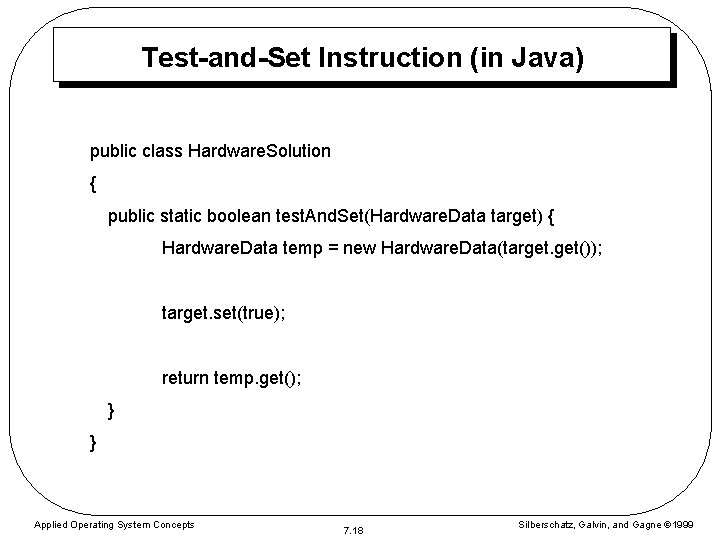
Test-and-Set Instruction (in Java) public class Hardware. Solution { public static boolean test. And. Set(Hardware. Data target) { Hardware. Data temp = new Hardware. Data(target. get()); target. set(true); return temp. get(); } } Applied Operating System Concepts 7. 18 Silberschatz, Galvin, and Gagne 1999
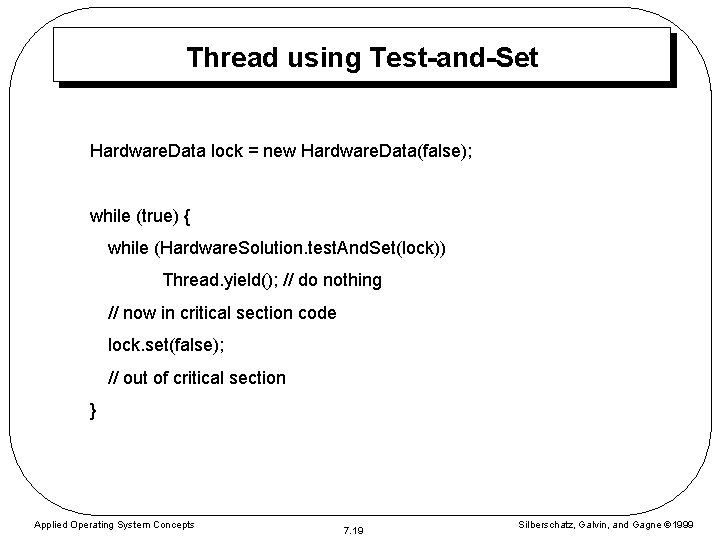
Thread using Test-and-Set Hardware. Data lock = new Hardware. Data(false); while (true) { while (Hardware. Solution. test. And. Set(lock)) Thread. yield(); // do nothing // now in critical section code lock. set(false); // out of critical section } Applied Operating System Concepts 7. 19 Silberschatz, Galvin, and Gagne 1999
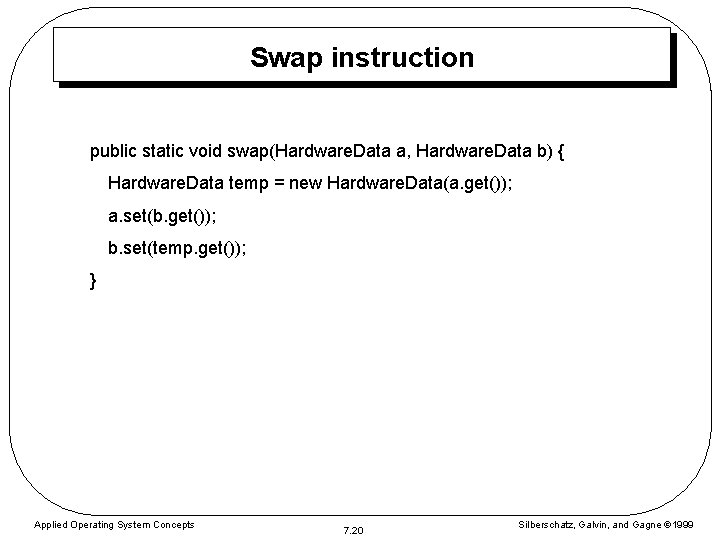
Swap instruction public static void swap(Hardware. Data a, Hardware. Data b) { Hardware. Data temp = new Hardware. Data(a. get()); a. set(b. get()); b. set(temp. get()); } Applied Operating System Concepts 7. 20 Silberschatz, Galvin, and Gagne 1999
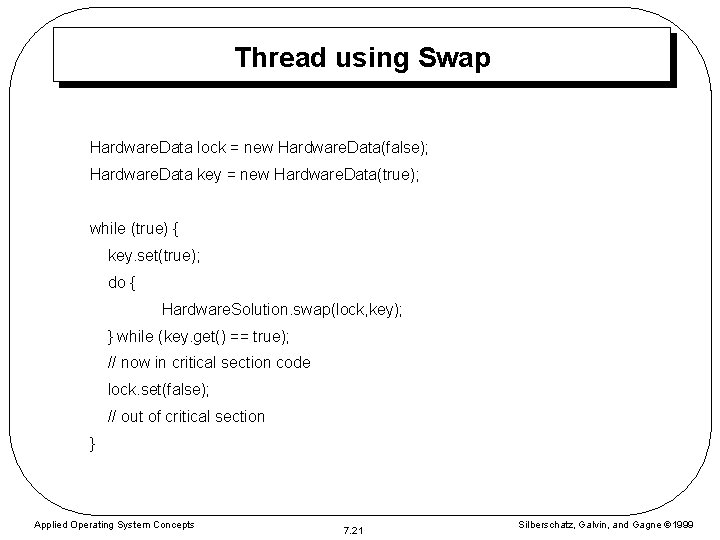
Thread using Swap Hardware. Data lock = new Hardware. Data(false); Hardware. Data key = new Hardware. Data(true); while (true) { key. set(true); do { Hardware. Solution. swap(lock, key); } while (key. get() == true); // now in critical section code lock. set(false); // out of critical section } Applied Operating System Concepts 7. 21 Silberschatz, Galvin, and Gagne 1999
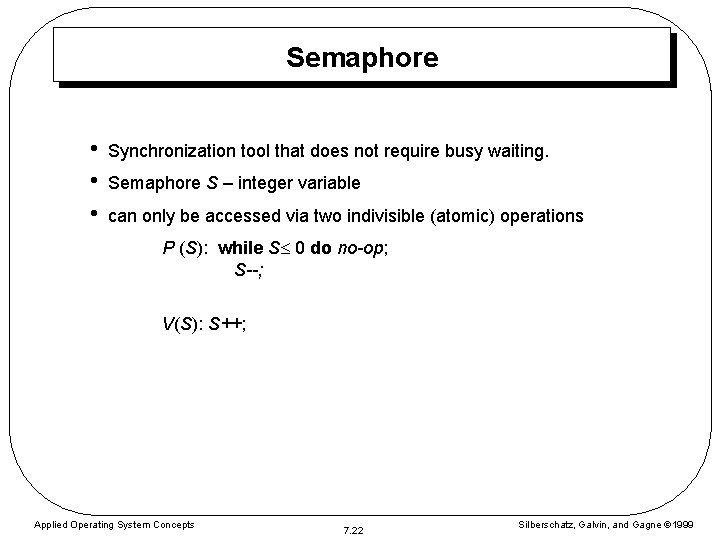
Semaphore • • • Synchronization tool that does not require busy waiting. Semaphore S – integer variable can only be accessed via two indivisible (atomic) operations P (S): while S 0 do no-op; S--; V(S): S++; Applied Operating System Concepts 7. 22 Silberschatz, Galvin, and Gagne 1999
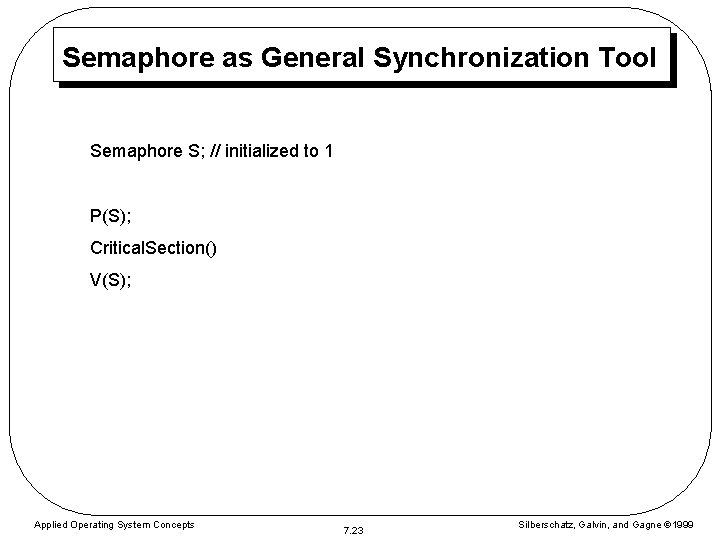
Semaphore as General Synchronization Tool Semaphore S; // initialized to 1 P(S); Critical. Section() V(S); Applied Operating System Concepts 7. 23 Silberschatz, Galvin, and Gagne 1999
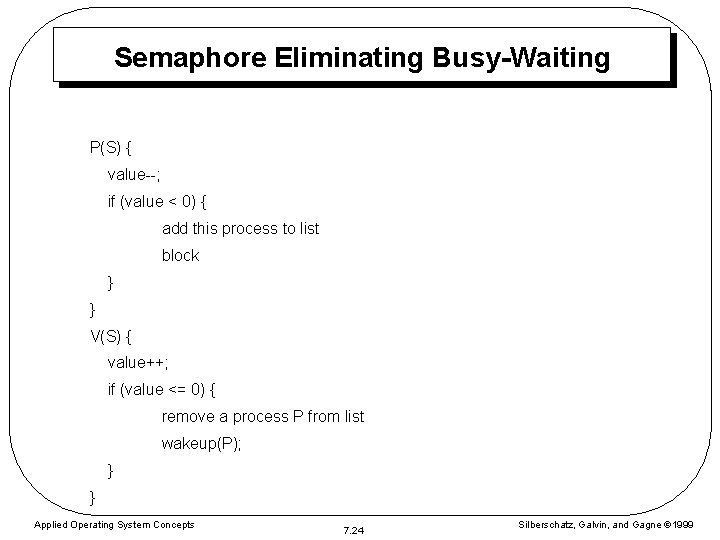
Semaphore Eliminating Busy-Waiting P(S) { value--; if (value < 0) { add this process to list block } } V(S) { value++; if (value <= 0) { remove a process P from list wakeup(P); } } Applied Operating System Concepts 7. 24 Silberschatz, Galvin, and Gagne 1999
![Synchronization Using Semaphores public class First. Semaphore { public static void main(String args[]) {](http://slidetodoc.com/presentation_image_h2/178f0f84fba8305780c8cf0e583dd6ee/image-25.jpg "Synchronization Using Semaphores public class First. Semaphore { public static void main(String args[]) {")
Synchronization Using Semaphores public class First. Semaphore { public static void main(String args[]) { Semaphore sem = new Semaphore(1); Worker[] bees = new Worker[5]; for (int i = 0; i < 5; i++) bees[i] = new Worker(sem, "Worker " + (new Integer(i)). to. String() ); for (int i = 0; i < 5; i++) bees[i]. start(); } } Applied Operating System Concepts 7. 25 Silberschatz, Galvin, and Gagne 1999
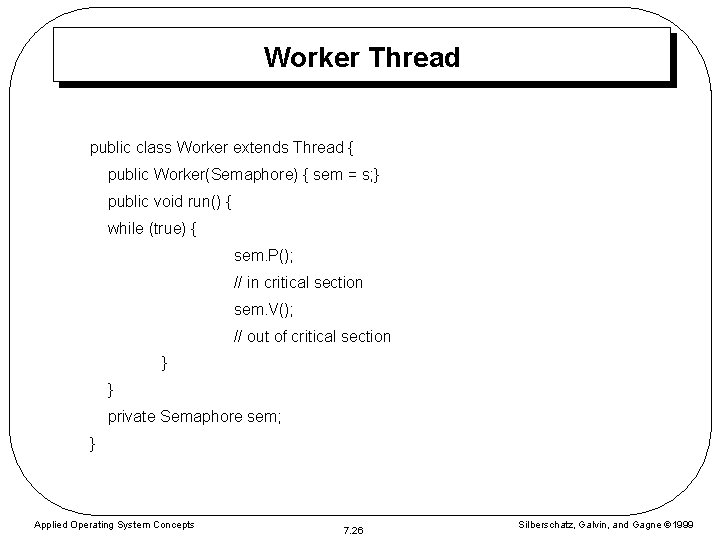
Worker Thread public class Worker extends Thread { public Worker(Semaphore) { sem = s; } public void run() { while (true) { sem. P(); // in critical section sem. V(); // out of critical section } } private Semaphore sem; } Applied Operating System Concepts 7. 26 Silberschatz, Galvin, and Gagne 1999
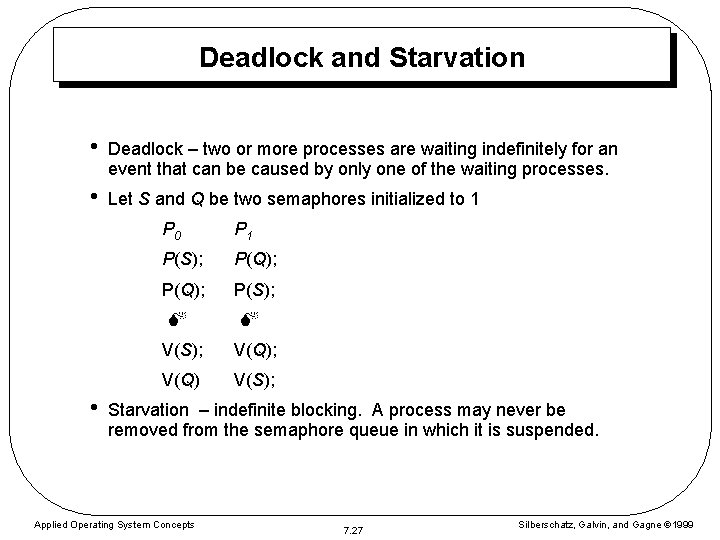
Deadlock and Starvation • Deadlock – two or more processes are waiting indefinitely for an event that can be caused by only one of the waiting processes. • Let S and Q be two semaphores initialized to 1 • P 0 P 1 P(S); P(Q); P(S); V(S); V(Q) V(S); Starvation – indefinite blocking. A process may never be removed from the semaphore queue in which it is suspended. Applied Operating System Concepts 7. 27 Silberschatz, Galvin, and Gagne 1999
Two Types of Semaphores • Counting semaphore – integer value can range over an unrestricted domain. • Binary semaphore – integer value can range only between 0 and 1; can be simpler to implement. • Can implement a counting semaphore S as a binary semaphore. Applied Operating System Concepts 7. 28 Silberschatz, Galvin, and Gagne 1999
Classical Problems of Synchronization • • • Bounded-Buffer Problem Readers and Writers Problem Dining-Philosophers Problem Applied Operating System Concepts 7. 29 Silberschatz, Galvin, and Gagne 1999
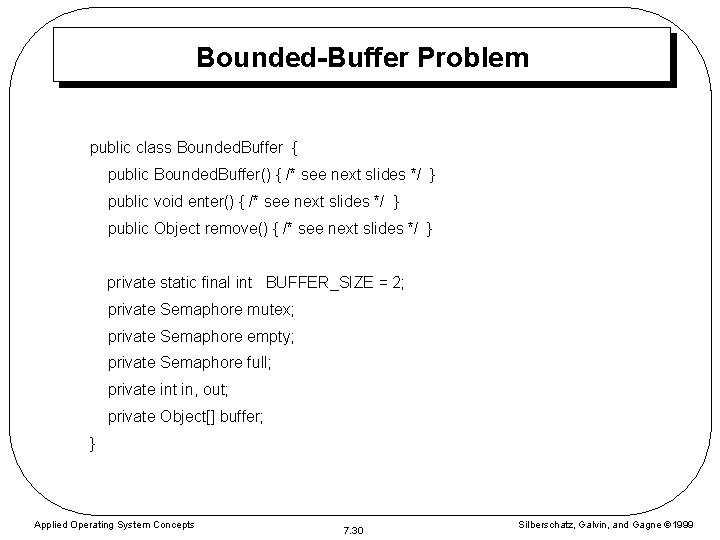
Bounded-Buffer Problem public class Bounded. Buffer { public Bounded. Buffer() { /* see next slides */ } public void enter() { /* see next slides */ } public Object remove() { /* see next slides */ } private static final int BUFFER_SIZE = 2; private Semaphore mutex; private Semaphore empty; private Semaphore full; private int in, out; private Object[] buffer; } Applied Operating System Concepts 7. 30 Silberschatz, Galvin, and Gagne 1999
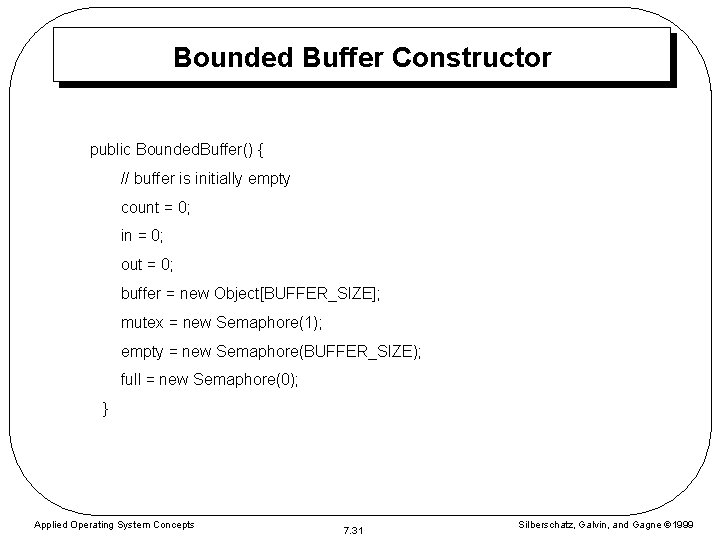
Bounded Buffer Constructor public Bounded. Buffer() { // buffer is initially empty count = 0; in = 0; out = 0; buffer = new Object[BUFFER_SIZE]; mutex = new Semaphore(1); empty = new Semaphore(BUFFER_SIZE); full = new Semaphore(0); } Applied Operating System Concepts 7. 31 Silberschatz, Galvin, and Gagne 1999
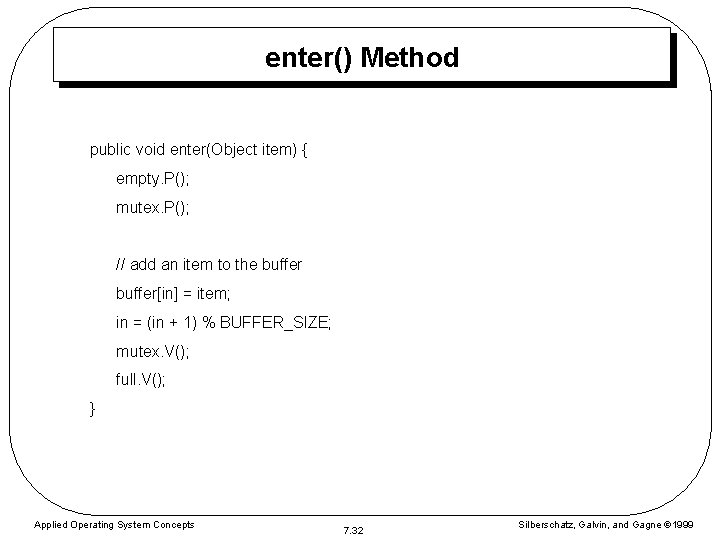
enter() Method public void enter(Object item) { empty. P(); mutex. P(); // add an item to the buffer[in] = item; in = (in + 1) % BUFFER_SIZE; mutex. V(); full. V(); } Applied Operating System Concepts 7. 32 Silberschatz, Galvin, and Gagne 1999
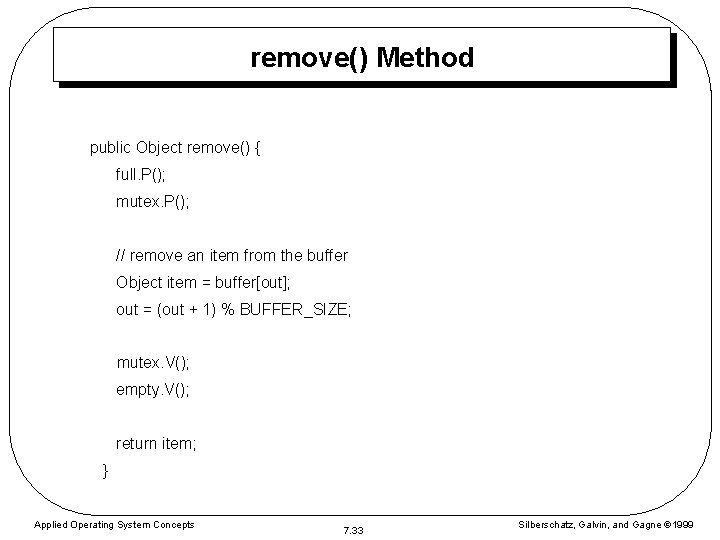
remove() Method public Object remove() { full. P(); mutex. P(); // remove an item from the buffer Object item = buffer[out]; out = (out + 1) % BUFFER_SIZE; mutex. V(); empty. V(); return item; } Applied Operating System Concepts 7. 33 Silberschatz, Galvin, and Gagne 1999
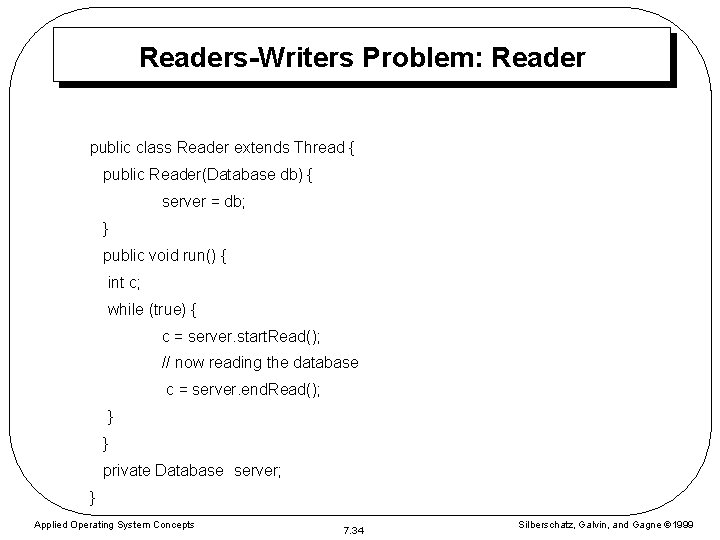
Readers-Writers Problem: Reader public class Reader extends Thread { public Reader(Database db) { server = db; } public void run() { int c; while (true) { c = server. start. Read(); // now reading the database c = server. end. Read(); } } private Database server; } Applied Operating System Concepts 7. 34 Silberschatz, Galvin, and Gagne 1999
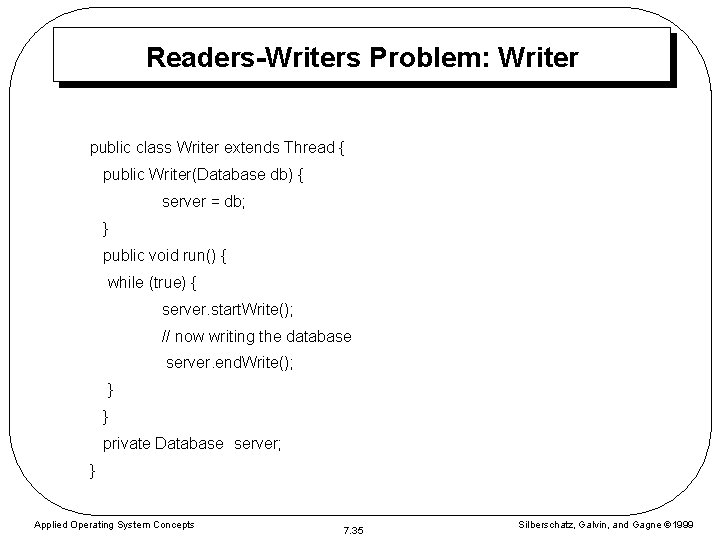
Readers-Writers Problem: Writer public class Writer extends Thread { public Writer(Database db) { server = db; } public void run() { while (true) { server. start. Write(); // now writing the database server. end. Write(); } } private Database server; } Applied Operating System Concepts 7. 35 Silberschatz, Galvin, and Gagne 1999
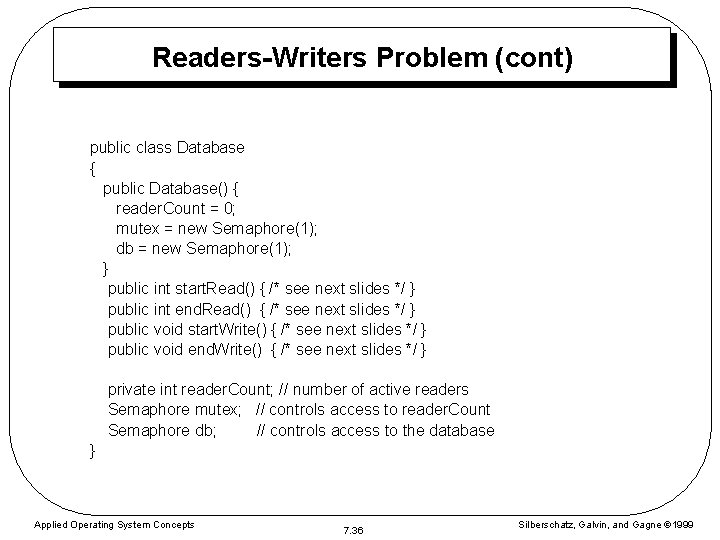
Readers-Writers Problem (cont) public class Database { public Database() { reader. Count = 0; mutex = new Semaphore(1); db = new Semaphore(1); } public int start. Read() { /* see next slides */ } public int end. Read() { /* see next slides */ } public void start. Write() { /* see next slides */ } public void end. Write() { /* see next slides */ } private int reader. Count; // number of active readers Semaphore mutex; // controls access to reader. Count Semaphore db; // controls access to the database } Applied Operating System Concepts 7. 36 Silberschatz, Galvin, and Gagne 1999
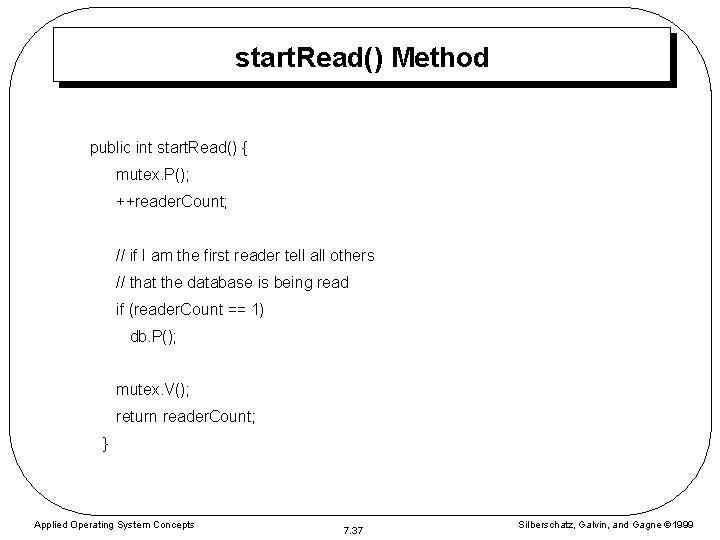
start. Read() Method public int start. Read() { mutex. P(); ++reader. Count; // if I am the first reader tell all others // that the database is being read if (reader. Count == 1) db. P(); mutex. V(); return reader. Count; } Applied Operating System Concepts 7. 37 Silberschatz, Galvin, and Gagne 1999
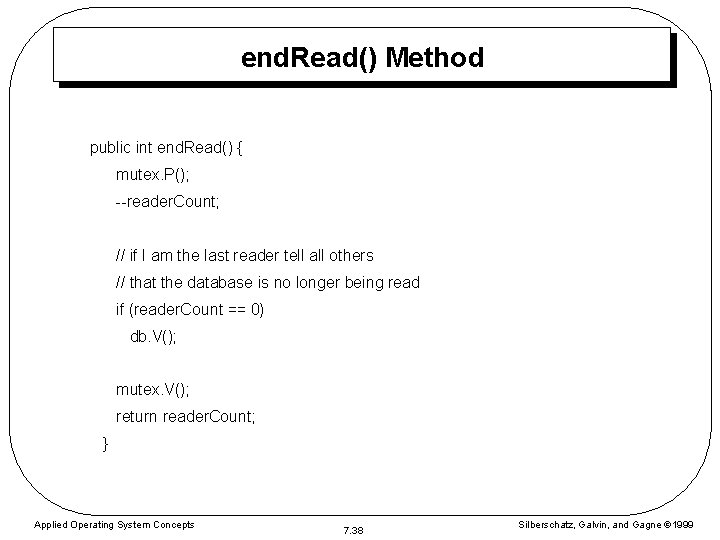
end. Read() Method public int end. Read() { mutex. P(); --reader. Count; // if I am the last reader tell all others // that the database is no longer being read if (reader. Count == 0) db. V(); mutex. V(); return reader. Count; } Applied Operating System Concepts 7. 38 Silberschatz, Galvin, and Gagne 1999
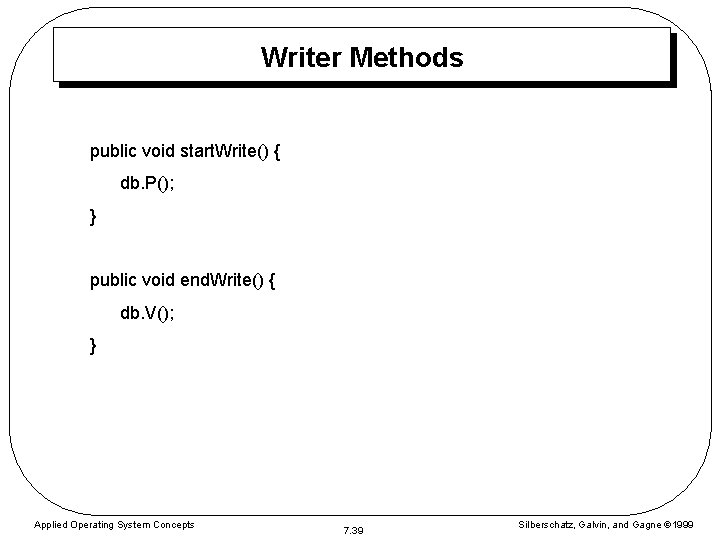
Writer Methods public void start. Write() { db. P(); } public void end. Write() { db. V(); } Applied Operating System Concepts 7. 39 Silberschatz, Galvin, and Gagne 1999
![Dining-Philosophers Problem • Shared data Semaphore chop. Stick[] = new Semaphore[5]; Applied Operating System](http://slidetodoc.com/presentation_image_h2/178f0f84fba8305780c8cf0e583dd6ee/image-40.jpg "Dining-Philosophers Problem • Shared data Semaphore chop. Stick[] = new Semaphore[5]; Applied Operating System")
Dining-Philosophers Problem • Shared data Semaphore chop. Stick[] = new Semaphore[5]; Applied Operating System Concepts 7. 40 Silberschatz, Galvin, and Gagne 1999
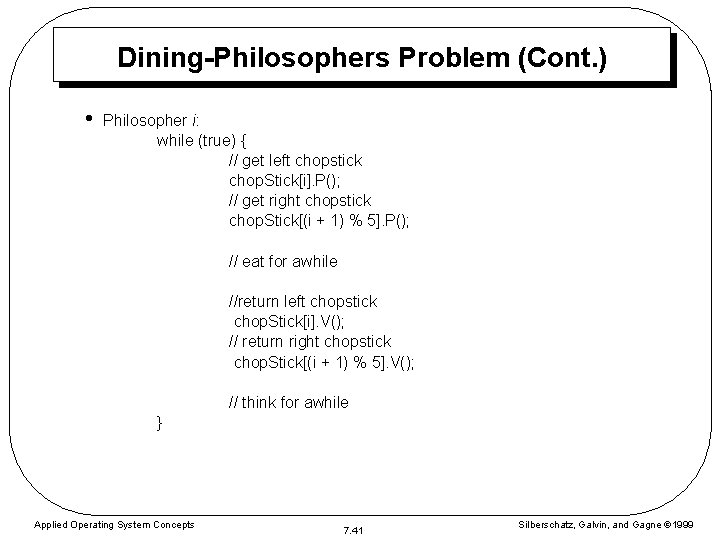
Dining-Philosophers Problem (Cont. ) • Philosopher i: while (true) { // get left chopstick chop. Stick[i]. P(); // get right chopstick chop. Stick[(i + 1) % 5]. P(); // eat for awhile //return left chopstick chop. Stick[i]. V(); // return right chopstick chop. Stick[(i + 1) % 5]. V(); // think for awhile } Applied Operating System Concepts 7. 41 Silberschatz, Galvin, and Gagne 1999
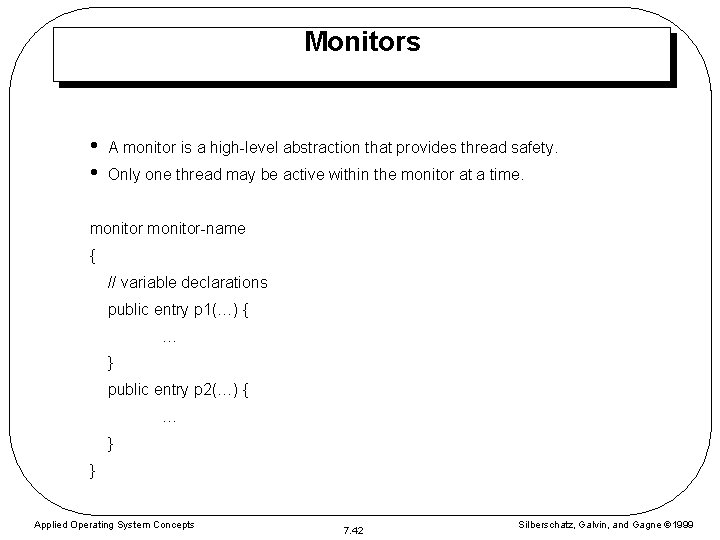
Monitors • • A monitor is a high-level abstraction that provides thread safety. Only one thread may be active within the monitor at a time. monitor-name { // variable declarations public entry p 1(…) { … } public entry p 2(…) { … } } Applied Operating System Concepts 7. 42 Silberschatz, Galvin, and Gagne 1999
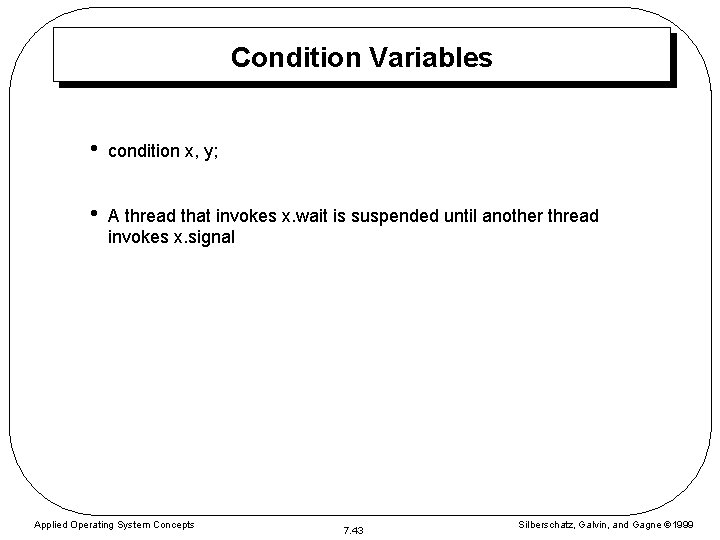
Condition Variables • condition x, y; • A thread that invokes x. wait is suspended until another thread invokes x. signal Applied Operating System Concepts 7. 43 Silberschatz, Galvin, and Gagne 1999
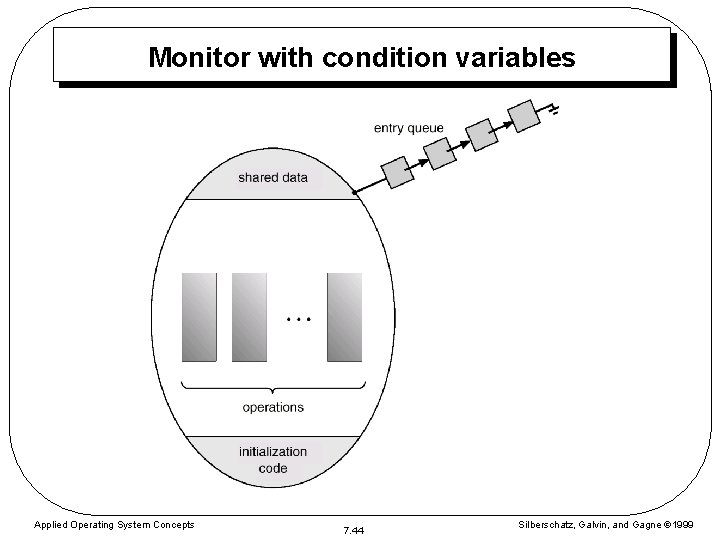
Monitor with condition variables Applied Operating System Concepts 7. 44 Silberschatz, Galvin, and Gagne 1999
![Solution to Dining Philosophers monitor dining. Philosophers { int[] state = new int[5]; static](http://slidetodoc.com/presentation_image_h2/178f0f84fba8305780c8cf0e583dd6ee/image-45.jpg "Solution to Dining Philosophers monitor dining. Philosophers { int[] state = new int[5]; static")
Solution to Dining Philosophers monitor dining. Philosophers { int[] state = new int[5]; static final int THINKING = 0; static final int HUNGRY = 1; static final int EATING = 2; condition[] self = new condition[5]; public dining. Philosophers { for (int i = 0; i < 5; i++) state[i] = THINKING; } public entry pick. Up(int i) { /* see next slides */ } public entry put. Down(int i) { /* see next slides */ } private test(int i) {/* see next slides */ } } Applied Operating System Concepts 7. 45 Silberschatz, Galvin, and Gagne 1999
![pick. Up() Procedure public entry pick. Up(int i) { state[i] = HUNGRY; test(i); if](http://slidetodoc.com/presentation_image_h2/178f0f84fba8305780c8cf0e583dd6ee/image-46.jpg "pick. Up() Procedure public entry pick. Up(int i) { state[i] = HUNGRY; test(i); if")
pick. Up() Procedure public entry pick. Up(int i) { state[i] = HUNGRY; test(i); if (state[i] != EATING) self[i]. wait; } Applied Operating System Concepts 7. 46 Silberschatz, Galvin, and Gagne 1999
![put. Down() Procedure public entry put. Down(int i) { state[i] = THINKING; // test](http://slidetodoc.com/presentation_image_h2/178f0f84fba8305780c8cf0e583dd6ee/image-47.jpg "put. Down() Procedure public entry put. Down(int i) { state[i] = THINKING; // test")
put. Down() Procedure public entry put. Down(int i) { state[i] = THINKING; // test left and right neighbors test((i + 4) % 5); test((i + 1) % 5); } Applied Operating System Concepts 7. 47 Silberschatz, Galvin, and Gagne 1999
![test() Procedure private test(int i) { if ( (state[(i + 4) % 5] !=](http://slidetodoc.com/presentation_image_h2/178f0f84fba8305780c8cf0e583dd6ee/image-48.jpg "test() Procedure private test(int i) { if ( (state[(i + 4) % 5] !=")
test() Procedure private test(int i) { if ( (state[(i + 4) % 5] != EATING) && (state[i] == HUNGRY) && (state[(i + 1) % 5] != EATING) ) { state[i] = EATING; self[i]. signal; } } Applied Operating System Concepts 7. 48 Silberschatz, Galvin, and Gagne 1999
Java Synchronization • • • Synchronized, wait(), notify() statements Multiple Notifications Block Synchronization Java Semaphores Java Monitors Applied Operating System Concepts 7. 49 Silberschatz, Galvin, and Gagne 1999
synchronized Statement • Every object has a lock associated with it. • Calling a synchronized method requires “owning” the lock. • If a calling thread does not own the lock (another thread already owns it), the calling thread is placed in the wait set for the object’s lock. • The lock is released when a thread exits the synchronized method. Applied Operating System Concepts 7. 50 Silberschatz, Galvin, and Gagne 1999
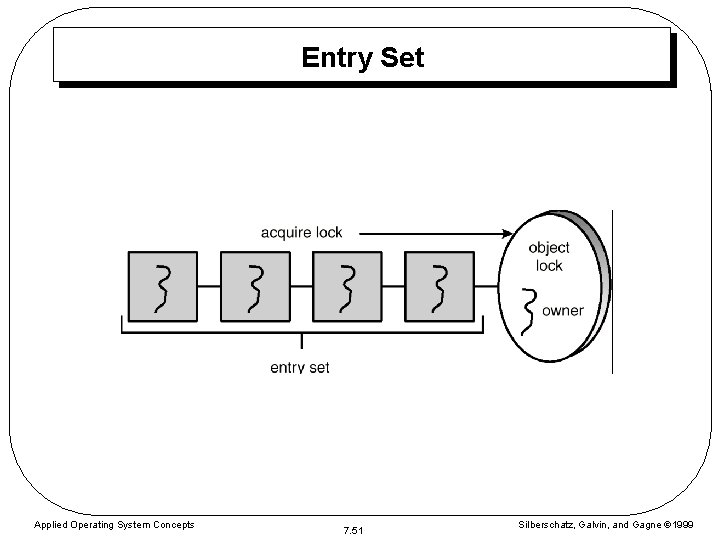
Entry Set Applied Operating System Concepts 7. 51 Silberschatz, Galvin, and Gagne 1999
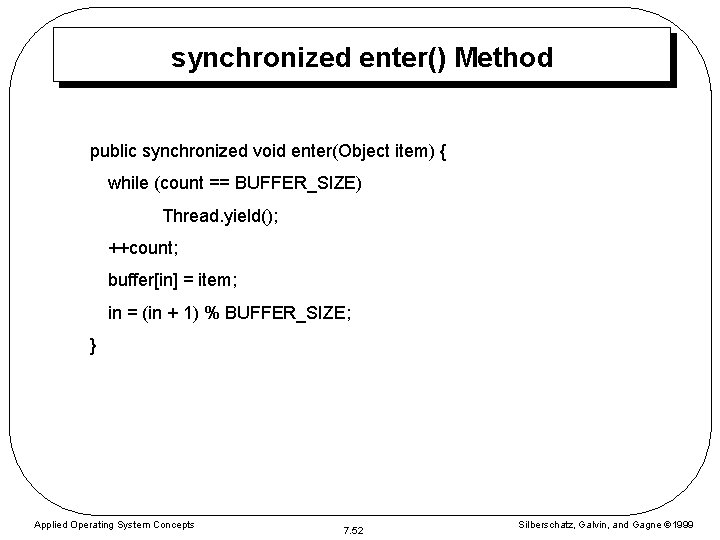
synchronized enter() Method public synchronized void enter(Object item) { while (count == BUFFER_SIZE) Thread. yield(); ++count; buffer[in] = item; in = (in + 1) % BUFFER_SIZE; } Applied Operating System Concepts 7. 52 Silberschatz, Galvin, and Gagne 1999
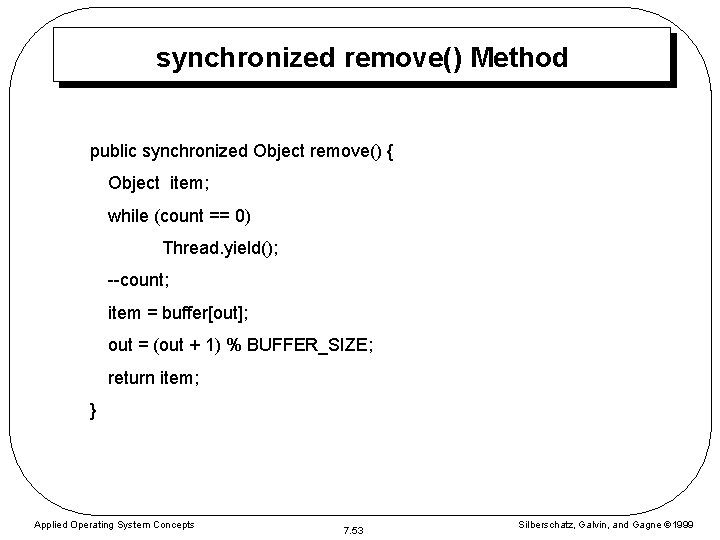
synchronized remove() Method public synchronized Object remove() { Object item; while (count == 0) Thread. yield(); --count; item = buffer[out]; out = (out + 1) % BUFFER_SIZE; return item; } Applied Operating System Concepts 7. 53 Silberschatz, Galvin, and Gagne 1999
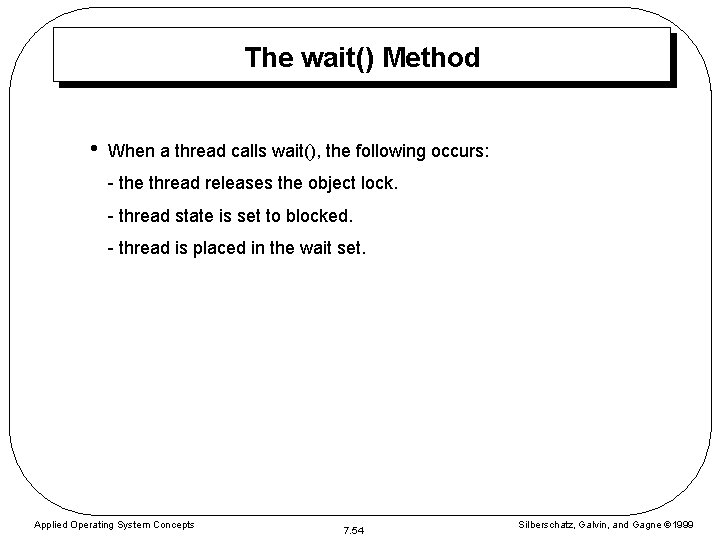
The wait() Method • When a thread calls wait(), the following occurs: - the thread releases the object lock. - thread state is set to blocked. - thread is placed in the wait set. Applied Operating System Concepts 7. 54 Silberschatz, Galvin, and Gagne 1999
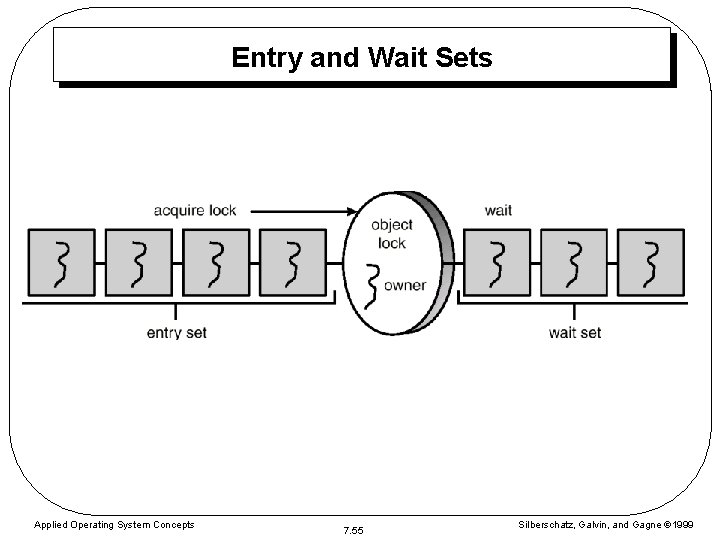
Entry and Wait Sets Applied Operating System Concepts 7. 55 Silberschatz, Galvin, and Gagne 1999
The notify() Method • When a thread calls notify(), the following occurs: - selects an arbitrary thread T from the wait set. - moves T to the entry set. - sets T to Runnable. T can now compete for the object’s lock again. Applied Operating System Concepts 7. 56 Silberschatz, Galvin, and Gagne 1999
enter() with wait/notify Methods public synchronized void enter(Object item) { while (count == BUFFER_SIZE) try { wait(); } catch (Interrupted. Exception e) { } } ++count; buffer[in] = item; in = (in + 1) % BUFFER_SIZE; notify(); } Applied Operating System Concepts 7. 57 Silberschatz, Galvin, and Gagne 1999
remove() with wait/notify Methods public synchronized Object remove() { Object item; while (count == 0) try { wait(); } catch (Interrupted. Exception e) { } --count; item = buffer[out]; out = (out + 1) % BUFFER_SIZE; notify(); return item; } Applied Operating System Concepts 7. 58 Silberschatz, Galvin, and Gagne 1999
Multiple Notifications • notify() selects an arbitrary thread from the wait set. *This may not be thread that you want to be selected. • • Java does not allow you to specify the thread to be selected. • notify. All() is a conservative strategy that works best when multiple threads may be in the wait set. notify. All() removes ALL threads from the wait set and places them in the entry set. This allows the threads to decide among themselves who should proceed next. Applied Operating System Concepts 7. 59 Silberschatz, Galvin, and Gagne 1999
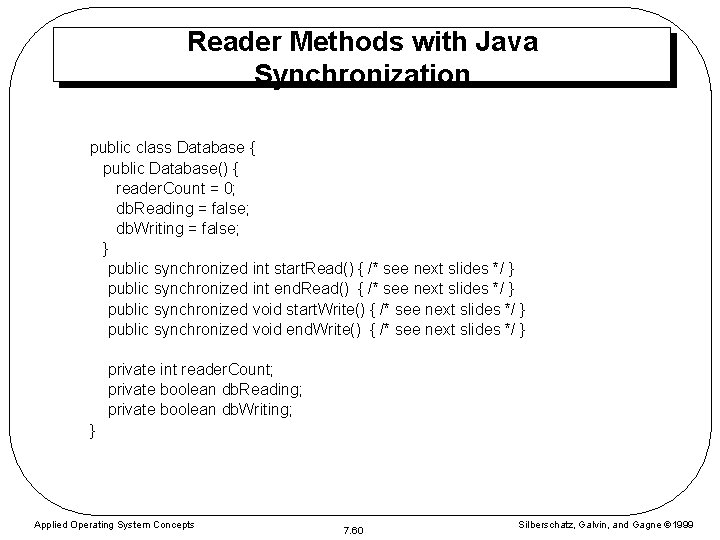
Reader Methods with Java Synchronization public class Database { public Database() { reader. Count = 0; db. Reading = false; db. Writing = false; } public synchronized int start. Read() { /* see next slides */ } public synchronized int end. Read() { /* see next slides */ } public synchronized void start. Write() { /* see next slides */ } public synchronized void end. Write() { /* see next slides */ } private int reader. Count; private boolean db. Reading; private boolean db. Writing; } Applied Operating System Concepts 7. 60 Silberschatz, Galvin, and Gagne 1999
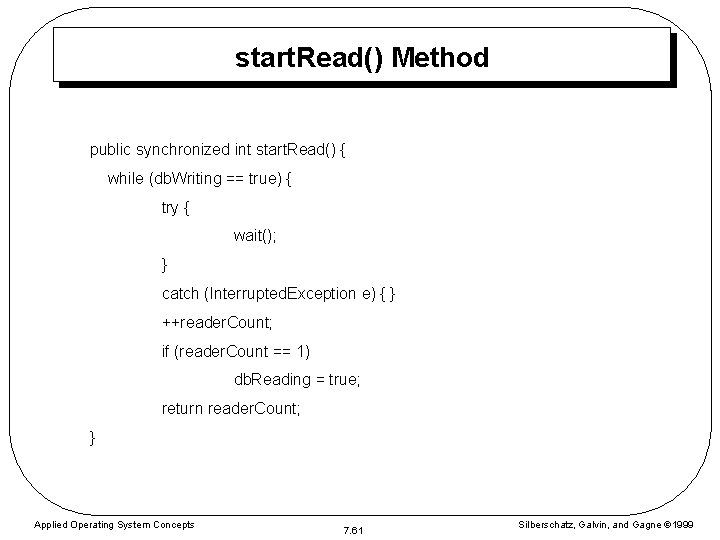
start. Read() Method public synchronized int start. Read() { while (db. Writing == true) { try { wait(); } catch (Interrupted. Exception e) { } ++reader. Count; if (reader. Count == 1) db. Reading = true; return reader. Count; } Applied Operating System Concepts 7. 61 Silberschatz, Galvin, and Gagne 1999
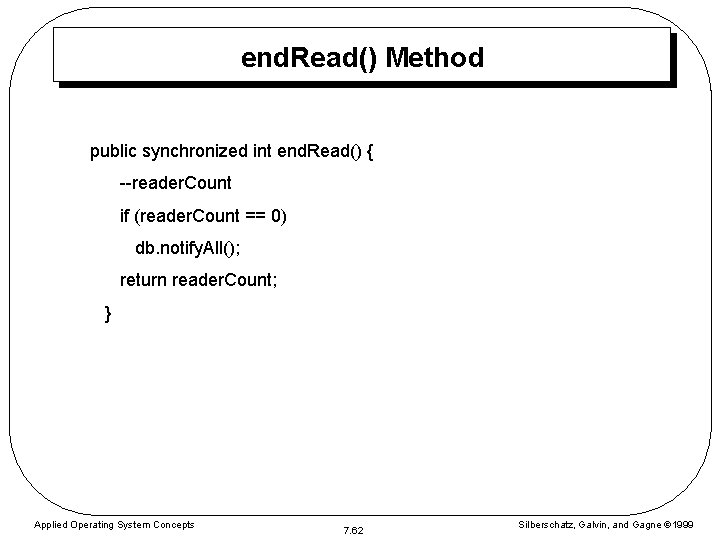
end. Read() Method public synchronized int end. Read() { --reader. Count if (reader. Count == 0) db. notify. All(); return reader. Count; } Applied Operating System Concepts 7. 62 Silberschatz, Galvin, and Gagne 1999
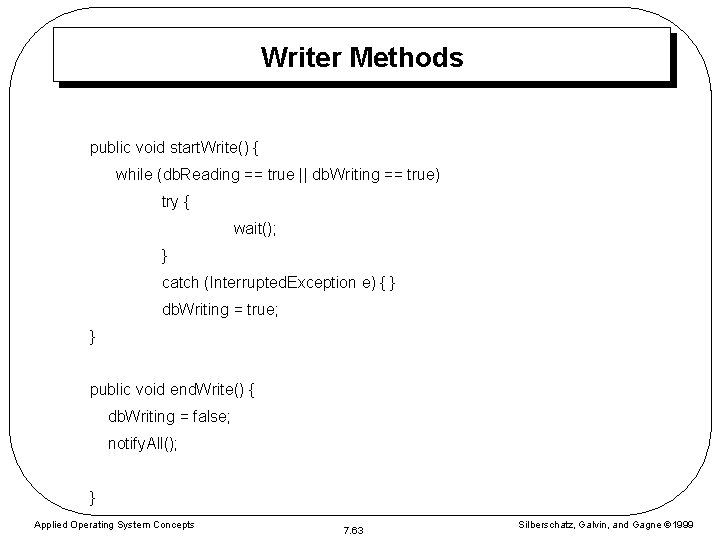
Writer Methods public void start. Write() { while (db. Reading == true || db. Writing == true) try { wait(); } catch (Interrupted. Exception e) { } db. Writing = true; } public void end. Write() { db. Writing = false; notify. All(); } Applied Operating System Concepts 7. 63 Silberschatz, Galvin, and Gagne 1999
Block Synchronization • Blocks of code – rather than entire methods – may be declared as synchronized. • This yields a lock scope that is typically smaller than a synchronized method. Applied Operating System Concepts 7. 64 Silberschatz, Galvin, and Gagne 1999
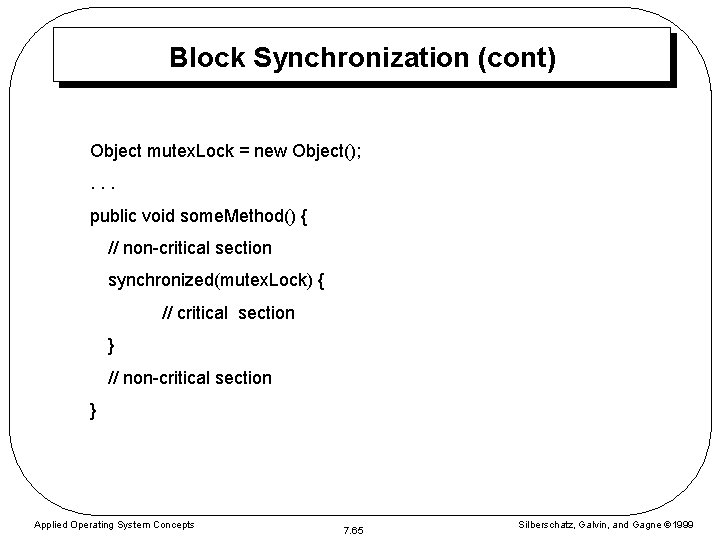
Block Synchronization (cont) Object mutex. Lock = new Object(); . . . public void some. Method() { // non-critical section synchronized(mutex. Lock) { // critical section } // non-critical section } Applied Operating System Concepts 7. 65 Silberschatz, Galvin, and Gagne 1999
Java Semaphores • Java does not provide a semaphore, but a basic semaphore can be constructed using Java synchronization mechanism. Applied Operating System Concepts 7. 66 Silberschatz, Galvin, and Gagne 1999
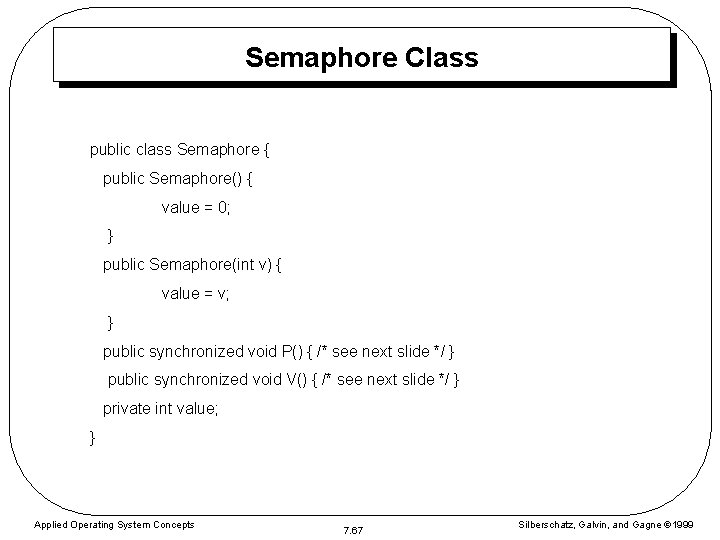
Semaphore Class public class Semaphore { public Semaphore() { value = 0; } public Semaphore(int v) { value = v; } public synchronized void P() { /* see next slide */ } public synchronized void V() { /* see next slide */ } private int value; } Applied Operating System Concepts 7. 67 Silberschatz, Galvin, and Gagne 1999
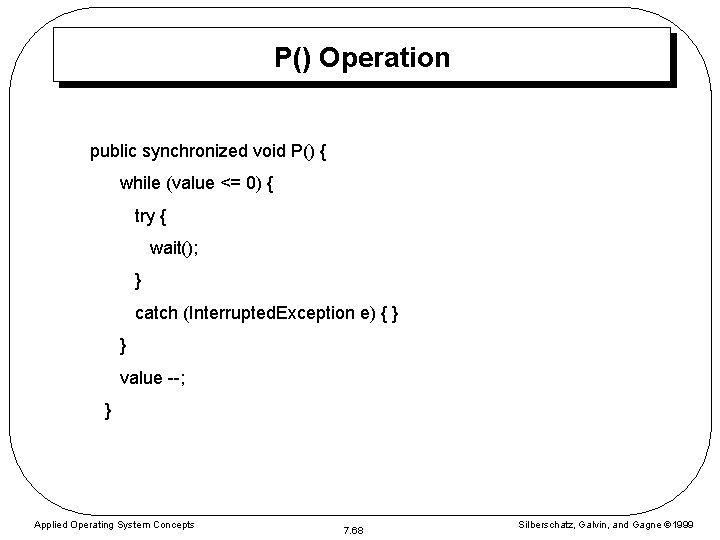
P() Operation public synchronized void P() { while (value <= 0) { try { wait(); } catch (Interrupted. Exception e) { } } value --; } Applied Operating System Concepts 7. 68 Silberschatz, Galvin, and Gagne 1999
V() Operation public synchronized void V() { ++value; notify(); } Applied Operating System Concepts 7. 69 Silberschatz, Galvin, and Gagne 1999
Solaris 2 Synchronization • Solaris 2 Provides: - adaptive mutex - condition variables - semaphores - reader-writer locks Applied Operating System Concepts 7. 70 Silberschatz, Galvin, and Gagne 1999
Windows NT Synchronization • Windows NT Provides: - mutex - critical sections - semaphores - event objects Applied Operating System Concepts 7. 71 Silberschatz, Galvin, and Gagne 1999
- Slides: 71