
Module 7 Genetics Heredity Punnett Squares and Pedigrees
- Slides: 17
Module 7: Genetics Heredity, Punnett Squares, and Pedigrees
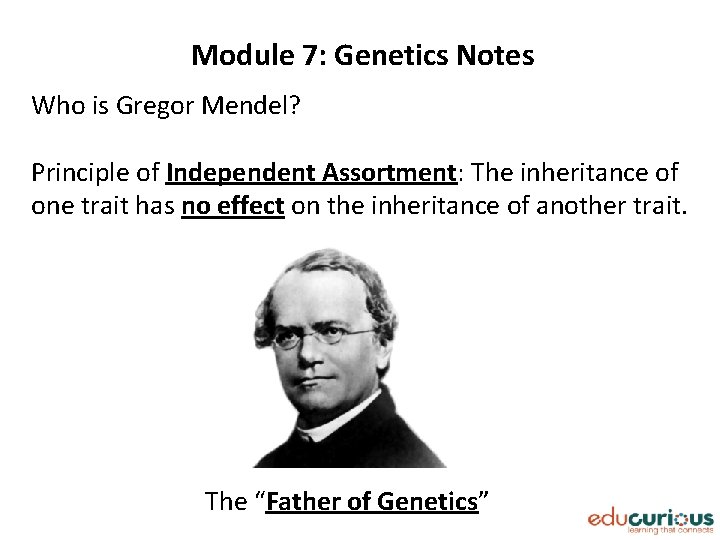
Module 7: Genetics Notes Who is Gregor Mendel? Principle of Independent Assortment: The inheritance of one trait has no effect on the inheritance of another trait. The “Father of Genetics”
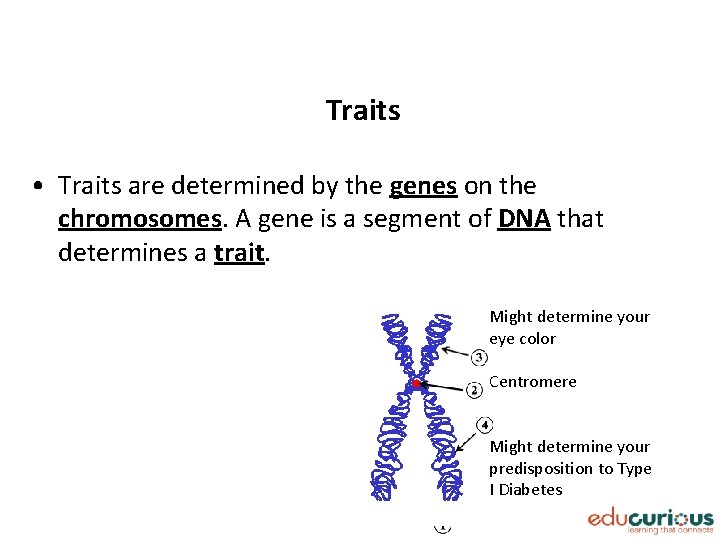
Traits • Traits are determined by the genes on the chromosomes. A gene is a segment of DNA that determines a trait. Might determine your eye color Centromere Might determine your predisposition to Type I Diabetes
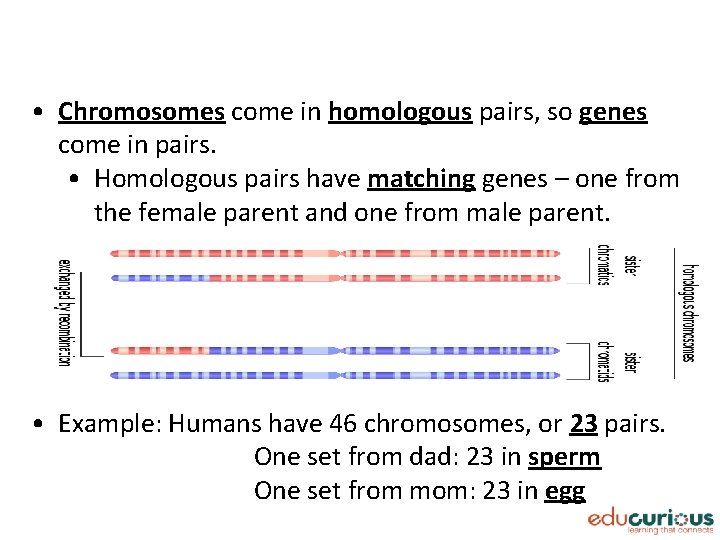
• Chromosomes come in homologous pairs, so genes come in pairs. • Homologous pairs have matching genes – one from the female parent and one from male parent. • Example: Humans have 46 chromosomes, or 23 pairs. One set from dad: 23 in sperm One set from mom: 23 in egg
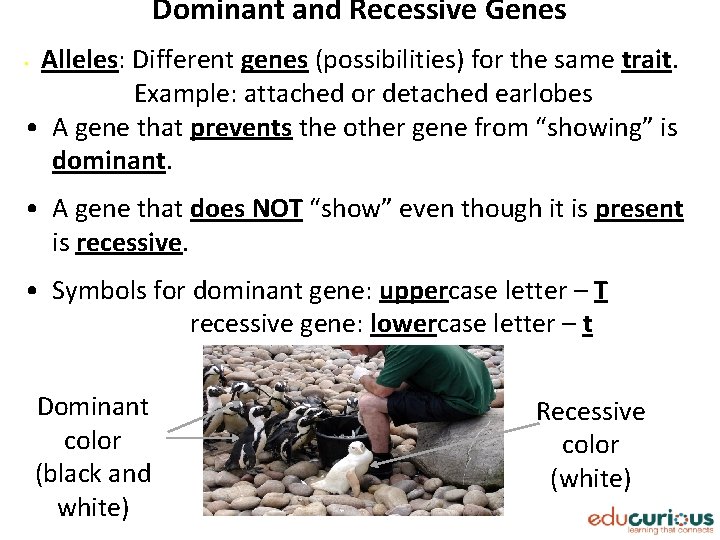
Dominant and Recessive Genes Alleles: Different genes (possibilities) for the same trait. Example: attached or detached earlobes • A gene that prevents the other gene from “showing” is dominant. • • A gene that does NOT “show” even though it is present is recessive. • Symbols for dominant gene: uppercase letter – T recessive gene: lowercase letter – t Dominant color (black and white) Recessive color (white)
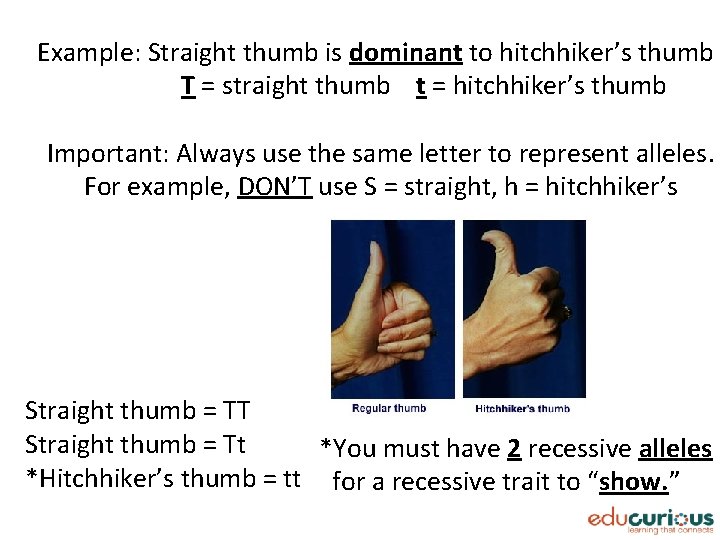
Example: Straight thumb is dominant to hitchhiker’s thumb T = straight thumb t = hitchhiker’s thumb Important: Always use the same letter to represent alleles. For example, DON’T use S = straight, h = hitchhiker’s Straight thumb = TT Straight thumb = Tt *You must have 2 recessive alleles *Hitchhiker’s thumb = tt for a recessive trait to “show. ”
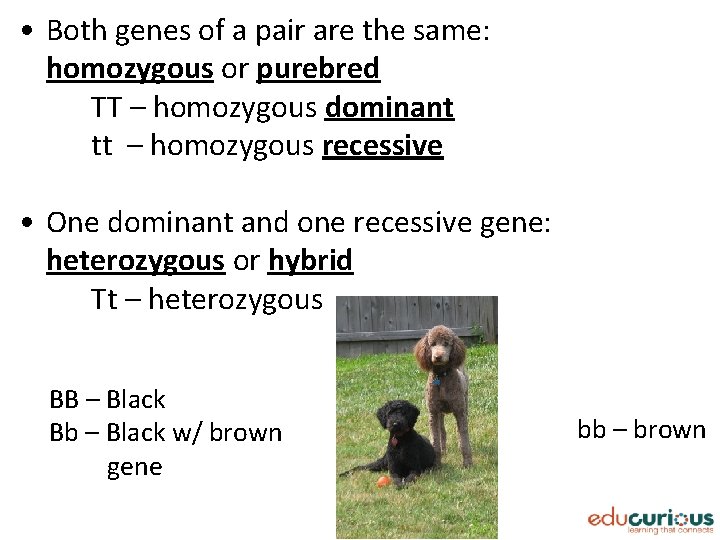
• Both genes of a pair are the same: homozygous or purebred TT – homozygous dominant tt – homozygous recessive • One dominant and one recessive gene: heterozygous or hybrid Tt – heterozygous BB – Black Bb – Black w/ brown gene bb – brown
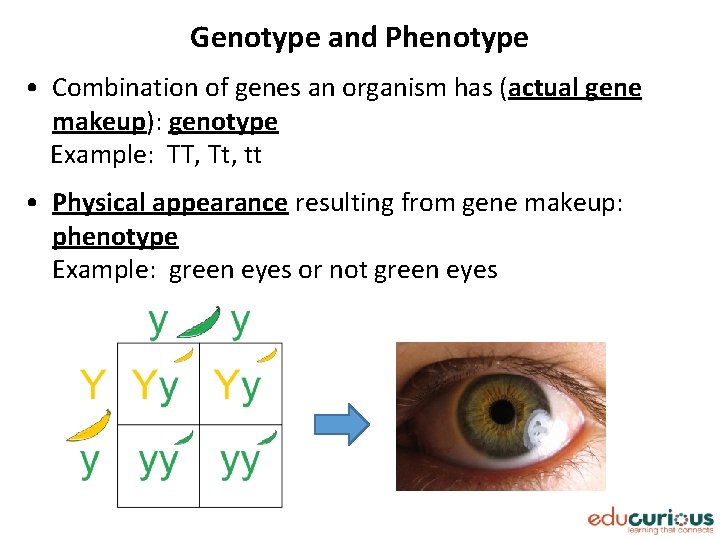
Genotype and Phenotype • Combination of genes an organism has (actual gene makeup): genotype Example: TT, Tt, tt • Physical appearance resulting from gene makeup: phenotype Example: green eyes or not green eyes
Punnett Squares and Probability • Used to predict the possible gene makeup of offspring: Punnett square
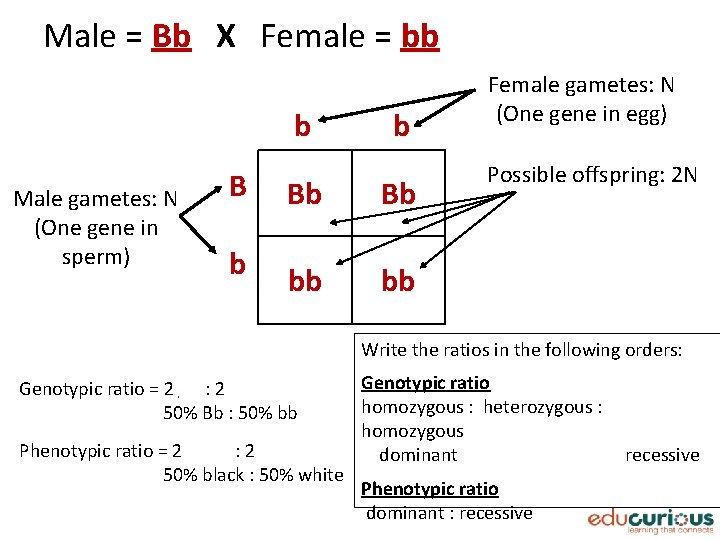
Male = Bb X Female = bb b Male gametes: N (One gene in sperm) B b b Bb Bb bb bb Female gametes: N (One gene in egg) Possible offspring: 2 N Write the ratios in the following orders: Genotypic ratio = 2 Bb : 2 bb 50% Bb : 50% bb Phenotypic ratio = 2 black : 2 white 50% black : 50% white Genotypic ratio homozygous : heterozygous : homozygous dominant Phenotypic ratio dominant : recessive
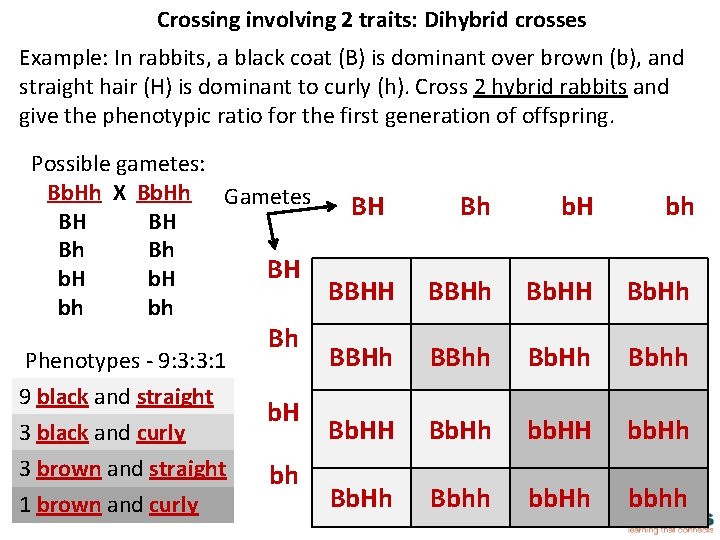
Crossing involving 2 traits: Dihybrid crosses Example: In rabbits, a black coat (B) is dominant over brown (b), and straight hair (H) is dominant to curly (h). Cross 2 hybrid rabbits and give the phenotypic ratio for the first generation of offspring. Possible gametes: Bb. Hh X Bb. Hh Gametes BH BH BH Bh Bh BH b. H BBHH bh bh Phenotypes - 9: 3: 3: 1 9 black and straight 3 black and curly 3 brown and straight 1 brown and curly Bh b. H bh BBHh Bb. HH Bb. Hh BBhh Bb. Hh Bbhh Bb. HH Bb. Hh bb. HH bb. Hh Bbhh bb. Hh bbhh
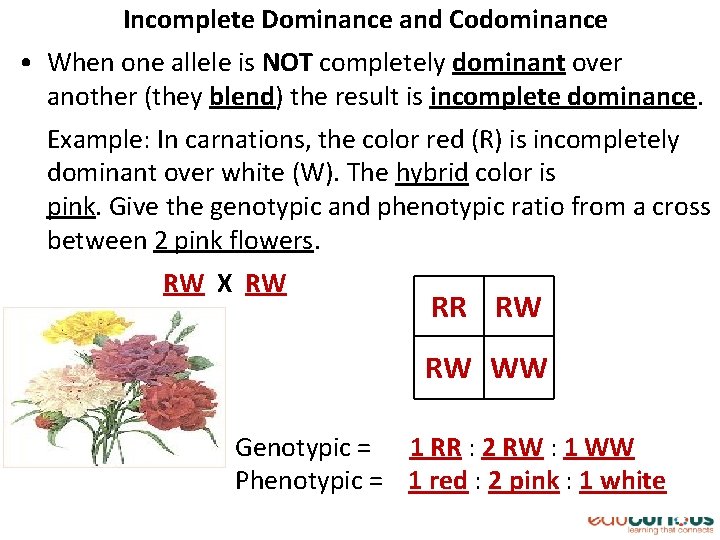
Incomplete Dominance and Codominance • When one allele is NOT completely dominant over another (they blend) the result is incomplete dominance. Example: In carnations, the color red (R) is incompletely dominant over white (W). The hybrid color is pink. Give the genotypic and phenotypic ratio from a cross between 2 pink flowers. RW X RW R R W RR RW WW Genotypic = 1 RR : 2 RW : 1 WW Phenotypic = 1 red : 2 pink : 1 white
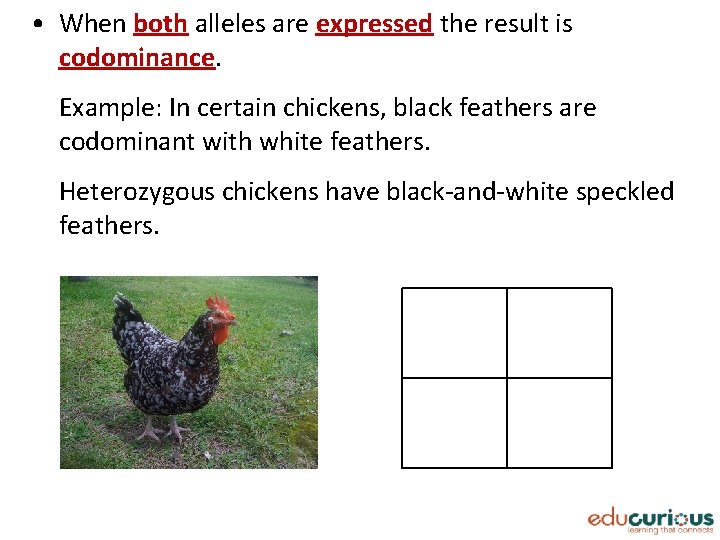
• When both alleles are expressed the result is codominance. Example: In certain chickens, black feathers are codominant with white feathers. Heterozygous chickens have black-and-white speckled feathers.
Sex-linked Traits • Genes for these traits are located only on the X chromosome (NOT on the Y chromosome). • X-linked alleles always show up in males, whether dominant or recessive, because males have only one X chromosome.
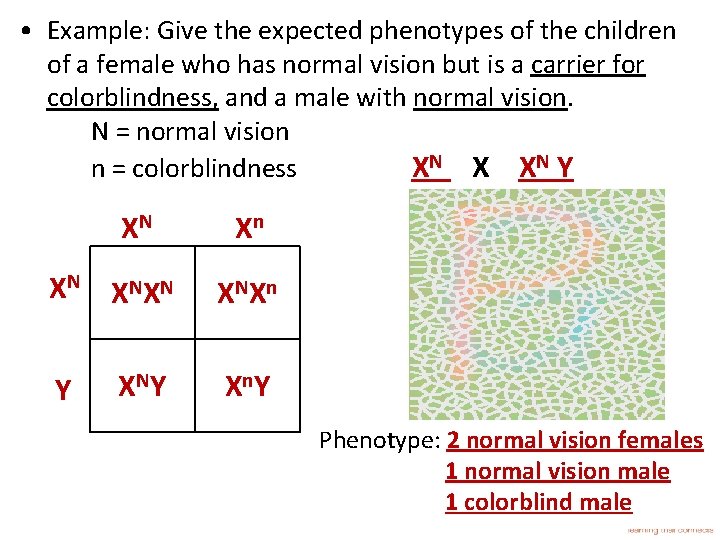
• Example: Give the expected phenotypes of the children of a female who has normal vision but is a carrier for colorblindness, and a male with normal vision. N = normal vision n = colorblindness XN X XN Y XN Xn X NX N X NX n X NY X n. Y Y Phenotype: 2 normal vision females 1 normal vision male 1 colorblind male
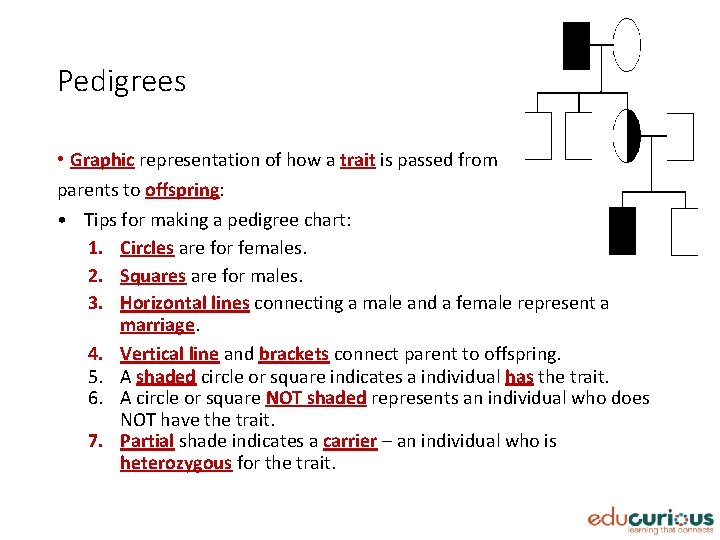
Pedigrees • Graphic representation of how a trait is passed from parents to offspring: • Tips for making a pedigree chart: 1. Circles are for females. 2. Squares are for males. 3. Horizontal lines connecting a male and a female represent a marriage. 4. Vertical line and brackets connect parent to offspring. 5. A shaded circle or square indicates a individual has the trait. 6. A circle or square NOT shaded represents an individual who does NOT have the trait. 7. Partial shade indicates a carrier – an individual who is heterozygous for the trait.
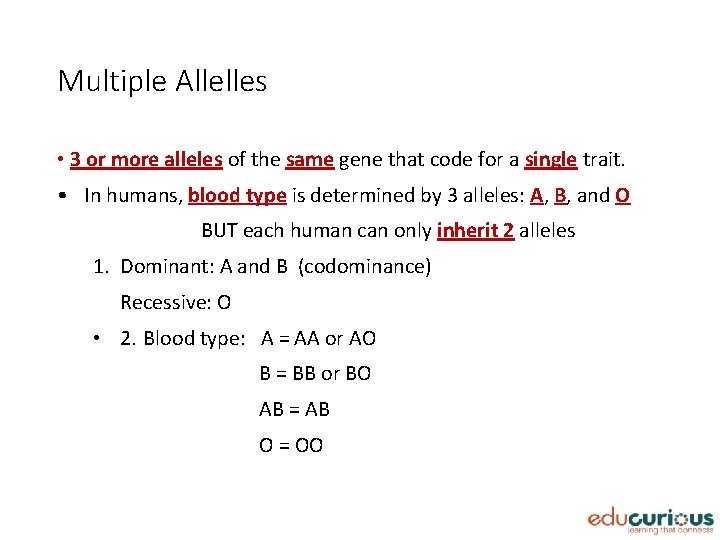
Multiple Allelles • 3 or more alleles of the same gene that code for a single trait. • In humans, blood type is determined by 3 alleles: A, B, and O BUT each human can only inherit 2 alleles 1. Dominant: A and B (codominance) Recessive: O • 2. Blood type: A = AA or AO B = BB or BO AB = AB O = OO