
Module 7 Differentiated Instruction in Tier 1 RTI
- Slides: 53
Module 7 Differentiated Instruction in Tier 1
RTI Professional Development Series Overview ▪ Response to Intervention (RTI) Overview ▪ Leadership in RTI ▪ Universal Screening ▪ Tier 1: Core Instruction ▪ Data-Based Decision Making and Progress Monitoring ▪ Tier 2: Supplemental Intervention ▪ Tier 3: Intensive Intervention 2
Module 7 Objectives Participants will be able to: ▪ Explain the importance of differentiated instruction within Tier I core instruction. ▪ Understand the key elements of differentiated instruction. ▪ Analyze differentiated instruction for three main instructional components: content, process, and product. ▪ Use data to differentiate instruction for all students. 3
Tier 1 Core Instruction ▪ Focus on prevention for all students ▪ High-quality instruction and materials: • Standards aligned • Research based • Differentiated 4
What is Differentiated Instruction? 5
Differentiated Instruction Activator ▪ What is differentiated instruction? ▪ How do teachers plan for differentiated instruction? ▪ How do teachers prepare their students and classrooms for differentiated instruction? ▪ What does differentiated instruction look like in the classroom? Workbook Activity 6
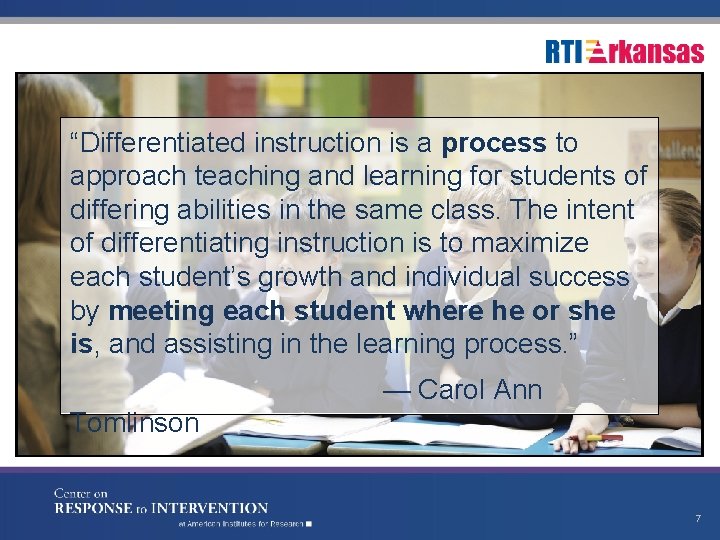
“Differentiated instruction is a process to approach teaching and learning for students of differing abilities in the same class. The intent of differentiating instruction is to maximize each student’s growth and individual success by meeting each student where he or she is, and assisting in the learning process. ” — Carol Ann Tomlinson 7
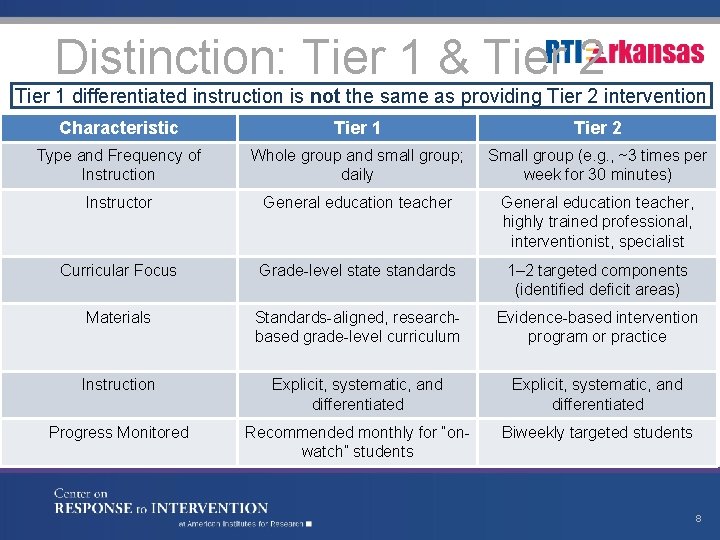
Distinction: Tier 1 & Tier 2 Tier 1 differentiated instruction is not the same as providing Tier 2 intervention Characteristic Tier 1 Tier 2 Type and Frequency of Instruction Whole group and small group; daily Small group (e. g. , ~3 times per week for 30 minutes) Instructor General education teacher, highly trained professional, interventionist, specialist Curricular Focus Grade-level state standards 1– 2 targeted components (identified deficit areas) Materials Standards-aligned, researchbased grade-level curriculum Evidence-based intervention program or practice Instruction Explicit, systematic, and differentiated Progress Monitored Recommended monthly for “onwatch” students Biweekly targeted students 8
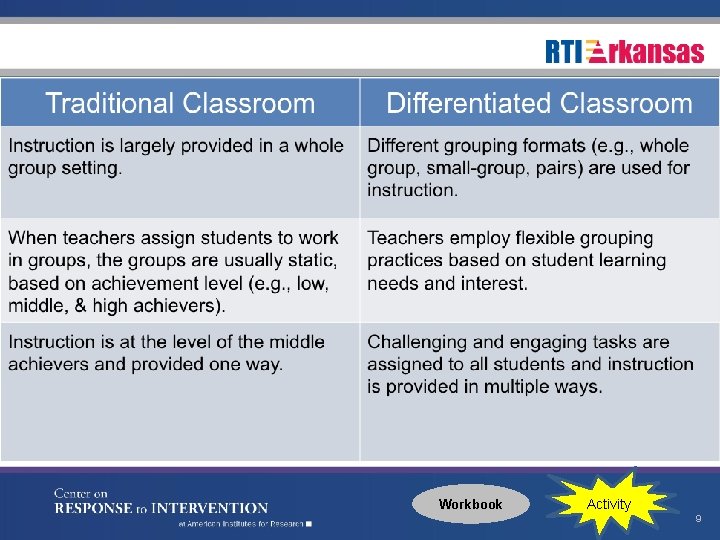
Workbook Activity 9
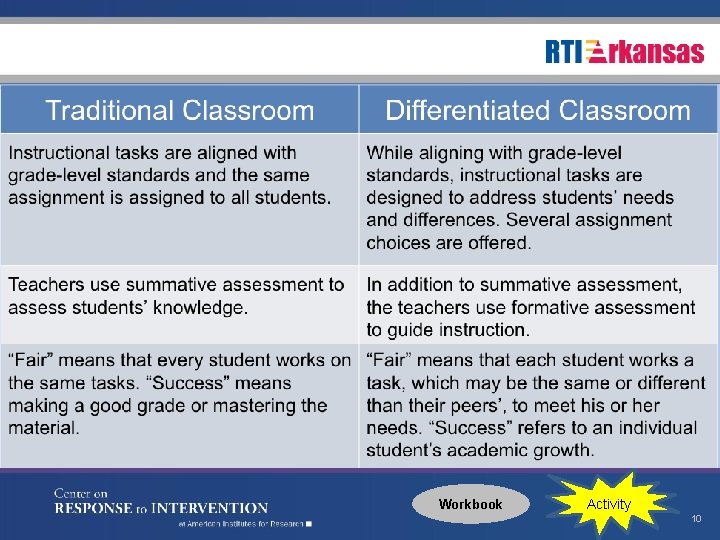
Workbook Activity 10
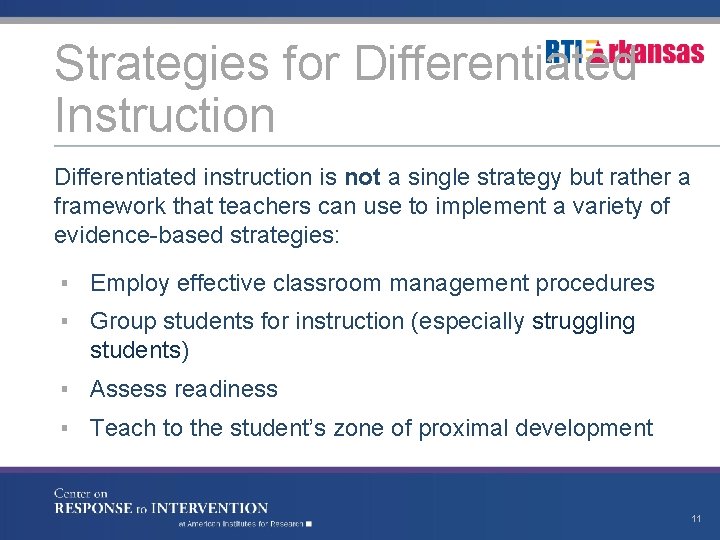
Strategies for Differentiated Instruction Differentiated instruction is not a single strategy but rather a framework that teachers can use to implement a variety of evidence-based strategies: ▪ Employ effective classroom management procedures ▪ Group students for instruction (especially struggling students) ▪ Assess readiness ▪ Teach to the student’s zone of proximal development 11
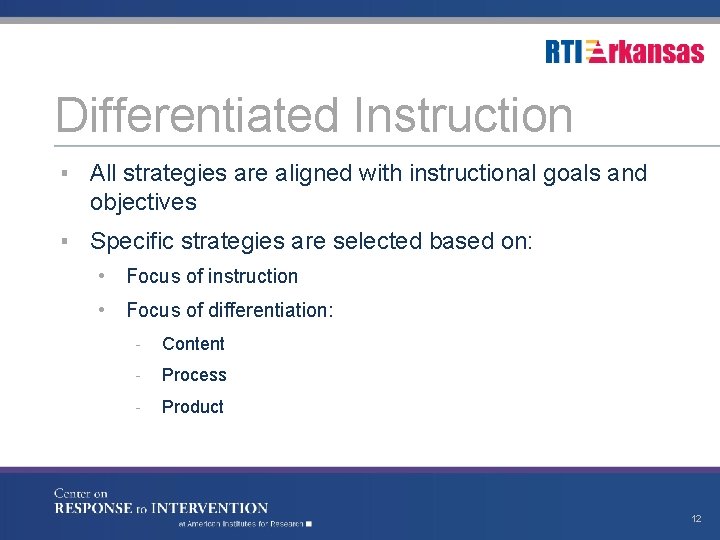
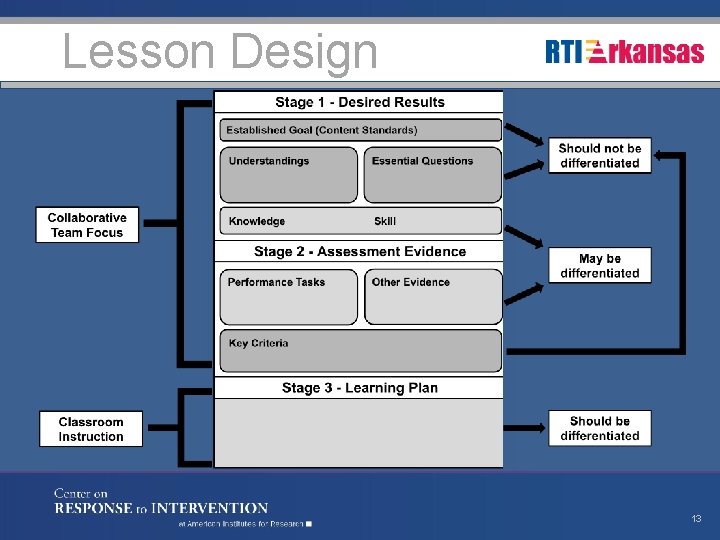
Differentiated Instruction ▪ All strategies are aligned with instructional goals and objectives ▪ Specific strategies are selected based on: • Focus of instruction • Focus of differentiation: – Content – Process – Product 12
Lesson Design 13
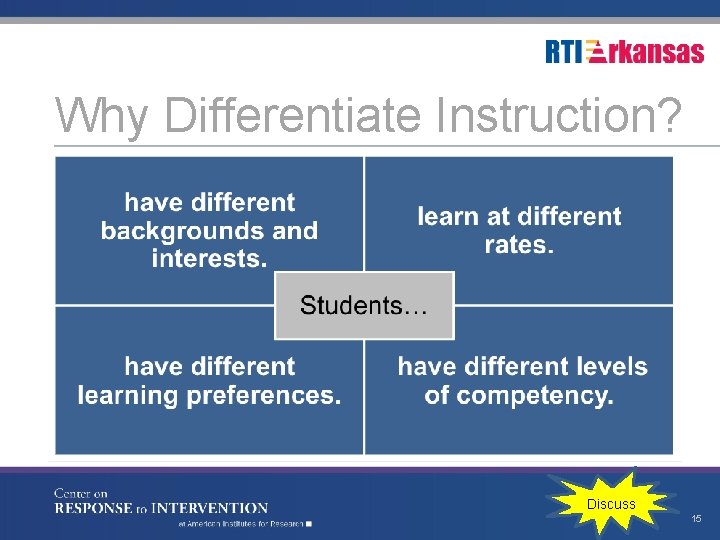
Why Differentiate Instruction? 14
Why Differentiate Instruction? Discuss 15
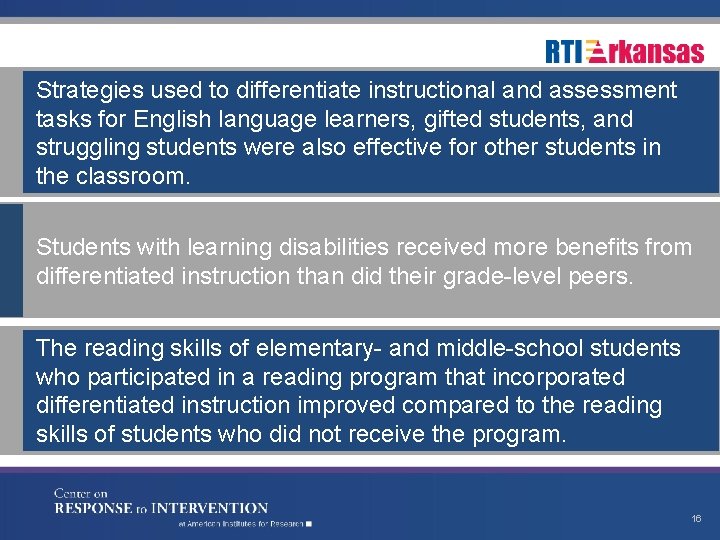
Strategies used to differentiate instructional and assessment tasks for English language learners, gifted students, and struggling students were also effective for other students in the classroom. Students with learning disabilities received more benefits from differentiated instruction than did their grade-level peers. The reading skills of elementary- and middle-school students who participated in a reading program that incorporated differentiated instruction improved compared to the reading skills of students who did not receive the program. 16
Instructional Grouping 17
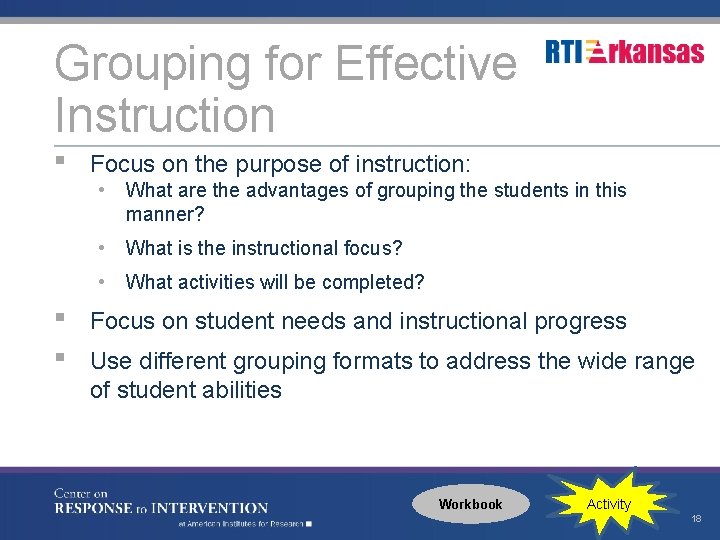
Grouping for Effective Instruction ▪ ▪ ▪ Focus on the purpose of instruction: • What are the advantages of grouping the students in this manner? • What is the instructional focus? • What activities will be completed? Focus on student needs and instructional progress Use different grouping formats to address the wide range of student abilities Workbook Activity 18
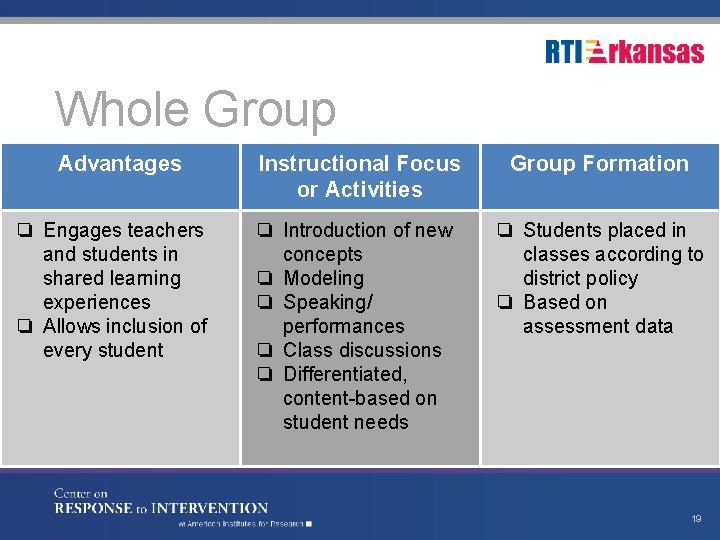
Whole Group Advantages ❏ Engages teachers and students in shared learning experiences ❏ Allows inclusion of every student Instructional Focus or Activities ❏ Introduction of new concepts ❏ Modeling ❏ Speaking/ performances ❏ Class discussions ❏ Differentiated, content-based on student needs Group Formation ❏ Students placed in classes according to district policy ❏ Based on assessment data 19
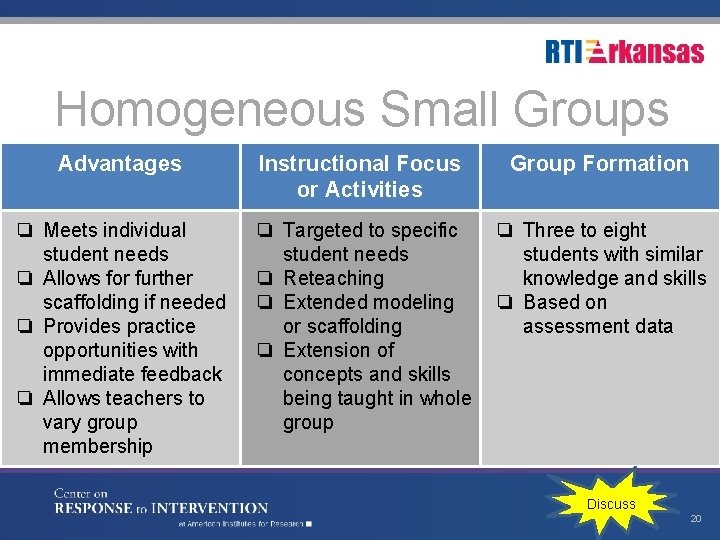
Homogeneous Small Groups Advantages Instructional Focus or Activities Group Formation ❏ Meets individual student needs ❏ Allows for further scaffolding if needed ❏ Provides practice opportunities with immediate feedback ❏ Allows teachers to vary group membership ❏ Targeted to specific student needs ❏ Reteaching ❏ Extended modeling or scaffolding ❏ Extension of concepts and skills being taught in whole group ❏ Three to eight students with similar knowledge and skills ❏ Based on assessment data Discuss 20
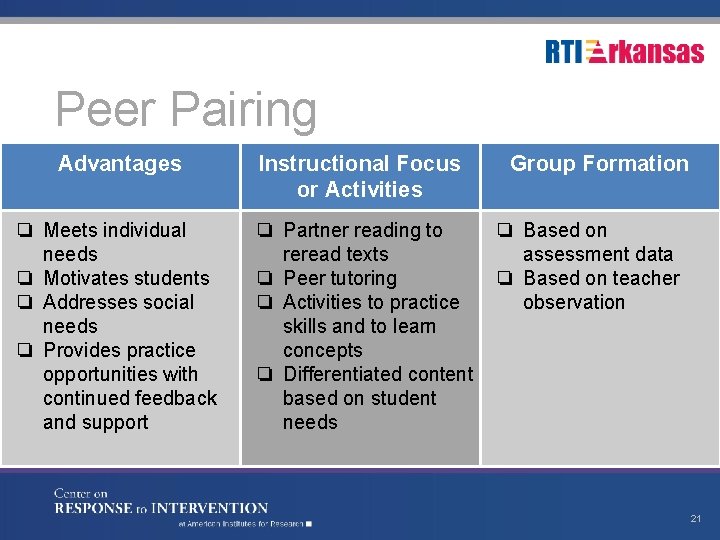
Peer Pairing Advantages Instructional Focus or Activities ❏ Meets individual needs ❏ Motivates students ❏ Addresses social needs ❏ Provides practice opportunities with continued feedback and support ❏ Partner reading to reread texts ❏ Peer tutoring ❏ Activities to practice skills and to learn concepts ❏ Differentiated content based on student needs Group Formation ❏ Based on assessment data ❏ Based on teacher observation 21
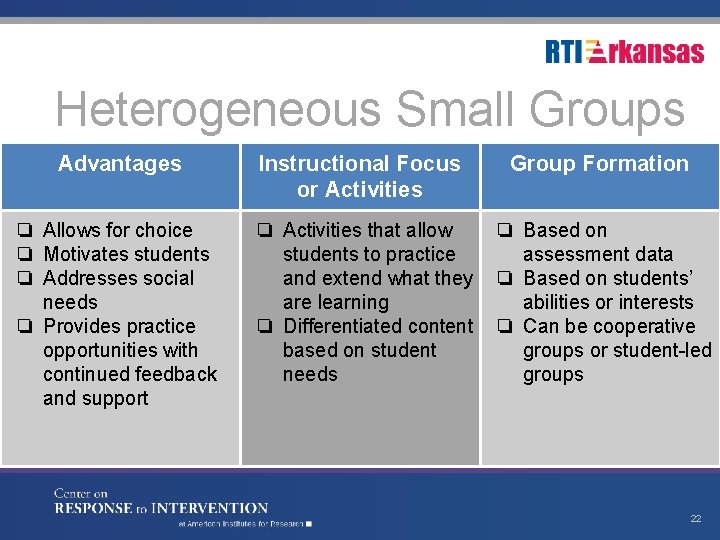
Heterogeneous Small Groups Advantages Instructional Focus or Activities Group Formation ❏ Allows for choice ❏ Motivates students ❏ Addresses social needs ❏ Provides practice opportunities with continued feedback and support ❏ Activities that allow students to practice and extend what they are learning ❏ Differentiated content based on student needs ❏ Based on assessment data ❏ Based on students’ abilities or interests ❏ Can be cooperative groups or student-led groups 22
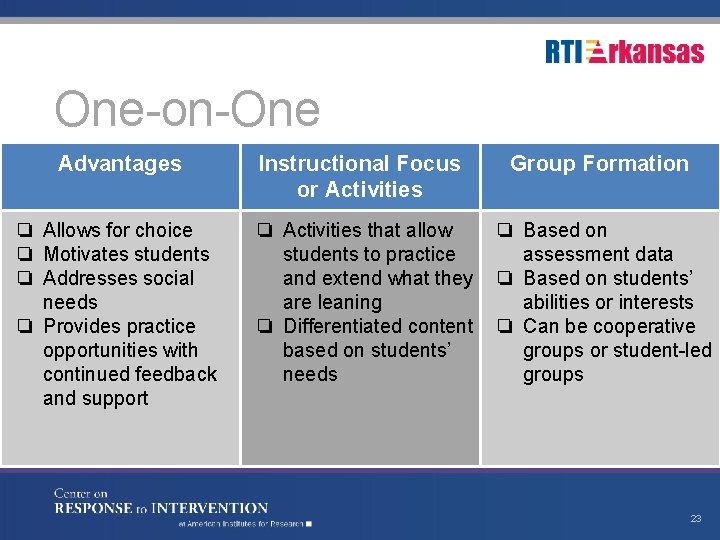
One-on-One Advantages Instructional Focus or Activities Group Formation ❏ Allows for choice ❏ Motivates students ❏ Addresses social needs ❏ Provides practice opportunities with continued feedback and support ❏ Activities that allow students to practice and extend what they are leaning ❏ Differentiated content based on students’ needs ❏ Based on assessment data ❏ Based on students’ abilities or interests ❏ Can be cooperative groups or student-led groups 23
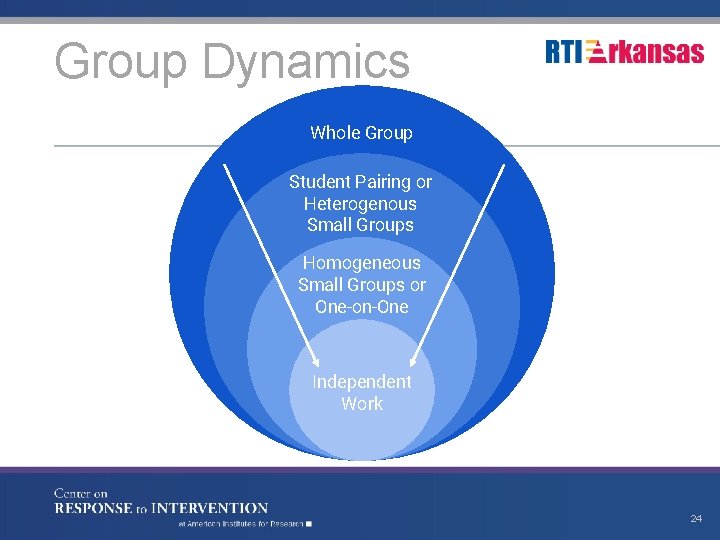
Group Dynamics Whole Group Student Pairing or Heterogenous Small Groups Homogeneous Small Groups or One-on-One Independent Work 24
Content, Process, and Product 25
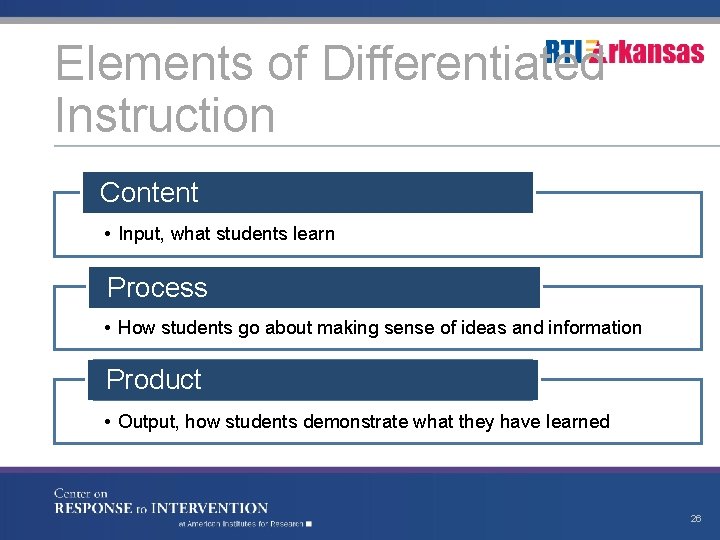
Elements of Differentiated Instruction Content • Input, what students learn Process • How students go about making sense of ideas and information Product • Output, how students demonstrate what they have learned 26
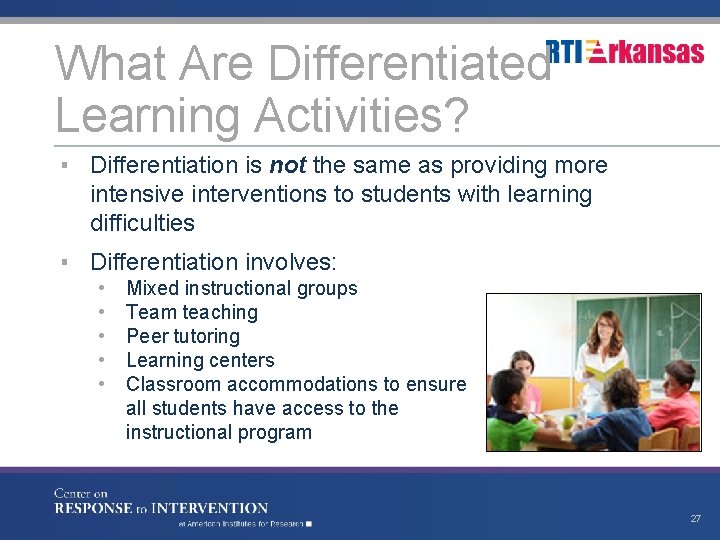
What Are Differentiated Learning Activities? ▪ Differentiation is not the same as providing more intensive interventions to students with learning difficulties ▪ Differentiation involves: • • • Mixed instructional groups Team teaching Peer tutoring Learning centers Classroom accommodations to ensure all students have access to the instructional program 27
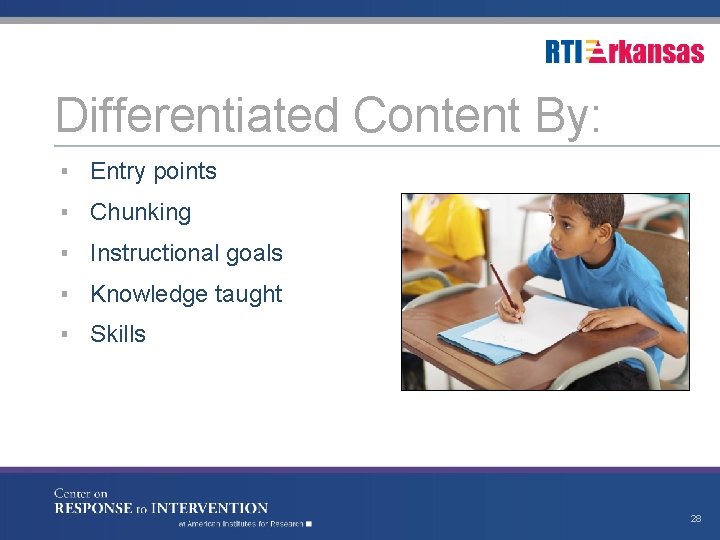
Differentiated Content By: ▪ Entry points ▪ Chunking ▪ Instructional goals ▪ Knowledge taught ▪ Skills 28
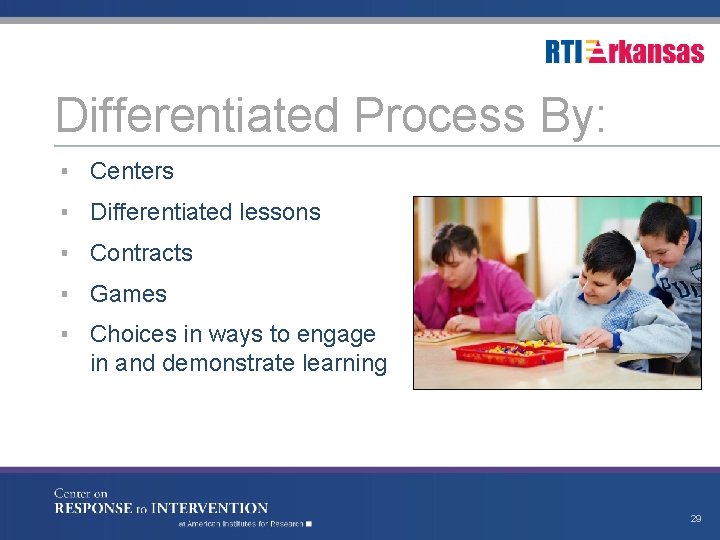
Differentiated Process By: ▪ Centers ▪ Differentiated lessons ▪ Contracts ▪ Games ▪ Choices in ways to engage in and demonstrate learning 29
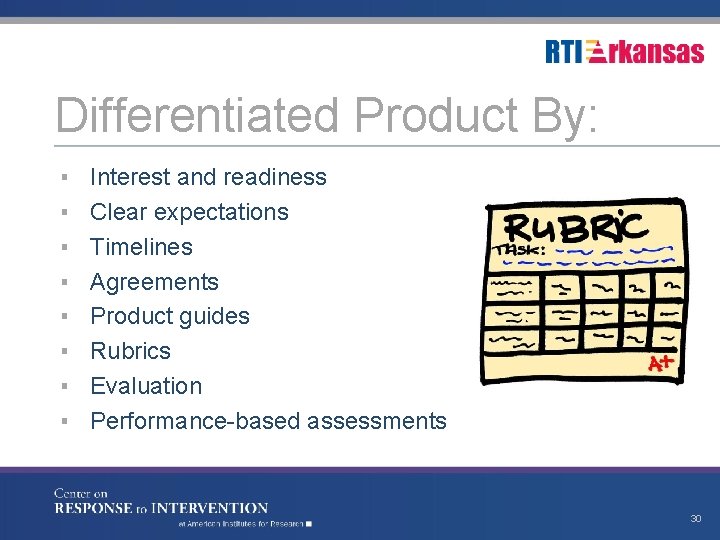
Differentiated Product By: ▪ ▪ ▪ ▪ Interest and readiness Clear expectations Timelines Agreements Product guides Rubrics Evaluation Performance-based assessments 30
Addressing Common Needs in Tier 1 ▪ Prioritize instruction ▪ Scaffold material ▪ Link assessment to instruction ▪ Adjust the pace of instruction ▪ Flexibly group students based on data 31
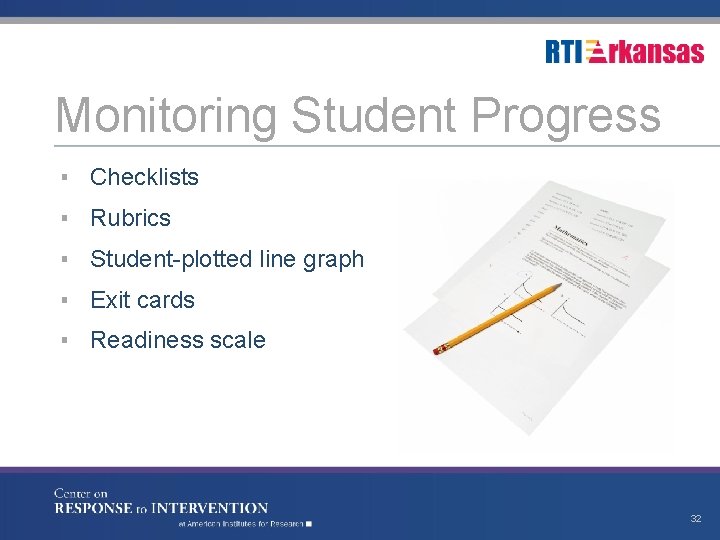
Monitoring Student Progress ▪ Checklists ▪ Rubrics ▪ Student-plotted line graph ▪ Exit cards ▪ Readiness scale 32
Reflecting on Practice What new ideas have I learned today that will help support the differentiation of content, process, and product in classroom instruction? Discuss 33
Using Data to Differentiate 34
Assessment-Driven Instruction When instruction is assessment-driven, teachers view assessment as an important step in the instructional cycle. “When teachers’ classroom assessments become an integral part of the instructional process and a central ingredient in their efforts to help students learn, the benefits of assessment for both students and teachers will be boundless. ” — Thomas Guskey, 2003, p. 11 35
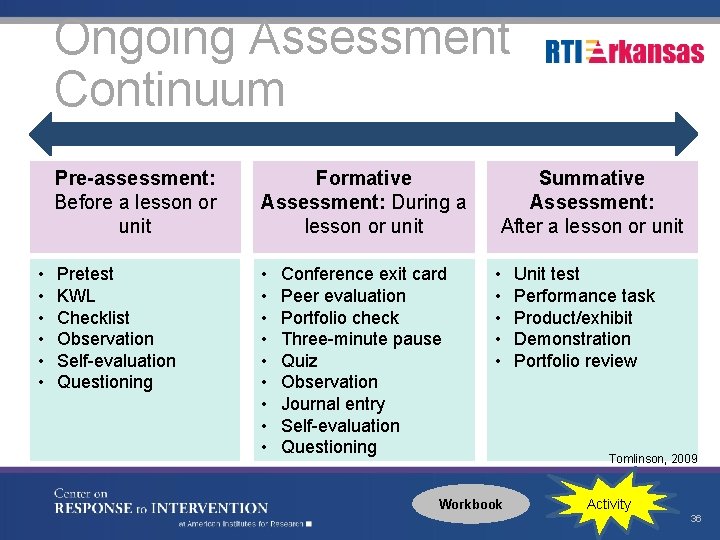
Ongoing Assessment Continuum • • • Pre-assessment: Before a lesson or unit Formative Assessment: During a lesson or unit Pretest KWL Checklist Observation Self-evaluation Questioning • • • Conference exit card Peer evaluation Portfolio check Three-minute pause Quiz Observation Journal entry Self-evaluation Questioning Summative Assessment: After a lesson or unit • • • Workbook Unit test Performance task Product/exhibit Demonstration Portfolio review Tomlinson, 2009 Activity 36
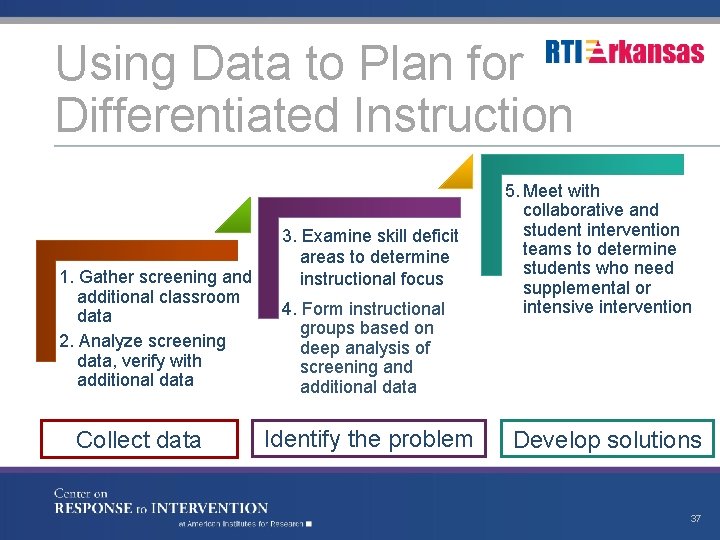
Using Data to Plan for Differentiated Instruction 1. Gather screening and additional classroom data 2. Analyze screening data, verify with additional data Collect data 3. Examine skill deficit areas to determine instructional focus 4. Form instructional groups based on deep analysis of screening and additional data Identify the problem 5. Meet with collaborative and student intervention teams to determine students who need supplemental or intensive intervention Develop solutions 37
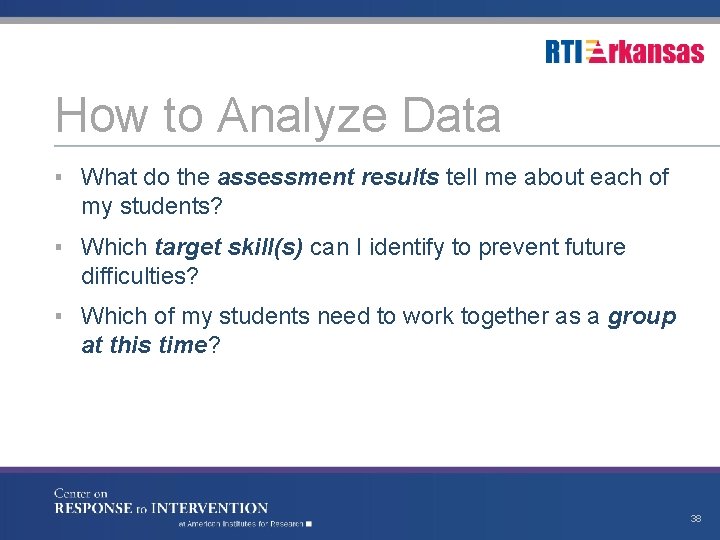
How to Analyze Data ▪ What do the assessment results tell me about each of my students? ▪ Which target skill(s) can I identify to prevent future difficulties? ▪ Which of my students need to work together as a group at this time? 38
How to Analyze Data: Data Walls As you watch, list the key words or phrases. Discuss 39
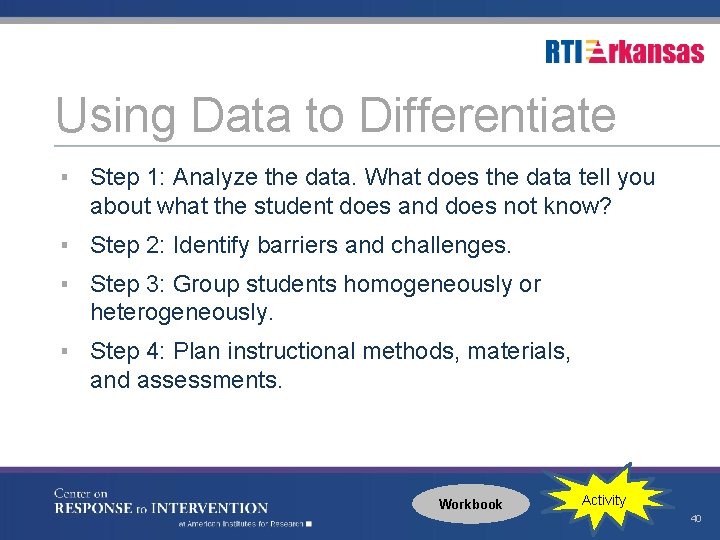
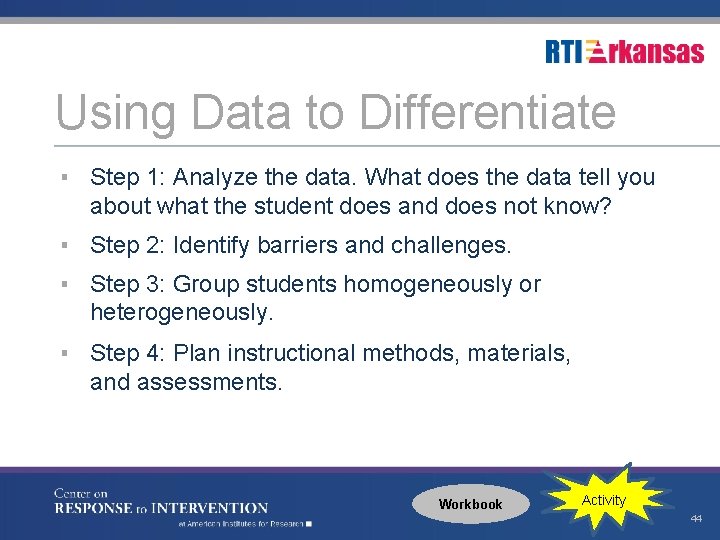
Using Data to Differentiate ▪ Step 1: Analyze the data. What does the data tell you about what the student does and does not know? ▪ Step 2: Identify barriers and challenges. ▪ Step 3: Group students homogeneously or heterogeneously. ▪ Step 4: Plan instructional methods, materials, and assessments. Workbook Activity 40
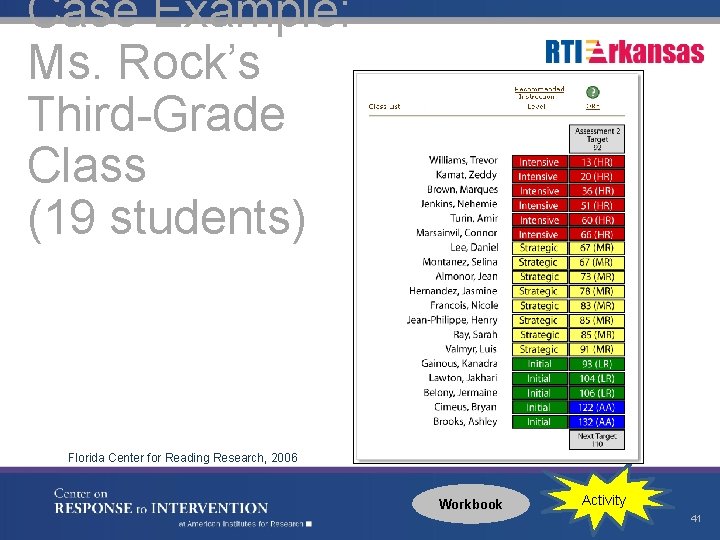
Case Example: Ms. Rock’s Third-Grade Class (19 students) Florida Center for Reading Research, 2006 Workbook Activity 41
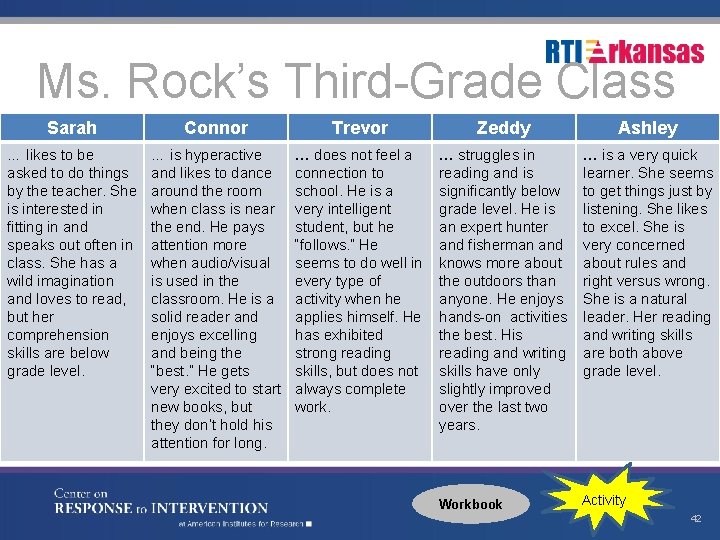
Ms. Rock’s Third-Grade Class Sarah Connor Trevor Zeddy Ashley … likes to be asked to do things by the teacher. She is interested in fitting in and speaks out often in class. She has a wild imagination and loves to read, but her comprehension skills are below grade level. … is hyperactive and likes to dance around the room when class is near the end. He pays attention more when audio/visual is used in the classroom. He is a solid reader and enjoys excelling and being the “best. ” He gets very excited to start new books, but they don’t hold his attention for long. … does not feel a connection to school. He is a very intelligent student, but he “follows. ” He seems to do well in every type of activity when he applies himself. He has exhibited strong reading skills, but does not always complete work. … struggles in reading and is significantly below grade level. He is an expert hunter and fisherman and knows more about the outdoors than anyone. He enjoys hands-on activities the best. His reading and writing skills have only slightly improved over the last two years. … is a very quick learner. She seems to get things just by listening. She likes to excel. She is very concerned about rules and right versus wrong. She is a natural leader. Her reading and writing skills are both above grade level. Workbook Activity 42
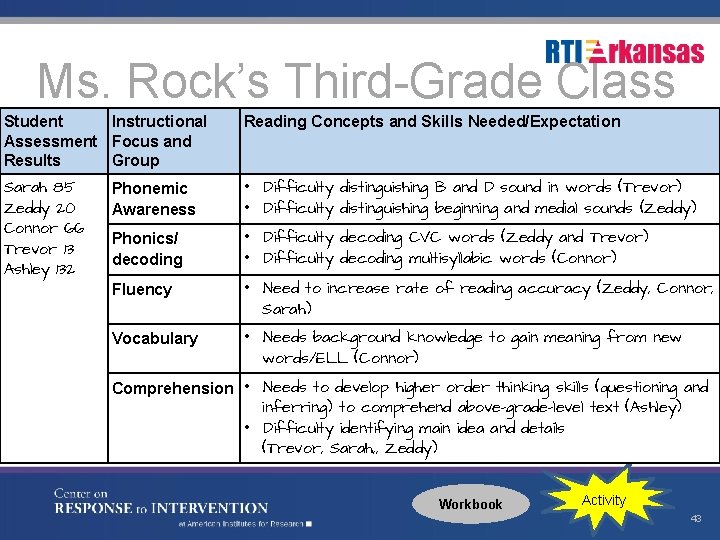
Ms. Rock’s Third-Grade Class Student Instructional Assessment Focus and Results Group Reading Concepts and Skills Needed/Expectation Sarah 85 Zeddy 20 Connor 66 Trevor 13 Ashley 132 Phonemic Awareness • Difficulty distinguishing B and D sound in words (Trevor) • Difficulty distinguishing beginning and medial sounds (Zeddy) Phonics/ decoding • Difficulty decoding CVC words (Zeddy and Trevor) • Difficulty decoding multisyllabic words (Connor) Fluency • Need to increase rate of reading accuracy (Zeddy, Connor, Sarah) Vocabulary • Needs background knowledge to gain meaning from new words/ELL (Connor) Comprehension • Needs to develop higher order thinking skills (questioning and inferring) to comprehend above-grade-level text (Ashley) • Difficulty identifying main idea and details (Trevor, Sarah, , Zeddy) Workbook Activity 43
Using Data to Differentiate ▪ Step 1: Analyze the data. What does the data tell you about what the student does and does not know? ▪ Step 2: Identify barriers and challenges. ▪ Step 3: Group students homogeneously or heterogeneously. ▪ Step 4: Plan instructional methods, materials, and assessments. Workbook Activity 44
Reflection 45
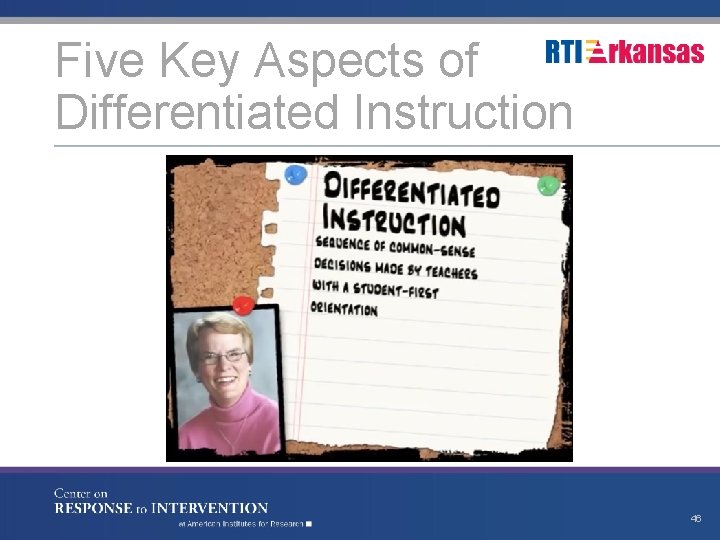
Five Key Aspects of Differentiated Instruction 46
Revisit Activator Activity ▪ What is differentiated instruction? ▪ How do teachers plan for differentiated instruction? ▪ How do teachers prepare their students and classrooms for differentiated instruction? ▪ What does differentiated instruction look like in the classroom? Workbook Activity 47
Next Steps ▪ With your team, reflect on your next steps. What steps do you need to add to the action plan created in Module 6 Tier 1 Core Instruction? ▪ What resources do you need to accomplish this work? Discuss 48
Resources and References 49
Need More Information? National Center on Intensive Intervention www. intensiveintervention. org National Center on Response to Intervention www. rti 4 success. org RTI Action Network www. rtinetwork. org Florida Center for Reading Research www. fcrr. org 50
References Baumgartner, T. , Lipowski, M. B. , & Rush, C. (2003). Increasing reading achievement of primary and middle school students through differentiated instruction (Master's research). Available from Education Resources Information Center. Chard, D. (n. d. ). Differentiating Instruction for Students with Special Needs. Easthampton Public Schools. Retrieved from http: //www. epsd. us/training/differentiatinginstruction-studentsspecial-needs. pdf Florida Center for Reading Research. (2006). Formation of groups—Third-grade class status report. Tallahassee, FL: Author. Retrieved from http: //www. fcrr. org/assessment/ET/diff/cls. Stat. Rprt 3. html Gibson, V. (2010). Differentiating instruction and practice: Practical steps for implementation. Metairie, LA: The Center for Development for Learning. Retrieved from http: //www. cdl. org/articles/differentiating-instruction-and-practice/ Guskey, T. R. (2003). Using data to improve student achievement. Educational Leadership, 60(5), 6– 11. Marshall, A. (2015). Brain scans show dyslexics read better with alternative strategies. Burlingame, CA: Davis Dyslexia Association International. Retrieved from https: //www. dyslexia. com/research/articles/alternative-brain-pathways/ 51
References Mc. Kenna, M. C. , & Walpole, S. (2005). How well does assessment inform our reading instruction? The Reading Teacher, 59, 84– 86. Mc. Quarrie, L. , Mc. Rae, P. , & Stack-Cutler, H. (2008). Differentiated instruction provincial research review. Edmonton: Alberta Initiative for School Improvement. Mitchell, D. (2010). Education that fits: Review of international trends in the education of students with special educational needs. University of Canterbury, Ministry of Education. Retrieved from https: //www. educationcounts. govt. nz/publications/special_education/education-that-fits/chaptersixteen-universal-design-for-learning Tomlinson, C. (2003). Differentiating instruction in mixed-ability classrooms. Upper Saddle River, NJ: Pearson/Merrill Prentice Hall. Tomlinson, C. A. & Mc. Tighe, J. (2006). Integrating differentiated instruction and understanding by design: Connecting content and kids. Alexandria, VA: ASCD. Tyner, B. (2004). Small-group Reading Instruction: A Differentiated Teaching Model for Beginning and Struggling Readers. Newark, DE: International Reading Association. 52
References Shaywitz, S. E. , Shaywitz, B. A. , Fulbright, S. E. , Skudlarski, P. , Mencl, W. E. , Constable, R. T. , …Gore, J. C. (2003). Neural systems for compensation and persistence: Young adult outcome of childhood reading disability. Biological Psychiatry, 54, 25– 33. Willoughby, J. (2012). Differentiating instruction: Meeting students where they are. Retrieved from https: //soarnc. org/wp-content/uploads/2014/05/Differentiated-Instruction. pdf 53