
Module 7 Clinical Assessment of the Lower Extremity
- Slides: 21
Module 7 Clinical Assessment of the Lower Extremity Distal to the Knee Lower Limb Orthotics I College of Health Sciences Orthotics & Prosthetics - St. Petersburg College 1 gg
Sources • “Assessment Strategies for Lower Extremity Orthoses”, Ch. 6, Lusardi & Nielsen, 1 st edition, 2000 (pdf file provided) • Various images from the internet College of Health Sciences Orthotics & Prosthetics - St. Petersburg College 2 gg
Student Learning Outcomes At the completion of this unit, the student should be capable of: • • Describing the roles of the orthotist and therapist in the assessment of the lower extremity for orthoses. Describing the goals of orthotic management. Comparing and contrasting the excursion of the hip, knee and ankle that are necessary for normal progression through the gait cycle to that of a pathological clinical presentation. Describing and documenting the clinical components of a pre-orthotic assessment in the formulation of a treatment plan to include: spatial relationship of articular surfaces; assessment of passive range of motion of a joint; observation of active range of motion of a joint; overall limb alignment; and assessment of deep tendon reflexes. College of Health Sciences Orthotics & Prosthetics - St. Petersburg College 3 gg
Agenda • Orthotist and Therapist Strategies • Goals of Orthotic Management • Joint Function and Integrity – Gait Review – Goniometric Measurements of Ankle & Foot Joints – Ankle Ligamentous Instability • Alignment of Limbs • Deep Tendon Reflexes College of Health Sciences Orthotics & Prosthetics - St. Petersburg College 4 gg
Orthotist and Therapist • Use similar strategies: – Therapist = Begins to define the goals of orthotic intervention and may have initial impressions about the design or components that might be appropriate. – Orthotist = Asks questions that help clarify the goals of orthotic intervention. – Both = Careful evaluation of the patient's musculoskeletal and neuromuscular status, assessment of current functional status and then estimation of future potential. College of Health Sciences Orthotics & Prosthetics - St. Petersburg College 5 gg
Goals of Orthotic Management • • • To protect To correct To substitute To enhance To stabilize or immobilize To reduce pain College of Health Sciences Orthotics & Prosthetics - St. Petersburg College 6 gg
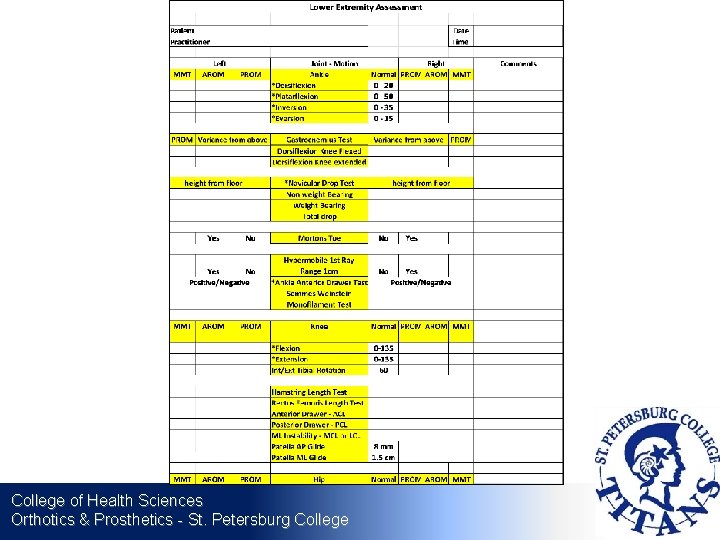
Joint Function and Integrity • Assessment begins with careful evaluation of joint function – – Spatial relationship of articular surfaces The axis of motion of the joints The alignment of limb segments Discrepancies in limb segmental length and girth • Observation of the patient's active movement • Passive movement of the patient's limb • Excursions of the hip, knee, and ankle that are necessary for "normal" progression • Document clinical observations College of Health Sciences Orthotics & Prosthetics - St. Petersburg College 7 gg
College of Health Sciences Orthotics & Prosthetics - St. Petersburg College 8 gg
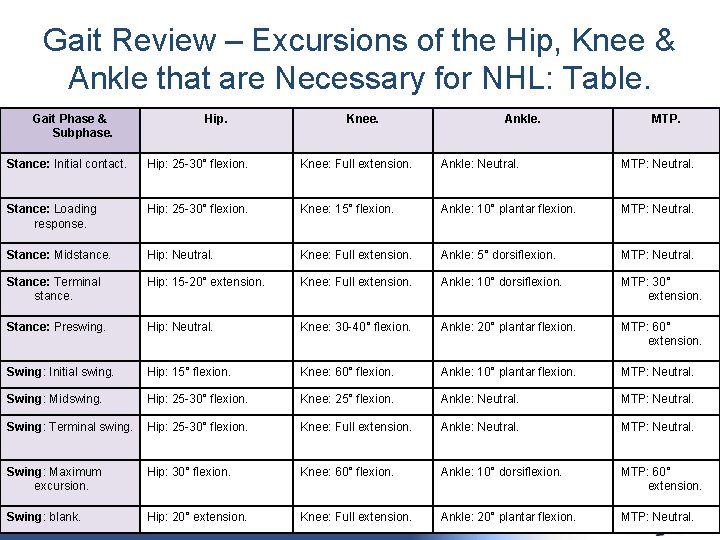
Gait Review – Excursions of the Hip, Knee & Ankle that are Necessary for NHL: Table. Gait Phase & Subphase. Hip. Knee. Ankle. MTP. Stance: Initial contact. Hip: 25 -30° flexion. Knee: Full extension. Ankle: Neutral. MTP: Neutral. Stance: Loading response. Hip: 25 -30° flexion. Knee: 15° flexion. Ankle: 10° plantar flexion. MTP: Neutral. Stance: Midstance. Hip: Neutral. Knee: Full extension. Ankle: 5° dorsiflexion. MTP: Neutral. Stance: Terminal stance. Hip: 15 -20° extension. Knee: Full extension. Ankle: 10° dorsiflexion. MTP: 30° extension. Stance: Preswing. Hip: Neutral. Knee: 30 -40° flexion. Ankle: 20° plantar flexion. MTP: 60° extension. Swing: Initial swing. Hip: 15° flexion. Knee: 60° flexion. Ankle: 10° plantar flexion. MTP: Neutral. Swing: Midswing. Hip: 25 -30° flexion. Knee: 25° flexion. Ankle: Neutral. MTP: Neutral. Swing: Terminal swing. Hip: 25 -30° flexion. Knee: Full extension. Ankle: Neutral. MTP: Neutral. Swing: Maximum excursion. Hip: 30° flexion. Knee: 60° flexion. Ankle: 10° dorsiflexion. MTP: 60° extension. Ankle: 20° plantar flexion. 9 gg MTP: Neutral. College of Health Sciences Swing: blank. & Prosthetics Hip: 20° extension. Knee: Full extension. Orthotics - St. Petersburg College
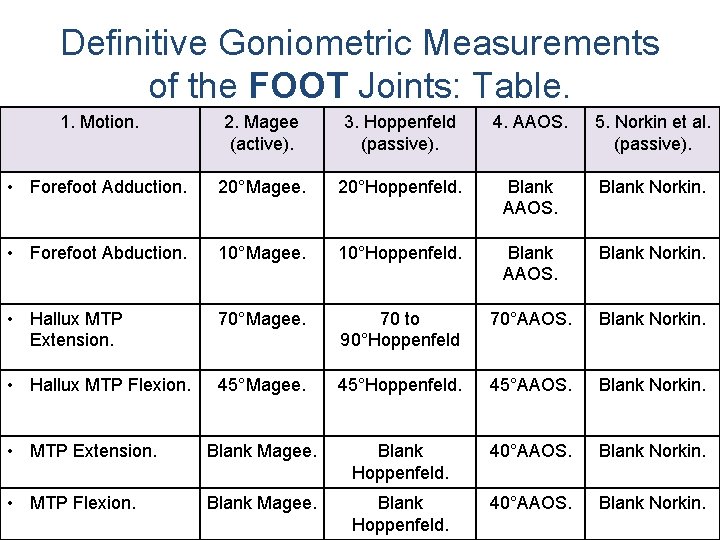
Definitive Goniometric Measurements of the FOOT Joints: Table. 1. Motion. 2. Magee (active). 3. Hoppenfeld (passive). 4. AAOS. 5. Norkin et al. (passive). • Forefoot Adduction. 20°Magee. 20°Hoppenfeld. Blank AAOS. Blank Norkin. • Forefoot Abduction. 10°Magee. 10°Hoppenfeld. Blank AAOS. Blank Norkin. • Hallux MTP Extension. 70°Magee. 70 to 90°Hoppenfeld 70°AAOS. Blank Norkin. • Hallux MTP Flexion. 45°Magee. 45°Hoppenfeld. 45°AAOS. Blank Norkin. Blank Magee. Blank Hoppenfeld. 40°AAOS. Blank Norkin. Blank Orthotics & Prosthetics - St. Petersburg College Hoppenfeld. 40°AAOS. Blank Norkin. • MTP Extension. Health Sciences Blank Magee. • College MTP of Flexion. 10 gg
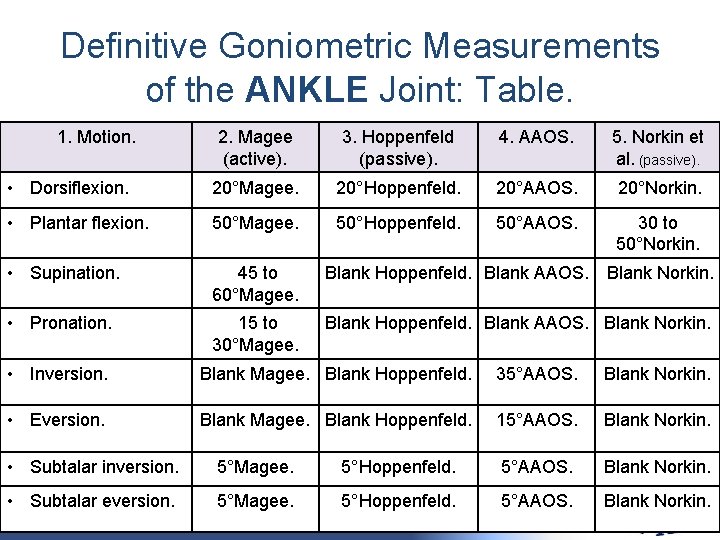
Definitive Goniometric Measurements of the ANKLE Joint: Table. 1. Motion. 2. Magee (active). 3. Hoppenfeld (passive). 4. AAOS. 5. Norkin et al. (passive). • Dorsiflexion. 20°Magee. 20°Hoppenfeld. 20°AAOS. 20°Norkin. • Plantar flexion. 50°Magee. 50°Hoppenfeld. 50°AAOS. 30 to 50°Norkin. • Supination. 45 to 60°Magee. Blank Hoppenfeld. Blank AAOS. Blank Norkin. • Pronation. 15 to 30°Magee. Blank Hoppenfeld. Blank AAOS. Blank Norkin. • Inversion. Blank Magee. Blank Hoppenfeld. 35°AAOS. Blank Norkin. • Eversion. Blank Magee. Blank Hoppenfeld. 15°AAOS. Blank Norkin. • Subtalar inversion. 5°Magee. 5°Hoppenfeld. 5°AAOS. Blank Norkin. of Health Sciences 5°Magee. • College Subtalar eversion. 5°Hoppenfeld. 5°AAOS. Blank Norkin. Orthotics & Prosthetics - St. Petersburg College 11 gg
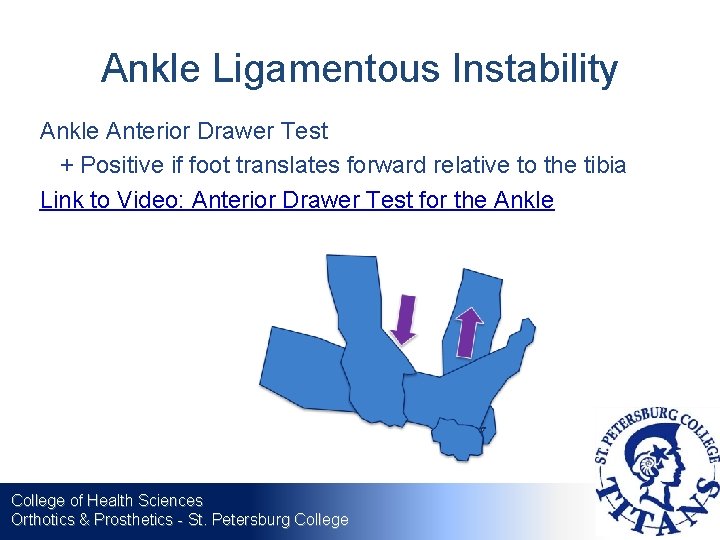
Ankle Ligamentous Instability Ankle Anterior Drawer Test + Positive if foot translates forward relative to the tibia Link to Video: Anterior Drawer Test for the Ankle College of Health Sciences Orthotics & Prosthetics - St. Petersburg College 12 gg
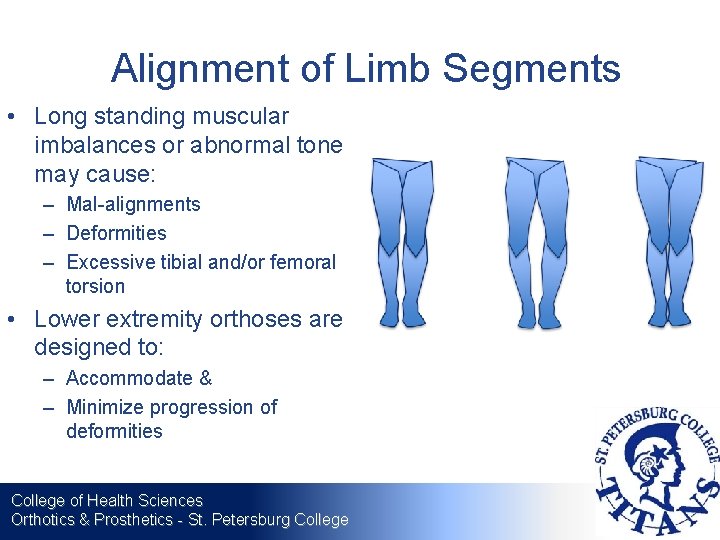
Alignment of Limb Segments • Long standing muscular imbalances or abnormal tone may cause: – Mal-alignments – Deformities – Excessive tibial and/or femoral torsion • Lower extremity orthoses are designed to: – Accommodate & – Minimize progression of deformities College of Health Sciences Orthotics & Prosthetics - St. Petersburg College 13 gg
Deep Tendon Reflexes of the Lower Extremity • Normal DTRs = symmetrical and similar in magnitude from proximal to distal joints • Indications of underlying neuromuscular dysfunction = – Asymmetric patterns between left vs. right – Significant difference in grade between distal and proximal reflexes • Link to Video: Abnormal Motoric Exam: Stretch or Deep Tendon Reflexes College of Health Sciences Orthotics & Prosthetics - St. Petersburg College 14 gg
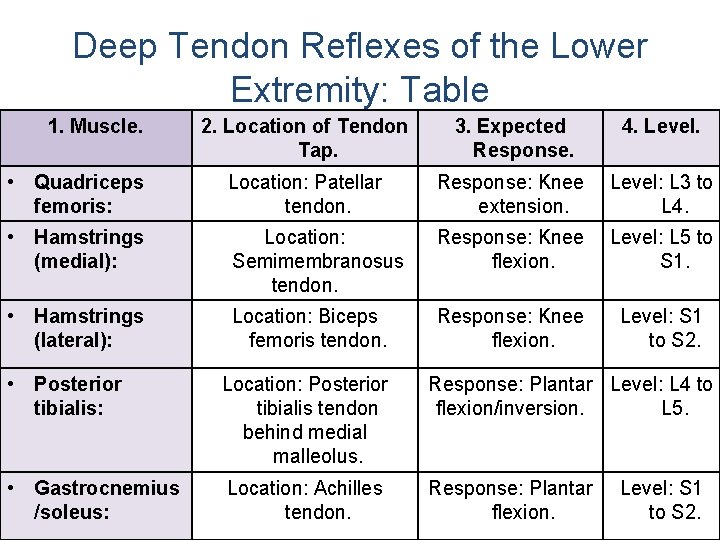
Deep Tendon Reflexes of the Lower Extremity: Table 1. Muscle. 2. Location of Tendon Tap. 3. Expected Response. 4. Level. • Quadriceps femoris: Location: Patellar tendon. Response: Knee extension. Level: L 3 to L 4. • Hamstrings (medial): Location: Semimembranosus tendon. Response: Knee flexion. Level: L 5 to S 1. • Hamstrings (lateral): Location: Biceps femoris tendon. Response: Knee flexion. Level: S 1 to S 2. • Posterior tibialis: Location: Posterior tibialis tendon behind medial malleolus. • Gastrocnemius Location: Achilles College of Health Sciences /soleus: Orthotics & Prosthetics - St. Petersburgtendon. College Response: Plantar Level: L 4 to flexion/inversion. L 5. Response: Plantar flexion. Level: S 1 to 15 gg. S 2.
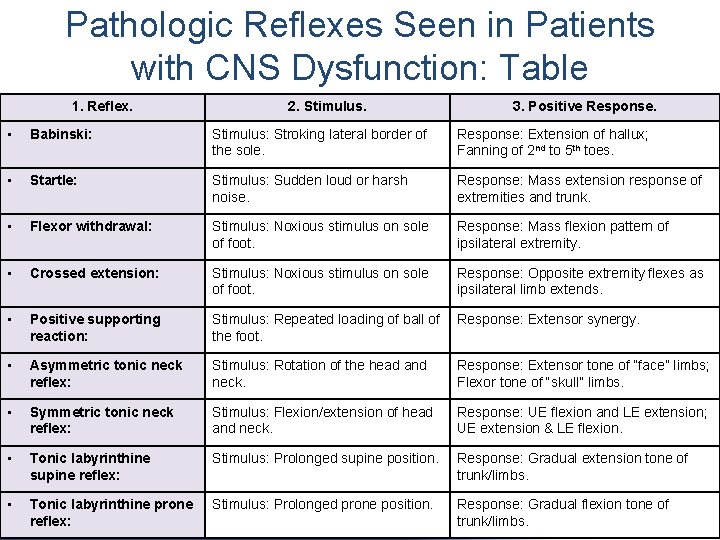
Pathologic Reflexes Seen in Patients with CNS Dysfunction: Table 1. Reflex. 2. Stimulus. 3. Positive Response. • Babinski: Stimulus: Stroking lateral border of the sole. Response: Extension of hallux; Fanning of 2 nd to 5 th toes. • Startle: Stimulus: Sudden loud or harsh noise. Response: Mass extension response of extremities and trunk. • Flexor withdrawal: Stimulus: Noxious stimulus on sole of foot. Response: Mass flexion pattern of ipsilateral extremity. • Crossed extension: Stimulus: Noxious stimulus on sole of foot. Response: Opposite extremity flexes as ipsilateral limb extends. • Positive supporting reaction: Stimulus: Repeated loading of ball of the foot. Response: Extensor synergy. • Asymmetric tonic neck reflex: Stimulus: Rotation of the head and neck. Response: Extensor tone of “face” limbs; Flexor tone of “skull” limbs. • Symmetric tonic neck reflex: Stimulus: Flexion/extension of head and neck. Response: UE flexion and LE extension; UE extension & LE flexion. • Tonic labyrinthine supine reflex: Stimulus: Prolonged supine position. Response: Gradual extension tone of trunk/limbs. Health Sciences • College Tonic of labyrinthine prone Stimulus: Prolonged prone position. Orthotics reflex: & Prosthetics - St. Petersburg College Response: Gradual flexion tone of 16 gg trunk/limbs.
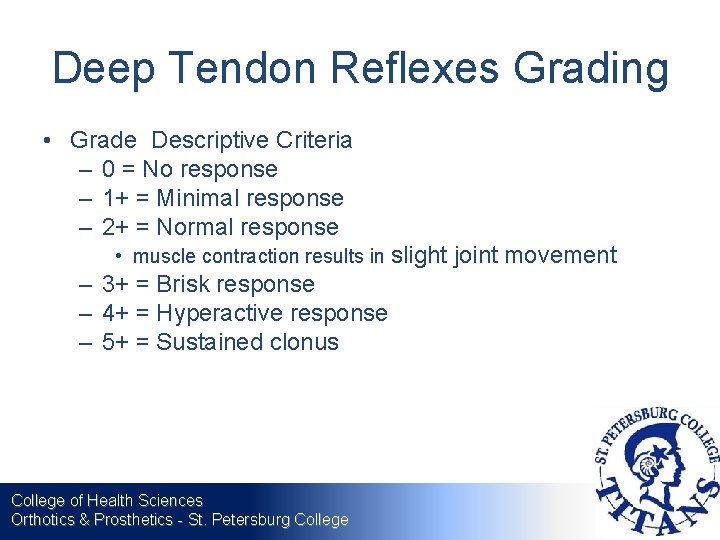
Deep Tendon Reflexes Grading • Grade Descriptive Criteria – 0 = No response – 1+ = Minimal response – 2+ = Normal response • muscle contraction results in slight joint movement – 3+ = Brisk response – 4+ = Hyperactive response – 5+ = Sustained clonus College of Health Sciences Orthotics & Prosthetics - St. Petersburg College 17 gg
Pre-Orthotic Assessment • The orthotist and therapist also evaluate functional muscle strength and muscular endurance • Traditional manual muscle tests or hand-held dynamometry • UMN or CNS patients: results of manual muscle testing may be influenced. College of Health Sciences Orthotics & Prosthetics - St. Petersburg College 18 gg
In Summary • An orthosis that corrects mal-alignments or protects unstable or vulnerable joints well, but in so doing, prevents the patient from accomplishing the important tasks and activities, will end up in the closet or under the bed instead of on the limb. • In order to make appropriate choices among orthotic component and design options, the orthotist and therapist must develop an understanding of how the patient currently functions, as well as the types of activities that the patient is required or would like to perform. College of Health Sciences Orthotics & Prosthetics - St. Petersburg College 19 gg
The End Lower Limb Orthotics I College of Health Sciences Orthotics & Prosthetics - St. Petersburg College 20 gg
Pedorthic Program of Study This workforce product was funded by a grant awarded by the U. S. Department of Labor’s Employment and Training Administration. The product was created by the grantee and does not necessarily reflect the official position of the U. S. Department of Labor. The U. S. Department of Labor makes no guarantees, warranties, or assurances of any kind, express or implied, with respect to such information, including any information on linked sites and including, but not limited to, accuracy of the information or its completeness, timeliness, usefulness, adequacy, continued availability, or ownership. Produced 2016. HOPE Careers Consortium is a partnership of five institutions of higher education that is building exciting new programs that will provide valuable career education and training in the Orthotics, Prosthetics, and Pedorthics (O&P) sector. The five institutions are: Baker College—Flint, Michigan; Century College—White Bear Lake, Minnesota; Oklahoma State University Institute of Technology—Okmulgee, Oklahoma; Spokane Falls Community College—Spokane, Washington; and St. Petersburg College—St. Petersburg, Florida. Although the authoring institution of this educational resource has made every effort to ensure that the information presented is correct, the institution assumes no liability to any party for any loss, damage, or disruption caused by errors or omissions. Except where otherwise noted, this work by St. Petersburg College is licensed under the Creative Commons Attribution 4. 0 International License. To view a copy of this license, click on the following link: Creative Commons Licenses 4. 0. College of Health Sciences Orthotics & Prosthetics - St. Petersburg College 21 gg