
Module 7 Chapter 6 Ethernet Technologies 10 Mbps
Module 7 Chapter 6 Ethernet Technologies
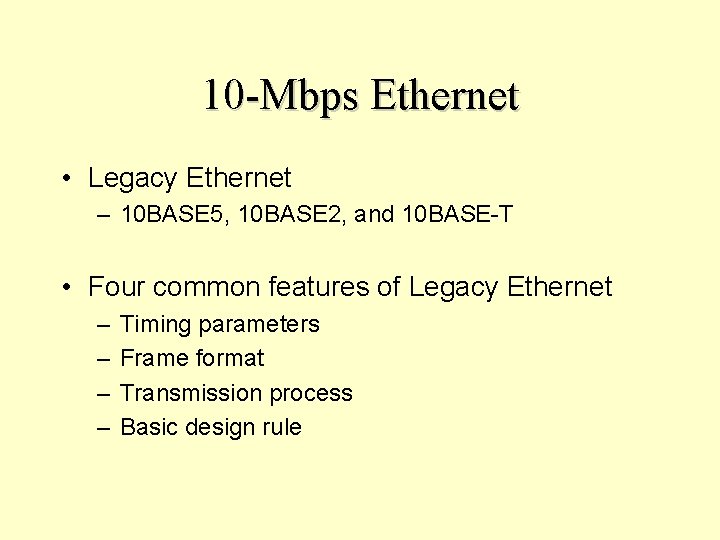
10 -Mbps Ethernet • Legacy Ethernet – 10 BASE 5, 10 BASE 2, and 10 BASE-T • Four common features of Legacy Ethernet – – Timing parameters Frame format Transmission process Basic design rule
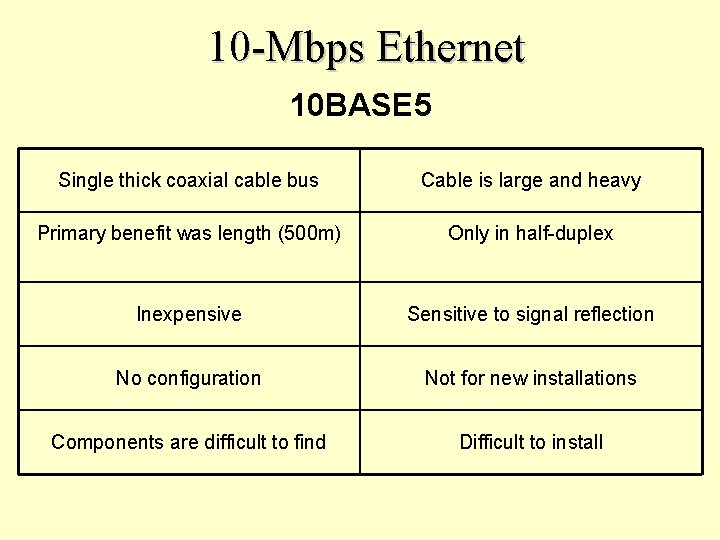
10 -Mbps Ethernet 10 BASE 5 Single thick coaxial cable bus Cable is large and heavy Primary benefit was length (500 m) Only in half-duplex Inexpensive Sensitive to signal reflection No configuration Not for new installations Components are difficult to find Difficult to install
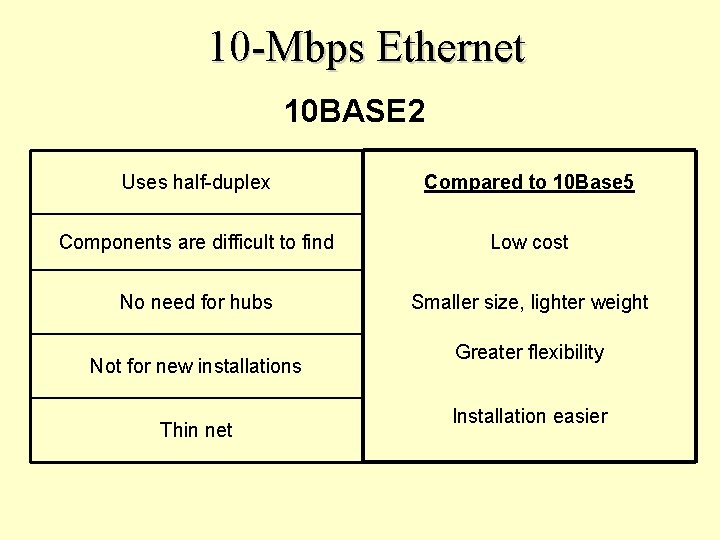
10 -Mbps Ethernet 10 BASE 2 Uses half-duplex Compared to 10 Base 5 Components are difficult to find Low cost No need for hubs Smaller size, lighter weight Not for new installations Thin net Greater flexibility Installation easier
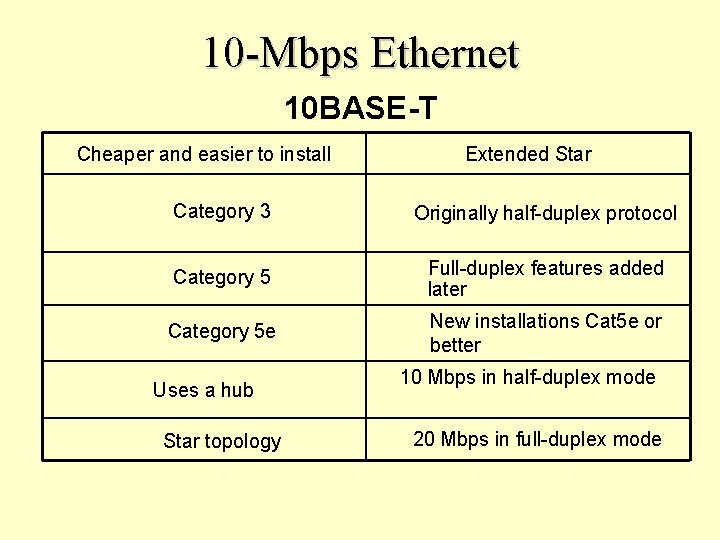
10 -Mbps Ethernet 10 BASE-T Cheaper and easier to install Extended Star Category 3 Originally half-duplex protocol Category 5 Full-duplex features added later Category 5 e New installations Cat 5 e or better Uses a hub Star topology 10 Mbps in half-duplex mode 20 Mbps in full-duplex mode
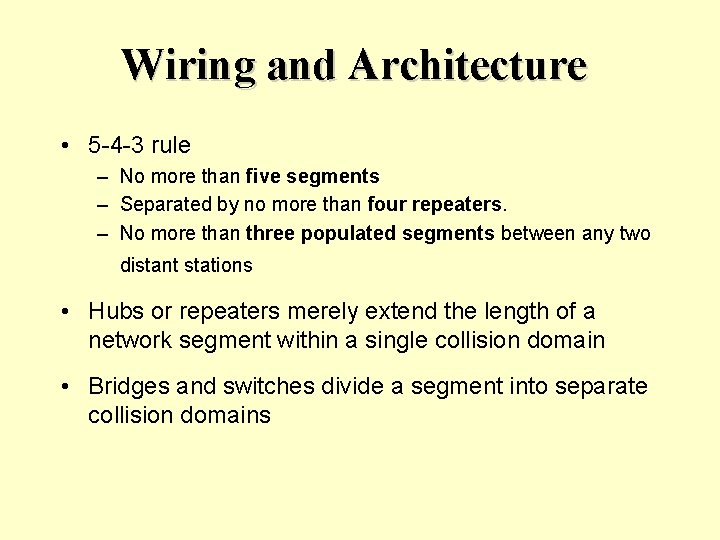
Wiring and Architecture • 5 -4 -3 rule – No more than five segments – Separated by no more than four repeaters. – No more than three populated segments between any two distant stations • Hubs or repeaters merely extend the length of a network segment within a single collision domain • Bridges and switches divide a segment into separate collision domains

Manchester Encoding • Manchester encoding is used in 10 Mbps systems • The direction of the edge transition in the middle of the timing window determines the binary value
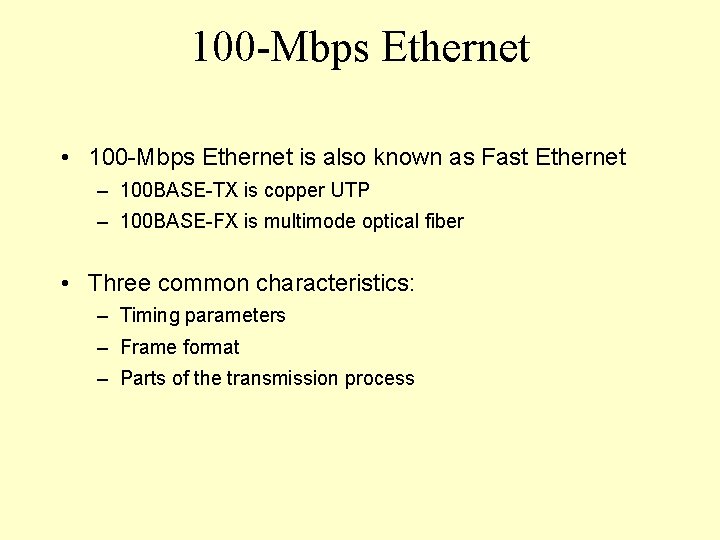
100 -Mbps Ethernet • 100 -Mbps Ethernet is also known as Fast Ethernet – 100 BASE-TX is copper UTP – 100 BASE-FX is multimode optical fiber • Three common characteristics: – Timing parameters – Frame format – Parts of the transmission process
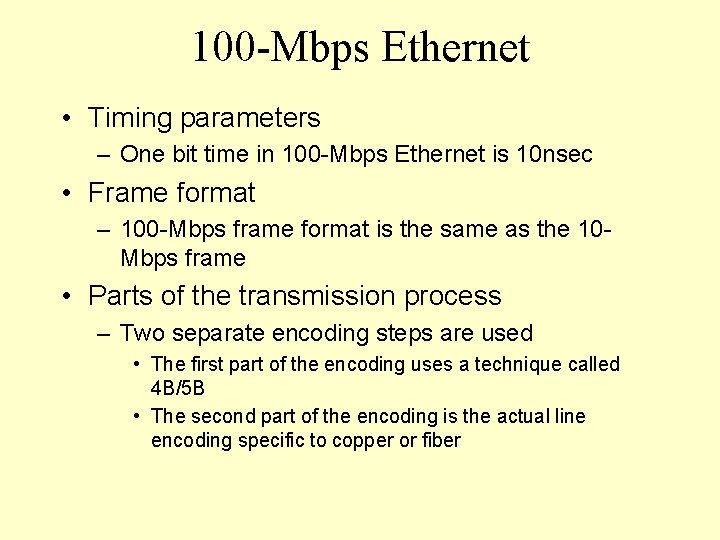
100 -Mbps Ethernet • Timing parameters – One bit time in 100 -Mbps Ethernet is 10 nsec • Frame format – 100 -Mbps frame format is the same as the 10 Mbps frame • Parts of the transmission process – Two separate encoding steps are used • The first part of the encoding uses a technique called 4 B/5 B • The second part of the encoding is the actual line encoding specific to copper or fiber
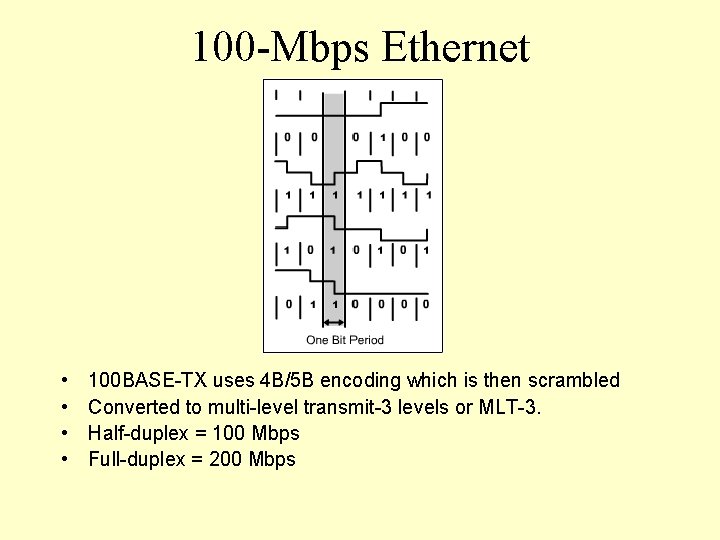
100 -Mbps Ethernet • • 100 BASE-TX uses 4 B/5 B encoding which is then scrambled Converted to multi-level transmit-3 levels or MLT-3. Half-duplex = 100 Mbps Full-duplex = 200 Mbps
Fast Ethernet Architecture • Fast Ethernet links consist of a connection between a station and a hub or switch – Hubs are considered multi-port repeaters – Switches are considered multi-port bridges – These are subject to the 100 m UTP distance limitation
Fast Ethernet Architecture • Class I repeater – Any repeater that changes between one Ethernet implementation and another – 140 bit-times of latency • Class II repeater – 92 bit-times latency – Cable between Class II repeaters may not exceed 5 meters
Fast Ethernet Architecture • Signaling scheme is inherently full duplex – Half duplex are not uncommon – Half duplex is undesirable • Switches have made the 100 m limitation less important • Workstations are located within 100 m of the switch • 100 m distance starts over at the switch
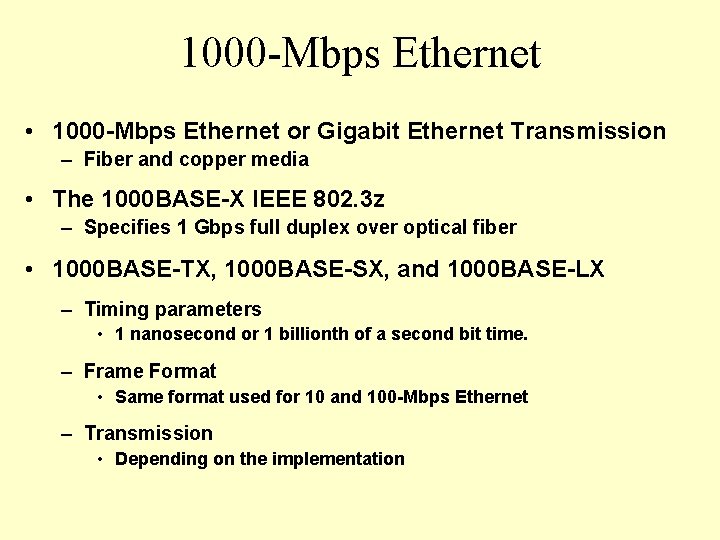
1000 -Mbps Ethernet • 1000 -Mbps Ethernet or Gigabit Ethernet Transmission – Fiber and copper media • The 1000 BASE-X IEEE 802. 3 z – Specifies 1 Gbps full duplex over optical fiber • 1000 BASE-TX, 1000 BASE-SX, and 1000 BASE-LX – Timing parameters • 1 nanosecond or 1 billionth of a second bit time. – Frame Format • Same format used for 10 and 100 -Mbps Ethernet – Transmission • Depending on the implementation
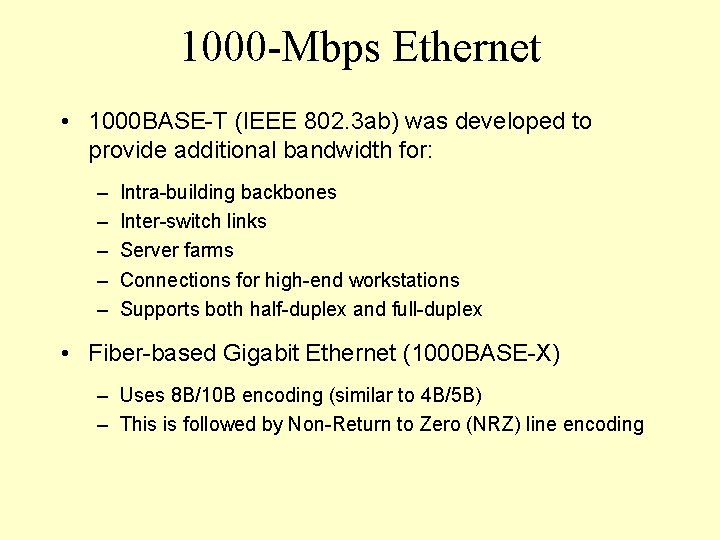
1000 -Mbps Ethernet • 1000 BASE-T (IEEE 802. 3 ab) was developed to provide additional bandwidth for: – – – Intra-building backbones Inter-switch links Server farms Connections for high-end workstations Supports both half-duplex and full-duplex • Fiber-based Gigabit Ethernet (1000 BASE-X) – Uses 8 B/10 B encoding (similar to 4 B/5 B) – This is followed by Non-Return to Zero (NRZ) line encoding
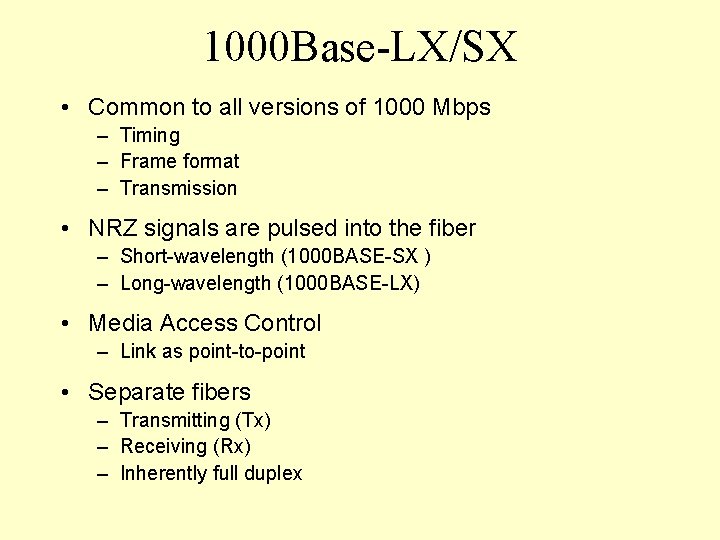
1000 Base-LX/SX • Common to all versions of 1000 Mbps – Timing – Frame format – Transmission • NRZ signals are pulsed into the fiber – Short-wavelength (1000 BASE-SX ) – Long-wavelength (1000 BASE-LX) • Media Access Control – Link as point-to-point • Separate fibers – Transmitting (Tx) – Receiving (Rx) – Inherently full duplex
Gigabit Ethernet • Gigabit Ethernet is the dominant technology for: – Backbone installations, – High-speed cross-connects – General infrastructure
10 Gigabit Ethernet • IEEE 802. 3 ae, governs the 10 Gb. E family • Provide increased bandwidth • Interoperable with existing infrastructure • Implementations being considered: – 10 GBASE-SR – 10 GBASE-LX 4 – 10 GBASE-LR and 10 GBASE-ER – 10 GBASE-SW, 10 GBASE-LW, and 10 GBASE-EW
10 Gigabit Ethernet • 10 GBASE-SR – – short distances, supports a range between 26 m to 82 m • 10 GBASE-LX 4 – – Uses wide wavelength division multiplexing (WWDM) – 240 m to 300 m over multimode fiber – 10 km over single-mode fiber • 10 GBASE-LR and 10 GBASE-ER – – Support 10 km and 40 km over single-mode fiber • 10 GBASE-SW, 10 GBASE-LW, and 10 GBASE-EW – – Known collectively as 10 GBASE-W – Works with OC-192 synchronous transport module
Future of Ethernet • The future of networking media is three-fold: 1. Copper (up to 1000 Mbps, perhaps more) 2. Wireless (approaching 100 Mbps, perhaps more) 3. Optical fiber (currently at 10, 000 Mbps and soon to be more) • Copper and wireless media have certain physical and practical limitations • Limitations on optical fiber are: – Electronics technology • emitters and detectors – Fiber manufacturing processes • Developments in Ethernet – Heavily weighted towards Laser light sources – Single-mode optical fiber

The End Break Time
- Slides: 21