
Module 7 A K12 Developmentally Appropriate Core Curriculum
- Slides: 12
Module 7 A K-12 Developmentally Appropriate Core Curriculum for Character Education The information in this Power. Point module should be read very carefully after listening to and watching each slide, or after listening to and watching the entire presentation. Since you control the transition from one slide to the next, you can pause to read after the narration and animation on each slide, or you can single-click on each slide during a second playing of the module to bypass the narration and animation and to bring up all of the readable copy. The additional reading of one or more of several books is strongly recommended as a follow-up. You may want to investigate the books by the following authors: Kevin Ryan, William Damon, Tom Lickona, Peter L. Benson, Ruth Charney, Marvin Berkowitz, Lawrence Kohlberg, Philip Vincent, Chip Wood, John Dewey, and Gordon Vessels.
In review, we have covered using all avenues to learning and all that we know about child development. Now we need to look at what to teach and when to teach it!
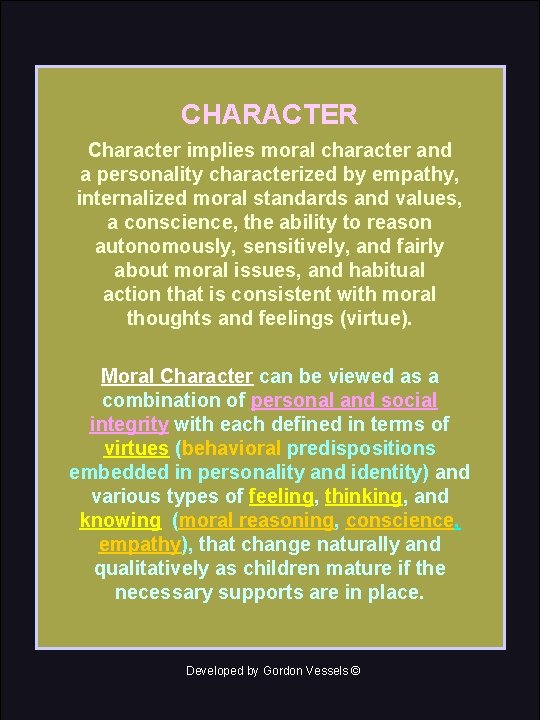
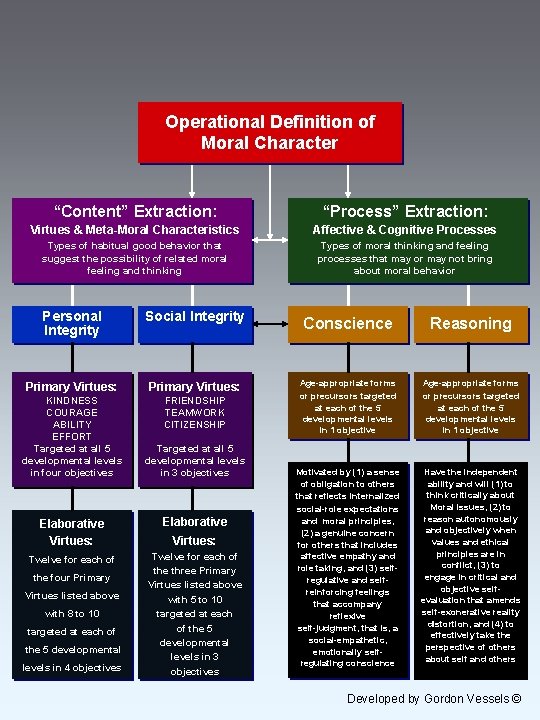
CHARACTER Character implies moral character and a personality characterized by empathy, internalized moral standards and values, a conscience, the ability to reason autonomously, sensitively, and fairly about moral issues, and habitual action that is consistent with moral thoughts and feelings (virtue). Moral Character can be viewed as a combination of personal and social integrity with each defined in terms of virtues (behavioral predispositions embedded in personality and identity) and various types of feeling, thinking, and knowing (moral reasoning, conscience, empathy), that change naturally and qualitatively as children mature if the necessary supports are in place. Developed by Gordon Vessels ©
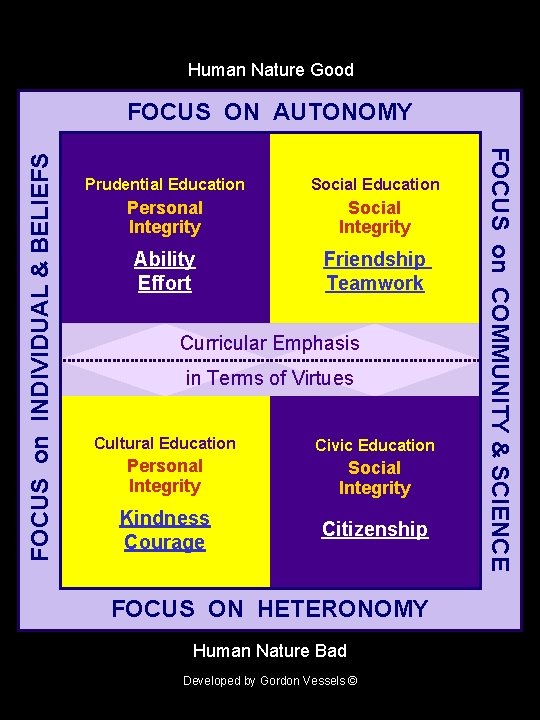
Human Nature Good Prudential Education Social Education Personal Integrity Social Integrity Ability Effort Friendship Teamwork Curricular Emphasis in Terms of Virtues Cultural Education Civic Education Personal Integrity Social Integrity Kindness Courage Citizenship FOCUS ON HETERONOMY Human Nature Bad Developed by Gordon Vessels © FOCUS on COMMUNITY & SCIENCE FOCUS on INDIVIDUAL & BELIEFS FOCUS ON AUTONOMY
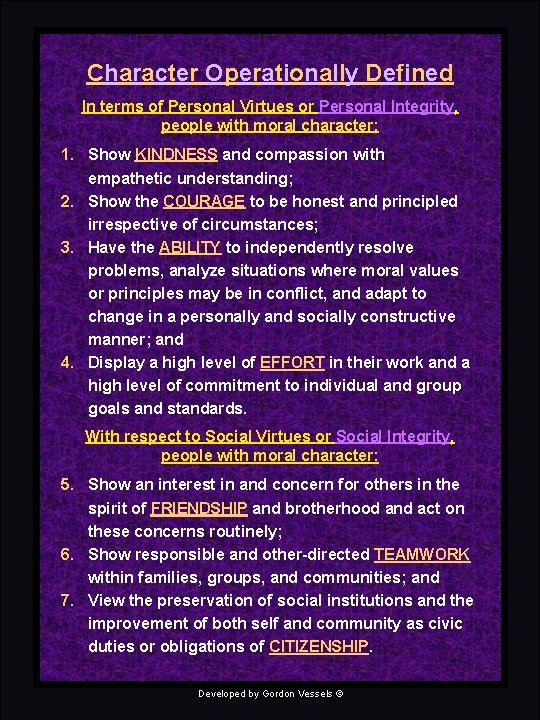
Character Operationally Defined In terms of Personal Virtues or Personal Integrity, people with moral character: 1. Show KINDNESS and compassion with empathetic understanding; 2. Show the COURAGE to be honest and principled irrespective of circumstances; 3. Have the ABILITY to independently resolve problems, analyze situations where moral values or principles may be in conflict, and adapt to change in a personally and socially constructive manner; and 4. Display a high level of EFFORT in their work and a high level of commitment to individual and group goals and standards. With respect to Social Virtues or Social Integrity, people with moral character: 5. Show an interest in and concern for others in the spirit of FRIENDSHIP and brotherhood and act on these concerns routinely; 6. Show responsible and other-directed TEAMWORK within families, groups, and communities; and 7. View the preservation of social institutions and the improvement of both self and community as civic duties or obligations of CITIZENSHIP. Developed by Gordon Vessels ©
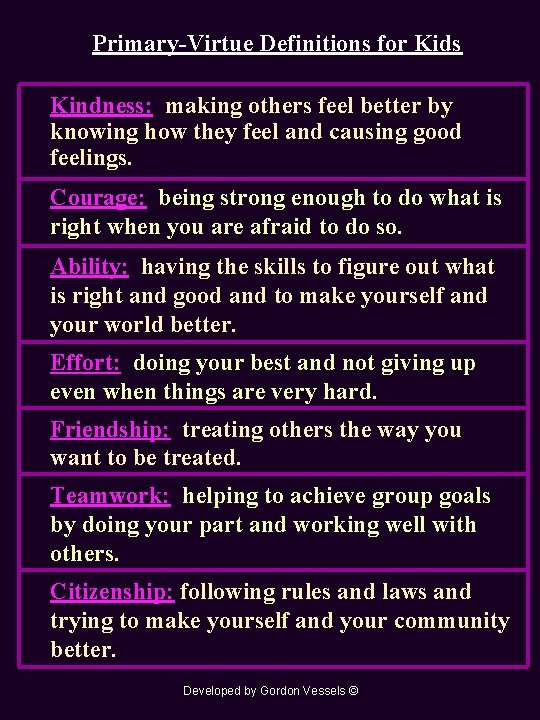
Primary-Virtue Definitions for Kids Kindness: making others feel better by knowing how they feel and causing good feelings. Courage: being strong enough to do what is right when you are afraid to do so. Ability: having the skills to figure out what is right and good and to make yourself and your world better. Effort: doing your best and not giving up even when things are very hard. Friendship: treating others the way you want to be treated. Teamwork: helping to achieve group goals by doing your part and working well with others. Citizenship: following rules and laws and trying to make yourself and your community better. Developed by Gordon Vessels ©
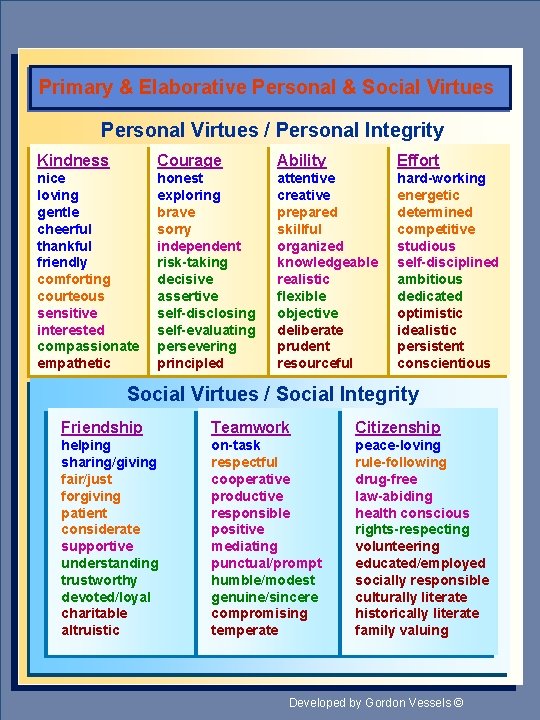
Primary & Elaborative Personal & Social Virtues Personal Virtues / Personal Integrity Kindness Courage Ability Effort nice loving gentle cheerful thankful friendly comforting courteous sensitive interested compassionate empathetic honest exploring brave sorry independent risk-taking decisive assertive self-disclosing self-evaluating persevering principled attentive creative prepared skillful organized knowledgeable realistic flexible objective deliberate prudent resourceful hard-working energetic determined competitive studious self-disciplined ambitious dedicated optimistic idealistic persistent conscientious Social Virtues / Social Integrity Friendship Teamwork Citizenship helping sharing/giving fair/just forgiving patient considerate supportive understanding trustworthy devoted/loyal charitable altruistic on-task respectful cooperative productive responsible positive mediating punctual/prompt humble/modest genuine/sincere compromising temperate peace-loving rule-following drug-free law-abiding health conscious rights-respecting volunteering educated/employed socially responsible culturally literate historically literate family valuing Developed by Gordon Vessels ©
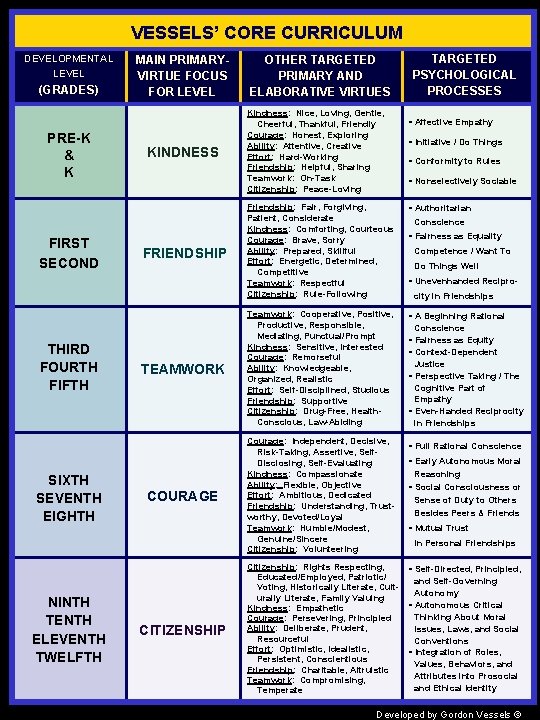
VESSELS’ CORE CURRICULUM DEVELOPMENTAL LEVEL (GRADES) PRE-K & K FIRST SECOND THIRD FOURTH FIFTH SIXTH SEVENTH EIGHTH NINTH TENTH ELEVENTH TWELFTH MAIN PRIMARYVIRTUE FOCUS FOR LEVEL KINDNESS OTHER TARGETED PRIMARY AND ELABORATIVE VIRTUES Kindness: Nice, Loving, Gentle, Cheerful, Thankful, Friendly Courage: Honest, Exploring Ability: Attentive, Creative Effort: Hard-Working Friendship: Helpful, Sharing Teamwork: On-Task Citizenship: Peace-Loving TARGETED PSYCHOLOGICAL PROCESSES • Affective Empathy • Initiative / Do Things • Conformity to Rules • Nonselectively Sociable Friendship: Fair, Forgiving, Patient, Considerate Kindness: Comforting, Courteous Courage: Brave, Sorry Ability: Prepared, Skillful Effort: Energetic, Determined, Competitive Teamwork: Respectful Citizenship: Rule-Following • Authoritarian TEAMWORK Teamwork: Cooperative, Positive, Productive, Responsible, Mediating, Punctual/Prompt Kindness: Sensitive, Interested Courage: Remorseful Ability: Knowledgeable, Organized, Realistic Effort: Self-Disciplined, Studious Friendship: Supportive Citizenship: Drug-Free, Health. Conscious, Law-Abiding • A Beginning Rational Conscience • Fairness as Equity • Context-Dependent Justice • Perspective Taking / The Cognitive Part of Empathy • Even-Handed Reciprocity in Friendships COURAGE Courage: Independent, Decisive, Risk-Taking, Assertive, Self. Disclosing, Self-Evaluating Kindness: Compassionate Ability: Flexible, Objective Effort: Ambitious, Dedicated Friendship: Understanding, Trustworthy, Devoted/Loyal Teamwork: Humble/Modest, Genuine/Sincere Citizenship: Volunteering FRIENDSHIP CITIZENSHIP Citizenship: Rights Respecting, Educated/Employed, Patriotic/ Voting, Historically Literate, Culturally Literate, Family Valuing Kindness: Empathetic Courage: Persevering, Principled Ability: Deliberate, Prudent, Resourceful Effort: Optimistic, Idealistic, Persistent, Conscientious Friendship: Charitable, Altruistic Teamwork: Compromising, Temperate Conscience • Fairness as Equality Competence / Want To Do Things Well • Unevenhanded Reciprocity in Friendships • Full Rational Conscience • Early Autonomous Moral Reasoning • Social Consciousness or Sense of Duty to Others Besides Peers & Friends • Mutual Trust In Personal Friendships • Self-Directed, Principled, and Self-Governing Autonomy • Autonomous Critical Thinking About Moral Issues, Laws, and Social Conventions • Integration of Roles, Values, Behaviors, and Attributes into Prosocial and Ethical Identity Developed by Gordon Vessels ©
Operational Definition of Moral Character “Content” Extraction: “Process” Extraction: Virtues & Meta-Moral Characteristics Affective & Cognitive Processes Types of habitual good behavior that suggest the possibility of related moral feeling and thinking Types of moral thinking and feeling processes that may or may not bring about moral behavior Personal Integrity Social Integrity Primary Virtues: KINDNESS COURAGE ABILITY EFFORT Targeted at all 5 developmental levels in four objectives FRIENDSHIP TEAMWORK CITIZENSHIP Targeted at all 5 developmental levels in 3 objectives Elaborative Virtues: Elaborative Twelve for each of the three Primary Virtues listed above with 5 to 10 targeted at each of the 5 developmental levels in 3 objectives the four Primary Virtues listed above with 8 to 10 targeted at each of the 5 developmental levels in 4 objectives Virtues: Conscience Reasoning Age-appropriate forms or precursors targeted at each of the 5 developmental levels in 1 objective Motivated by (1) a sense of obligation to others that reflects internalized social-role expectations and moral principles, (2) a genuine concern for others that includes affective empathy and role taking, and (3) selfregulative and selfreinforcing feelings that accompany reflexive self-judgment, that is, a social-empathetic, emotionally selfregulating conscience Have the independent ability and will (1) to think critically about Moral issues, (2) to reason autonomously and objectively when values and ethical principles are in conflict, (3) to engage in critical and objective selfevaluation that amends self-exonerative reality distortion, and (4) to effectively take the perspective of others about self and others Developed by Gordon Vessels ©
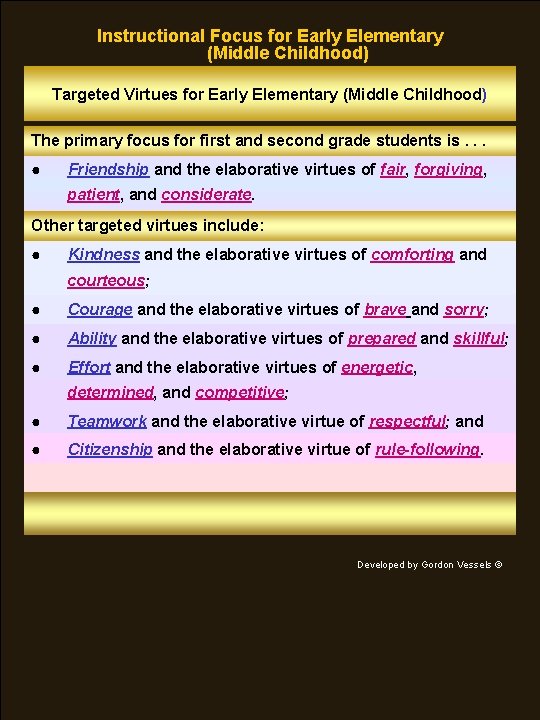
Instructional Focus for Early Elementary (Middle Childhood) Targeted Virtues for Early Elementary (Middle Childhood) The primary focus for first and second grade students is. . . ● Friendship and the elaborative virtues of fair, forgiving, patient, and considerate. Other targeted virtues include: ● Kindness and the elaborative virtues of comforting and courteous; ● Courage and the elaborative virtues of brave and sorry; ● Ability and the elaborative virtues of prepared and skillful; ● Effort and the elaborative virtues of energetic, determined, and competitive; ● Teamwork and the elaborative virtue of respectful; and ● Citizenship and the elaborative virtue of rule-following. Developed by Gordon Vessels ©
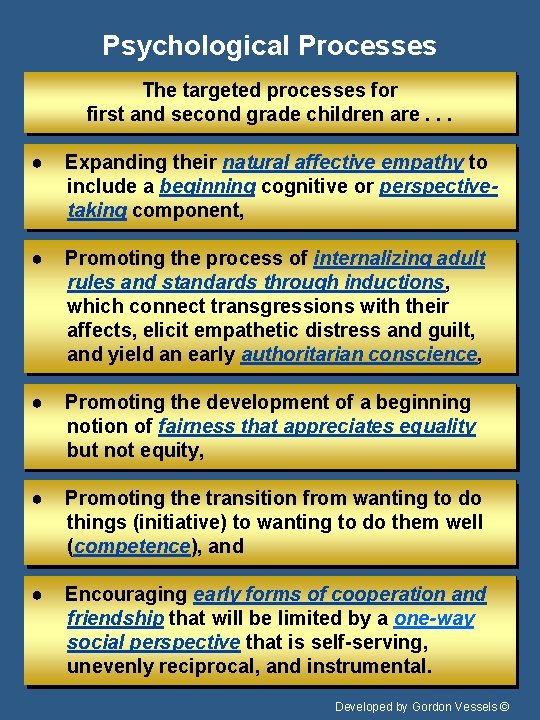
Psychological Processes The targeted processes for first and second grade children are. . . ● Expanding their natural affective empathy to include a beginning cognitive or perspectivetaking component, ● Promoting the process of internalizing adult rules and standards through inductions, which connect transgressions with their affects, elicit empathetic distress and guilt, and yield an early authoritarian conscience, ● Promoting the development of a beginning notion of fairness that appreciates equality but not equity, ● Promoting the transition from wanting to do things (initiative) to wanting to do them well (competence), and ● Encouraging early forms of cooperation and friendship that will be limited by a one-way social perspective that is self-serving, unevenly reciprocal, and instrumental. Developed by Gordon Vessels ©
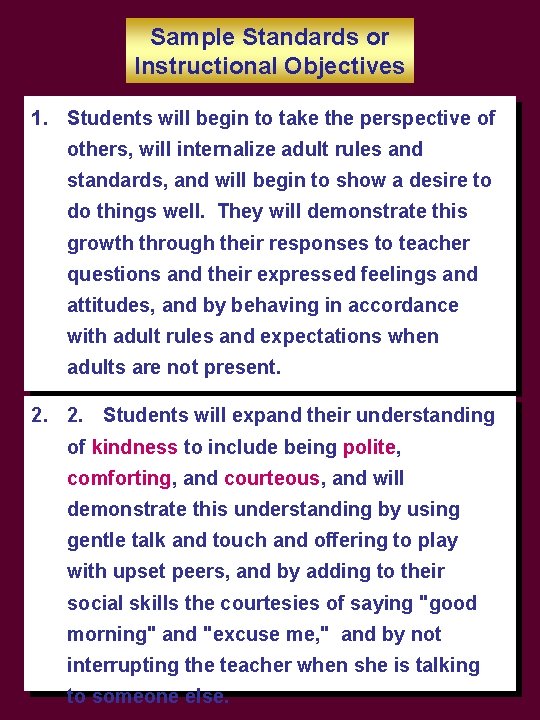
Sample Standards or Instructional Objectives 1. Students will begin to take the perspective of others, will internalize adult rules and standards, and will begin to show a desire to do things well. They will demonstrate this growth through their responses to teacher questions and their expressed feelings and attitudes, and by behaving in accordance with adult rules and expectations when adults are not present. 2. 2. Students will expand their understanding of kindness to include being polite, comforting, and courteous, and will demonstrate this understanding by using gentle talk and touch and offering to play with upset peers, and by adding to their social skills the courtesies of saying "good morning" and "excuse me, " and by not interrupting the teacher when she is talking to someone else.