
Module 6 Prison Reform Module aims and structure

- Slides: 15
Module 6 Prison Reform
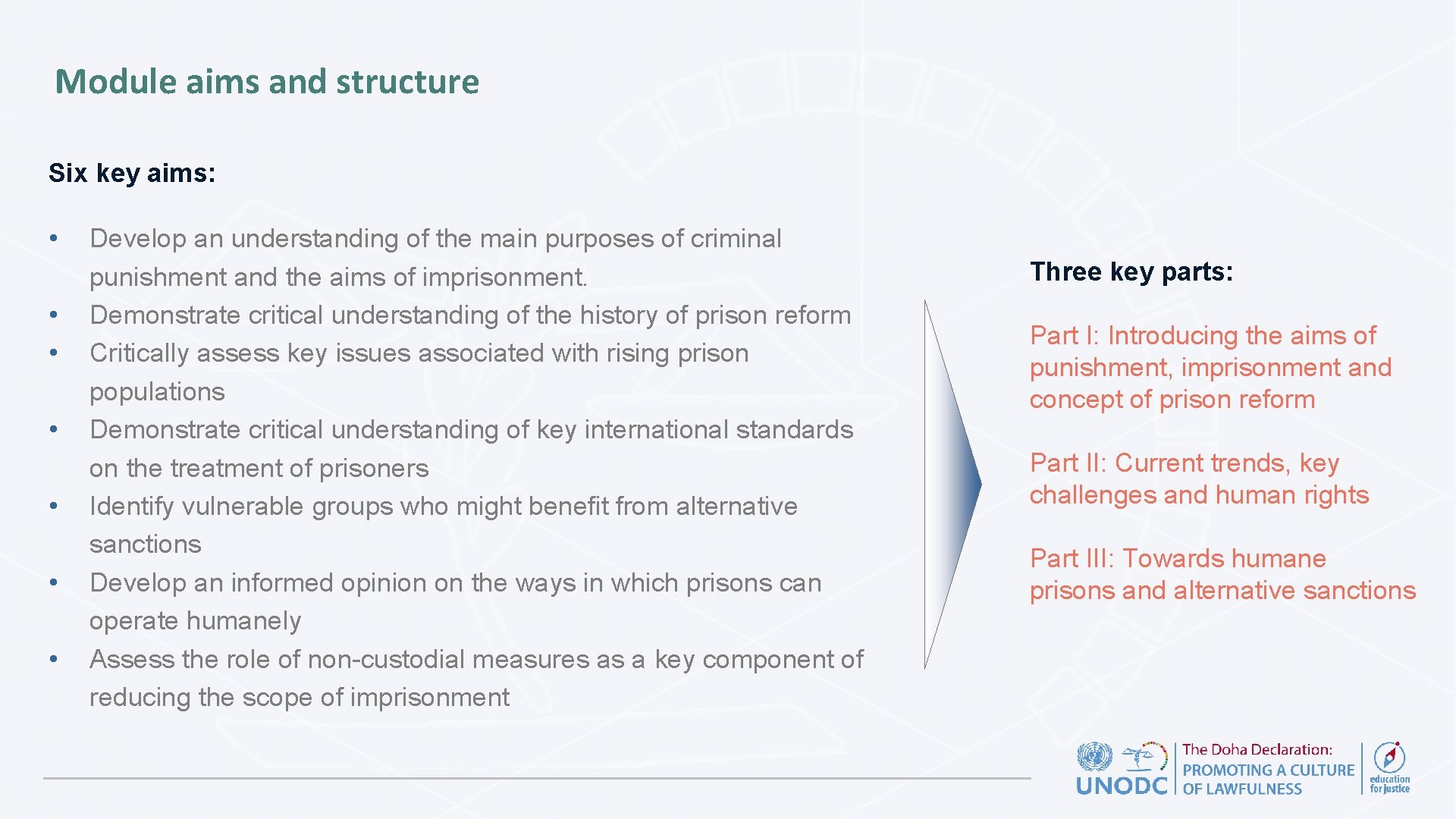
Module aims and structure Six key aims: • • Develop an understanding of the main purposes of criminal punishment and the aims of imprisonment. Demonstrate critical understanding of the history of prison reform Critically assess key issues associated with rising prison populations Demonstrate critical understanding of key international standards on the treatment of prisoners Identify vulnerable groups who might benefit from alternative sanctions Develop an informed opinion on the ways in which prisons can operate humanely Assess the role of non-custodial measures as a key component of reducing the scope of imprisonment Three key parts: Part I: Introducing the aims of punishment, imprisonment and concept of prison reform Part II: Current trends, key challenges and human rights Part III: Towards humane prisons and alternative sanctions
Part I: Introducing the aims of punishment, imprisonment and the concept of prison reform
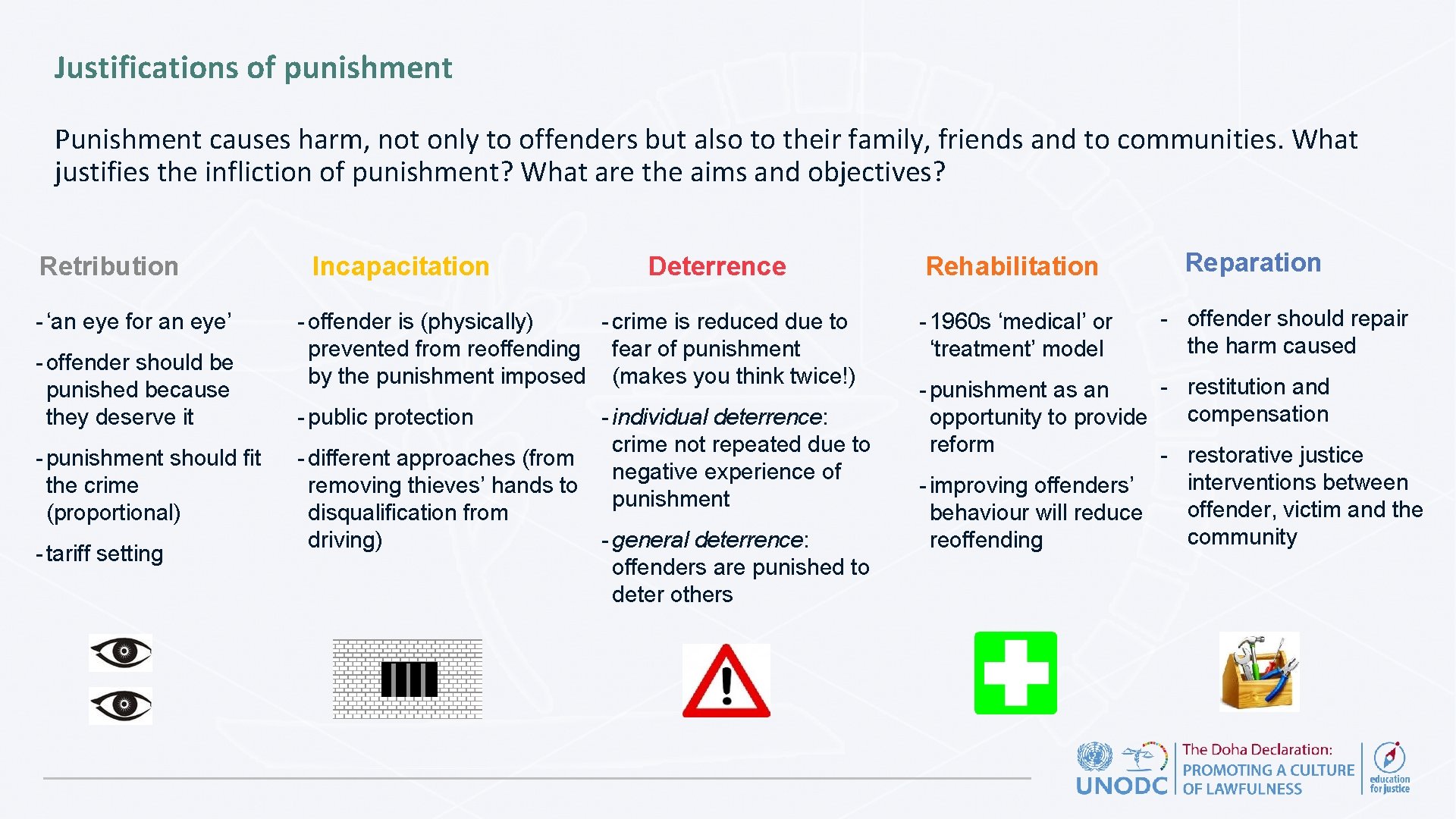
Justifications of punishment Punishment causes harm, not only to offenders but also to their family, friends and to communities. What justifies the infliction of punishment? What are the aims and objectives? Retribution - ‘an eye for an eye’ - offender should be punished because they deserve it - punishment should fit the crime (proportional) - tariff setting Incapacitation Deterrence - offender is (physically) - crime is reduced due to prevented from reoffending fear of punishment by the punishment imposed (makes you think twice!) - public protection - individual deterrence: crime not repeated due to - different approaches (from negative experience of removing thieves’ hands to punishment disqualification from driving) - general deterrence: offenders are punished to deter others Rehabilitation - 1960 s ‘medical’ or ‘treatment’ model Reparation - offender should repair the harm caused - restitution and - punishment as an compensation opportunity to provide reform - restorative justice interventions between - improving offenders’ offender, victim and the behaviour will reduce community reoffending
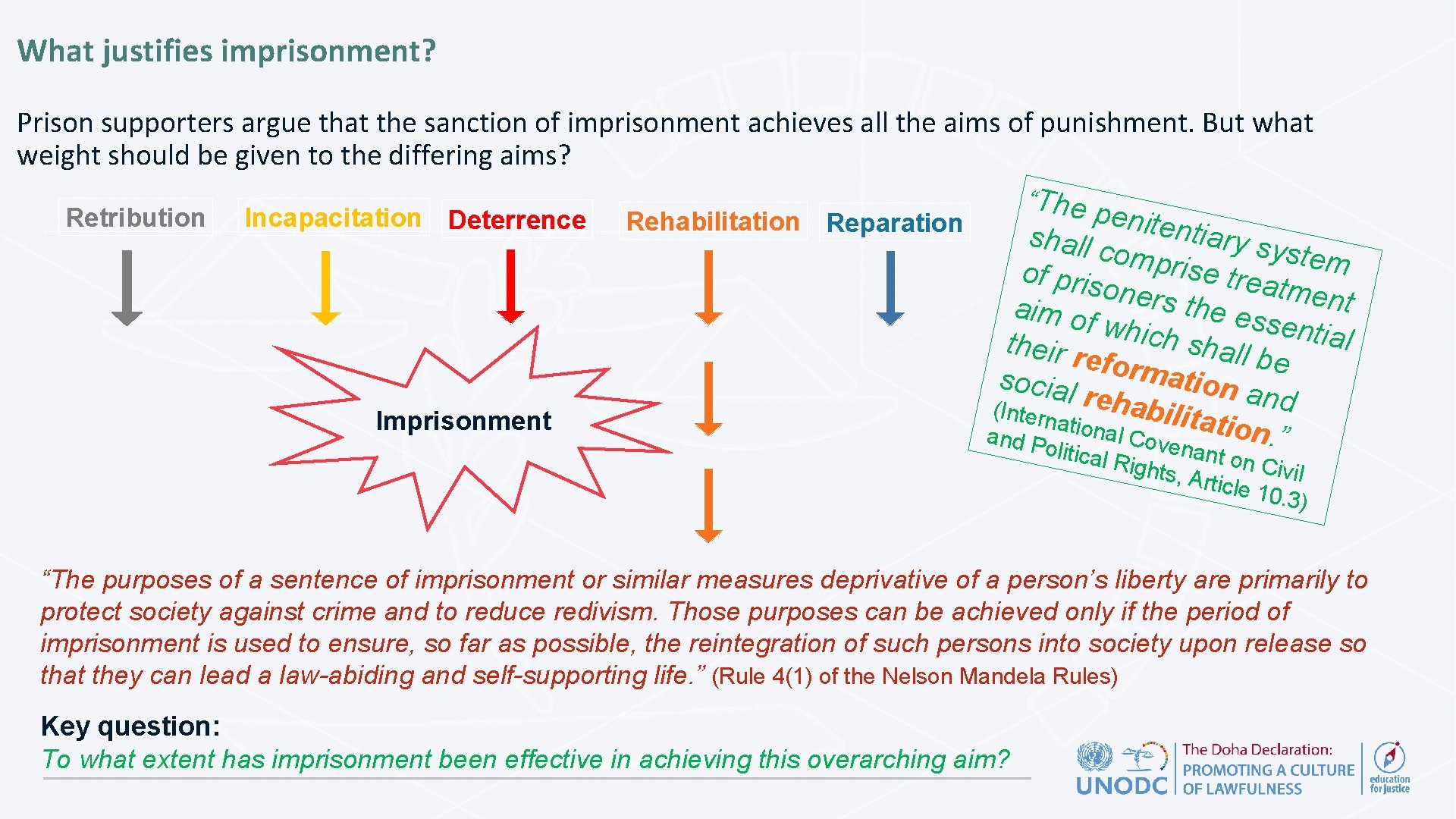
What justifies imprisonment? Prison supporters argue that the sanction of imprisonment achieves all the aims of punishment. But what weight should be given to the differing aims? “The penite Retribution Incapacitation Deterrence Rehabilitation Reparation ntiary shall c system ompri se tre of pris atmen oners t the es aim o f whic sentia h sha l their r ll be eform ation social a r n e d h a (Intern b ilitatio Imprisonment ationa n l Cove and P. ” oliti nan cal Ri t on Civ ghts, il Article 10. 3) “The purposes of a sentence of imprisonment or similar measures deprivative of a person’s liberty are primarily to protect society against crime and to reduce redivism. Those purposes can be achieved only if the period of imprisonment is used to ensure, so far as possible, the reintegration of such persons into society upon release so that they can lead a law-abiding and self-supporting life. ” (Rule 4(1) of the Nelson Mandela Rules) Key question: To what extent has imprisonment been effective in achieving this overarching aim?
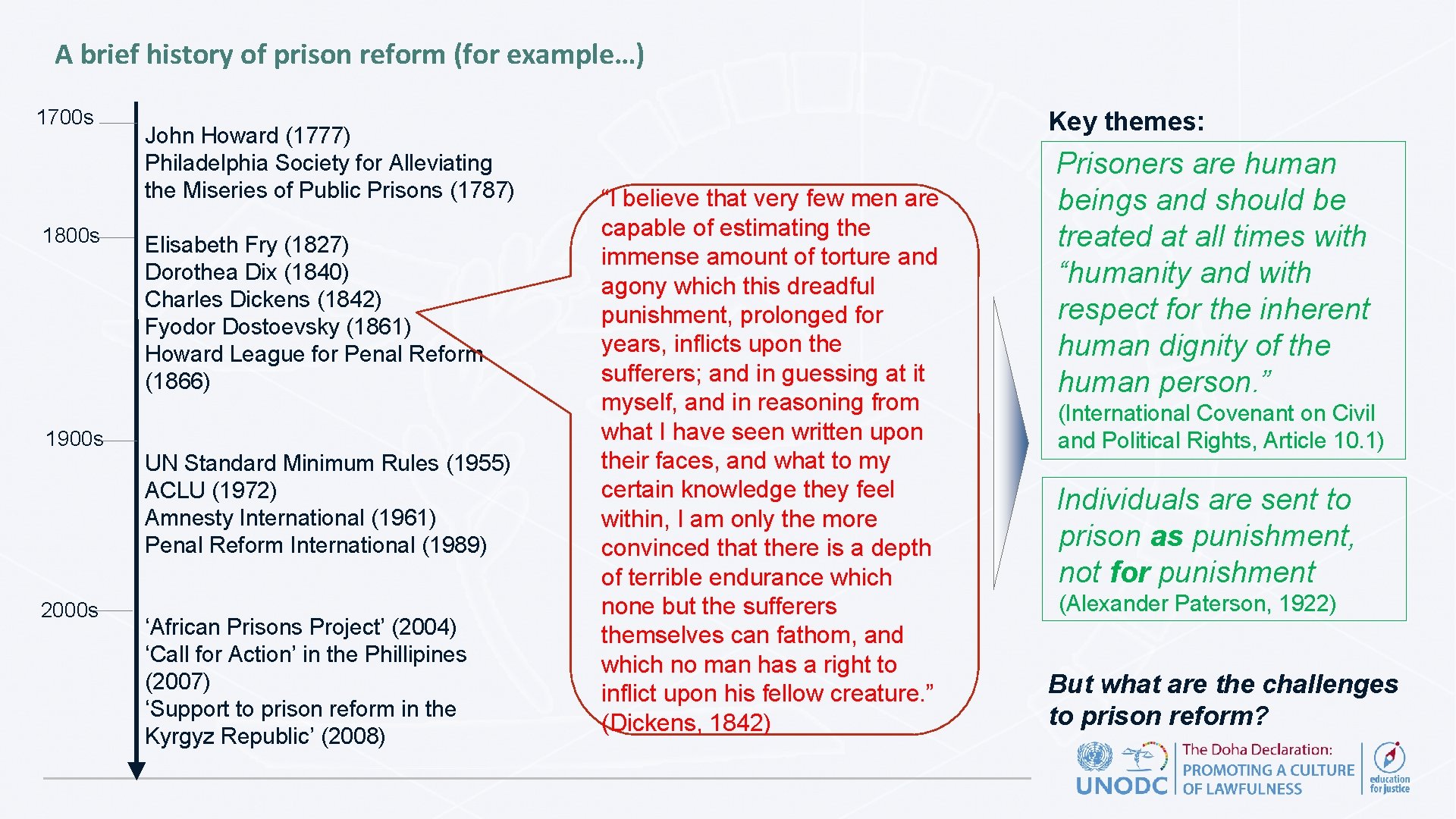
A brief history of prison reform (for example…) 1700 s 1800 s John Howard (1777) Philadelphia Society for Alleviating the Miseries of Public Prisons (1787) Elisabeth Fry (1827) Dorothea Dix (1840) Charles Dickens (1842) Fyodor Dostoevsky (1861) Howard League for Penal Reform (1866) 1900 s UN Standard Minimum Rules (1955) ACLU (1972) Amnesty International (1961) Penal Reform International (1989) 2000 s ‘African Prisons Project’ (2004) ‘Call for Action’ in the Phillipines (2007) ‘Support to prison reform in the Kyrgyz Republic’ (2008) Key themes: “I believe that very few men are capable of estimating the immense amount of torture and agony which this dreadful punishment, prolonged for years, inflicts upon the sufferers; and in guessing at it myself, and in reasoning from what I have seen written upon their faces, and what to my certain knowledge they feel within, I am only the more convinced that there is a depth of terrible endurance which none but the sufferers themselves can fathom, and which no man has a right to inflict upon his fellow creature. ” (Dickens, 1842) Prisoners are human beings and should be treated at all times with “humanity and with respect for the inherent human dignity of the human person. ” (International Covenant on Civil and Political Rights, Article 10. 1) Individuals are sent to prison as punishment, not for punishment (Alexander Paterson, 1922) But what are the challenges to prison reform?
Part II: Current trends, key challenges and human rights
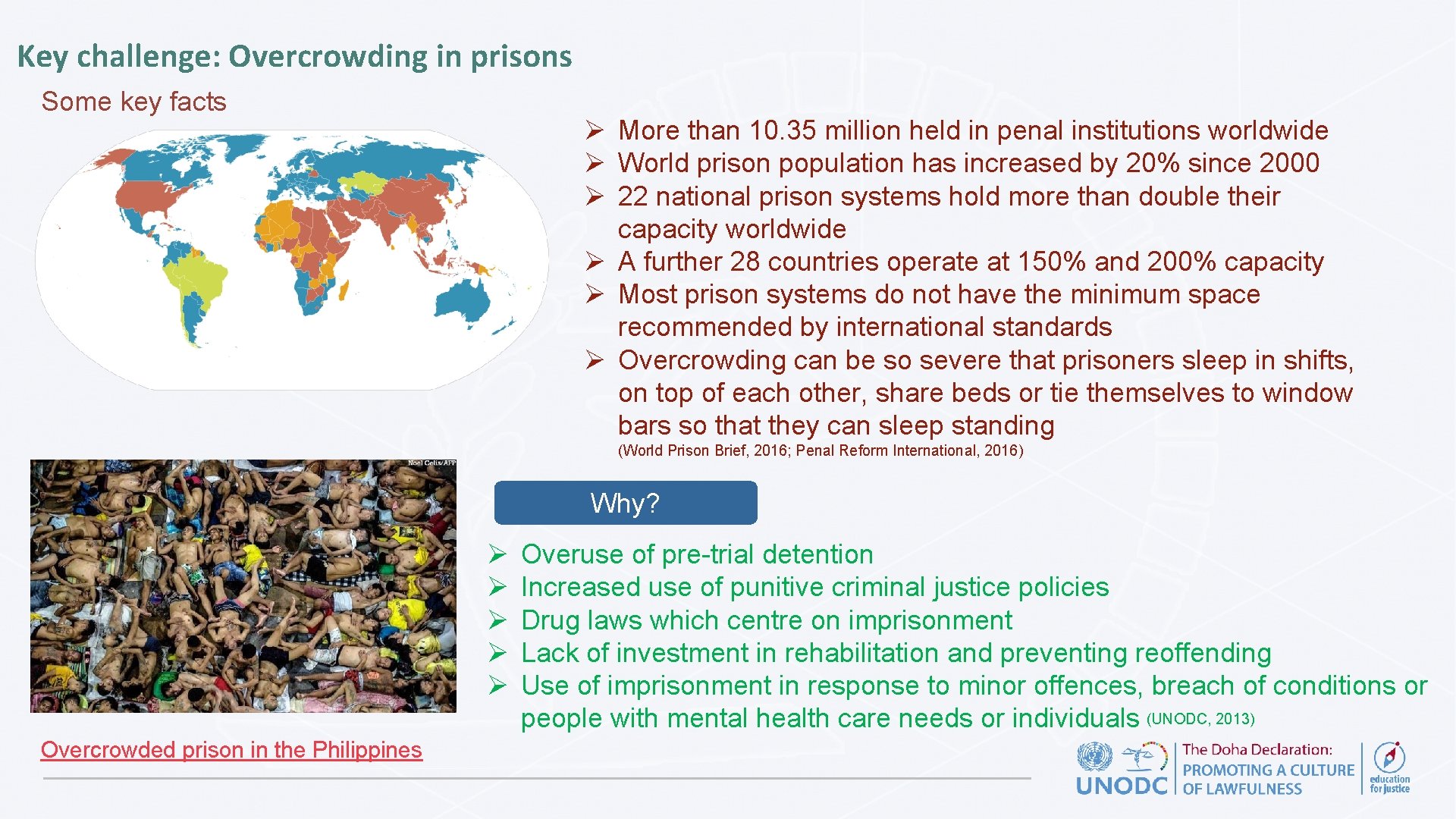
Key challenge: Overcrowding in prisons Some key facts Ø More than 10. 35 million held in penal institutions worldwide Ø World prison population has increased by 20% since 2000 Ø 22 national prison systems hold more than double their capacity worldwide Ø A further 28 countries operate at 150% and 200% capacity Ø Most prison systems do not have the minimum space recommended by international standards Ø Overcrowding can be so severe that prisoners sleep in shifts, on top of each other, share beds or tie themselves to window bars so that they can sleep standing (World Prison Brief, 2016; Penal Reform International, 2016) Why? Ø Ø Ø Overcrowded prison in the Philippines Overuse of pre-trial detention Increased use of punitive criminal justice policies Drug laws which centre on imprisonment Lack of investment in rehabilitation and preventing reoffending Use of imprisonment in response to minor offences, breach of conditions or people with mental health care needs or individuals (UNODC, 2013)
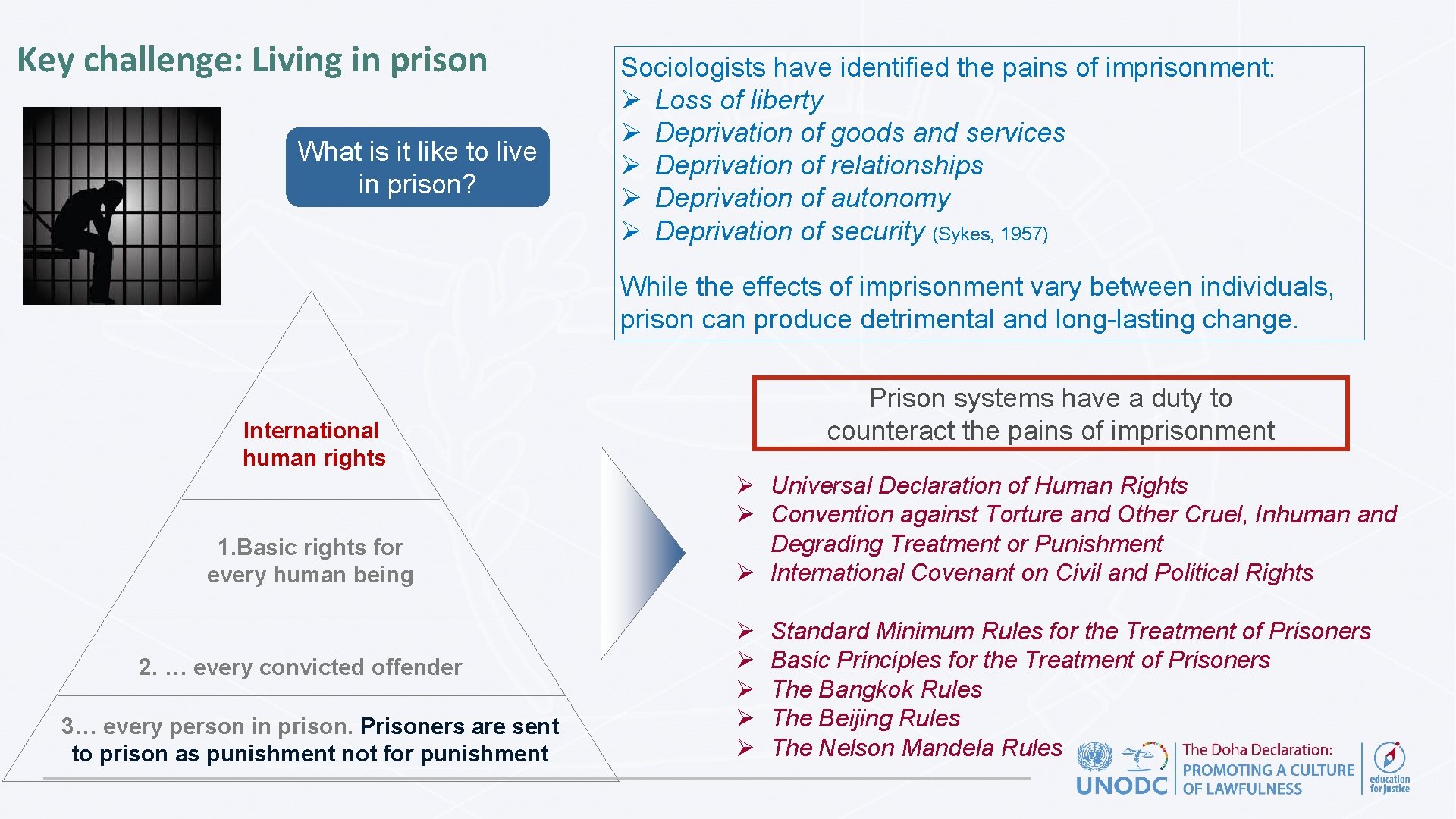
Key challenge: Living in prison What is it like to live in prison? Sociologists have identified the pains of imprisonment: Ø Loss of liberty Ø Deprivation of goods and services Ø Deprivation of relationships Ø Deprivation of autonomy Ø Deprivation of security (Sykes, 1957) While the effects of imprisonment vary between individuals, prison can produce detrimental and long-lasting change. Prison systems have a duty to counteract the pains of imprisonment International human rights 1. Basic rights for every human being 2. … every convicted offender 3… every person in prison. Prisoners are sent to prison as punishment not for punishment Ø Universal Declaration of Human Rights Ø Convention against Torture and Other Cruel, Inhuman and Degrading Treatment or Punishment Ø International Covenant on Civil and Political Rights Ø Ø Ø Standard Minimum Rules for the Treatment of Prisoners Basic Principles for the Treatment of Prisoners The Bangkok Rules The Beijing Rules The Nelson Mandela Rules
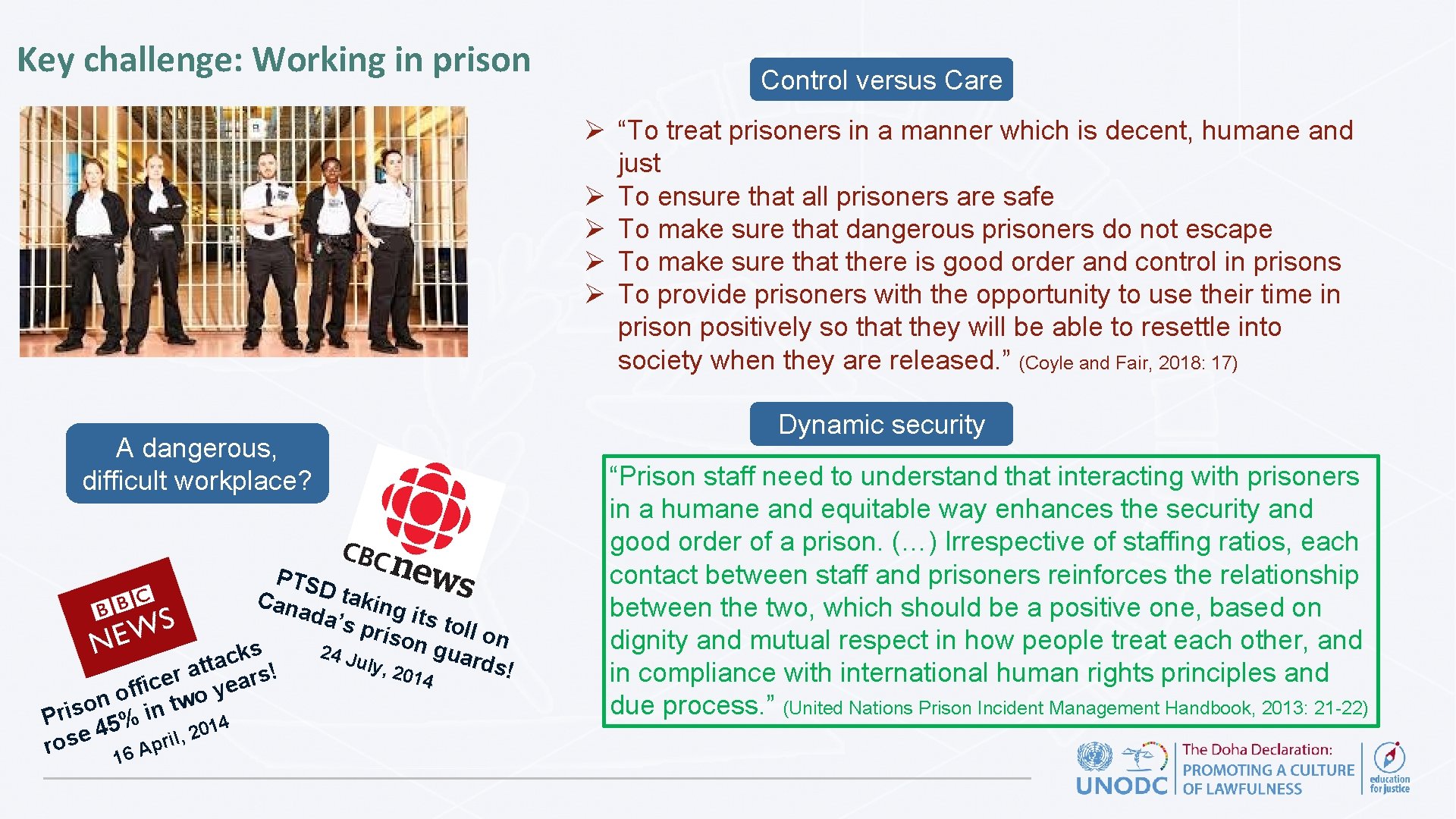
Key challenge: Working in prison Control versus Care Ø “To treat prisoners in a manner which is decent, humane and just Ø To ensure that all prisoners are safe Ø To make sure that dangerous prisoners do not escape Ø To make sure that there is good order and control in prisons Ø To provide prisoners with the opportunity to use their time in prison positively so that they will be able to resettle into society when they are released. ” (Coyle and Fair, 2018: 17) A dangerous, difficult workplace? PTS Can D taking ada’ s pri its toll o son n g s 24 J u k a c r u a d l t y s! t , 2 a ! 0 r s 1 r 4 e a c i e f f y o o n tw o s i n i r P % 5 14 0 4 2 e il, s r o p r 16 A Dynamic security “Prison staff need to understand that interacting with prisoners in a humane and equitable way enhances the security and good order of a prison. (…) Irrespective of staffing ratios, each contact between staff and prisoners reinforces the relationship between the two, which should be a positive one, based on dignity and mutual respect in how people treat each other, and in compliance with international human rights principles and due process. ” (United Nations Prison Incident Management Handbook, 2013: 21 -22)
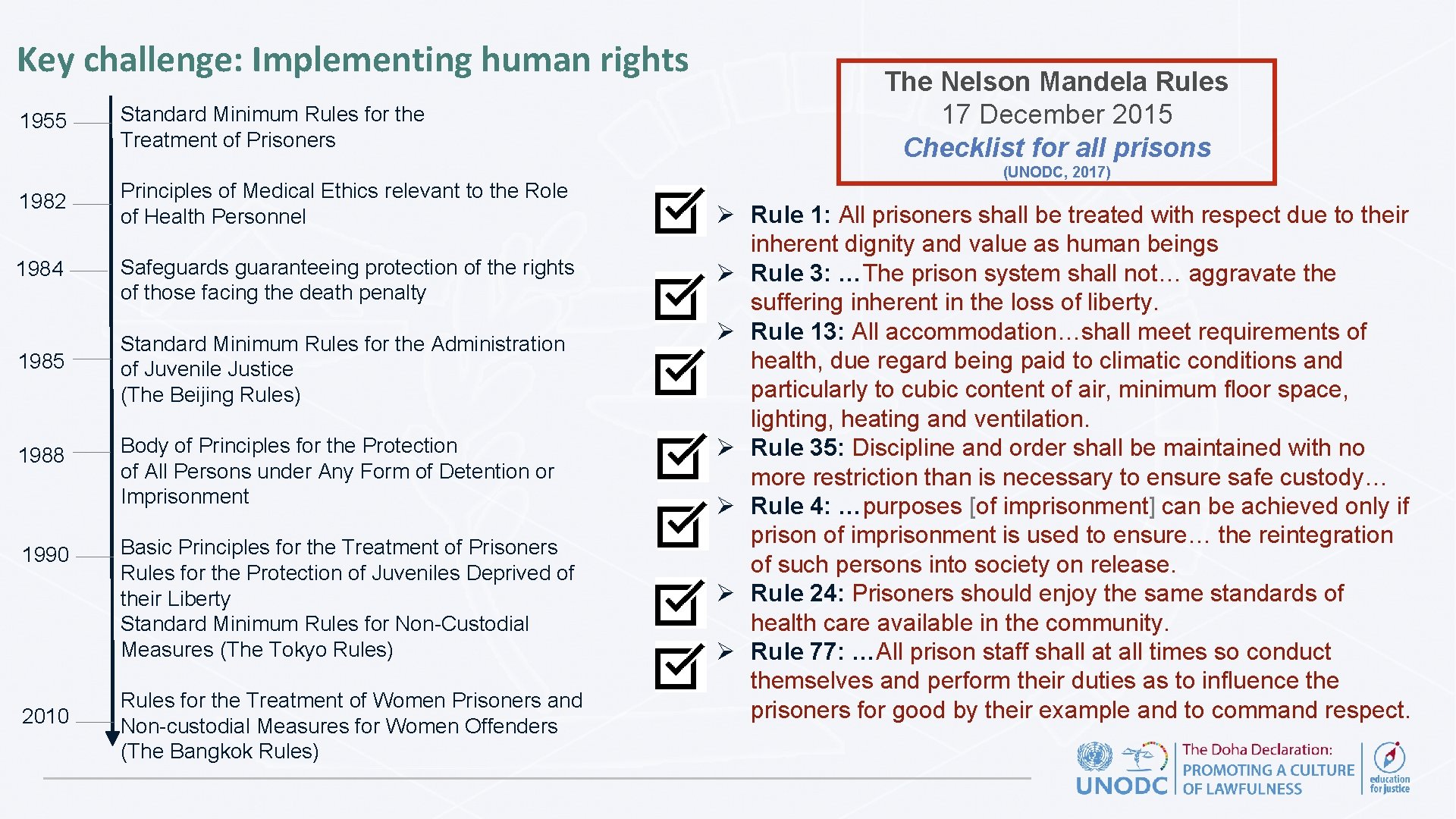
Key challenge: Implementing human rights 1955 1982 1984 1985 Standard Minimum Rules for the Treatment of Prisoners Principles of Medical Ethics relevant to the Role of Health Personnel Safeguards guaranteeing protection of the rights of those facing the death penalty Standard Minimum Rules for the Administration of Juvenile Justice (The Beijing Rules) 1988 Body of Principles for the Protection of All Persons under Any Form of Detention or Imprisonment 1990 Basic Principles for the Treatment of Prisoners Rules for the Protection of Juveniles Deprived of their Liberty Standard Minimum Rules for Non-Custodial Measures (The Tokyo Rules) 2010 Rules for the Treatment of Women Prisoners and Non-custodial Measures for Women Offenders (The Bangkok Rules) The Nelson Mandela Rules 17 December 2015 Checklist for all prisons (UNODC, 2017) Ø Rule 1: All prisoners shall be treated with respect due to their inherent dignity and value as human beings Ø Rule 3: …The prison system shall not… aggravate the suffering inherent in the loss of liberty. Ø Rule 13: All accommodation…shall meet requirements of health, due regard being paid to climatic conditions and particularly to cubic content of air, minimum floor space, lighting, heating and ventilation. Ø Rule 35: Discipline and order shall be maintained with no more restriction than is necessary to ensure safe custody… Ø Rule 4: …purposes [of imprisonment] can be achieved only if prison of imprisonment is used to ensure… the reintegration of such persons into society on release. Ø Rule 24: Prisoners should enjoy the same standards of health care available in the community. Ø Rule 77: …All prison staff shall at all times so conduct themselves and perform their duties as to influence the prisoners for good by their example and to command respect.
Part III: Towards humane prisons and alternatives sanctions
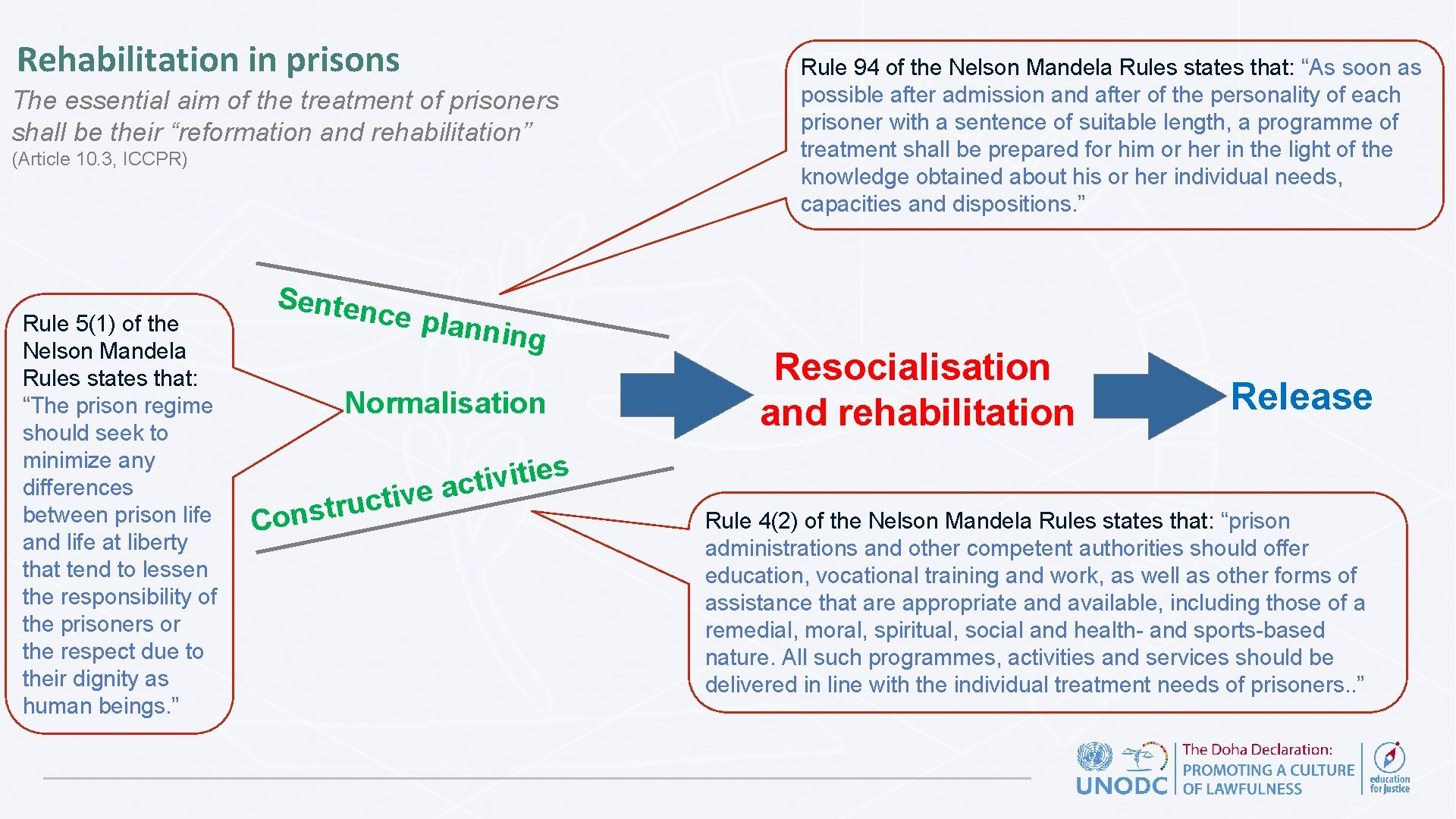
Rehabilitation in prisons The essential aim of the treatment of prisoners shall be their “reformation and rehabilitation” (Article 10. 3, ICCPR) Rule 5(1) of the Nelson Mandela Rules states that: “The prison regime should seek to minimize any differences between prison life and life at liberty that tend to lessen the responsibility of the prisoners or the respect due to their dignity as human beings. ” Rule 94 of the Nelson Mandela Rules states that: “As soon as possible after admission and after of the personality of each prisoner with a sentence of suitable length, a programme of treatment shall be prepared for him or her in the light of the knowledge obtained about his or her individual needs, capacities and dispositions. ” Senten ce plan ning Normalisation Cons s e i t i v i t c a e v i t c tru Resocialisation and rehabilitation Release Rule 4(2) of the Nelson Mandela Rules states that: “prison administrations and other competent authorities should offer education, vocational training and work, as well as other forms of assistance that are appropriate and available, including those of a remedial, moral, spiritual, social and health- and sports-based nature. All such programmes, activities and services should be delivered in line with the individual treatment needs of prisoners. . ”
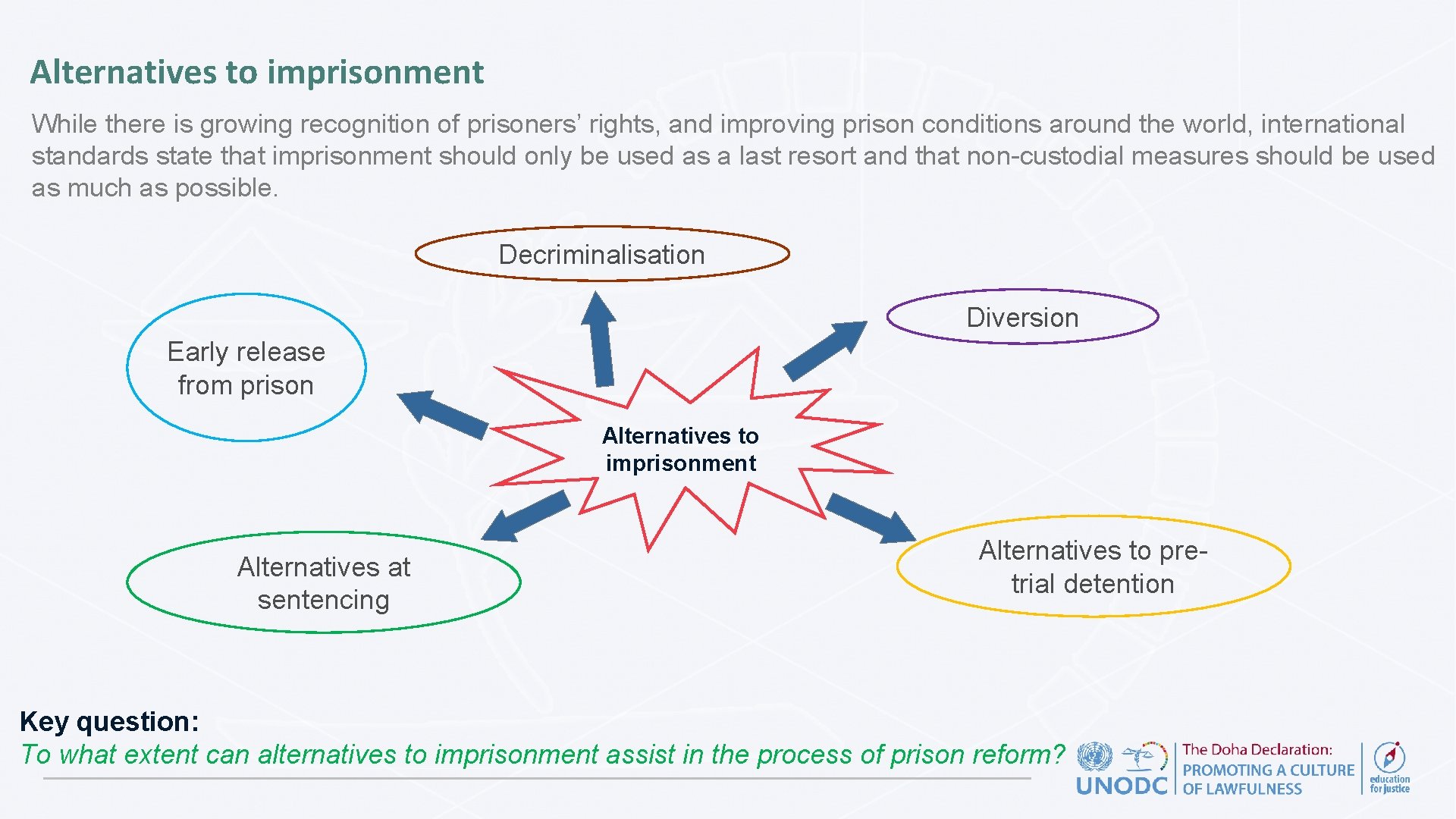
Alternatives to imprisonment While there is growing recognition of prisoners’ rights, and improving prison conditions around the world, international standards state that imprisonment should only be used as a last resort and that non-custodial measures should be used as much as possible. Decriminalisation Diversion Early release from prison Alternatives to imprisonment Alternatives at sentencing Alternatives to pretrial detention Key question: To what extent can alternatives to imprisonment assist in the process of prison reform?
More information @Doha. Declaration e 4 j@unodc. org/dohadeclaration unodc. org/e 4 J