
MODULE 6 Normalization Prepared by KIM GASTHIN M

MODULE 6: Normalization Prepared by: KIM GASTHIN M. CALIMQUIM Chapter 5 © 2007 by Prentice Hall (Hoffer, Prescott & Mc. Fadden) 1
Data Normalization • Primarily a tool to validate and improve a logical design so that it satisfies certain constraints that avoid unnecessary duplication of data • The process of decomposing relations with anomalies to produce smaller, wellstructured relations Chapter 5 2
Well-Structured Relations • A relation that contains minimal data redundancy and allows users to insert, delete, and update rows without causing data inconsistencies • Goal is to avoid anomalies – Insertion Anomaly–adding new rows forces user to create duplicate data – Deletion Anomaly–deleting rows may cause a loss of data that would be needed for other future rows – Modification Anomaly–changing data in a row forces changes to other rows because of duplication General rule of thumb: A table should not pertain to more than one entity type Chapter 5 3
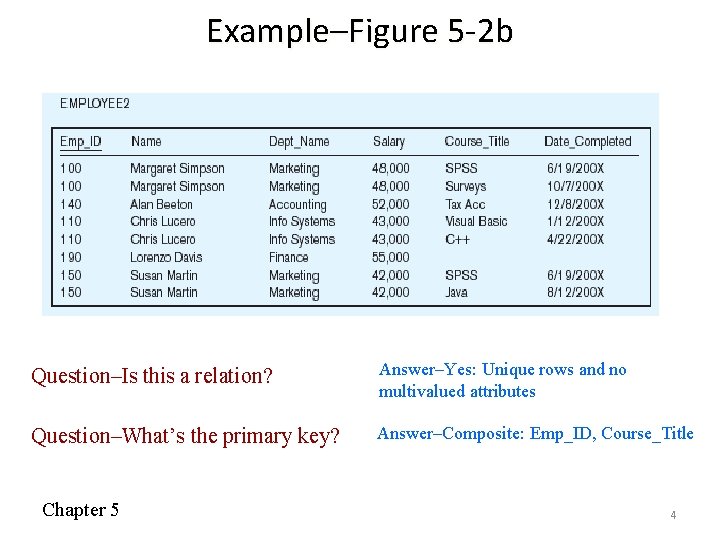
Example–Figure 5 -2 b Question–Is this a relation? Answer–Yes: Unique rows and no multivalued attributes Question–What’s the primary key? Answer–Composite: Emp_ID, Course_Title Chapter 5 4
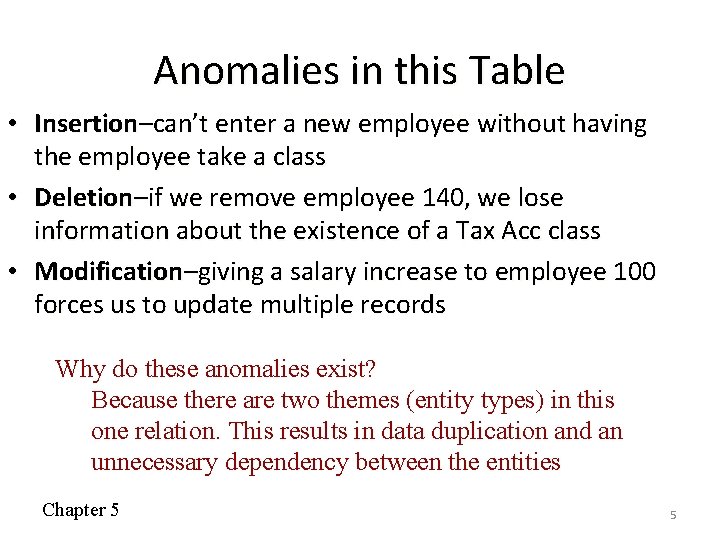
Anomalies in this Table • Insertion–can’t enter a new employee without having the employee take a class • Deletion–if we remove employee 140, we lose information about the existence of a Tax Acc class • Modification–giving a salary increase to employee 100 forces us to update multiple records Why do these anomalies exist? Because there are two themes (entity types) in this one relation. This results in data duplication and an unnecessary dependency between the entities Chapter 5 5

Functional Dependencies and Keys • Functional Dependency: The value of one attribute (the determinant) determines the value of another attribute • Candidate Key: – A unique identifier. One of the candidate keys will become the primary key • E. g. perhaps there is both credit card number and SS# in a table…in this case both are candidate keys – Each non-key field is functionally dependent on every candidate key Chapter 5 6

Figure 5. 22 Steps in normalization Chapter 5 7
First Normal Form • No multivalued attributes • Every attribute value is atomic • Fig. 5 -25 is not in 1 st Normal Form (multivalued attributes) it is not a relation • Fig. 5 -26 is in 1 st Normal form • All relations are in 1 st Normal Form Chapter 5 8
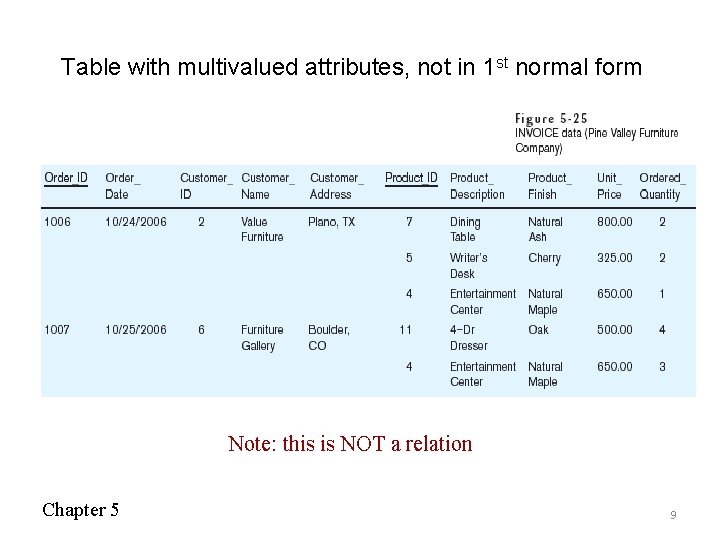
Table with multivalued attributes, not in 1 st normal form Note: this is NOT a relation Chapter 5 9
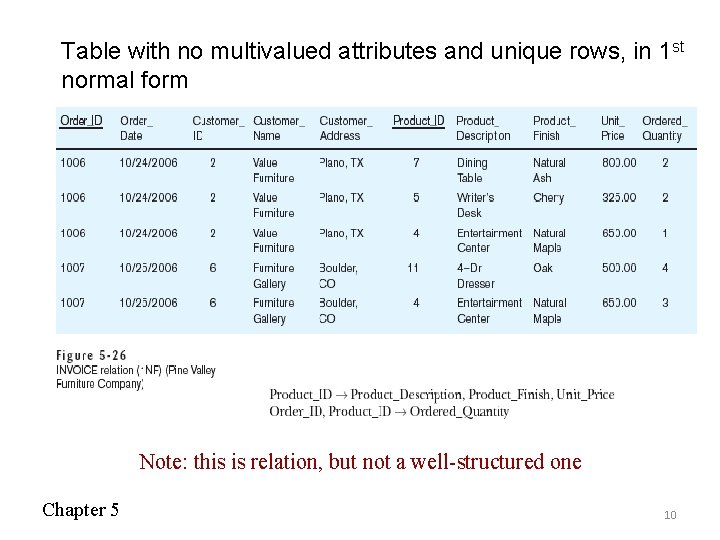
Table with no multivalued attributes and unique rows, in 1 st normal form Note: this is relation, but not a well-structured one Chapter 5 10
Anomalies in this Table • Insertion–if new product is ordered for order 1007 of existing customer, customer data must be re-entered, causing duplication • Deletion–if we delete the Dining Table from Order 1006, we lose information concerning this item's finish and price • Update–changing the price of product ID 4 requires update in several records Why do these anomalies exist? Because there are multiple themes (entity types) in one relation. This results in duplication and an unnecessary dependency between the entities Chapter 5 11
Second Normal Form • 1 NF PLUS every non-key attribute is fully functionally dependent on the ENTIRE primary key – Every non-key attribute must be defined by the entire key, not by only part of the key – No partial functional dependencies Chapter 5 12
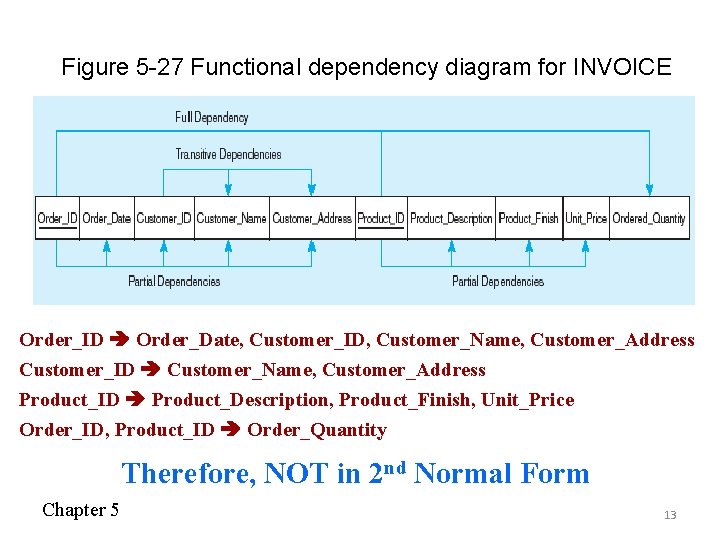
Figure 5 -27 Functional dependency diagram for INVOICE Order_ID Order_Date, Customer_ID, Customer_Name, Customer_Address Customer_ID Customer_Name, Customer_Address Product_ID Product_Description, Product_Finish, Unit_Price Order_ID, Product_ID Order_Quantity Therefore, NOT in 2 nd Normal Form Chapter 5 13
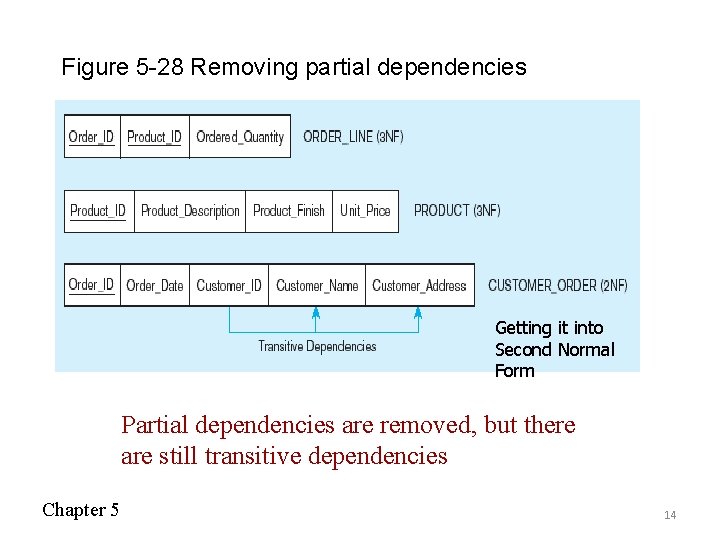
Figure 5 -28 Removing partial dependencies Getting it into Second Normal Form Partial dependencies are removed, but there are still transitive dependencies Chapter 5 14
Third Normal Form • 2 NF PLUS no transitive dependencies (functional dependencies on non-primary-key attributes) • Note: This is called transitive, because the primary key is a determinant for another attribute, which in turn is a determinant for a third • Solution: Non-key determinant with transitive dependencies go into a new table; non-key determinant becomes primary key in the new table and stays as foreign key in the old table Chapter 5 15
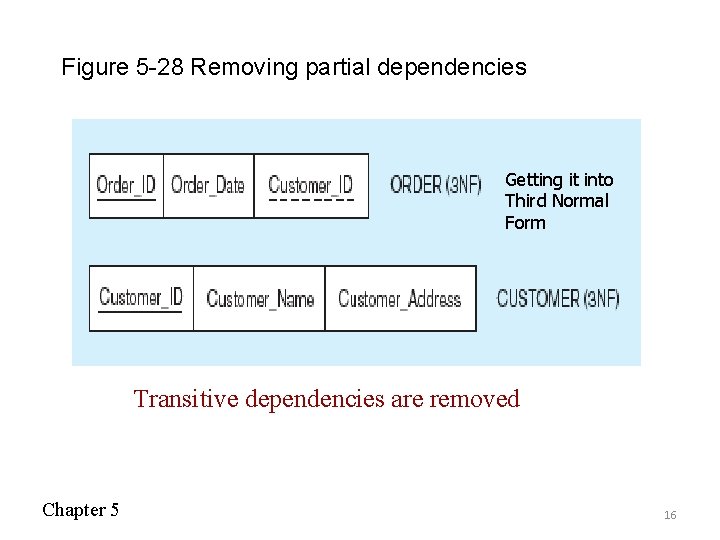
Figure 5 -28 Removing partial dependencies Getting it into Third Normal Form Transitive dependencies are removed Chapter 5 16
Merging Relations • View Integration–Combining entities from multiple ER models into common relations • Issues to watch out for when merging entities from different ER models: – Synonyms–two or more attributes with different names but same meaning – Homonyms–attributes with same name but different meanings – Transitive dependencies–even if relations are in 3 NF prior to merging, they may not be after merging – Supertype/subtype relationships–may be hidden prior to merging Chapter 5 17
- Slides: 17