
Module 6 Dont be afraid Reading Passage ARACHNOPHOBIA
Module 6 – Don’t be afraid! Reading Passage - ARACHNOPHOBIA
Frontal questions: 1. Students mood. Sharing some feeling and emotions during these difficult days we are passing through. 2. Students mention some of their most common fears. We brainstorm them. FEARS

6 a/Reading passage 1° step – New vocabulary arachnophobia – fear of spiders plughole – a hole in a bath or sink venom – a poisonous substance secreted by animals startle – to move or jump suddenly (as in surprise or alarm) pest controller – a person whose job is to eradicate pests from an area moth – the name of an insect scuttle – a metal container with a handle 2° step – Reading passage Students read the text carefully, taking notes and try to paraphrase the text. 3° step – Comprehensive exercises (Questions whenever facing difficulties)
6 b/Vocabulary, Feelings, Idioms, Prepositions, Word formation, Phrasal Verbs VOCABULARY phobia – an unreasonable fear of something lessen – make or become less healing – the process of becoming healthy againg IMPORTANT Real vs True In modern English, we associate 'real' with living or non-living things, having physical existence. That is, to represent something which can be felt, seen and touched. For example, 'a real hero' or 'real estate'. On the contrary, we associate 'true' with concepts that do not have any physical existence, but can be perceived. For example, 'a true story' or 'true effort'.
Feelings Discussion Think of situations that make you feel: anxious nervous embarrassed dizzy scared HAPPY ? Match the given words with the given situations in the book.
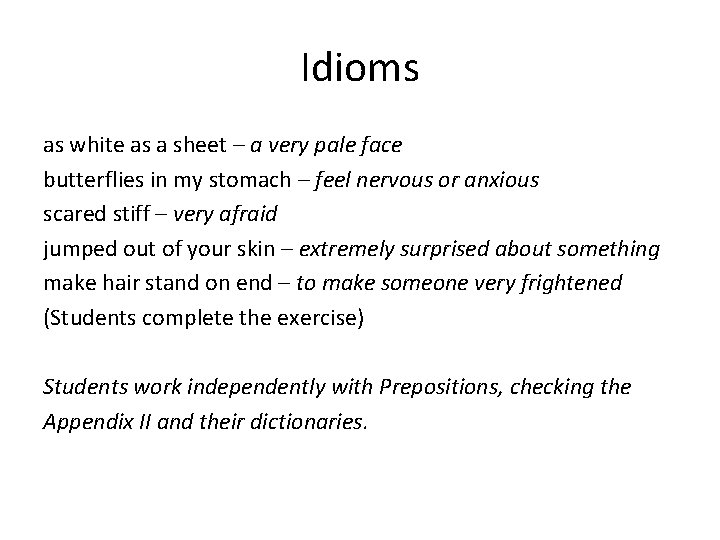
Idioms as white as a sheet – a very pale face butterflies in my stomach – feel nervous or anxious scared stiff – very afraid jumped out of your skin – extremely surprised about something make hair stand on end – to make someone very frightened (Students complete the exercise) Students work independently with Prepositions, checking the Appendix II and their dictionaries.
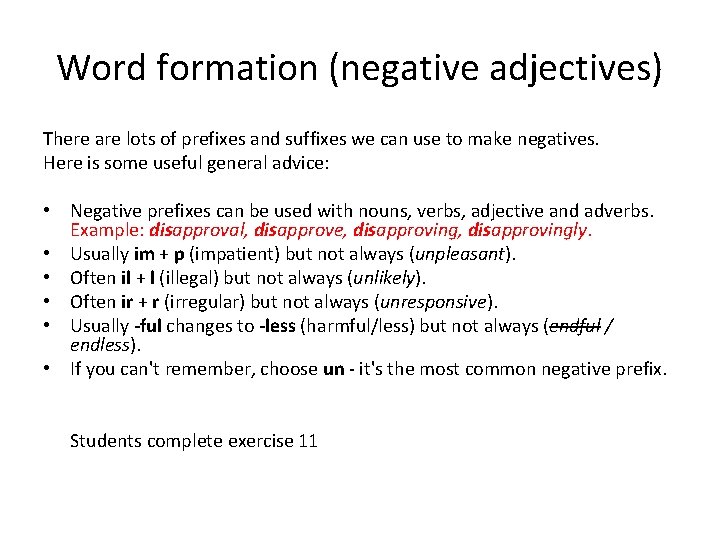
Word formation (negative adjectives) There are lots of prefixes and suffixes we can use to make negatives. Here is some useful general advice: • Negative prefixes can be used with nouns, verbs, adjective and adverbs. Example: disapproval, disapprove, disapprovingly. • Usually im + p (impatient) but not always (unpleasant). • Often il + l (illegal) but not always (unlikely). • Often ir + r (irregular) but not always (unresponsive). • Usually -ful changes to -less (harmful/less) but not always (endful / endless). • If you can't remember, choose un - it's the most common negative prefix. Students complete exercise 11
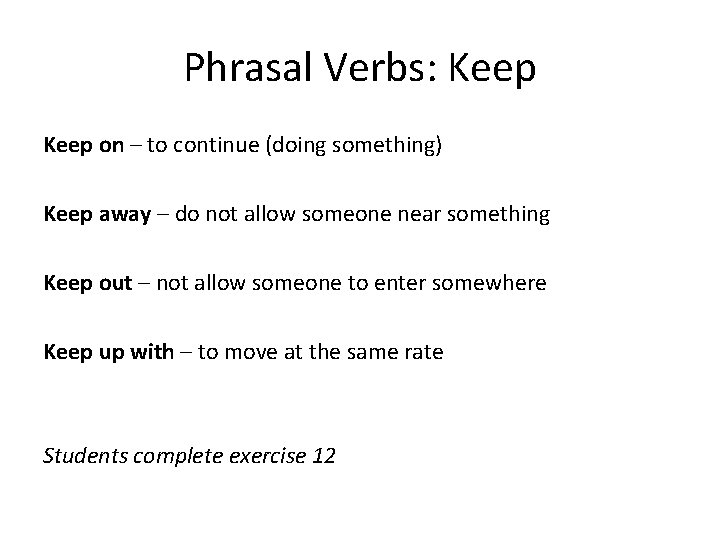
Phrasal Verbs: Keep on – to continue (doing something) Keep away – do not allow someone near something Keep out – not allow someone to enter somewhere Keep up with – to move at the same rate Students complete exercise 12
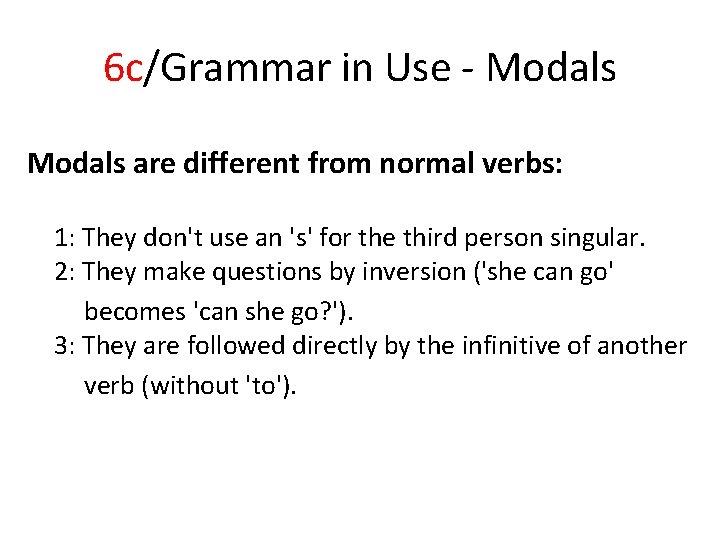
6 c/Grammar in Use - Modals are different from normal verbs: 1: They don't use an 's' for the third person singular. 2: They make questions by inversion ('she can go' becomes 'can she go? '). 3: They are followed directly by the infinitive of another verb (without 'to').
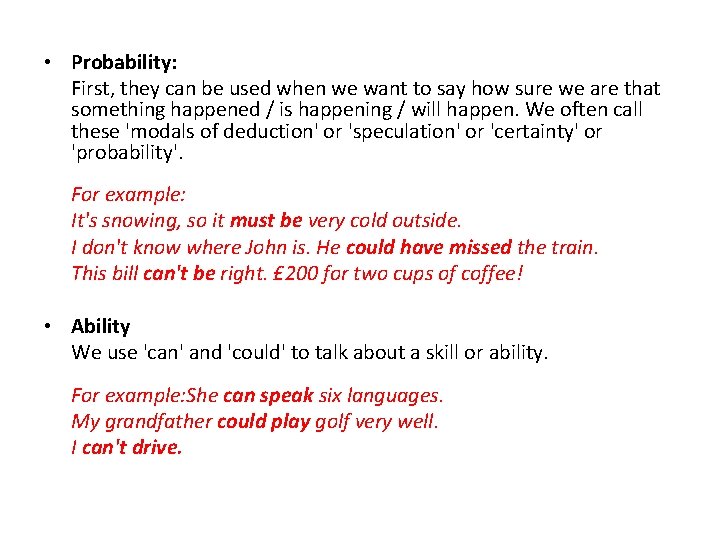
• Probability: First, they can be used when we want to say how sure we are that something happened / is happening / will happen. We often call these 'modals of deduction' or 'speculation' or 'certainty' or 'probability'. For example: It's snowing, so it must be very cold outside. I don't know where John is. He could have missed the train. This bill can't be right. £ 200 for two cups of coffee! • Ability We use 'can' and 'could' to talk about a skill or ability. For example: She can speak six languages. My grandfather could play golf very well. I can't drive.
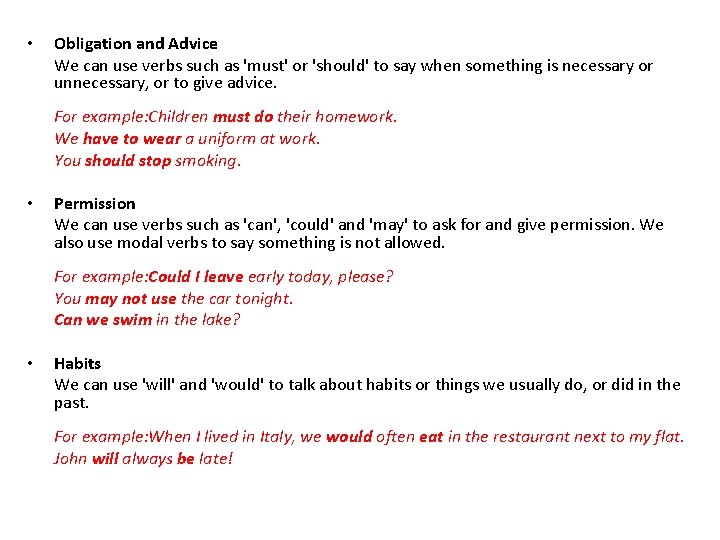
• Obligation and Advice We can use verbs such as 'must' or 'should' to say when something is necessary or unnecessary, or to give advice. For example: Children must do their homework. We have to wear a uniform at work. You should stop smoking. • Permission We can use verbs such as 'can', 'could' and 'may' to ask for and give permission. We also use modal verbs to say something is not allowed. For example: Could I leave early today, please? You may not use the car tonight. Can we swim in the lake? • Habits We can use 'will' and 'would' to talk about habits or things we usually do, or did in the past. For example: When I lived in Italy, we would often eat in the restaurant next to my flat. John will always be late!
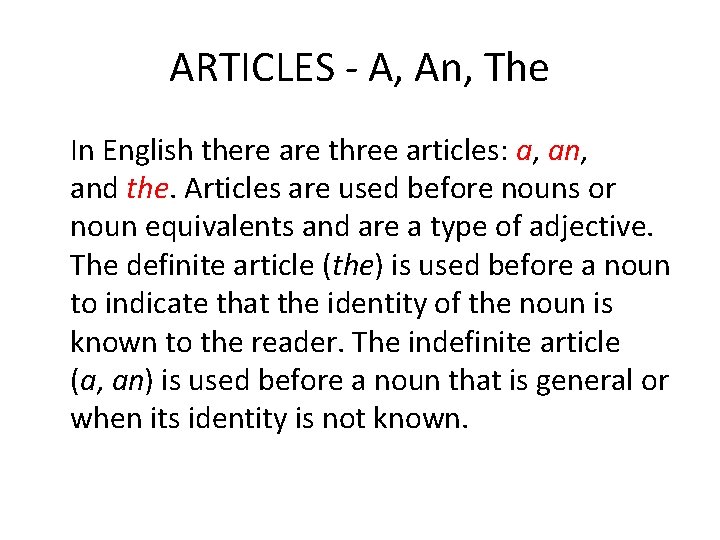
ARTICLES - A, An, The In English there are three articles: a, and the. Articles are used before nouns or noun equivalents and are a type of adjective. The definite article (the) is used before a noun to indicate that the identity of the noun is known to the reader. The indefinite article (a, an) is used before a noun that is general or when its identity is not known.
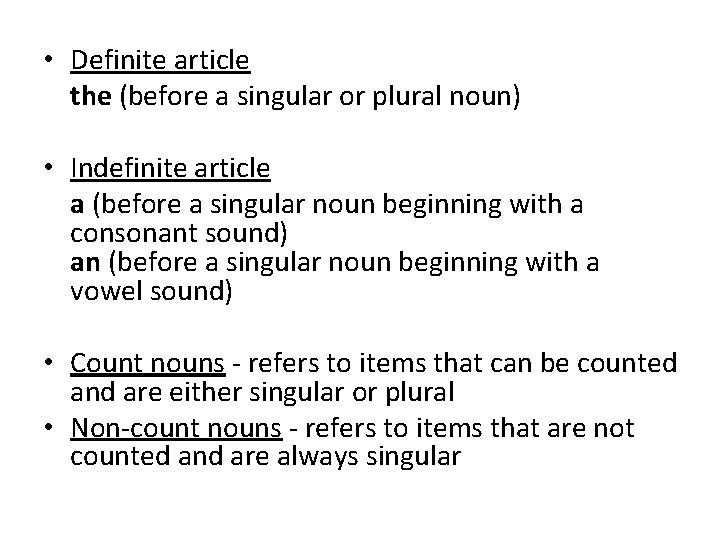
• Definite article the (before a singular or plural noun) • Indefinite article a (before a singular noun beginning with a consonant sound) an (before a singular noun beginning with a vowel sound) • Count nouns - refers to items that can be counted and are either singular or plural • Non-count nouns - refers to items that are not counted and are always singular
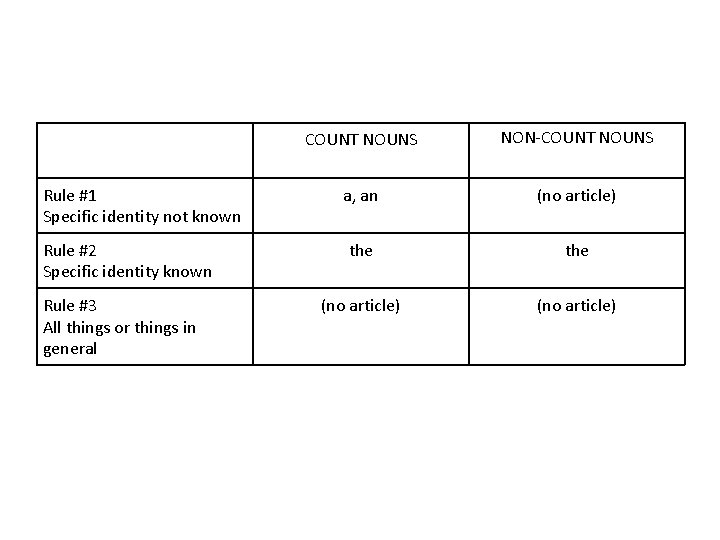
Rule #1 Specific identity not known Rule #2 Specific identity known Rule #3 All things or things in general COUNT NOUNS NON-COUNT NOUNS a, an (no article) the (no article)
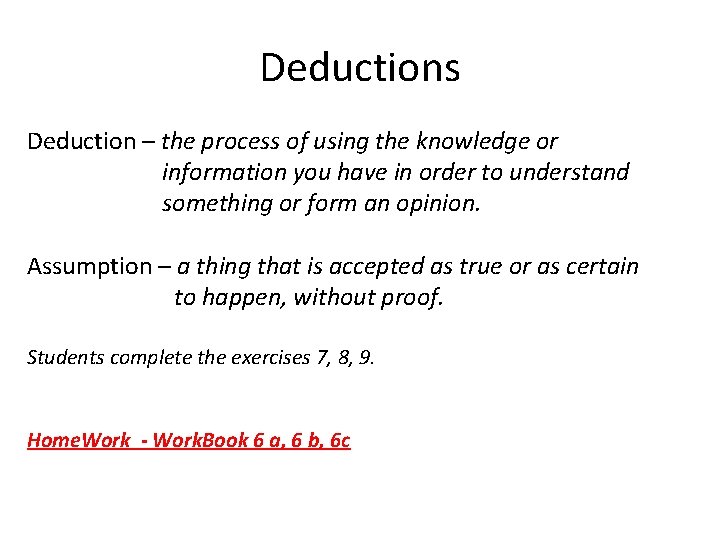
Deductions Deduction – the process of using the knowledge or information you have in order to understand something or form an opinion. Assumption – a thing that is accepted as true or as certain to happen, without proof. Students complete the exercises 7, 8, 9. Home. Work - Work. Book 6 a, 6 b, 6 c
THE END Migena Rukaj
- Slides: 16