
Module 6 Consciousness Sleep and Dreams Different States
![REM Sleep n Rapid eye movement, [REM], is when your eyes move from side](https://slidetodoc.com/presentation_image_h2/448ac292e26f248a5606c072bbd9d2d7/image-17.jpg "REM Sleep n Rapid eye movement, [REM], is when your eyes move from side")
- Slides: 29
Module 6: Consciousness , Sleep and Dreams
Different States of Consciousness covers the many different levels of awareness of one’s thoughts and feelings. It might include creating images in one’s mind, following one's thought processes , or having unusual emotional occurrences. n [You can tell if your conscious, if you are aware of your existence and your own thoughts. ] n Continuum of Consciousness refers to a broad range of experiences , from being sharply alert to being completely unaware and unresponsive. n
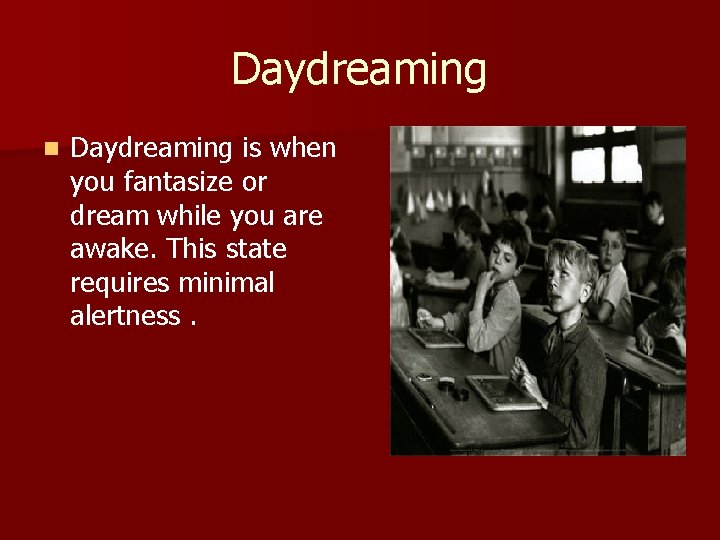
Daydreaming n Daydreaming is when you fantasize or dream while you are awake. This state requires minimal alertness.
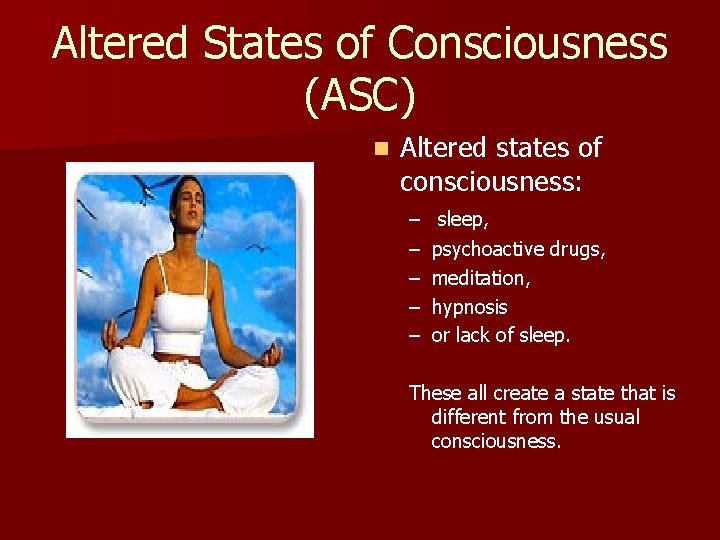
Altered States of Consciousness (ASC) n Altered states of consciousness: – – – sleep, psychoactive drugs, meditation, hypnosis or lack of sleep. These all create a state that is different from the usual consciousness.
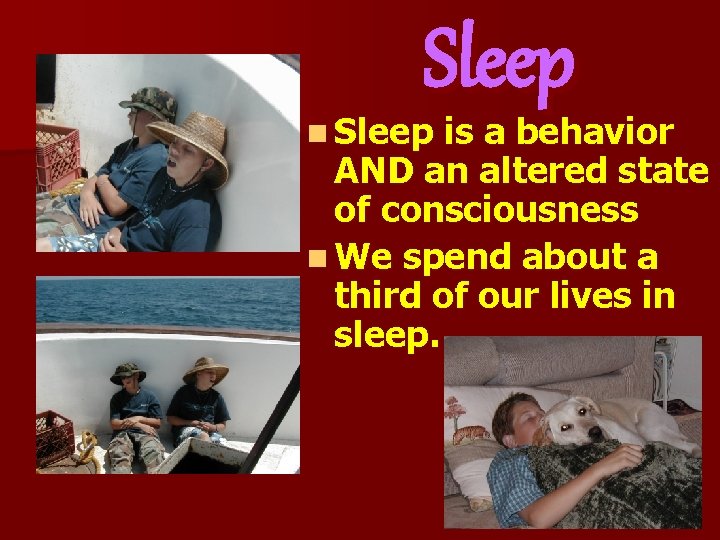
Sleep n Sleep is a behavior AND an altered state of consciousness n We spend about a third of our lives in sleep.
Sleep and Dreams n Sleep has five important stages that involve the many types of consciousness and awareness , etc. n Dreaming occurs when we are asleep and is a type of consciousness (REM). In our dreams, we witness a handful of surprising visual and auditory detailed images. These dreams can be related in odd ways and are usually in color.
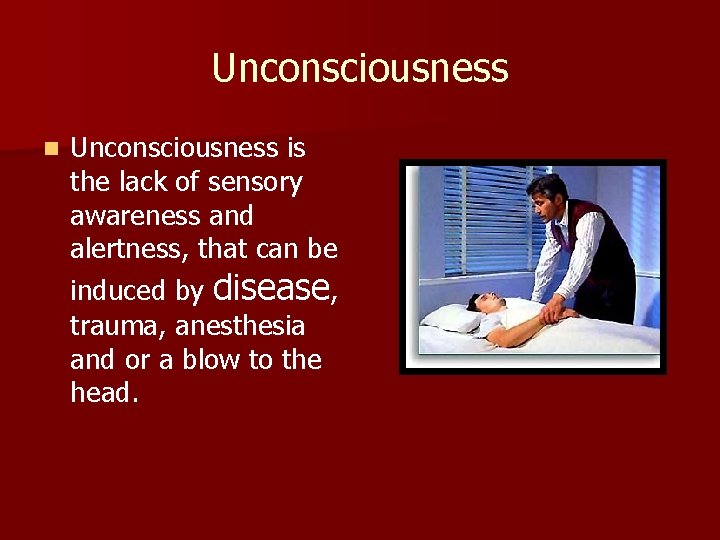
Unconsciousness n Unconsciousness is the lack of sensory awareness and alertness, that can be induced by disease, trauma, anesthesia and or a blow to the head.
B. Rhythms of Sleeping and Walking
Chronobiology: the study of forces that control the body at different times of the day, month or year. Daily: ? Monthly: ? Annual: ?
Circadian Rhythm and Biological Clocks n Circadian rhythm: Many of our behaviors display rhythmic variation, or behavioral changes that occur every 24 hrs. § One cycle lasts about 24 hours (e. g. sleepwaking cycle). § Light is an external cue that can set the circadian rhythm. § Some circadian rhythms are endogenous suggesting the existence of an internal (biological) clock. n Biological clocks are a timing system embedded in our genetics that control and regulate physiological responses for different periods of time.
Circadian Problems and Treatments The most common circadian problems are accidents, jet lag, and resetting the clock n melatonin ( a hormone given by the pineal gland), has proved to help those with disrupted circadian clocks, sleep better. n Light therapy is used to reset the circadian clocks and to treat those who suffer from sleeping disorders. n
C. World Of Sleep
Stages of Sleep n The stages of sleep are when the electrical activity and physiological responses, in the brain, changes through the many periods of sleep. (Stages 1 -4 (NREM) and REM)
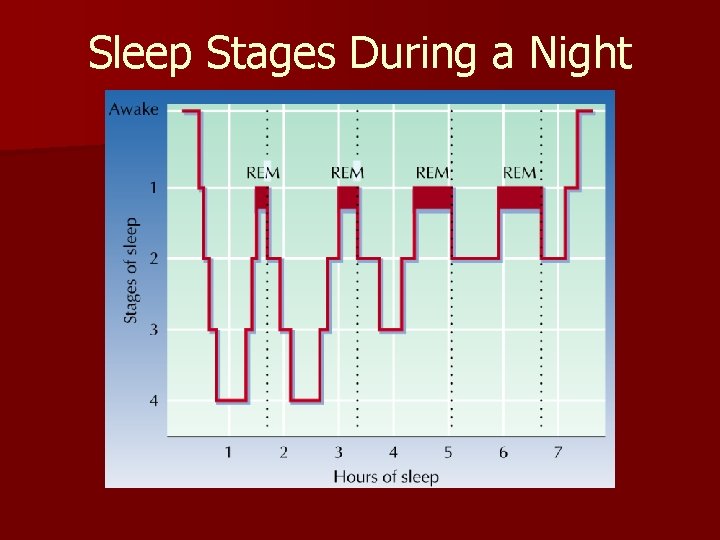
Sleep Stages During a Night
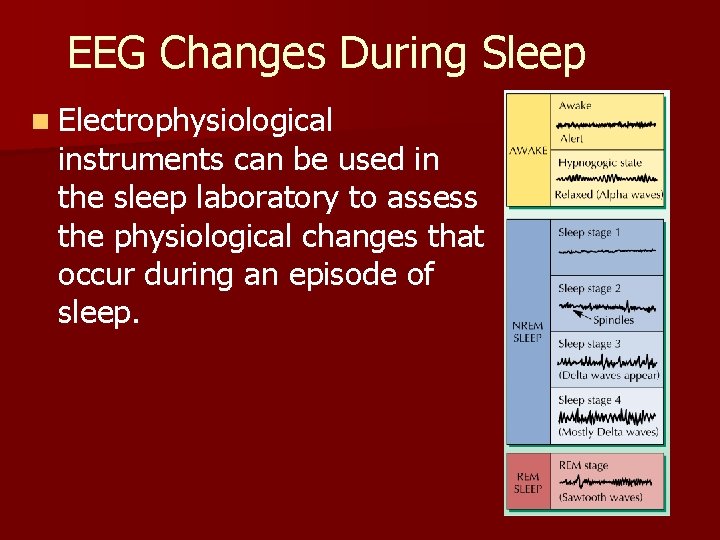
EEG Changes During Sleep n Electrophysiological instruments can be used in the sleep laboratory to assess the physiological changes that occur during an episode of sleep.
Non- REM Sleep Non- REM sleep (80% of your sleep) is separated into stages 1, 2, 3, and 4 n 1: the shift from being awake to sleep and lasts 1 -7 minutes. You gradually lose alertness to your surroundings and experience drifting thoughts. n 2: The start of sleep n 3: You are asleep for 3045 minutes n 4: The deepest sleep occurs in this stage. [It is the hardest to be awakened from] n Heart rate , respiration , temperature, and blood flow to the brain decrease by growth hormone. n
REM Sleep n Rapid eye movement, [REM], is when your eyes move from side to side, under your lids. n Muscles are paralyzed. n It makes up the remaining 20% of sleep time. n Increase in length throughout night n Dreaming and nightmares takes place in this state. n Essential part of sleep: REM rebound
Sequence of Stages n Usually REM occurs after the second stage of sleep (after 90 minutes). n You go through the sleeping stages and REM , approximately 5 -7 times a night.
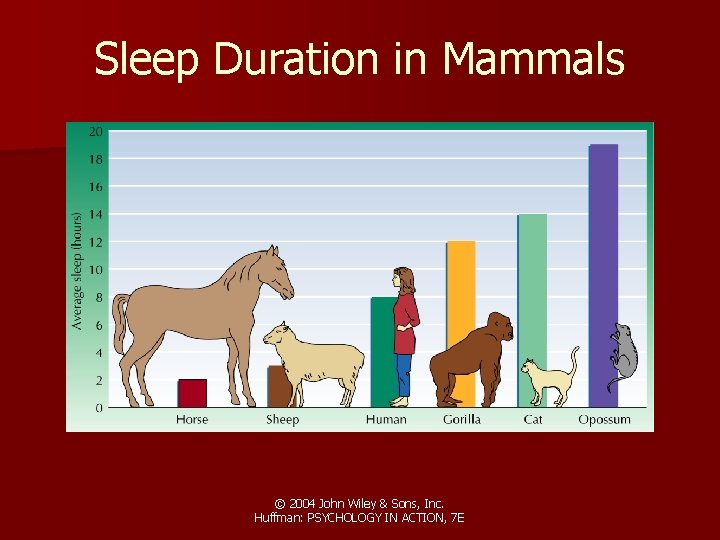
Sleep Duration in Mammals © 2004 John Wiley & Sons, Inc. Huffman: PSYCHOLOGY IN ACTION, 7 E
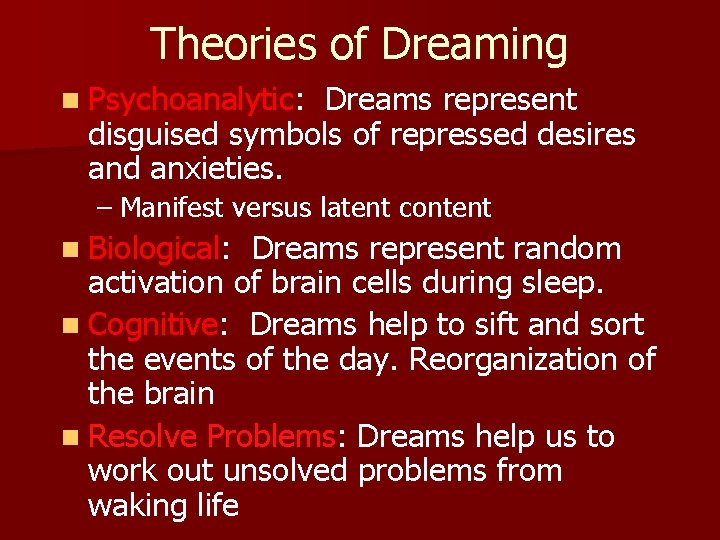
Theories of Dreaming n Psychoanalytic: Dreams represent disguised symbols of repressed desires and anxieties. – Manifest versus latent content n Biological: Dreams represent random activation of brain cells during sleep. n Cognitive: Dreams help to sift and sort the events of the day. Reorganization of the brain n Resolve Problems: Dreams help us to work out unsolved problems from waking life
Sleep Disorders and Disturbances INSOMNIA NARCOLEPSY SLEEP APNEA NIGHT TERRORS
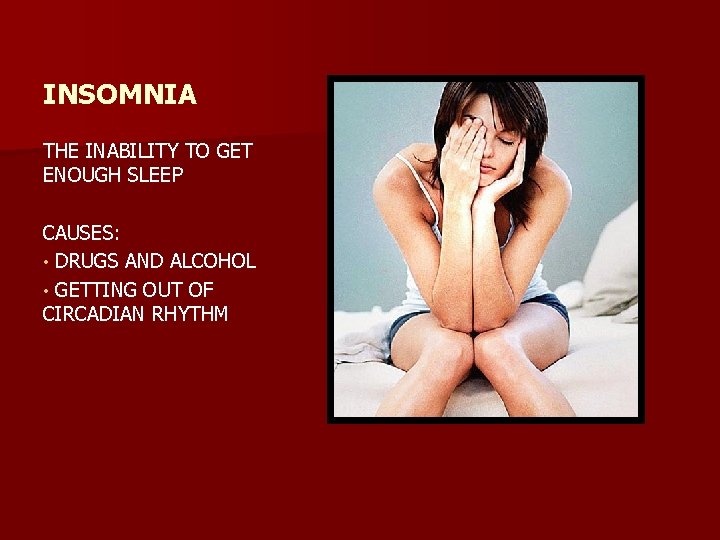
INSOMNIA THE INABILITY TO GET ENOUGH SLEEP CAUSES: • DRUGS AND ALCOHOL • GETTING OUT OF CIRCADIAN RHYTHM
NARCOLEPSY DISORDER IN WHICH A PERSON FALLS ASLEEP NO MATTER WHAT IS GOING ON PERSON CAN GO INTO INSTANT “REM” • n You. Tube - Narcolepsy News From CNN
SLEEP APNEA BREATHING STOPS WHEN SOMEONE IS ASLEEP PERSON DOESN’T USUALLY KNOW IT’S HAPPENING, BUT IT CAUSES A SEVERE DISRUPTION OF REM SLEEP, THUS LEADING TO EXHAUSTION n You. Tube - CNN - Sleep Apnea and Weight • HEAVY SNORING CAN BE A SIGN • n You. Tube - Snoring & Sleep Apnea Solution
E. Questions About Sleep
NIGHT TERROR (INCUBUS ATTACKS) NIGHTMARES THAT OCCUR DURING NREM SLEEP WHEN THE BODY IS NOT PREARED FOR A DREAM ASSOCIATED WITH PANIC • VERY REAL/TRAUMATIZING • MOST OFTEN HAPPEN IN CHILDREN n You. Tube - Do Your Children Have Night Terrors? • HOW TO TREAT: • DIET • REGULAR SLEEP CYCLE n You. Tube – Night Terror Home Videos
n How much sleep do I need? - Infants 17 hours, Toddlers 10 hours , Adolescence and Adulthood 10 hours, Old Age 6. h Hours. n Why do I sleep? - Repair Theory- sleep is mainly the restorative process that helps repair the body. Adaptive theory- sleep is mainly used to protect early humans & animals from nocturnal predators. n What If I Miss Sleep? - Sleep deprivation weakens the body’s immune system, which produces a risk of contracting viruses and infections. It also causes irritability, unhappiness, hallucinations and problems performing cognitive activates.
Myths of Sleep n n n Everyone needs 8 hrs of sleep per night to maintain good health. Learning of complicated subjects such as calculus can be done during sleep. Some people never dream. Dreams last only a few seconds. Genital arousal during sleep reflects dream content. • May be a useful index of physical versus psychological causes of impotence in males
Citations Plotnik, Rod (2002). Introduction to Psychology. Pacific Grove, nn. C. A. : Wadsworth Group. n Siegel, Jerome M. (2008). Sleep. Retrieved December 29, 2008, nnfrom Encarta Online Deluxe Web site: nnhttp: //www. semel. ucla. edu/sleepresearch/encarta/Article. htm n