
Module 5 Storage and Dispensing Locations 1 Objective
Module 5: Storage and Dispensing Locations 1
Objective Upon completion of this module, participants should be able to discuss common locations for storage & dispensing of ethanol-blended fuels and will provide a basic understanding of these storage/ dispensing sites. 2
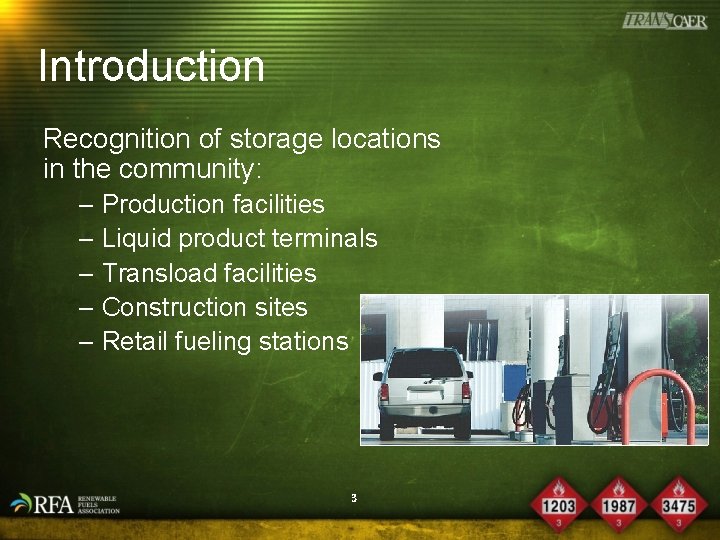
Introduction Recognition of storage locations in the community: – Production facilities – Liquid product terminals – Transload facilities – Construction sites – Retail fueling stations 3
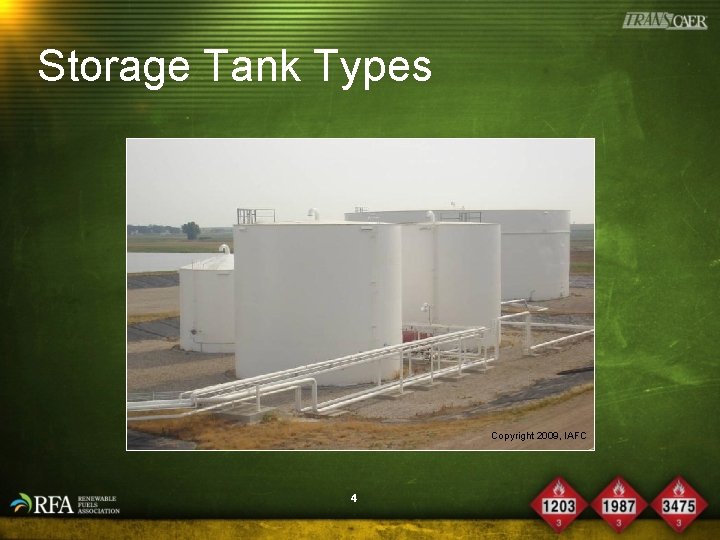
Storage Tank Types Copyright 2009, IAFC 4

Storage Tank Design • Typically stored in conventional carbon steel storage tanks – May be smaller than other tanks at terminal • 3 general types of storage tanks: – Cone roof (closed-top) tanks – External floating roof (EFR) tanks have open top with a floating pan – Internal floating roof (IFR) tanks with closed top & internal floating pan 5

Storage Tank Design Internal floating roof (IFR) tanks: – Closed roof – Internal floating pan – Eyebrow venting – Fire protection 6
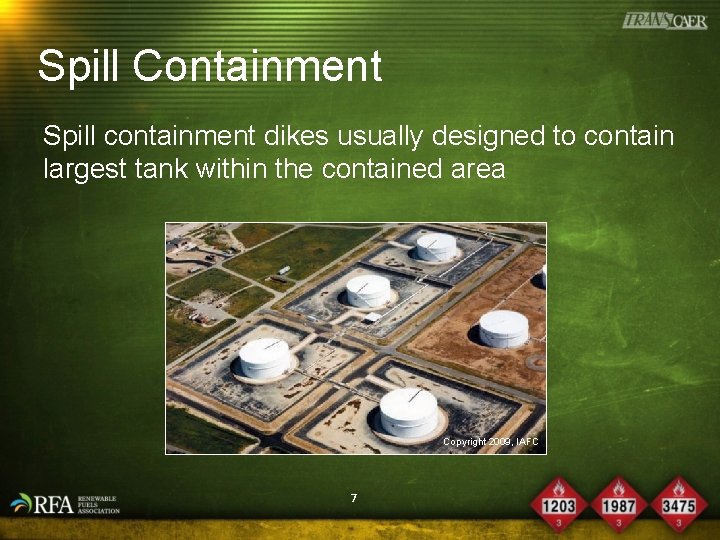
Spill Containment Spill containment dikes usually designed to contain largest tank within the contained area Copyright 2009, IAFC 7
Tank Fire Protection Systems Fixed (Built-in) fire protection systems: – Can deliver water, foam or a combination of extinguishing media – Combination of components permanently installed – Can be activated manually &/ or by detection device – Fire protection systems should meet current industry standards & codes 8
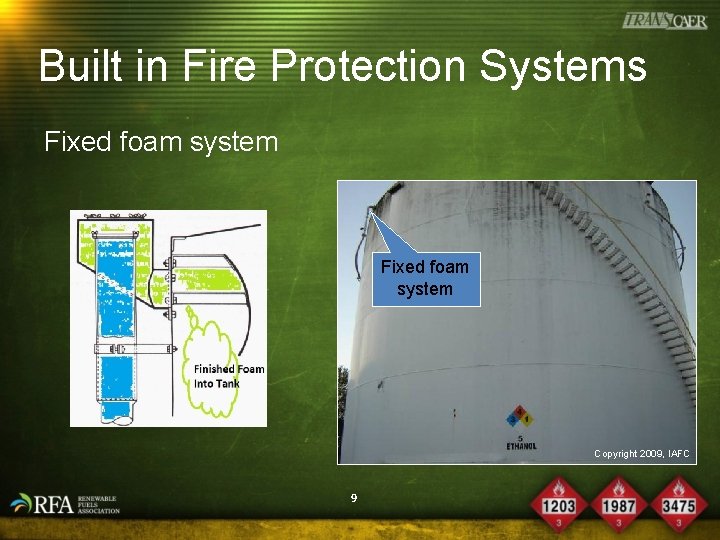
Built in Fire Protection Systems Fixed foam system Copyright 2009, IAFC 9
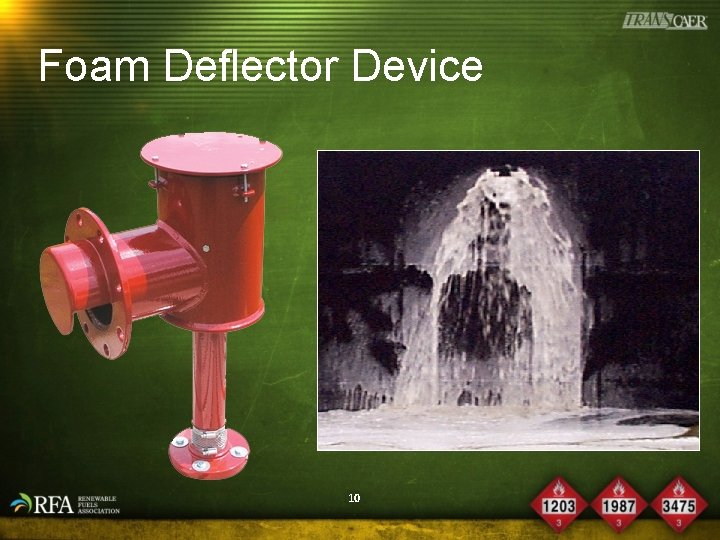
Foam Deflector Device 10
Emergency Response Pre-planning • Pre-planning for potential incidents at liquid product terminals is extremely important • Fire departments that help provide protection to liquid product terminals should have: – Access to high-flow fire fighting foam equipment – Access to large supplies of compatible AR-AFFF foam available 11
Emergency Response Planning • Consortiums between multiple tank farm operations & fire department • Fixed fire suppression systems currently best protection for large storage tanks • Fire department personnel should be familiar with systems & pre-calculate required flow rates • Pre-plan operations supplying systems • Practice exercise at least annually 12
Key Considerations Emergency response challenges: – Limited access for fire fighting equipment – Inadequate water supplies in area – Containment dikes & their systems – Miles of exposed product piping – Loading rack facilities 13
Working Relationships • Pre-established working relations between fire department & facility operators • Cooperative pre-planning is extremely important Property of Wikimedia® Commons, reprinted with permission Property of Wikimedia® Commons reprinted with permission 14
Terminal Size Considerations • Smaller bulk distribution storage facilities may pose unique challenges to local fire departments – Possibilities include: • No fire protection • Unstaffed • Limited site resources • Flammable liquid fuels stored at facilities in modest quantities 15
Terminal Size Considerations • Large distribution storage facilities also pose unique challenges to local fire departments – Possibilities include: • Size of fire emergency • Multi-dimensional emergency situation • Multiple type and large quantities of resources needed • Flammable liquid fuels stored at facilities in significant quantities 16
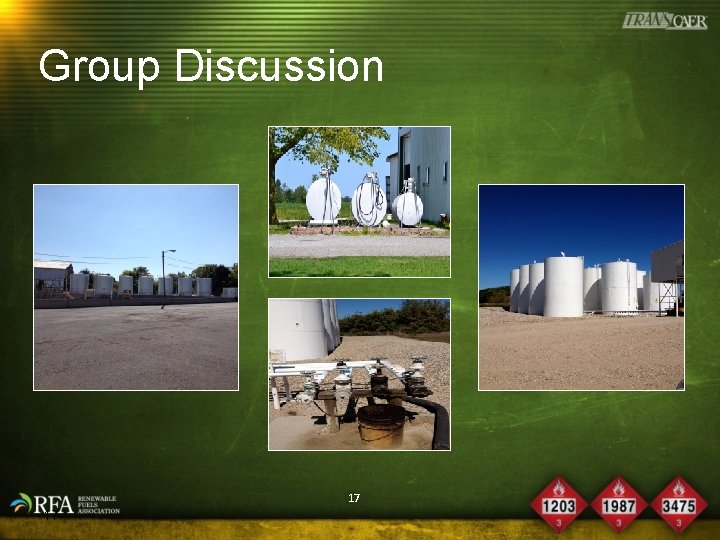
Group Discussion 17 17
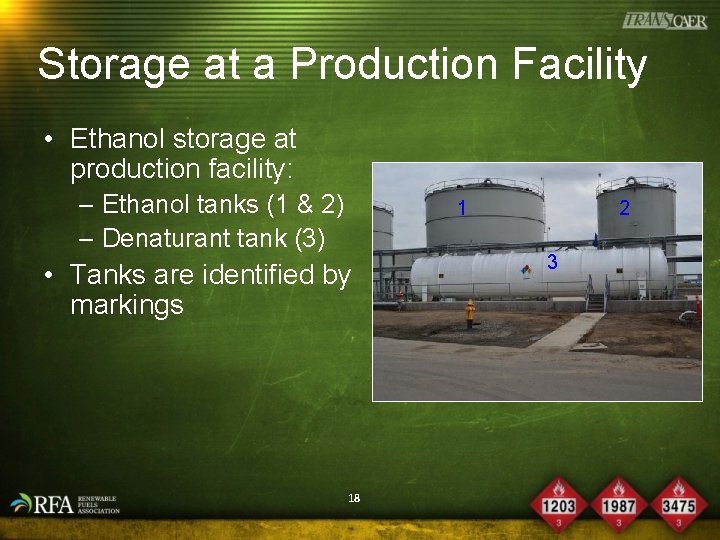
Storage at a Production Facility • Ethanol storage at production facility: – Ethanol tanks (1 & 2) – Denaturant tank (3) 1 • Tanks are identified by markings 18 2 3
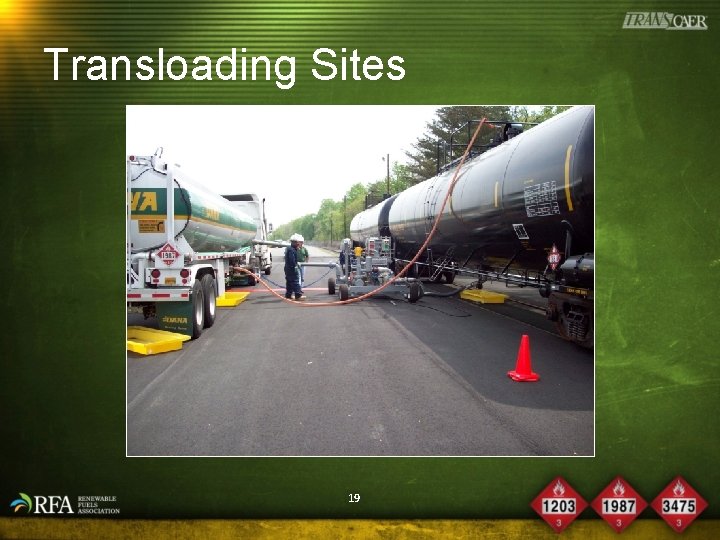
Transloading Sites 19
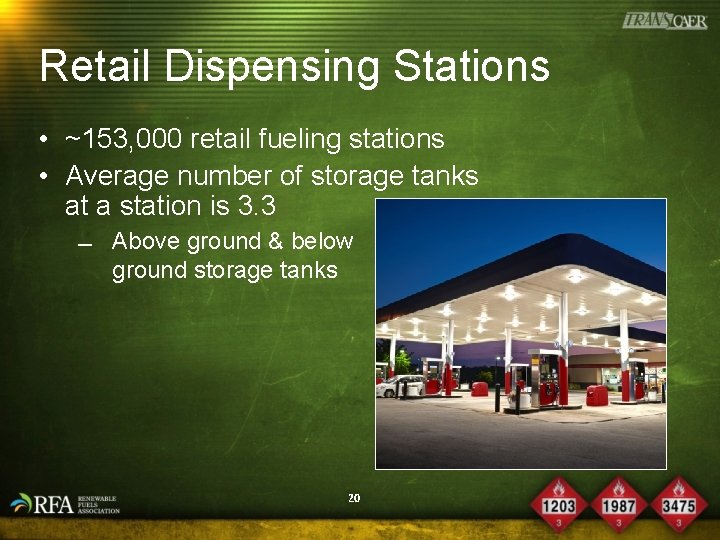
Retail Dispensing Stations • ~153, 000 retail fueling stations • Average number of storage tanks at a station is 3. 3 Above ground & below ground storage tanks 20
Retail Fuel Storage • Retail fuel configurations: – Underground tanks – Small volume above-ground steel tanks • Vertical or horizontal design • Filled by highway cargo tank trucks 21
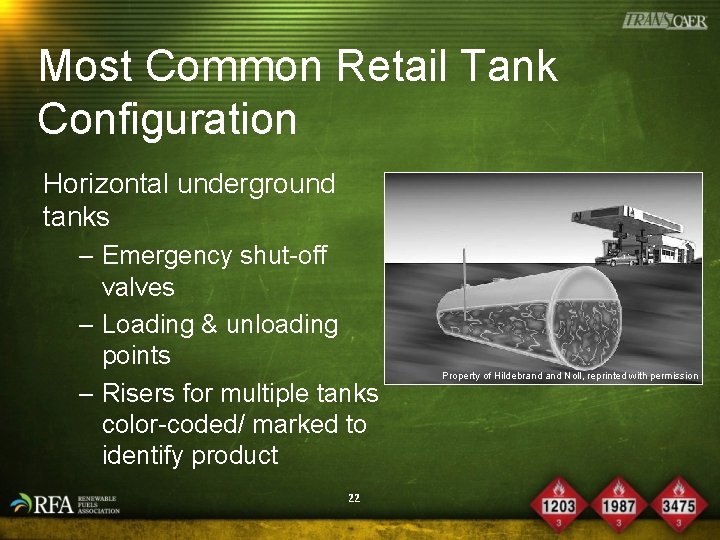
Most Common Retail Tank Configuration Horizontal underground tanks – Emergency shut-off valves – Loading & unloading points – Risers for multiple tanks color-coded/ marked to identify product 22 Property of Hildebrand Noll, reprinted with permission
Summary • Denatured fuel ethanol is commonly found at liquid product terminals • Pre-planning for potential events at liquid product terminals is extremely important • Facility familiarization & relationships • Liquid product terminals vary greatly in capacity & the types of products stored • Retail fueling stations have many different storage tank configurations 23
Activity 5. 1: Ethanol in Your Jurisdiction Purpose: – To allow participants to determine the potential for an ethanol emergency in their jurisdictions 24
- Slides: 24