
MODULE 5 RESPIRATION 5 2 2 f COENZYMES

- Slides: 16
MODULE 5 - RESPIRATION 5. 2. 2 f COENZYMES
Learning outcomes Describe the importance of coenzymes Describe the process of anaerobic respiration in mammals and yeast Explain the benefits of anaerobic respiration Explain why the energy yield is much less in anaerobic respiration than aerobic respiration.
Exam Question - Starter 1) What is the connection between phosphate and the energy needs of a cell? (2 marks) 2) ATP is a small, water-soluble molecule which can be rapidly and easily converted back into ADP if ATPase is present. Explain how these features make ATP suitable for it’s function. (3 marks) Answers 1) ATP is a molecule made from ADP and phosphate, using energy from reactions like those of repiration/Energy stored in the chemical bond between ADP and P can be released when it’s needed, by breaking ATP back down into ADP and P 2) ATP is small and water-soluble, it can be easily transported around cells to places where there a demand/there it can be rapidly converted back into ADP to release the energy stored in bonds/because an enzyme is required for this reaction there is less chance fro it being broken down in the wrong place – less waist
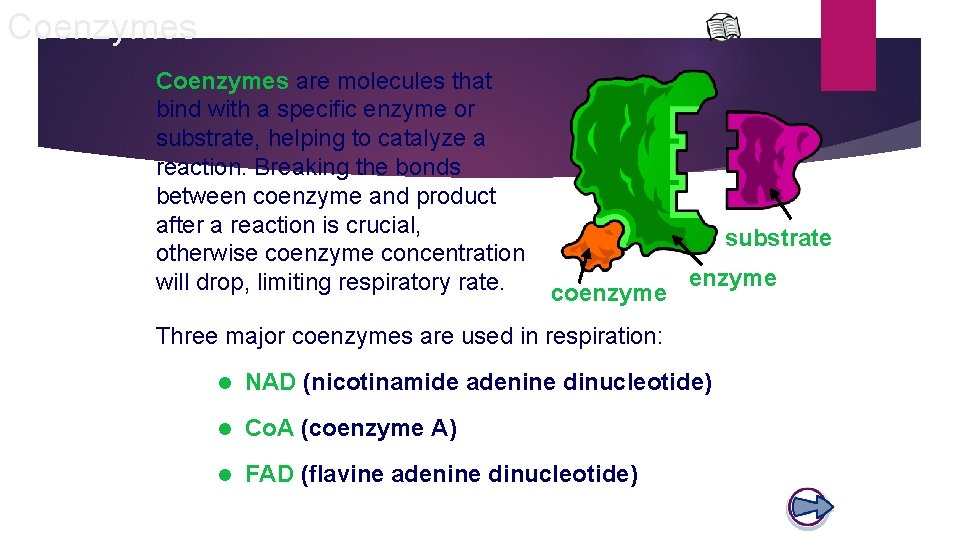
COENZYMES Coenzymes are complex organic molecules that are used by enzymes to accept or donate molecules involved in a reaction. They are often referred to as ‘Helper’ molecules as they carry chemical groups or ions about, e. g. NAD removes H+ and carries it to other molecules.
Coenzymes are molecules that bind with a specific enzyme or substrate, helping to catalyze a reaction. Breaking the bonds between coenzyme and product after a reaction is crucial, otherwise coenzyme concentration will drop, limiting respiratory rate. substrate coenzyme Three major coenzymes are used in respiration: l NAD (nicotinamide adenine dinucleotide) l Co. A (coenzyme A) l FAD (flavine adenine dinucleotide)
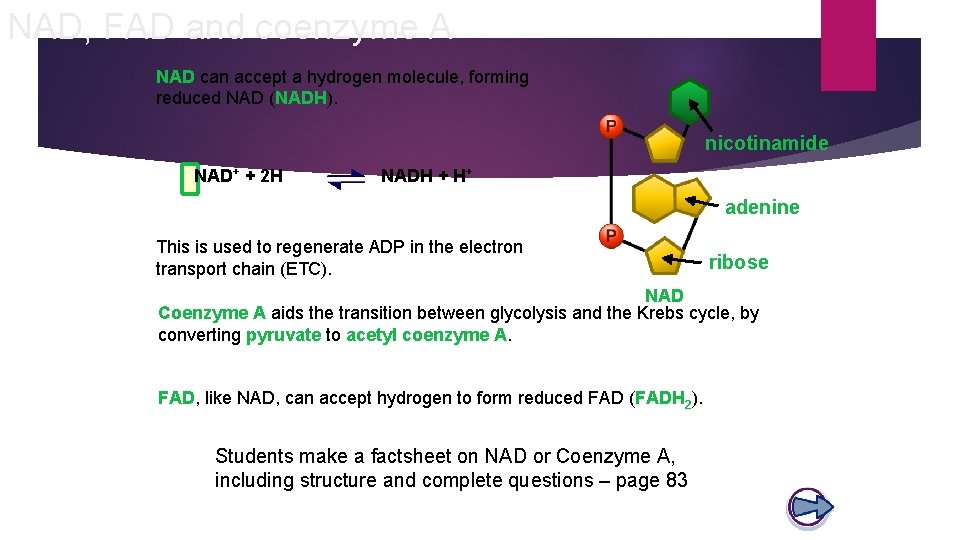
NAD, FAD and coenzyme A NAD can accept a hydrogen molecule, forming reduced NAD (NADH). nicotinamide NAD+ + 2 H NADH + H+ adenine This is used to regenerate ADP in the electron transport chain (ETC). ribose NAD Coenzyme A aids the transition between glycolysis and the Krebs cycle, by converting pyruvate to acetyl coenzyme A. FAD, like NAD, can accept hydrogen to form reduced FAD (FADH 2). Students make a factsheet on NAD or Coenzyme A, including structure and complete questions – page 83
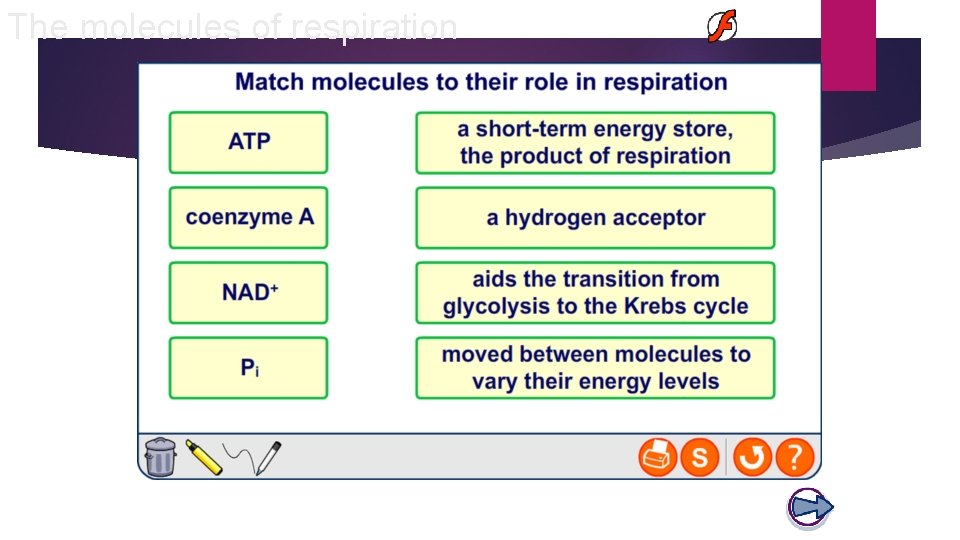
The molecules of respiration
Practical Investigating the Redox Reactions of Respiration At certain stages during the breakdown of glucose during respiration, oxidation occurs by removal of hydrogen atoms. These hydrogen atoms are usually picked up by NAD. The dye, methylene blue acts as a hydrogen acceptor and once it has picked up the hydrogen atoms, it becomes colourless. In this practical, you will investigate the effects of yeast on methylene blue in varying conditions.
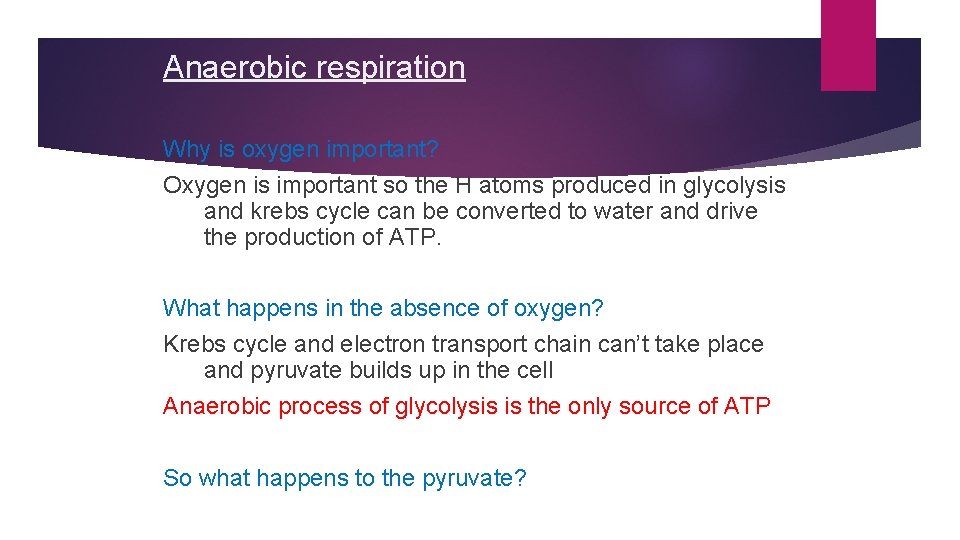
Anaerobic respiration Why is oxygen important? Oxygen is important so the H atoms produced in glycolysis and krebs cycle can be converted to water and drive the production of ATP. What happens in the absence of oxygen? Krebs cycle and electron transport chain can’t take place and pyruvate builds up in the cell Anaerobic process of glycolysis is the only source of ATP So what happens to the pyruvate?
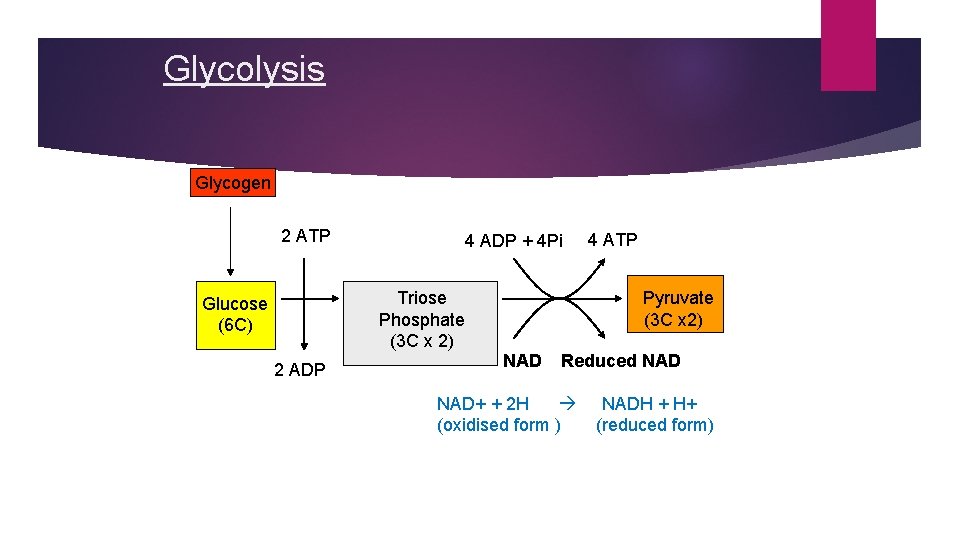
Glycolysis Glycogen 2 ATP 4 ADP + 4 Pi Triose Phosphate (3 C x 2) Glucose (6 C) 2 ADP 4 ATP Pyruvate (3 C x 2) NAD Reduced NAD+ + 2 H (oxidised form ) NADH + H+ (reduced form)
http: //www. youtube. com/watch? v=c. DC 29 i. Bxb 3 w
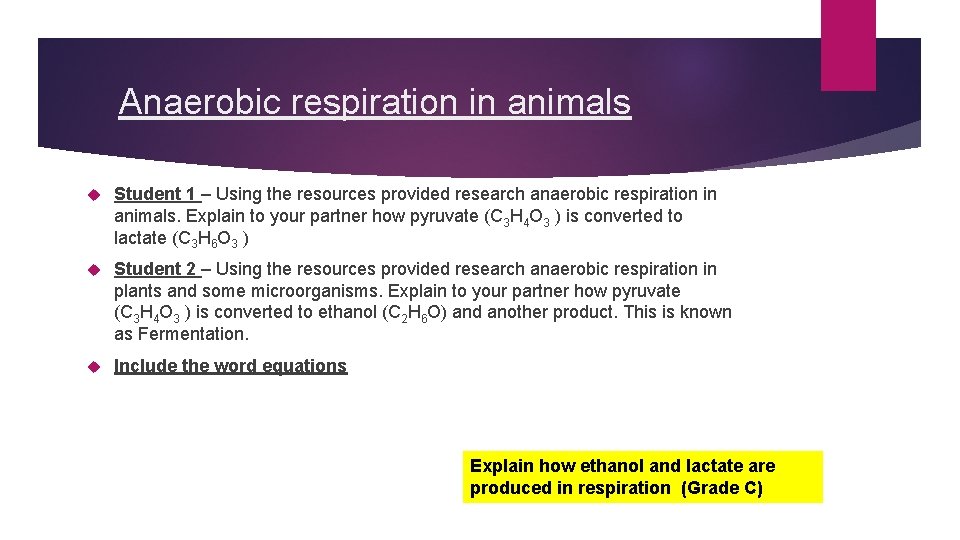
Anaerobic respiration in animals Student 1 – Using the resources provided research anaerobic respiration in animals. Explain to your partner how pyruvate (C 3 H 4 O 3 ) is converted to lactate (C 3 H 6 O 3 ) Student 2 – Using the resources provided research anaerobic respiration in plants and some microorganisms. Explain to your partner how pyruvate (C 3 H 4 O 3 ) is converted to ethanol (C 2 H 6 O) and another product. This is known as Fermentation. Include the word equations Explain how ethanol and lactate are produced in respiration (Grade C)
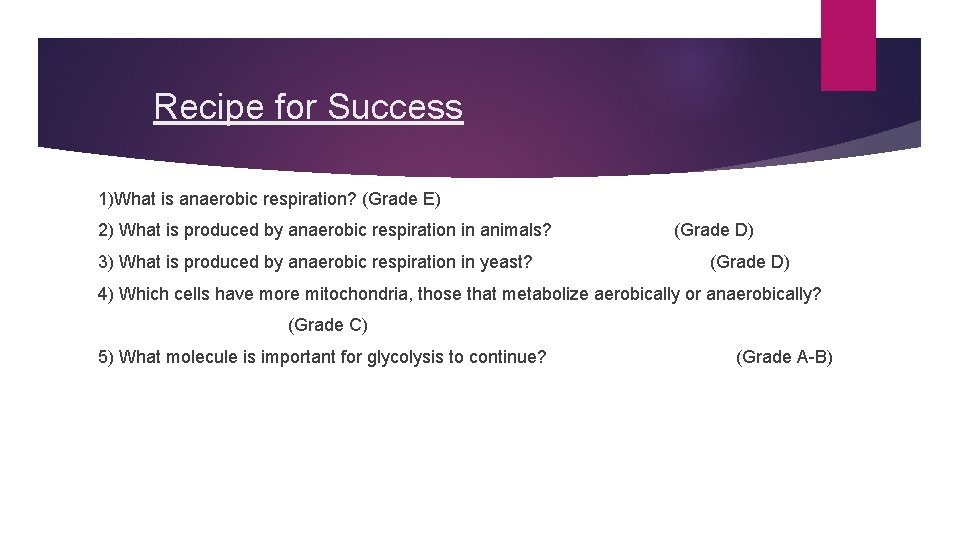
Recipe for Success 1)What is anaerobic respiration? (Grade E) 2) What is produced by anaerobic respiration in animals? 3) What is produced by anaerobic respiration in yeast? (Grade D) 4) Which cells have more mitochondria, those that metabolize aerobically or anaerobically? (Grade C) 5) What molecule is important for glycolysis to continue? (Grade A-B)
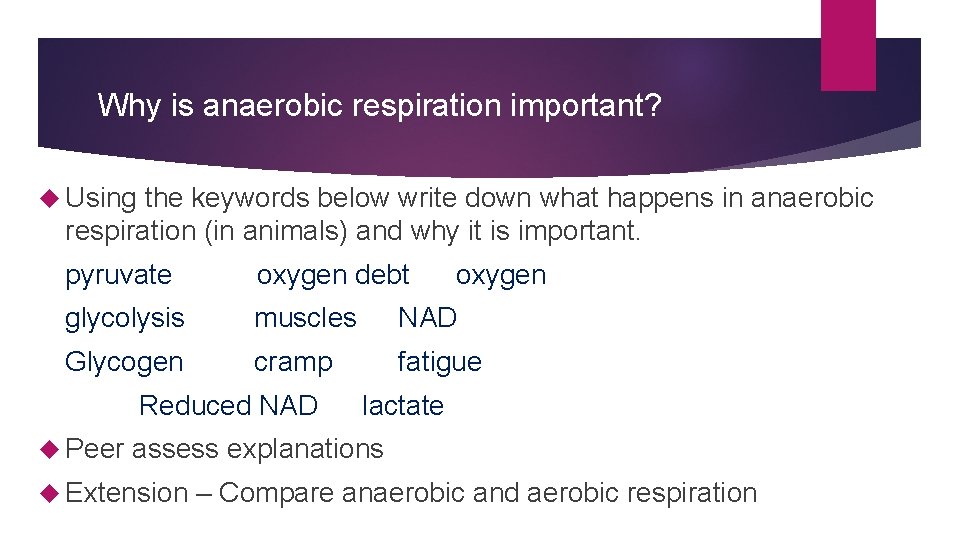
Why is anaerobic respiration important? Using the keywords below write down what happens in anaerobic respiration (in animals) and why it is important. pyruvate oxygen debt glycolysis muscles NAD Glycogen cramp fatigue Reduced NAD Peer oxygen lactate assess explanations Extension – Compare anaerobic and aerobic respiration
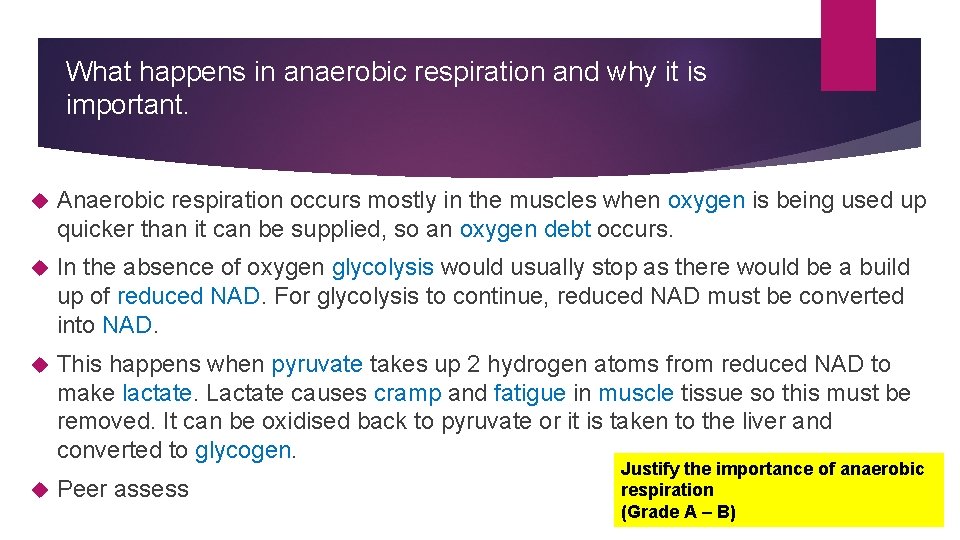
What happens in anaerobic respiration and why it is important. Anaerobic respiration occurs mostly in the muscles when oxygen is being used up quicker than it can be supplied, so an oxygen debt occurs. In the absence of oxygen glycolysis would usually stop as there would be a build up of reduced NAD. For glycolysis to continue, reduced NAD must be converted into NAD. This happens when pyruvate takes up 2 hydrogen atoms from reduced NAD to make lactate. Lactate causes cramp and fatigue in muscle tissue so this must be removed. It can be oxidised back to pyruvate or it is taken to the liver and converted to glycogen. Peer assess Justify the importance of anaerobic respiration (Grade A – B)
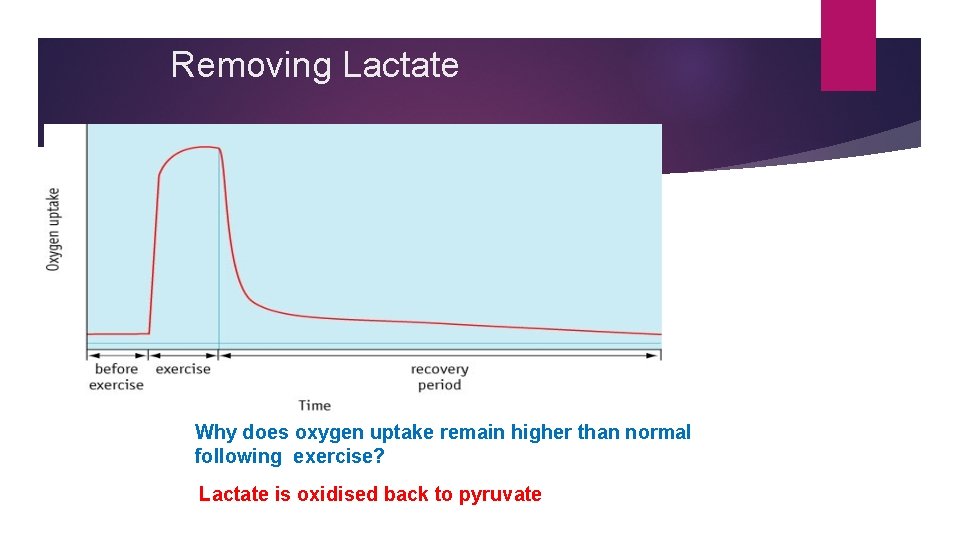
Removing Lactate Why does oxygen uptake remain higher than normal following exercise? Lactate is oxidised back to pyruvate