
Module 5 Part 2 Interpreting Baseline Data Using
Module 5 Part 2 Interpreting Baseline Data Using Run Charts Adapted from: The Institute for Healthcare Improvement (IHI), the Agency for Healthcare Research and Quality (AHRQ), and the Health Resources and Services Administration (HRSA) Quality Toolkits

Objectives • Describe rules for constructing a high quality run chart • Describe rules for evaluating run chart data points • Interpret baseline performance using the rules for performance

Determine a Baseline
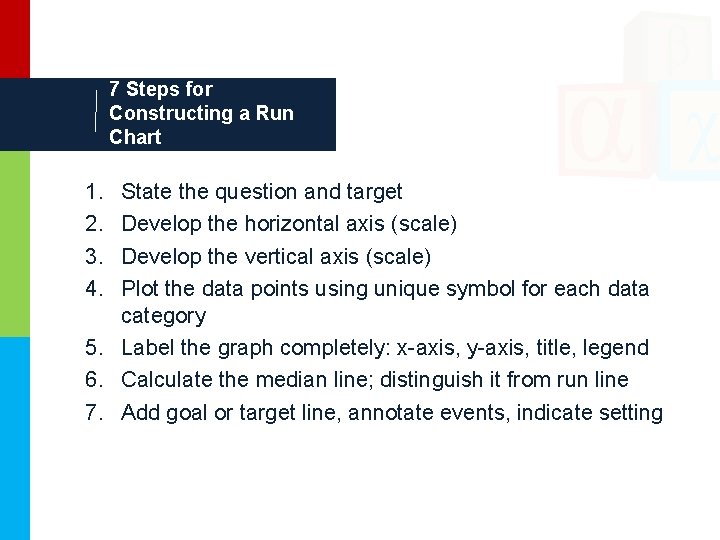
7 Steps for Constructing a Run Chart 1. 2. 3. 4. State the question and target Develop the horizontal axis (scale) Develop the vertical axis (scale) Plot the data points using unique symbol for each data category 5. Label the graph completely: x-axis, y-axis, title, legend 6. Calculate the median line; distinguish it from run line 7. Add goal or target line, annotate events, indicate setting
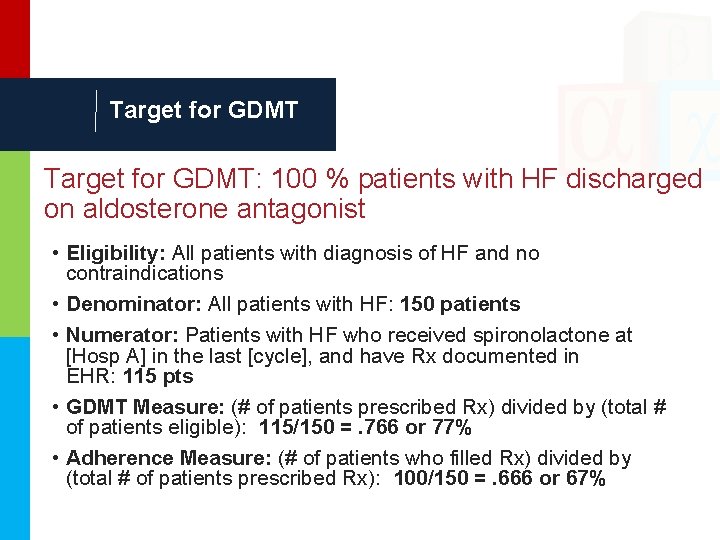
Target for GDMT: 100 % patients with HF discharged on aldosterone antagonist • Eligibility: All patients with diagnosis of HF and no contraindications • Denominator: All patients with HF: 150 patients • Numerator: Patients with HF who received spironolactone at [Hosp A] in the last [cycle], and have Rx documented in EHR: 115 pts • GDMT Measure: (# of patients prescribed Rx) divided by (total # of patients eligible): 115/150 =. 766 or 77% • Adherence Measure: (# of patients who filled Rx) divided by (total # of patients prescribed Rx): 100/150 =. 666 or 67%
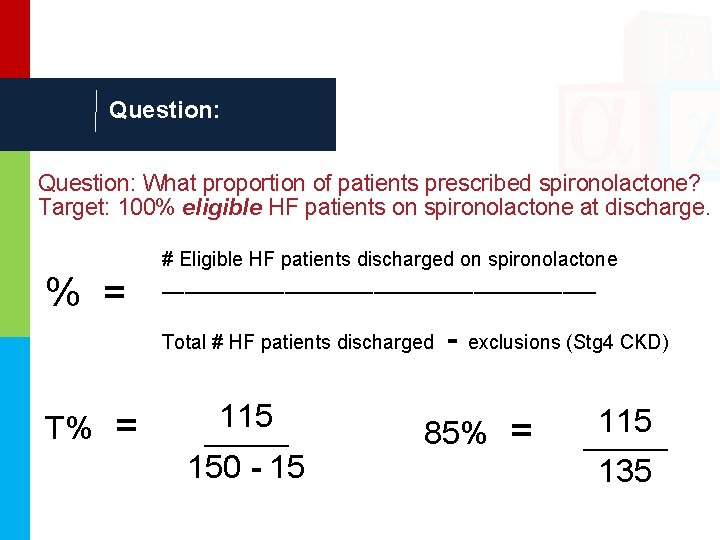
Question: What proportion of patients prescribed spironolactone? Target: 100% eligible HF patients on spironolactone at discharge. % = # Eligible HF patients discharged on spironolactone ____________________ Total # HF patients discharged T% = 115 ________ 150 - 15 - exclusions (Stg 4 CKD) 85% = 115 ________ 135
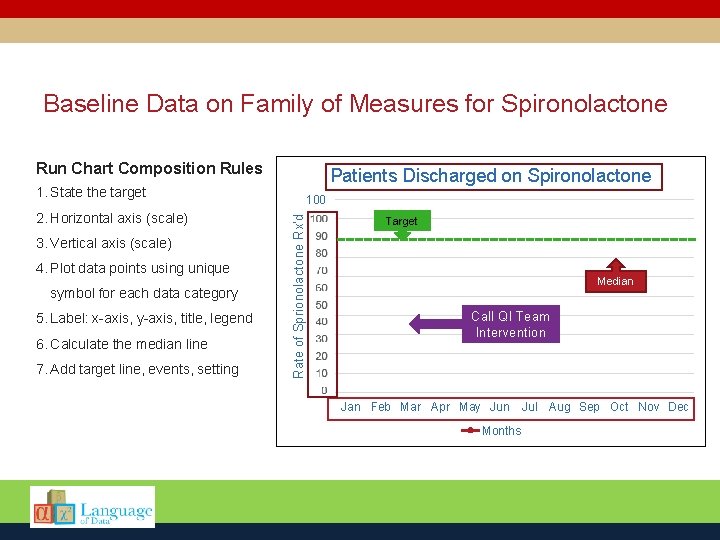
Baseline Data on Family of Measures for Spironolactone Run Chart Composition Rules Patients Discharged on Spironolactone 1. State the target 3. Vertical axis (scale) 4. Plot data points using unique symbol for each data category 5. Label: x-axis, y-axis, title, legend 6. Calculate the median line 7. Add target line, events, setting Rate of Sprionolactone Rx’d 2. Horizontal axis (scale) 100 90 Target 80 70 60 Median 50 40 30 Call QI Team Intervention 20 10 0 Jan Feb Mar Apr May Jun Months Jul Aug Sep Oct Nov Dec
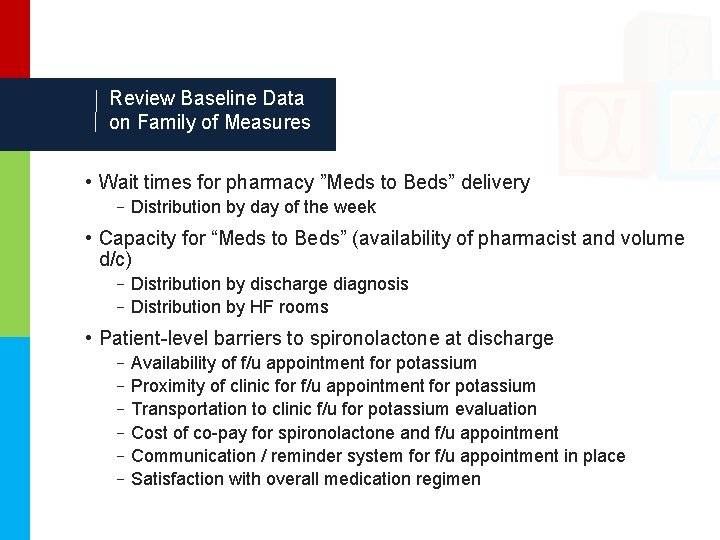
Review Baseline Data on Family of Measures • Wait times for pharmacy ”Meds to Beds” delivery –Distribution by day of the week • Capacity for “Meds to Beds” (availability of pharmacist and volume d/c) –Distribution by discharge diagnosis –Distribution by HF rooms • Patient-level barriers to spironolactone at discharge –Availability of f/u appointment for potassium –Proximity of clinic for f/u appointment for potassium –Transportation to clinic f/u for potassium evaluation –Cost of co-pay for spironolactone and f/u appointment –Communication / reminder system for f/u appointment in place –Satisfaction with overall medication regimen
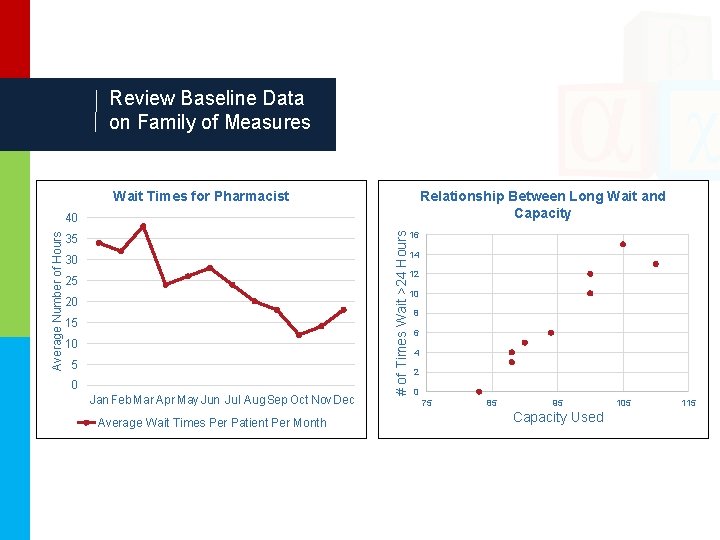
Review Baseline Data on Family of Measures Wait Times for Pharmacist Relationship Between Long Wait and Capacity 35 30 25 20 15 10 5 0 Jan Feb Mar Apr May Jun Jul Aug. Sep Oct Nov. Dec Average Wait Times Per Patient Per Month # of Times Wait >24 Hours Average Number of Hours 40 16 14 12 10 8 6 4 2 0 75 85 95 Capacity Used 105 115
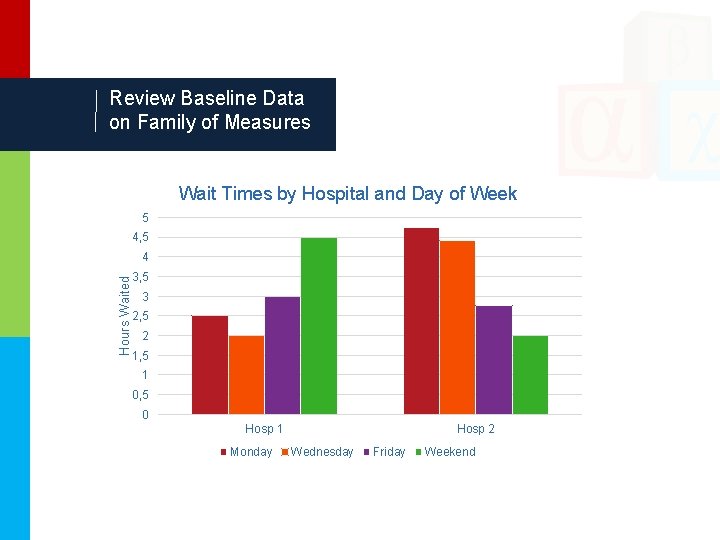
Review Baseline Data on Family of Measures Wait Times by Hospital and Day of Week 5 4, 5 Hours Waited 4 3, 5 3 2, 5 2 1, 5 1 0, 5 0 Hosp 1 Monday Hosp 2 Wednesday Friday Weekend

Interpreting Baseline Performance • Percent compliance with a guideline or target • Example: How many patients with HF were prescribed or received an aldosterone antagonist at discharge?
Basic Rules for Interpretation of Run Charts Rules for interpretation of a non-random signal in run charts 1. A shift of 6 or more consecutive points above median 2. A trend of 5 or more consecutive points, all up or down 3. A run of appropriate duration/direction, given total number of data points 4. An “astronomical data point” or outlier is explainable (or not present)
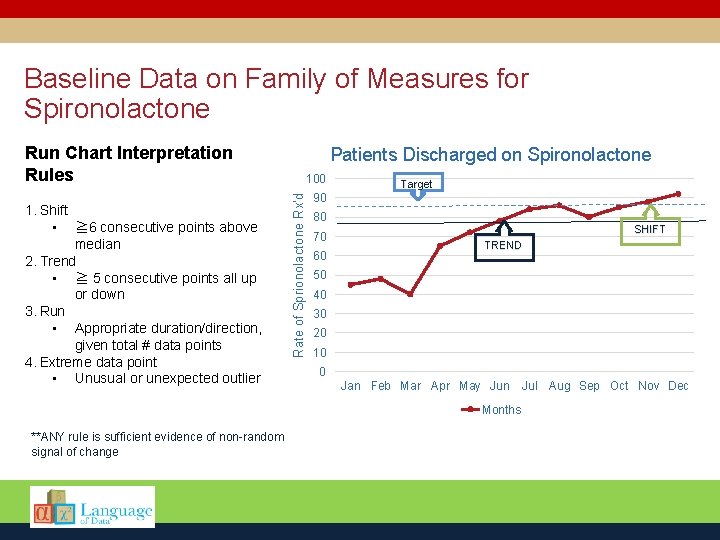
Baseline Data on Family of Measures for Spironolactone Run Chart Interpretation Rules 100 Rate of Sprionolactone Rx’d 1. Shift • ≧ 6 consecutive points above median 2. Trend • ≧ 5 consecutive points all up or down 3. Run • Appropriate duration/direction, given total # data points 4. Extreme data point • Unusual or unexpected outlier Patients Discharged on Spironolactone Target 90 80 70 60 SHIFT TREND 50 40 30 20 10 0 Jan Feb Mar Apr May Jun Months **ANY rule is sufficient evidence of non-random signal of change Jul Aug Sep Oct Nov Dec
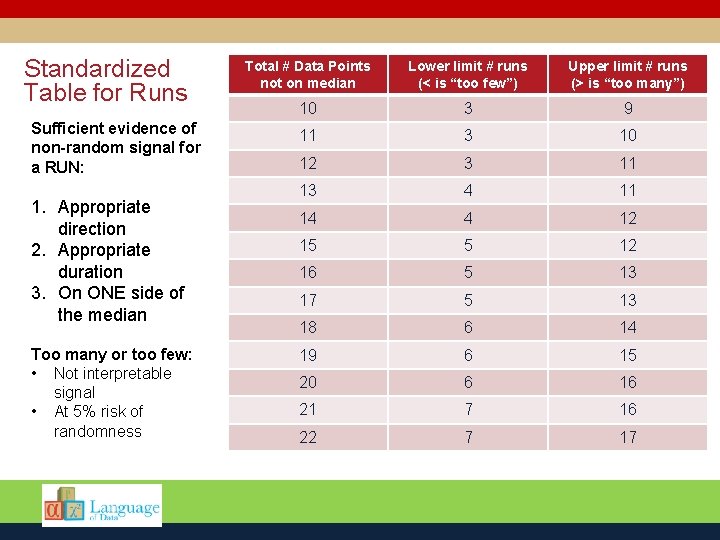
Standardized Table for Runs Sufficient evidence of non-random signal for a RUN: 1. Appropriate direction 2. Appropriate duration 3. On ONE side of the median Too many or too few: • Not interpretable signal • At 5% risk of randomness Total # Data Points not on median Lower limit # runs (< is “too few”) Upper limit # runs (> is “too many”) 10 3 9 11 3 10 12 3 11 13 4 11 14 4 12 15 5 12 16 5 13 17 5 13 18 6 14 19 6 15 20 6 16 21 7 16 22 7 17
Useful Run Chart Modifications • Multiple measures on one chart –Stratified groups or categories –Sub-groups • Using an X-axis other than time • Using real-time scale with unequal time intervals • Adding a trend line to a run chart
Summary • Run charts are used to define and analyze baseline performance • Answers the question “how do we know a change is an improvement? ” • Rules for interpretation of a non-random signal in run charts: 1. A shift of 6 or more consecutive points above median 2. A trend of 5 or more consecutive points, all up or down 3. A run of appropriate duration/direction, given total number of data points 4. An “astronomical data point” or outlier is explainable or not present
- Slides: 16