
Module 5 Introduction to XQuery XML is now

![Xpath filter predicates n Syntax: expression 1 [ expression 2 ] n n [](https://slidetodoc.com/presentation_image_h2/8f0361c409b92dee06731d871fe2e947/image-53.jpg "Xpath filter predicates n Syntax: expression 1 [ expression 2 ] n n [")
- Slides: 54
Module 5 Introduction to XQuery
XML is now everywhere n Google search (warning: unreliable numbers) n n n n 285. 000 for XML 1. 000 for XQuery 11. 000 for XSLT 12. 000 for XML Schema 60. 000 for. NET 200. 000 for Java 64. 000 for SQL The highest Google number among all the technology buzzwords that I searched (except RSS) 9/6/2021 2
Sources of XML data 1. 2. 3. 4. 5. 6. 7. 8. Inter-application communication data (WS, Rest, etc) Mobile devices communication data Logs Blogs (RSS) Metadata (e. g. Schema, WSDL, XMP) Presentation data (e. g. XHTML) Documents (e. g. Word) Views of other sources of data n 9. Relational, LDAP, CSV, Excel, etc. Sensor data n 9/6/2021 3
Some vertical application domains for XML n n n n n Health. Care Level Seven http: //www. hl 7. org/ Geography Markup Language (GML) Systems Biology Markup Language (SBML) http: //sbml. org/ XBRL, the XML based Business Reporting standard http: //www. xbrl. org/ Global Justice XML Data Model (GJXDM) http: //it. ojp. gov/jxdm eb. XML http: //www. ebxml. org/ e. g. Encoded Archival Description Application http: //lcweb. loc. gov/ead/ Digital photography metadata XMP An XML grammar for sensor data (Sensor. ML) Real Simple Syndication (RSS 2. 0) 9/6/2021 Basically everywhere. 4
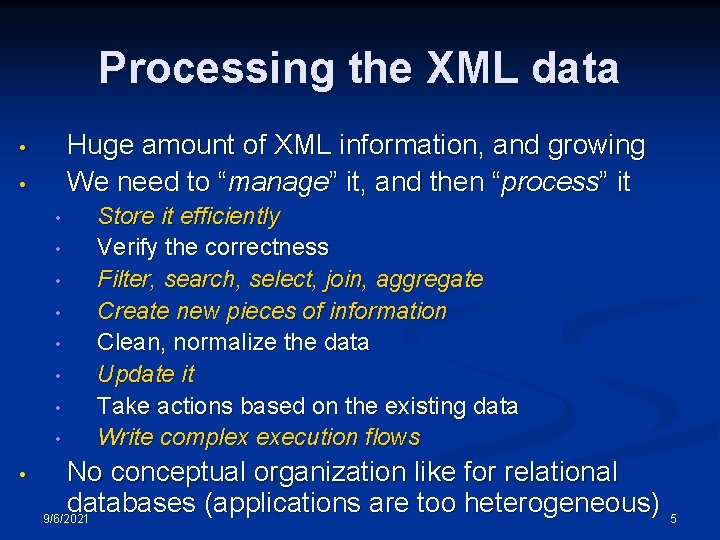
Processing the XML data Huge amount of XML information, and growing We need to “manage” it, and then “process” it • • • Store it efficiently Verify the correctness Filter, search, select, join, aggregate Create new pieces of information Clean, normalize the data Update it Take actions based on the existing data Write complex execution flows No conceptual organization like for relational databases (applications are too heterogeneous) 9/6/2021 5
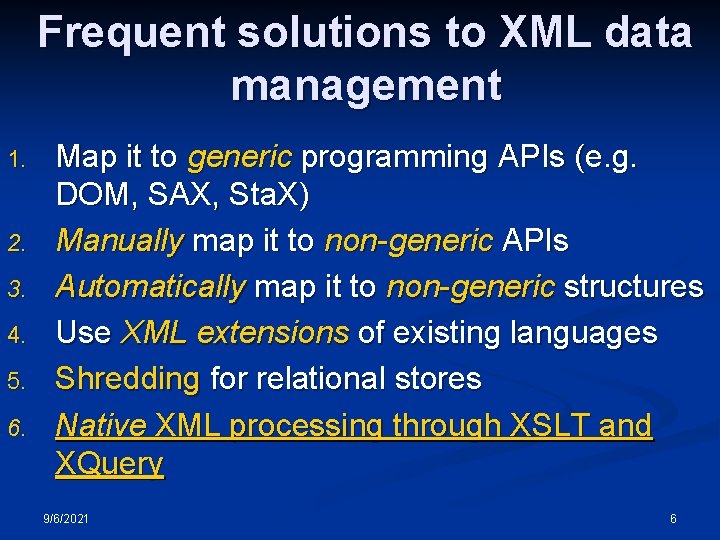
Frequent solutions to XML data management 1. 2. 3. 4. 5. 6. Map it to generic programming APIs (e. g. DOM, SAX, Sta. X) Manually map it to non-generic APIs Automatically map it to non-generic structures Use XML extensions of existing languages Shredding for relational stores Native XML processing through XSLT and XQuery 9/6/2021 6
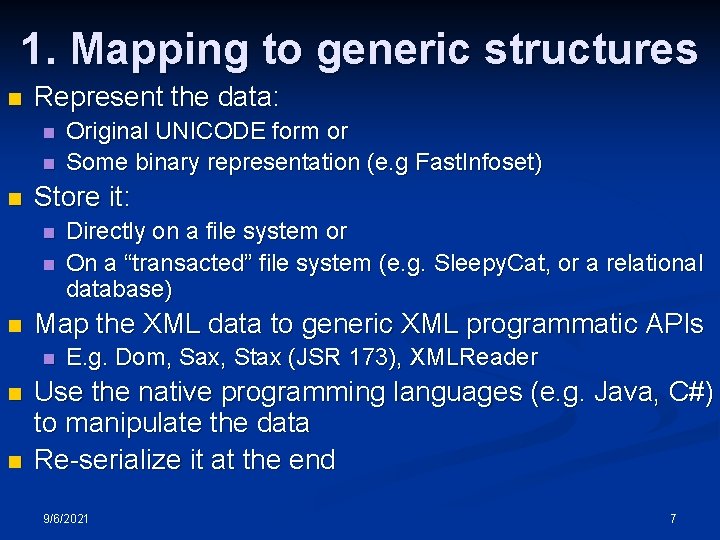
1. Mapping to generic structures n Represent the data: n n n Store it: n n Directly on a file system or On a “transacted” file system (e. g. Sleepy. Cat, or a relational database) Map the XML data to generic XML programmatic APIs n n Original UNICODE form or Some binary representation (e. g Fast. Infoset) E. g. Dom, Sax, Stax (JSR 173), XMLReader Use the native programming languages (e. g. Java, C#) to manipulate the data Re-serialize it at the end 9/6/2021 7
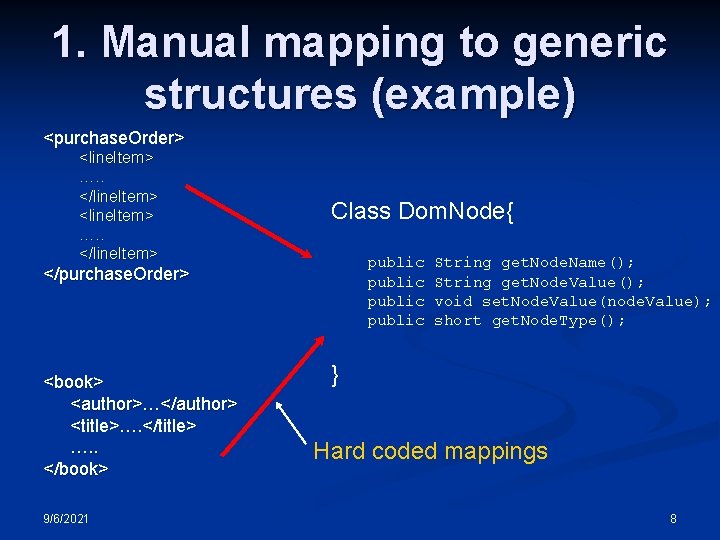
1. Manual mapping to generic structures (example) <purchase. Order> <line. Item> …. . </line. Item> Class Dom. Node{ public </purchase. Order> <book> <author>…</author> <title>…. </title> …. . </book> 9/6/2021 String get. Node. Name(); String get. Node. Value(); void set. Node. Value(node. Value); short get. Node. Type(); } Hard coded mappings 8
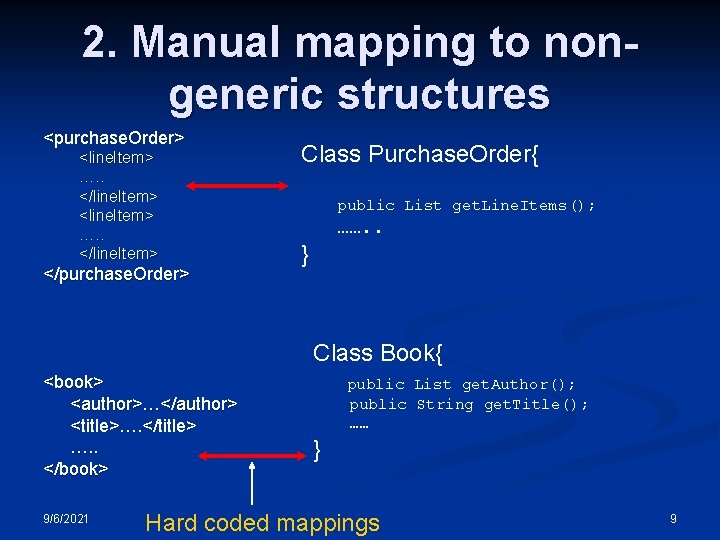
2. Manual mapping to nongeneric structures <purchase. Order> <line. Item> …. . </line. Item> </purchase. Order> Class Purchase. Order{ public List get. Line. Items(); ……. . } Class Book{ <book> <author>…</author> <title>…. </title> …. . </book> 9/6/2021 public List get. Author(); public String get. Title(); …… } Hard coded mappings 9
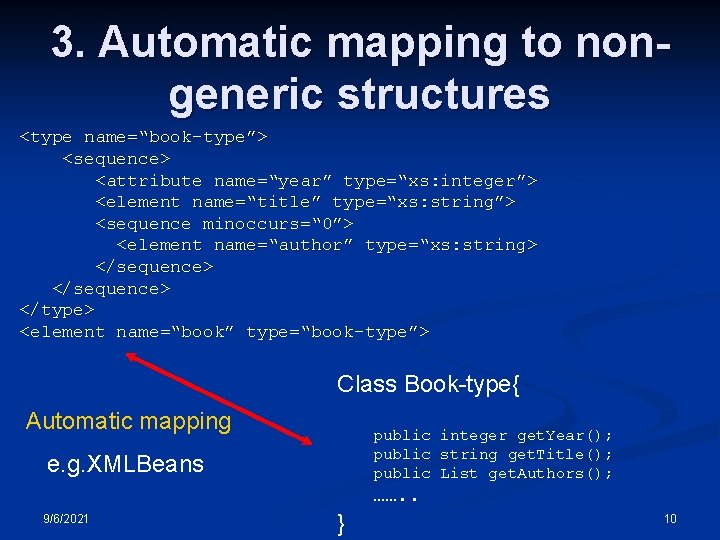
3. Automatic mapping to nongeneric structures <type name=“book-type”> <sequence> <attribute name=“year” type=“xs: integer”> <element name=“title” type=“xs: string”> <sequence minoccurs=“ 0”> <element name=“author” type=“xs: string> </sequence> </type> <element name=“book” type=“book-type”> Class Book-type{ Automatic mapping public integer get. Year(); public string get. Title(); public List get. Authors(); e. g. XMLBeans ……. . 9/6/2021 } 10
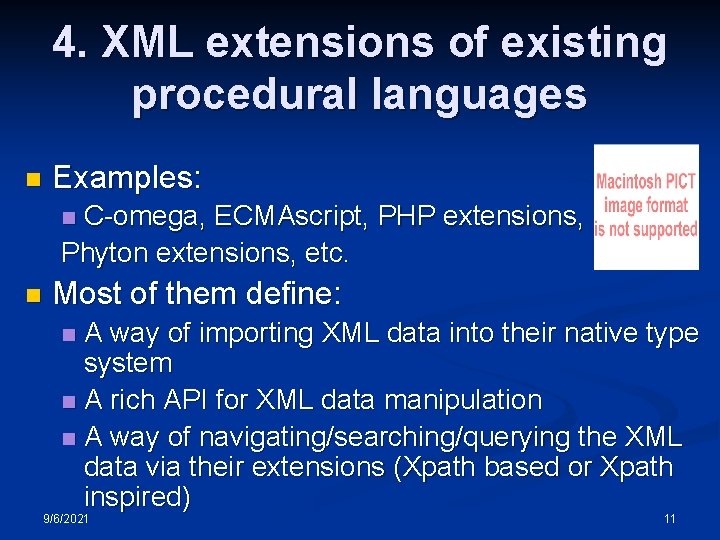
4. XML extensions of existing procedural languages n Examples: C-omega, ECMAscript, PHP extensions, Phyton extensions, etc. n n Most of them define: A way of importing XML data into their native type system n A rich API for XML data manipulation n A way of navigating/searching/querying the XML data via their extensions (Xpath based or Xpath inspired) n 9/6/2021 11
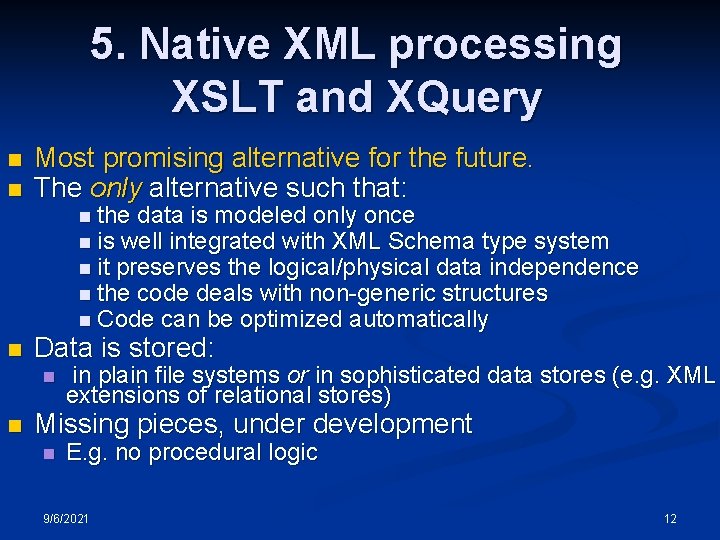
5. Native XML processing XSLT and XQuery n n Most promising alternative for the future. The only alternative such that: n Data is stored: n the data is modeled only once n is well integrated with XML Schema type system n it preserves the logical/physical data independence n the code deals with non-generic structures n Code can be optimized automatically n n in plain file systems or in sophisticated data stores (e. g. XML extensions of relational stores) Missing pieces, under development n E. g. no procedural logic 9/6/2021 12
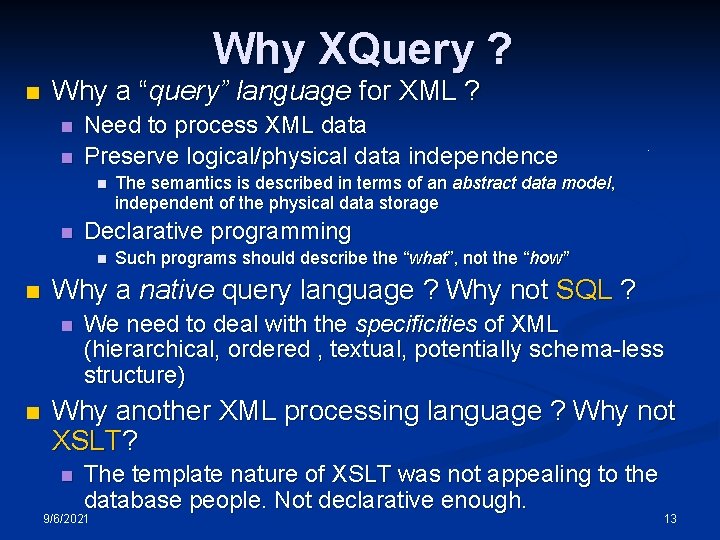
Why XQuery ? n Why a “query” language for XML ? n n Need to process XML data Preserve logical/physical data independence n n Declarative programming n n Such programs should describe the “what”, not the “how” Why a native query language ? Why not SQL ? n n The semantics is described in terms of an abstract data model, independent of the physical data storage We need to deal with the specificities of XML (hierarchical, ordered , textual, potentially schema-less structure) Why another XML processing language ? Why not XSLT? n The template nature of XSLT was not appealing to the database people. Not declarative enough. 9/6/2021 13
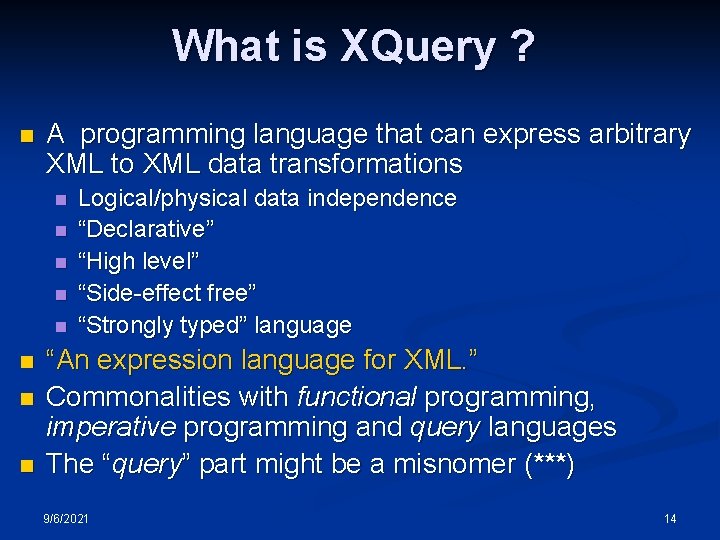
What is XQuery ? n A programming language that can express arbitrary XML to XML data transformations n n n n Logical/physical data independence “Declarative” “High level” “Side-effect free” “Strongly typed” language “An expression language for XML. ” Commonalities with functional programming, imperative programming and query languages The “query” part might be a misnomer (***) 9/6/2021 14
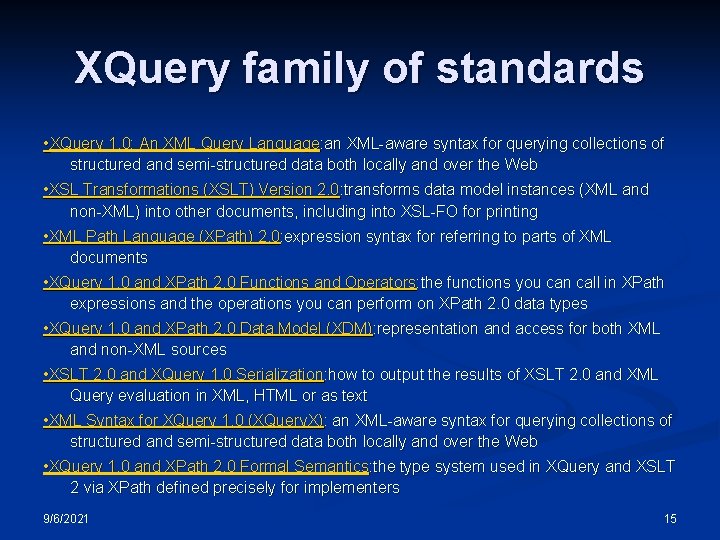
XQuery family of standards • XQuery 1. 0: An XML Query Language: an XML-aware syntax for querying collections of structured and semi-structured data both locally and over the Web • XSL Transformations (XSLT) Version 2. 0: transforms data model instances (XML and non-XML) into other documents, including into XSL-FO for printing • XML Path Language (XPath) 2. 0: expression syntax for referring to parts of XML documents • XQuery 1. 0 and XPath 2. 0 Functions and Operators: the functions you can call in XPath expressions and the operations you can perform on XPath 2. 0 data types • XQuery 1. 0 and XPath 2. 0 Data Model (XDM): representation and access for both XML and non-XML sources • XSLT 2. 0 and XQuery 1. 0 Serialization: how to output the results of XSLT 2. 0 and XML Query evaluation in XML, HTML or as text • XML Syntax for XQuery 1. 0 (XQuery. X): an XML-aware syntax for querying collections of structured and semi-structured data both locally and over the Web • XQuery 1. 0 and XPath 2. 0 Formal Semantics: the type system used in XQuery and XSLT 2 via XPath defined precisely for implementers 9/6/2021 15
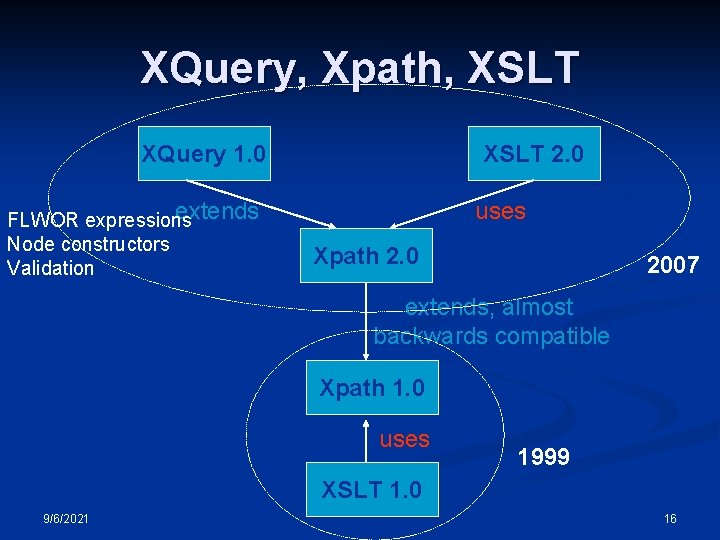
XQuery, Xpath, XSLT XQuery 1. 0 extends FLWOR expressions Node constructors Validation XSLT 2. 0 uses Xpath 2. 0 2007 extends, almost backwards compatible Xpath 1. 0 uses 1999 XSLT 1. 0 9/6/2021 16
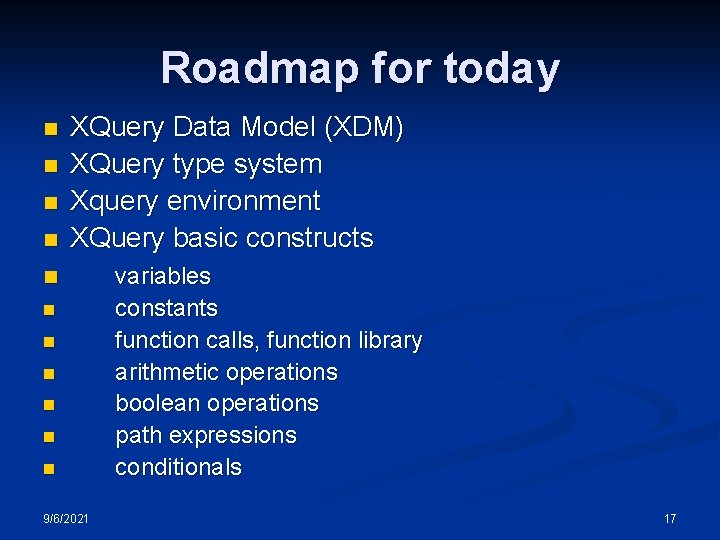
Roadmap for today n n XQuery Data Model (XDM) XQuery type system Xquery environment XQuery basic constructs n n n n 9/6/2021 variables constants function calls, function library arithmetic operations boolean operations path expressions conditionals 17
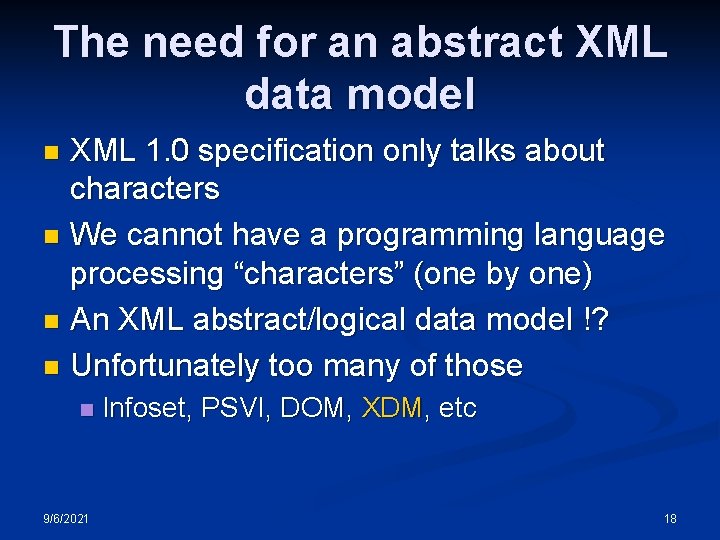
The need for an abstract XML data model XML 1. 0 specification only talks about characters n We cannot have a programming language processing “characters” (one by one) n An XML abstract/logical data model !? n Unfortunately too many of those n n 9/6/2021 Infoset, PSVI, DOM, XDM, etc 18
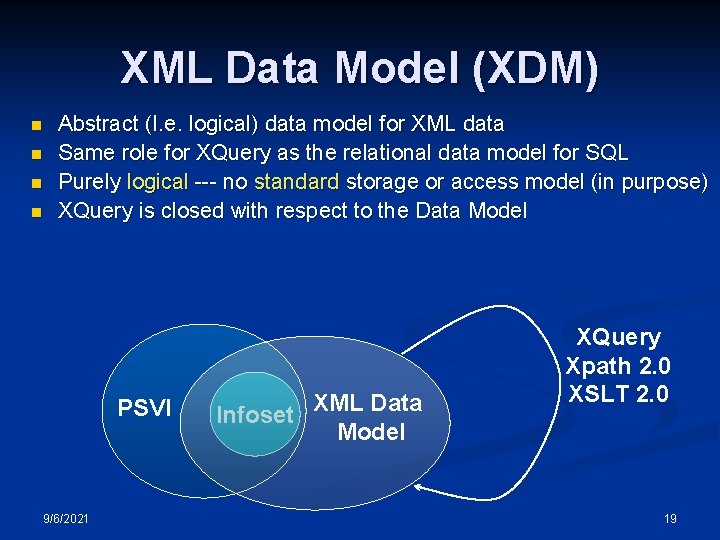
XML Data Model (XDM) n n Abstract (I. e. logical) data model for XML data Same role for XQuery as the relational data model for SQL Purely logical --- no standard storage or access model (in purpose) XQuery is closed with respect to the Data Model PSVI 9/6/2021 Infoset XML Data Model XQuery Xpath 2. 0 XSLT 2. 0 19
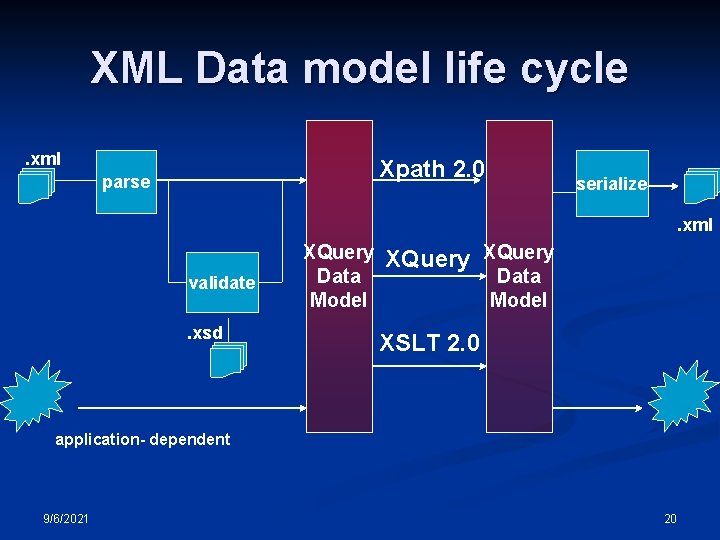
XML Data model life cycle. xml Xpath 2. 0 parse serialize. xml validate. xsd XQuery Data Model XSLT 2. 0 application- dependent 9/6/2021 20
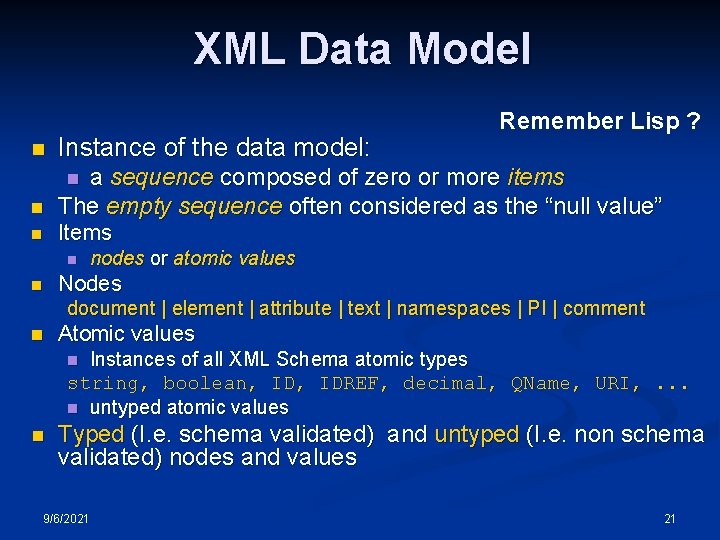
XML Data Model Remember Lisp ? n Instance of the data model: n a sequence composed of zero or more items The empty sequence often considered as the “null value” n Items n nodes or atomic values Nodes document | element | attribute | text | namespaces | PI | comment n Atomic values Instances of all XML Schema atomic types string, boolean, IDREF, decimal, QName, URI, . . . n untyped atomic values n n Typed (I. e. schema validated) and untyped (I. e. non schema validated) nodes and values 9/6/2021 21
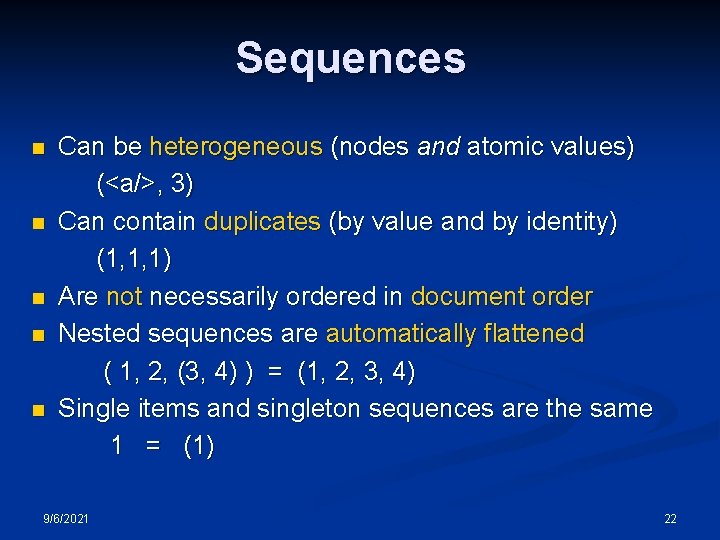
Sequences n n n Can be heterogeneous (nodes and atomic values) (<a/>, 3) Can contain duplicates (by value and by identity) (1, 1, 1) Are not necessarily ordered in document order Nested sequences are automatically flattened ( 1, 2, (3, 4) ) = (1, 2, 3, 4) Single items and singleton sequences are the same 1 = (1) 9/6/2021 22
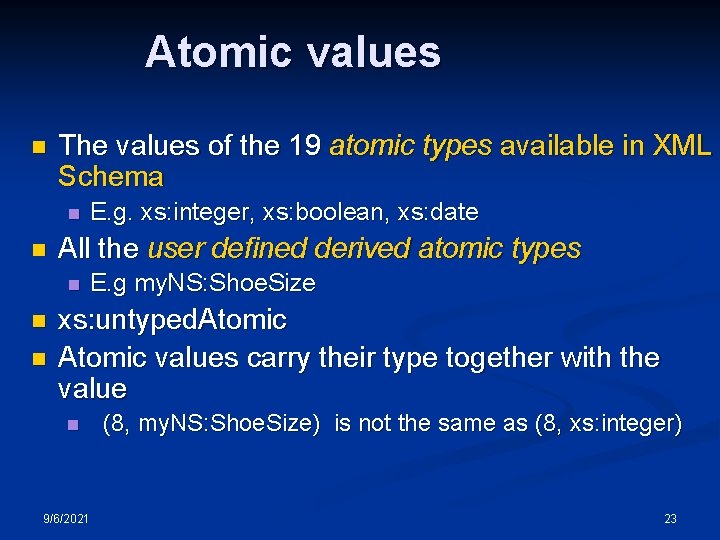
Atomic values n The values of the 19 atomic types available in XML Schema n n All the user defined derived atomic types n n n E. g. xs: integer, xs: boolean, xs: date E. g my. NS: Shoe. Size xs: untyped. Atomic values carry their type together with the value n 9/6/2021 (8, my. NS: Shoe. Size) is not the same as (8, xs: integer) 23
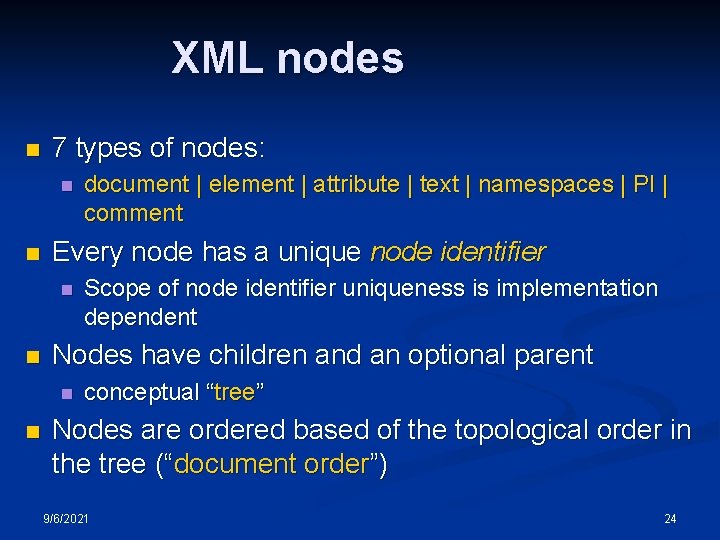
XML nodes n 7 types of nodes: n n Every node has a unique node identifier n n Scope of node identifier uniqueness is implementation dependent Nodes have children and an optional parent n n document | element | attribute | text | namespaces | PI | comment conceptual “tree” Nodes are ordered based of the topological order in the tree (“document order”) 9/6/2021 24
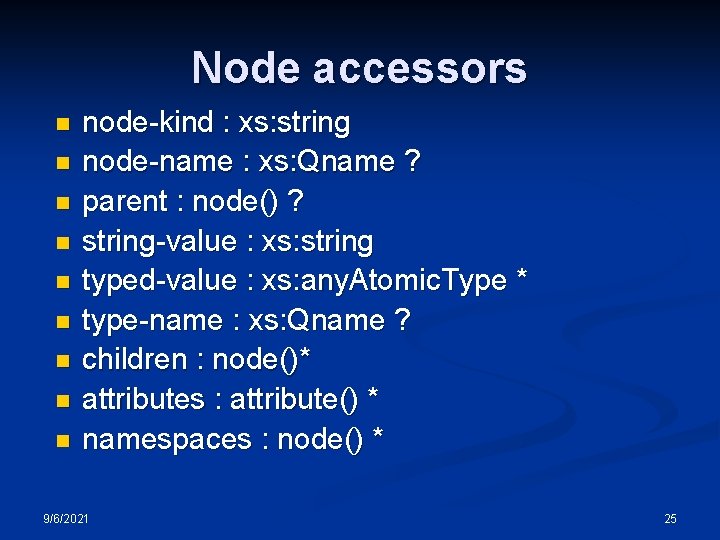
Node accessors n n n n node-kind : xs: string node-name : xs: Qname ? parent : node() ? string-value : xs: string typed-value : xs: any. Atomic. Type * type-name : xs: Qname ? children : node()* attributes : attribute() * namespaces : node() * 9/6/2021 25
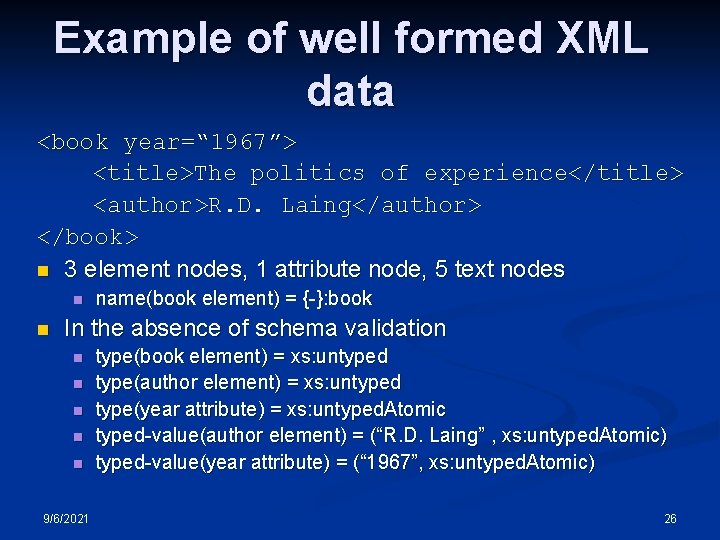
Example of well formed XML data <book year=“ 1967”> <title>The politics of experience</title> <author>R. D. Laing</author> </book> n 3 element nodes, 1 attribute node, 5 text nodes n n name(book element) = {-}: book In the absence of schema validation n n 9/6/2021 type(book element) = xs: untyped type(author element) = xs: untyped type(year attribute) = xs: untyped. Atomic typed-value(author element) = (“R. D. Laing” , xs: untyped. Atomic) typed-value(year attribute) = (“ 1967”, xs: untyped. Atomic) 26
XML schema example <type name=“book-type”> <sequence> <attribute name=“year” type=“xs: integer”> <element name=“title” type=“xs: string”> <sequence minoccurs=“ 0”> <element name=“author” type=“xs: string> </sequence> </type> <element name=“book” type=“book-type”> 9/6/2021 27
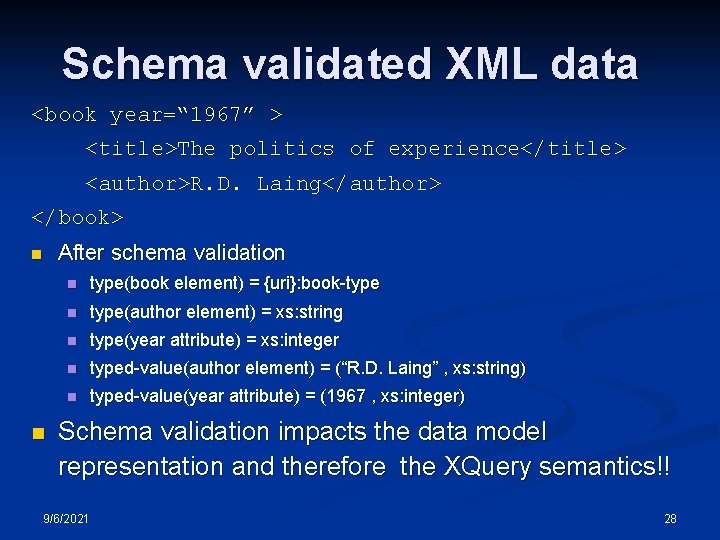
Schema validated XML data <book year=“ 1967” > <title>The politics of experience</title> <author>R. D. Laing</author> </book> n n After schema validation n type(book element) = {uri}: book-type n type(author element) = xs: string n type(year attribute) = xs: integer n typed-value(author element) = (“R. D. Laing” , xs: string) n typed-value(year attribute) = (1967 , xs: integer) Schema validation impacts the data model representation and therefore the XQuery semantics!! 9/6/2021 28
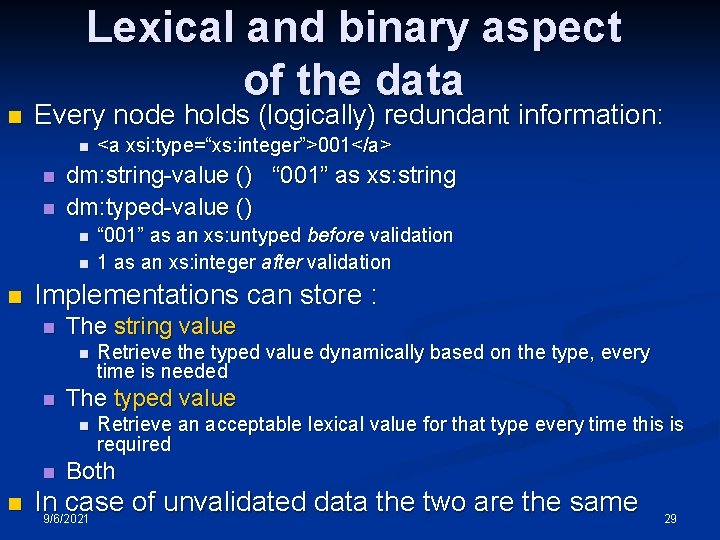
Lexical and binary aspect of the data n Every node holds (logically) redundant information: n n n dm: string-value () “ 001” as xs: string dm: typed-value () n n n “ 001” as an xs: untyped before validation 1 as an xs: integer after validation Implementations can store : n The string value n n n Retrieve the typed value dynamically based on the type, every time is needed The typed value n n <a xsi: type=“xs: integer”>001</a> Retrieve an acceptable lexical value for that type every time this is required Both In case of unvalidated data the two are the same 9/6/2021 29
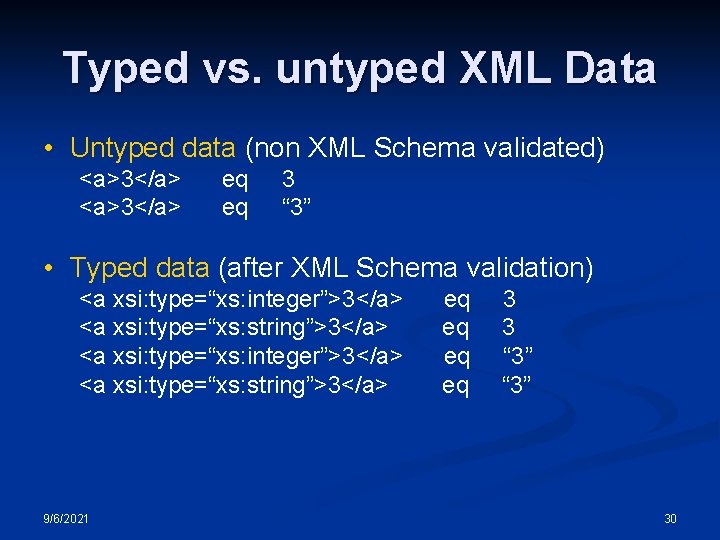
Typed vs. untyped XML Data • Untyped data (non XML Schema validated) <a>3</a> eq eq 3 “ 3” • Typed data (after XML Schema validation) <a xsi: type=“xs: integer”>3</a> <a xsi: type=“xs: string”>3</a> 9/6/2021 eq eq 3 3 “ 3” 30
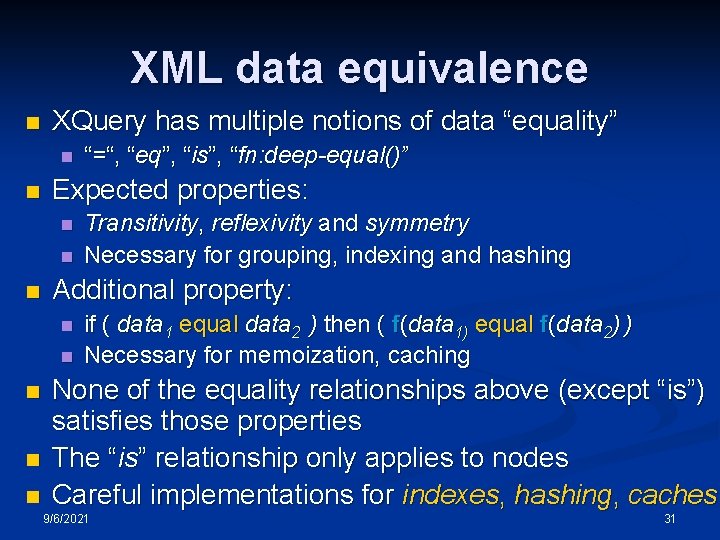
XML data equivalence n XQuery has multiple notions of data “equality” n n Expected properties: n n n Transitivity, reflexivity and symmetry Necessary for grouping, indexing and hashing Additional property: n n “=“, “eq”, “is”, “fn: deep-equal()” if ( data 1 equal data 2 ) then ( f(data 1) equal f(data 2) ) Necessary for memoization, caching None of the equality relationships above (except “is”) satisfies those properties The “is” relationship only applies to nodes Careful implementations for indexes, hashing, caches 9/6/2021 31
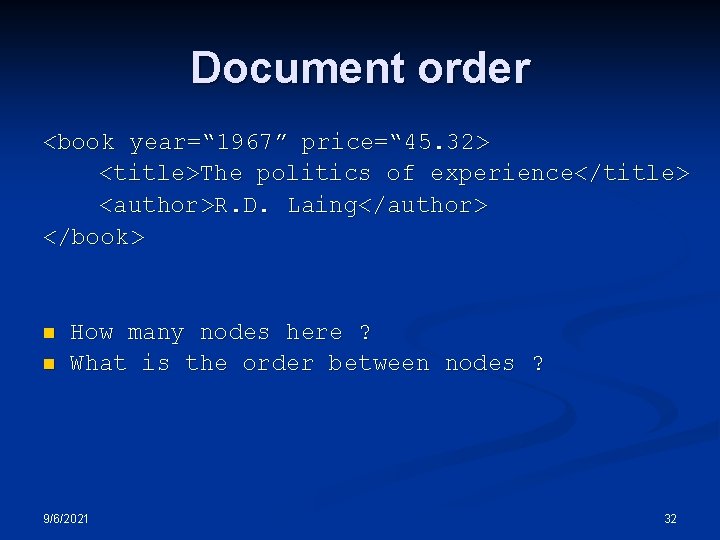
Document order <book year=“ 1967” price=“ 45. 32> <title>The politics of experience</title> <author>R. D. Laing</author> </book> n n How many nodes here ? What is the order between nodes ? 9/6/2021 32
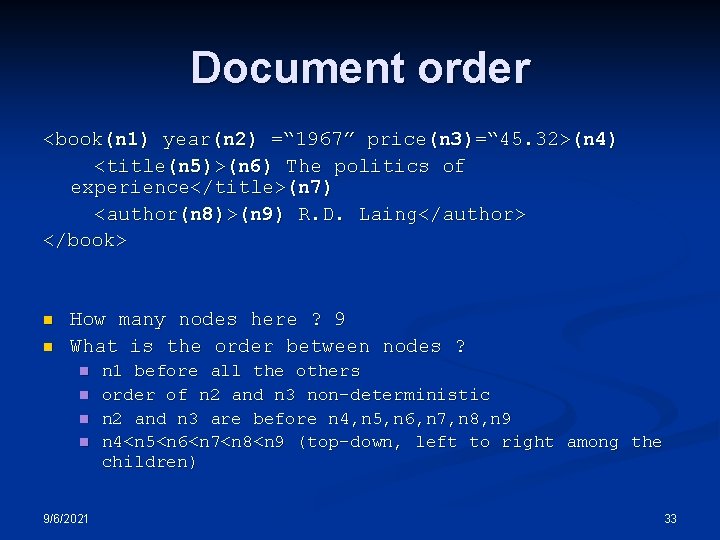
Document order <book(n 1) year(n 2) =“ 1967” price(n 3)=“ 45. 32>(n 4) <title(n 5)>(n 6) The politics of experience</title>(n 7) <author(n 8)>(n 9) R. D. Laing</author> </book> n n How many nodes here ? 9 What is the order between nodes ? n n 9/6/2021 n 1 before all the others order of n 2 and n 3 non-deterministic n 2 and n 3 are before n 4, n 5, n 6, n 7, n 8, n 9 n 4<n 5<n 6<n 7<n 8<n 9 (top-down, left to right among the children) 33
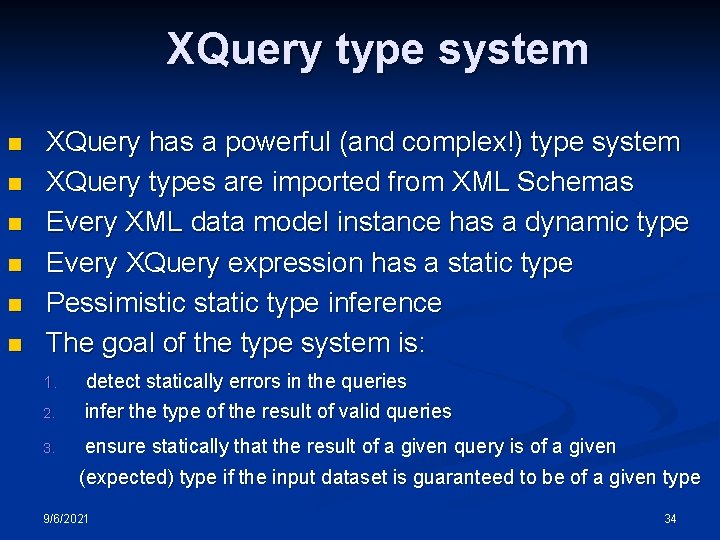
XQuery type system n n n XQuery has a powerful (and complex!) type system XQuery types are imported from XML Schemas Every XML data model instance has a dynamic type Every XQuery expression has a static type Pessimistic static type inference The goal of the type system is: 2. detect statically errors in the queries infer the type of the result of valid queries 3. ensure statically that the result of a given query is of a given 1. (expected) type if the input dataset is guaranteed to be of a given type 9/6/2021 34
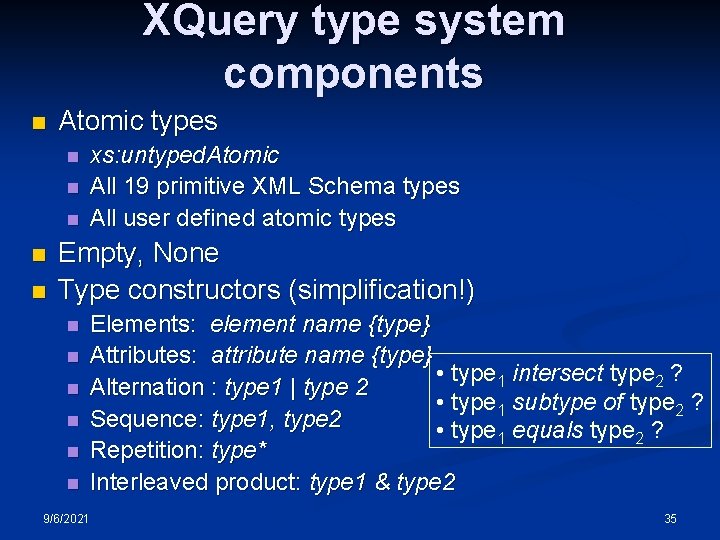
XQuery type system components n Atomic types n n n xs: untyped. Atomic All 19 primitive XML Schema types All user defined atomic types Empty, None Type constructors (simplification!) n n n Elements: element name {type} Attributes: attribute name {type} • type 1 intersect type 2 ? Alternation : type 1 | type 2 • type 1 subtype of type 2 ? Sequence: type 1, type 2 • type 1 equals type 2 ? Repetition: type* Interleaved product: type 1 & type 2 9/6/2021 35
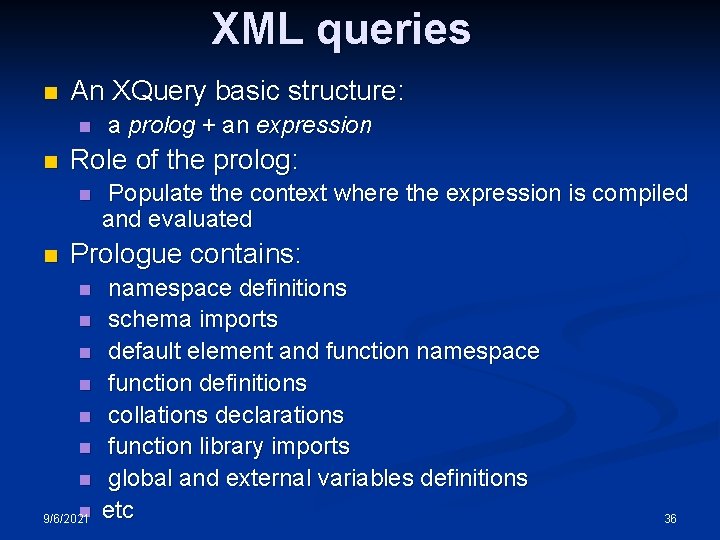
XML queries n An XQuery basic structure: n n Role of the prolog: n n a prolog + an expression Populate the context where the expression is compiled and evaluated Prologue contains: n n n n 9/6/2021 namespace definitions schema imports default element and function namespace function definitions collations declarations function library imports global and external variables definitions etc 36
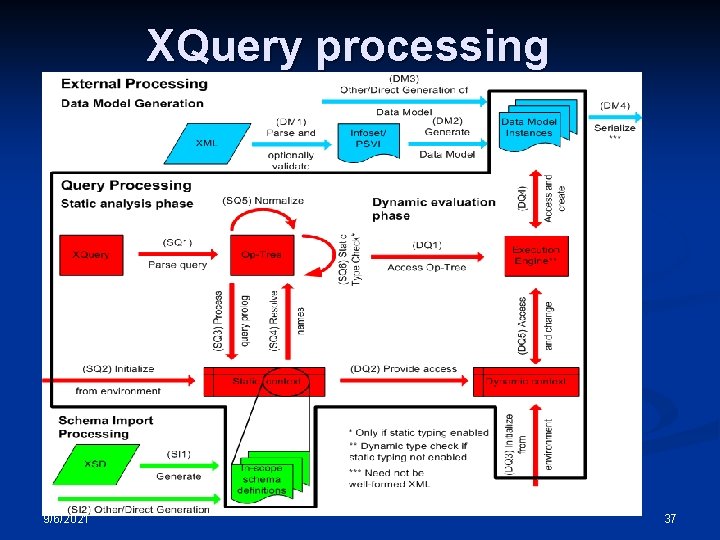
XQuery processing 9/6/2021 37
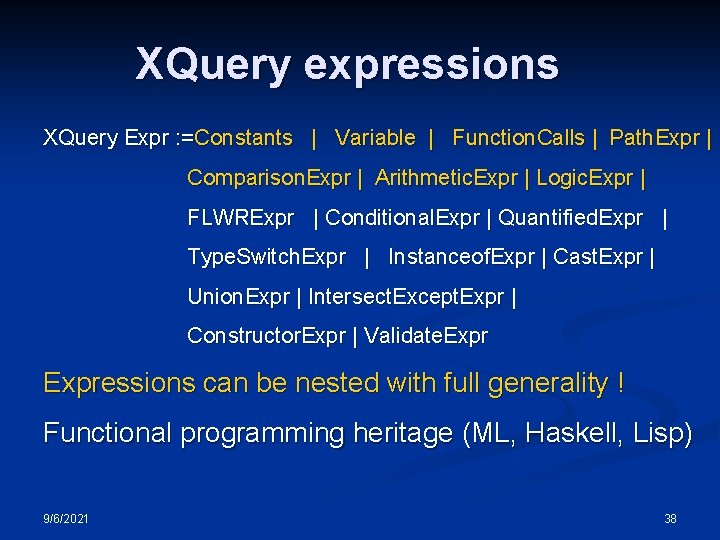
XQuery expressions XQuery Expr : =Constants | Variable | Function. Calls | Path. Expr | Comparison. Expr | Arithmetic. Expr | Logic. Expr | FLWRExpr | Conditional. Expr | Quantified. Expr | Type. Switch. Expr | Instanceof. Expr | Cast. Expr | Union. Expr | Intersect. Except. Expr | Constructor. Expr | Validate. Expressions can be nested with full generality ! Functional programming heritage (ML, Haskell, Lisp) 9/6/2021 38
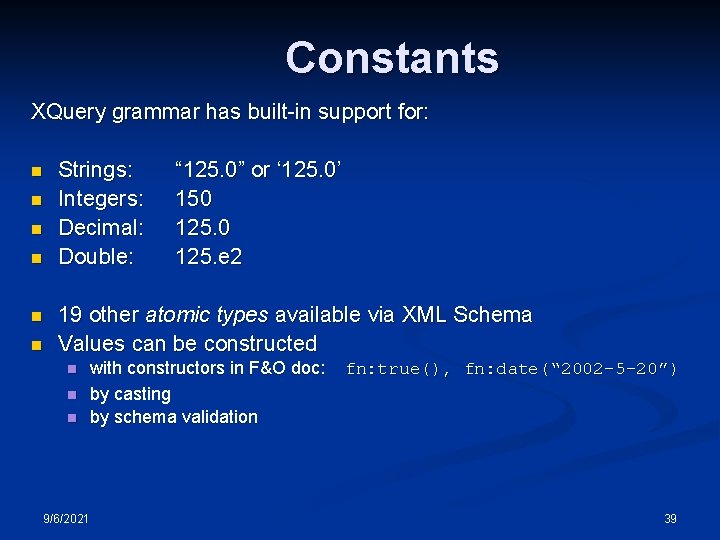
Constants XQuery grammar has built-in support for: n n n Strings: Integers: Decimal: Double: “ 125. 0” or ‘ 125. 0’ 150 125. e 2 19 other atomic types available via XML Schema Values can be constructed n n n with constructors in F&O doc: by casting by schema validation 9/6/2021 fn: true(), fn: date(“ 2002 -5 -20”) 39
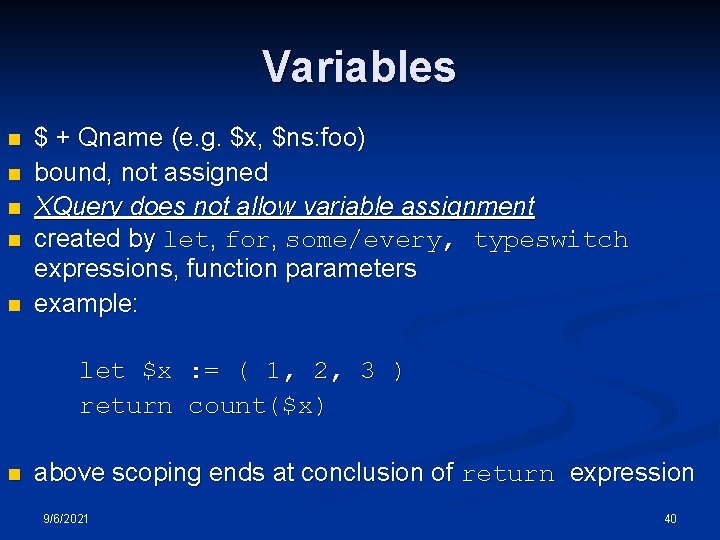
Variables n n n $ + Qname (e. g. $x, $ns: foo) bound, not assigned XQuery does not allow variable assignment created by let, for, some/every, typeswitch expressions, function parameters example: let $x : = ( 1, 2, 3 ) return count($x) n above scoping ends at conclusion of return expression 9/6/2021 40
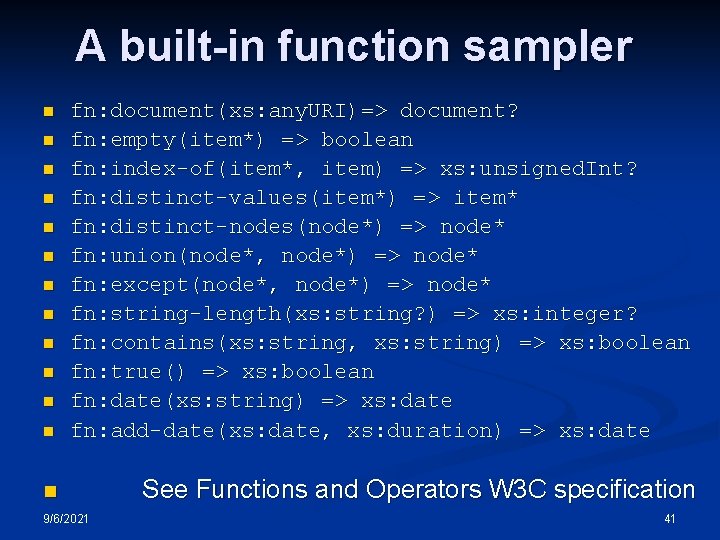
A built-in function sampler n n n fn: document(xs: any. URI)=> document? fn: empty(item*) => boolean fn: index-of(item*, item) => xs: unsigned. Int? fn: distinct-values(item*) => item* fn: distinct-nodes(node*) => node* fn: union(node*, node*) => node* fn: except(node*, node*) => node* fn: string-length(xs: string? ) => xs: integer? fn: contains(xs: string, xs: string) => xs: boolean fn: true() => xs: boolean fn: date(xs: string) => xs: date fn: add-date(xs: date, xs: duration) => xs: date n 9/6/2021 See Functions and Operators W 3 C specification 41
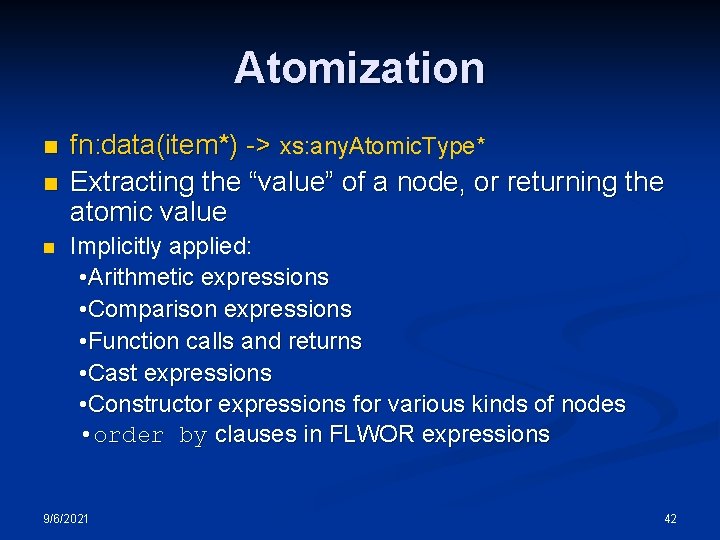
Atomization n fn: data(item*) -> xs: any. Atomic. Type* Extracting the “value” of a node, or returning the atomic value Implicitly applied: • Arithmetic expressions • Comparison expressions • Function calls and returns • Cast expressions • Constructor expressions for various kinds of nodes • order by clauses in FLWOR expressions 9/6/2021 42
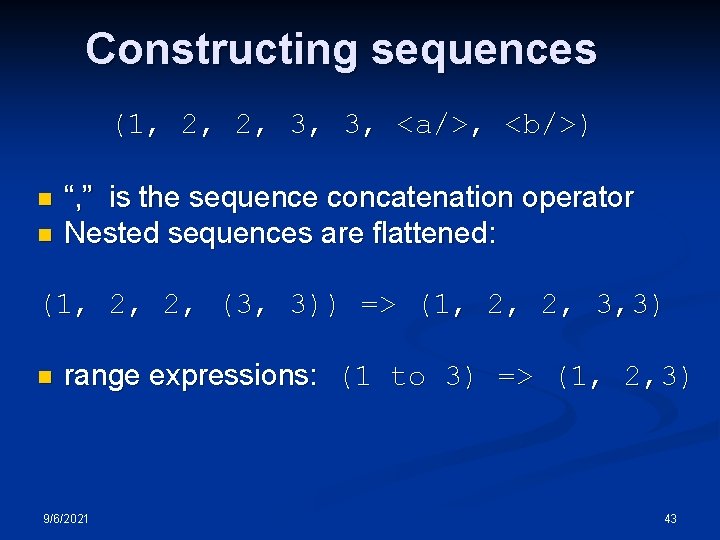
Constructing sequences (1, 2, 2, 3, 3, <a/>, <b/>) n n “, ” is the sequence concatenation operator Nested sequences are flattened: (1, 2, 2, (3, 3)) => (1, 2, 2, 3, 3) n range expressions: (1 to 3) => (1, 2, 3) 9/6/2021 43
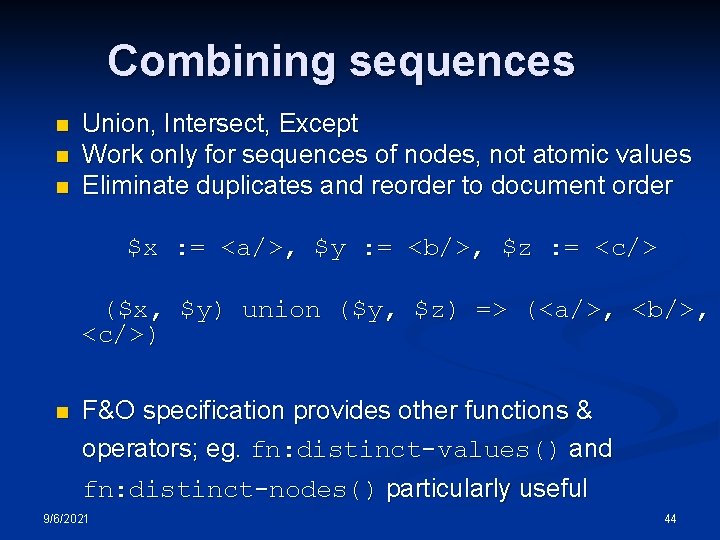
Combining sequences n n n Union, Intersect, Except Work only for sequences of nodes, not atomic values Eliminate duplicates and reorder to document order $x : = <a/>, $y : = <b/>, $z : = <c/> ($x, $y) union ($y, $z) => (<a/>, <b/>, <c/>) n F&O specification provides other functions & operators; eg. fn: distinct-values() and fn: distinct-nodes() particularly useful 9/6/2021 44
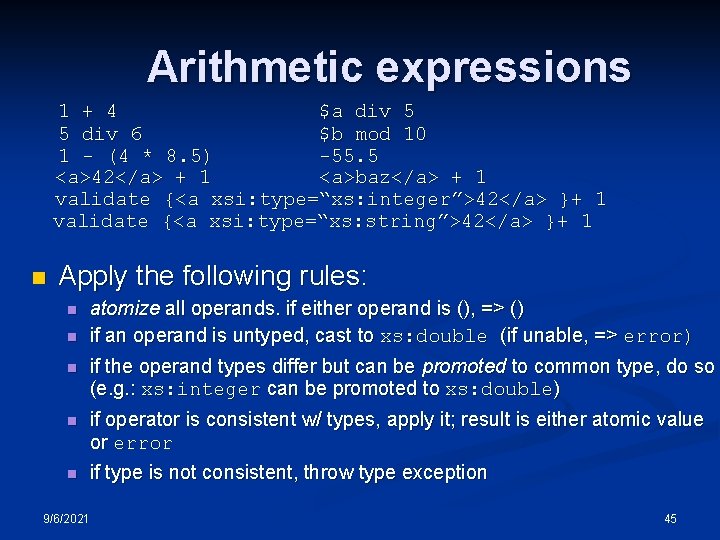
Arithmetic expressions 1 + 4 $a div 5 5 div 6 $b mod 10 1 - (4 * 8. 5) -55. 5 <a>42</a> + 1 <a>baz</a> + 1 validate {<a xsi: type=“xs: integer”>42</a> }+ 1 validate {<a xsi: type=“xs: string”>42</a> }+ 1 n Apply the following rules: n n n atomize all operands. if either operand is (), => () if an operand is untyped, cast to xs: double (if unable, => error) if the operand types differ but can be promoted to common type, do so (e. g. : xs: integer can be promoted to xs: double) if operator is consistent w/ types, apply it; result is either atomic value or error if type is not consistent, throw type exception 9/6/2021 45
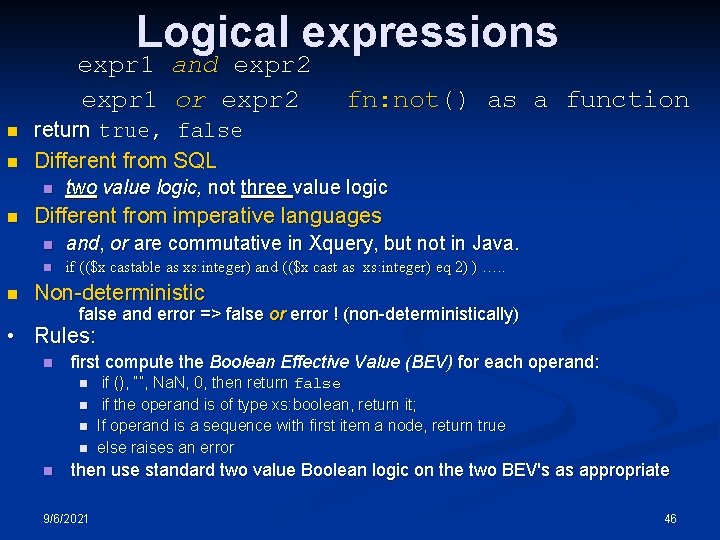
Logical expressions expr 1 and expr 2 expr 1 or expr 2 n n return true, false Different from SQL n n n fn: not() as a function two value logic, not three value logic Different from imperative languages n and, or are commutative in Xquery, but not in Java. n if (($x castable as xs: integer) and (($x cast as xs: integer) eq 2) ) …. . Non-deterministic false and error => false or error ! (non-deterministically) • Rules: n first compute the Boolean Effective Value (BEV) for each operand: n n n if (), “”, Na. N, 0, then return false if the operand is of type xs: boolean, return it; If operand is a sequence with first item a node, return true else raises an error then use standard two value Boolean logic on the two BEV's as appropriate 9/6/2021 46
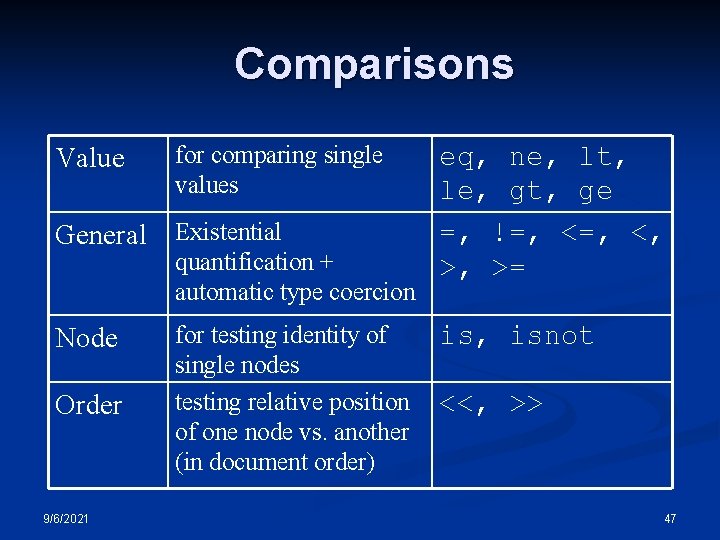
Comparisons Value for comparing single values General Existential quantification + automatic type coercion Node Order 9/6/2021 for testing identity of single nodes testing relative position of one node vs. another (in document order) eq, ne, lt, le, gt, ge =, !=, <, >, >= is, isnot <<, >> 47
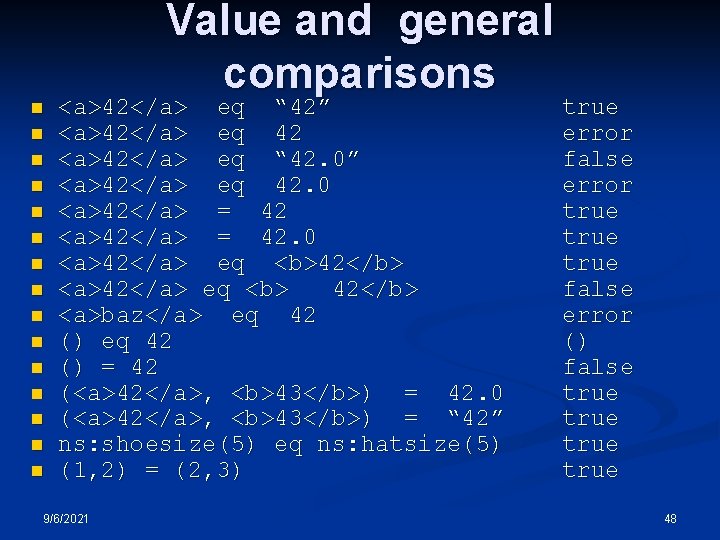
Value and general comparisons n n n n <a>42</a> eq “ 42” <a>42</a> eq 42 <a>42</a> eq “ 42. 0” <a>42</a> eq 42. 0 <a>42</a> = 42. 0 <a>42</a> eq <b>42</b> <a>42</a> eq <b> 42</b> <a>baz</a> eq 42 () = 42 (<a>42</a>, <b>43</b>) = 42. 0 (<a>42</a>, <b>43</b>) = “ 42” ns: shoesize(5) eq ns: hatsize(5) (1, 2) = (2, 3) 9/6/2021 true error false error true false error () false true 48
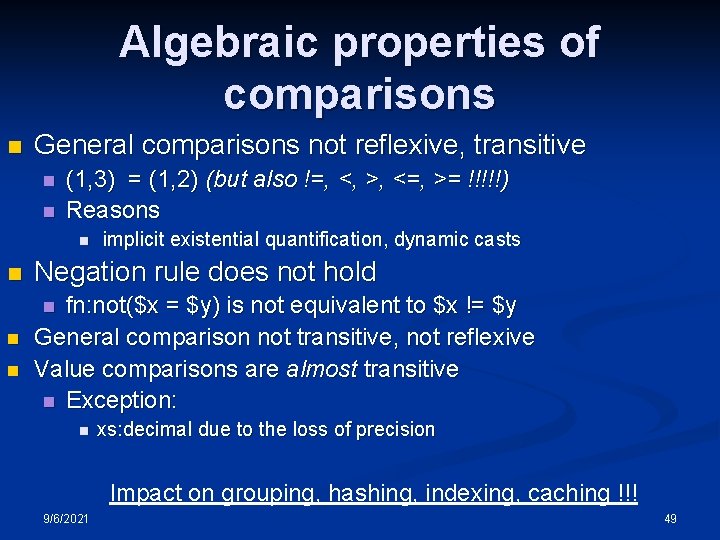
Algebraic properties of comparisons n General comparisons not reflexive, transitive n n (1, 3) = (1, 2) (but also !=, <, >, <=, >= !!!!!) Reasons n n implicit existential quantification, dynamic casts Negation rule does not hold fn: not($x = $y) is not equivalent to $x != $y General comparison not transitive, not reflexive Value comparisons are almost transitive n Exception: n n xs: decimal due to the loss of precision Impact on grouping, hashing, indexing, caching !!! 9/6/2021 49
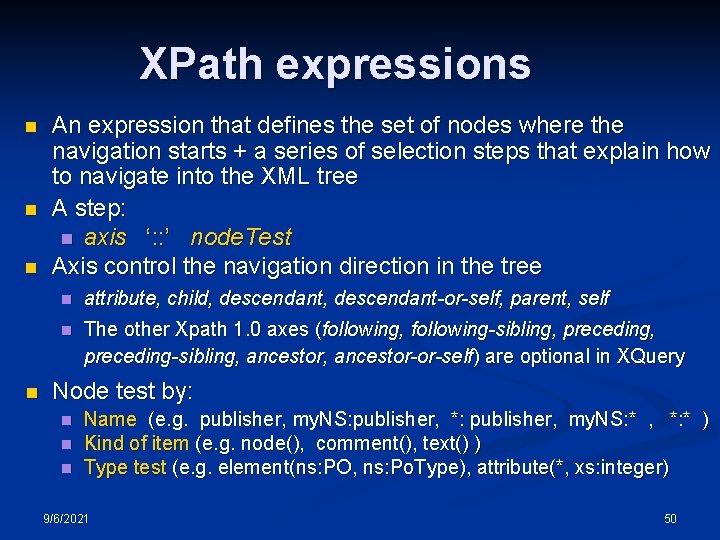
XPath expressions n n An expression that defines the set of nodes where the navigation starts + a series of selection steps that explain how to navigate into the XML tree A step: n axis ‘: : ’ node. Test Axis control the navigation direction in the tree n attribute, child, descendant-or-self, parent, self n The other Xpath 1. 0 axes (following, following-sibling, preceding-sibling, ancestor-or-self) are optional in XQuery Node test by: n n n Name (e. g. publisher, my. NS: publisher, *: publisher, my. NS: * , *: * ) Kind of item (e. g. node(), comment(), text() ) Type test (e. g. element(ns: PO, ns: Po. Type), attribute(*, xs: integer) 9/6/2021 50
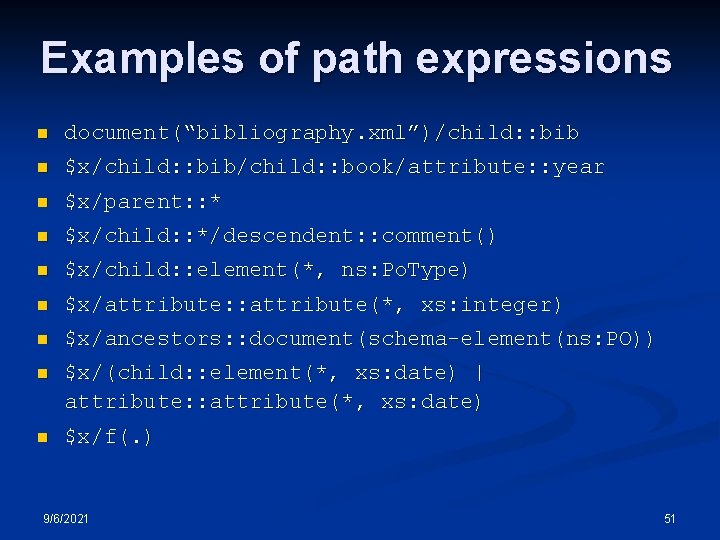
Examples of path expressions n document(“bibliography. xml”)/child: : bib n $x/child: : bib/child: : book/attribute: : year n $x/parent: : * n $x/child: : */descendent: : comment() n $x/child: : element(*, ns: Po. Type) n $x/attribute: : attribute(*, xs: integer) n $x/ancestors: : document(schema-element(ns: PO)) n $x/(child: : element(*, xs: date) | attribute: : attribute(*, xs: date) n $x/f(. ) 9/6/2021 51
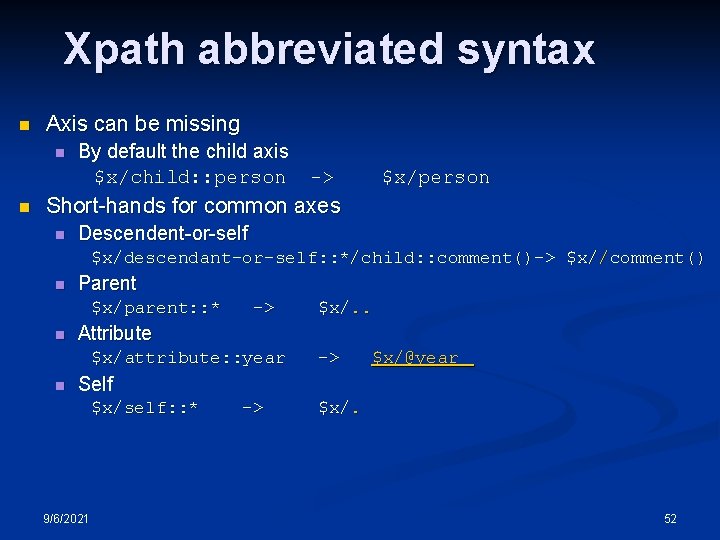
Xpath abbreviated syntax n Axis can be missing n n By default the child axis $x/child: : person -> $x/person Short-hands for common axes n Descendent-or-self $x/descendant-or-self: : */child: : comment()-> $x//comment() n Parent $x/parent: : * n -> Attribute $x/attribute: : year n $x/. . -> $x/@year Self $x/self: : * 9/6/2021 -> $x/. 52
Xpath filter predicates n Syntax: expression 1 [ expression 2 ] n n [ ] is an overloaded operator Filtering by position (if numeric value) : /book[3]/author[1] /book[3]/author[1 to 2] n Filtering by predicate : n n //book [author/firstname = “ronald”] [@price <25] [count(author [@gender=“female”] )>0 Classical Xpath mistake n 9/6/2021 $x/a/b[1] means $x/a/(b[1]) and not ($x/a/b)[1] 53
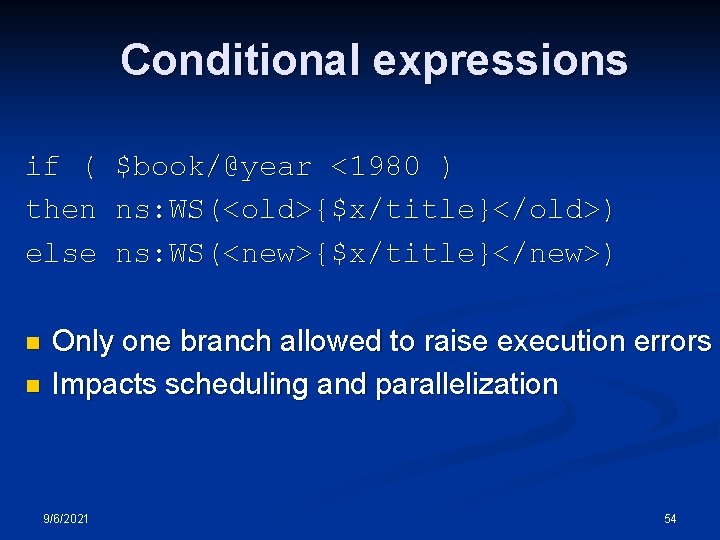
Conditional expressions if ( then else n n $book/@year <1980 ) ns: WS(<old>{$x/title}</old>) ns: WS(<new>{$x/title}</new>) Only one branch allowed to raise execution errors Impacts scheduling and parallelization 9/6/2021 54