
Module 5 Fire Fighting Foam Principles and EthanolBlended
Module 5: Fire Fighting Foam Principles and Ethanol-Blended Fuel
Objective Upon the successful completion of this module, participants will be able to develop foam use strategies for controlling / fighting fires associated with ethanol-blended fuels. 2
Introduction § Production of ethanol large & likely to continue to increase § Predominate danger from tanker trucks & rail cars carrying large amounts of ethanol, manufacturing facilities, & storage facilities § Responders need to be prepared for large-scale emergencies & prepared with most effective techniques & extinguishing media 3
Basic Foam Principles § What is foam? – “…an aggregate of air-filled bubbles formed from aqueous solutions which is lower in density than flammable liquids. It is used principally to form a cohesive floating blanket on flammable and combustible liquids, and prevents or extinguishes fire by excluding air and cooling the fuel. It also prevents reignition by suppressing formation of flammable vapors. It has the property of adhering to surfaces, which provides a degree of exposure protection from adjacent fires” (NFPA 11). 4
Basic Foam Principles § Why use foam? – Only agent capable of suppressing vapors & providing visible proof of security – Foam blanket on unignited spill can prevent fire – Suppression of vapors prevents them from finding ignition source 5
Basic Foam Principles § Why use foam? – Can provide post-fire security by protecting hazard until it can be secured / removed – Can provide protection from flammable liquids for fire & rescue personnel during emergency operations 6
Basic Foam Principles § How foam works: – Foam can: § Exclude oxygen from fuel vapors § Cool fuel surface with water content of foam § Prevent release of flammable vapors from fuel surface § Emulsify fuel 7
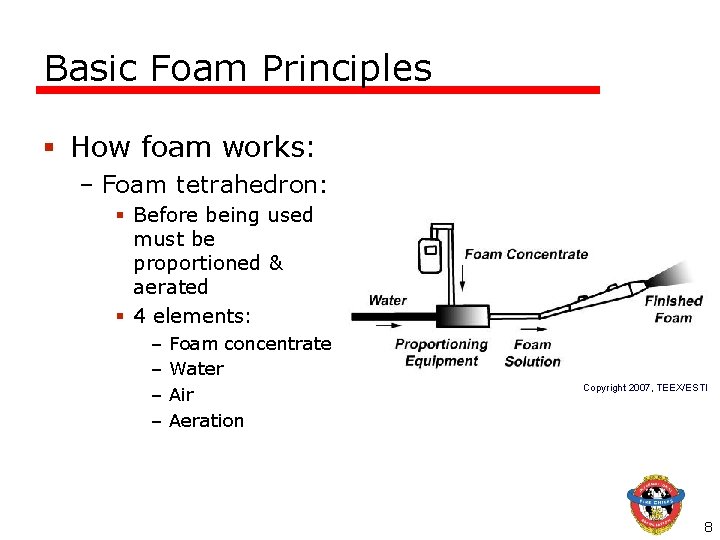
Basic Foam Principles § How foam works: – Foam tetrahedron: § Before being used must be proportioned & aerated § 4 elements: – – Foam concentrate Water Air Aeration Copyright 2007, TEEX/ESTI 8
Basic Foam Principles § What is foam not effective on? – Foam is not effective on Class C electrical fires: § Foam contains 94– 97% water & water conducts electricity § Class C fires can be extinguished using nonconductive extinguishing agents 9
Basic Foam Principles § What is foam not effective on? – Foam is not effective on 3 -dimensional fires: § Recommended to first control spill fire § Extinguish flowing fire using dry chemical agent 10
Basic Foam Principles § What is foam not effective on? – Foam is not effective on pressurized gases: § Vapor pressure too high for foam to be effective § Examples: – Propane – Butane – Vinyl chloride – Butadiene 11

Basic Foam Principles § What is foam not effective on? – Foam is not effective on combustible metals: § Combustible metals usually react with water § Fires involving combustible metals require specialized techniques & extinguishing agents 12
Basic Foam Principles § What is foam effective on? – Effective at suppressing vapors & extinguishing Class B fires – 2 categories of Class B products: § Hydrocarbons § Polar solvents – Hydrocarbons – Polar solvents 13
Basic Foam Principles § Foam terminology: – Foam concentrate – Foam solution – Finished foam 14
Basic Foam Principles § Types of foam: – Protein foam – Fluoroprotein foams – AFFF – FFFP – AR foam 15
Basic Foam Principles § Foam characteristics: – Knockdown – Heat resistance – Fuel tolerance – Vapor suppression – Alcohol tolerance 16
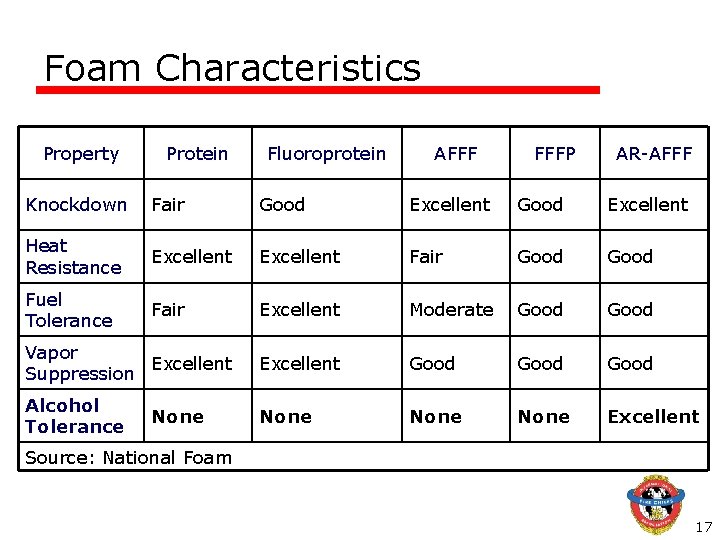
Foam Characteristics Property Protein Fluoroprotein AFFF FFFP AR-AFFF Knockdown Fair Good Excellent Heat Resistance Excellent Fair Good Fuel Tolerance Fair Excellent Moderate Good Vapor Excellent Suppression Excellent Good Alcohol Tolerance None Excellent None Source: National Foam 17
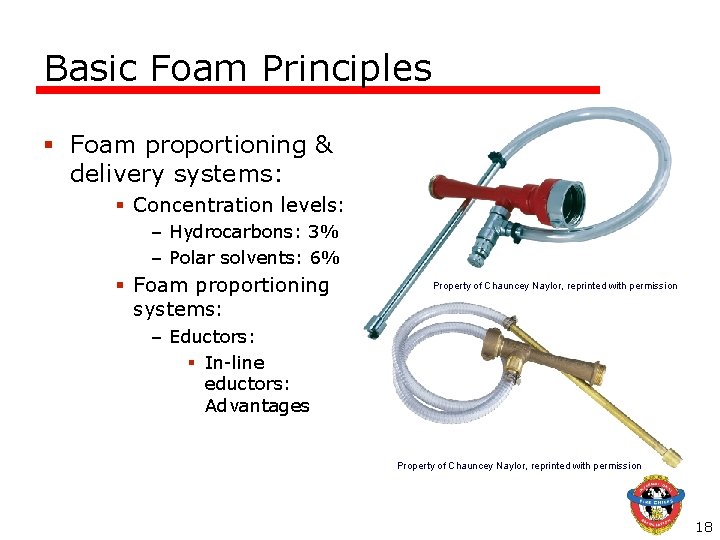
Basic Foam Principles § Foam proportioning & delivery systems: § Concentration levels: – Hydrocarbons: 3% – Polar solvents: 6% § Foam proportioning systems: Property of Chauncey Naylor, reprinted with permission – Eductors: § In-line eductors: Advantages Property of Chauncey Naylor, reprinted with permission 18
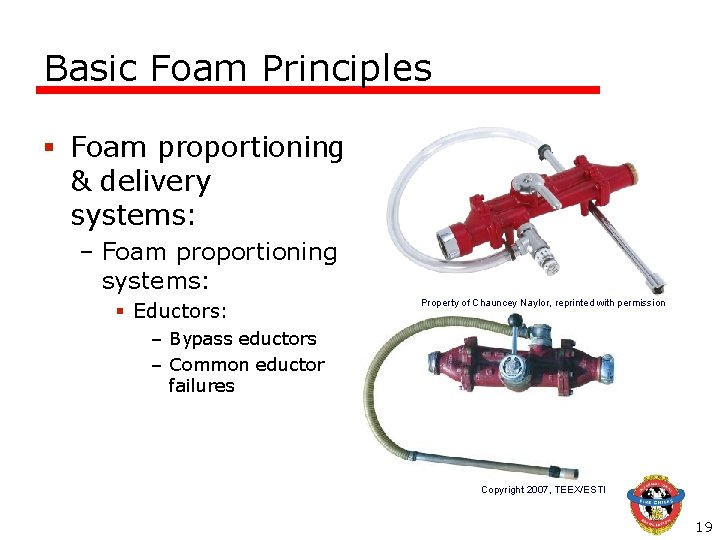
Basic Foam Principles § Foam proportioning & delivery systems: – Foam proportioning systems: § Eductors: Property of Chauncey Naylor, reprinted with permission – Bypass eductors – Common eductor failures Copyright 2007, TEEX/ESTI 19
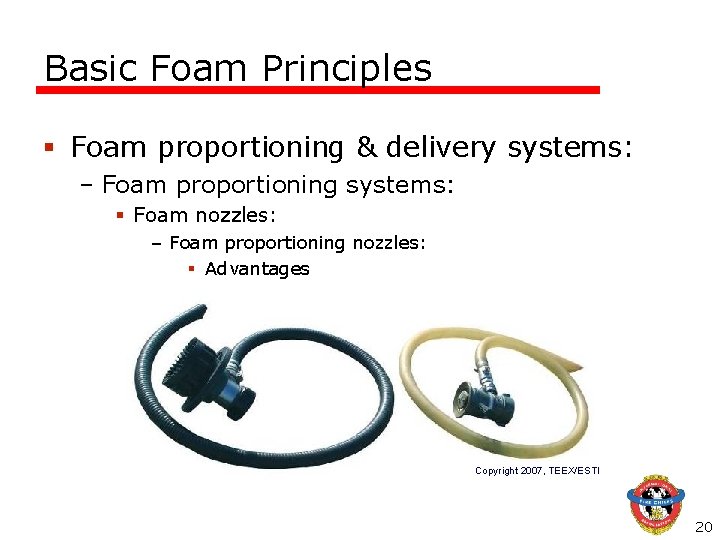
Basic Foam Principles § Foam proportioning & delivery systems: – Foam proportioning systems: § Foam nozzles: – Foam proportioning nozzles: § Advantages Copyright 2007, TEEX/ESTI 20
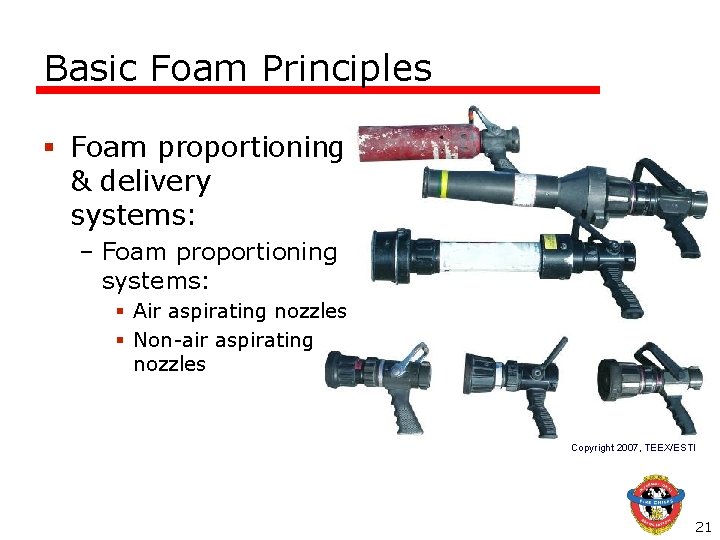
Basic Foam Principles § Foam proportioning & delivery systems: – Foam proportioning systems: § Air aspirating nozzles § Non-air aspirating nozzles Copyright 2007, TEEX/ESTI 21
Basic Foam Principles § Application techniques: – Never plunge foam directly into the fuel – Bounce-off: § Effective if there is an object in / behind spill area – Bank-in: § Particularly effective with non-air aspirating fog nozzles 22
Basic Foam Principles § Application techniques: – Rain-down: § Nozzle elevated & foam allowed to fall over spill as gently as possible 23
Foam and Ethanol-Fuel Blends § Foams not developed for application on alcohol- / ethanol-blended fuels: – Ineffective on fuels containing alcohols / ethanol: § Alcohol / Ethanol attacks & absorbs foam solution 24
Foam and Ethanol-Fuel Blends § AR foams: – Forms tough membrane between foam blanket & alcohol-type fuel – Crucial to use in combating ethanol-blended fuel fires – Apply gently to surface of alcohol- / ethanol-blended fuels 25
Foam and Ethanol-Fuel Blends § AR foams: – Use Type II application techniques: § Apply indirectly to fire – Type III application: § Effective only when deflected off surfaces § Best option may be to protect surrounding exposures 26
Foam and Ethanol-Fuel Blends § Require higher flow rate of foam to extinguish fires: – AFFF-type: 1 gpm foam / 10 ft 2 burning surface on hydrocarbon-type fuel – Ethanol-blended fuels: 2 gpm foam / 10 ft 2 of AR type foam 27
Foam Recommendations for Fire Departments § Consider converting to AR foam concentrates § Develop means of having cache of AR foam readily available 28

Foam Recommendations for Fire Departments § AR foams effective on both alcohol & hydrocarbon fires: – Some have quicker knockdown abilities & longer foam retention times than protein-based hydrocarbon foams – Thermal imaging camera recommended 29

Foam Recommendations for Fire Departments Copyright ERG 30
Foam Recommendations for Fire Departments § AR foams effective on both alcohol & hydrocarbon fires: – Uncertain if fire is alcohol- / ethanol-blended: § Consider doubling application rate – Foam of choice 31
Summary § AR foam best choice for incidents § AR foam recommended choice for all fuel fires involving gasoline- / ethanol-blended fuels § AR foam performs on hydrocarbon fires as well: – Preferred choice from response standpoint if nature of burning fuel is unclear 32
- Slides: 32