
Module 5 Establishing a Universal Screening Process RTI

Module 5 Establishing a Universal Screening Process
RTI Professional Development Series Overview ▪ Response to Intervention (RTI) Overview ▪ Leadership in RTI ▪ Universal Screening ▪ Tier 1: Core Instruction ▪ Data-Based Decision Making and Progress Monitoring ▪ Tier 2: Supplemental Intervention ▪ Tier 3: Intensive Intervention 2
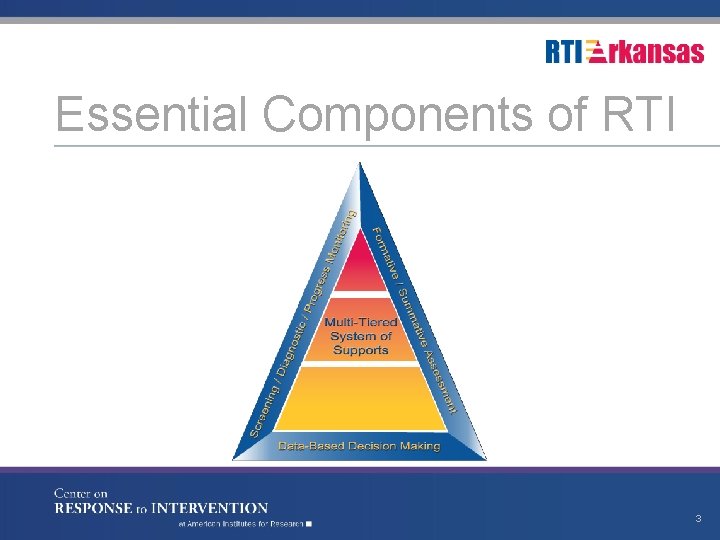
Essential Components of RTI 3
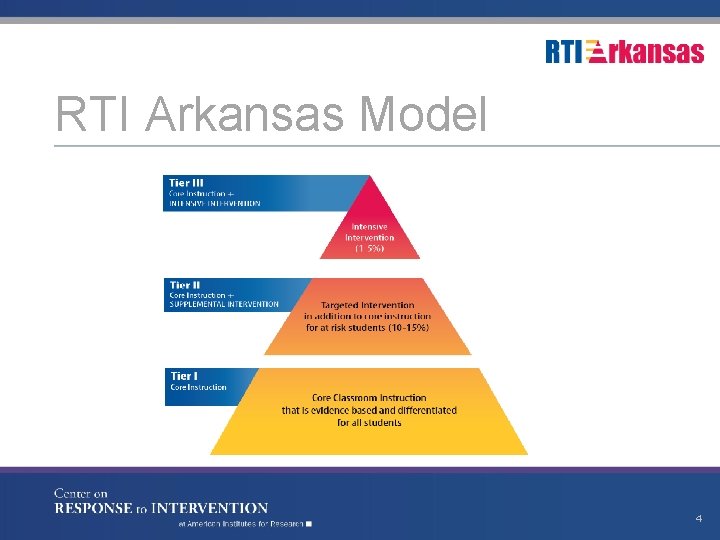
RTI Arkansas Model 4
Universal Screening Modules ▪ Module 3: Universal Screening Overview • • What is universal screening? Why universal screening? ▪ Module 4: Selecting Universal Screeners • • What should be considered in selecting universal screening tools? How do teams select valid and reliable tools? ▪ Module 5: Establishing a Universal Screening Process • • How is universal screening implemented? How is universal screening data used for decision making? 5
Module 5 Objectives Participants will be able to: ▪ Develop an implementation plan for the universal screening process. ▪ Explain how universal screening can be used for decision making at different tiers of instruction. 6
How is Universal Screening Implemented? 7

Top 3 Reasons for Implementing Universal Screening Workbook Activity 8
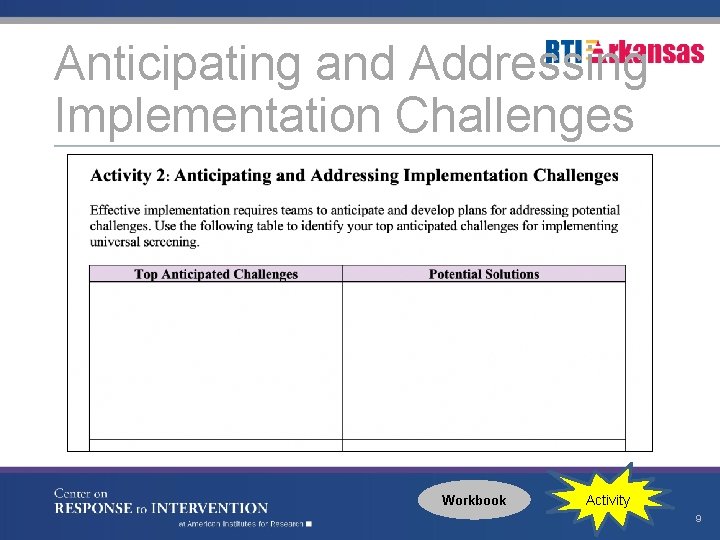
Anticipating and Addressing Implementation Challenges Workbook Activity 9
Considerations for Universal Screening Implementation ▪ Outcome measures ▪ Scope ▪ Population ▪ Timing ▪ Materials ▪ Funds ▪ Training 10
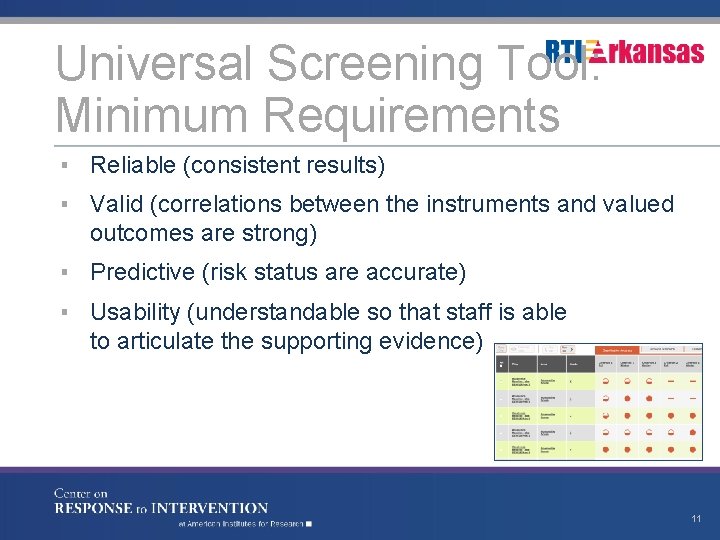
Universal Screening Tool: Minimum Requirements ▪ Reliable (consistent results) ▪ Valid (correlations between the instruments and valued outcomes are strong) ▪ Predictive (risk status are accurate) ▪ Usability (understandable so that staff is able to articulate the supporting evidence) 11
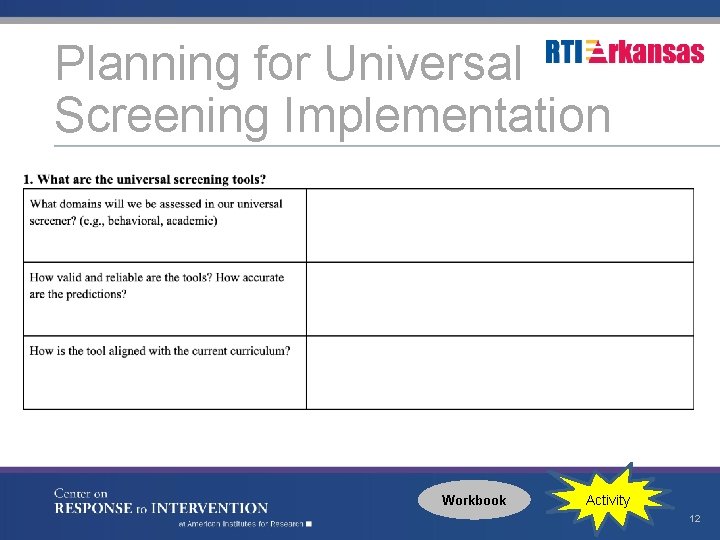
Planning for Universal Screening Implementation Workbook Activity 12
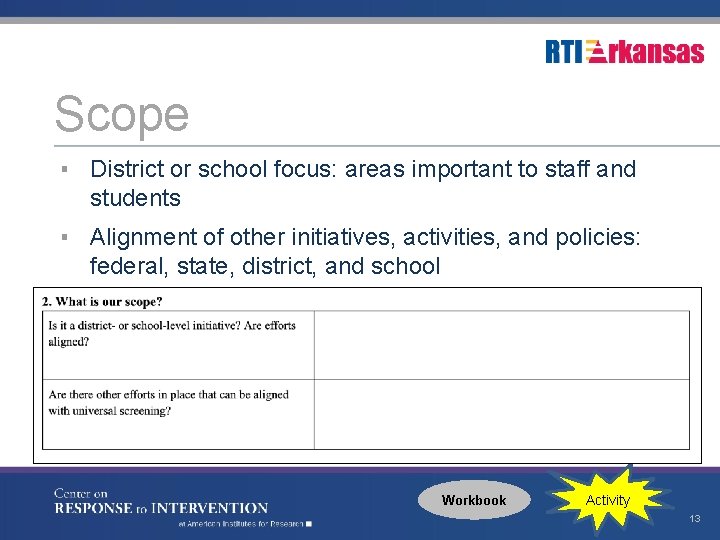
Scope ▪ District or school focus: areas important to staff and students ▪ Alignment of other initiatives, activities, and policies: federal, state, district, and school Workbook Activity 13
Target Population ▪ Screening tools may vary in the validity, reliability, and accuracy depending on the student population • Specific subgroups (EL, special education) • Test may need language or other accommodations ▪ Grade levels • Tools may vary by grade and benchmark periods 14
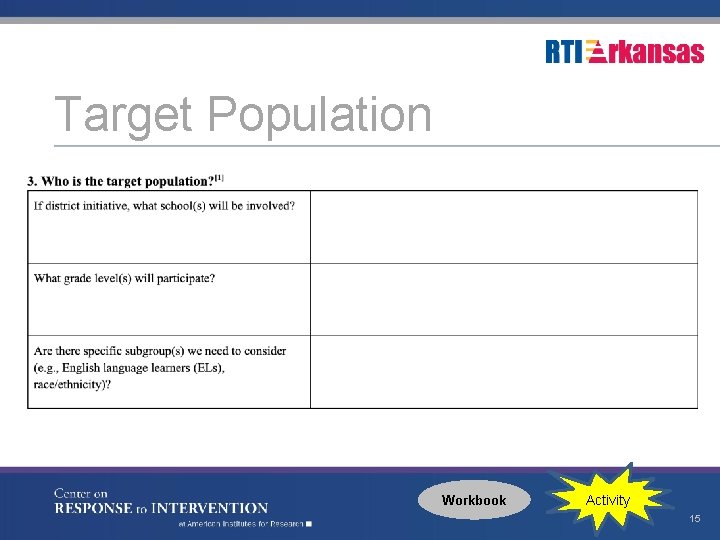
Target Population Workbook Activity 15

Timing ▪ Scheduling for test administration and scoring • Screening is conducted for all students (i. e. , is universal) • A process to screen all students occurs more than once per year (e. g. , fall, winter, and spring) ▪ Scheduling time for interpretation and decision making ▪ Delivery • Individually administered test approximately 1 to 5 minutes • Class-wide tests range from 3 to 60 minutes 16

Universal Screening: Three Times Per Year Screening typically occurs at least 3 times per year
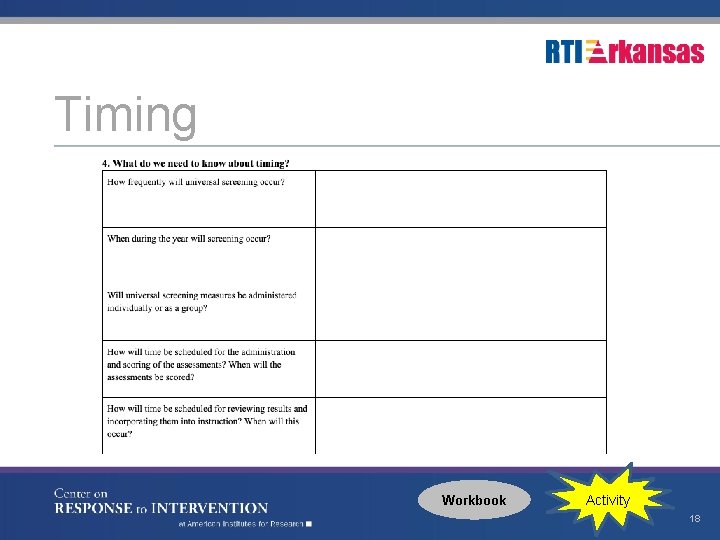
Timing Workbook Activity 18
Staff Roles ▪ Options for administering and scoring the assessments: • assessment team • general education teacher • paraeducator • computer or Web (depends on tool) ▪ Data team for analyzing and sharing data (e. g. , leadership, grade-level, content specific, student intervention team) 19
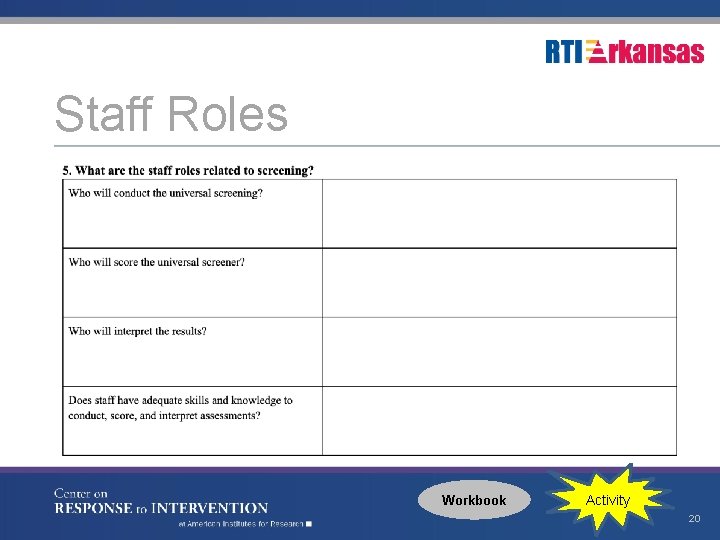
Staff Roles Workbook Activity 20
Administration ▪ Delivery options • Paper and pencil • Computer/Internet ▪ Analysis • Internet-based analysis and reporting software • Statistical software ▪ Location • Classroom • Other space (i. e. , Computer lab) 21
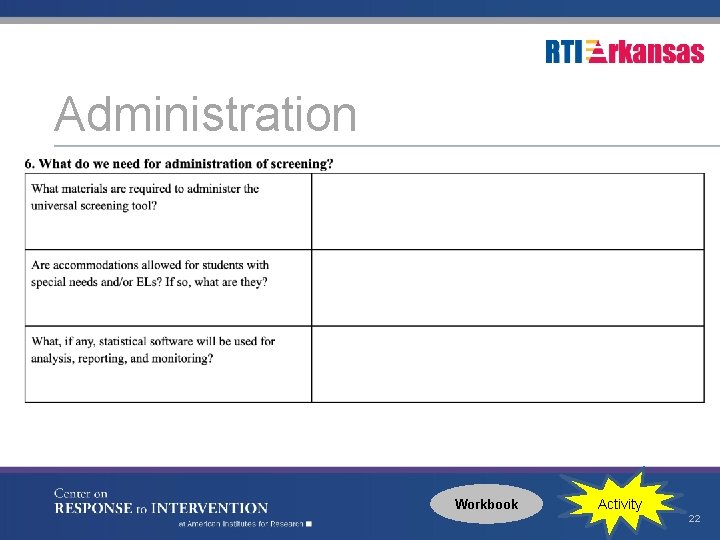
Administration Workbook Activity 22
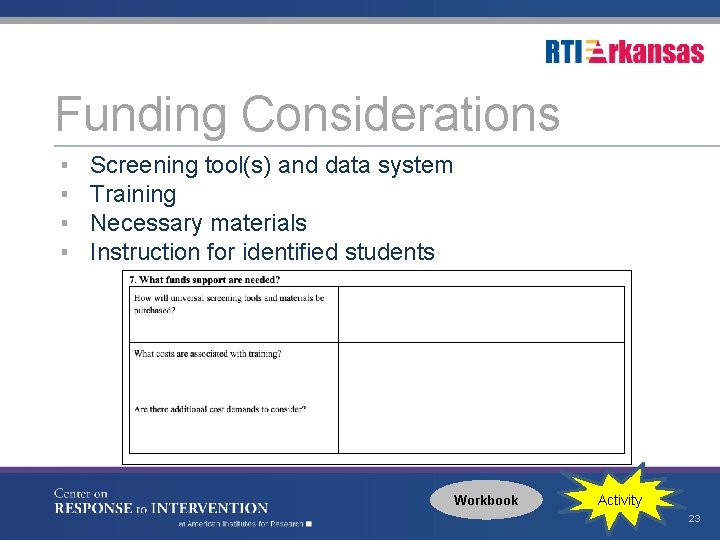
Funding Considerations ▪ ▪ Screening tool(s) and data system Training Necessary materials Instruction for identified students Workbook Activity 23
Training ▪ To ensure the fidelity of implementation ▪ Training may include: • Field-tested training manuals • Professional development activities (e. g. , in-person, web-based) ▪ Ongoing technical assistance support 24
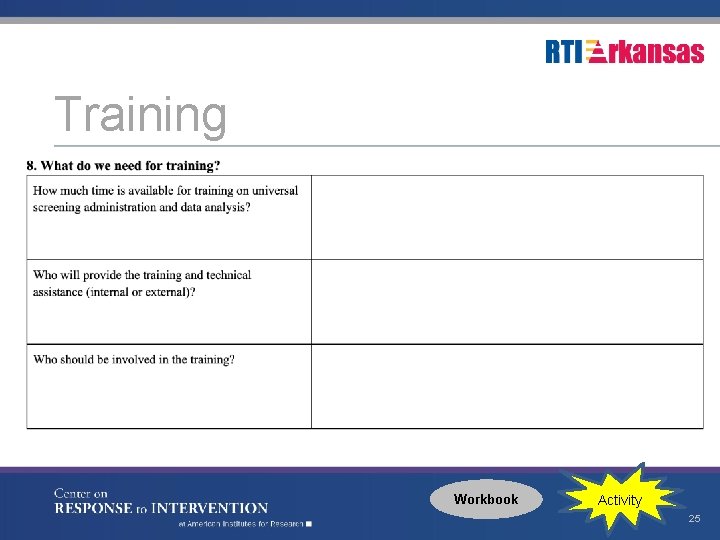
Training Workbook Activity 25
How is Universal Screening Data Used for Decision Making? 26
RTI Decision Making Process ▪ Data-driven and based on validated methods ▪ Involves a broad base of stakeholders ▪ Operationalized with clear, established decision rules (e. g. , movement between levels or tiers, determination of appropriate instruction or interventions) 27
Effective RTI Teaming ▪ RTI team is representative of all key stakeholders ▪ Structures and clear processes are in place to guide decision making ▪ Time is set aside for the team to meet regularly 28
Types of Universal Screening Decisions ▪ Identifying students who need additional assessment and intervention ▪ Identifying system (e. g. , district, school, grade, class) trends and needs ▪ Monitoring the effects of individual and system interventions/changes 29
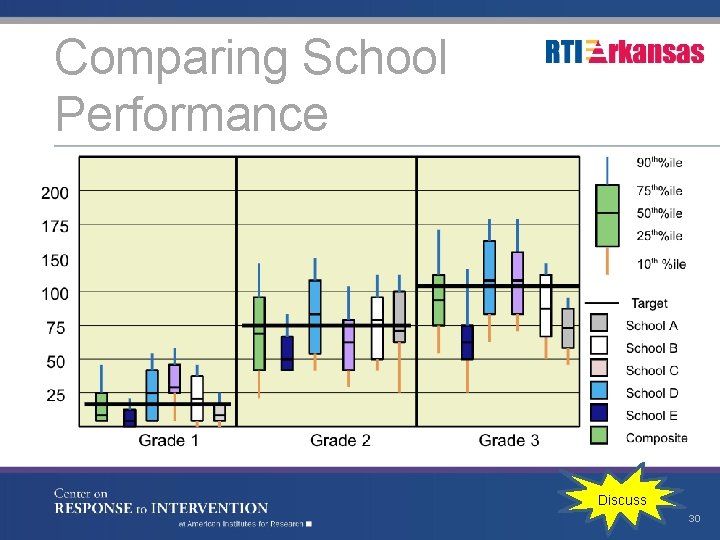
Comparing School Performance Discuss 30
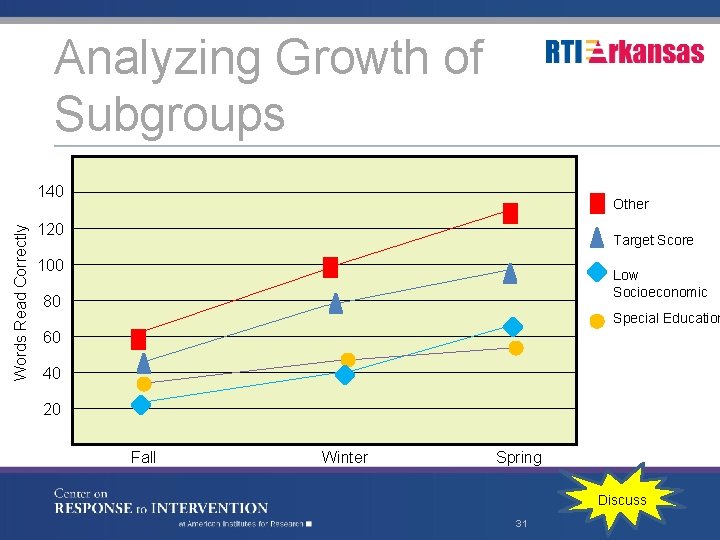
Analyzing Growth of Subgroups Words Read Correctly 140 Other 120 Target Score 100 Low Socioeconomic 80 Special Education 60 40 20 Fall Winter Spring Discuss 31
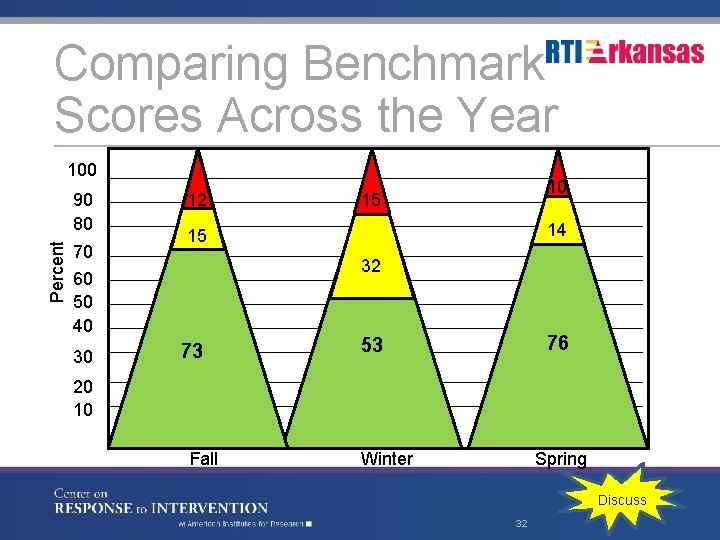
Comparing Benchmark Scores Across the Year 100 Percent 90 80 70 60 50 40 30 12 10 15 14 15 32 5573 76 53 20 10 Fall Winter Spring Discuss 32
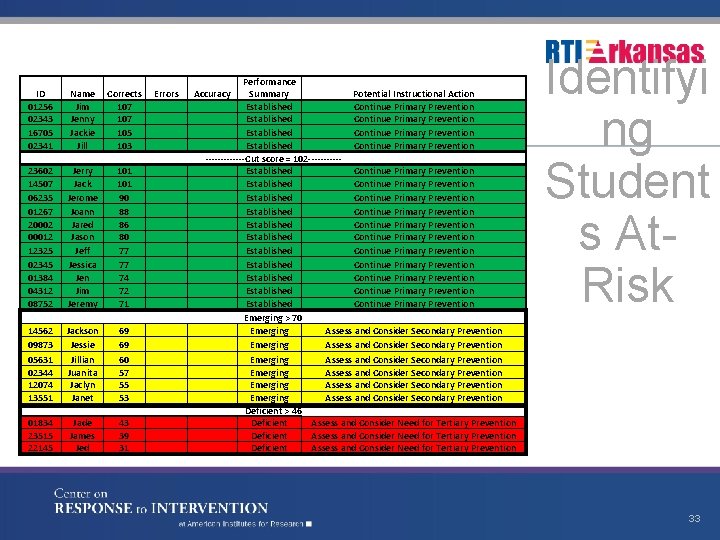
ID 01256 02343 16705 02341 Name Jim Jenny Jackie Jill Corrects 107 105 103 23602 14507 06235 01267 20002 00012 12325 02345 01384 04312 08752 Jerry Jack Jerome Joann Jared Jason Jeff Jessica Jen Jim Jeremy 101 90 88 86 80 77 77 74 72 71 14562 09873 05631 02344 12074 13551 Jackson Jessie Jillian Juanita Jaclyn Janet 69 69 60 57 55 53 01834 23515 22145 Jade James Jed 43 39 31 Errors Performance Summary Potential Instructional Action Established Continue Primary Prevention -------Cut score = 102 -----Established Continue Primary Prevention Established Continue Primary Prevention Established Continue Primary Prevention Emerging > 70 Emerging Assess and Consider Secondary Prevention Emerging Assess and Consider Secondary Prevention Deficient > 46 Deficient Assess and Consider Need for Tertiary Prevention Accuracy Identifyi ng Student s At. Risk 33
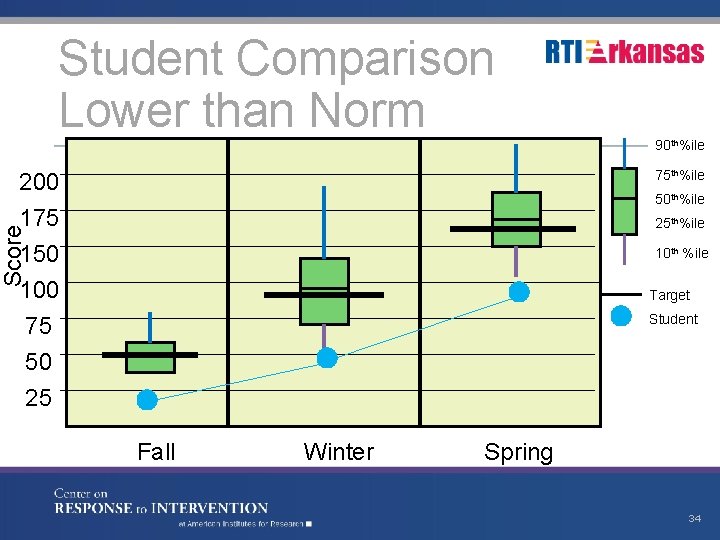
Student Comparison Lower than Norm 90 th%ile 75 th%ile 200 175 150 100 75 50 25 50 th%ile Score 25 th%ile 10 th %ile Target Student Fall Winter Spring 34
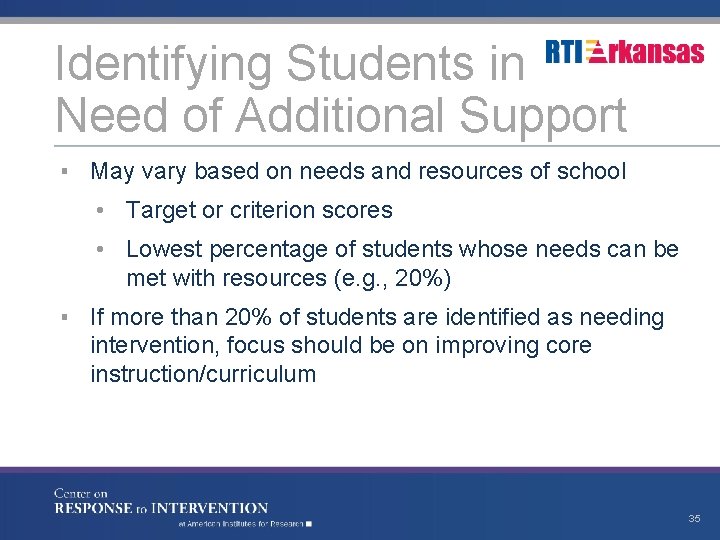
Identifying Students in Need of Additional Support ▪ May vary based on needs and resources of school • Target or criterion scores • Lowest percentage of students whose needs can be met with resources (e. g. , 20%) ▪ If more than 20% of students are identified as needing intervention, focus should be on improving core instruction/curriculum 35
Closing 36
Next Steps As a team, discuss the following: ▪ Are there additional challenges to consider? ▪ On a scale of 1 -10 (10 = very prepared), how prepared do you feel to address these and other identified challenges? Why? ▪ What resources and supports do you need? Workbook Activity 37
Did We Meet the Module Objectives? THINK-PAIR-SHARE As a result of the presentation, how comfortable do you feel in: ▪ developing a universal screening process implementation plan with your team? ▪ explaining how universal screening can be used for decision making at different levels of instruction? What other questions do you still have about implementing universal screening? 38
Resources ▪ www. intensiveintervention. org ▪ www. rti 4 success. org ▪ www. iris. peabody. vanderbilt. edu 39
References ▪ National Center on Response to Intervention. (2010). Implementer Series Module 1: Screening. Washington, DC: U. S. Department of Education, Office of Special Education Programs, National Center on Response to Intervention. Retrieved from http: //www. rti 4 success. org/resource/rti-implementer-series-module-1 -screening 40
- Slides: 40