
Module 5 Data use Orphans and Vulnerable Children
Module 5 Data use Orphans and Vulnerable Children Monitoring, Evaluation and Reporting (MER) Indicators Implementing Partner Training December 2018

5. 1. Introduction 2
Overview 5. 1. Introduction 5. 2. Meeting targets for OVC receiving services 5. 3. Increasing the proportion of children who know their HIV status 5. 4. Increasing the proportion of HIV+ children who receive sustained ART 5. 5. Process indicators 5. 6. Data use exercise 5. 7. Conclusion 3
Introduction Barriers to decision making OVC programs collect data from each household and beneficiary. Yet evidence-based decision making has been limited for many reasons: • Decision makers do not have confidence in the data. • Timely data are not available to decision makers. • Decision makers do not always have the resources to visualize data to inform allocation of resources. 4
Introduction Learning objectives 1. Visualize OVC_SERV and OVC_HIVSTAT data submitted in DATIM. 2. Display process indicators created with HIV status data potentially collected in the management information system (MIS) database. 3. Reinforce best practices for data visualization. 4. Reflect on how to leverage available data to improve resource allocation and strengthen performance. 5
PEPFAR supports the UNAIDS global targets for 2030 • 95% of all people living with HIV will know their HIV status • 95% of all people with diagnosed HIV infection will receive sustained antiretroviral therapy (ART) • 95% of all people receiving ART will have viral suppression 6
5. 2. Meeting targets for OVC receiving services 7
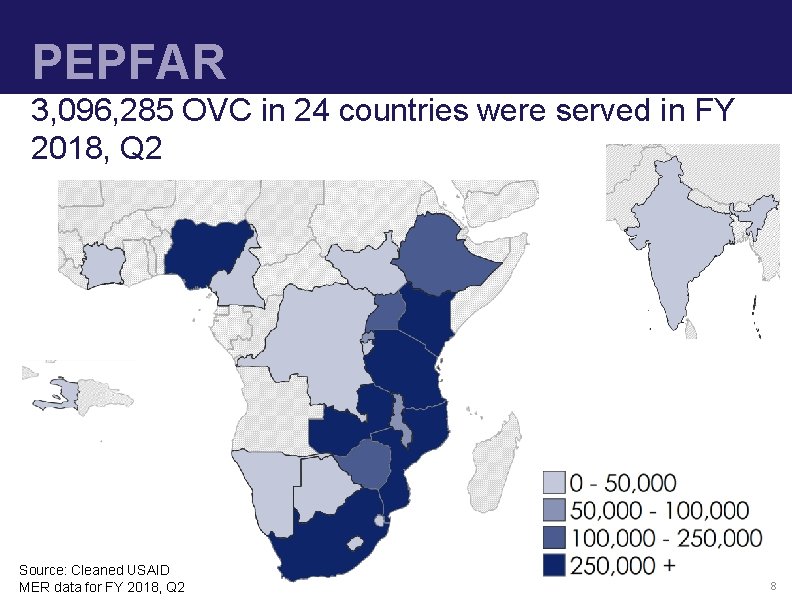
PEPFAR 3, 096, 285 OVC in 24 countries were served in FY 2018, Q 2 Source: Cleaned USAID MER data for FY 2018, Q 2 8
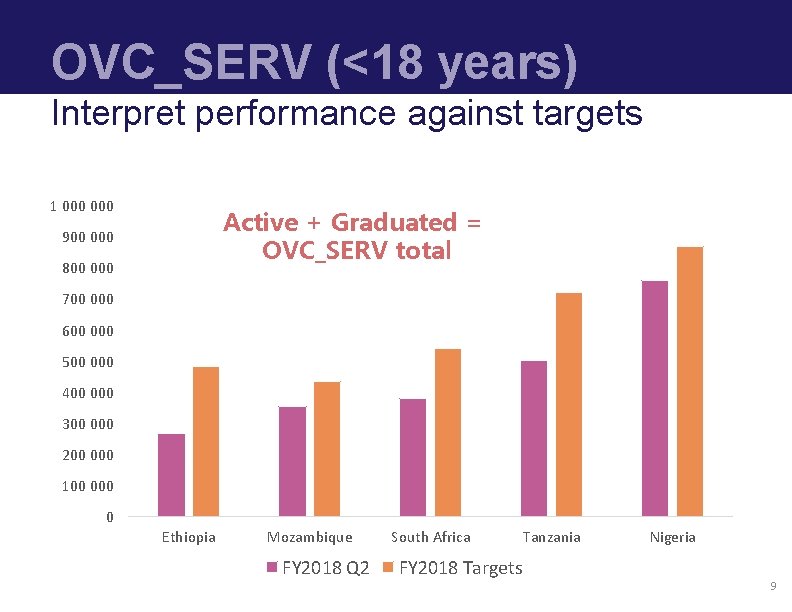
OVC_SERV (<18 years) Interpret performance against targets 1 000 Active + Graduated = OVC_SERV total 900 000 800 000 700 000 600 000 500 000 400 000 300 000 200 000 100 0 Ethiopia Mozambique FY 2018 Q 2 South Africa FY 2018 Targets Tanzania Nigeria 9
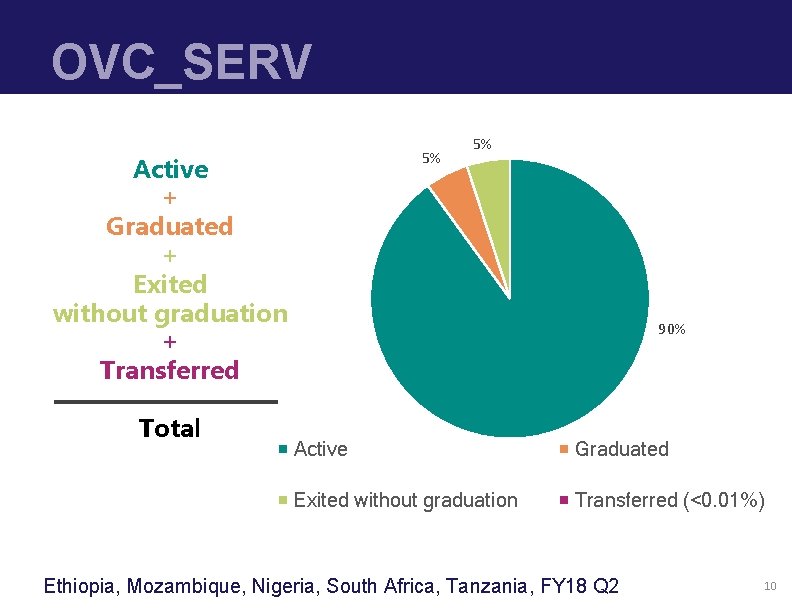
OVC_SERV 5% Active + Graduated + Exited without graduation + Transferred Total 5% 90% Active Graduated Exited without graduation Transferred (<0. 01%) Ethiopia, Mozambique, Nigeria, South Africa, Tanzania, FY 18 Q 2 10
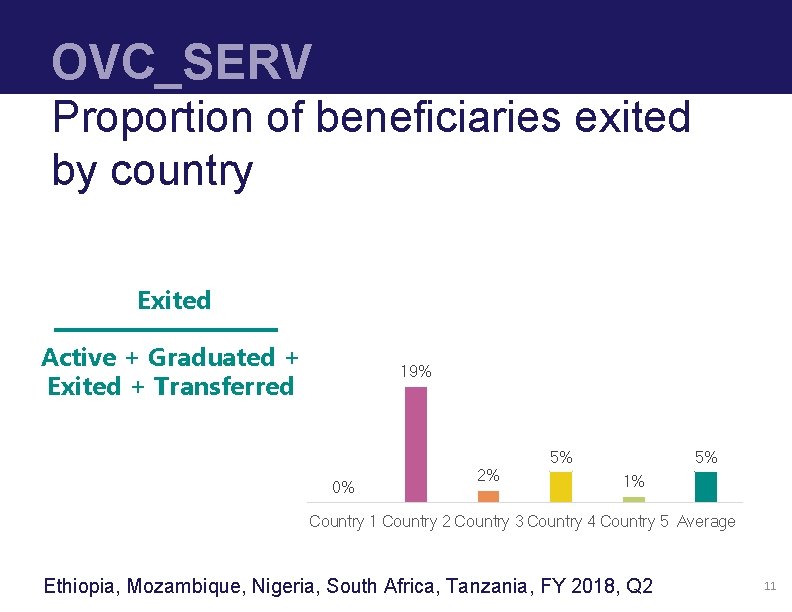
OVC_SERV Proportion of beneficiaries exited by country Exited Active + Graduated + Exited + Transferred 19% 5% 0% 2% 5% 1% Country 1 Country 2 Country 3 Country 4 Country 5 Average Ethiopia, Mozambique, Nigeria, South Africa, Tanzania, FY 2018, Q 2 11
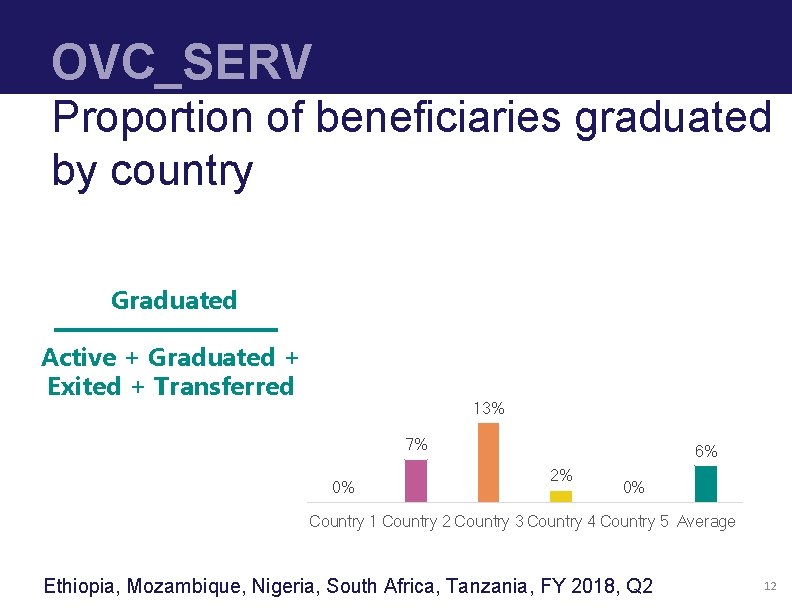
OVC_SERV Proportion of beneficiaries graduated by country Graduated Active + Graduated + Exited + Transferred 13% 7% 0% 6% 2% 0% Country 1 Country 2 Country 3 Country 4 Country 5 Average Ethiopia, Mozambique, Nigeria, South Africa, Tanzania, FY 2018, Q 2 12
5. 3. Increasing the proportion of children who know their HIV status 13
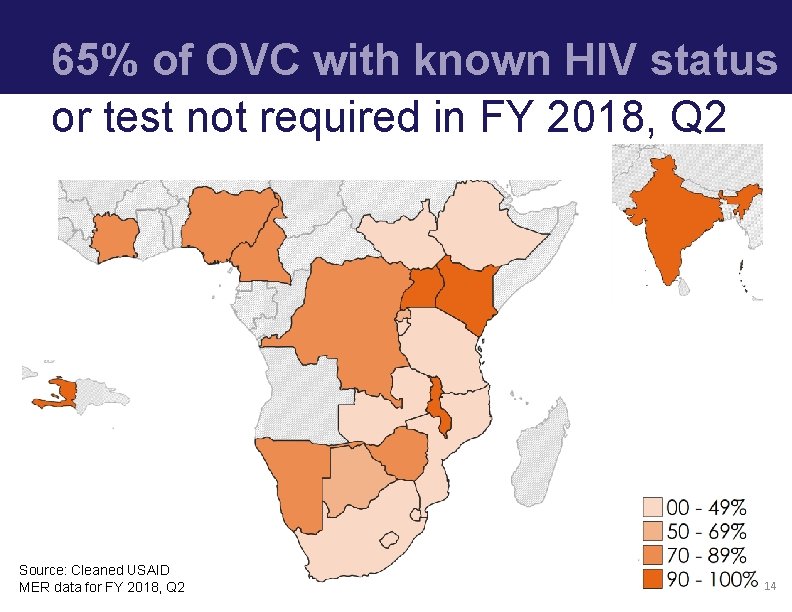
65% of OVC with known HIV status or test not required in FY 2018, Q 2 Source: Cleaned USAID MER data for FY 2018, Q 2 14
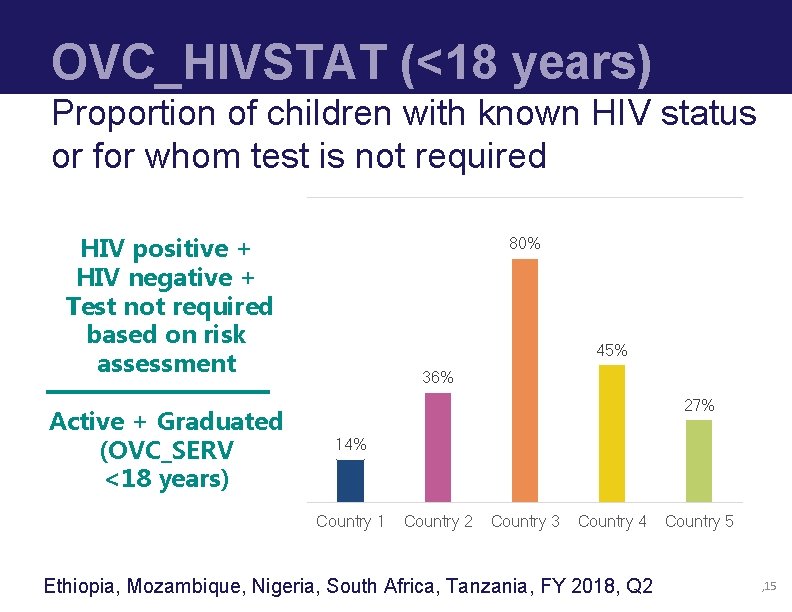
OVC_HIVSTAT (<18 years) Proportion of children with known HIV status or for whom test is not required HIV positive + HIV negative + Test not required based on risk assessment Active + Graduated (OVC_SERV <18 years) 80% 45% 36% 27% 14% Country 1 Country 2 Country 3 Country 4 Ethiopia, Mozambique, Nigeria, South Africa, Tanzania, FY 2018, Q 2 Country 5 , 15
5. 4. Increasing the proportion of HIV+ children who receive sustained ART
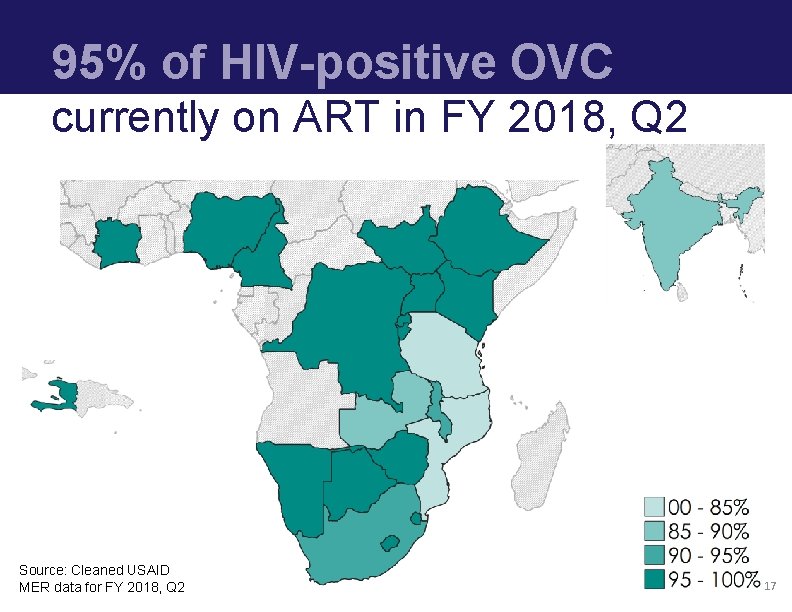
95% of HIV-positive OVC currently on ART in FY 2018, Q 2 Source: Cleaned USAID MER data for FY 2018, Q 2 17
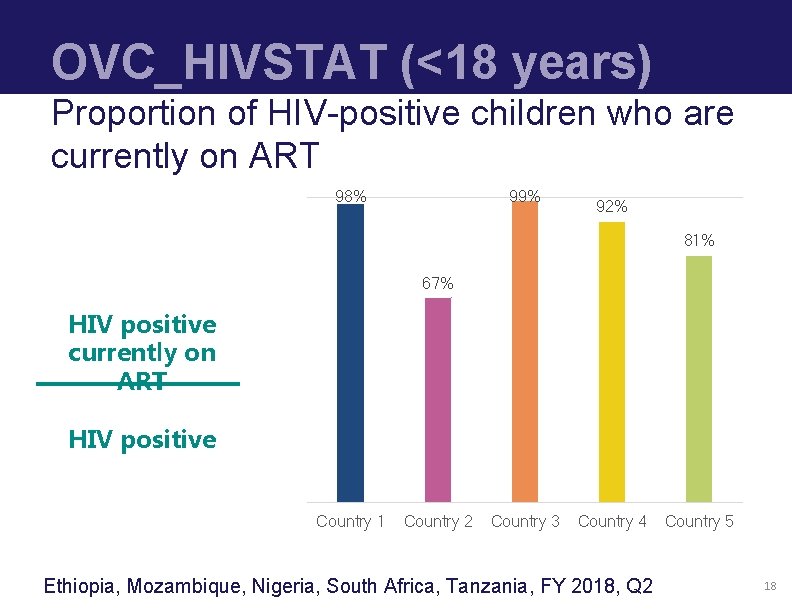
OVC_HIVSTAT (<18 years) Proportion of HIV-positive children who are currently on ART 98% 99% 92% 81% 67% HIV positive currently on ART HIV positive Country 1 Country 2 Country 3 Country 4 Ethiopia, Mozambique, Nigeria, South Africa, Tanzania, FY 2018, Q 2 Country 5 18
5. 5. Process indicators 19
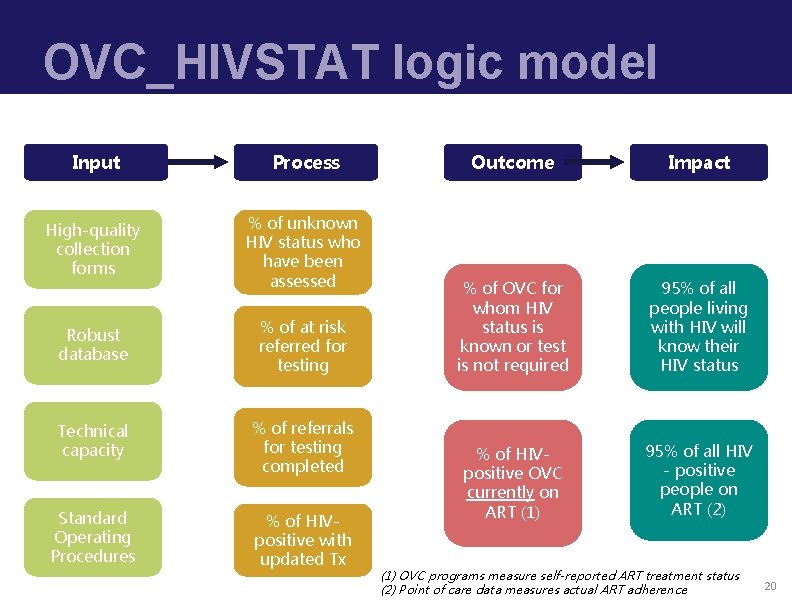
OVC_HIVSTAT logic model Input Process High-quality collection forms % of unknown HIV status who have been assessed Robust database % of at risk referred for testing Technical capacity % of referrals for testing completed Standard Operating Procedures % of HIVpositive with updated Tx Outcome Impact % of OVC for whom HIV status is known or test is not required 95% of all people living with HIV will know their HIV status % of HIVpositive OVC currently on ART (1) 95% of all HIV - positive people on ART (2) (1) OVC programs measure self-reported ART treatment status (2) Point of care data measures actual ART adherence 20
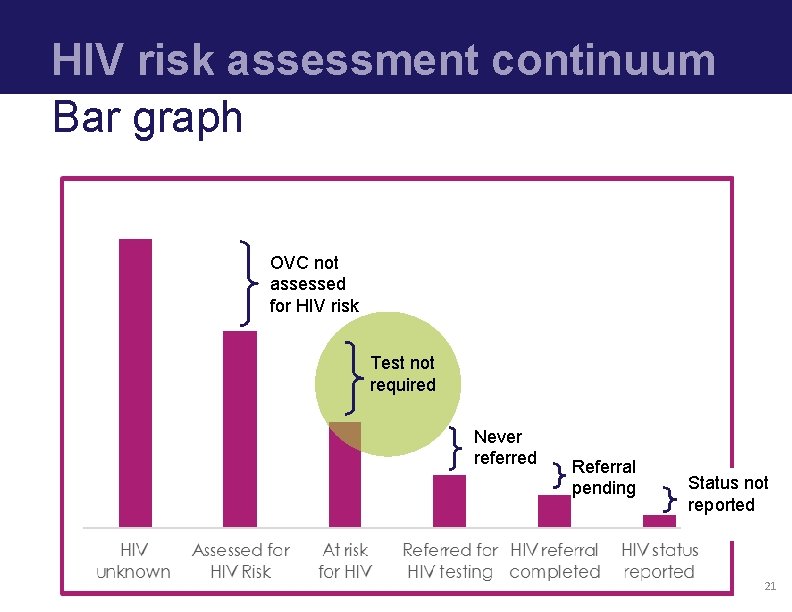
HIV risk assessment continuum Bar graph OVC not assessed for HIV risk Test not required Never referred Referral pending Status not reported 21
HIV risk assessment continuum Process indicators Ideally, these process indicators would all be at 100%: • % of OVC with unknown HIV status who have been assessed • % at risk for HIV referred for testing • % of referrals for testing completed • % with completed testing referral who have reported HIV status to IP 22
5. 6. Data use exercise 23
Data use exercise Instructions Exercise 1. Using your most recent DATIM submission: • Create the following graphs • Disaggregate by community-based organization (CBO), if possible Exercise 2. Using your internal management information system (MIS) data: • Create the following graphs • Disaggregate by CBO, if possible 24
Tips for improving data visualizations 1. Make sure you’re using the appropriate denominator. For example: • • • OVC_SERV (Active + Graduated) Active + Graduated + Exited + Transferred HIV-positive 2. Give the chart a meaningful title, including year(s) of data collection. 3. Consider disaggregating data by sex and/or age. Simple, clean presentations allow your data to speak for themselves. 25
5. 7. Conclusion 26
Strategies for improving evidence-based decision making 1. Based on current performance, establish attainable internal performance targets. 2. Provide regular feedback on process indicators. 3. Organize data analysis meetings to review progress. 4. Identify subunits with weak performance and provide supportive supervision and enhanced training. Through regular analysis of data and evidence-based decision making, attain OVC_SERV coverage targets and improve the linkages among risk assessment, testing, and treatment. 27
Thank you 28
This presentation was produced with the support of the United States Agency for International Development (USAID) under the terms of MEASURE Evaluation cooperative agreement AID-OAA-L-14 -00004. MEASURE Evaluation is implemented by the Carolina Population Center, University of North Carolina at Chapel Hill in partnership with ICF International; John Snow, Inc. ; Management Sciences for Health; Palladium; and Tulane University. Views expressed are not necessarily those of USAID or the United States government. www. measureevaluation. org
- Slides: 29