
MODULE 5 COMPENSATION MANAGEMENT UNIT 1 CONT METHODS
- Slides: 10
MODULE 5: COMPENSATION MANAGEMENT UNIT 1 CONT. , METHODS OF WAGE PAYMENT SYSTEM & SALARY
Outline Ø 1. 2. 3. Wage Payment System Time Wage Method Piece Wage Method Balance Method Ø Salary ü Characteristics of Salary Ø Determinants of Wages & Salary
Methods of Wage Payment System Time Wage Method Ø Wage is determined on the basis of time worked which may be hourly, daily, weekly, monthly or any other time base. Ø A worker is paid wage for the time worked irrespective of his output during that time. Ø This is the oldest and most prevalent system of wage payment. 3
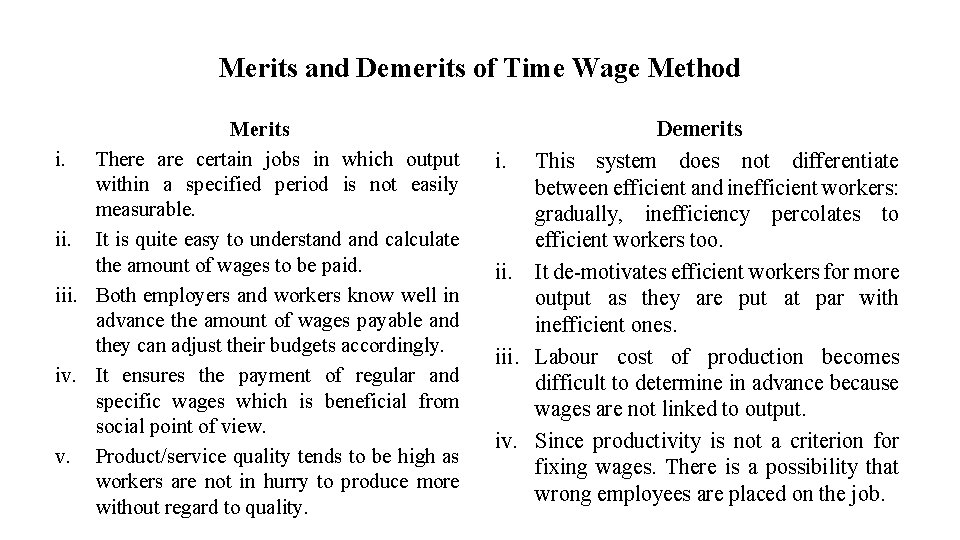
Merits and Demerits of Time Wage Method Merits i. There are certain jobs in which output within a specified period is not easily measurable. ii. It is quite easy to understand calculate the amount of wages to be paid. iii. Both employers and workers know well in advance the amount of wages payable and they can adjust their budgets accordingly. iv. It ensures the payment of regular and specific wages which is beneficial from social point of view. v. Product/service quality tends to be high as workers are not in hurry to produce more without regard to quality. Demerits i. This system does not differentiate between efficient and inefficient workers: gradually, inefficiency percolates to efficient workers too. ii. It de-motivates efficient workers for more output as they are put at par with inefficient ones. iii. Labour cost of production becomes difficult to determine in advance because wages are not linked to output. iv. Since productivity is not a criterion for fixing wages. There is a possibility that wrong employees are placed on the job.
Methods of Wage Payment System Cont. , Piece Wage Method Ø Workers are paid wages according to the quantity of output during a specified period. Ø This may be calculated on the basis of number of units produced or the completion of a job where output is not measurable in terms of individual units. 5
Merits and Demerits of Piece Wage Method Merits i. iii. iv. v. There is a direct relationship between output and wages which works as a motivating factor to workers to produce more. It differentiates efficient and inefficient workers and provides incentives to inefficient workers to become efficient. This is fair and equitable so far as utilisation of human resources is concerned. It requires less supervision if there is in-built system for product quality control. The organisation can estimate its cost of production well in advance because wage cost is directly proportional to output. Demerits i. iii. iv. vi. There is a problem in fixing piece rate in the absence of any standardised procedure. There is a tendency on the part of the employers to cut piece rate if workers' earnings are quite high. The method does not ensure minimum wages as output may be adversely affected by factors beyond control. The product quality and machinery conditions are likely to suffer because workers concentrate more on quantity rather than quality. There may be jealousy and interpersonal conflict among workers because of their uneven earnings at the same workplace. Labour unions generally oppose this system because of the fear of discrimination among workers based on their working.
Methods of Wage Payment System Cont. , Balanced Method Ø This is also known as debt method Ø It combines time wage and piece wage methods. Ø A worker is guaranteed a fixed wage based on time rate with a provision of piece wage method. Ø Thus, if worker produces more quantity in a period, usually on weekly or monthly basis, and earns more than his time wage. Ø He/She is given credit for additional output which is compensated in another period in which production quantity falls below the time wage. 7
Salary Ø This is a reward paid to worker like wage for supplying their labour and services to an enterprise. But salary earners regard their income as per annum. Ø It is paid to office workers (white collar jobs) or the supervisors of the wage earners. Ø Peretomode and Peretomode (2001) defines salary is a fixed regular payment usually made every month to employees. ” Ø In essence, it is the amount paid at the end of a month/ annum whether the employee work or not.
Characteristics of Wages and Salary Ø It is a total package which includes the basic salary and allowances Ø A salary is progressive, in most cases increasing annually Ø It is often regarded as personal to the individual Ø A salary is also often confidential Ø In the private sector of employment, salaries are seldom the subject of trade union negotiations while in the public sector employment; salaries have been serious issues of trade union negotiations.
Determinants of Wages and Salary Ø Demand for and supply of labor Ø Supply of labor ØLabour unions Ø Cost of living Ø Prevailing wage rates Ø Ability to pay Ø Job requirements Ø State regulation Ø Increment system