
Module 5 Abnormal Gait 3 E Objective Gait
Module 5 Abnormal Gait 3 E: Objective Gait Analysis of Pathological
References • Perry, J and Burnfield, J. (2010). Gait Analysis: Normal and Pathological Function 2 nd Edition. Ch 15. • Edelstein, JE and Moroz, A. (2011) Lower-Limb Prosthetics and Orthotics: Clinical Concepts. Ch. 23 (pdf provided on ANGEL) • Lusardi and Nielsen. Orthotics and Prosthetics in Rehabilitation, 2 nd edition, Ch 3. • Smith, Michael, Bowker. AAOS Atlas of Amputations and Limb Deficiencies, 3 rd edition, Chs 30 and 31.
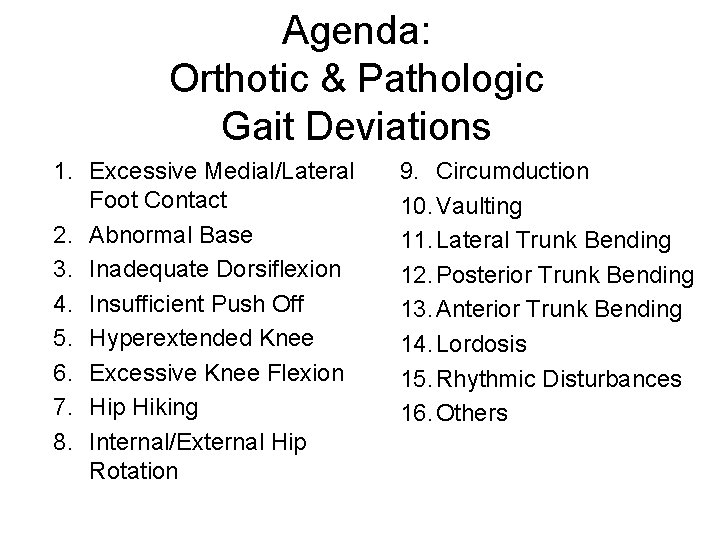
Agenda: Orthotic & Pathologic Gait Deviations 1. Excessive Medial/Lateral Foot Contact 2. Abnormal Base 3. Inadequate Dorsiflexion 4. Insufficient Push Off 5. Hyperextended Knee 6. Excessive Knee Flexion 7. Hip Hiking 8. Internal/External Hip Rotation 9. Circumduction 10. Vaulting 11. Lateral Trunk Bending 12. Posterior Trunk Bending 13. Anterior Trunk Bending 14. Lordosis 15. Rhythmic Disturbances 16. Others
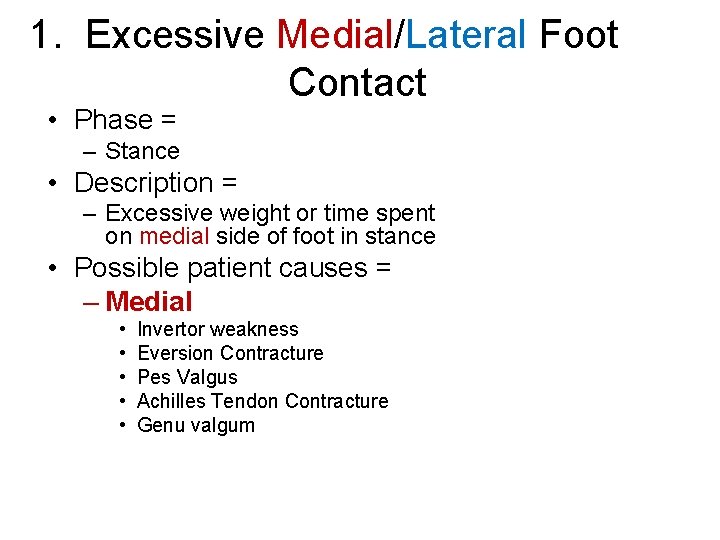
1. Excessive Medial/Lateral Foot Contact • Phase = – Stance • Description = – Excessive weight or time spent on medial side of foot in stance • Possible patient causes = – Medial • • • Invertor weakness Eversion Contracture Pes Valgus Achilles Tendon Contracture Genu valgum
1. Excessive Medial/Lateral Foot Contact Lateral • Phase = – Stance • Description = – Excessive weight or time spent on lateral side of foot in stance • Possible Patient Causes = – Lateral • • Evertor weakness Inversion Contracture Talipes equinovarus Genu varum • Video Link to Excessive Lateral Border
1. Excessive Medial/Lateral Foot Contact Either Direction • Phase = – Stance • Description = – Excessive weight or time spent on medial or lateral side of foot in stance • Possible Ox Causes = – Either direction • Uneven wear of shoe heel • Insufficient accommodation for tibial torsion or toe out in Ox • Ox ankle joint mal-aligned
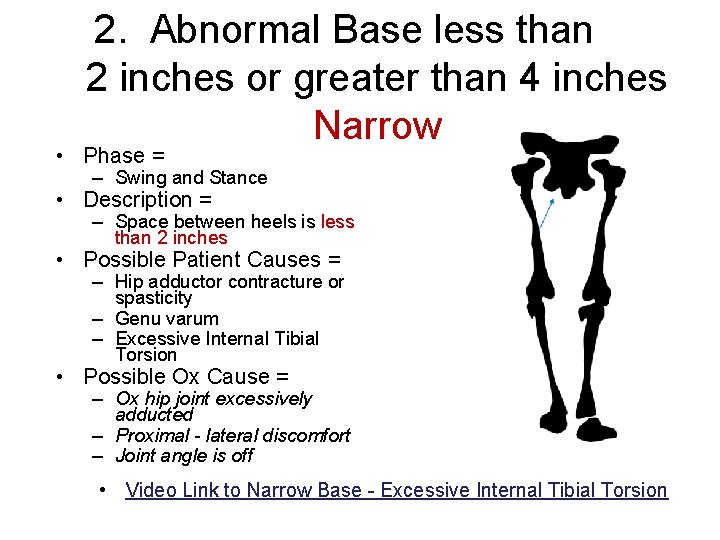
2. Abnormal Base less than 2 inches or greater than 4 inches Narrow • Phase = – Swing and Stance • Description = – Space between heels is less than 2 inches • Possible Patient Causes = – Hip adductor contracture or spasticity – Genu varum – Excessive Internal Tibial Torsion • Possible Ox Cause = – Ox hip joint excessively adducted – Proximal - lateral discomfort – Joint angle is off • Video Link to Narrow Base - Excessive Internal Tibial Torsion
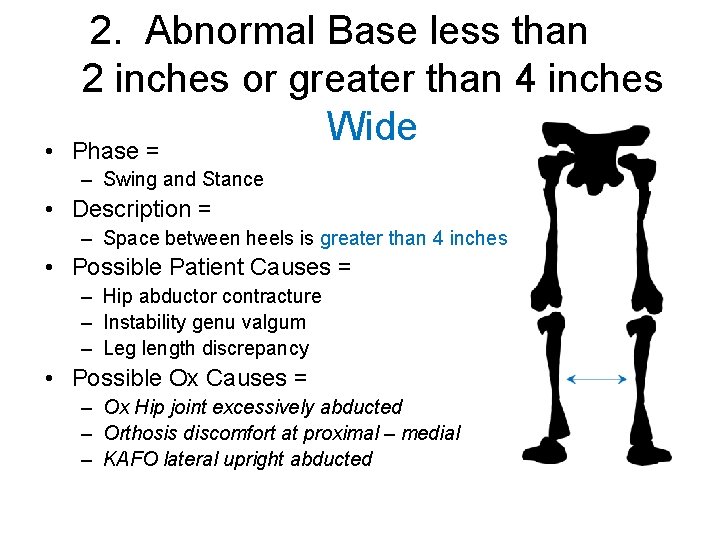
• 2. Abnormal Base less than 2 inches or greater than 4 inches Wide Phase = – Swing and Stance • Description = – Space between heels is greater than 4 inches • Possible Patient Causes = – Hip abductor contracture – Instability genu valgum – Leg length discrepancy • Possible Ox Causes = – Ox Hip joint excessively abducted – Orthosis discomfort at proximal – medial – KAFO lateral upright abducted
3. Inadequate Dorsi. Flexion • Phase = – Heel strike to foot flat – Swing • Description = – ‘Foot slap’ early stance or toe dragging in swing OR – Toe walking • Video Link to Foot Slap Gait –Prosthesis • Video Link to Toe Walking • Possible Patient Causes = – Dorsiflexor weakness/Plantarflexor much stronger – Spasticity • Possible Ox Causes = – Worn plantar stop – Weak dorsi assist spring
4. Insufficient Push Off • Phase = – Push off • Description = – Weight on heel and entire foot leaves ground for swing • Possible Patient Causes = – – – Plantar flexor weakness Ruptured achillies tendon Pes calcaneus Metatarsal pain, short first metatarsal, hammer toes Pes varus or valgus Insufficient weight bearing on involved limb • Possible Ox Causes = – Ox plantar stop set in excessive dorsiflexion
5. Hyperextended Knee • Phase = – Heel strike to heel off • Description = – Extension of knee in stance • Possible Patient Causes = – – – Quad weakness Genu recurvatum Ligamental laxity Gastroc. weakness Compensation of contra-lateral hip or knee flexion contracture or skeletal shortening • Possible Ox Causes = – Ox plantar stop set in excessive plantar flexion
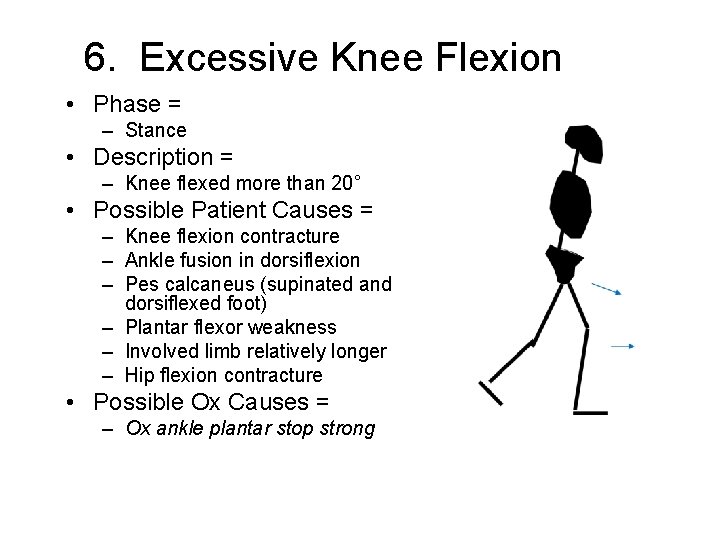
6. Excessive Knee Flexion • Phase = – Stance • Description = – Knee flexed more than 20° • Possible Patient Causes = – Knee flexion contracture – Ankle fusion in dorsiflexion – Pes calcaneus (supinated and dorsiflexed foot) – Plantar flexor weakness – Involved limb relatively longer – Hip flexion contracture • Possible Ox Causes = – Ox ankle plantar stop strong
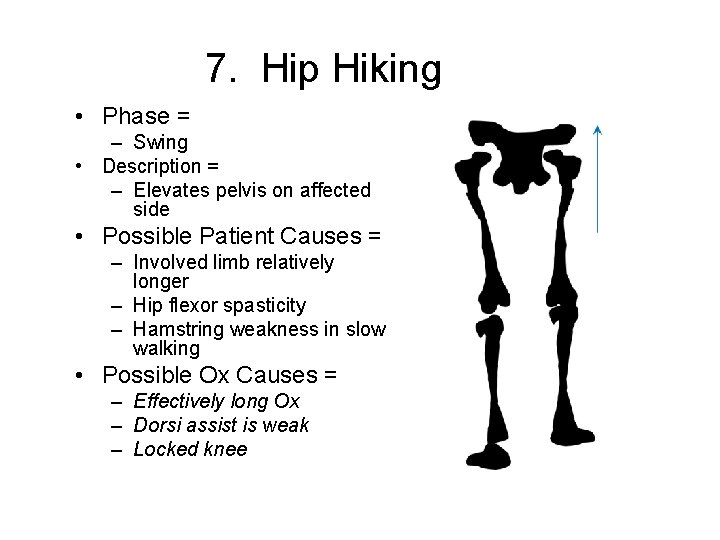
7. Hip Hiking • Phase = – Swing • Description = – Elevates pelvis on affected side • Possible Patient Causes = – Involved limb relatively longer – Hip flexor spasticity – Hamstring weakness in slow walking • Possible Ox Causes = – Effectively long Ox – Dorsi assist is weak – Locked knee
8. Internal/External Hip Rotation • Phase = – Swing and Stance • Description = – Excessive or inadequate rotation of the limb • Possible Patient Causes = – Internal • • Biceps Femoris weakness Pes Varus Peroneal weakness Spasticity. . . “Scissor Gait”
8. Internal/External Hip Rotation • Phase = – Swing and Stance • Description = – Excessive or inadequate rotation of the limb • Possible Patient Causes = – External • • • Quadriceps weakness Inner hamstring weakness Pes valgus Tibialis posterior and anterior weakness Spasticity Plantar flexor weakness
8. Internal/External Hip Rotation Either Direction • Phase = – Swing and Stance • Description = – Excessive or inadequate rotation of the limb • Possible Ox Causes = – Either Direction • Uneven wear of shoe heel • Insufficient accommodation for tibial torsion or toe out in Ox • Ox ankle joint mal-aligned
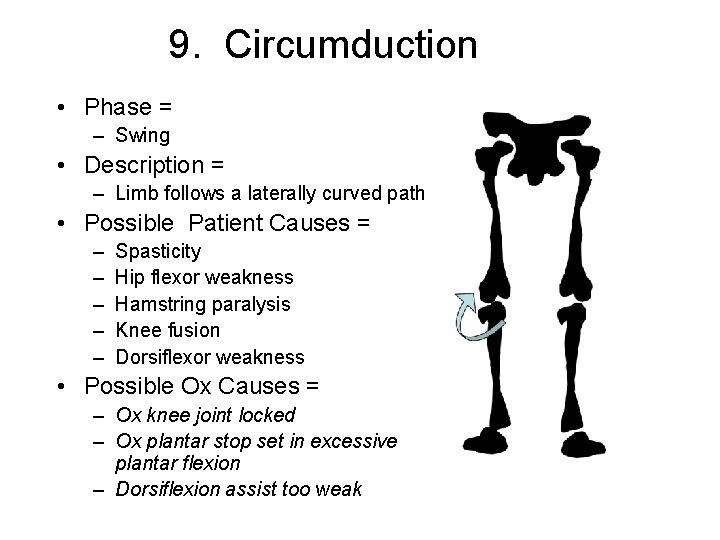
9. Circumduction • Phase = – Swing • Description = – Limb follows a laterally curved path • Possible Patient Causes = – – – Spasticity Hip flexor weakness Hamstring paralysis Knee fusion Dorsiflexor weakness • Possible Ox Causes = – Ox knee joint locked – Ox plantar stop set in excessive plantar flexion – Dorsiflexion assist too weak
10. Vaulting • Phase = – Swing • Description = – Exaggerated plantar flexion of the contralateral side • Possible Causes = – Involved limb is relatively longer – Weak hamstrings in slow walking – Inability to attain a neutral ankle posture in mid-swing
11. Lateral Trunk Bending • Phase = – Stance FF to Mid. Stance or Swing • Description – Stance lean toward involved side with weight (‘+’ Trendelenberg) – Swing lean toward unaffected side • Possible Patient Causes = – – – Hip abductor weakness Hip dislocation/ coxa vara Hip pain Involved limb longer Weak gastroc Scoliosis • Possible Ox Causes = – Ox hip joint excessively abducted – Ox discomfort
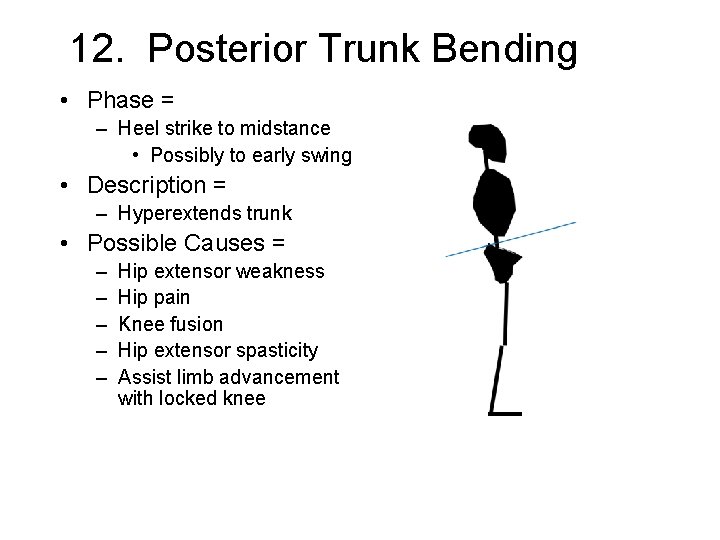
12. Posterior Trunk Bending • Phase = – Heel strike to midstance • Possibly to early swing • Description = – Hyperextends trunk • Possible Causes = – – – Hip extensor weakness Hip pain Knee fusion Hip extensor spasticity Assist limb advancement with locked knee
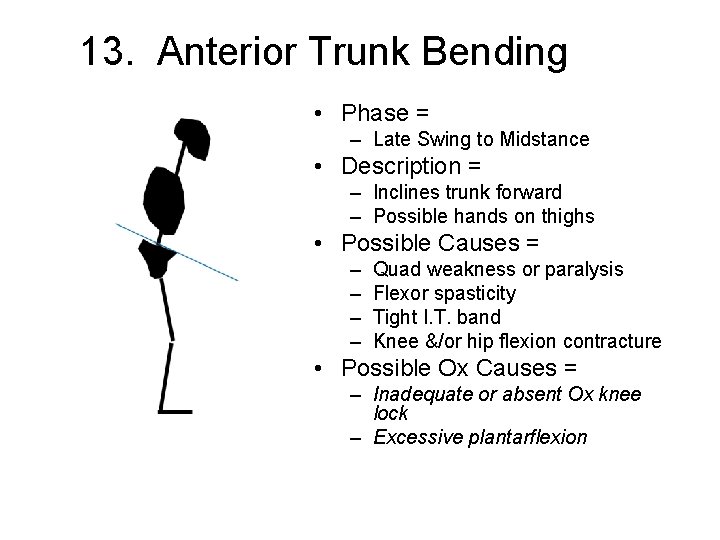
13. Anterior Trunk Bending • Phase = – Late Swing to Midstance • Description = – Inclines trunk forward – Possible hands on thighs • Possible Causes = – – Quad weakness or paralysis Flexor spasticity Tight I. T. band Knee &/or hip flexion contracture • Possible Ox Causes = – Inadequate or absent Ox knee lock – Excessive plantarflexion
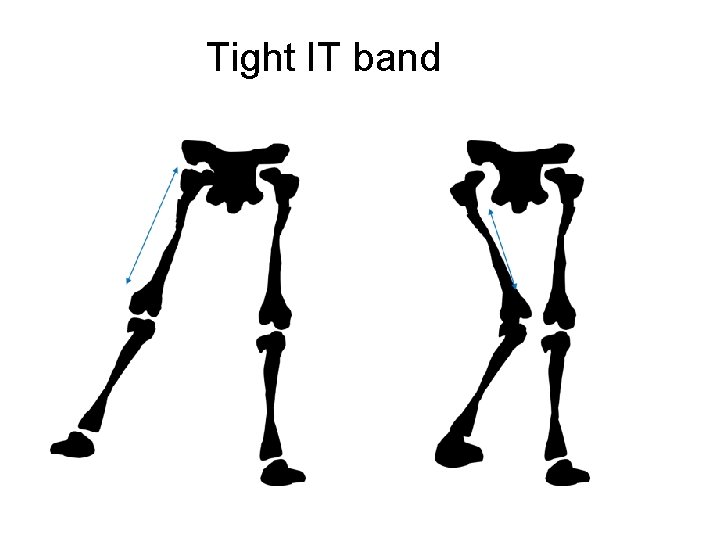
Tight IT band
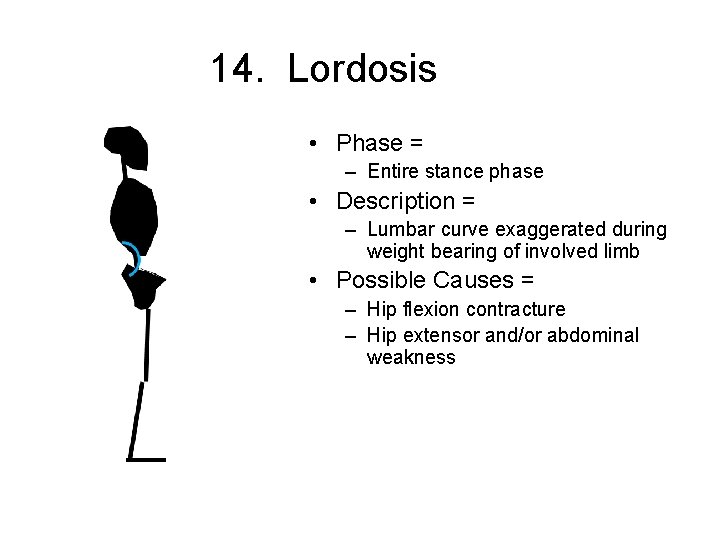
14. Lordosis • Phase = – Entire stance phase • Description = – Lumbar curve exaggerated during weight bearing of involved limb • Possible Causes = – Hip flexion contracture – Hip extensor and/or abdominal weakness
15. Rhythmic Disturbances • Phase = – Stance and Swing • Description = – Length of step and period of time spent on involved limb different than contra-lateral • Possible Causes = – Pain or fear of falling – Neurological deficiency – Inadequate limb length
16. Others • Phase = – All • Possible Causes = – Abnormal movements – tremors – Abnormal activity or posture of upper limbs – Abnormal activity of head and neck – Rotation of foot at heel strike – Noise from joints or Ox – Early fatigue
Orthotic & Pathologic Gait Deviations (NYU) 1. Excessive Medial/Lateral Foot Contact 2. Abnormal Base 3. Inadequate Dorsiflexion 4. Insufficient Push Off 5. Hyperextended Knee 6. Excessive Knee Flexion 7. Hip Hiking 8. Internal/External Hip Rotation 9. Circumduction 10. Vaulting 11. Lateral Trunk Bending 12. Posterior Trunk Bending 13. Anterior Trunk Bending 14. Lordosis 15. Rhythmic Disturbances 16. Others
The End
Pedorthic Program of Study This workforce product was funded by a grant awarded by the U. S. Department of Labor’s Employment and Training Administration. The product was created by the grantee and does not necessarily reflect the official position of the U. S. Department of Labor. The U. S. Department of Labor makes no guarantees, warranties, or assurances of any kind, express or implied, with respect to such information, including any information on linked sites and including, but not limited to, accuracy of the information or its completeness, timeliness, usefulness, adequacy, continued availability, or ownership. Produced 2016. HOPE Careers Consortium is a partnership of five institutions of higher education that is building exciting new programs that will provide valuable career education and training in the Orthotics, Prosthetics, and Pedorthics (O&P) sector. The five institutions are: Baker College—Flint, Michigan; Century College—White Bear Lake, Minnesota; Oklahoma State University Institute of Technology— Okmulgee, Oklahoma; Spokane Falls Community College—Spokane, Washington; and St. Petersburg College—St. Petersburg, Florida. Although the authoring institution of this educational resource has made every effort to ensure that the information presented is correct, the institution assumes no liability to any party for any loss, damage, or disruption caused by errors or omissions. Except where otherwise noted, this work by St. Petersburg College is licensed under the Creative Commons Attribution 4. 0 International License. To view a copy of this license, click on the following link: Creative Commons Licenses 4. 0.
- Slides: 28