
Module 4 REFERENCING AND AVOIDING PLAGIARISM Part 1
- Slides: 5
Module 4 REFERENCING AND AVOIDING PLAGIARISM Part 1 Making your work consistent, reliable and accurate.
What this module will cover? • By the end of this tutorial, you should be able to. . . • Explain the key reasons for using references in academic work. • Understand how to make in text and end of text references. • Examine a number of useful resources for developing referencing skills. • Define plagiarism and identify different forms of plagiarism. • Identify important strategies to help avoid plagiarism.
How will you learn these skills? The following slides and activities will help you to. . . • Reflect on the purpose referencing. • Familiarise yourself with the Harvard referencing style. • Reference in a foreign language. • Reflect on plagiarism. • Practise how to avoid plagiarism.
So, what is a reference? In academic writing, a reference is a previously published written work which has been used as a source for theory or claims in your own work. Otheracademic systems apart from Harvard There a number of forms or styles of referencing. are MHRA, the Chicago System, the (MLA) or the (APA). The School of Languages at Aston University uses the Harvard Referencing system. For further details please see Aston University’s ‘An Introductory Guide to Citing References. ’ You should check with your University which system you should use. . Although the Harvard system was originally developed in the USA, it has become the most common system in use internationally and is frequently the standard house style for academic journals, so this tutorial will use it for practice too. Harvard has the advantages of flexibility, simplicity, clarity and ease of use, both for author and reader.
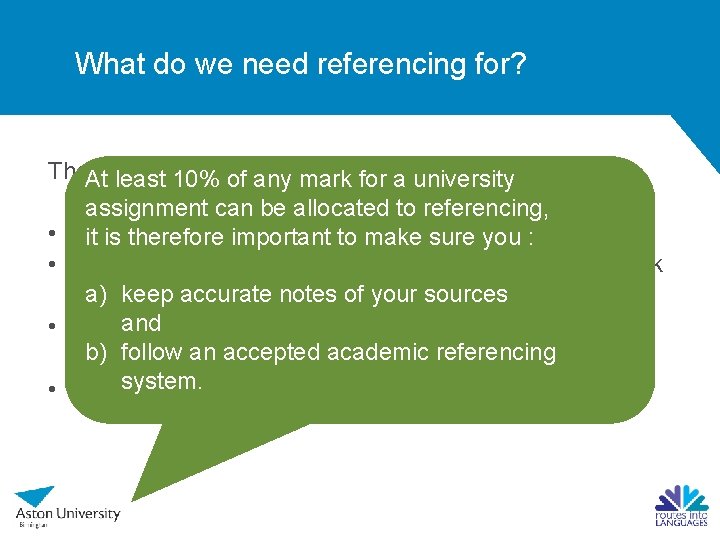
What do we need referencing for? The. Atpurposes are: least 10%ofofreferencing any mark for a university assignment can be allocated to referencing, • To other writers’ words it isacknowledge therefore important to make sureand youideas : • To demonstrate the range of sources used in your work a) keep accurate notes of your sources and provide some authority to your conclusions and readers of your work to locate and verify • To enable b) follow an accepted academic referencing your sources system. • To avoid plagiarism