
Module 4 Professional Driving Habits Purpose Understand the
Module 4 Professional Driving Habits
Purpose Understand the concept of Defensive Driving Understand that personal attitudes and defensive driving habits are key to preventing collisions. Link Defensive Driving with Visual Search Patterns, Timing, the IPDE process and the 6 Basic Conditions. In-depth discussion about the types of impairments and impairing effects on a drivers condition. Understand the importance of fatigue management
Defensive Driving The most influential factor to preventing a collision is?
Defensive Driving THE DRIVER
Defensive Driving Major factors to avoiding a collision: Driver’s skills Knowledge Habits Attitudes Physical and mental condition
Elements of Defensive Driving To successfully avoid collisions, the professional driver requires a high degree of: Driver’s skills Knowledge Alertness Foresight Skill Good Habits
Knowledge Gained from formal training Practice Experience
Alertness Staying focused Free of distractions Detecting hazards Mental alertness
Foresight Ability to anticipate Assess traffic situations far ahead Predict hazards
Judgment Recognition of alternatives in any traffic situation Ability to make proper choices to avoid a collision Knowledge and experience Critical thinking skills Intuition
Skill Ability to manipulate the controls of the vehicle Perform basic traffic manoeuvres Turns, passing, reversing, parking etc. Develop skills through learning Mastering the skill by doing them the right way every time
Good Habits Developed by consciously practicing the proper way Performance becomes instinctive Good visual search patterns
Review Defensive drivers are PRO-ACTIVE rather than RE-ACTIVE. Elements of Defensive Driving are: Knowledge Alertness Judgment Foresight Skill Good Habits
Steps for Avoiding Hazards Defensive Drivers utilize the IPDE Method of driving: Identify Predict Decide Execute
The IPDE Method Recognizing potential hazards before they become a real hazard Early recognition allows the time you need to avoid trouble Proper eye use is vital to see potential dangers
Step 1 - Identify The driver must be able to identify any real or potential hazards or dangerous situations. Early recognition allows the time you need to avoid trouble Proper eye use is vital to see potential dangers
Step 1 - Identify A REAL HAZARD: Is happening and will require an action from the driver YOU MUST REACT What is some examples of REAL Hazards?
Step 1 - Identify A POTENTIAL HAZARD: Might happen and may require an action from the driver YOU MAY HAVE TO REACT What is some examples of POTENTIAL Hazards?
Step 2 - Predict likely outcomes for Real Hazards REAL Hazards?
Step 2 – Predict Continued Predict likely outcomes for Potential Hazards?
Step 3 - Decide WHAT DID YOU DECIDE TO DO?
Step 4 - Execute Put your plan into action Steer? Brake? Accelerate?
The IPDE Method Review As a group, think of 5 real and 5 potential hazards Complete the entire IPDE process for each How did you do?
The IPDE Method Review The sooner you IDENTIFY The sooner you can PREDICT The sooner you can DECIDE The sooner you can EXECUTE
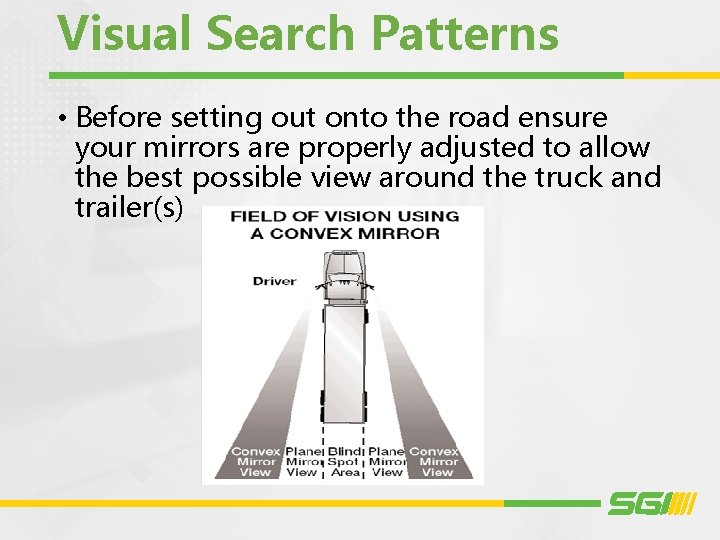
Visual Search Patterns • Before setting out onto the road ensure your mirrors are properly adjusted to allow the best possible view around the truck and trailer(s)
Visual Search Patterns Continued As the 6 basic conditions change, so should your visual search patterns. Highway Urban areas Night Emergency
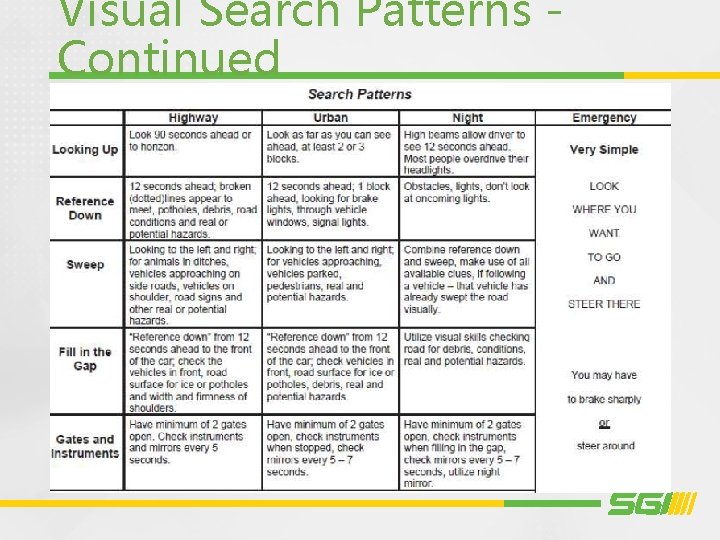
Visual Search Patterns Continued
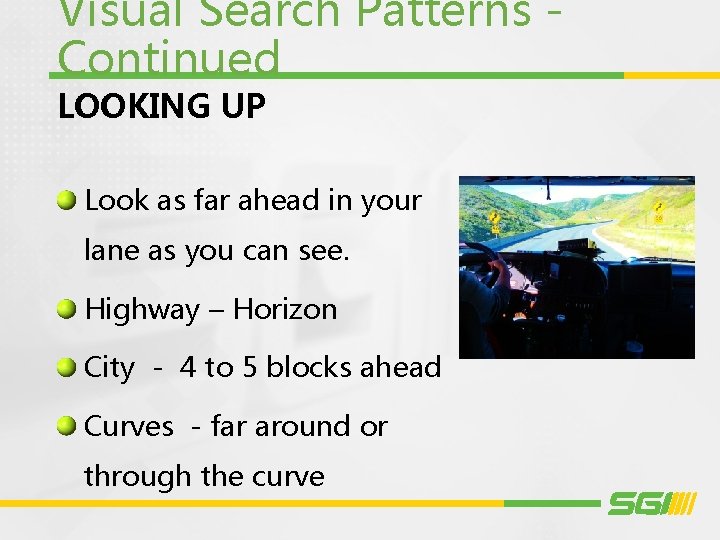
Visual Search Patterns Continued LOOKING UP Look as far ahead in your lane as you can see. Highway – Horizon City - 4 to 5 blocks ahead Curves - far around or through the curve
Visual Search Patterns Continued REFERENCING DOWN Bring your eyes down from the LOOK UP position to 12 seconds in front of your vehicle The faster you are traveling - the further away the 12 seconds will be Urban areas – a block to a block and a half ahead.
Visual Search Patterns Continued SWEEP Sweep your eyes from left to right Sweep your eyes from the LOOK UP position to the reference down point - 12 seconds Better field of vision More aware of the hazards
Visual Search Patterns Continued FILLING IN THE GAP Scan the space from your 12 second reference point to the front of the truck. Look for pot holes, tail lights, smaller vehicles
Visual Search Patterns Continued MIRRORS AND GATES Check your mirrors Check is someone is in your front gate Make note of any vehicles you follow or are following you Check your mirrors every 7 to 10 seconds Know what's going on around your vehicle
Visual Search Patterns Continued CHECK YOUR INSTRUMENT PANEL Check gauges when safe Avoid taking your eyes off the road Rely on your other senses to help Keep an eye on the vital gauges
Visual Search Patterns Continued PROPER SEQUENCE Look up Reference down Sweep left to right Fill in the gap Mirrors/gates & gauges
Visual Search Patterns Continued EMERGENCY EYE USE LOOK & STEER WHERE YOU WANT TO GO
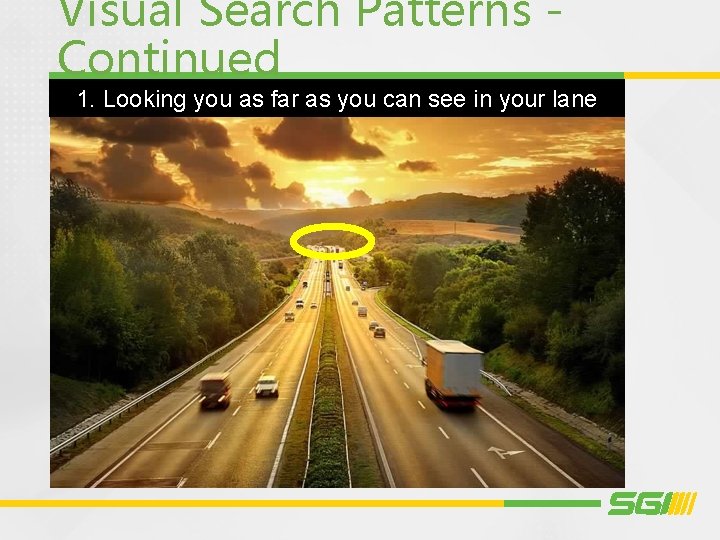
Visual Search Patterns Continued 1. Looking you as far as you can see in your lane
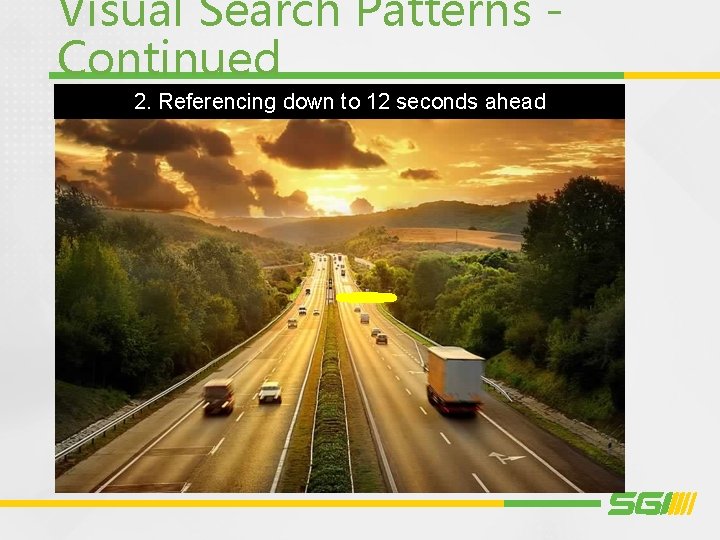
Visual Search Patterns Continued 2. Referencing down to 12 seconds ahead
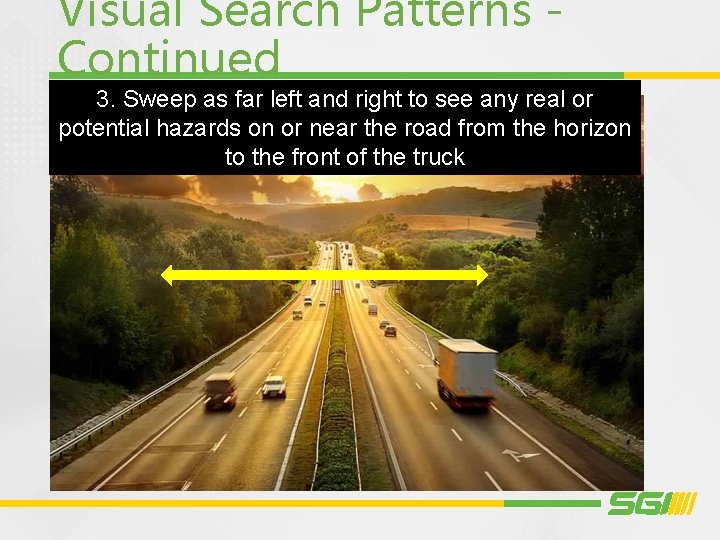
Visual Search Patterns Continued 3. Sweep as far left and right to see any real or potential hazards on or near the road from the horizon to the front of the truck
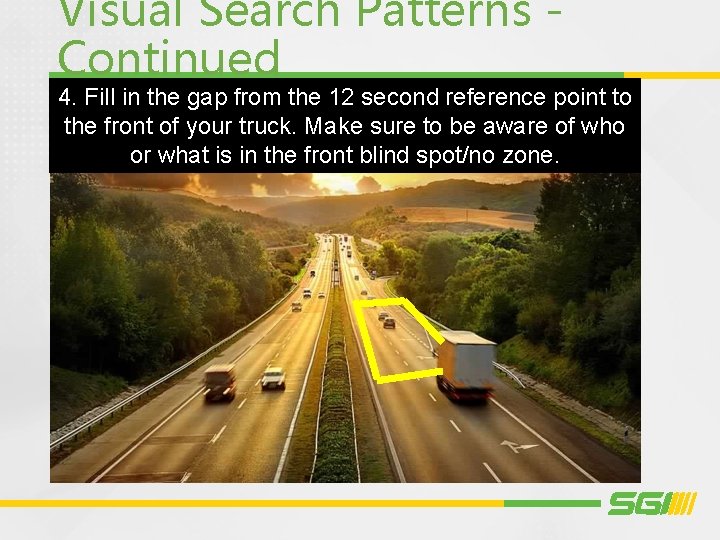
Visual Search Patterns Continued 4. Fill in the gap from the 12 second reference point to the front of your truck. Make sure to be aware of who or what is in the front blind spot/no zone.
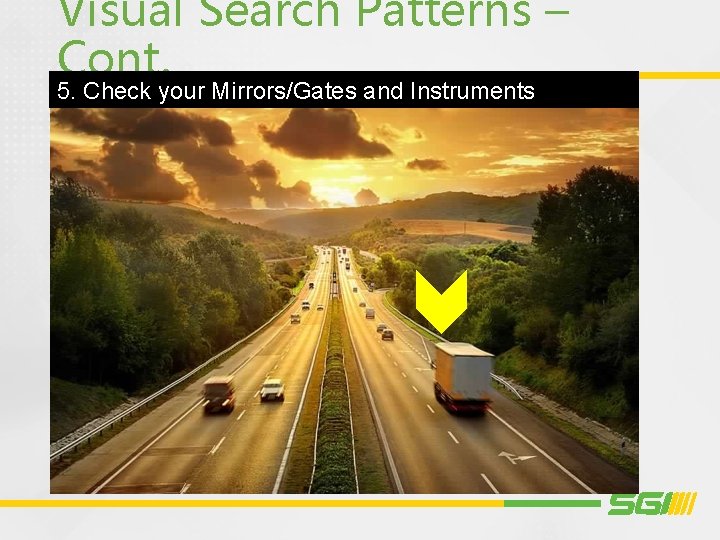
Visual Search Patterns – Cont. 5. Check your Mirrors/Gates and Instruments
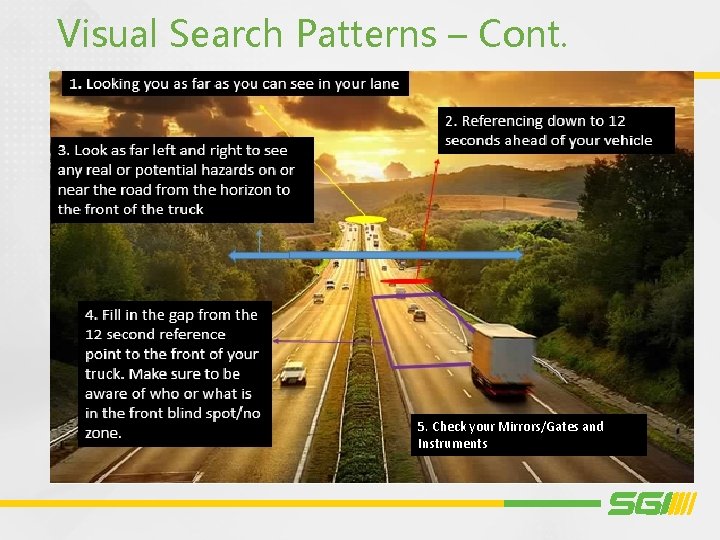
Visual Search Patterns – Cont. 5. Check your Mirrors/Gates and Instruments
Visual Search Patterns – Cont. Visual search patterns should be completed every 5 to 10 seconds Don’t let your eyes fixate on one spot too long This can be especially dangerous on the highway as it creates HIGHWAY HYPNOSIS
Review What are the 4 types of visual search patterns?
Review - Answer Highway Urban Night Emergenc y
Review In what sequence should we train our eyes to move?
Review - Answer Look up Reference down Sweep left to right Fill in the gap Mirrors/gates & gauges
Review What are the benefits of using your eyes properly?
Review - Answer Identify sooner Predict sooner Decide sooner And Execute sooner
Review Visual search patterns help to prevent what from happening?
Review - Answer Eye fixation Highway hypnosis Delayed reactions
The 6 Basic Driving Conditions There are six basic conditions in any driving situation Your ability to adjust to these conditions will increase your chances of avoiding a collision It is the driver’s responsibility to adjust to these changing
The 6 Basic Driving Conditions These changes can be minor to very serious Can require little to no adjustments A driver may need to get off the road completely
The 6 Basic Conditions – Cont. What are the 6 basic conditions?
The 6 Basic Conditions – Cont. Driver Weather Vehicle Road Light Traffic
The 6 Basic Conditions – Con’t LIGHT CONDITIONS SEE and BE SEEN Natural vs artificial Night driving Glare from the sun Reflections Other head lights Smoke Fog Over cast Sunrise and Sunset
The 6 Basic Conditions – Cont. WEATHER CONDITIONS Rain Extreme heat Snow Affects visibility, Fog traction and High Winds vehicle control
The 6 Basic Conditions – Weather Cont. WEATHER CONDITIONS What do you consider IDEAL weather conditions?
The 6 Basic Conditions – Cont. ROAD CONDITION Ice and Snow Gravel Rain Mud hydro-plane Divided highway Road debris Secondary road Pot holes Two-lane road
The 6 Basic Conditions – Cont. TRAFFIC CONDITIONS Number of vehicles Type of Vehicles Pedestrians Time of Day - Time of Year Traffic Volume Location Urban vs Highway Residential vs City Centre School Zone – Play ground
The 6 Basic Conditions – Cont. VEHICLE CONDITION Proper maintenance Tires - properly inflated, proper tread depth Windshield Major vs minor defects Season ready Wear and tear
The 6 Basic Conditions – Cont. DRIVER CONDITION Mental and physical Skill level: sharpness/ health inexperienced vs Zero impairment experienced Zero Distractions Knowledge Proper fatigue Confidence management
The 6 Basic Conditions – Cont. THE MOST IMPORTANT CONDITION DRIVER CONDITION
The 6 Basic Conditions – Driver Cont. RECOGNITION AND DECISION ERRORS Both of these can potentially arise from diminished mental or physical condition of the driver. They can also arise from POOR CHOICES
The 6 Basic Conditions – Driver Cont. RECOGNITION ERRORS Distraction (psychological, environmental, situational) General Inattention blindness Failing to identify changing conditions Improper visual search patterns (fixation)
The 6 Basic Conditions – Driver Cont. DECISION ERRORS Speed Risk taking Failing to adapt to changing conditions Failing to obey traffic control indicators and laws
The 6 Basic Conditions – Driver Cont. CIRCUMSTANCES OF RECOGNITION ERRORS Stress that diminishes Money or Family a drivers capacity to issues operate a vehicle Time pressures Health problems Distractions from in and out of the vehicle
The 6 Basic Conditions – Driver Con’t CIRCUMSTANCES OF DECISION ERRORS Inattention Environmental distractions Conscious choices to disregarding laws Over confidence – violate laws and rules of driving Unconscious decision errors – not identifying potential hazards Time management
Review What are the 6 Basic Conditions?
Review - Answers Driver Vehicle Light Weather Road Traffic
Review What are the categories of errors?
Review - Answer Recognition Decision
Review What is the most important condition?
Review - Answer DRIVER CONDITION
Impairing Factors of Driver Condition EFFECTS AND CONSEQUENCES OF IMPAIRING FACTORS ON DRIVER CONDITION Alcohol Drugs Road Rage Distracted Driving
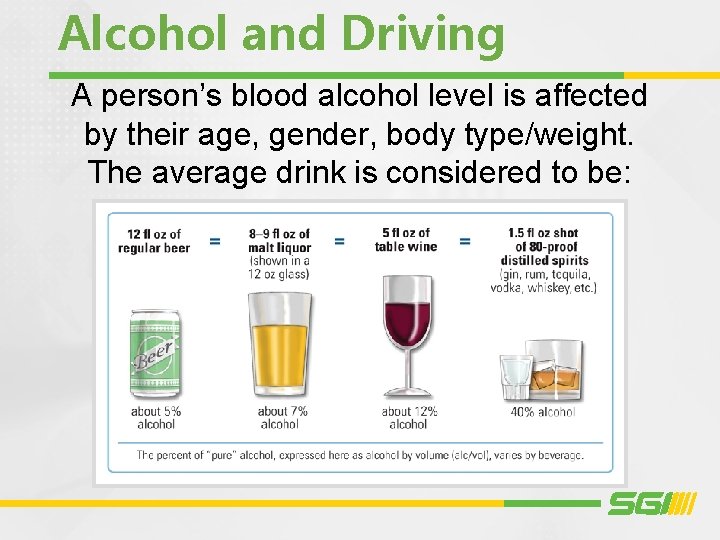
Alcohol and Driving A person’s blood alcohol level is affected by their age, gender, body type/weight. The average drink is considered to be:
Impaired Driving Drugs (prescribed, non-prescribed, or illegal) Driving under the influence of any drugs can affect your driving ability Ask your doctor or pharmacist about any potential side effects of your medication. Over the counter medication requires the same attention
Impairment Vs. BAC Impairment is how you feel with the level of alcohol in your system BAC or Blood Alcohol Content is based 100% on the amount of Alcohol you consume Alcohol is measured in milligrams of alcohol per 100 milliliters of blood 0. 04% BAC = 40 mg/100 ml 0. 08% BAC = 80 mg/100 ml
Impairment is different than BAC (Blood Alcohol Content) begins with the very first drink. Impairment can be influenced by: Rate of consumption Age Gender Body weight and type Food consumption Medication and Drugs Environment and Mood Fatigue and Stress Tolerance to alcohol
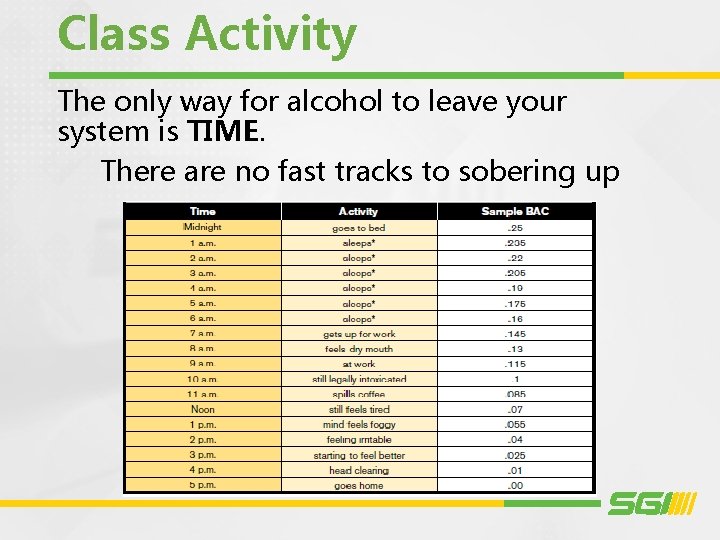
Class Activity The only way for alcohol to leave your system is TIME. There are no fast tracks to sobering up
10 Impairing Effects of Alcohol 1. Reasoning/Judgment 2. Inhibitions 3. Memory 4. Vision 5. Speech 6. Hearing 7. Muscular Coordination 8. Consciousness 9. Automatic Processes 10. Death
Reasoning/ Judgment Your reasoning/ judgment is affected by first drink. This effect may not be noticeable Inability to think clearly/rationally Inability to make good decisions Impulsive or acting without thinking a situation is common
Inhibitions are a mental process imposing restraint upon behavior or another mental process. When our inhibitions are impaired we may partake or demonstrate behaviors not typical to our personality. Overconfident Relaxed More outgoing Over emotional Dangerous, risky, impulsive behavior
Memory Repetitive Forgetful Unable to store/recall memories Blackouts
Vision Visual acuity reduced (blurred vision) Reduced ability to control eye movement Reduced Peripheral Vision = Tunnel Vision Lack of depth perception
Speech Words slurred or run together Too loud for situation Volume fluctuates for no reason Slow or rapid Using wrong words or no words at all
Hearing Auditory acuity is reduced Sounds are muffled Tolerance for loud noise increases Unable to determine the direction of sounds Excessive alcohol consumption cause long term permanent hearing loss.
Muscle Coordination Fine Motor Skills affected Hand – eye coordination Overall clumsiness Putting key into ignition Gross Motor Skills affected Legs weaken Loss of balance Bumping into things Slower reaction time or NO reaction time
Consciousness Alcohol induced sleepiness Brain impaired beyond ability to function Loss of consciousness – Pass out Coma
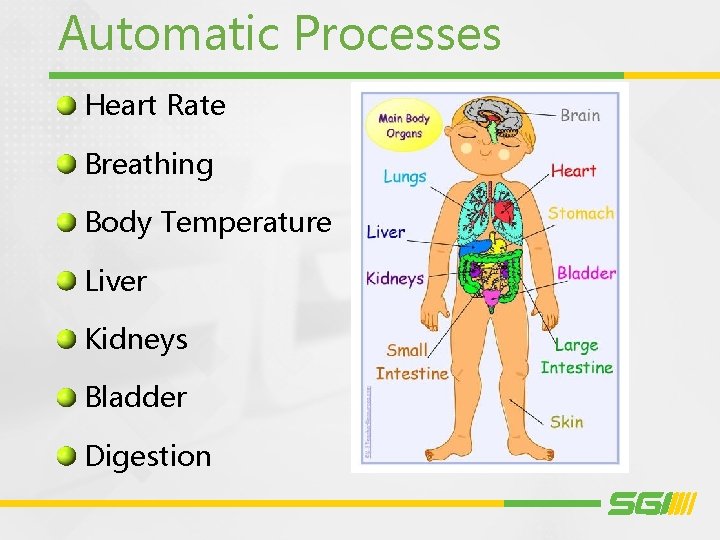
Automatic Processes Heart Rate Breathing Body Temperature Liver Kidneys Bladder Digestion
Death Can occur during any of the previous stages Brain activity surges and then stops Body temperature drops Muscles tense – Rigor Mortis When Muscles relax all bodily fluids are released
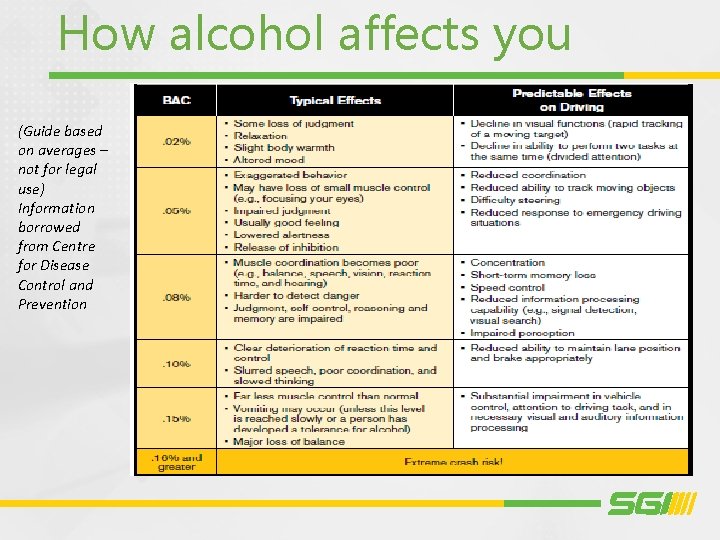
How alcohol affects you (Guide based on averages – not for legal use) Information borrowed from Centre for Disease Control and Prevention
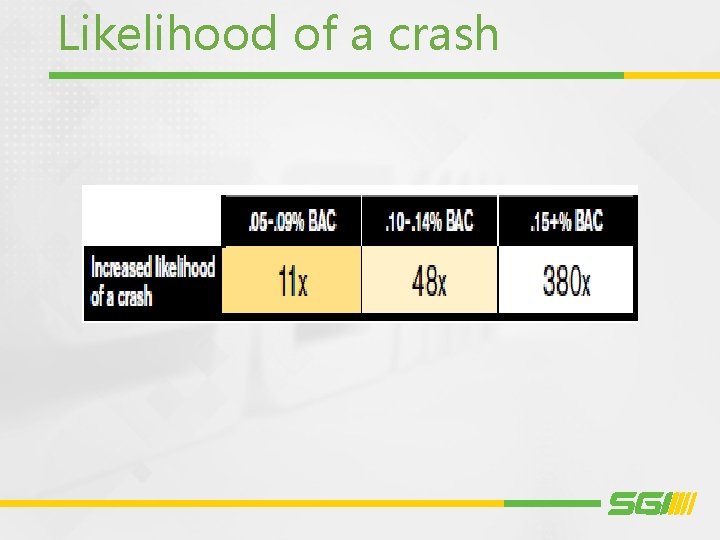
Likelihood of a crash
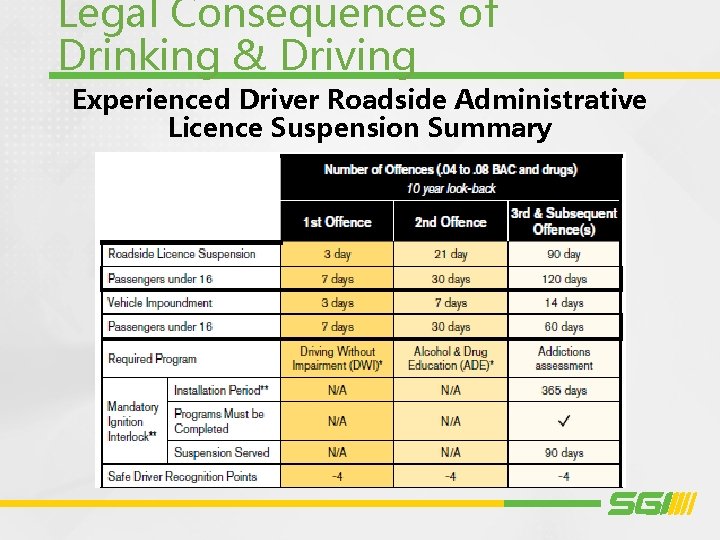
Legal Consequences of Drinking & Driving Experienced Driver Roadside Administrative Licence Suspension Summary
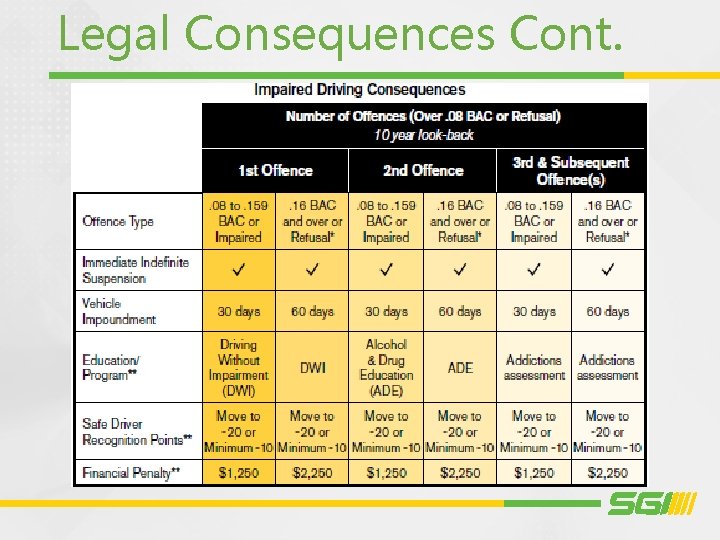
Legal Consequences Cont.
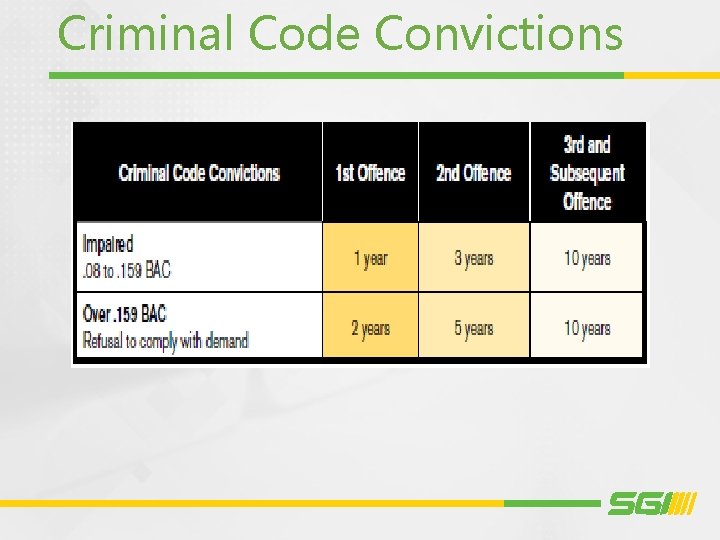
Criminal Code Convictions
Drugs and Driving High is a DUI Over the counter medication Tylenol, Advil, Nyquil, Sudafed, Gravol Prescription medication Morphine, Valium, Ritalin, Prozac Illegal Drugs Marijuana, Ecstasy, Cocaine, Heroin, Opium, Crystal Meth, Amphetamine, LSD, Speed, Inhalants, PCP
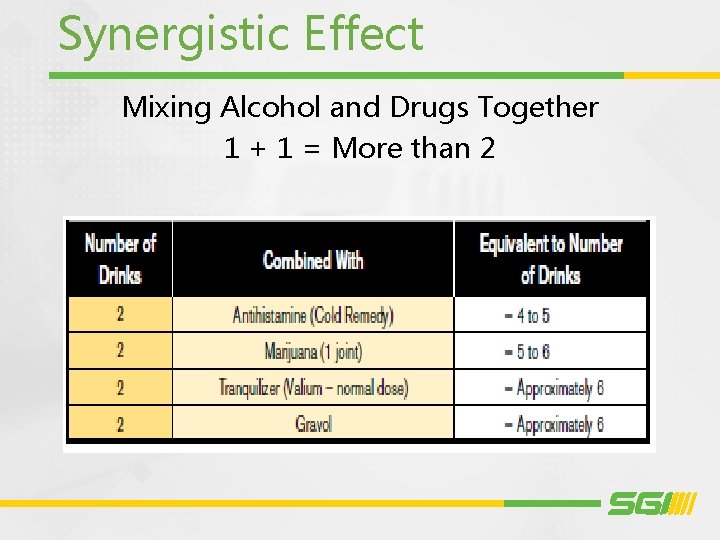
Synergistic Effect Mixing Alcohol and Drugs Together 1 + 1 = More than 2
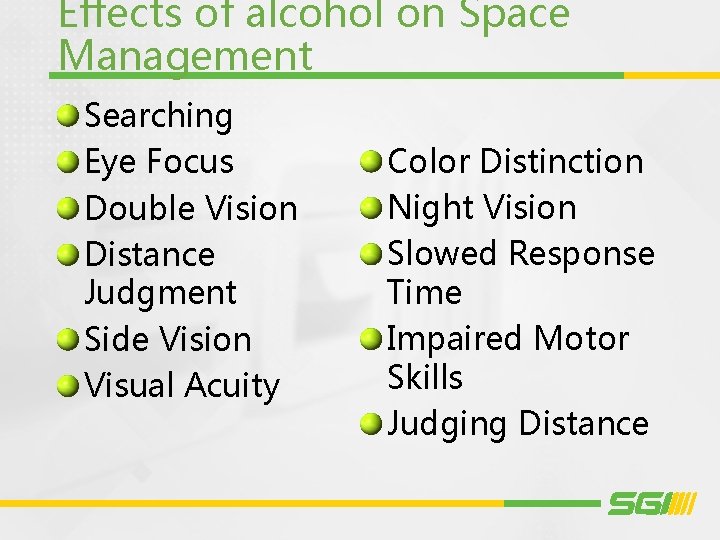
Effects of alcohol on Space Management Searching Eye Focus Double Vision Distance Judgment Side Vision Visual Acuity Color Distinction Night Vision Slowed Response Time Impaired Motor Skills Judging Distance
Alcohol and Drugs Review 1. What Does BAC stand for? Blood Alcohol Content 2. What can lower BAC levels? Time 3. At what rate does alcohol leave the body? 0. 015% per hour
Alcohol and Drugs Review – Cont. 4. What Is it called when you mix Drugs and Alcohol? Synergistic Effect 5. What are the 3 categories of Drugs? Prescription, Over the counter, Illegal 6. What BAC limit will result in a Criminal Code Conviction? . 08%
Fatigue and driving FATIGUE Lack of sleep Medications Driving alone Driving long distances Driving at times the body is used to being asleep
Fatigue and Driving – Cont. Stress Anxiety Illness – flu or cold to chronic illness Injuries
Fatigue and Driving – Cont. Pre-Trip Mental Inventory Am I fully rested? Am I free from alcohol or other drugs? Am I feeling healthy? Am I able to concentrate on driving? Is my attitude courteous, careful and considerate?
Fatigue and Driving – Cont. Warning signs of driver fatigue Yawning Inability to keep eyes focused and head up Having wandering, disconnected thoughts Driving the past few kilometres without remembering them. (highway hypnosis) Drifting between lanes Tailgating or missing traffic signs Noticing a vehicle in the rear-view mirror that seemed to appear out of nowhere
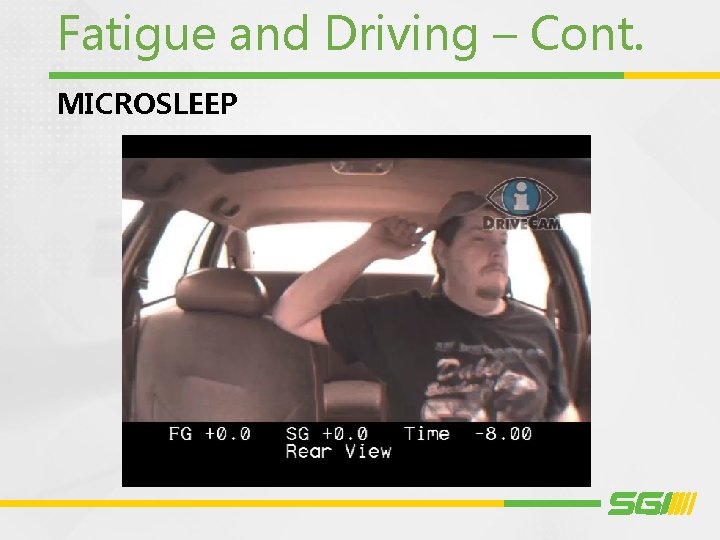
Fatigue and Driving – Cont. MICROSLEEP
Managing Driver Fatigue The following actions will help prevent driver fatigue: Stop if you become sleepy while on the road Get plenty of sleep the night before a long trip Avoid working all day and then driving all night. Stay overnight rather than driving straight through Schedule a break every two hours or every 160 km Stretch or take a walk to get some fresh air Take a mid-afternoon break. Have a 20 -40 -minute nap Travel with an awake and alert passenger or let them drive
Fatigue and Driving Review What causes fatigue?
Fatigue and Driving Review Lack of sleep Medications Driving alone Driving long distances Driving at times the body is used to being asleep
Road Rage What is road rage? What can we do to minimize it? I don’t get road rage – but how much do I create?
Road Rage – Cont. TIPS TO AVOID ROAD RAGE Plan your route in advance Don’t bring your problems with you on the road Recognize stress and try to reduce it Be courteous to other motorists Don’t take someone else’s road rage personally
Distracted Driving Visual – Takes your eyes off the road Manual – Takes your hands off the steering wheel Cognitive – Takes your mind off the driving task Fines for distracted driving - $280. 00 and 4 demerit points on your licence.
Distracted Driving Law The distracted driving law applies to all vehicles as defined in The Traffic Safety Act and distractions are not limited to the use of cellular phones, and include activities such as: Reading printed materials Writing, printing or sketching Personal grooming (brushing teeth, flossing, putting on makeup, shaving) Using electronic devices such as laptop computers, cameras, video entertainment displays and programing portable audio players (e. g. MP 3 players)
Managing Driver Condition Emotions and Distractions SDP technique – Stop, Drop and Process STOP – Stop and think before you act Drop – Reduce the intensity of your emotions Process - Think about it!!
Distracted Driving – Cont. DISTRACTION IS A CHOICE! Keep your attention where it belongs and use the Basic Collision Prevention Formula: Collisions can be avoided if you practice IPDE: 1. Identify - Recognize the hazard 2. Predict – Predict the possibilities 3. Decide – Make a decision 4. Execute - Act in time
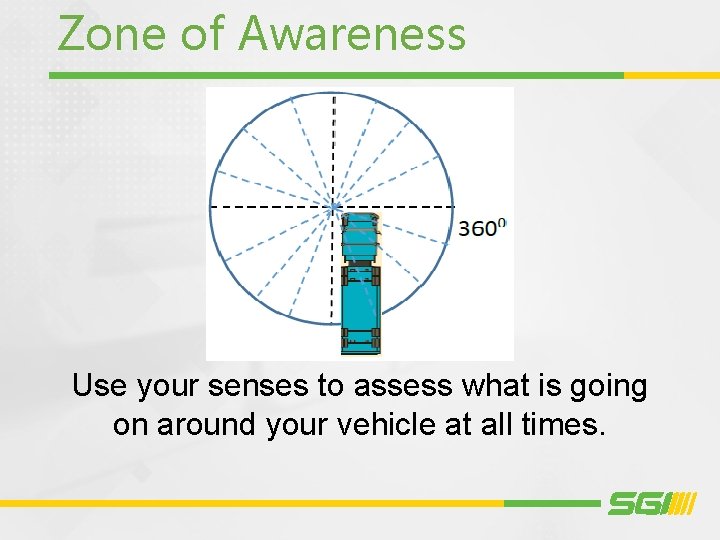
Zone of Awareness Use your senses to assess what is going on around your vehicle at all times.
Use your senses Which senses will help you with your driving task? Vision Hearing Feel Smell Taste
Senses Cont. There are two interesting facts related to vision that you should be aware of: Speed Peripheral vision is decreased as we travel faster Steering We steer where we look
Visual Search Patterns Continuously scanning our surroundings on and off the road leads to good visual habits. Specifically: Look up Reference down Sweep Fill in the Gap Mirrors/Gates & Gauges
Good Visual Habit Tips Night driving Glare Unobstructed view Road side obstruction Other vehicles/Traffic
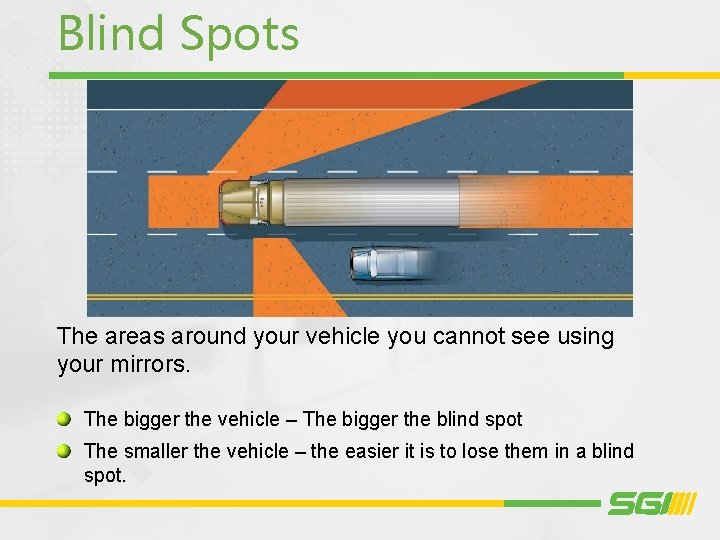
Blind Spots The areas around your vehicle you cannot see using your mirrors. The bigger the vehicle – The bigger the blind spot The smaller the vehicle – the easier it is to lose them in a blind spot.
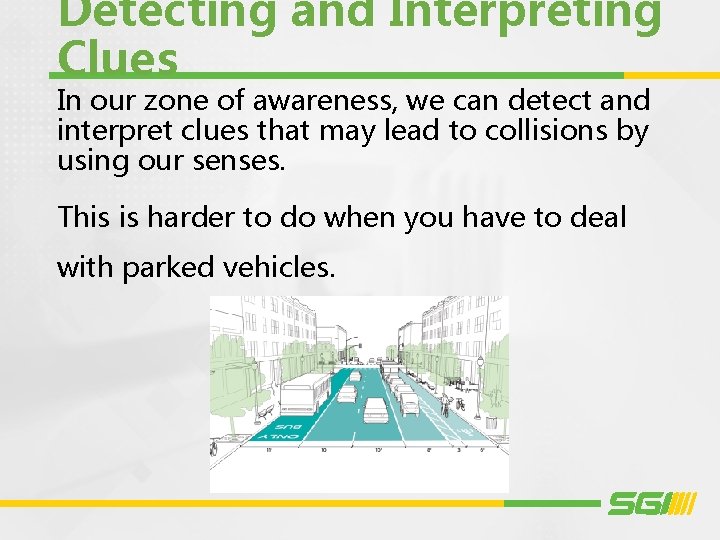
Detecting and Interpreting Clues In our zone of awareness, we can detect and interpret clues that may lead to collisions by using our senses. This is harder to do when you have to deal with parked vehicles.
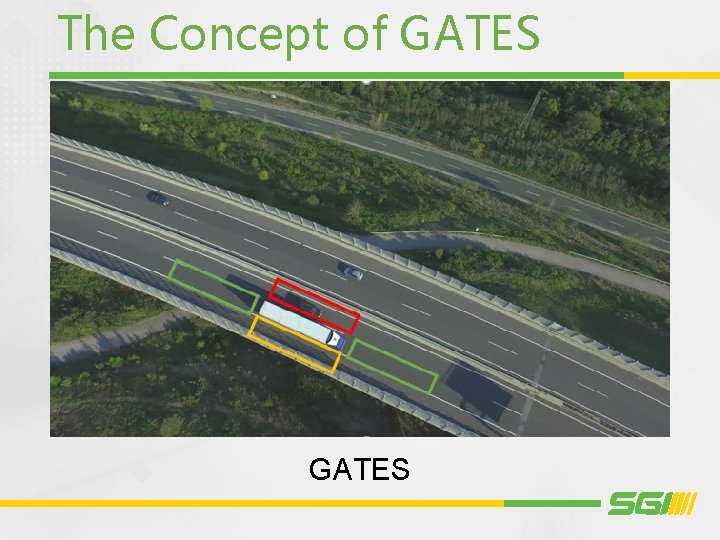
The Concept of GATES
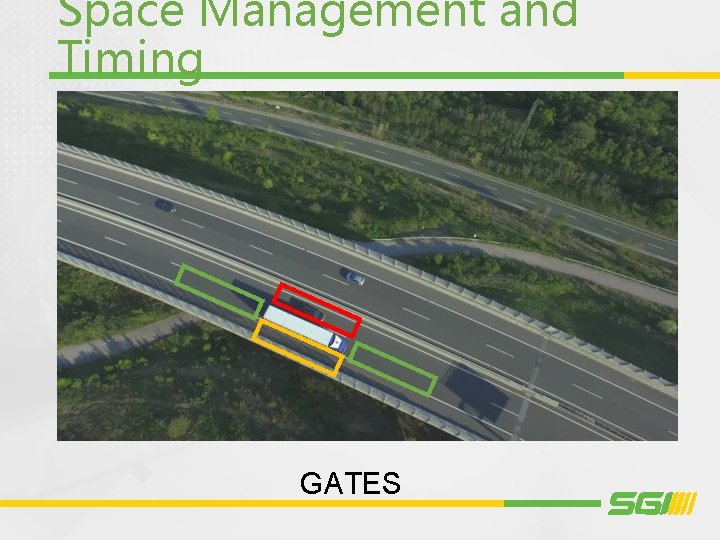
Space Management and Timing GATES
Space and Timing The amount of space you want to create and manage in front of you depends on a few factors: Speed Weight Height Length and size of your vehicle
Space and Timing Counting can be used for many driving situations: Fixed objects Following distance Passing Turns Stopping Building speed Entering or exiting a highway or freeway
Determining the Following Distance If you drive a power unit, semi trailer, bus, truck or truck and trailer, round out the length of the vehicle to the nearest metre and divide by three to determine your following distance. • Example: If your truck and trailer is 14. 6 m, round to 15 m, then divide by three. 15 = 5 -second count 3
When to increase your following distance Oversize vehicles that obscure your vision Dangerous goods carriers Vehicles that stop frequently, such as delivery vans, school buses, etc. Two-wheeled vehicles - motorcycles/bicycles Vehicles being driven erratically Emergency vehicles
Space and Timing Review 1. How do we measure space? In seconds 2. How do we count it out? Thou-sand one, Thou-sand two, etc. 3. How do you determine what your following distance should be in a truck? Your total length to the nearest metre divided by 3
Types of Collisions Vehicles behind - Rear end Oncoming – Head on Loss of control Intersection or Angle – Turning Vehicles passing you – side swipe, cut off, run off the road
Collisions with the vehicle behind Tailgaters Speed IPDE
Collisions with Oncoming Vehicles 1. Why do they happen? 2. How can we avoid them?
Collisions at Intersections 1. Why do they happen? 2. How can we avoid them?
Collisions Caused by Vehicles Passing You 1. What to watch for/warning signs 2. 3 types of collisions 3. How can we avoid these situations
Collisions Caused by You Passing üIs it safe üIs it Legal üIs it Necessary
Space Management Above Beneath What to look for How to manage
Speed Management 1. What does speed effect? 2. What is meant by IDEAL CONDITIONS? 3. Who is responsible to adjust the speed of the vehicle?
Consequences of Speeding Fines Safe Driver Recognition Program Driver Improvement Program
Stopping a Moving Vehicle In order to stop a moving vehicle a driver needs to perform three actions: 1. See 2. Think 3. Do
Stopping a Moving Vehicle – Cont. The distance a commercial vehicle needs to stop is affected by the following four factors: 1. Brake Condition 2. Traction 3. Weight 4. Speed
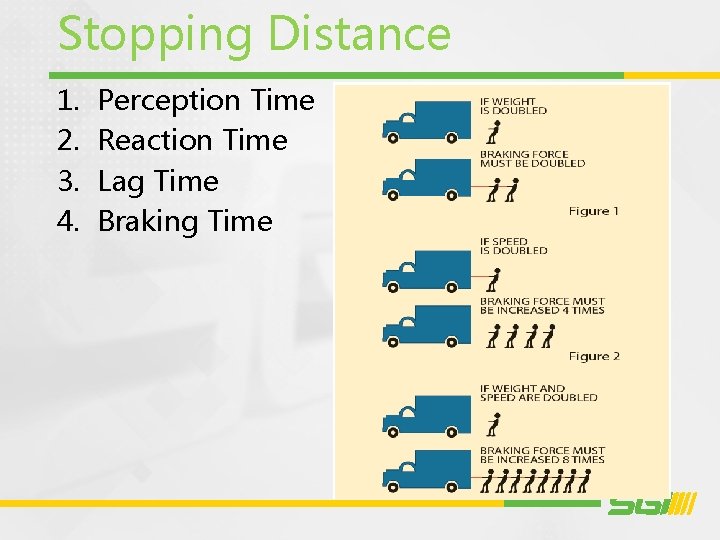
Stopping Distance 1. 2. 3. 4. Perception Time Reaction Time Lag Time Braking Time
Emergency Driving Techniques Skid control and the professional driver: Loss of traction: Tire failure Faulty brakes Excessive acceleration or speed in curves Rough or slippery surfaces Hydroplaning Jackknifing
Jackknifing You do not Jackknife unless you skid. 1. The Dangers of Jackknifing 2. Tractor Jackknifing 3. Trailer Jackknifing 4. Recovery / Steering 5. Avoidance
Braking ABS Threshold Panic
Tire Blow Out Tire air leaks How to control if a tire blows
Loss of Brakes Signs of a Brake Failure How to handle the emergency situation Note: If loss of air drops below 70 psi, it is likely the spring brakes have started applying. If you don’t get to a safe spot to park before air pressure drops between 20 to 45 psi, you may be stranded in the driving area of the highway.
Loss of Visibility Headlights Fail The Hood Flies Up Mud or Slush on the Windshield
Emergency Evasive Action Controlled emergency Braking Quick Steering with or without Braking Leaving the paved portion of the road
Fueling and Fuel Efficiency Diesel and Propane Vehicles: The Do’s and Don'ts of fueling
Fuel Efficiency Your driving habits can reduce the amount of fuel you burn. Some tips for fuel efficient driving: Weather Preventative Maintenance Proper warm up Idling
Review What are some conditions that can affect your fuel efficiency?

Review WIND SNOW COVERED ROADS
Review What are some truck specific areas that create a less fuel efficient situation?
Review UNDER INFLATED TIRES UNNECESSARY THROTTLE
Summary A proactive driver is a safe driver. Driving while fatigued can be just as dangerous as driving impaired. Following too close is one of the primary causes of collisions. Keeping your emotions in check will help you avoid road rage. Proper visual search patterns are the best way to avoid a collision. A good driver makes proper choices and avoids impaired driving. ZERO TOLERANCE
- Slides: 154