
Module 4 Normal Gait 1 B Static Assessment
Module 4: Normal Gait 1 B: Static Assessment: Posture & Balance
References • Winter, DA. (1995). Human balance and posture control during standing and walking. Gait & Posture, December, No 3, 193 to 214. (pdf available on ANGEL) • Perry, J and Burnfield, J. (2010). Gait Analysis: Normal and Pathological Function 2 nd edition. Chs 1 to 3. • Levangie, P. and Norkin, C. (2011). Joint Structure & Function: A Comprehensive Analysis 5 th Edition. Ch. 1 (pg 4 to 10) and 13. • Recommended: – Magee, DJ. (2008). Orthopedic Physical Assessment, 5 th edition. Ch 15. (pdf available on ANGEL) • Other referenced Journal Publications.
Agenda • • A. Standing Posture Inputs – 1. Visual – 2. Somatosensory – 3. Proprioceptive – 4. Vestibular B. Quiet Standing Variables of Interest – 1. Kinematics – 2. Base of Support (Bo. S) – 3. Kinetics • • a. Center of Mass (Co. M) b. Line of Gravity (Lo. G) c. Center of Gravity (Co. G) d. Ground Reaction Force (GRF) • e. Center of Pressure (Co. P) • C. Postural Control – 1. Muscle Synergies – 2. Kinetics & Kinematics of Posture – 3. Optimal Sagittal Plane Posture • D. NHL vs. Pathological
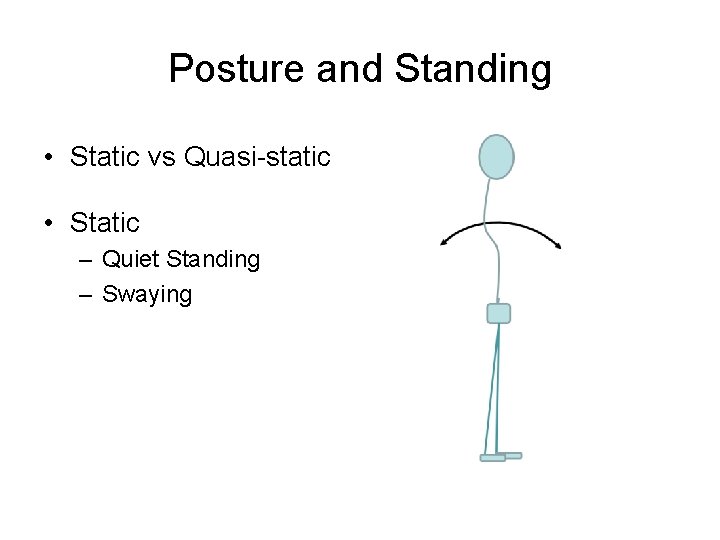
Posture and Standing • Static vs Quasi-static • Static – Quiet Standing – Swaying
Posture and Standing, continued • Static – Quiet Standing – Postural Sway • Motion of body during quiet stance • Sway Envelope (when standing with feet approximately 4 inches apart) – 12°in Sagittal Plane – 16°in Frontal Plane • Perturbed Standing
Standing Posture Goals • So we don’t fall down • Decrease energy consumption • How does the body monitor standing balance?
A. Standing Posture Inputs • 1. Visual System
A. Standing Posture Inputs, continued • 2. Somatosensory System – Processes information about the somatic sensation • Pain, temperature, touch, proprioception
A. Standing Posture Inputs, 2 • 3. Proprioceptive Stimuli – Internal forces that are generated by the position or movement of a body part – Static forces on the joints, muscles and tendons, which maintain limb position against the force of gravity, indicate the position of a limb
A. Standing Posture Inputs, 3 • 3. Proprioceptive Stimuli (continued) – Movement indicated by dynamic changes in the forces applied to muscles, tendons and joints • Proprioception is critical for maintaining posture and balance – Somatosensory proprioceptive cues are combined with vestibular and visual cues to control motor responses to changes in body/head position • Assessment IMPORTANT for proper patient care! Source of Information: Neuroscience Online, Ch 10
A. Standing Posture Inputs, 4 • 4. Vestibular System – Inner ear membrane – Three semicircular ducts (horizontal, anterior and posterior) – Two Otolith organs (Saccule and Utricle) – Cochlea (mainly auditory) • Monitors orientation of the body with respect to gravity • During dynamics motion – adjust orientation with respect to self generated movements, and forces exerted from the outside world Source of Information: Neuroscience Online, Ch 10
A. Standing Posture Inputs, 5 • 4. Vestibular System, continued – 3 Semicircular Ducts • Oriented 90 degrees to each other • Act like accelerometers Source of Information: Neuroscience Online, Ch 10
A. Standing Posture Inputs, 6 • 4. Vestibular System, continued • Otolithic organs (Saccule & Utricle) – Lie against the walls of the inner ear between the semicircular ducts and the cochlea – Receptors (cilia) topped by small, calcium carbonate crystals called otoconia – As head tilts, cilia move & send signals to brain stem though the VIIIth nerve Source of Information: Neuroscience Online, Ch 10
B. Variables of Interest – Quiet Standing • 1. Kinematics – What specific joints / body segments? • 2. Base of Support • 3. Kinetics – What specific variables?
B. Variables of Interest – Quiet Standing, 2 § 1. Kinematics = Body Alignment – Sagittal and Coronal Plane § Ankle Angles § Knee Angles § Hip Angles § Pelvis Angles § Trunk Angles
B. Variables of Interest – Quiet Standing, 3 • 2. Base of Support (Bo. S) – Size – Shape Why would Bo. S be important to know?
B. Variables of Interest – Quiet Standing, 4 • 3. Kinetics • Location and velocity of Center of Pressure!
3. Kinetic Variables of Interest • • • a. Center of Mass (Co. M) b. Line of Gravity (Lo. G) c. Center of Gravity (Co. G) d. Ground Reaction Force (GRF) e. Center of Pressure (Co. P)
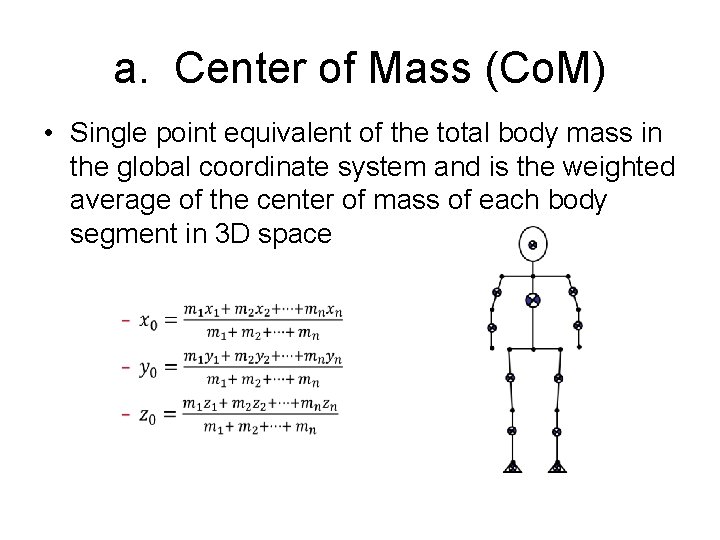
a. Center of Mass (Co. M) • Single point equivalent of the total body mass in the global coordinate system and is the weighted average of the center of mass of each body segment in 3 D space
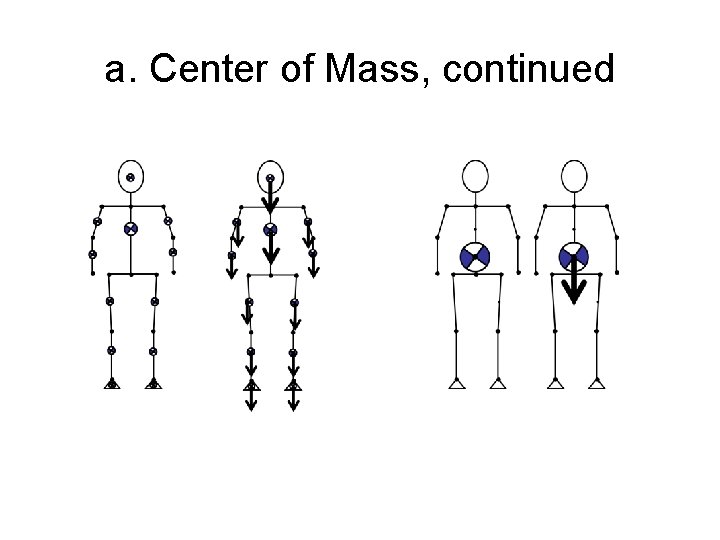
a. Center of Mass, continued
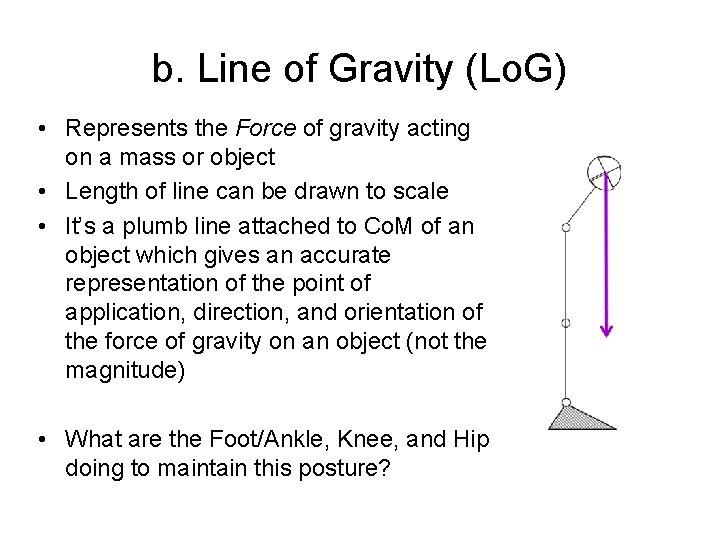
b. Line of Gravity (Lo. G) • Represents the Force of gravity acting on a mass or object • Length of line can be drawn to scale • It’s a plumb line attached to Co. M of an object which gives an accurate representation of the point of application, direction, and orientation of the force of gravity on an object (not the magnitude) • What are the Foot/Ankle, Knee, and Hip doing to maintain this posture?
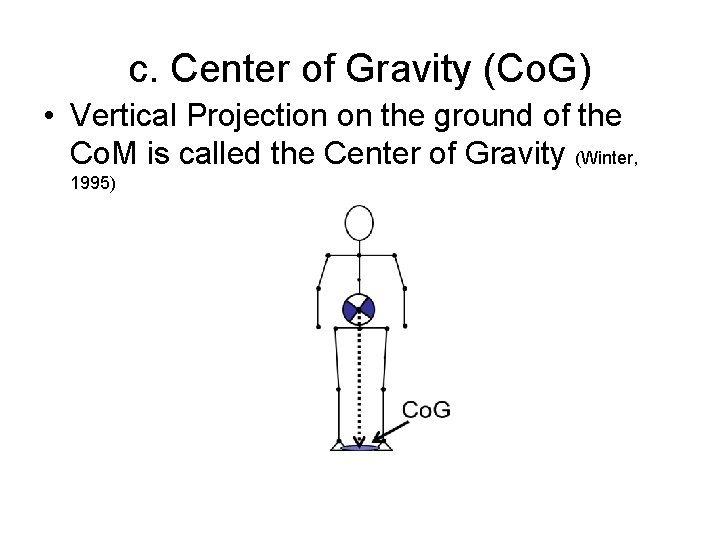
c. Center of Gravity (Co. G) • Vertical Projection on the ground of the Co. M is called the Center of Gravity (Winter, 1995)
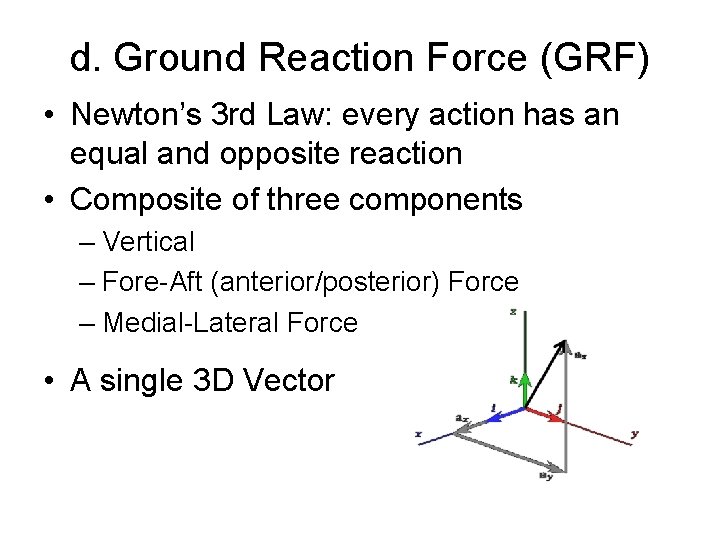
d. Ground Reaction Force (GRF) • Newton’s 3 rd Law: every action has an equal and opposite reaction • Composite of three components – Vertical – Fore-Aft (anterior/posterior) Force – Medial-Lateral Force • A single 3 D Vector
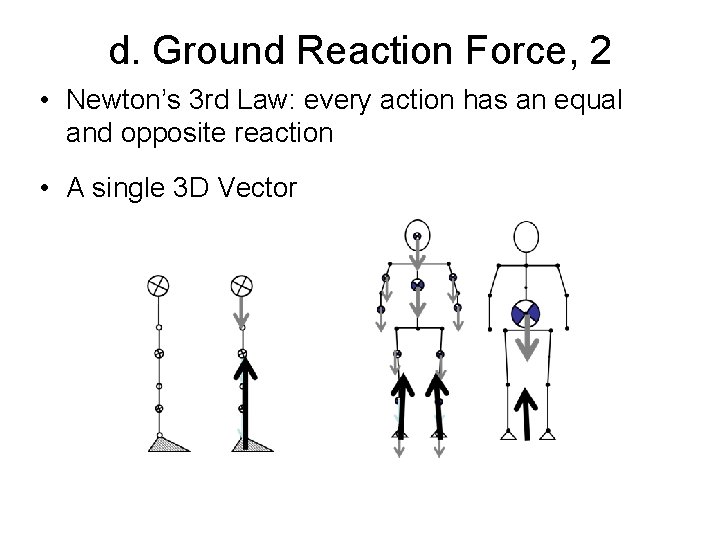
d. Ground Reaction Force, 2 • Newton’s 3 rd Law: every action has an equal and opposite reaction • A single 3 D Vector
e. Center of Pressure (Co. P) • The point location on the ground of the Ground Reaction Force (GRF) vector • Represents weighted averages of all the pressures of the surface area in contact with the ground – 1 foot on ground, Co. P lies under foot – 2 feet on ground, Co. P lies somewhere between the 2 feet • Location of Co. P under feet are direct reflections of the neuromuscular control – Explain?
e. Center of Pressure (Co. P), continued - Data • Stability maintained by keeping the body’s Co. M inside the Bo. S
e. Center of Pressure (Co. P), continued - Quiet Stance • Majority of Standing studies collect Kinetic data – – GRF Co. G Co. P Co. M • Relationship of Co. M to Co. P? – Co. M movement greater or less than Co. P?
Static Posture • Quiet standing balance can occur with little or no muscle activation when the body’s center of gravity (weight line) is aligned through the joint axes of the lower limbs (Perry, 1992) • Impossible because of body composition and structure, but we can get close!
Static Posture, continued • External Gravitational forces are relatively small • Weight of body • Little to no dynamic forces • Internal forces generated to balance the external forces • Small amount of muscle activity • Passive capsular tension • Ligamentous tension
Volunteer • Quiet Standing Posture • Crouch stance • Bent over at hip without knee bend • Other conditions? ?
C. Postural Control § Postural control (statically or dynamically) is a person’s ability to maintain stability of body and body segments in response to forces threatening to disturb equilibrium.
C. Postural Control, 2 • Primary control of balance is a learned function of the Central Nervous System (Horak et al. , 1997) – Sensors System – What? – Actuation – What? • Reactive Control – Actions in response to external forces • Proactive Control – Anticipatory response to internally generated forces, i. e. raising arms or bending over to pick up something
C. Postural Control, 3 • Static Posture Muscular control – Large amount or small amount?
C. Postural Control – 1. Muscle Synergies • Synergy - The interaction of elements that when combined produce a total effect that is greater than the sum of the individual elements. • Muscle Synergy - Groups of muscles that contract together to accomplish the same body movement.
1. Muscle Synergies in Balance • Ankle Strategy during quiet stance and small perturbations – Ankle plantar/dorsiflexors control Anterior/Posterior motion (Winter, 1995)
1. Muscle Synergies in Balance • Hip Strategy during quiet stance or small perturbations – Hip abductors/adductors control Medial/Lateral motion (Winter, 1995)

C. Postural Control 2. Kinetics & Kinematics of Posture • External Forces – Gravity – Inertia – Ground Reaction Forces • Internal Forces – Muscle activity – Passive tension in ligaments, tendons, joint capsules, and other soft tissues • In static posture: – Sum (External Forces) + Sum (Internal Forces) = ?
2. Kinetics & Kinematics of Posture, continued • Effect of external forces on body segments dependent on location/direction of GRF • GRF passes through a joint – No external gravitation moment created • GRF passes a distance away from a joint – Internal moment created to counterbalance • Muscular • Ligamentous • Bone on Bone • Direction of moment?
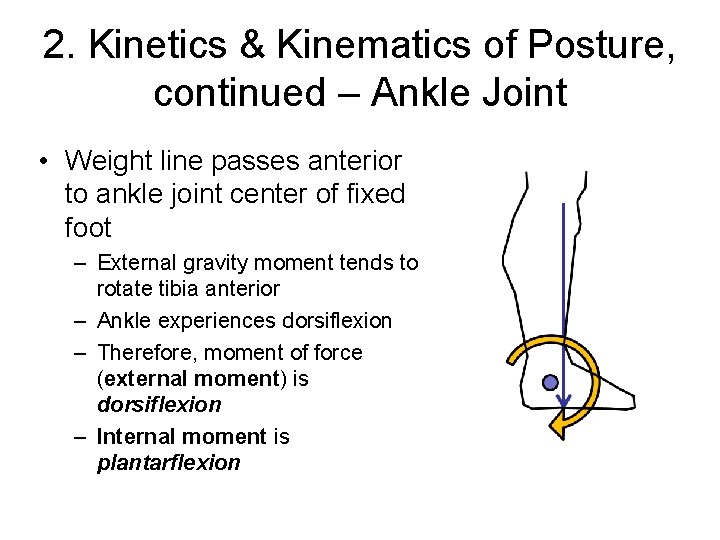
2. Kinetics & Kinematics of Posture, continued – Ankle Joint • Weight line passes anterior to ankle joint center of fixed foot – External gravity moment tends to rotate tibia anterior – Ankle experiences dorsiflexion – Therefore, moment of force (external moment) is dorsiflexion – Internal moment is plantarflexion
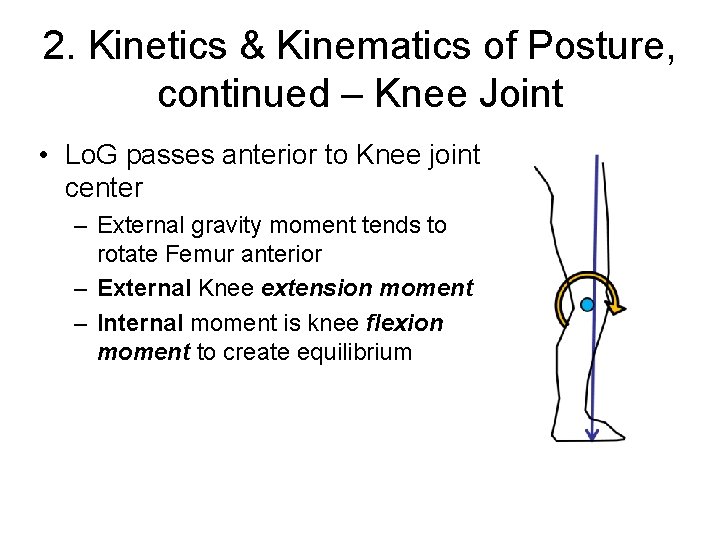
2. Kinetics & Kinematics of Posture, continued – Knee Joint • Lo. G passes anterior to Knee joint center – External gravity moment tends to rotate Femur anterior – External Knee extension moment – Internal moment is knee flexion moment to create equilibrium
3. Optimal Sagittal Plane Posture • Ankle – Position = Neutral – So, Lo. G is anterior (2 to 4 cm) to lateral malleoli – Creates an External Moment = Dorsiflexion Moment – Countered by an Internal Moment = Plantarflexor Moment – Requires Soleus and Gastrocnemius activity
3. Optimal Sagittal Plane Posture, 2 • Knee – Position = Full Extension – So, Lo. G anterior to midline of knee & posterior to Patella – Creates an External Moment = Extension Moment – Countered by Internal Moment = Flexor Moment – Requires passive tension in ligaments… – Limited data indicating EMG of Gastrocnemius and Hamstrings
3. Optimal Sagittal Plane Posture, 3 • Hip and Pelvis – Hip Position = Neutral – Position of Pelvis = Level – So, Lo. G passes slightly posterior to hip joint through greater trochanter – Creates an External Moment= Hip Extension Moment – Countered by Internal Moment = Hip Flexion Moment – Requires hip flexor activity
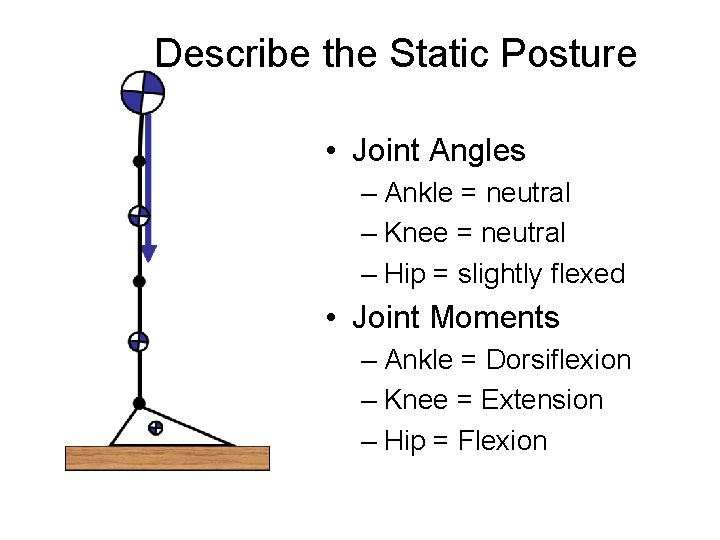
Describe the Static Posture • Joint Angles – Ankle = neutral – Knee = neutral – Hip = slightly flexed • Joint Moments – Ankle = Dorsiflexion – Knee = Extension – Hip = Flexion
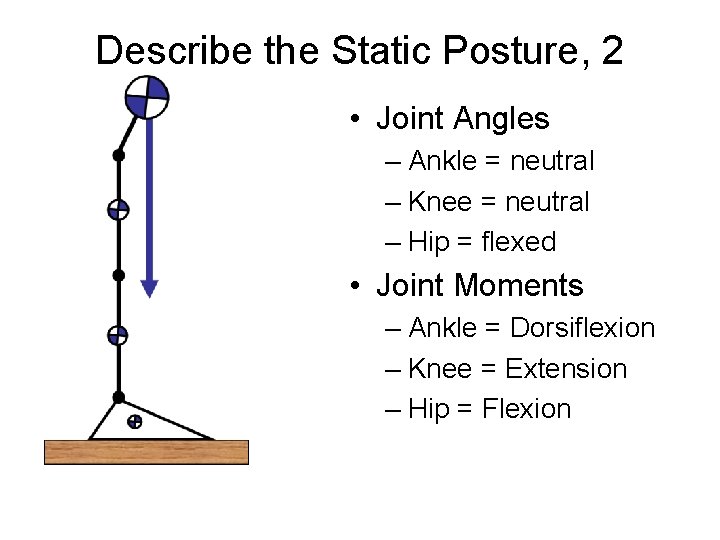
Describe the Static Posture, 2 • Joint Angles – Ankle = neutral – Knee = neutral – Hip = flexed • Joint Moments – Ankle = Dorsiflexion – Knee = Extension – Hip = Flexion
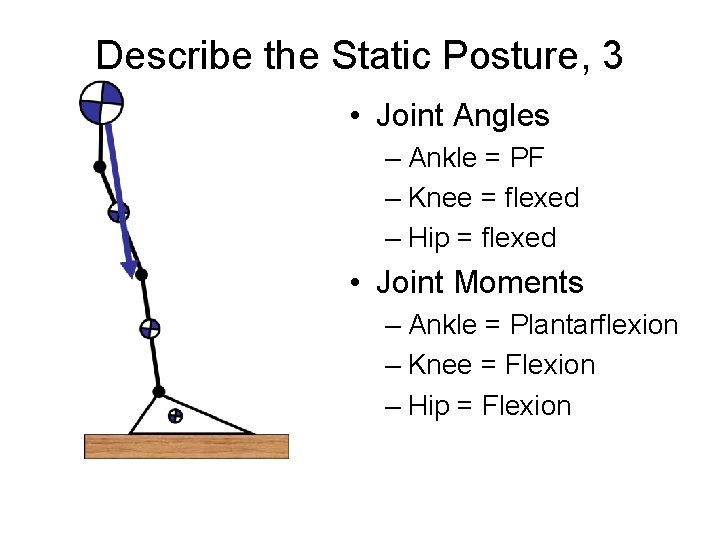
Describe the Static Posture, 3 • Joint Angles – Ankle = PF – Knee = flexed – Hip = flexed • Joint Moments – Ankle = Plantarflexion – Knee = Flexion – Hip = Flexion
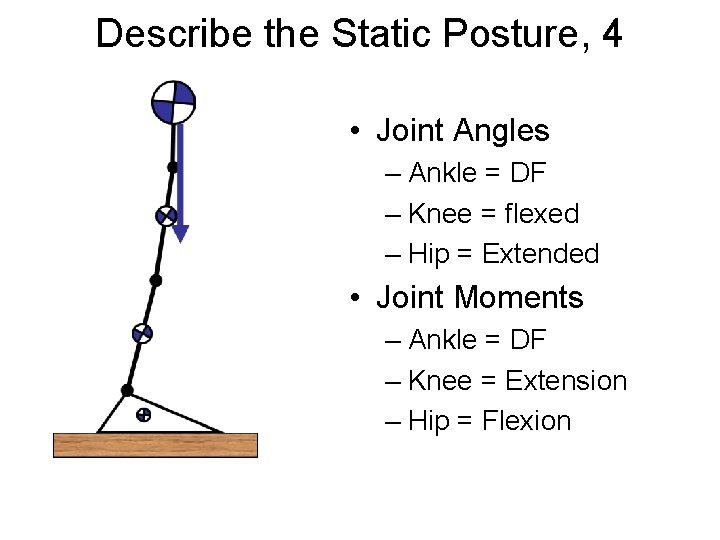
Describe the Static Posture, 4 • Joint Angles – Ankle = DF – Knee = flexed – Hip = Extended • Joint Moments – Ankle = DF – Knee = Extension – Hip = Flexion
D. NHL vs. Pathological • NHL – Synergistic – Cyclic – Synchronized • Pathological – Muscle action either excessive, inadequate, or abnormally timed – Soft tissue tightness
Dynamic Gait… • Get up & walk!!! – – Observe!! Kinematics Body segment positions Use your knowledge of muscle activation timing and amplitude • Continue to study gait – Kinematics, Kinetics, Muscle activation patterns – All planes!!!
The End

Pedorthic Program of Study This workforce product was funded by a grant awarded by the U. S. Department of Labor’s Employment and Training Administration. The product was created by the grantee and does not necessarily reflect the official position of the U. S. Department of Labor. The U. S. Department of Labor makes no guarantees, warranties, or assurances of any kind, express or implied, with respect to such information, including any information on linked sites and including, but not limited to, accuracy of the information or its completeness, timeliness, usefulness, adequacy, continued availability, or ownership. Produced 2016. HOPE Careers Consortium is a partnership of five institutions of higher education that is building exciting new programs that will provide valuable career education and training in the Orthotics, Prosthetics, and Pedorthics (O&P) sector. The five institutions are: Baker College—Flint, Michigan; Century College—White Bear Lake, Minnesota; Oklahoma State University Institute of Technology— Okmulgee, Oklahoma; Spokane Falls Community College—Spokane, Washington; and St. Petersburg College—St. Petersburg, Florida. Although the authoring institution of this educational resource has made every effort to ensure that the information presented is correct, the institution assumes no liability to any party for any loss, damage, or disruption caused by errors or omissions. Except where otherwise noted, this work by St. Petersburg College is licensed under the Creative Commons Attribution 4. 0 International License. To view a copy of this license, click on the following link: Creative Commons Licenses 4. 0.
- Slides: 51