
MODULE 4 How to train our muscles how


- Slides: 32
MODULE 4 How to train our muscles – how to start training
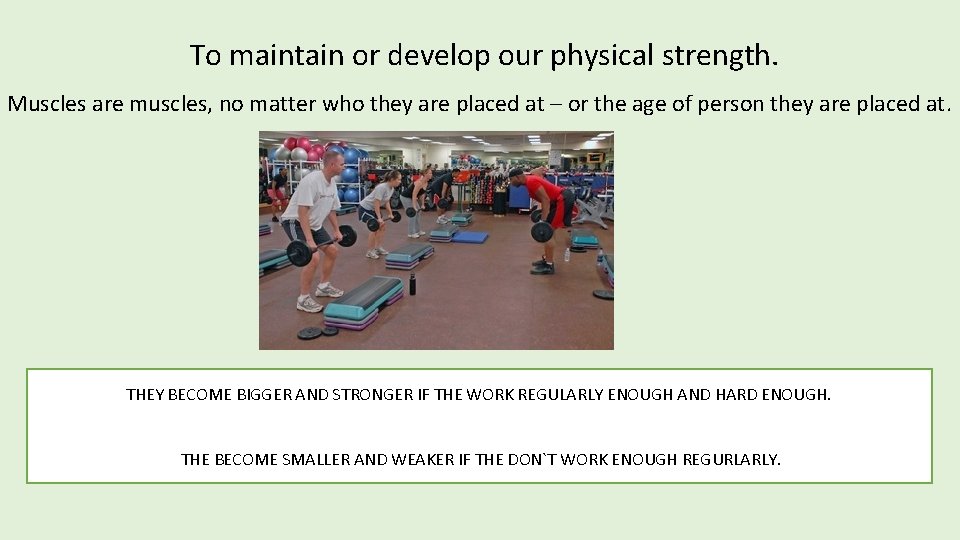
To maintain or develop our physical strength. Muscles are muscles, no matter who they are placed at – or the age of person they are placed at. THEY BECOME BIGGER AND STRONGER IF THE WORK REGULARLY ENOUGH AND HARD ENOUGH. THE BECOME SMALLER AND WEAKER IF THE DON`T WORK ENOUGH REGURLARLY.
THE GOOD NEWS
Seniors +60 have the same effect of training and increase in muscle mass as young people. 10 to 45% increase after 8 – 12 weeks of regular training of muscle strength. The improved strength is not only achieved through an increase of muscle mass – but also by improving the number of nerves.
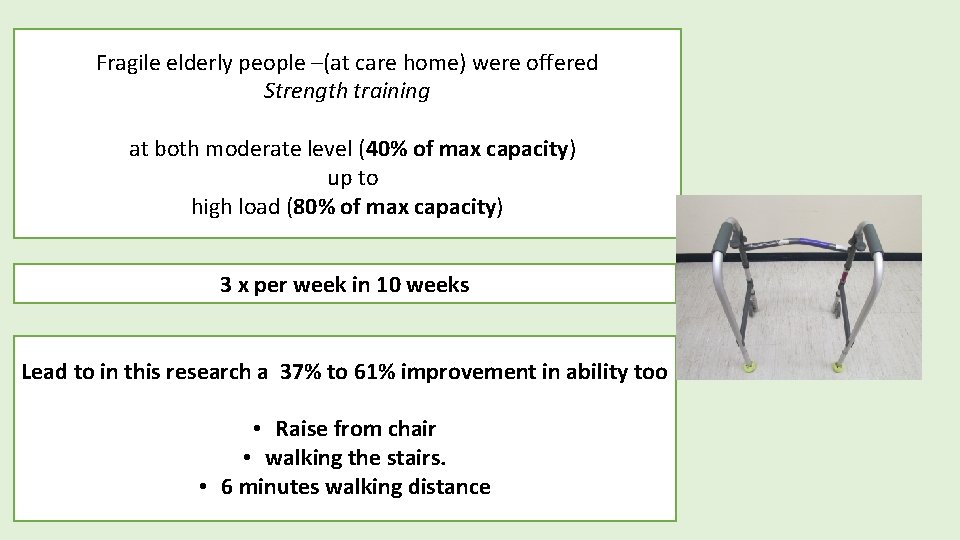
Fragile elderly people –(at care home) were offered Strength training at both moderate level (40% of max capacity) up to high load (80% of max capacity) 3 x per week in 10 weeks Lead to in this research a 37% to 61% improvement in ability too • Raise from chair • walking the stairs. • 6 minutes walking distance
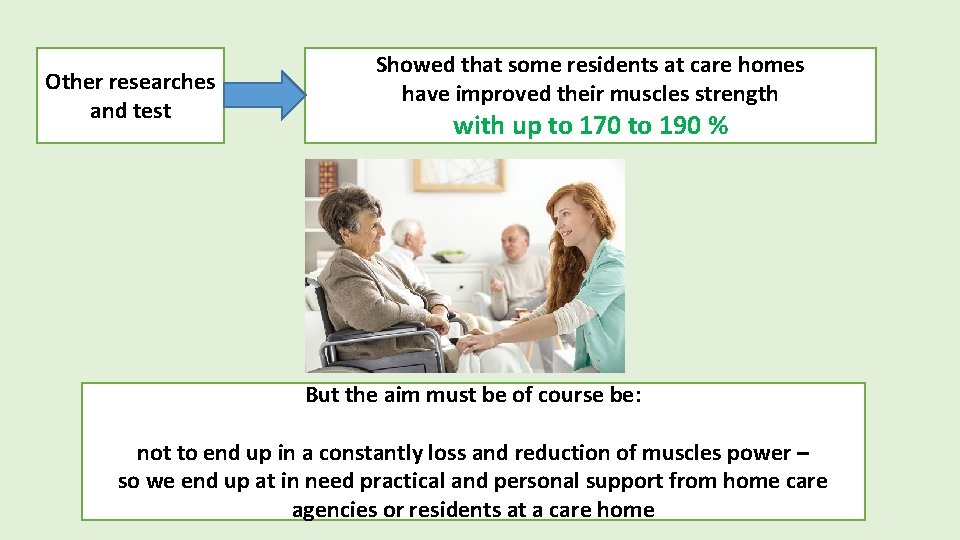
Other researches and test Showed that some residents at care homes have improved their muscles strength with up to 170 to 190 % But the aim must be of course be: not to end up in a constantly loss and reduction of muscles power – so we end up at in need practical and personal support from home care agencies or residents at a care home
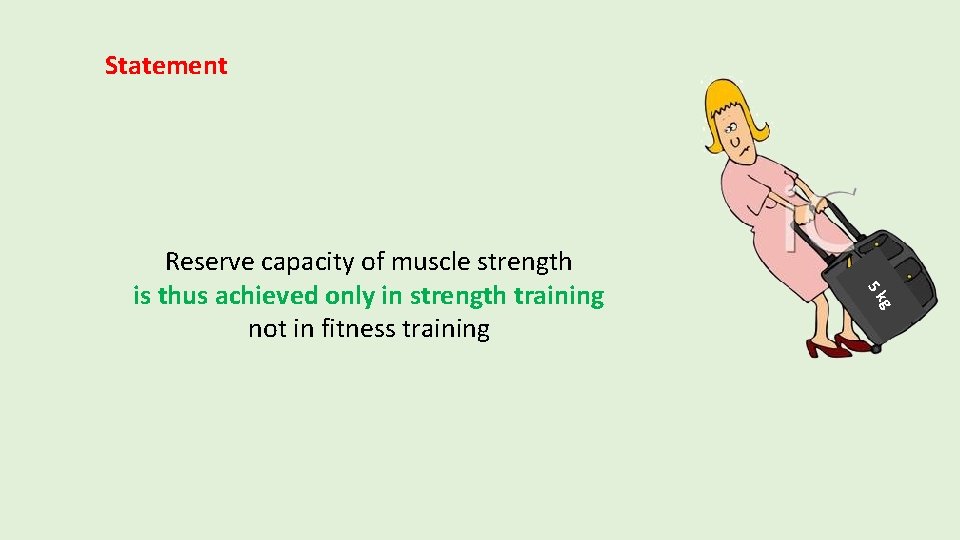
Statement 5 k g Reserve capacity of muscle strength is thus achieved only in strength training not in fitness training
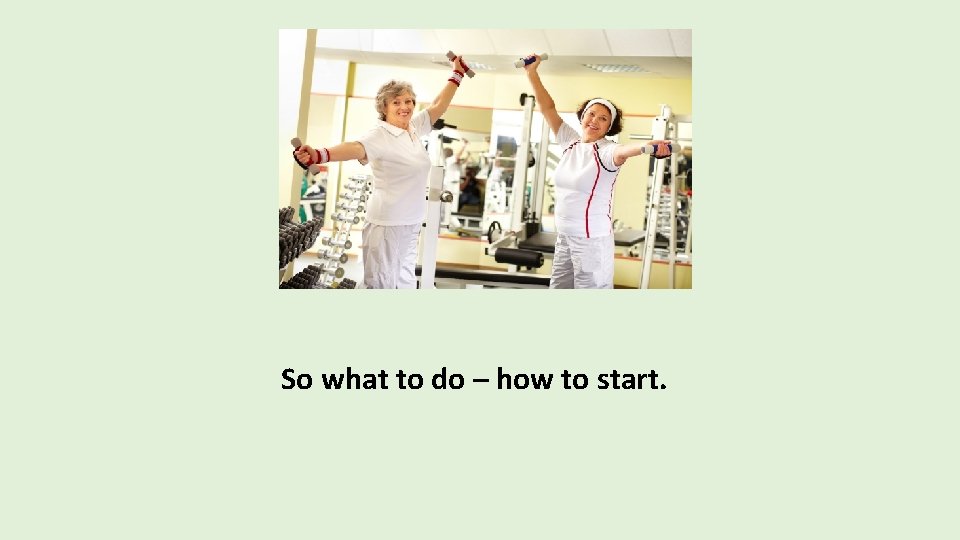
So what to do – how to start.
How to train strength. Develop strength. Rule You test your muscle strength by putting so much weight that you can do the exercise at most 15 -18 times. You are trying out quite simply. You must not be able to get over the 18 times with a properly performed exercise. If you are over 18, you need to pay more attention.
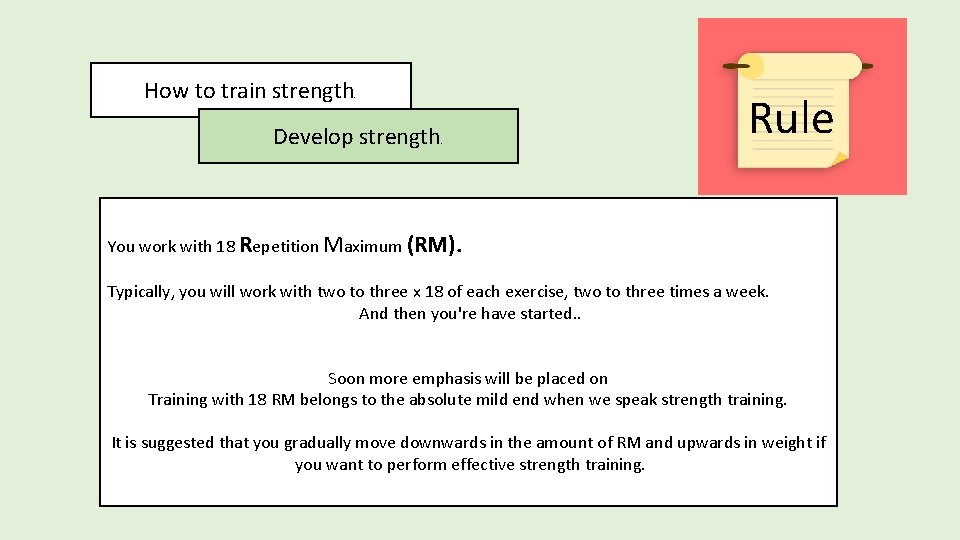
How to train strength. Develop strength. Rule You work with 18 Repetition Maximum (RM). Typically, you will work with two to three x 18 of each exercise, two to three times a week. And then you're have started. . Soon more emphasis will be placed on Training with 18 RM belongs to the absolute mild end when we speak strength training. It is suggested that you gradually move downwards in the amount of RM and upwards in weight if you want to perform effective strength training.
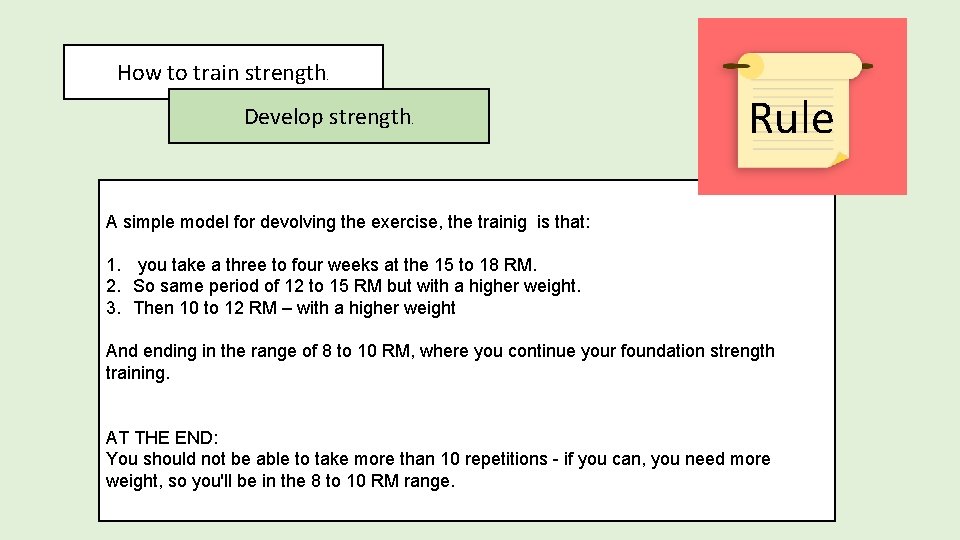
How to train strength. Develop strength. Rule A simple model for devolving the exercise, the trainig is that: 1. you take a three to four weeks at the 15 to 18 RM. 2. So same period of 12 to 15 RM but with a higher weight. 3. Then 10 to 12 RM – with a higher weight And ending in the range of 8 to 10 RM, where you continue your foundation strength training. AT THE END: You should not be able to take more than 10 repetitions - if you can, you need more weight, so you'll be in the 8 to 10 RM range.
Rule HAVING THE CARE HOME ELDERLY IN MIND WE DON`T NEED TO GO THAT HARD WE DO NOT TRAIN FOR OLYMPICs – WE ONLY TRAIN TO MAINTAIN OUR INDEPENDENCY LATER IN LIFE
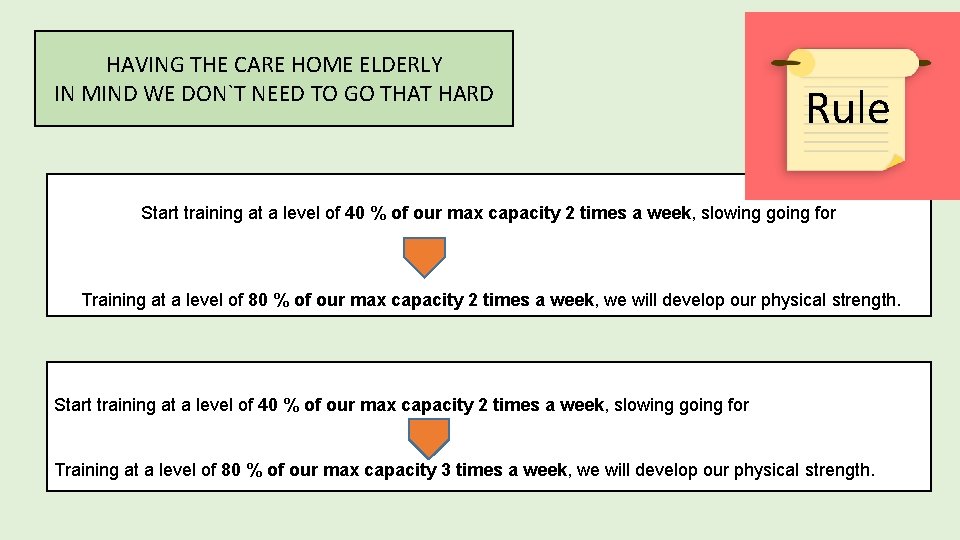
HAVING THE CARE HOME ELDERLY IN MIND WE DON`T NEED TO GO THAT HARD Rule Start training at a level of 40 % of our max capacity 2 times a week, slowing going for Training at a level of 80 % of our max capacity 2 times a week, we will develop our physical strength. Start training at a level of 40 % of our max capacity 2 times a week, slowing going for Training at a level of 80 % of our max capacity 3 times a week, we will develop our physical strength.
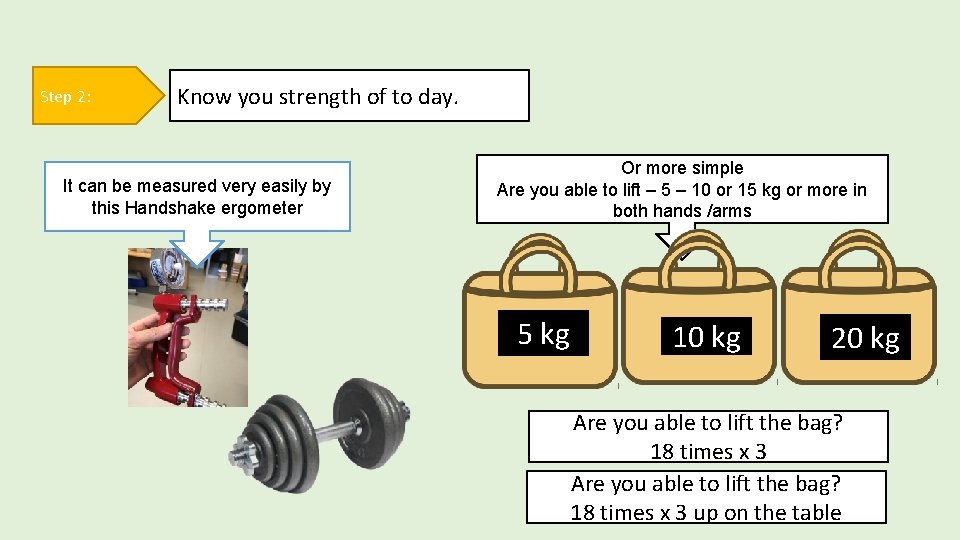
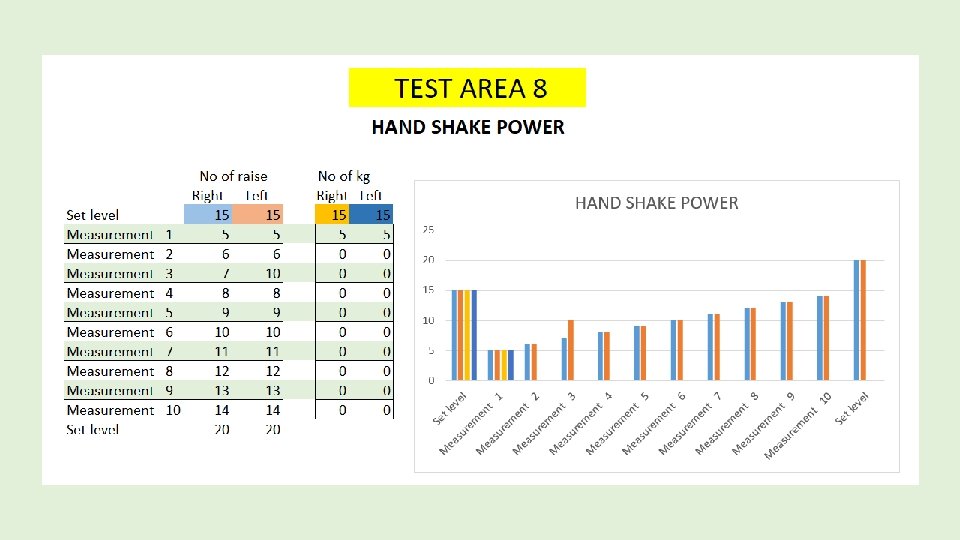
Step 2: Know you strength of to day. It can be measured very easily by this Handshake ergometer Or more simple Are you able to lift – 5 – 10 or 15 kg or more in both hands /arms 5 kg 10 kg 20 kg Are you able to lift the bag? 18 times x 3 up on the table
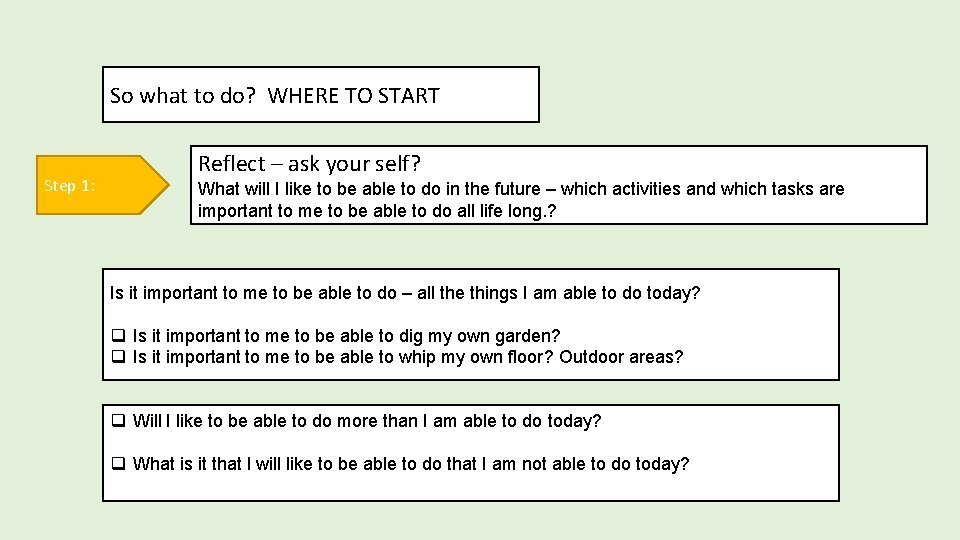
So what to do? WHERE TO START Step 1: Reflect – ask your self? What will I like to be able to do in the future – which activities and which tasks are important to me to be able to do all life long. ? Is it important to me to be able to do – all the things I am able to do today? q Is it important to me to be able to dig my own garden? q Is it important to me to be able to whip my own floor? Outdoor areas? q Will I like to be able to do more than I am able to do today? q What is it that I will like to be able to do that I am not able to do today?
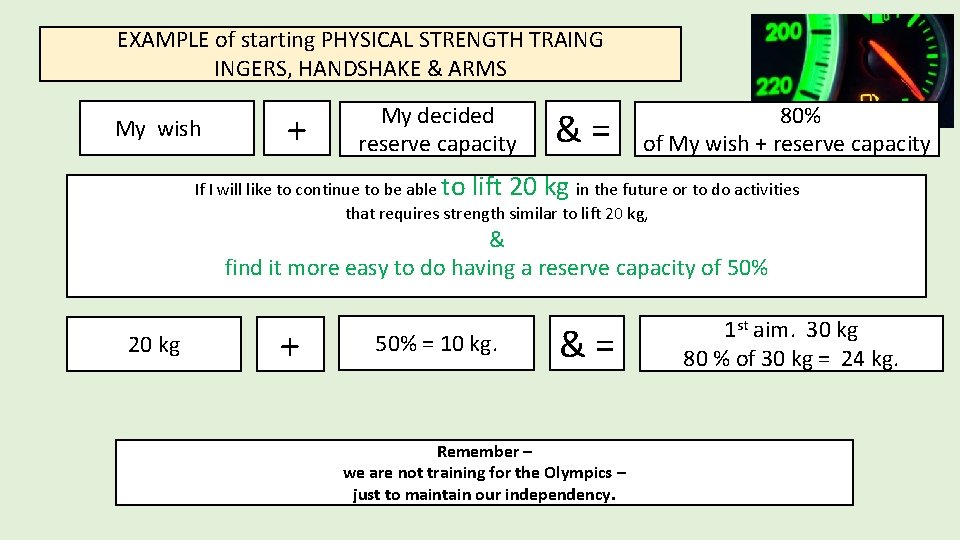
EXAMPLE of starting PHYSICAL STRENGTH TRAING INGERS, HANDSHAKE & ARMS My wish + My decided reserve capacity &= 80% of My wish + reserve capacity If I will like to continue to be able to lift 20 kg in the future or to do activities that requires strength similar to lift 20 kg, & find it more easy to do having a reserve capacity of 50% 20 kg + 50% = 10 kg. &= Remember – we are not training for the Olympics – just to maintain our independency. 1 st aim. 30 kg 80 % of 30 kg = 24 kg.
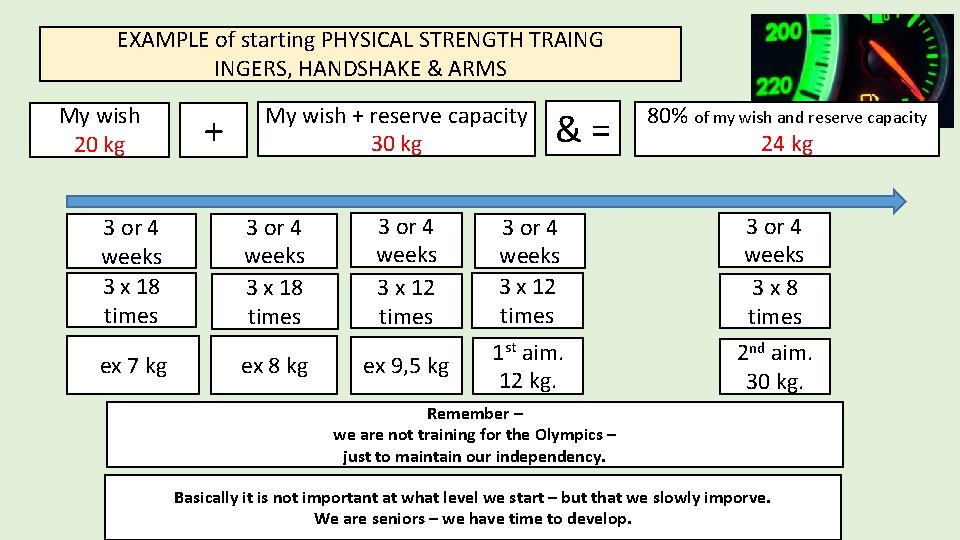
EXAMPLE of starting PHYSICAL STRENGTH TRAING INGERS, HANDSHAKE & ARMS My wish 20 kg 3 or 4 weeks 3 x 18 times ex 7 kg + My wish + reserve capacity 30 kg 3 or 4 weeks 3 x 18 times ex 8 kg &= 80% of my wish and reserve capacity 24 kg 3 or 4 weeks 3 x 12 times 3 or 4 weeks 3 x 8 times ex 9, 5 kg 1 st aim. 12 kg. 2 nd aim. 30 kg. Remember – we are not training for the Olympics – just to maintain our independency. Basically it is not important at what level we start – but that we slowly imporve. We are seniors – we have time to develop.
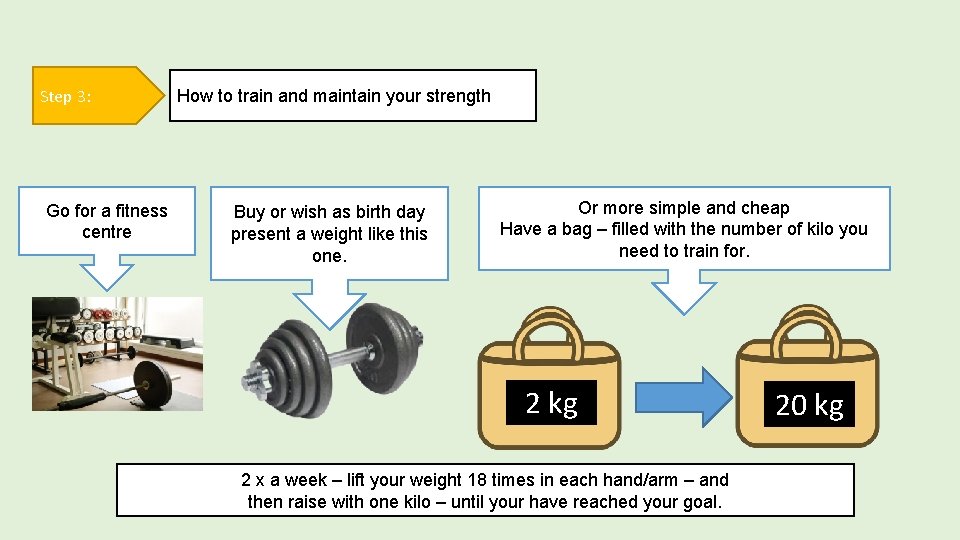
Step 3: Go for a fitness centre How to train and maintain your strength Buy or wish as birth day present a weight like this one. Or more simple and cheap Have a bag – filled with the number of kilo you need to train for. 2 kg 2 x a week – lift your weight 18 times in each hand/arm – and then raise with one kilo – until your have reached your goal. 20 kg
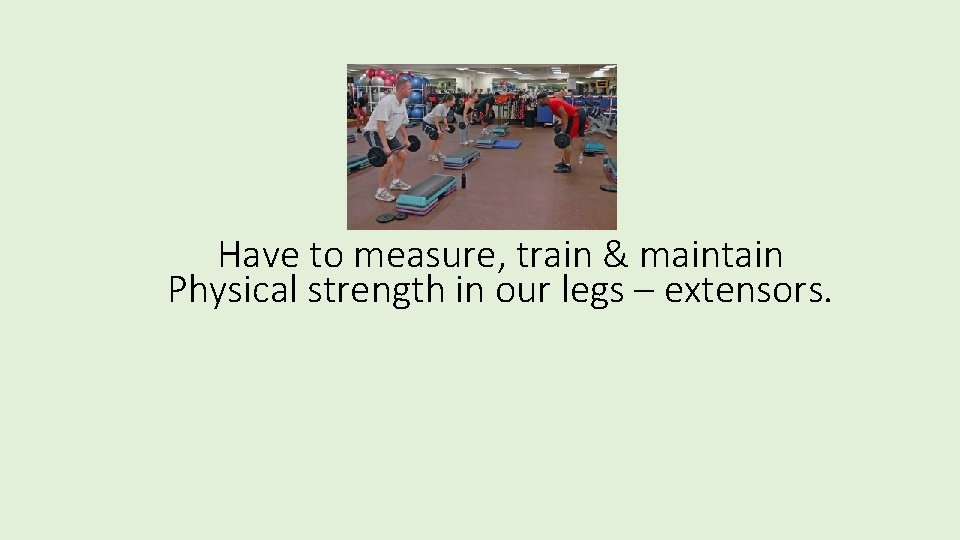
Have to measure, train & maintain Physical strength in our legs – extensors.
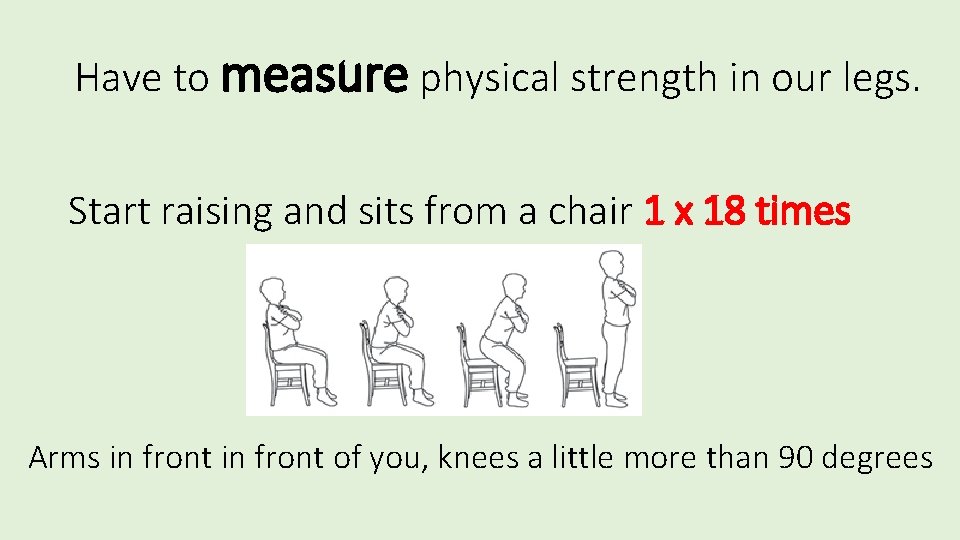
Have to measure physical strength in our legs. Start raising and sits from a chair 1 x 18 times Arms in front of you, knees a little more than 90 degrees
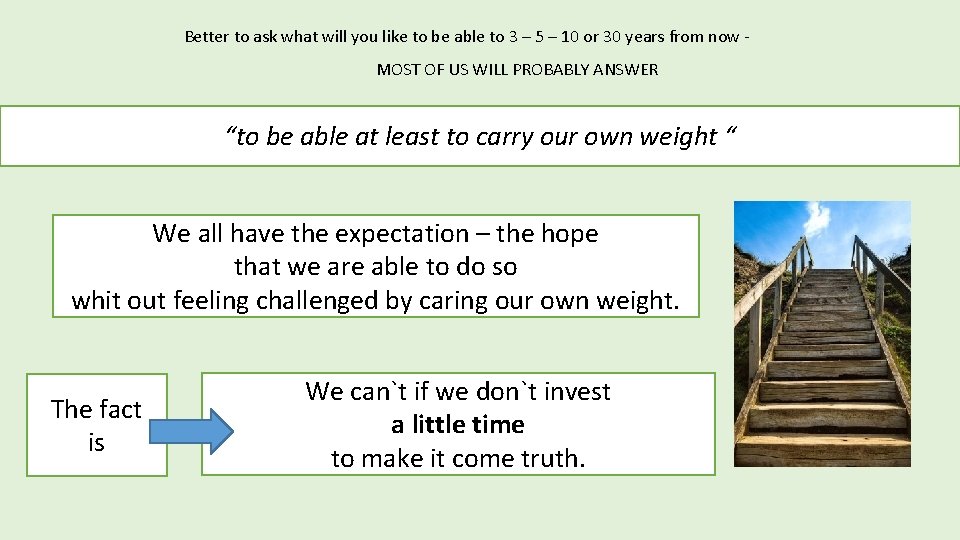
Better to ask what will you like to be able to 3 – 5 – 10 or 30 years from now MOST OF US WILL PROBABLY ANSWER “to be able at least to carry our own weight “ We all have the expectation – the hope that we are able to do so whit out feeling challenged by caring our own weight. The fact is We can`t if we don`t invest a little time to make it come truth.
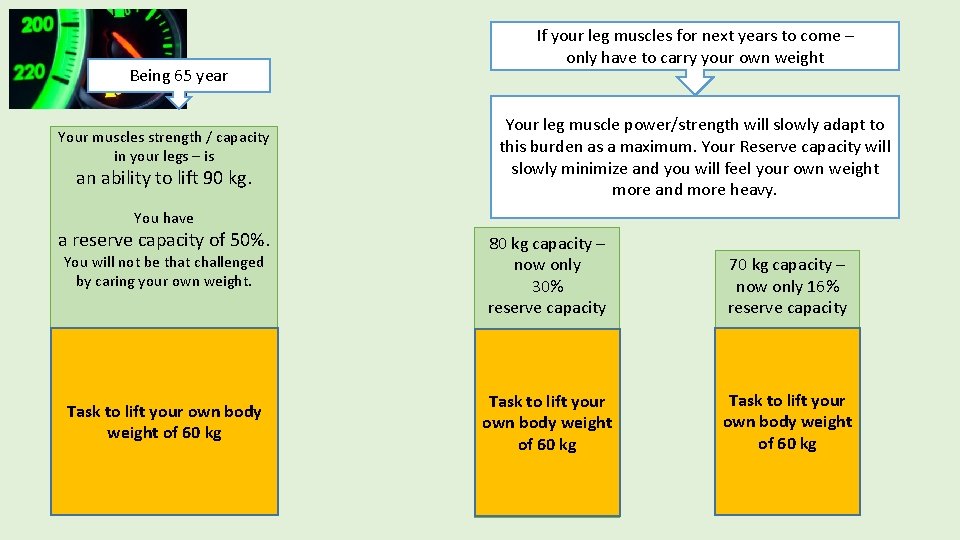
Being 65 year Your muscles strength / capacity in your legs – is an ability to lift 90 kg. If your leg muscles for next years to come – only have to carry your own weight Your leg muscle power/strength will slowly adapt to this burden as a maximum. Your Reserve capacity will slowly minimize and you will feel your own weight more and more heavy. You have a reserve capacity of 50%. You will not be that challenged by caring your own weight. 80 kg capacity – now only 30% reserve capacity 70 kg capacity – now only 16% reserve capacity Task to lift your own body weight of 60 kg
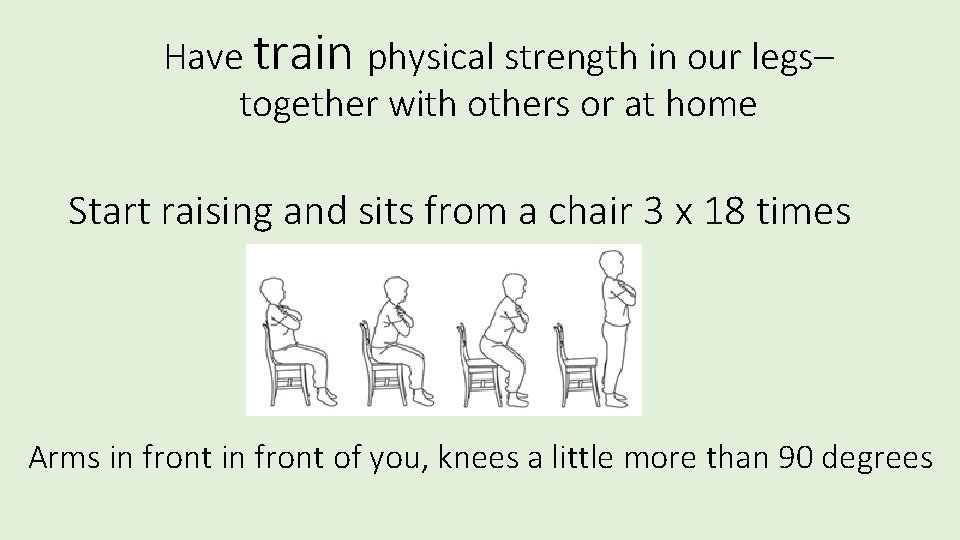
Have train physical strength in our legs– together with others or at home Start raising and sits from a chair 3 x 18 times Arms in front of you, knees a little more than 90 degrees
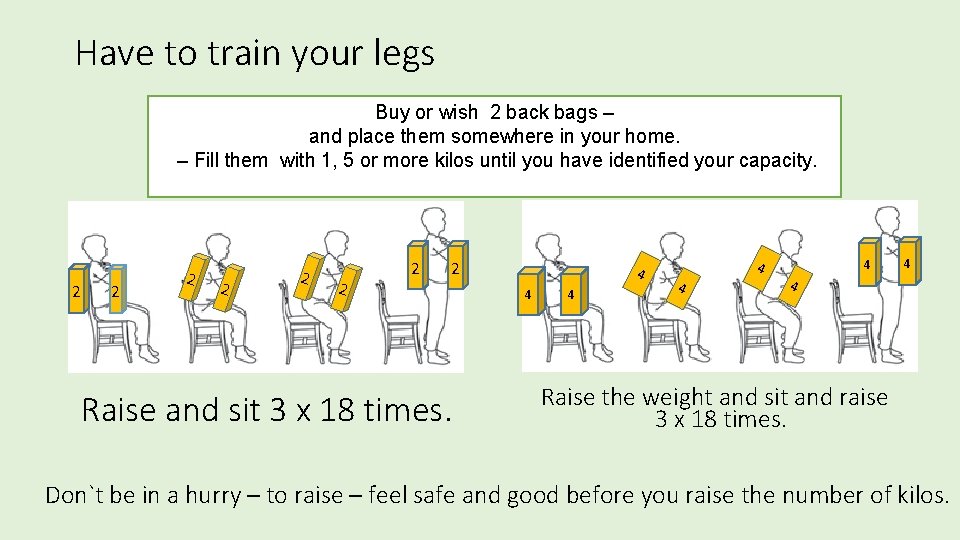
Have to train your legs Buy or wish 2 back bags – and place them somewhere in your home. – Fill them with 1, 5 or more kilos until you have identified your capacity. 2 2 2 2 Raise and sit 3 x 18 times. 4 4 4 4 Raise the weight and sit and raise 3 x 18 times. Don`t be in a hurry – to raise – feel safe and good before you raise the number of kilos.
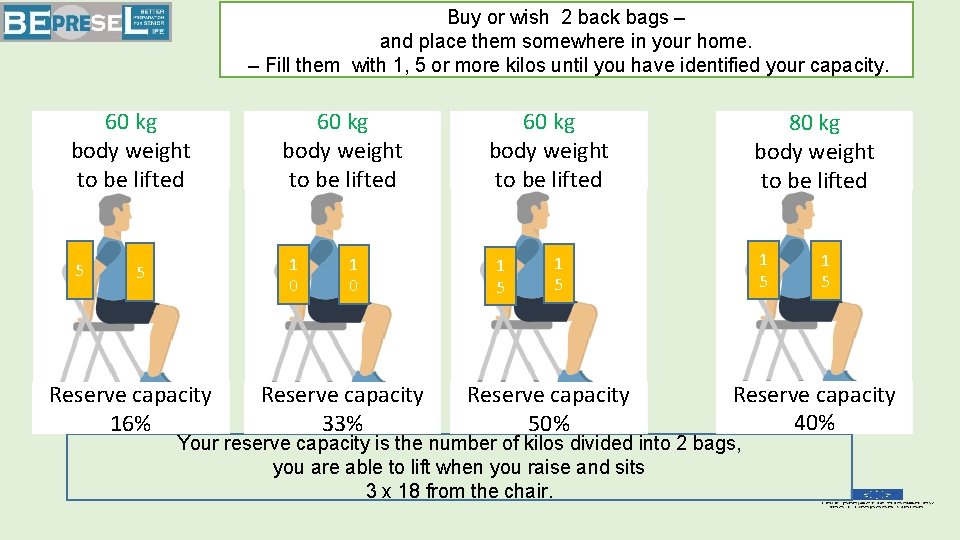
Buy or wish 2 back bags – and place them somewhere in your home. – Fill them with 1, 5 or more kilos until you have identified your capacity. 60 kg body weight to be lifted 5 60 kg body weight to be lifted 1 0 5 Reserve capacity 16% 1 0 Reserve capacity 33% 60 kg body weight to be lifted 1 5 80 kg body weight to be lifted 1 5 Reserve capacity 50% 1 5 Reserve capacity 40% Your reserve capacity is the number of kilos divided into 2 bags, you are able to lift when you raise and sits 3 x 18 from the chair.
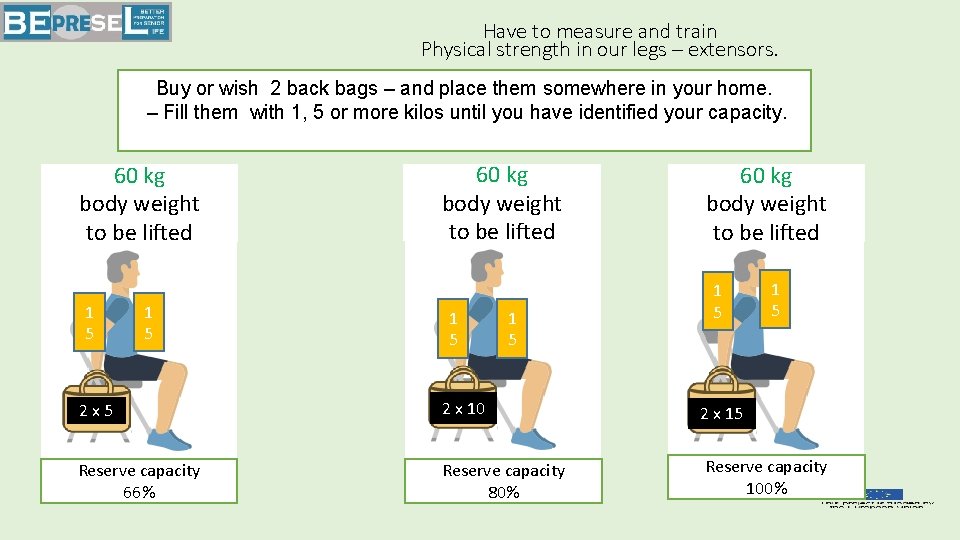
Have to measure and train Physical strength in our legs – extensors. Buy or wish 2 back bags – and place them somewhere in your home. – Fill them with 1, 5 or more kilos until you have identified your capacity. 60 kg body weight to be lifted 1 5 1 5 60 kg body weight to be lifted 1 5 2 x 5 2 x 10 2 x 15 Reserve capacity 66% Reserve capacity 80% Reserve capacity 100%
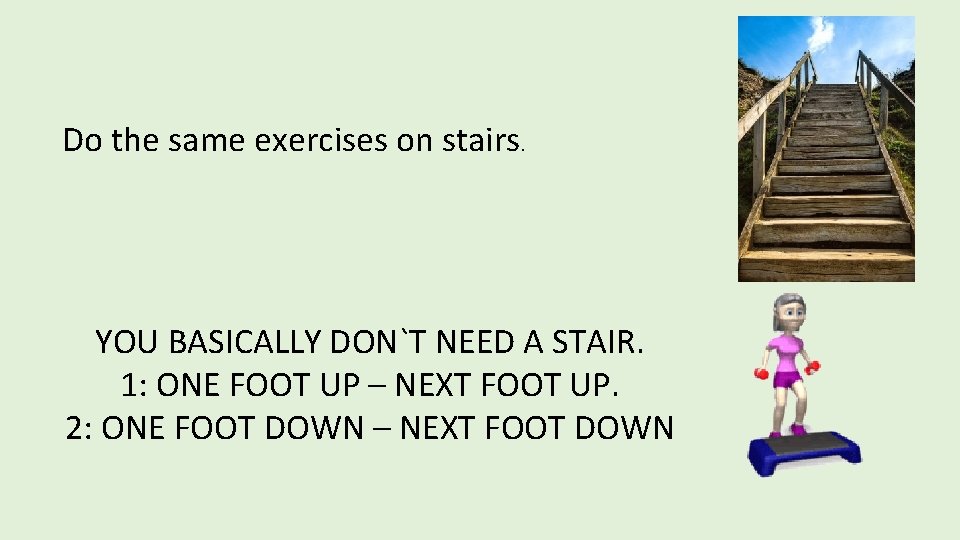
Do the same exercises on stairs. YOU BASICALLY DON`T NEED A STAIR. 1: ONE FOOT UP – NEXT FOOT UP. 2: ONE FOOT DOWN – NEXT FOOT DOWN
REMEMBER THE BEST RESULT COMES – DOING IT 2 TIMES A WEEK AND HOPEFULLY 3 TIMES A WEEK. LEAVING LABOR MARKED – WE HAVE RECEIVED 37 TO 40 HOURS MORE PER WEEK. IT TAKES ONLY 10 MINUTES X 3 OF INVESTMENT TO BE ABLE TO CARRY 10 KG TO FIRST FLOOR OR ANYWHERE ELSE 10 YEARS FROM NOW.
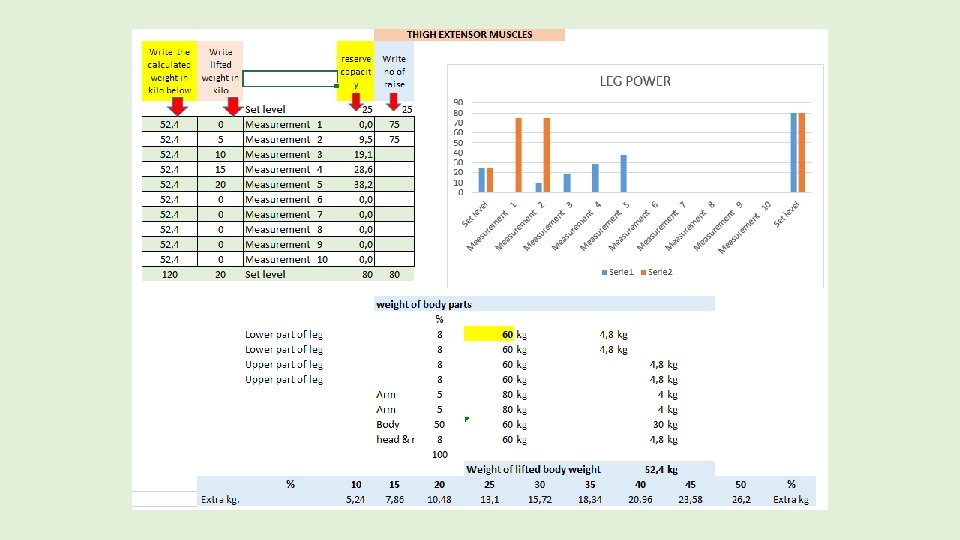
Let Measure our strength in our LEGS and write the result into the Senior Health Profile.