
Module 4 Driver Evaluation Slide 4 2 Purpose
- Slides: 42
Module 4 Driver Evaluation
Slide 4 -2 Purpose of the Module � To be able to evaluate a driver when teaching BTW lessons. Module 4 PW page 4 -2
Slide 4 -3 Module Sections This module will cover three topics: � Types and characteristics of in-vehicle evaluation � How to evaluate the driver � Providing feedback to the driver Module 4 PW page 4 -2
Slide 4 -4 Module Objectives � By the end of this Module, you will be able to: ◦ Describe the various types of in-vehicle evaluation. ◦ Describe acceptable criteria for rating a driver’s performance. ◦ Describe how evaluation takes place and what can be evaluated in the vehicle. ◦ Demonstrate how to provide feedback on the driver’s performance. Module 4 PW page 4 -2
Slide 4 -5 Types of In-vehicle Evaluation 1. Initial evaluation: what is the student bringing to this lesson, what have they retained/incorporated from the last lesson? 2. On-going evaluation each time a driver drives. 3. Guided self-evaluation by the student. 4. Summative evaluation at the end of the in-vehicle phase. Module 4 PW page 4 -2
Slide 4 -6 Characteristics of Initial Evaluation � Determine what the student has learned up to that point. � Look at previous BTW lesson evaluations. � Ask the student what they are having difficulties with. � Ask short questions to gauge their understanding. Module 4 PW page 4 -3
Characteristics of the On-Going Evaluation Slide 4 -7 �Occurs each time a driver drives. �Requires immediate and appropriate feedback from the instructor. �Instructors must specifically identify the “mistakes” a driver makes. Module 4 PW page 4 -4
Characteristics of the On-Going Evaluation �Mistakes must be corrected. ◦ through use of words. ◦ through use of visual aids. ◦ through the use of demonstration. �Provide praise and other positive re-enforcements when necessary. �Written on the individual driver’s in-vehicle record. Module 4 PW page 4 -4 Slide 4 -8
Characteristics of Guided Self-Evaluation by the Student Slide 4 -9 � Formal attempt to evaluate their own driving performance. � Ensure that students recognize their responsibility for continual self-appraisal during the years of future driving. � Students will evaluate their own performance after driving established route. � Can take the form of brief commentaries which include their most important actions. Module 4
Characteristics of Guided Self-Evaluation by the Student Slide 4 -10 �Share with the students (parents) skills they need to practice with their parents before the next lesson. �Have the students record their evaluation for further assessment by the instructor and student. �Instructor should avoid imposing their own evaluation before allowing students to do so. Module 4 PW page 4 -5
Characteristics of Summative Evaluation Slide 4 -11 � Evaluate student learning at the end of an instructional unit by comparing it against a standard or benchmark. � Cumulative evaluations used to measure student growth after instruction. � Include a clear alignment between assessment, curriculum, and instruction. � Includes end of unit in-vehicle evaluations and course grades. Module 4 PW page 4 -5
Measurements Obtained When Evaluating Drivers Slide 4 -12 �The driver’s skills at maneuvering the car. �The driver’s speed choices. �The driver’s ability to understand the information presented by the roadway (signs, lines, traffic lights). �The driver’s understanding of the rules of the road. Module 4 PW page 4 -6
Measurements Obtained When Evaluating Drivers Slide 4 -13 � The driver’s ability to see, identify & interact with other road users. � The driver’s searching skills and their ability to identify and avoid situations that are likely to produce a collision. � The Module 4 driver’s management of space and time. PW page 4 -6
Slide 4 -14 What Evaluations Can Determine? � Where this student is on the learning progression. � What the next step in the learning process is for this student. � � If the lesson is achieving the intended learning outcomes. If not, what is the cause and what might remediate this? Identify the cause, leading to the weakness and focus on correcting that behavior. Which drivers are most successful in responding to hazardous traffic situations. The driver’s strengths and weaknesses based on positive feedback to meet their goals. Module 4 PW page 4 -7
Slide 4 -15 Activity #1: Types and Characteristics of Invehicle Evaluation Fill in the correct answer for each question on types and characteristics of in-vehicle evaluation Module 4 PW page 4 -8
Slide 4 -16 Identifying a Driver’s Performance Reliably � � Identify objectives and content that will influence a driver’s behaviors. Be completely familiar with the objectives and the behaviors the student will demonstrate during the lesson. Identify what driver’s do and how they control the car. Set criteria for acceptable performance as established in the lesson plan objectives. � Prescribe a rating method/route. � Evaluate the driver while driving. Module 4 PW page 4 -9
What to Do When Evaluating the Driver Slide 4 -17 �Observe the driver behaviors closely and carefully. �Observe the change in traffic situations and conditions. �Rate the driver after the performance. �Record Module 4 the rating in writing. PW page 4 -9
Slide 4 -18 The Process for Driver Evaluation � Create an evaluation route which will present environments & situations to be evaluated. � Direct the driver over the route. � Observe users. the road environment & all other road � Anticipate potential issues on the roadway well in advance. � Observe Module 4 the vehicle behavior. PW page 4 -10
Slide 4 -19 The Process for Driver Evaluation � � � Assess what information the driver is acquiring & when they are getting it & compare this to the information they need to acquire to drive safely. Assess how successful the driver is in their making decisions and the consistency of this process. Assess the effectiveness of the driver in implementing the decisions. � Ensure the safe operation of the vehicle at all times. � Record the observations. Module 4 PW page 4 -10
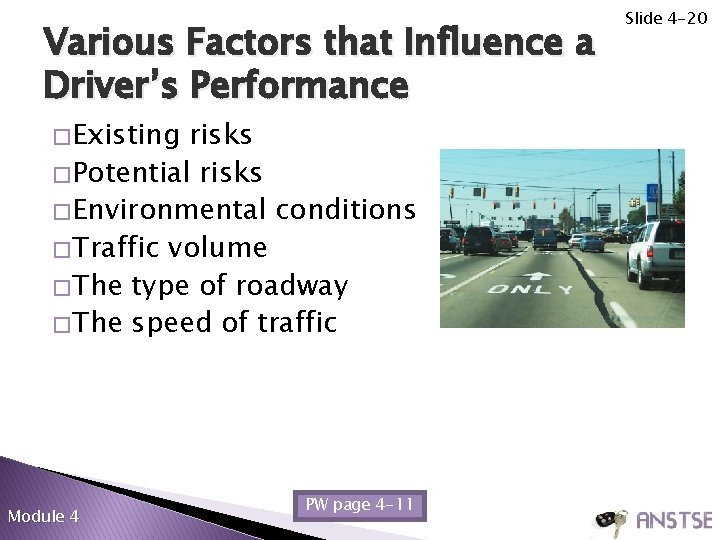
Various Factors that Influence a Driver’s Performance � Existing risks � Potential risks � Environmental conditions � Traffic volume � The type of roadway � The speed of traffic Module 4 PW page 4 -11 Slide 4 -20
Factors that Influence Objectivity of Evaluations � � Slide 4 -21 Giving the directions as planned Rating the driver’s performance on what was observed Avoid any pet peeves that you may have Avoid any critical comments during the evaluation process Module 4 PW page 4 -12
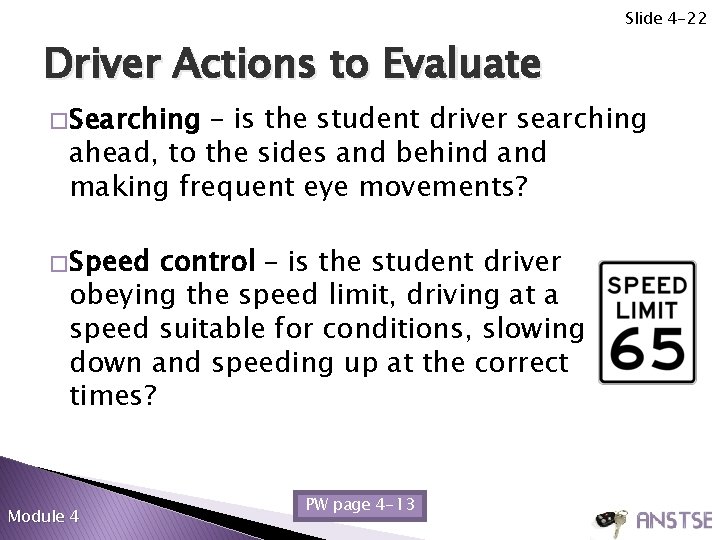
Slide 4 -22 Driver Actions to Evaluate � Searching – is the student driver searching ahead, to the sides and behind and making frequent eye movements? � Speed control – is the student driver obeying the speed limit, driving at a speed suitable for conditions, slowing down and speeding up at the correct times? Module 4 PW page 4 -13
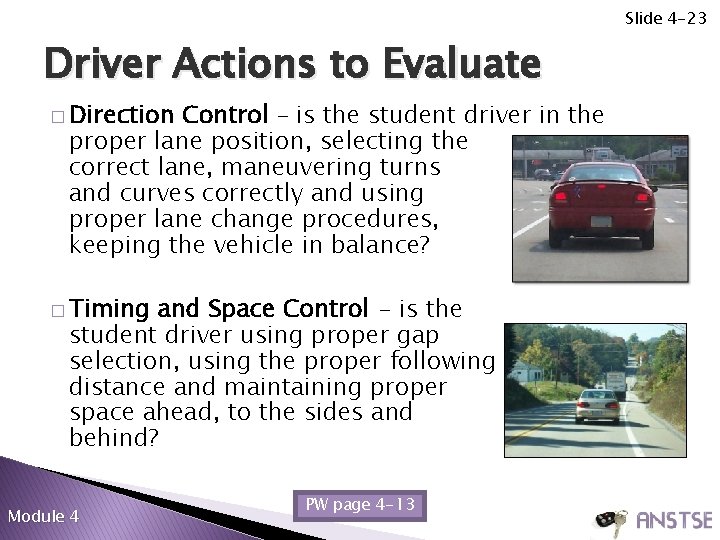
Slide 4 -23 Driver Actions to Evaluate � Direction Control – is the student driver in the proper lane position, selecting the correct lane, maneuvering turns and curves correctly and using proper lane change procedures, keeping the vehicle in balance? � Timing and Space Control - is the student driver using proper gap selection, using the proper following distance and maintaining proper space ahead, to the sides and behind? Module 4 PW page 4 -13
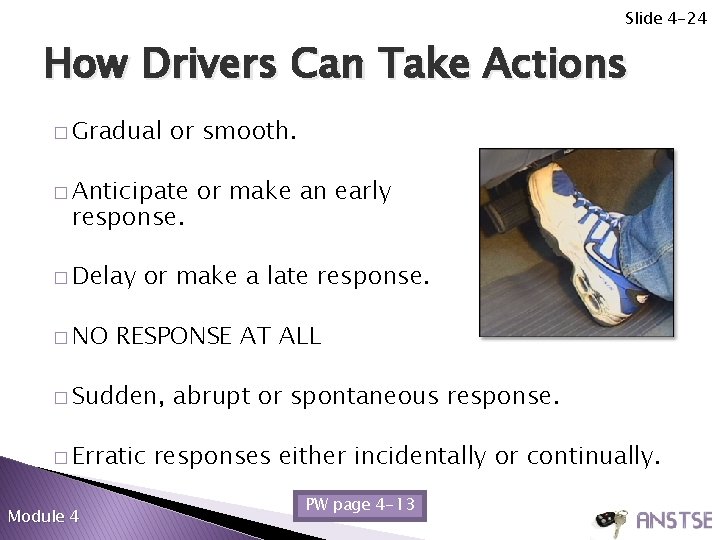
Slide 4 -24 How Drivers Can Take Actions � Gradual or smooth. � Anticipate response. � Delay � NO or make a late response. RESPONSE AT ALL � Sudden, � Erratic Module 4 or make an early abrupt or spontaneous responses either incidentally or continually. PW page 4 -13
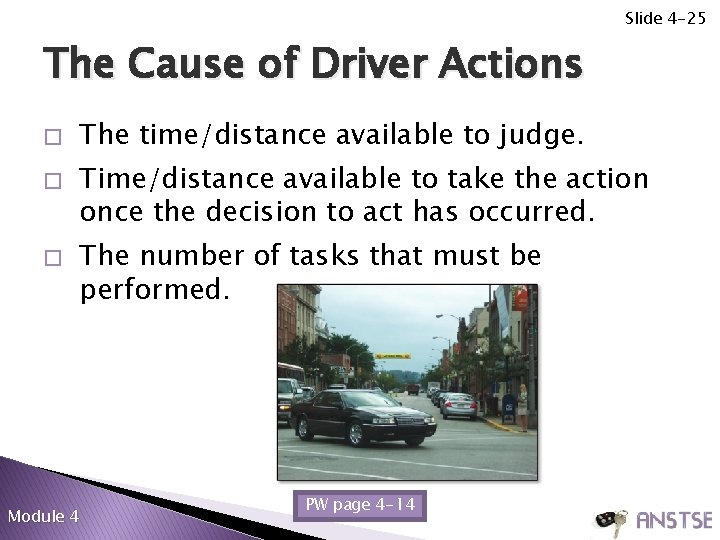
Slide 4 -25 The Cause of Driver Actions � � � The time/distance available to judge. Time/distance available to take the action once the decision to act has occurred. The number of tasks that must be performed. Module 4 PW page 4 -14
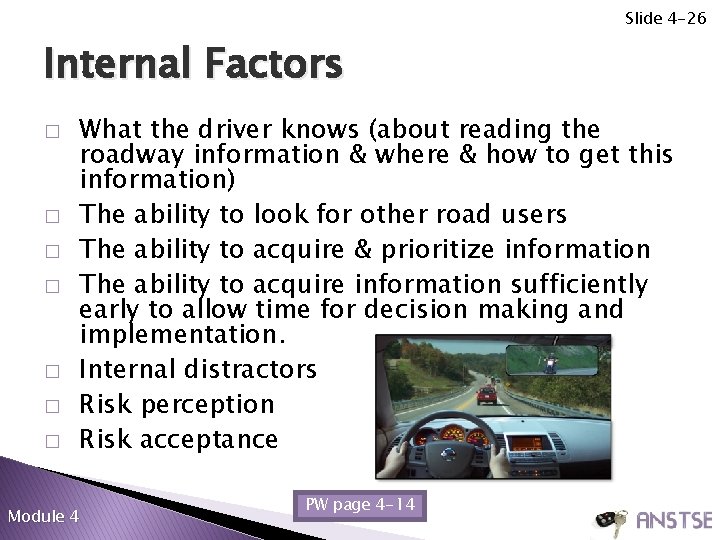
Slide 4 -26 Internal Factors � � � � What the driver knows (about reading the roadway information & where & how to get this information) The ability to look for other road users The ability to acquire & prioritize information The ability to acquire information sufficiently early to allow time for decision making and implementation. Internal distractors Risk perception Risk acceptance Module 4 PW page 4 -14
Slide 4 -27 External Factors � The quantity of information available � The quality of the information available � The complexity of the environment � External distractors Module 4 PW page 4 -14
Slide 4 -28 Acceptable Criteria for Rating a Driver’s Performance � Decreasing risk by searching, adjusting speed or direction. � Not causing another driver to change speed and/or direction. � Reporting what was observed about the driver’s behaviors. � Complying with traffic laws. Module 4 PW page 4 -15
Slide 4 -29 Unacceptable Criteria for Rating a Driver’s Performance � You “feel comfortable. ” � The driver does what you do. � You become frightened. � You compare one driver to another driver. Would you feel comfortable with the student driving towards you in another vehicle? Module 4 PW page 4 -15
Slide 4 -30 Activity #2: How to Evaluate the Driver Fill in the correct answer for each question on how to evaluate the driver. Module 4 PW page 4 -16
Slide 4 -31 Providing Feedback to a Driver Be done in a systematic way related to the objectives of the lesson/environment. � Relate to judgment and/or performance in searching, speed control, direction control, and timing/decision-making skills. � Be done immediately if mistake are being made, such as: � ◦ Wrong actions or inactions. ◦ Wrong judgments or decisions. Module 4 PW page 4 -17
Slide 4 -32 Providing Feedback to a Driver � � � Communicated in a clear & concise manner Remedial suggestions relevant to the driver’s abilities should be outlined Provide reasons why this individual would find it helpful to work to implement these suggestions. Module 4 PW page 4 -17
Slide 4 -33 Record Keeping � � ◦ ◦ � Keep records of the driving performance of each student during each in-vehicle period. Should indicate the: lesson objectives the content practiced an evaluation of the student’s performance and progress suggestions for what should be covered in subsequent practice periods. An accurate record of the student’s past performance encourages the instructor to design each in-vehicle practice in relation to needed skills and objectives. Module 4 PW page 4 -18
Slide 4 -34 BTW Activity Behind-the-Wheel Activity Take this section with you to the vehicle when conducting the behindthe-wheel activity. Module 4 PW page 4 -19
Slide 4 -35 Activity Purpose � To demonstrate teaching techniques, coaching the driver, providing commentary and practice evaluating a driver when teaching BTW lessons. Module 4 PW page 4 -19
Slide 4 -36 Activity Objectives By the end of this activity, you will be able to demonstrate: • The various teaching techniques. • Coaching techniques. • Questioning techniques for in-vehicle. • How to visually search the roadway. • How to summarize the lesson. • The various types of in-vehicle evaluation. • How, when or where to provide feedback to the driver’s performance. • How to fill out information on an evaluation form. Module 4 PW page 4 -19
Slide 4 -37 Specific Activities You will perform the following activities in the vehicle: � Role play by providing directions and commentary teaching. � Practice various coaching techniques. � Practice how to visually search the roadway. � Engage observers. � Summarize lesson. � Practice providing feedback. � Practice filling out evaluation form. Module 4 PW page 4 -19
Slide 4 -38 Materials Needed � Clipboard � Pens / pencils � Sample driving route(s) � Sample lesson plan(s) � Evaluation forms � The Behind-the-Wheel Activity page from your participant workbook Module 4 PW page 4 -19
Slide 4 -39 Module Summary � With the conclusion of this Module, you should be able to: ◦ Describe the various types of in-vehicle evaluation. ◦ Describe acceptable criteria for rating a driver’s performance. ◦ Describe how evaluation takes place and what can be evaluated in the vehicle. ◦ Describe how to provide feedback on the driver’s performance. Module 4 PW page 4 -20
Slide 4 -40 Module Review Activity: Key Words Matchup Complete the Activity in the Participant Workbook. Module 4 PW page 4 -21
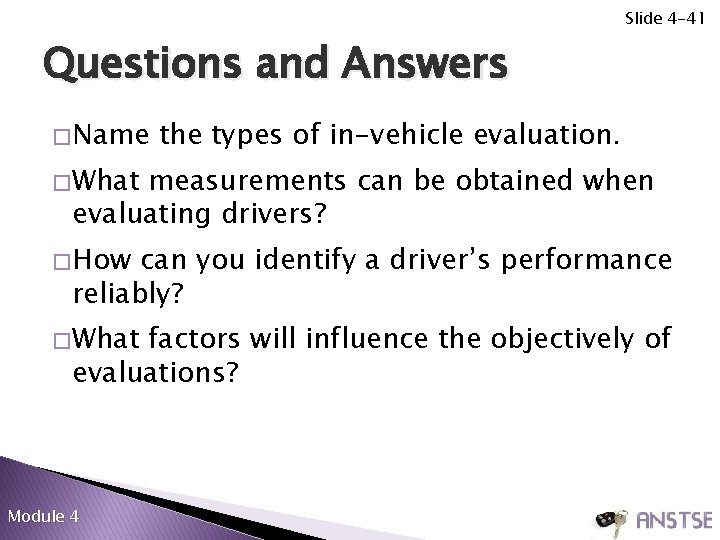
Slide 4 -41 Questions and Answers � Name the types of in-vehicle evaluation. � What measurements can be obtained when evaluating drivers? � How can you identify a driver’s performance reliably? � What factors will influence the objectively of evaluations? Module 4
Slide 4 -42 Questions? ? Module 4