
Module 4 CHLD 105 Observation and Assessment This
Module 4 CHLD 105 Observation and Assessment This slide show was created by Laura Paciorek as a companion to "Principles and Practices of Teaching Young Children" by Cindy Stephens, Gina Peterson, Sharon Eyrich, and Jennifer Paris, College of the Canyons is licensed under CC BY 4. 0 / A derivative from the original work The book contains text with various licenses. Images all contain license information.
Observation versus Supervision According to Gordon and Browne (2016) “Observing is more than ordinary supervision. It takes energy and concentration to become an accurate observer. ”[i] Gordon, A. M. , & Browne, K. W. (2016). Beginning essentials in early childhood education. Boston, MA: Cengage Learning
Define these concepts ● Objectivity ● Bias How do you know if you are being objective? How do you keep your bias in check?
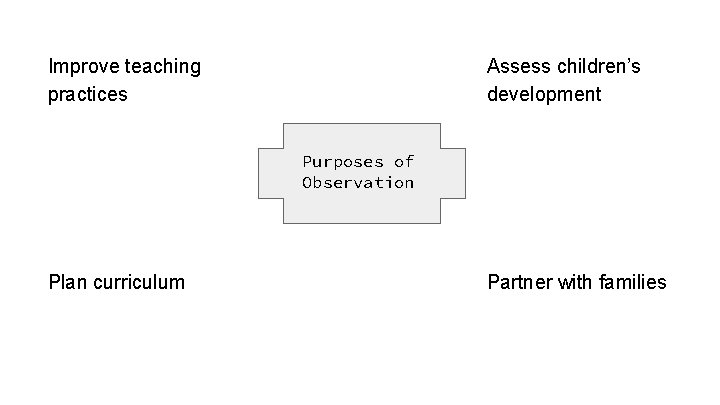
Improve teaching practices Assess children’s development Purposes of Observation Plan curriculum Partner with families
![[i] Image by COC OER Team is licensed under CC BY 4. 0.](http://slidetodoc.com/presentation_image_h2/37248623bbe1737986aa73ceab585cba/image-5.jpg "[i] Image by COC OER Team is licensed under CC BY 4. 0.")
[i] Image by COC OER Team is licensed under CC BY 4. 0.
Observations May be spontaneous OR May be planned
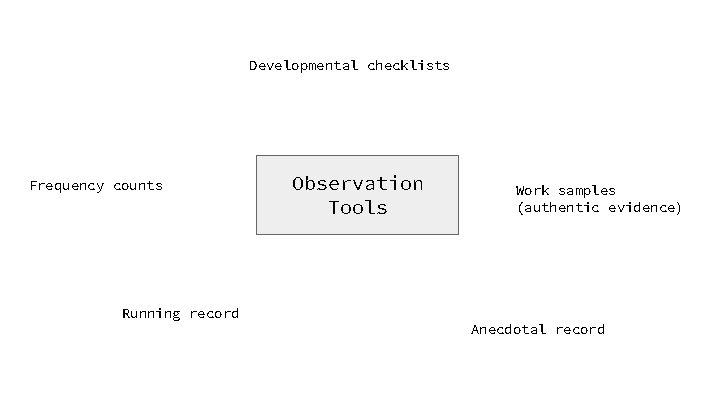
Developmental checklists Frequency counts Running record Observation Tools Work samples (authentic evidence) Anecdotal record

Documentation Boards or Panels contain. . . ● ● Learning goal and objectives Children’s language development The process and complete project The milestones of development
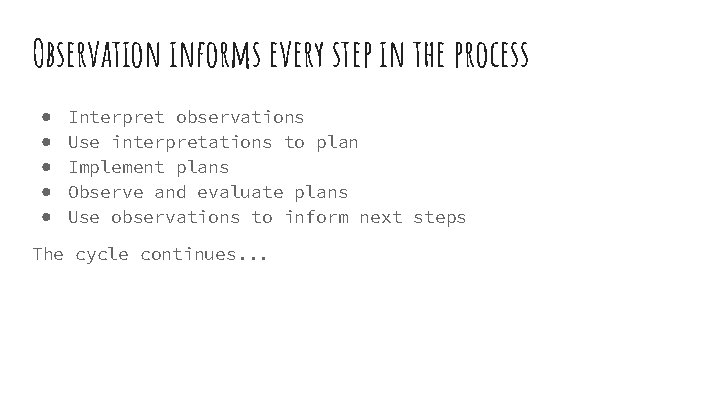
Observation informs every step in the process ● ● ● Interpret observations Use interpretations to plan Implement plans Observe and evaluate plans Use observations to inform next steps The cycle continues. . .
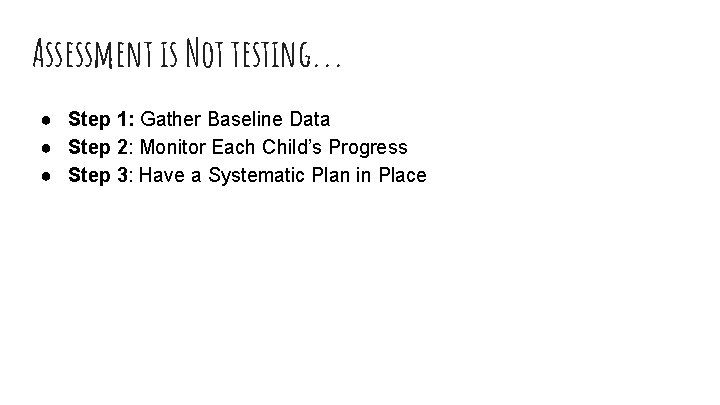
Assessment is Not testing. . . ● Step 1: Gather Baseline Data ● Step 2: Monitor Each Child’s Progress ● Step 3: Have a Systematic Plan in Place
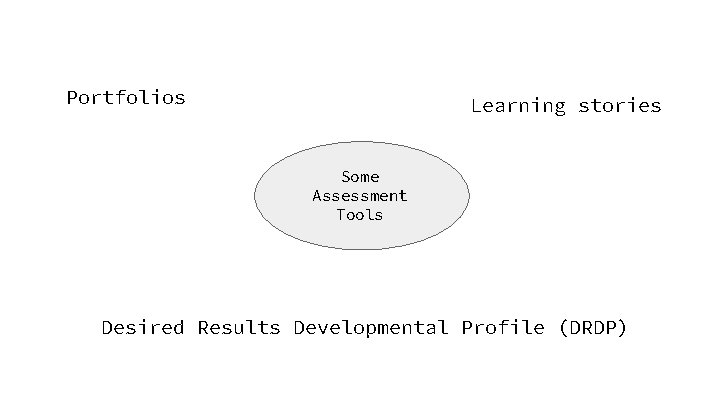
Portfolios Learning stories Some Assessment Tools Desired Results Developmental Profile (DRDP)
Partner with Families provide valuable input in the assessment process!
- Slides: 12