
Module 4 Child Rights in Governance Session map
- Slides: 17
Module 4: Child Rights in Governance
Session map: 1. Key issues 2. Child rights in governance assessments 3. Strategies 4. Regional examples
Key issues: § Definition of “governance” § The exercise of economic, political and administrative authority to manage a country’s affairs at all levels § Governance reforms will not deliver sustainable results if they are not mindful of children § Normative imperative § Instrumental argument § Empirical evidence
Significant investments in governance § Promoting good governance is an integral part of development programming for many development partners § Several adopted new strategies in the past few years § Rationale: § Governance is at the heart of promoting human rights, democracy and Ro. L § Required for sustainable development § Critical for aid effectiveness
Mainstreaming CR in governance reforms 1. Child rights-sensitive governance assessment: § Offers a strategic opportunity to feature child rights concerns prominently and concretely in governancerelated interventions and funding support. 2. Identify stakeholders: § Key actors that are instrumental in helping governments meet their goals under the CRC. 3. Identify entry points: § Requires a comprehensive set of entry interlocking interventions
Child-sensitive governance assessment § All development partners engage in governance assessments § Challenges: § “Governance” - an umbrella concept § Challenge agreeing on operational indicators and establishing clear causal links § Plethora of governance assessment tools currently used
Key categories of child-sensitive governance assessment tool 1. Political Governance/Voice and Accountability 2. Rule of Law/Legal and Judicial Systems 3. Control of Corruption 4. Government Effectiveness 5. Social Governance/Socio-economic indicators 6. Political Dialogue/Quality of Partnerships, including Participation and Civil Society and Governance
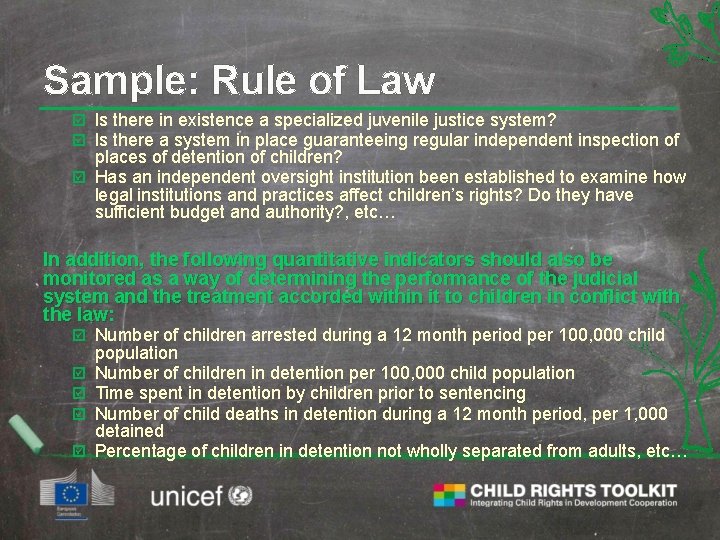
Sample: Rule of Law þ Is there in existence a specialized juvenile justice system? þ Is there a system in place guaranteeing regular independent inspection of places of detention of children? þ Has an independent oversight institution been established to examine how legal institutions and practices affect children’s rights? Do they have sufficient budget and authority? , etc… In addition, the following quantitative indicators should also be monitored as a way of determining the performance of the judicial system and the treatment accorded within it to children in conflict with the law: þ Number of children arrested during a 12 month period per 100, 000 child þ þ population Number of children in detention per 100, 000 child population Time spent in detention by children prior to sentencing Number of child deaths in detention during a 12 month period, per 1, 000 detained Percentage of children in detention not wholly separated from adults, etc…
Use of CR assessment tool: § Strategic opportunity to feature child rights concerns more prominently § Support political dialogue between donors and partner countries § Inform Human Rights Country Strategies § Support governance projects § Inform the eligibility criteria for budget support (GGDC)
Strategies to ensure governance reforms support CR: • In the field of INSTITUTION BUILDING • In the field of SERVICE DELIVERY • In the field of RULE OF LAW/PARLIAMENTS • In the field of ANTI-CORRUPTION
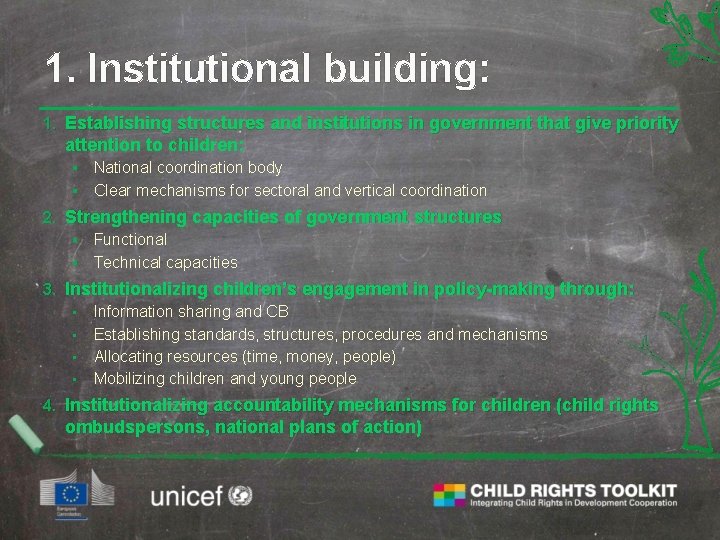
1. Institutional building: 1. Establishing structures and institutions in government that give priority attention to children: National coordination body § Clear mechanisms for sectoral and vertical coordination § 2. Strengthening capacities of government structures § Functional § Technical capacities 3. Institutionalizing children’s engagement in policy-making through: • Information sharing and CB • Establishing standards, structures, procedures and mechanisms • Allocating resources (time, money, people) • Mobilizing children and young people 4. Institutionalizing accountability mechanisms for children (child rights ombudspersons, national plans of action)
2. Service delivery: § Principles and standards: • Services are CHILD-CENTERED; • Services are all INCLUSIVE (including access, affordability, cultural and diversity appropriateness and acceptability); • Services have built-in mechanisms for CHILD PARTICIPATION; • Services have built-in mechanisms for ACCOUNTABILITY. • Strategies: 1. Supporting systems for birth registration. 2. Promoting national data collection systems.
3. Strategies in field of Ro. L: 1. Supporting legislative reform for child rights 2. Support to Parliaments 3. Justice for children: • Strengthening the system of justice for children; • Strengthening the capacity of those in contact with children in conflict with the law; • Legal empowerment and access to justice.
4. Strategies in field of anticorruption: 1. Engaging children and youth in anti-corruption initiatives: § Citizen’s score cards § Taking part in public expenditure tracking § Youth anti-corruption leagues 2. Improving the flow of information on key services to children and parents.
Regional examples