
Module 4 B Introduction Assessment Step 3Step TIP
Module 4 B Introduction Assessment: Step 3–Step
TIP Chapter 4: Assessment n n n Module 4 A – Screening and Step 1–Step 2 Module 4 B – The Assessment Process: Step 3–Step 7 Module 4 C – The Assessment Process: Step 8–Step 12 TIP 42: Substance Abuse Treatment for Persons with Co-Occurring Disorders Inservice Training OH #4 B-2
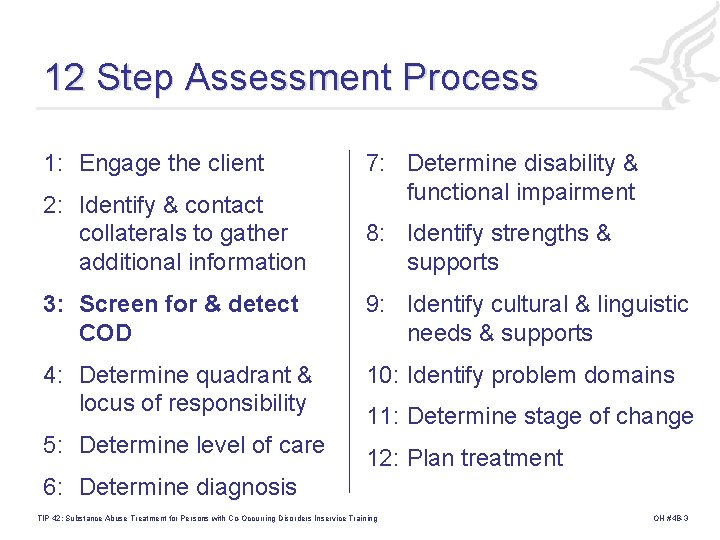
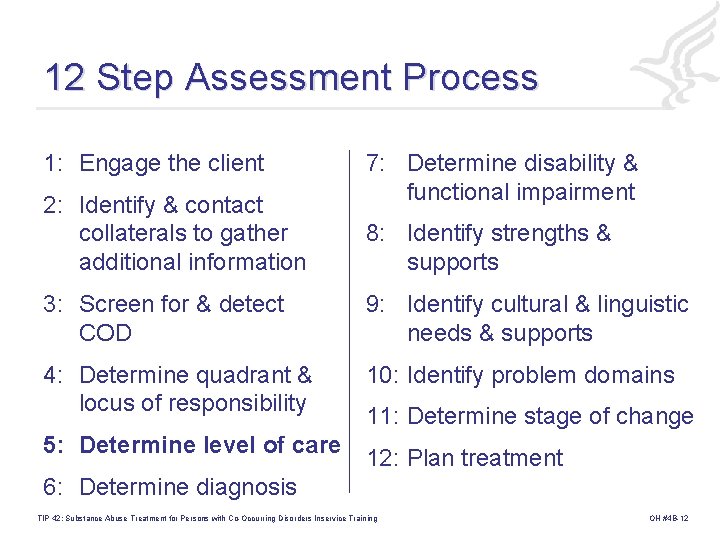
12 Step Assessment Process 1: Engage the client 2: Identify & contact collaterals to gather additional information 7: Determine disability & functional impairment 8: Identify strengths & supports 3: Screen for & detect COD 9: Identify cultural & linguistic needs & supports 4: Determine quadrant & locus of responsibility 10: Identify problem domains 5: Determine level of care 11: Determine stage of change 12: Plan treatment 6: Determine diagnosis TIP 42: Substance Abuse Treatment for Persons with Co-Occurring Disorders Inservice Training OH #4 B-3
Screening n Screening for COD seeks to answer a “yes” or “no” question: – Does the substance abuse client being screened show signs of a possible mental health problem? OR – Does the mental health client being screened show signs of a possible substance abuse problem? TIP 42: Substance Abuse Treatment for Persons with Co-Occurring Disorders Inservice Training OH #4 B-4
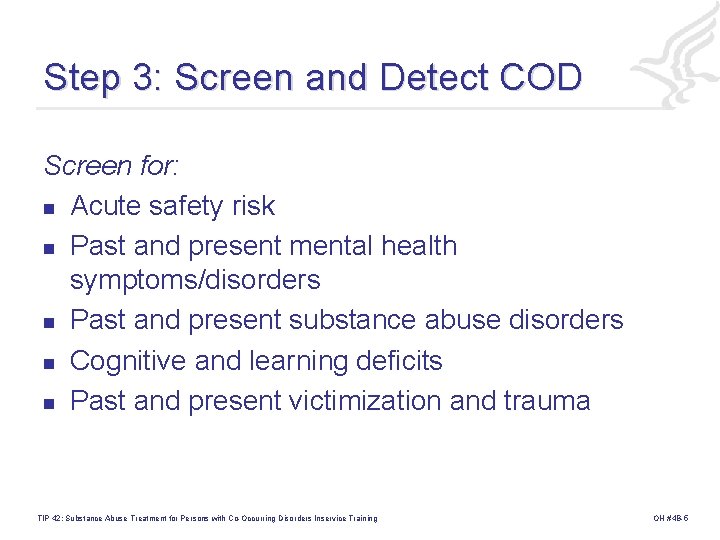
Step 3: Screen and Detect COD Screen for: n Acute safety risk n Past and present mental health symptoms/disorders n Past and present substance abuse disorders n Cognitive and learning deficits n Past and present victimization and trauma TIP 42: Substance Abuse Treatment for Persons with Co-Occurring Disorders Inservice Training OH #4 B-5
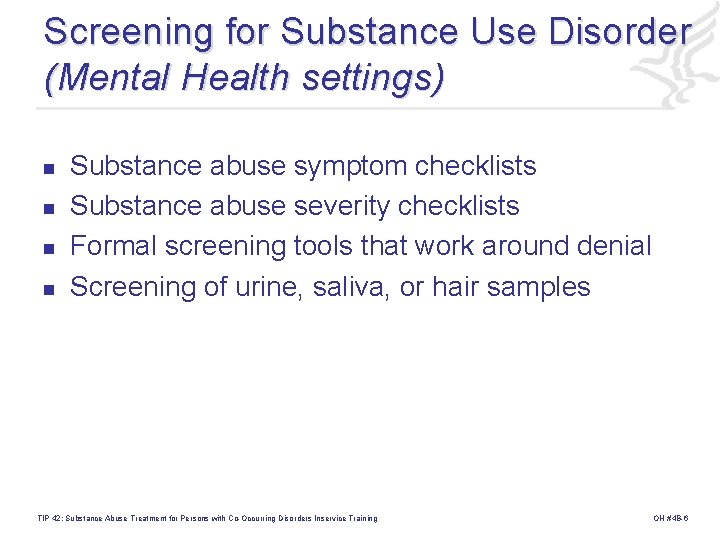
Screening for Substance Use Disorder (Mental Health settings) n n Substance abuse symptom checklists Substance abuse severity checklists Formal screening tools that work around denial Screening of urine, saliva, or hair samples TIP 42: Substance Abuse Treatment for Persons with Co-Occurring Disorders Inservice Training OH #4 B-6

12 Step Assessment Process 1: Engage the client 2: Identify & contact collaterals to gather additional information 7: Determine disability & functional impairment 8: Identify strengths & supports 3: Screen for & detect COD 9: Identify cultural & linguistic needs & supports 4: Determine quadrant & locus of responsibility 10: Identify problem domains 5: Determine level of care 11: Determine stage of change 12: Plan treatment 6: Determine diagnosis TIP 42: Substance Abuse Treatment for Persons with Co-Occurring Disorders Inservice Training OH #4 B-7
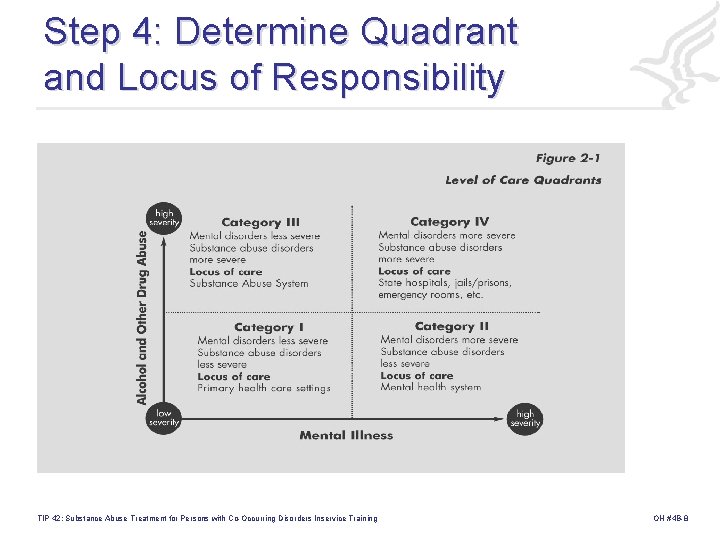
Step 4: Determine Quadrant and Locus of Responsibility TIP 42: Substance Abuse Treatment for Persons with Co-Occurring Disorders Inservice Training OH #4 B-8
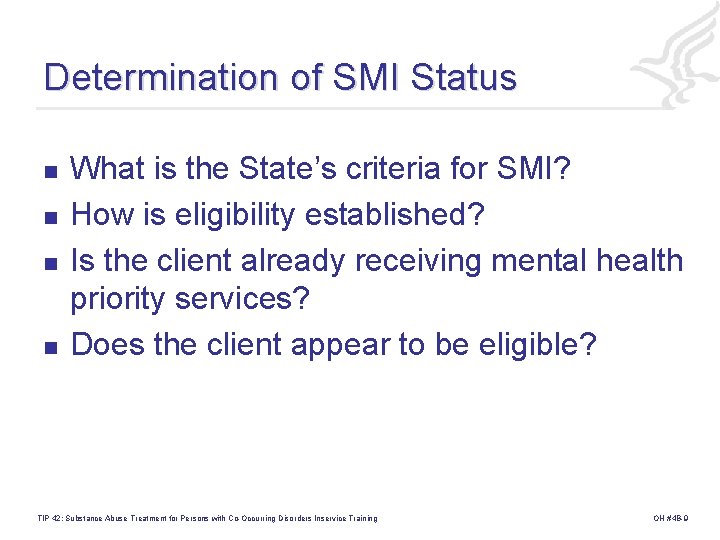
Determination of SMI Status n n What is the State’s criteria for SMI? How is eligibility established? Is the client already receiving mental health priority services? Does the client appear to be eligible? TIP 42: Substance Abuse Treatment for Persons with Co-Occurring Disorders Inservice Training OH #4 B-9
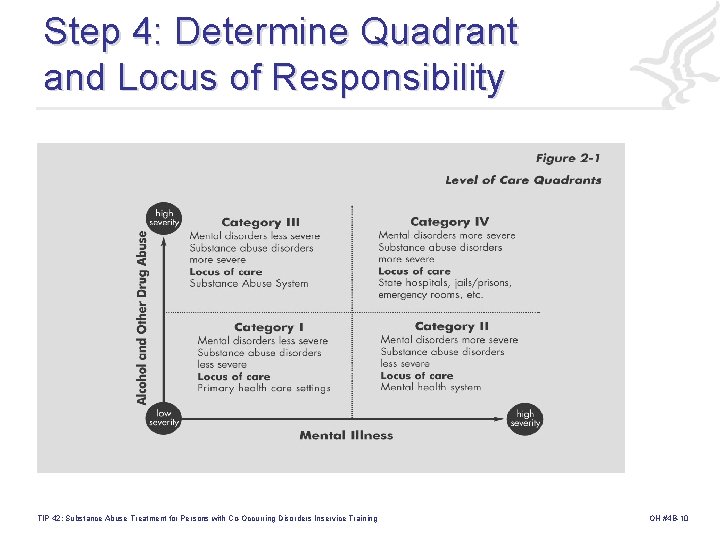
Step 4: Determine Quadrant and Locus of Responsibility TIP 42: Substance Abuse Treatment for Persons with Co-Occurring Disorders Inservice Training OH #4 B-10
TIP Exercise— Cases & Quadrants of Care With your partner: n Select one case (Maria M. , or George T. , or Jane B. ) on pp. 69 and 70. n Change or add information that would result in assignment of that case to a different quadrant. (1 minute) TIP 42: Substance Abuse Treatment for Persons with Co-Occurring Disorders Inservice Training OH #4 B-11
12 Step Assessment Process 1: Engage the client 2: Identify & contact collaterals to gather additional information 7: Determine disability & functional impairment 8: Identify strengths & supports 3: Screen for & detect COD 9: Identify cultural & linguistic needs & supports 4: Determine quadrant & locus of responsibility 10: Identify problem domains 5: Determine level of care 11: Determine stage of change 12: Plan treatment 6: Determine diagnosis TIP 42: Substance Abuse Treatment for Persons with Co-Occurring Disorders Inservice Training OH #4 B-12
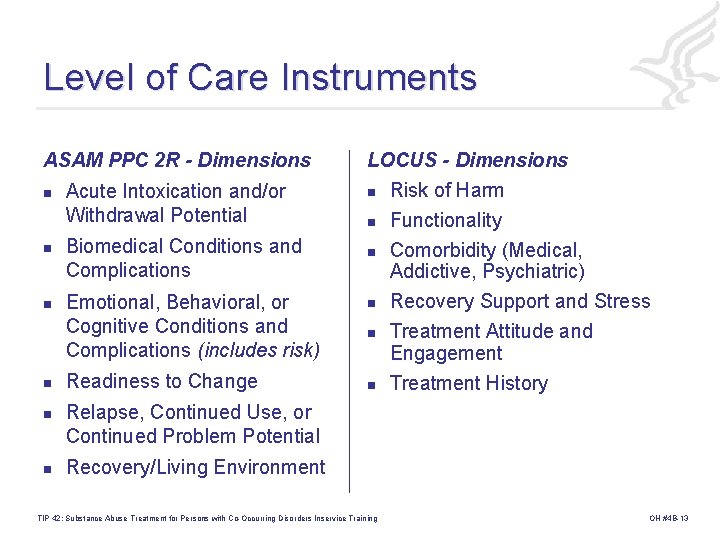
Level of Care Instruments ASAM PPC 2 R - Dimensions n n n Acute Intoxication and/or Withdrawal Potential Biomedical Conditions and Complications Emotional, Behavioral, or Cognitive Conditions and Complications (includes risk) Readiness to Change LOCUS - Dimensions n Risk of Harm n Functionality n Comorbidity (Medical, Addictive, Psychiatric) n Recovery Support and Stress n Treatment Attitude and Engagement n Treatment History Relapse, Continued Use, or Continued Problem Potential Recovery/Living Environment TIP 42: Substance Abuse Treatment for Persons with Co-Occurring Disorders Inservice Training OH #4 B-13
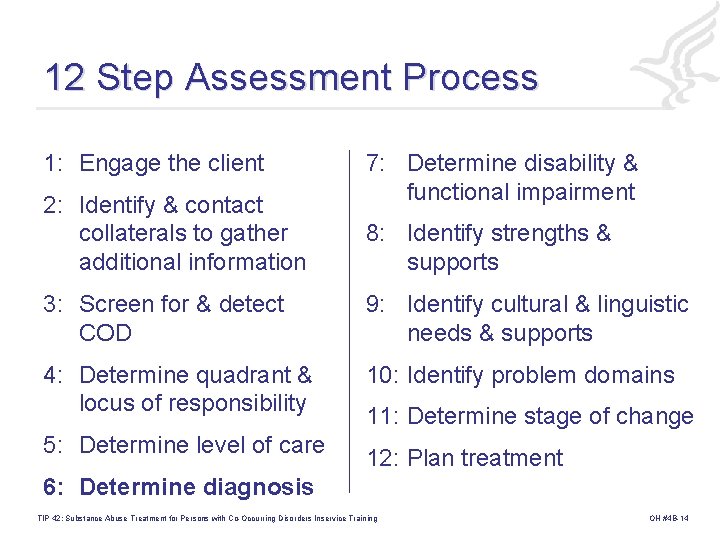
12 Step Assessment Process 1: Engage the client 2: Identify & contact collaterals to gather additional information 7: Determine disability & functional impairment 8: Identify strengths & supports 3: Screen for & detect COD 9: Identify cultural & linguistic needs & supports 4: Determine quadrant & locus of responsibility 10: Identify problem domains 5: Determine level of care 11: Determine stage of change 12: Plan treatment 6: Determine diagnosis TIP 42: Substance Abuse Treatment for Persons with Co-Occurring Disorders Inservice Training OH #4 B-14
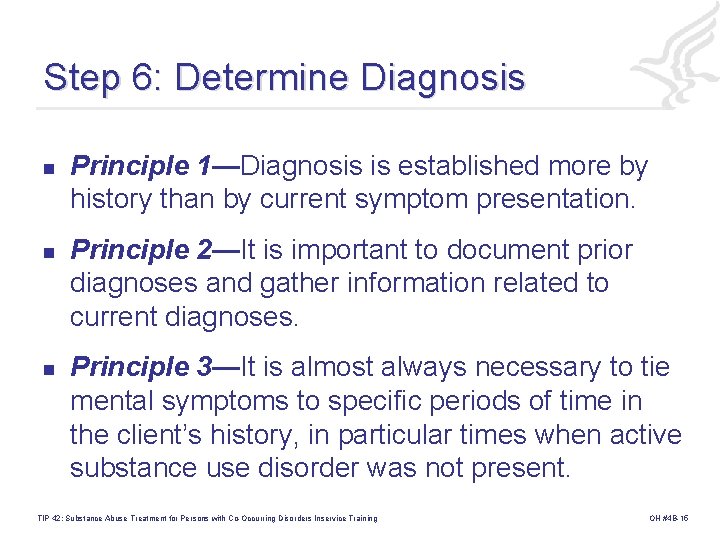
Step 6: Determine Diagnosis n n n Principle 1—Diagnosis is established more by history than by current symptom presentation. Principle 2—It is important to document prior diagnoses and gather information related to current diagnoses. Principle 3—It is almost always necessary to tie mental symptoms to specific periods of time in the client’s history, in particular times when active substance use disorder was not present. TIP 42: Substance Abuse Treatment for Persons with Co-Occurring Disorders Inservice Training OH #4 B-15
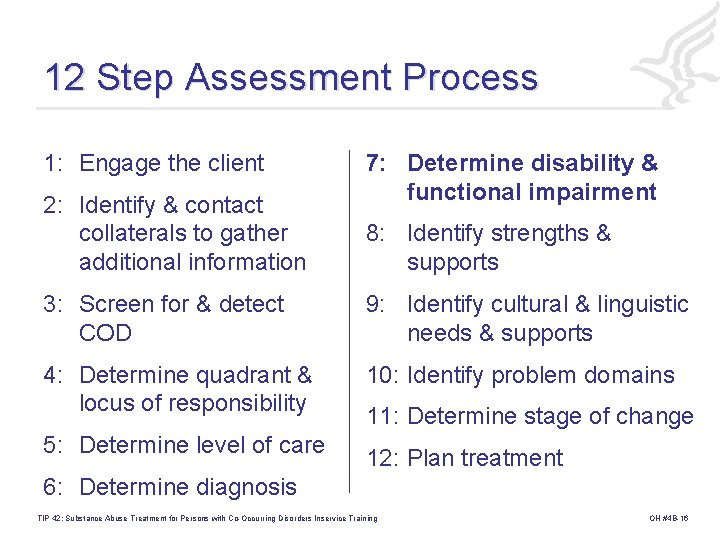
12 Step Assessment Process 1: Engage the client 2: Identify & contact collaterals to gather additional information 7: Determine disability & functional impairment 8: Identify strengths & supports 3: Screen for & detect COD 9: Identify cultural & linguistic needs & supports 4: Determine quadrant & locus of responsibility 10: Identify problem domains 5: Determine level of care 11: Determine stage of change 12: Plan treatment 6: Determine diagnosis TIP 42: Substance Abuse Treatment for Persons with Co-Occurring Disorders Inservice Training OH #4 B-16
TIP Exercise—Step 7 Application to Case Examples n n Review with your partner the case on p. 89 OR the case on p. 90. In your opinion, how useful was the determination of disability and functional impairment: – For the counselor? – For the client? (3 minutes) TIP 42: Substance Abuse Treatment for Persons with Co-Occurring Disorders Inservice Training OH #4 B-17
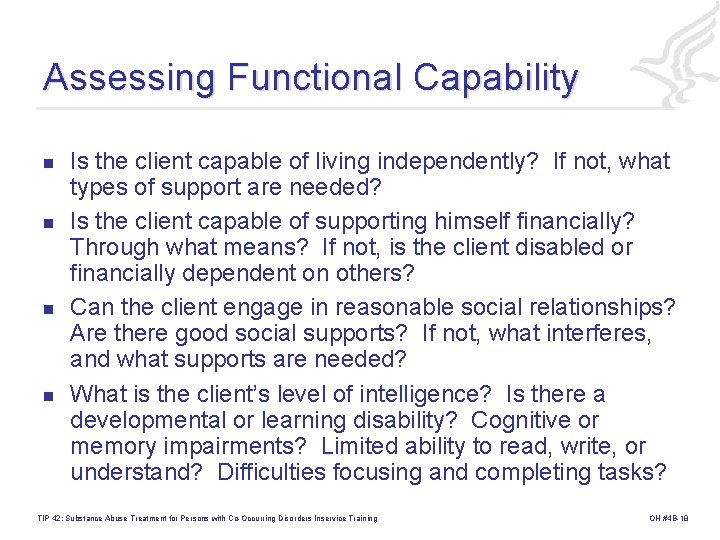
Assessing Functional Capability n n Is the client capable of living independently? If not, what types of support are needed? Is the client capable of supporting himself financially? Through what means? If not, is the client disabled or financially dependent on others? Can the client engage in reasonable social relationships? Are there good social supports? If not, what interferes, and what supports are needed? What is the client’s level of intelligence? Is there a developmental or learning disability? Cognitive or memory impairments? Limited ability to read, write, or understand? Difficulties focusing and completing tasks? TIP 42: Substance Abuse Treatment for Persons with Co-Occurring Disorders Inservice Training OH #4 B-18
- Slides: 18