
Module 35 Social Thinking and Social Influence Josef

- Slides: 32
Module 35 Social Thinking and Social Influence Josef F. Steufer/Getty Images
Social Thinking and Social Influence Social Thinking 35 -1: WHAT DO SOCIAL PSYCHOLOGISTS STUDY? HOW DO WE TEND TO EXPLAIN OTHERS’ BEHAVIOR AND OUR OWN? • Social psychologists – Use scientific methods to study how people think about, influence, and relate to one another – Study the social influences that explain why the same person will act differently in different situations
Social Thinking and Social Influence Social Thinking • When explaining others’ behavior, especially from an individualist Western cultural perspective – Fundamental attribution error committed by underestimating the influence of the situation and overestimating the effects of stable, enduring traits – Behavior more readily attributed to the influence of the situation – Explaining and attributing actions can have important real-life social and economic effects
Social Thinking and Social Influence Social Thinking The Fundamental Attribution Error • Attribution theory, Fritz Heider (1958): The theory that we explain someone else’s behavior by crediting either the situation (a situational attribution) or the person’s disposition (a dispositional attribution). – The fundamental attribution error is the tendency, when analyzing others’ behavior, to overestimate the influence of personal traits and underestimate the effects of the situation. • Fundamental attribution error demonstrated in a study (Napolitan & Goethals, 1979): – Students attributed behavior of others to personal traits, even when they were told that behavior was part of an experimental situation.
Social Thinking and Social Influence Social Thinking The Fundamental Attribution Error What Factors Affect Our Attributions? • Cultural factors: – Individuals from individualist cultures (Westerners) more often attribute behavior to personal traits. – Individuals from collectivist cultures (East Asian, for example) more often attribute behavior to situational factors. • When we explain our own behavior, we are sensitive to how behavior changes the situation. • We are also sensitive to the power of the situation when we explain the behavior of people we have seen in different situations. • Is most likely to occur when judging others’ behaviors, not our own, and especially when a stranger acts badly.
Social Thinking and Social Influence Social Thinking The Fundamental Attribution Error What Are the Consequences of Our Attributions? • Explaining and attributing actions can have important real-life social and economic effects. – A person’s friendliness may be attributed to romantic interest or politeness. – Unemployment and poverty may be attributed to personal dispositions. • The point to remember: Our attributions—to a person’s disposition or to the situation—have real consequences.
Social Thinking and Social Influence Social Thinking Attitudes and Actions 35 -2: HOW DO ATTITUDES AND ACTIONS INTERACT? • Attitudes are feelings influenced by beliefs, that predispose reactions to objects, people, and events. Attitudes Affect Actions – Peripheral route persuasion occurs when people are influenced by incidental cues; produce fast but relatively thoughtless changes in attitudes. – Central route persuasion occurs when people are offered evidence and arguments to trigger thoughtful responses. • Attitudes are especially likely to affect behavior when external influences are minimal, and when the attitude is stable, specific to the behavior, and easily recalled.
Social Thinking and Social Influence Social Thinking Attitudes and Actions Affect Attitudes • Not only will people stand up for what they believe, they also will more strongly believe in what they have stood up for. • Foot-in-the-door phenomenon – People agreeing to a small request will find it easier to agree later to a larger one – Principle works for negative and positive behavior • Many streams of evidence confirm that attitudes follow behavior. Cooperative actions, such as those performed by people on sports teams, feed mutual liking. Such attitudes, in turn, promote positive behavior.
Social Thinking and Social Influence Social Thinking Attitudes and Actions Role Playing Affects Attitudes – A role is a set of expectations (norms) about a social position, defining how those in the position ought to behave. – At first, your behaviors in a new role may feel phony, as though you are acting, but eventually these new ways of acting become a part of you. – Philip Zimbardo’s 1972 Stanford Prison simulation study: controversial, but showed the power of the situation and of role playing. – Other studies have shown that role playing can even train torturers (Staub, 1989).
Social Thinking and Social Influence Social Thinking Attitudes and Actions Cognitive Dissonance: Relief From Tension • Cognitive dissonance theory: We act to reduce the discomfort (dissonance) we feel when two of our thoughts (cognitions) are inconsistent. – When we become aware that our attitudes and our actions clash, we can reduce the resulting dissonance by changing our attitudes. – Brain regions the become active when we experience conflict and negative arousal also become active when people experience cognitive dissonance. – Through cognitive dissonance we often bring attitudes into line with our actions (Festinger, 1957). This can be used positively: Act as though you like someone and you soon may.
Social Thinking and Social Influence Cultural Influences 35 -3: HOW DOES CULTURE AFFECT OUR BEHAVIOR? Culture: The enduring behaviors, ideas, attitudes, values, and traditions shared by a group of people • Transmitted from one generation to the next • Transmits customs and beliefs that enable us to communicate with each other • Transmits agreed-upon rules to avoid confrontation Variation Across Cultures • Norm: Understood rules for accepted and expected behavior • Each cultural group evolves its own norms; when cultures collide, their differing norms can confuse or even anger
Social Thinking and Social Influence Cultural Influences Variation Over Time Like biological creatures, • Cultures vary and compete for resources • Cultures evolve over time, and may change rapidly; cultural evolution is far faster than biological evolution • Cultural changes can be negative or positive • Cultures shape our lives
Social Thinking and Social Influence Conformity: Complying With Social Pressures 35 -4: WHAT IS AUTOMATIC MIMICRY, AND HOW DO CONFORMITY EXPERIMENTS REVEAL THE POWER OF SOCIAL INFLUENCE? Automatic Mimicry – Behavior is contagious; what we see we often do. – Chartrand colleagues (1999) demonstrated the chameleon effect with college students. – Automatic mimicry helps people to empathize and feel what others feel (mood linkage). – The more we mimic, the greater our empathy, and the more people tend to like us. – Suggestibility and mimicry are subtle forms of conformity.
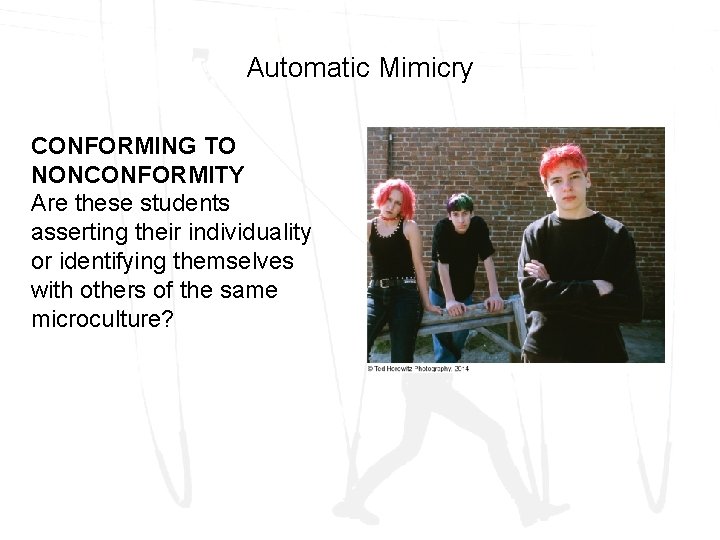
Automatic Mimicry CONFORMING TO NONCONFORMITY Are these students asserting their individuality or identifying themselves with others of the same microculture?
Social Thinking and Social Influence Conformity: Complying With Social Pressures Conformity and Social Norms • Conformity: Adjusting our behavior or thinking to coincide with a group standard • Solomon Asch’s (1955) experiments on conformity showed that people fear being “oddballs, ” and will often conform with other group members, even though they do not agree with the group’s decision • Later investigations have not always found as much conformity as Asch found, but it is nevertheless a significant phenomenon
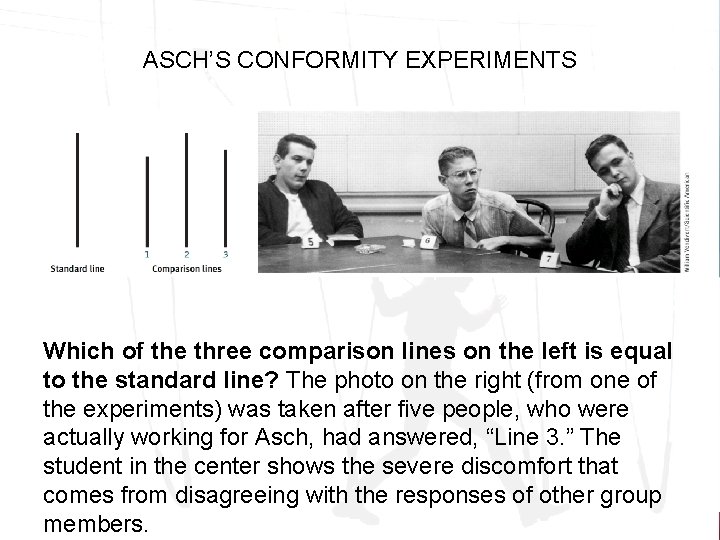
ASCH’S CONFORMITY EXPERIMENTS Which of the three comparison lines on the left is equal to the standard line? The photo on the right (from one of the experiments) was taken after five people, who were actually working for Asch, had answered, “Line 3. ” The student in the center shows the severe discomfort that comes from disagreeing with the responses of other group members.
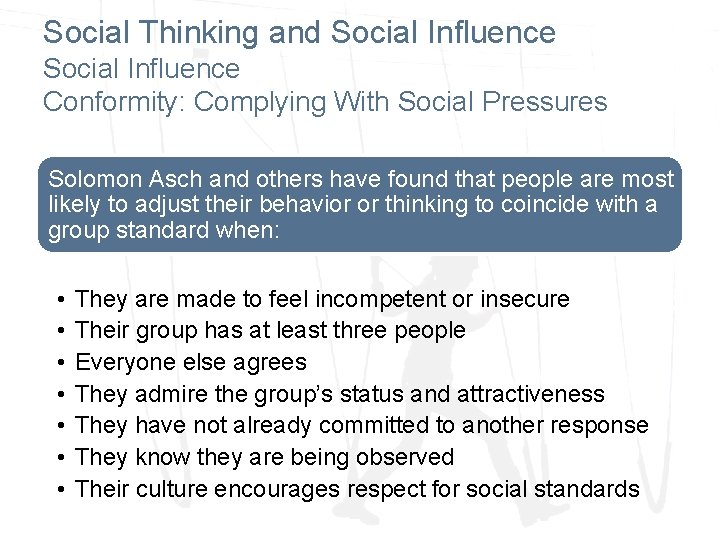
Social Thinking and Social Influence Conformity: Complying With Social Pressures Solomon Asch and others have found that people are most likely to adjust their behavior or thinking to coincide with a group standard when: • • They are made to feel incompetent or insecure Their group has at least three people Everyone else agrees They admire the group’s status and attractiveness They have not already committed to another response They know they are being observed Their culture encourages respect for social standards
Social Thinking and Social Influence Conformity: Complying With Social Pressures • Normative social influence: Influence resulting from a person’s desire to gain approval or avoid disapproval – Conforming to avoid rejection or to gain social approval • Informational social influence: Influence resulting from one’s willingness to accept others’ opinions as new information – Conforming because we want to be accurate • Conformity rates are generally lower in individualist cultures than in collectivist cultures, which put a higher value on honoring group standards
Social Thinking and Social Influence Obedience: Following Orders 35 -5: WHAT DID MILGRAM’S OBEDIENCE EXPERIMENTS TEACH US ABOUT THE POWER OF SOCIAL INFLUENCE? • Stanley Milgram’s experiments (1963, 1974) were intended to see how people would respond to outright commands. – Research participants became “teachers” to supposedly random “learners” and believed they were subjecting them to escalating levels of electric shocks. – More than 60 percent complied fully; other studies have shown even higher obedience rates. • People in these studies obeyed orders even when they thought they were harming another person.
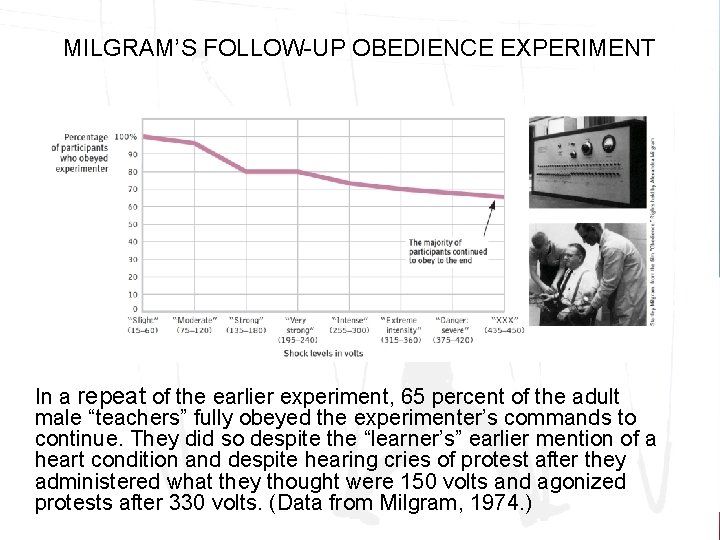
MILGRAM’S FOLLOW-UP OBEDIENCE EXPERIMENT In a repeat of the earlier experiment, 65 percent of the adult male “teachers” fully obeyed the experimenter’s commands to continue. They did so despite the “learner’s” earlier mention of a heart condition and despite hearing cries of protest after they administered what they thought were 150 volts and agonized protests after 330 volts. (Data from Milgram, 1974. )
Social Thinking and Social Influence Obedience: Following Orders Obedience in the Milgram experiments was highest when: • Person giving orders was nearby and was perceived to be a legitimate authority figure • Research was supported by a prestigious institution • Victim was depersonalized or at a distance • There were no role models for defiance
Social Thinking and Social Influence Obedience: Following Orders Lessons From the Obedience Studies – Strong social influences can make people conform to falsehoods or capitulate to cruelty – Ordinary people are corrupted by evil situations – People get to real-life violence in tiny increments (the footin-the-door phenomenon): In any society, great evils often grow out of people’s compliance with lesser evils – Milgram (1974): “ Ordinary people, simply doing their jobs, and without any particular hostility on their part, can become agents in a terrible destructive process”
Social Thinking and Social Influence Group Behavior 35 -6: HOW IS OUR BEHAVIOR AFFECTED BY THE PRESENCE OF OTHERS? Social Facilitation • In social facilitation (Triplett, 1898), the presence of others arouses people, improving performance on easy or well-learned tasks but decreasing it on difficult ones. – Our arousal heightens our reactions, strengthening our most likely response—the correct one on an easy task but an incorrect one on a difficult task. • Home advantage for team sports; doing something we do well in front of a friendly audience • Crowding effect; performers know that a “good house” is a full one
Social Thinking and Social Influence Group Behavior Home team advantage – When others observe us, we perform well-learned tasks more quickly and accurately. – But on new and difficult tasks, performance is less quick and accurate.
Social Thinking and Social Influence Group Behavior Social Loafing – Tendency for people in a group to exert less effort when pooling their efforts toward attaining a common goal than when individually accountable • Three causes of social loafing: – Acting as part of group and feeling less accountable – Feeling individual contribution doesn’t matter and is dispensable – Slacking off, or free riding on others’ efforts, which is especially common when there is lack of identification with the group
Social Thinking and Social Influence Group Behavior Deindividuation – The loss of self-awareness and self-restraint occurring in group situations that foster arousal and anonymity. – Thrives in many different settings. – When we shed self-awareness and self-restraint— whether in a mob, at a rock concert, at a ballgame, or at worship—we become more responsive to the group experience, whether bad or good.
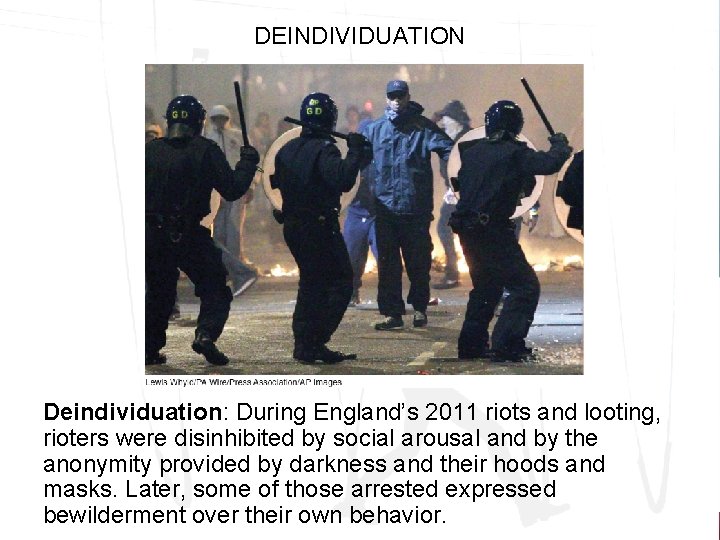
DEINDIVIDUATION Deindividuation: During England’s 2011 riots and looting, rioters were disinhibited by social arousal and by the anonymity provided by darkness and their hoods and masks. Later, some of those arrested expressed bewilderment over their own behavior.
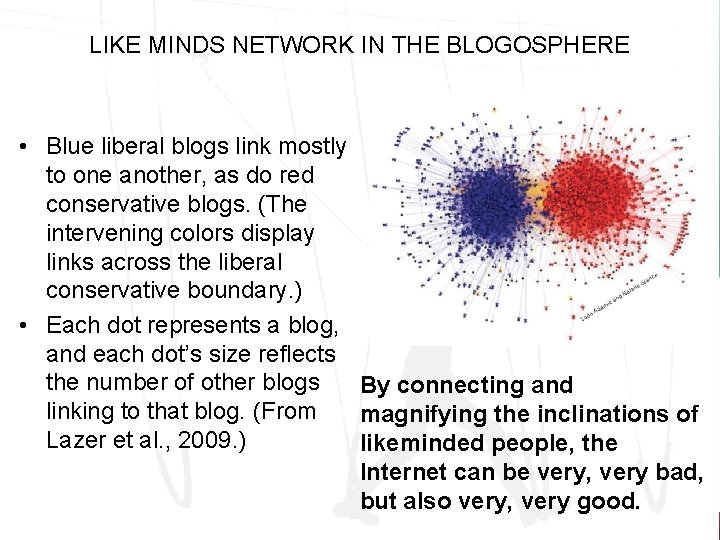
Social Thinking and Social Influence Group Polarization 35 -7: WHAT ARE GROUP POLARIZATION AND GROUPTHINK, AND HOW MUCH POWER DO WE HAVE AS INDIVIDUALS? – Group polarization: The enhancement of a group’s prevailing inclinations through discussion within the group. – Online communication magnifies this effect, for better (motivating positive social change in protest groups) and for worse (cementing prejudiced opinions in hate groups).
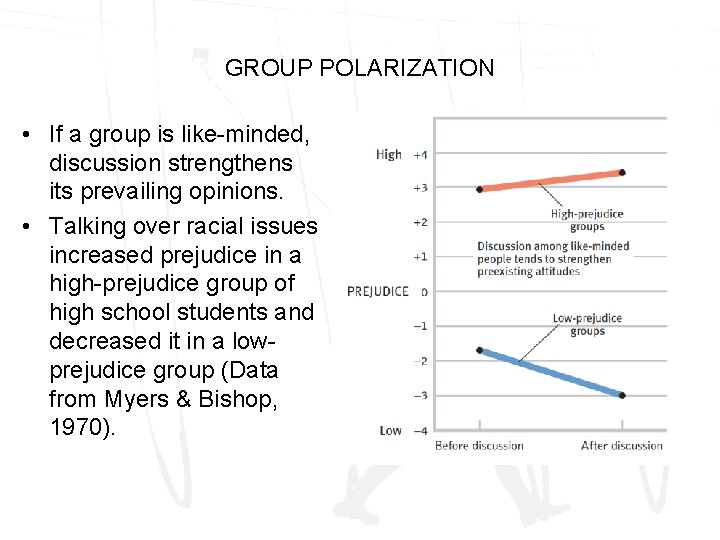
GROUP POLARIZATION • If a group is like-minded, discussion strengthens its prevailing opinions. • Talking over racial issues increased prejudice in a high-prejudice group of high school students and decreased it in a lowprejudice group (Data from Myers & Bishop, 1970).
LIKE MINDS NETWORK IN THE BLOGOSPHERE • Blue liberal blogs link mostly to one another, as do red conservative blogs. (The intervening colors display links across the liberal conservative boundary. ) • Each dot represents a blog, and each dot’s size reflects the number of other blogs By connecting and linking to that blog. (From magnifying the inclinations of Lazer et al. , 2009. ) likeminded people, the Internet can be very, very bad, but also very, very good.
Social Thinking and Social Influence Group Polarization • Groupthink (Janis, 1982): The mode of thinking that occurs when the desire for harmony within a decisionmaking group overrides a realistic appraisal of alternatives • Groupthink is prevented when leaders – Welcome various opinions, usually in diverse groups – Invite experts’ critiques of developing plans – Assign people to identify possible problems
Social Thinking and Social Influence Group Polarization The Power of Individuals • Power of the individual (personal control) and the power of the situation (social control) interact. • A committed individual or a small minority with consistently expressed views may sway the majority. • The power of one or two individuals to sway majorities is referred to as minority influence.