
Module 3 Transportation and Transfer of EthanolBlended Fuels
Module 3: Transportation and Transfer of Ethanol-Blended Fuels
Objective Upon the successful completion of this module, participants will be able to describe how ethanol-blended fuels are transported and transferred and where the most likely points for error in these actions will exist. 2
Introduction § Essential to quickly & effectively identify presence of ethanol / ethanol-blended fuels at scene of incident § Can be challenging because containers in which ethanol is transported not always clearly marked § Steps taken to ensure incidents managed effectively 3

Transportation and Placarding § Gasoline & ethanolblended fuels transported in same general types of containers & tanks § MC-306 / DOT-406 Copyright 2006, TEEX/ESTI 4
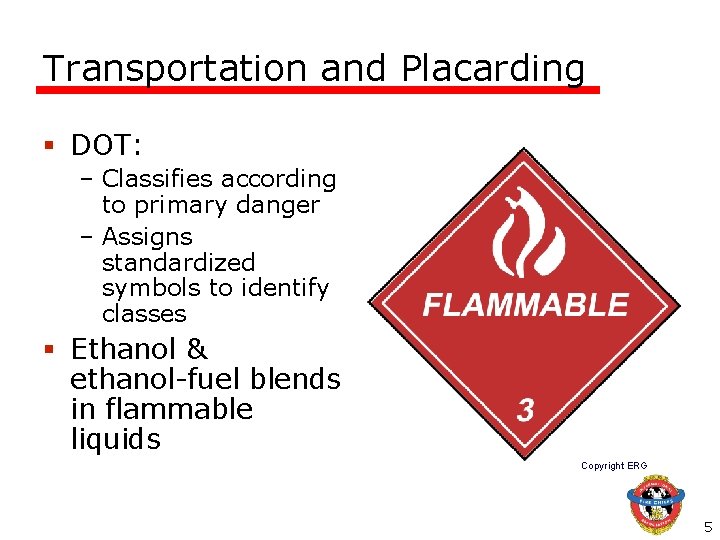
Transportation and Placarding § DOT: – Classifies according to primary danger – Assigns standardized symbols to identify classes § Ethanol & ethanol-fuel blends in flammable liquids Copyright ERG 5

Transportation and Placarding § Tanker placards: – Lower ethanol concentrations up to & including E-10 blended fuels: UN 1203 flammable placard – E-85: UN 3475 flammable placard – E-95: UN / NA 1987 flammable placard Copyright ERG 6
Transportation and Placarding § Rail tanks identified similarly § Pressure & vacuum relief devices same as currently found on gasoline-style transport tankers § Bottom loaded & unloaded by standard 4 -inch quick connect / direct connections 7
Transportation and Placarding § Valving internal to tanks with breakaway piping & remote shut-off controls § Vapor recovery systems same as currently found on gasoline tankers 8
Transportation and Placarding § Most E-95 transported by rail: – Some by waterway & very small amounts by pipeline § Storage depots with no access to rail receive it by road tankers: – Trans-loading 9
Transportation and Placarding § NFPA 704 diamond: – Uses colors, numbers, & special symbols to indicate presence of hazardous materials – Higher number = greater hazard 10
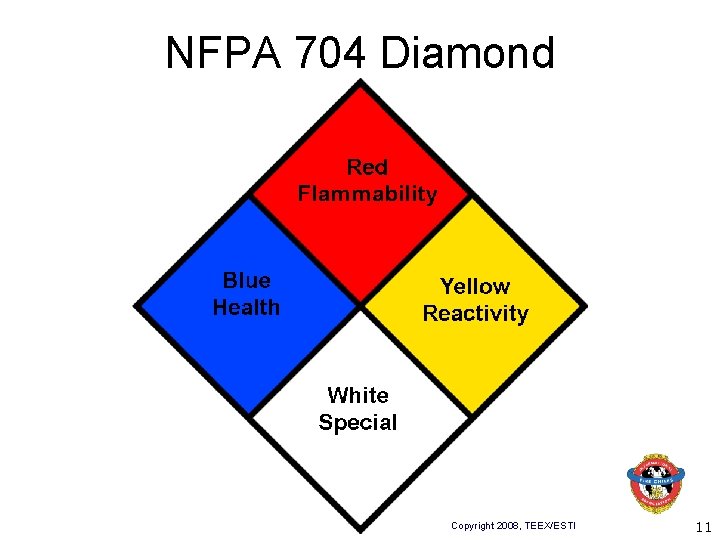
NFPA 704 Diamond Copyright 2008, TEEX/ESTI 11
Transportation and Placarding § NFPA 704 diamond: – Health: Blue – Flammability: Red – Reactivity: Yellow – Special: White (special notice) 12
Transportation and Placarding § NFPA diamond for E-100, E-95, E-85, & gasoline: – 1: Blue health square: slight to moderate irritation – 0: Reactivity yellow square – 3: Flammability red square: high flammability with ignition likely under most conditions – No commonly accepted special character (white) 13

NFPA Diamond for E-100, E-95, E-85, and Gasoline Copyright 2008, TEEX/ESTI 14
Transportation and Placarding § Most hazardous materials incidents occur during transportation & transfer operations § Be aware of areas / routes where large shipments of ethanol & ethanol-blended fuels routinely pass § E-95 now leading single hazardous material transported by rail 15
Transportation and Placarding § Most of Midwest & other ethanol production facilities have access to rail sidings, many bulk storage fuel depots do not have rail sidings: – Much of E-95 off-loaded & transferred to tanker trucks for distribution to bulk storage facilities via highways 16

Transportation and Placarding § Placards able to indicate high-concentration ethanol-blended fuels: – Does not distinguish between gasoline & E-10 gasohol – E-10 requires AR foam for emergency response § TRANSCAER 17

Activity 3. 1 — Ethanol Spill Emergency § Purpose: – To allow participants to determine the hazards associated with an ethanol emergency. 18
Summary § Variety of sources for information about chemicals involved in spill / fire incidents: – MSDS – UN numbers – DOT placards – NFPA 704 placards § E-95 become leading hazardous material transported by rail: – Transfer commonly occurs via highways 19
- Slides: 19