
Module 3 State Migrant Education Program Funding Allocation
- Slides: 72
Module 3: State Migrant Education Program Funding Allocation and Use of Funds New Directors’ Orientation Tutorial
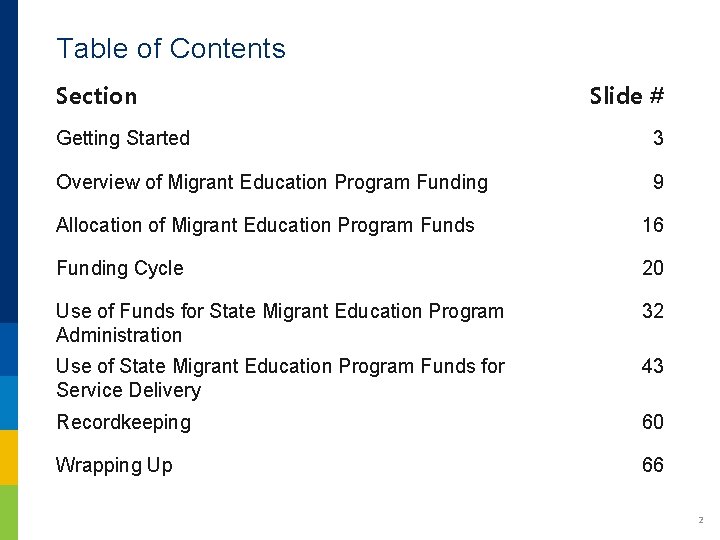
Table of Contents Section Slide # Getting Started 3 Overview of Migrant Education Program Funding 9 Allocation of Migrant Education Program Funds 16 Funding Cycle 20 Use of Funds for State Migrant Education Program Administration 32 Use of State Migrant Education Program Funds for Service Delivery 43 Recordkeeping 60 Wrapping Up 66 2
Getting Started In This Section • Tutorial Objectives • How to Use the Tutorial • Icons to Guide You • Key Readings and Resources 3
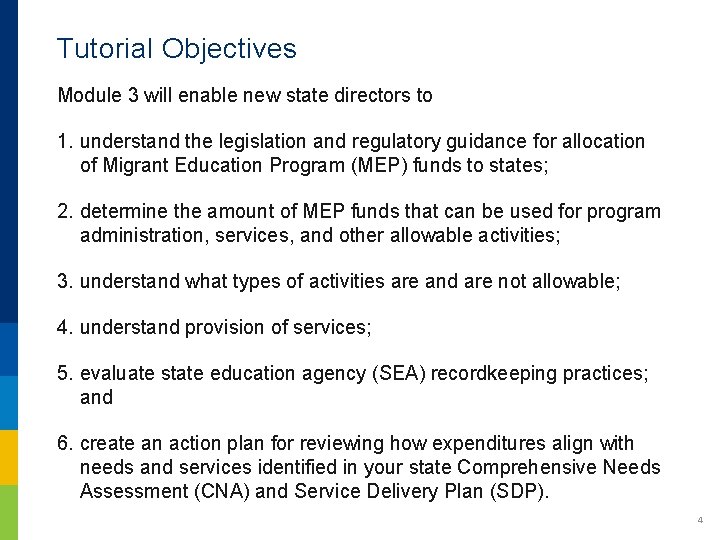
Tutorial Objectives Module 3 will enable new state directors to 1. understand the legislation and regulatory guidance for allocation of Migrant Education Program (MEP) funds to states; 2. determine the amount of MEP funds that can be used for program administration, services, and other allowable activities; 3. understand what types of activities are and are not allowable; 4. understand provision of services; 5. evaluate state education agency (SEA) recordkeeping practices; and 6. create an action plan for reviewing how expenditures align with needs and services identified in your state Comprehensive Needs Assessment (CNA) and Service Delivery Plan (SDP). 4
How to Use the Tutorial For optimal benefit from the tutorial, you should • allow sufficient time to read the slides, reflect on the information, and complete all activities on the slides or on the Quick Resource and Reflection Sheets (QRRS) that can be downloaded as worksheets; • read each slide as well as the information referenced in the slides; • engage with the “What Do You Think? ” slides to facilitate interaction with the information (Answers will be provided directly following each of these slides. ); 5
How to Use the Tutorial For optimal benefit from the tutorial, you should (continued) • pause to reflect on your state program at the “Check-in” slides (A QRRS document will typically accompany these. ); • complete the “Pop Quiz!” slides to reinforce key concepts; • review your state’s MEP documents and reports as directed; • develop an action plan using the worksheets provided; • add actionable items to your MEP planning calendar (See QRRS 14. 2. ); and • contact your OME Program Officer follow-up questions. 6
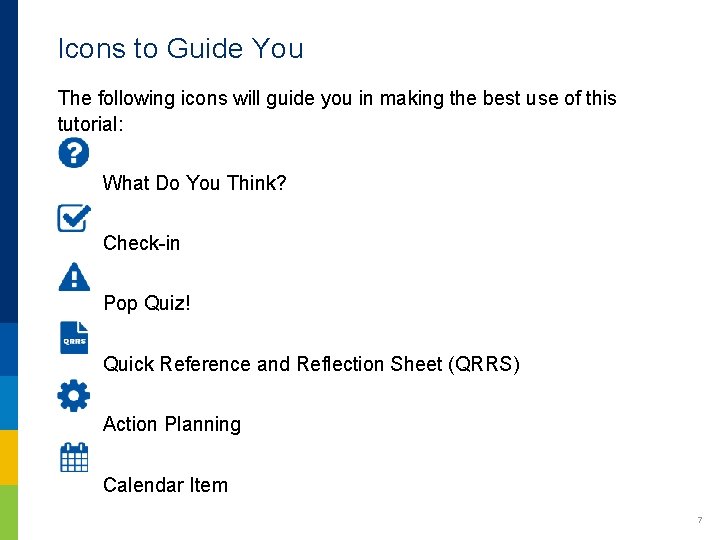
Icons to Guide You The following icons will guide you in making the best use of this tutorial: What Do You Think? Check-in Pop Quiz! Quick Reference and Reflection Sheet (QRRS) Action Planning Calendar Item 7
Key Readings and Resources You should have these documents readily available while completing the module, as the module will refer to these documents for more complete information on various topics. • MEP Guidance on the Education of Migratory Children under Title I, Part C of the Elementary and Secondary Education Act of 1965, o Chapter I: State Application and Funding o Chapter X: Fiscal Requirements o Chapter XI: State Administration • A copy of your state’s Consolidated State Application, including any amendments to MEP sections • A copy of your state’s Service Delivery Plan (SDP) • A copy of your last federal monitoring report 8
Overview of Migrant Education Program Funding In This Section • Purpose of the Migrant Education Program • Authorizing Legislation • Statute, Regulations, and Guidance • Guiding Cost Principles 9
Purpose of the Migrant Education Program Assist states to: • Support high-quality and comprehensive educational programs for migratory children to help reduce the educational disruptions and other problems that result from repeated moves; • Ensure that migratory children who move among the states are not penalized in any manner by disparities among the states in curriculum, graduation requirements, and state academic content and student academic achievement standards; • Ensure that migratory children are provided with appropriate educational services (including supportive services) that address their special needs in a coordinated and efficient manner; Section 1301 of the ESEA, as amended 10
Purpose of the Migrant Education Program • Ensure that migratory children receive full and appropriate opportunities to meet the same challenging State academic content and student academic achievement standards that all children are expected to meet; • Design programs to help migratory children in overcome educational disruption, cultural and language barriers, social isolation, various health-related problems, and other factors that inhibit the ability of such children to do well in school, and to prepare such children to make a successful transition to postsecondary education or employment; and • Ensure that migratory children benefit from state and local systemic reforms. Section 1301 of the ESEA, as amended 11
Authorizing Legislation Title I, Part C, Section 1302 of the Elementary and Secondary Education Act, as amended (ESEA), authorizes grants to states “to establish or improve, directly or through local operating agencies, programs of education for migratory children. ” SEAs have flexibility in the way awarded funds are used. However, any use of MEP funds must adhere to all applicable statute and regulations. Section 1302 of the ESEA, as amended 12
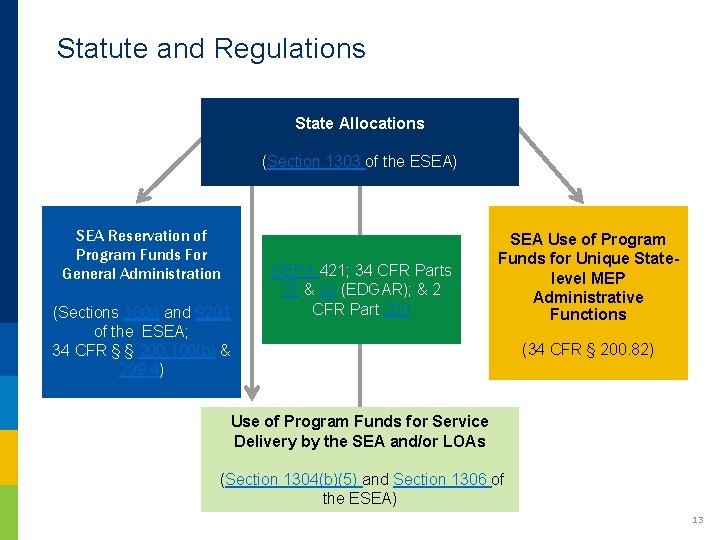
Statute and Regulations State Allocations (Section 1303 of the ESEA) SEA Reservation of Program Funds For General Administration (Sections 1004 and 9201 of the ESEA; 34 CFR § § 200. 100(b) & 299. 4) GEPA 421; 34 CFR Parts 76 & 80 (EDGAR); & 2 CFR Part 200 SEA Use of Program Funds for Unique Statelevel MEP Administrative Functions (34 CFR § 200. 82) Use of Program Funds for Service Delivery by the SEA and/or LOAs (Section 1304(b)(5) and Section 1306 of the ESEA) 13
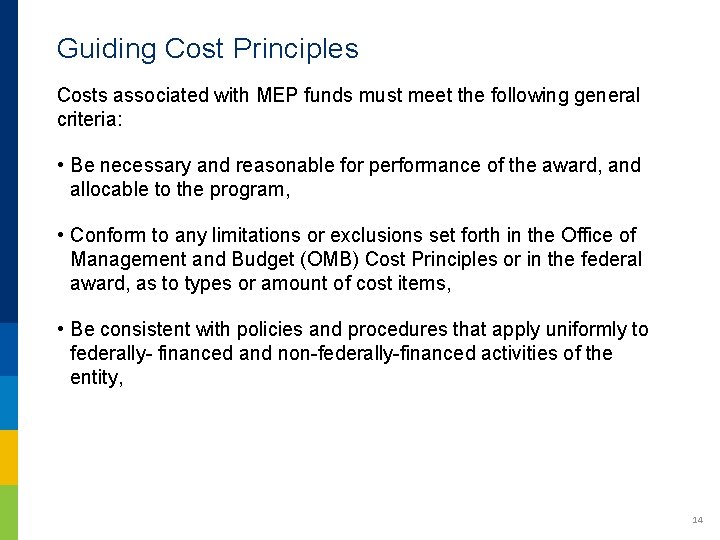
Guiding Cost Principles Costs associated with MEP funds must meet the following general criteria: • Be necessary and reasonable for performance of the award, and allocable to the program, • Conform to any limitations or exclusions set forth in the Office of Management and Budget (OMB) Cost Principles or in the federal award, as to types or amount of cost items, • Be consistent with policies and procedures that apply uniformly to federally- financed and non-federally-financed activities of the entity, 14
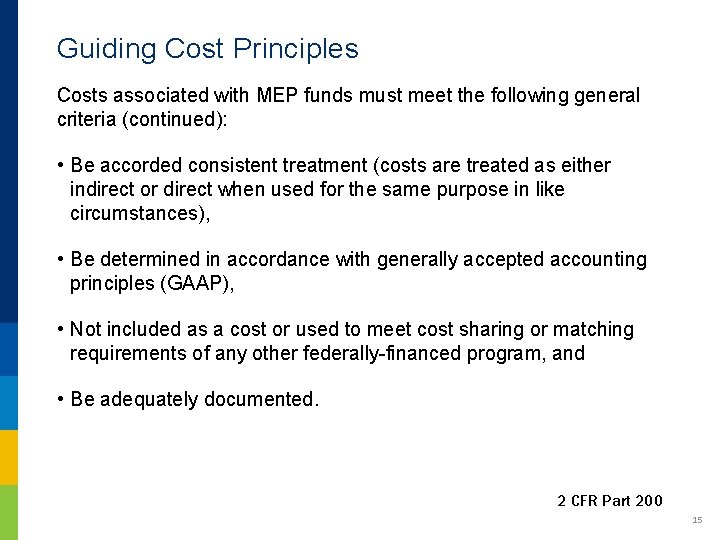
Guiding Cost Principles Costs associated with MEP funds must meet the following general criteria (continued): • Be accorded consistent treatment (costs are treated as either indirect or direct when used for the same purpose in like circumstances), • Be determined in accordance with generally accepted accounting principles (GAAP), • Not included as a cost or used to meet cost sharing or matching requirements of any other federally-financed program, and • Be adequately documented. 2 CFR Part 200 15
Allocation of Migrant Education Program Funds In This Section • State Base Allocation • Adjustments to the Base Allocation 16
State Base Allocation MEP funds are allocated to SEAs on a formula basis. By law, the amount of MEP funds that each State receives starts with a base allocation, which is the amount of MEP funds that the SEA received for FY 2002. The base amount is based upon: • A calculation of the state’s full-time equivalent (FTE) count of eligible migrant children (using Category 1 and Category 2 Child Counts data) for the 2000 -2001 reporting period, and • The state’s per-pupil expenditures (SPPE) 17
Adjustments to the State Base Allocation • The availability of federal funds less the Department of Education (ED) set aside amount for coordination activities (Section 1308 of the ESEA, as amended). • If Congress appropriates MEP funds for any fiscal year in an amount that is less than the total amount all SEAs received in FY 2002, each state’s base amount is ratably reduced. • If Congress appropriates MEP funds for any fiscal year in an amount that exceed the amount appropriated for FY 2002, the states receive the “base” amount and an “additional” amount based on their current counts of migrant children and their current SPPE amount. (To date, Congress has never appropriated an amount of MEP funds that exceeds the amount appropriated for FY 2002) 18
Check-in How much was your state MEP allocation this fiscal year? • How were allocated funds used to provide educational services to migrant children in your state? See QRRS 3. 1 - State MEP Funding Review 19
Funding Cycle In This Section • Consolidated State Application Process • Funding Availability Period • Funding Cycle Closeout • State Funding Cycle 20
SEA Application for Funding • SEAs may apply for Title I, Part C funds by submitting to ED either: o A Title I, Part C (MEP) program-specific application or o A Consolidated State Application. All States receiving MEP funds have chosen to submit consolidated State applications that included Title I, Part C. • Applications are submitted at the beginning of each reauthorization cycle and remain in effect, subject to the need to provide amendments based on change of facts or circumstances, until the effective date of the next ESEA reauthorization. 21
Consolidated State Application • Your state accountability office will have the most current Consolidated State Application and any amendments submitted for ED review and approval. o If you cannot locate a copy within your SEA, please contact your OME Program Officer. 22
Amendments to Consolidated State Application If the SEA makes a substantive change to the Consolidated State Application, the SEA is required to obtain ED’s approval of the proposed amendment. • OME recommends that you contact your program officer to discuss changes prior to submitting a formal amendment to ED. • Contacting your program officer in advance will: o Provide you with a sounding board to talk through reasons for making changes and how those changes will affect the state delivery of services to migrant children and o Increase the chance that an amendment submitted to ED will be approved upon initial submission. 23
Check-in Before contacting your MEP program officer, you will want to do some preliminary planning. See QRRS 3. 2 – Revising Your State MEP 24
Funding Availability Period ED awards MEP funds to SEAs for a 15 -month period, beginning on July 1 st of the award cycle. While initial funding to SEAs is for a 15 month period, • If funds are not obligated by the end of that 15 -month period, states may carry over unobligated funds for an additional 12 months, giving the SEA up to 27 months to obligate the funds. o Funds not obligated by the end of the 27 -month period will go through a closeout process. Unobligated funds will revert to the federal government and must be returned within 90 days of the end of the 27 -month period. EDGAR § 76. 137, GEPA Sec. 421(b) S 25
Funding Availability Period Obligations are “the amounts of orders placed, contracts and subgrants awarded, services, and similar transactions during a given period that will require payment by the grantee during the same or a future period. ” • SEAs have an additional 90 days beyond the 27 -month period to draw down funds necessary to satisfy payment of funds already obligated within the 27 -month period. EDGAR § 80. 23 26
Funding Availability Period There is no special process for requesting a carryover of funds at the end of the initial 15 -month period for obligation. • Carryover funds must be used in accordance with the statute and regulations that are in effect for the carryover period – not the legislation or regulations in effect during the year for which the funds were appropriated (if different legislation or regulations were then in effect). • Funds subgranted to a LOA and not obligated by the end of the federal fiscal year (September 30) are considered part of the SEA carryover. A subgrant award is not itself an obligation of any MEP funds. 27
Funding Cycle Closeout If LOAs request a large percentage of MEP funds for carryover from one year to another, this could indicate a significant deficiency in the LOA’s planning for and use of MEP funds. • A review of LOA expenditures as part of monitoring and reporting is one way to keep abreast of program spending. • SEAs have the discretion to: o Allow LOA(s) to carryover unused MEP funds at the end of the initial funding period (for a total obligation period of up to 27 months) or o Take back any previously awarded MEP funds that LOAs do not use in the 12 -month initial project period. 28
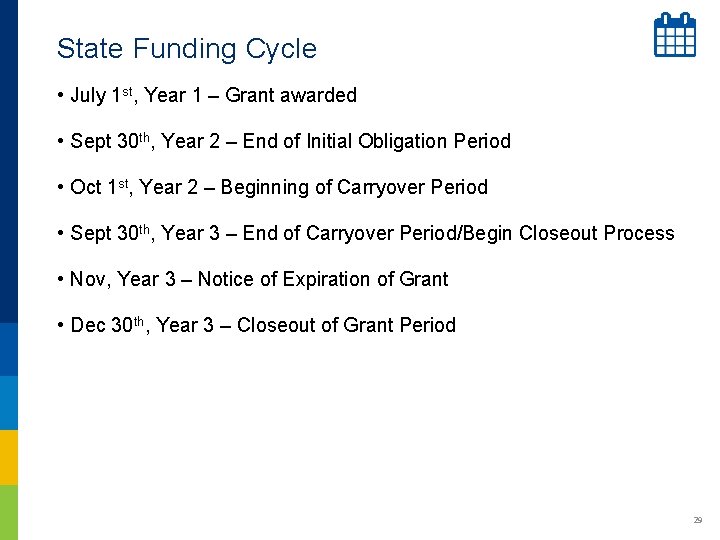
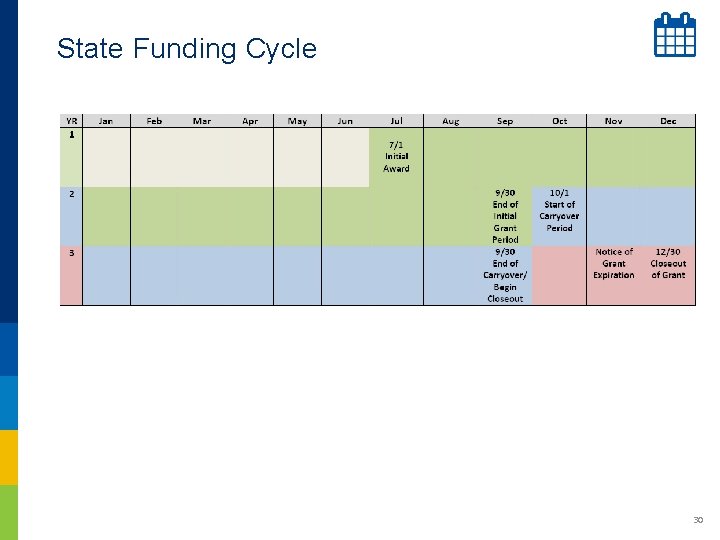
State Funding Cycle • July 1 st, Year 1 – Grant awarded • Sept 30 th, Year 2 – End of Initial Obligation Period • Oct 1 st, Year 2 – Beginning of Carryover Period • Sept 30 th, Year 3 – End of Carryover Period/Begin Closeout Process • Nov, Year 3 – Notice of Expiration of Grant • Dec 30 th, Year 3 – Closeout of Grant Period 29
State Funding Cycle 30
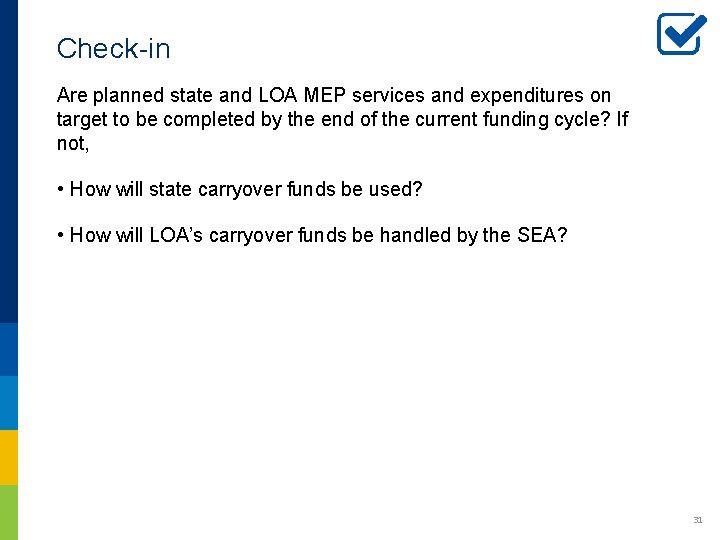
Check-in Are planned state and LOA MEP services and expenditures on target to be completed by the end of the current funding cycle? If not, • How will state carryover funds be used? • How will LOA’s carryover funds be handled by the SEA? 31
Use of Funds for State Migrant Education Program Administration In This Section • Examples of Allowable General Administration Activities • State General Administration Spending Limits • State Use of Funds for the Administration of Unique Migrant Education Program Activities 32
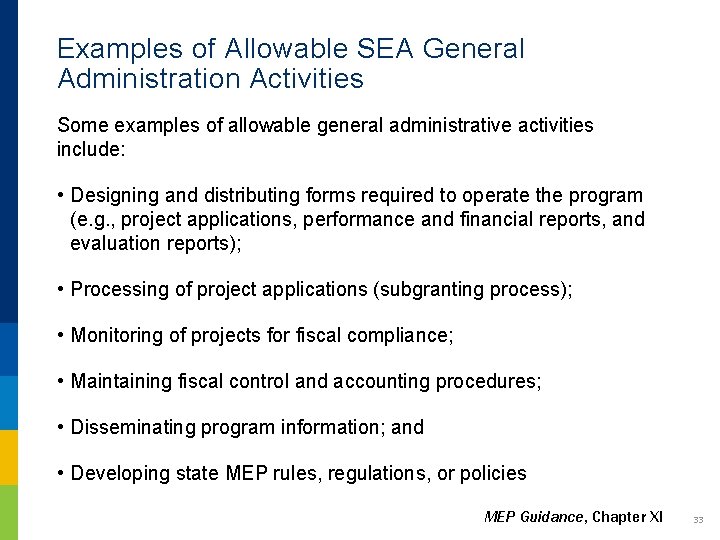
Examples of Allowable SEA General Administration Activities Some examples of allowable general administrative activities include: • Designing and distributing forms required to operate the program (e. g. , project applications, performance and financial reports, and evaluation reports); • Processing of project applications (subgranting process); • Monitoring of projects for fiscal compliance; • Maintaining fiscal control and accounting procedures; • Disseminating program information; and • Developing state MEP rules, regulations, or policies MEP Guidance, Chapter XI 33
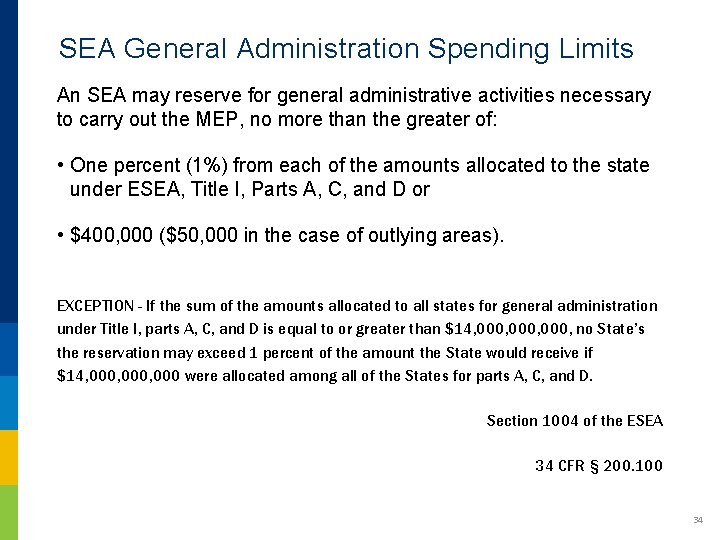
SEA General Administration Spending Limits An SEA may reserve for general administrative activities necessary to carry out the MEP, no more than the greater of: • One percent (1%) from each of the amounts allocated to the state under ESEA, Title I, Parts A, C, and D or • $400, 000 ($50, 000 in the case of outlying areas). EXCEPTION - If the sum of the amounts allocated to all states for general administration under Title I, parts A, C, and D is equal to or greater than $14, 000, no State’s the reservation may exceed 1 percent of the amount the State would receive if $14, 000, 000 were allocated among all of the States for parts A, C, and D. Section 1004 of the ESEA 34 CFR § 200. 100 34
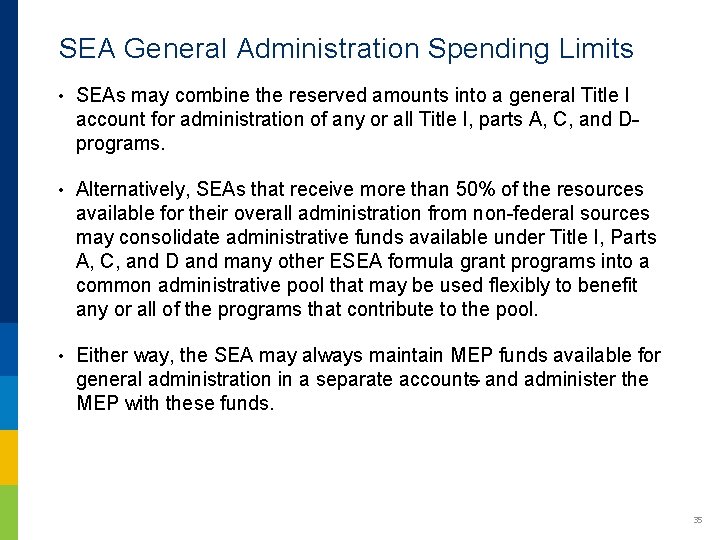
SEA General Administration Spending Limits • SEAs may combine the reserved amounts into a general Title I account for administration of any or all Title I, parts A, C, and D programs. • Alternatively, SEAs that receive more than 50% of the resources available for their overall administration from non-federal sources may consolidate administrative funds available under Title I, Parts A, C, and D and many other ESEA formula grant programs into a common administrative pool that may be used flexibly to benefit any or all of the programs that contribute to the pool. • Either way, the SEA may always maintain MEP funds available for general administration in a separate accounts and administer the MEP with these funds. 35
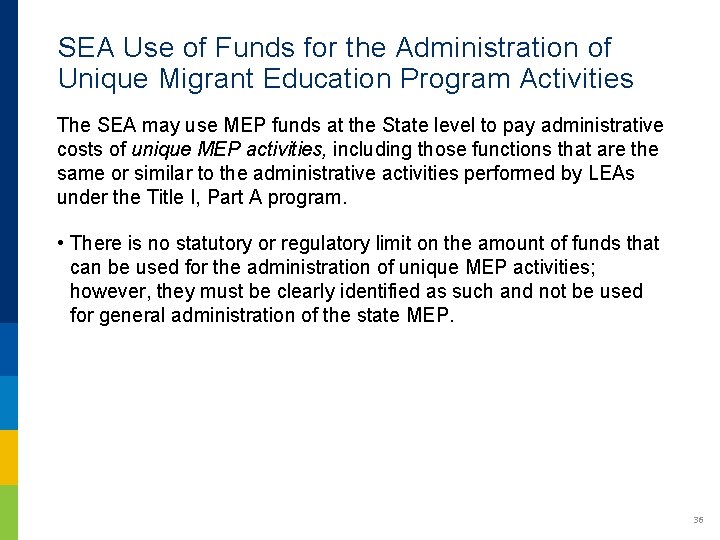
SEA Use of Funds for the Administration of Unique Migrant Education Program Activities The SEA may use MEP funds at the State level to pay administrative costs of unique MEP activities, including those functions that are the same or similar to the administrative activities performed by LEAs under the Title I, Part A program. • There is no statutory or regulatory limit on the amount of funds that can be used for the administration of unique MEP activities; however, they must be clearly identified as such and not be used for general administration of the state MEP. 36
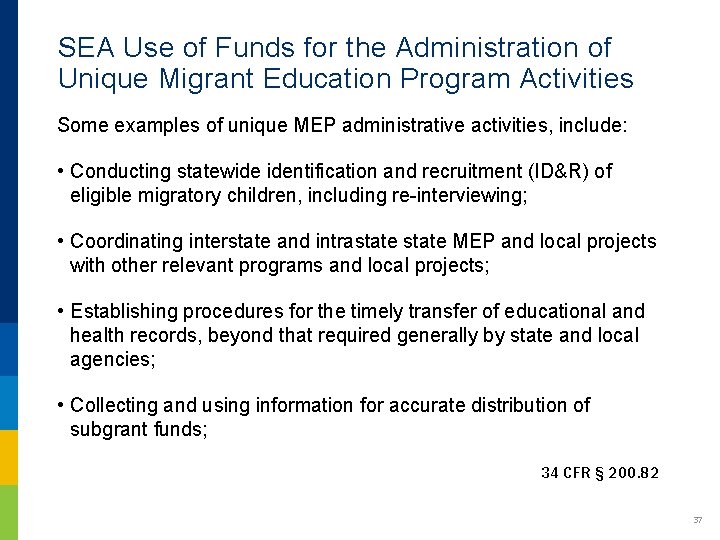
SEA Use of Funds for the Administration of Unique Migrant Education Program Activities Some examples of unique MEP administrative activities, include: • Conducting statewide identification and recruitment (ID&R) of eligible migratory children, including re-interviewing; • Coordinating interstate and intrastate MEP and local projects with other relevant programs and local projects; • Establishing procedures for the timely transfer of educational and health records, beyond that required generally by state and local agencies; • Collecting and using information for accurate distribution of subgrant funds; 34 CFR § 200. 82 37
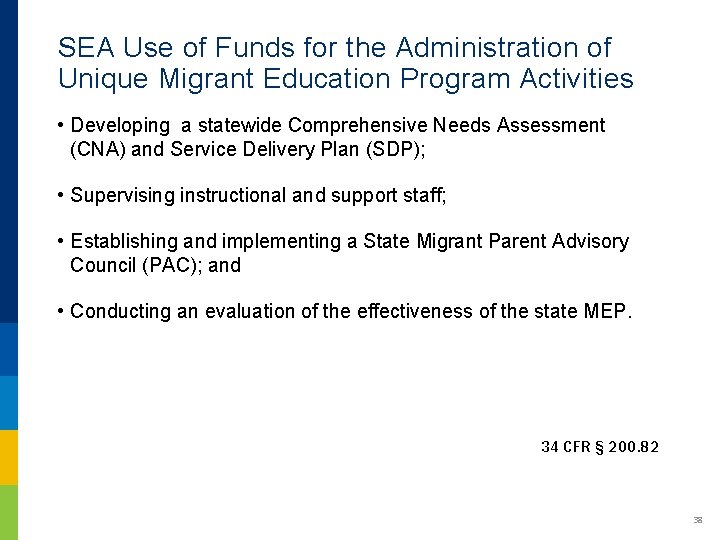
SEA Use of Funds for the Administration of Unique Migrant Education Program Activities • Developing a statewide Comprehensive Needs Assessment (CNA) and Service Delivery Plan (SDP); • Supervising instructional and support staff; • Establishing and implementing a State Migrant Parent Advisory Council (PAC); and • Conducting an evaluation of the effectiveness of the state MEP. 34 CFR § 200. 82 38
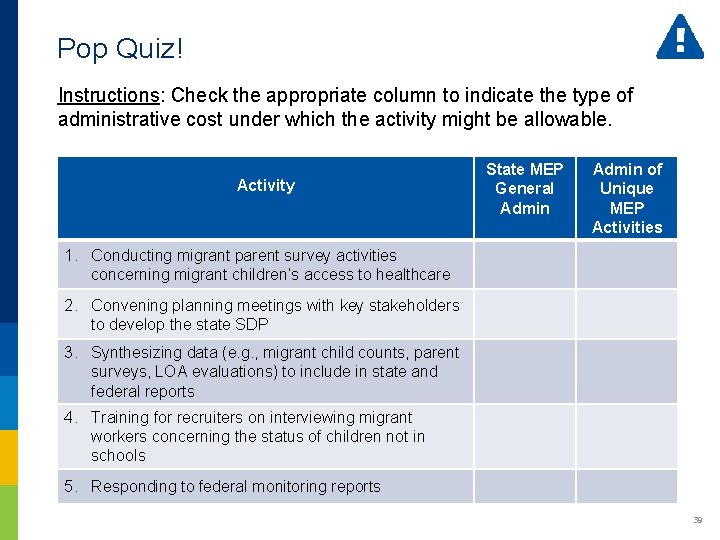
Pop Quiz! Instructions: Check the appropriate column to indicate the type of administrative cost under which the activity might be allowable. Activity State MEP General Admin of Unique MEP Activities 1. Conducting migrant parent survey activities concerning migrant children’s access to healthcare 2. Convening planning meetings with key stakeholders to develop the state SDP 3. Synthesizing data (e. g. , migrant child counts, parent surveys, LOA evaluations) to include in state and federal reports 4. Training for recruiters on interviewing migrant workers concerning the status of children not in schools 5. Responding to federal monitoring reports 39
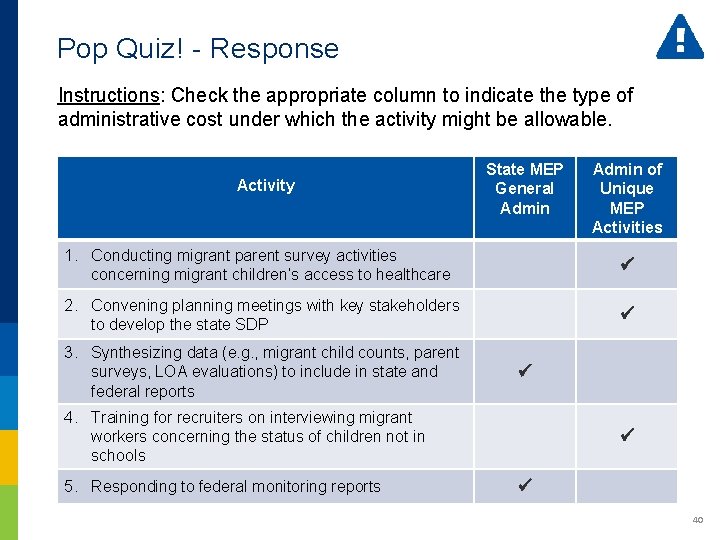
Pop Quiz! - Response Instructions: Check the appropriate column to indicate the type of administrative cost under which the activity might be allowable. Activity State MEP General Admin of Unique MEP Activities 1. Conducting migrant parent survey activities concerning migrant children’s access to healthcare 2. Convening planning meetings with key stakeholders to develop the state SDP 3. Synthesizing data (e. g. , migrant child counts, parent surveys, LOA evaluations) to include in state and federal reports 4. Training for recruiters on interviewing migrant workers concerning the status of children not in schools 5. Responding to federal monitoring reports 40
Pop Quiz! - Response Items 3 and 5 pertain to activities required for the general administration of the state-wide MEP. 3. Synthesizing data (e. g. , Child Counts, parent surveys, LOA evaluations) to include in state and federal reports MEP data collection and synthesis for state and federal reports 5. Responding to federal monitoring reports – monitoring (both state monitoring by federal MEP and LOA monitoring by state MEP are allowable general administration activities) 41
Pop Quiz! - Response Items 1, 2, and 4 are considered unique activities to the MEP, and funds can be used for the administration of these activities. 1. Conducting migrant parent survey activities concerning migrant children’s access to healthcare 2. Convening planning meetings with key stakeholders to develop the state SDP 4. Training for recruiters on interviewing migrant workers concerning the status of children not in schools 42
Use of Migrant Education Program Funds for Delivery of Services In This Section • State Use of Funds • Provision of Services • Special Migrant Populations • Recordkeeping • Exceptions to Recordkeeping Requirements 43
State Use of Funds SEAs have considerable flexibility in determining how MEP funds are used, as long as they have developed a Statewide plan to ensure: • The special needs of migratory children are specifically addressed (ascertained through the Comprehensive Needs Assessment); • The plan is developed in collaboration with parents of migratory children; • Funds are first used to meet the unique needs of migrant children that result from their migrant lifestyle, and to permit these children to participate effectively in school; 44
State Use of Funds • Funds are not used for services migratory children are already eligible for under other programs; • Migratory children are given the same opportunity to meet the state academic content standards and student academic standards that all children are expected to meet; • Services for migratory children are integrated with other services; • Services to be provided are based on a plan that specifies measurable program goals and outcomes; and • Services to be provided result from joint planning among local, state, and federal programs, including programs under Title I, Part A, early childhood programs, language instruction educational programs. Section 1306(a)(1) of the ESEA, as amended 45
State Use of Funds In developing an annual budget and determining if expenses are allowable, consider whether the expenses: • Provide for services that address the educational needs of migrant children as identified in the CNA and included in the SDP; and • Provide for services that are not available from other federal, state, or local programs. 46
Provision of Services For the purposes of the MEP, services are a subset of all the activities that the MEP provides through its program and projects. • Services are distinct in that they are the educational or educationally related activities provided to migrant children to enable them to succeed in school. Sections 1304(c)(6) and 1306(b) of the ESEA, as amended Sections 9101(37) and 9501 of the ESEA 47
Provision of Services MEP services are educational or educationally-related activities that: • Directly benefit a migrant child; • Address a need of a migrant child consistent with the SEA’s CNA and SDP; • Are grounded in scientifically based research, or in the case of support services, are generally accepted practice; and • Are designed to enable the program to meet its measurable outcomes and contribute to the achievement of the state’s performance targets. 48
Provision of Services can generally be broken down into two types: 1. Instructional services include: o Educational activities for preschool-age children and o Academic instruction for elementary and secondary students 2. Educationally-related support services include: o Advocacy for migrant children; o Health, nutrition, and social services; o Necessary educational supplies; and o Transportation. 49
Pop Quiz! Which of the following is not an MEP service? 1. A school provides literacy tutoring to migrant children at home. 2. An LOA provides health and nutrition classes to migrant families with school-age children. 3. A school establishes a half-day educational program for pre-K migrant children. 4. An LOA conducts activities to identify and recruit migrant children for enrollment in public schools. 50
Pop Quiz! – Response While item #4 is an “allowable activity” for use of MEP funds, it is not considered a service, as it does not provide an instructional or an educationally-related support service to migrant children. If items #1 -3 are aligned with the statewide CNA and SDP, then they would be allowable activities. • Items 1 and 3 are activities that provide direct education or educationally related services. • Item 2 is a support service that does provide instruction on health and nutrition and may benefit migrant children so that they are able to participate effectively in school. Note: Before using MEP funds, the LOA should ensure that these services are not provided through other federal, state, or local programs. MEP funds can be used to supplement activities, but not supplant activities. 51
Special Migrant Populations Among migrant children and youth, there are subgroups of special concern who may need more intensive services to address their various risk factors. These subgroups include • Students identified as Priority for Services (PFS), • Preschool children, and • Out-of-school youth (OSY). 52
Special Migrant Populations When planning services to migrant children, states must give Priority for Services (PFS) to those migrant children who: • Are failing, or are most at-risk of failing, to meet the state’s content and performance standards, and • Whose education has been interrupted during the regular school year. Section 1304(d) of the ESEA, as amended 53
Special Migrant Populations It is important for SEAs and LOAs to establish procedures for identifying students who are PFS and to understand their unique needs in order to assist them in becoming academically successful. • Data on PFS students are required to be collected as part of the SEA’s MEP program evaluation and Consolidated State Performance Report (CSPR) Part II reporting. • State should include methods for: o Determining the needs of PFS children in the CNA, o Providing services to PFS children in the SDP, and o Evaluating the effectiveness of services for PFS children. 54
Special Migrant Populations Preschool migratory children are typically those children age 3 -5 (not in kindergarten). • These young migrant children are often not enrolled in early childhood programs due to factors related to: o Access, o Availability, and o Affordability. 55
Special Migrant Populations It is important that SEAs and LOAs have a clear understanding of what types of programs are needed to serve the developmental needs of preschool migratory children. • The CSPR Part II requires data collection on children: o Birth through age 2 and o Ages 3 -5 (not K). • SEAs should include methods for: o Determining the needs of preschool migratory children in the CNA, and o Providing services for preschool migrant children in the SDP. See the Service Delivery Plan Toolkit for suggestions on including strategies to address the needs of preschool migratory children. 56
Special Migrant Populations Out of School Youth (OSY) refers to migrant youth (typically age 16 -21) who meet the definition of a migratory child, but who are not currently enrolled in a K-12 school. They could include: • Students who have dropped out of school, and • Youth who are working on their GED. 57
Special Migrant Populations OSY are one of the groups of migratory youth who are least likely to graduate from high school. • Data on OSY are a required component of CSPR Part II reporting. For a list of suggested strategies for addressing the needs of OSY, see the Service Delivery Plan Toolkit, Section E. 1. 58
Check-in Certain subpopulations of migrant children and youth need more intense services to overcome increased risk factors. How has your state identified these students, and what services have been planned to overcome their unique challenges? See QRRS 3. 3 -- Provision of Services 59
Recordkeeping In This Section • Recordkeeping Requirements • Exceptions 60
Recordkeeping Records must be kept and accessible for three years following the last date of expenditure for an associated funding period. • Records must be maintained longer if there any outstanding (unresolved) litigation, claim, negotiation, audit, or other action involving the records. EDGAR §§ 76. 730, 76. 731, and 80. 42 See QRRS 3. 4 -- Recordkeeping 61
Exception to General Recordkeeping Requirements • If the SEA consolidates its general administration funds, its records for use of these funds need only reflect that the funds were obligated for the administration of one or more of the programs that contributed to the administrative cost pool. o EDGAR requirements for maintaining records and making them accessible still apply. 62
Exception to General Recordkeeping Requirements The length of time that an SEA must keep a Certificate of Eligibility (COE) on file will vary. • The COE for a migrant child must be kept on record for three years after the date of the last expenditure report for the fiscal year for which the child was included in the state’s child count. MEP Guidance, Chapter XI, C. 3 63
Exception to General Recordkeeping Requirements For example, a COE that indicates that a child made a qualifying move in October 2007 means that the child remained eligible, without another qualifying move, until October 2010. A child that was eligible in October 2010 would have been included in the Category 1 Child Count for the period September 1, 2010 – August 31, 2011 and generated FY 2012 funding for the state. FY 2012 funds may be used, with carryover, until September 30, 2014. The SEA does not need to submit the final expenditure report for these funds to the Department until as late as December 31, 2014. The three-year record retention period begins in December 2014, when the SEA submits the final expenditure report, and runs until December 31, 2017. Therefore, the SEA would have to keep this particular COE until December 31, 2017. MEP Guidance, Chapter XI, C. 3 64
Check-in Were there any recommendations from your last federal monitoring visit that would indicate the need for a change in recordkeeping practices? 65
Wrapping Up In This Section • Key Concepts • Action Planning • Resources 66
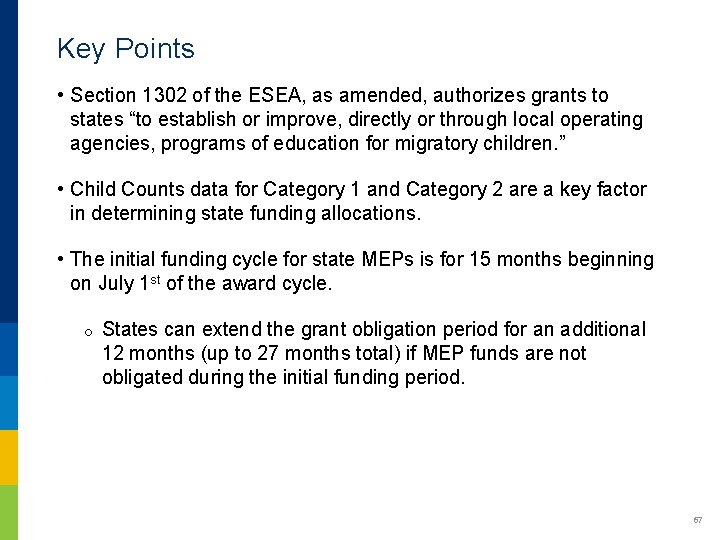
Key Points • Section 1302 of the ESEA, as amended, authorizes grants to states “to establish or improve, directly or through local operating agencies, programs of education for migratory children. ” • Child Counts data for Category 1 and Category 2 are a key factor in determining state funding allocations. • The initial funding cycle for state MEPs is for 15 months beginning on July 1 st of the award cycle. o States can extend the grant obligation period for an additional 12 months (up to 27 months total) if MEP funds are not obligated during the initial funding period. 67
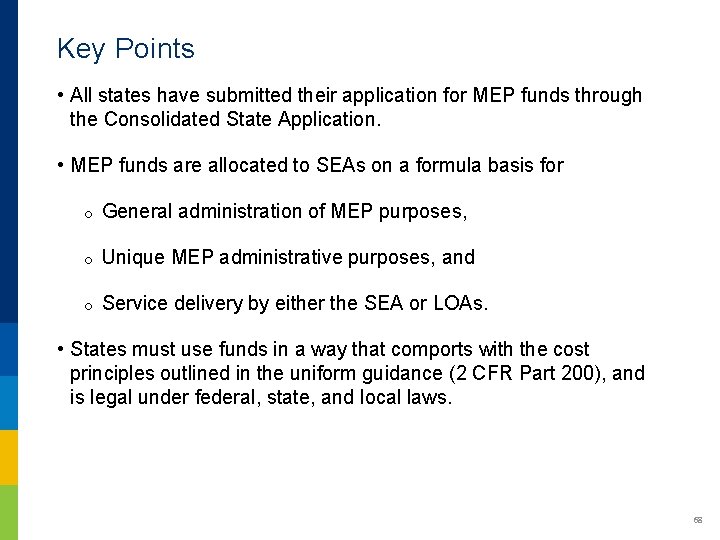
Key Points • All states have submitted their application for MEP funds through the Consolidated State Application. • MEP funds are allocated to SEAs on a formula basis for o General administration of MEP purposes, o Unique MEP administrative purposes, and o Service delivery by either the SEA or LOAs. • States must use funds in a way that comports with the cost principles outlined in the uniform guidance (2 CFR Part 200), and is legal under federal, state, and local laws. 68
Key Points • States are required to have a comprehensive plan for assessing the needs of migratory children and delivery of services that helps reduce the impact that their migratory lifestyle has on their educational success. • MEP services should first be targeted to Priority for Service (PFS) students – those students who have had their education disrupted and who are most at-risk of failing or falling below assessment standards. 69
Action Planning Consider the following questions: • How well does your CNA reflect your state’s current migrant population? • Who is providing the MEP services and activities identified in your SDP? • Is your state MEP on track with delivery of services and budget expenditures? See QRRS 3. 5 – State MEP Funding Allocation and Use of Funds Action Planning Remember to add any actionable items to your MEP planning calendar. 70
Resources for State Migrant Education Program Funding Allocation and Use of Funds • MEP Guidance on Education of Migratory Children under Title I, Part C, of the Elementary and Secondary Education Act of 1965 – explanation of guidelines to implement the laws and regulations related to the MEP o Chapter I: State Application and Funding o Chapter X: Fiscal Requirements o Chapter XI: State Administration 71
Resources for State Migrant Education Program Funding Allocation and Use of Funds • Glossary of Terms – Alphabetical listing of key terms applicable to migrant education (https: //results. ed. gov/idrmanual/section/glossary) • MEP Officers – List of OME contact information (https: //results. ed. gov/about/contact) 72