
Module 3 Risk Analysis and its Components Risk


- Slides: 32
Module 3 Risk Analysis and its Components
Risk Analysis ● ● WTO SPS agreement puts emphasis on sound science Risk analysis = integrated mechanism to enable: ● ● ● Data organisation Estimate of human risks Development of consistent outcomes across food supply
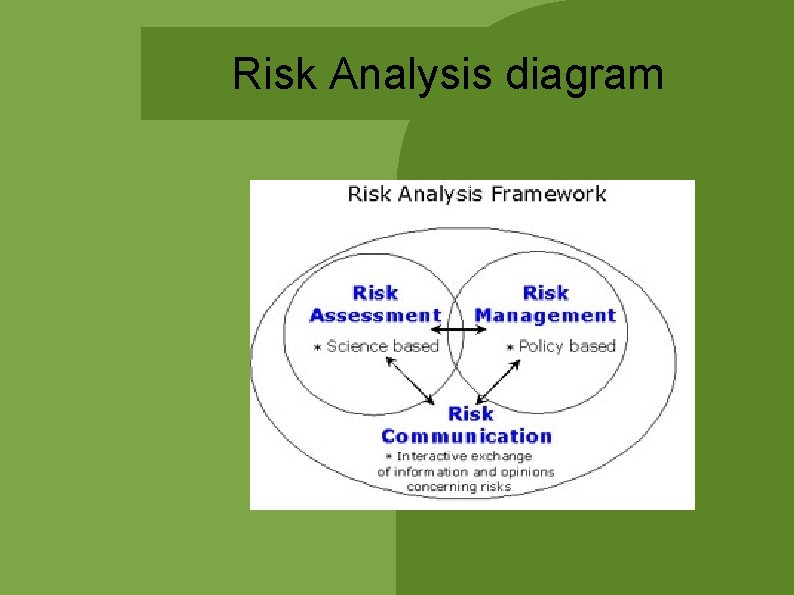
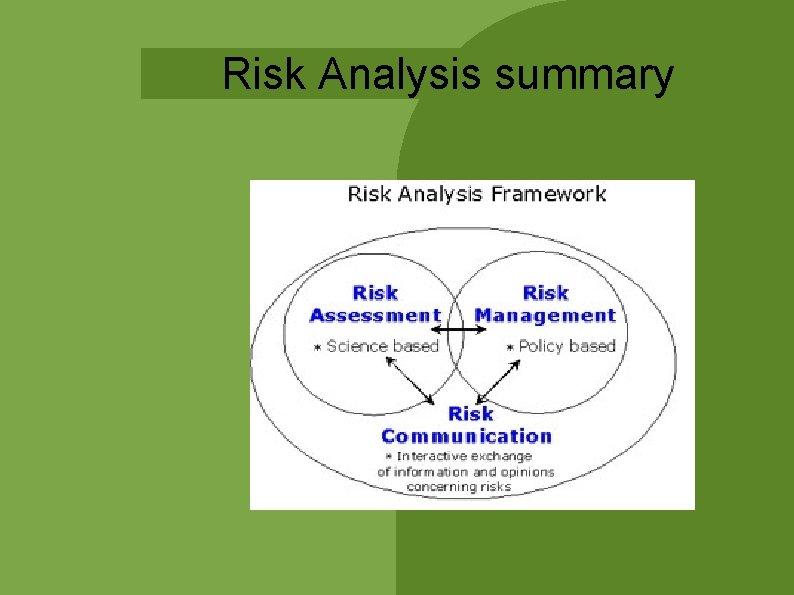
Risk Analysis ● Three components: ● ● risk assessment, risk management and risk communication. Risk: A function of the probability of an adverse effect and the magnitude of that effect, consequential to a hazard(s) in food.
Risk Analysis diagram
Why undertake risk analysis? 1. consistency across scientific disciplines 2. establish appropriate priority or level of protection 3. identify methods to address food safety more effectively 4. introduce appropriate food control measures
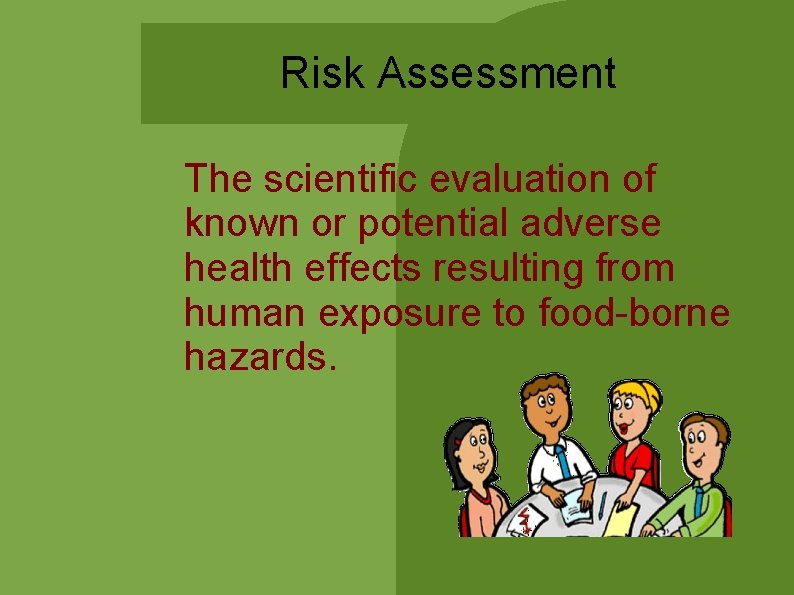
Risk Assessment The scientific evaluation of known or potential adverse health effects resulting from human exposure to food-borne hazards.
Risk Assessment ● Consists of: hazard identification, ii. hazard characterization, iii. exposure assessment, iv. risk characterization. i.
Risk Assessment Hazard A biological, chemical, or physical agent in or property of food that may have an adverse health effect.
Risk Assessment Hazard Identification: The identification of known or potential health effects associated with a particular agent. Hazard Characterization: The qualitative and/or quantitative evaluation of the nature of the adverse effects associated with biological, chemical, and physical agents which may be present in food.
Risk Assessment Exposure Assessment: The qualitative and/or quantitative evaluation of the degree of intake likely to occur.
Exposure Assessment Chemical Hazards ● National Food Consumption data ● ● WHO GEMS Food ● ● (1) total diet studies; (2) selective studies of individual foods, (3) duplicate portion studies. Regional diets Cab show if estimated exposure > ADI/PTWI etc ● but NOT converse!!
Exposure Assessment Microbial Hazards ● Assess changes in populations of bacteria based on: ● ● ecology of the bacterial pathogen of concern; processing, packaging and storing of food; preparation steps, such as cooking, which may inactivate bacterial agents; and, cultural factors relating to consumers.
Risk Assessment Risk Characterisation: Integration of hazard identification, hazard characterization and exposure assessment into an estimation of the adverse effects likely to occur in a given population, including attendant uncertainties.
Hazard Added Chemical Hazards ● ● ● Food Additive Pesticide Residues Veterinary Drug Residues
Hazard Characterisation ● Acceptable Daily Intake (ADI) ● ● the amount of the substance, expressed on a body weight basis, that can be ingested daily over a lifetime without appreciable health risk (notionally "zero" risk). "ADI not specified" ● the total daily intake of the substance, arising from its use at the levels necessary to achieve the desired effect and from its acceptable background in food, does not represent a hazard to health.
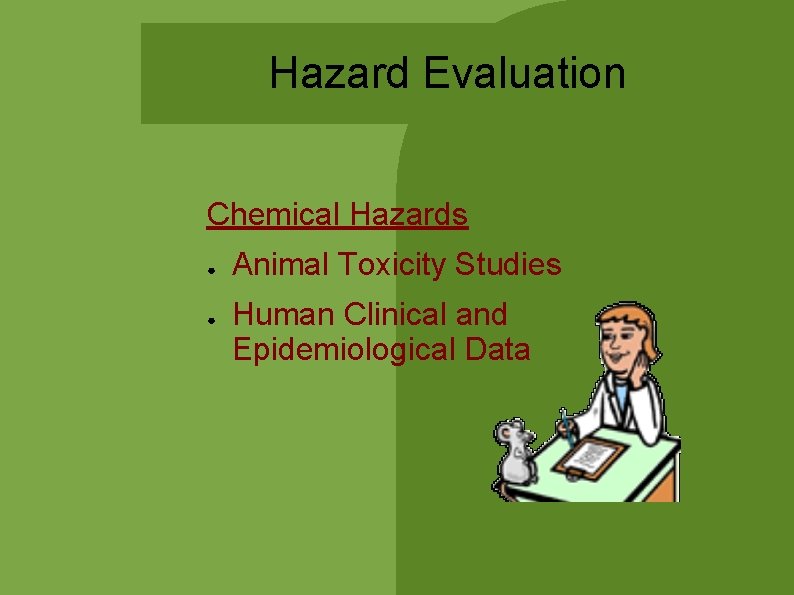
Hazard Evaluation Chemical Hazards ● ● Animal Toxicity Studies Human Clinical and Epidemiological Data
Hazard Contaminants Heavy metals Mycotoxins Hazard Characterisation Provisional Tolerable Weekly Intake PTWI Provisional Maximum Tolerable Daily Intake PMTDI the amount of the substance, expressed on a body weight basis, that can be tolerated weekly or daily over a lifetime without appreciable health risk (notionally "zero" risk). "ALARA" as low as reasonably achievable - no threshold for adverse effects would be determined
Hazard Contaminants ● Heavy metals ● Mycotoxins
Hazard Characterisation ● PTWI ● PMTDI (Provisional Tolerable Weekly Intake) (Provisional Maximum Tolerable Daily Intake) ● ● the amount of the substance, expressed on a body weight basis, that can be tolerated weekly or daily over a lifetime without appreciable health risk. "ALARA" ● as low as reasonably achievable - no threshold for adverse effects could be determined
Hazard Microbial Hazards E. Coli Hazard Characterisation ●A qualitative or quantitative description of the severity and duration of adverse effects that may result from the ingestion of a microorganism or its toxin in food. ●A dose-response assessment is generally performed if the data are obtainable.
Exposure Assessment ● Chemical Hazards (1) total diet studies; (2) selective studies of individual foods, and; (3) duplicate portion studies. ● WHO GEMS Food
Exposure Assessment ● Microbial Hazards ● ● estimate of the number of pathogenic bacteria or the level of bacterial toxin consumed in food. bacterial pathogens are dynamic - may increase or decrease dramatically in food matrices.
Risk Characterization Chemical Hazards ● ● ● Risk notionally zero if exposure below ADI or PTWI/PMTDI No threshold – population risk from exposure and potency Documents assumptions and uncertainties
Risk Characterization Microbial Risks ● ● A quantitative or qualitative estimate of the potential for adverse effects Depends upon outcome of preceding steps Quantitative or qualitative Qualitative risk assessment depends on knowledge and experience of food and pathogens.
Risk Management “The process, distinct from risk assessment, of weighing policy alternatives, in consultation with all interested parties, considering risk assessment and other factors relevant for the health protection of consumers and for the promotion of fair trade practices, and, if needed, selecting appropriate prevention and control options. ”
Risk Management 1. Risk Evaluation ● Identification of a Hazard ● Commissioning of Risk Assessment ● Consideration of Risk Assessment result 2. Risk Management Option Assessment 3. Implementation of Management Decision 4. Monitoring and Review
Risk Management 1. Follow a structured approach. 2. Protection of human health is primary consideration 3. Decisions and practices should be transparent. 4. Should include determination of risk assessment policy as a specific component of risk management.
Risk Management 1. Maintain functional separation of risk management and risk assessment to ensure scientific integrity of process. 2. Take into account uncertainty in risk assessment. 3. Clear, interactive communication with consumers and other interested parties. 4. Continuing process that takes into account all newly generated data in the evaluation and review of risk management decisions.
Risk Communication “The interactive exchange of information and opinions throughout the risk analysis process concerning risk, riskrelated factors and risk perceptions, among risk assessors, risk managers, consumers, industry, the academic community and other interested parties, including the explanation of risk assessment findings and the basis of risk management decisions. ”
Goals of Risk Communication 1. Awareness and understanding of the specific issues under consideration 2. Consistency and transparency in risk management decisions 3. Sound basis for understanding risk management decisions 4. Improve the effectiveness and efficiency of the risk analysis 5. Contribute to development and delivery of information and education when used as risk management options;
Goals of Risk Communication 1. 2. 3. 4. Public trust and confidence in the safety of food supply; Working relationships/mutual respect among all participants; Involvement of interested parties in the risk communication; and, Exchange information concerning risks associated with food and related topics.
Risk Analysis summary