
Module 3 Mitigation Hierarchy Training Modules for Applying
- Slides: 36
Module 3 – Mitigation Hierarchy Training Modules for Applying the Mitigation Hierarchy: Planning Policy and Projects for No Net Loss or a Net Gain of Biodiversity Module 3 The mitigation hierarchy, including offsets and compensation, and goals such as Biodiversity Net Gain, No Net Loss. 1
Mitigation Hierarchy Module – Abstract The mitigation hierarchy is one of the principal tools to enable governments and companies to reconcile development and biodiversity conservation goals. This module explains the mitigation hierarchy, why it is useful and some of the key drivers for using it: law, project finance conditions, voluntary corporate commitments and the availability of practical tools for doing so. It explains the first two steps in the mitigation hierarchy, including ‘avoidance’ (the most important step) and the second step: minimisation. It then covers restoration (the third step in the hierarchy) and the concept of ‘residual impacts’ (those left after avoidance, minimisation and restoration). It explains the last step: ‘biodiversity offsets’ or compensation. The module sets out three alternative end goals for applying the mitigation hierarchy: No Net Loss, Biodiversity Net Gain, and target-based compensation. Finally, it explains the difference between offsets and compensation. 2
Mitigation Hierarchy Module - Contents Slides Introduction: The mitigation hierarchy and why follow it? Drivers and recent advances. 4 -6 Avoidance and minimisation 7 -16 Restoration and residual impacts 17 -21 Biodiversity offsets 22 -24 No Net Loss, Biodiversity Net Gain and target-based compensation 25 -32 Offsets versus compensation 33 -35 Take home messages 36 3
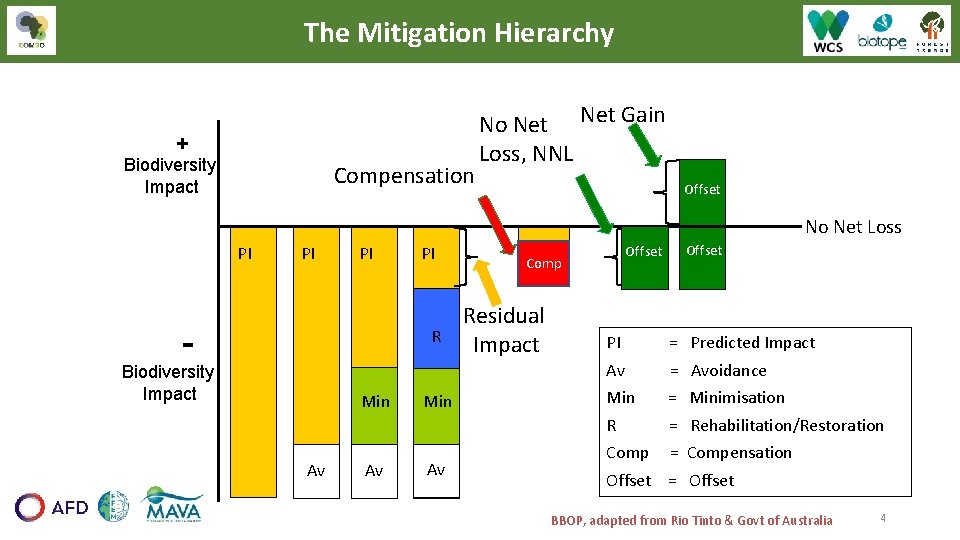
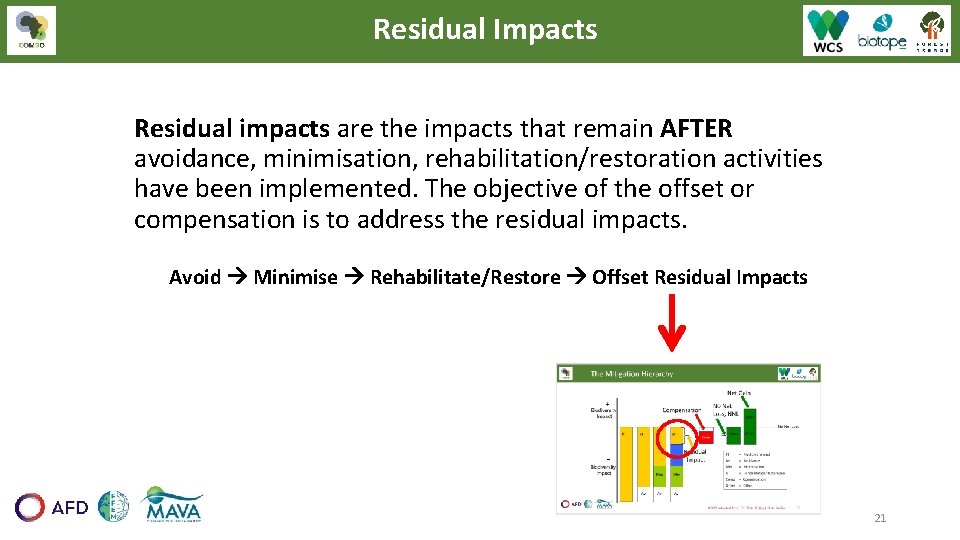
The Mitigation Hierarchy + Biodiversity Impact Compensation No Net Gain Loss, NNL Offset No Net Loss PI PI PI - PI R Biodiversity Impact Min Av Av Min Av Offset Comp Residual Impact Offset PI = Predicted Impact Av = Avoidance Min = Minimisation R = Rehabilitation/Restoration Comp = Compensation Offset = Offset BBOP, adapted from Rio Tinto & Govt of Australia 4
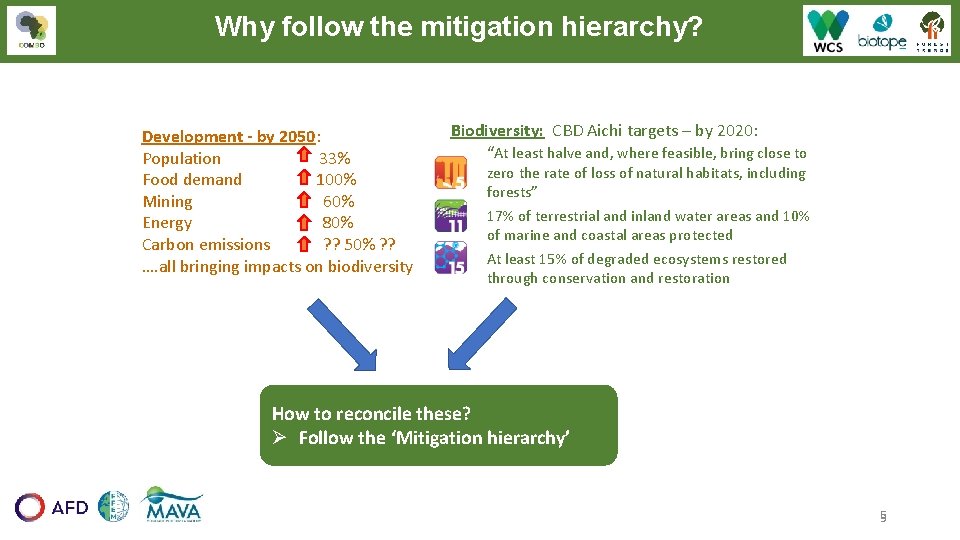
Why follow the mitigation hierarchy? Development - by 2050: Population 33% Food demand 100% Mining 60% Energy 80% Carbon emissions ? ? 50% ? ? …. all bringing impacts on biodiversity Biodiversity: CBD Aichi targets – by 2020: “At least halve and, where feasible, bring close to zero the rate of loss of natural habitats, including forests” 17% of terrestrial and inland water areas and 10% of marine and coastal areas protected At least 15% of degraded ecosystems restored through conservation and restoration How to reconcile these? Ø Follow the ‘Mitigation hierarchy’ 5 5
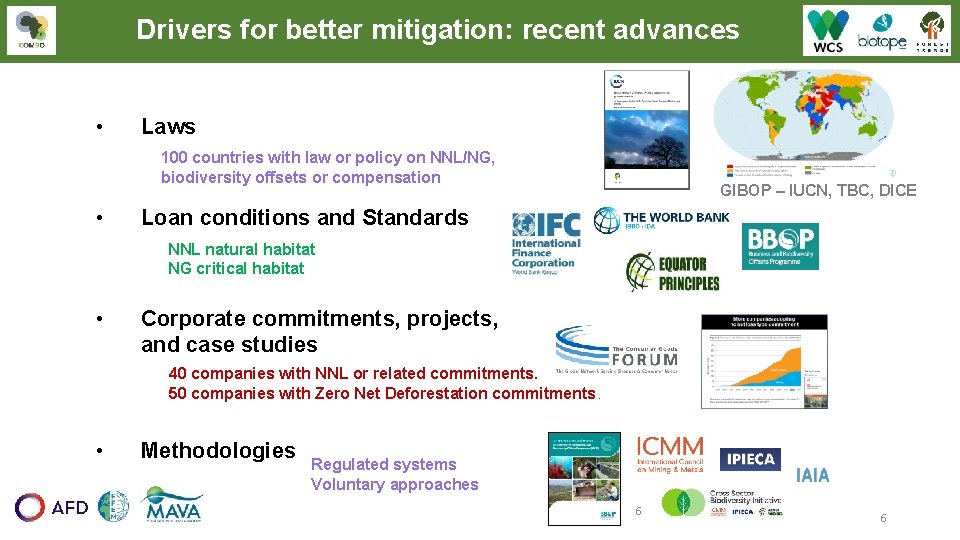
Drivers for better mitigation: recent advances • Laws 100 countries with law or policy on NNL/NG, biodiversity offsets or compensation • GIBOP – IUCN, TBC, DICE Loan conditions and Standards NNL natural habitat NG critical habitat • Corporate commitments, projects, and case studies 40 companies with NNL or related commitments. 50 companies with Zero Net Deforestation commitments. • Methodologies Regulated systems Voluntary approaches 6 6
Mitigation hierarchy Avoidance and minimisation 7
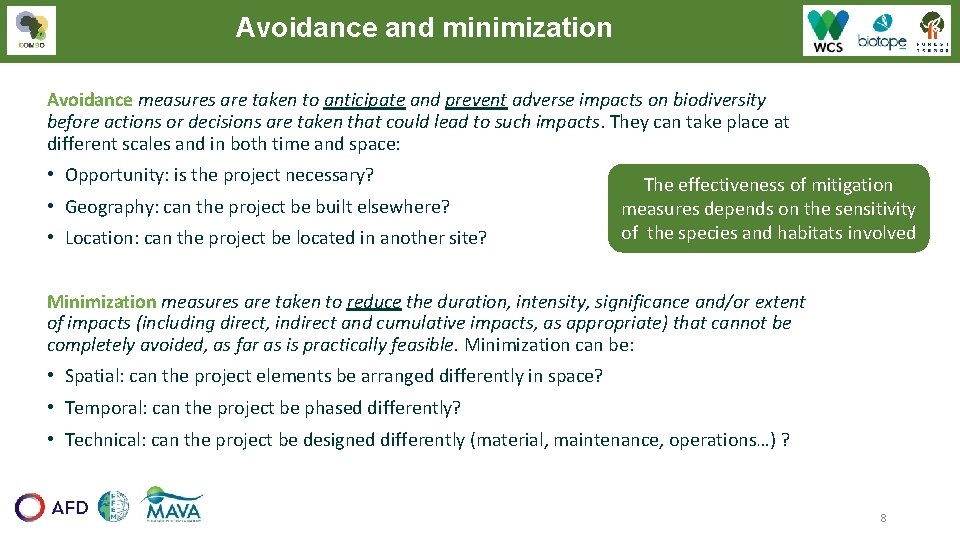
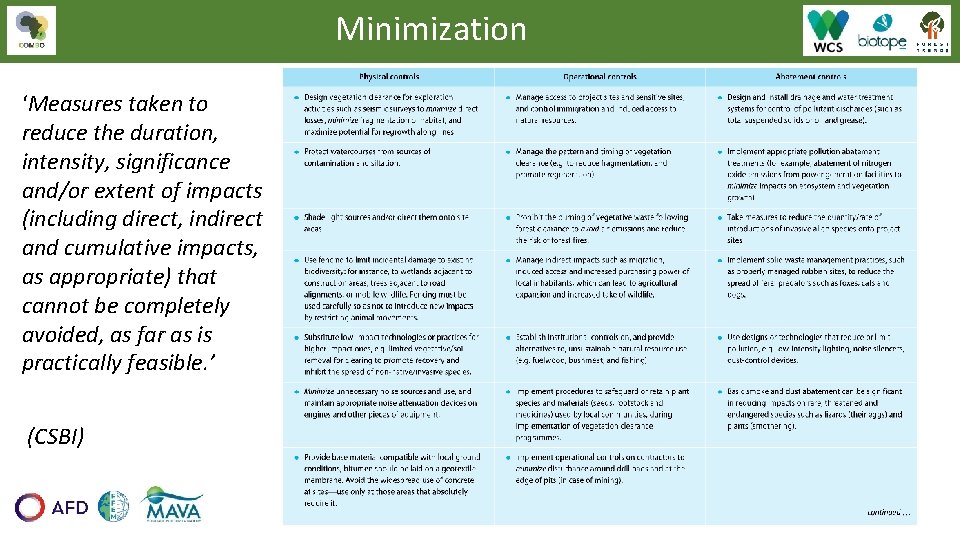
Avoidance and minimization Avoidance measures are taken to anticipate and prevent adverse impacts on biodiversity before actions or decisions are taken that could lead to such impacts. They can take place at different scales and in both time and space: • Opportunity: is the project necessary? • Geography: can the project be built elsewhere? • Location: can the project be located in another site? The effectiveness of mitigation measures depends on the sensitivity of the species and habitats involved Minimization measures are taken to reduce the duration, intensity, significance and/or extent of impacts (including direct, indirect and cumulative impacts, as appropriate) that cannot be completely avoided, as far as is practically feasible. Minimization can be: • Spatial: can the project elements be arranged differently in space? • Temporal: can the project be phased differently? • Technical: can the project be designed differently (material, maintenance, operations…) ? 8
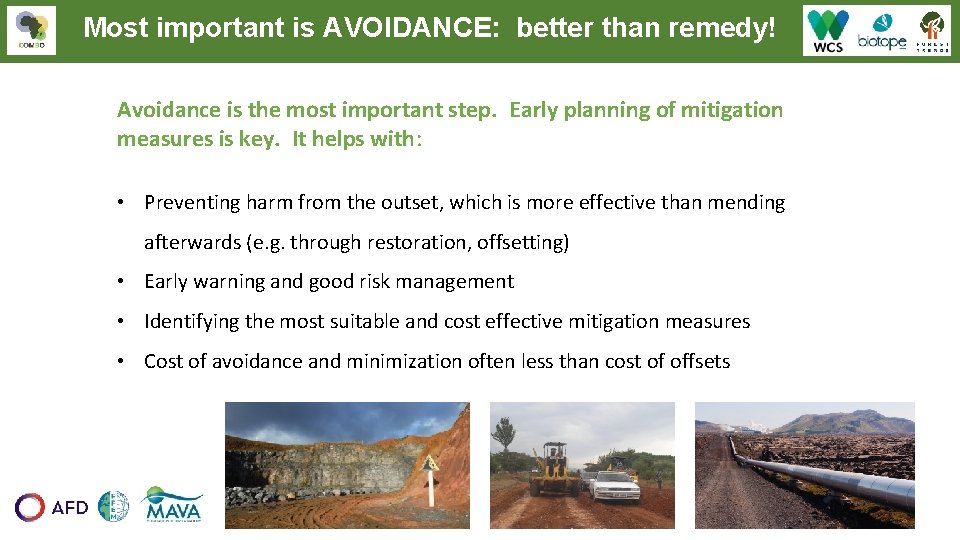
Most important is AVOIDANCE: better than remedy! Avoidance is the most important step. Early planning of mitigation measures is key. It helps with: • Preventing harm from the outset, which is more effective than mending afterwards (e. g. through restoration, offsetting) • Early warning and good risk management • Identifying the most suitable and cost effective mitigation measures • Cost of avoidance and minimization often less than cost of offsets 9
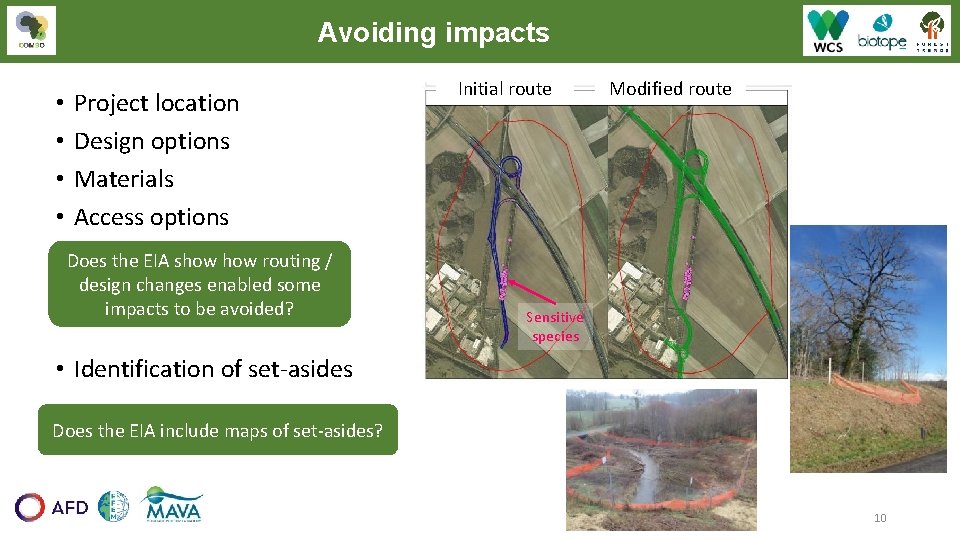
Avoiding impacts • • Project location Design options Materials Access options Does the EIA show routing / design changes enabled some impacts to be avoided? Initial route Modified route Sensitive species • Identification of set-asides Does the EIA include maps of set-asides? 10
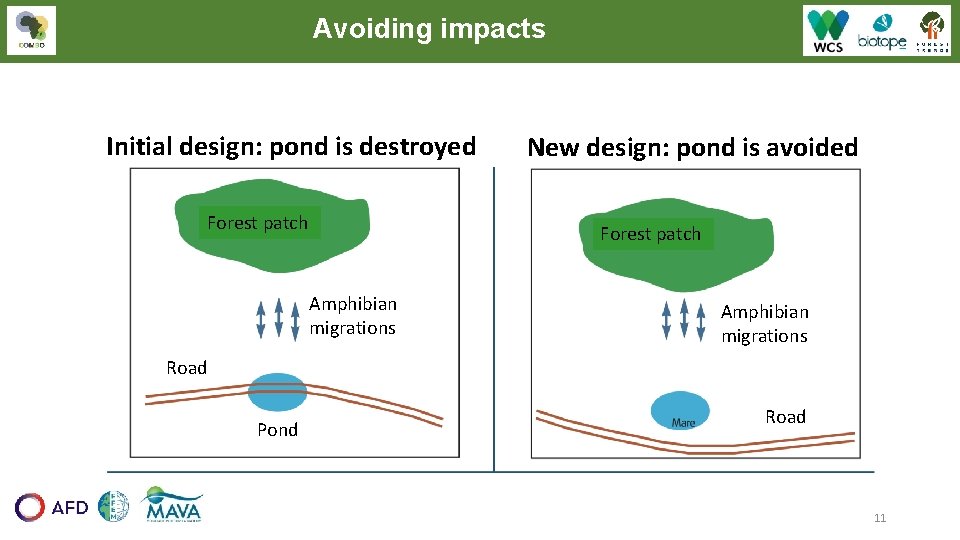
Avoiding impacts Initial design: pond is destroyed Forest patch New design: pond is avoided Forest patch Amphibian migrations Road Pond Road 11
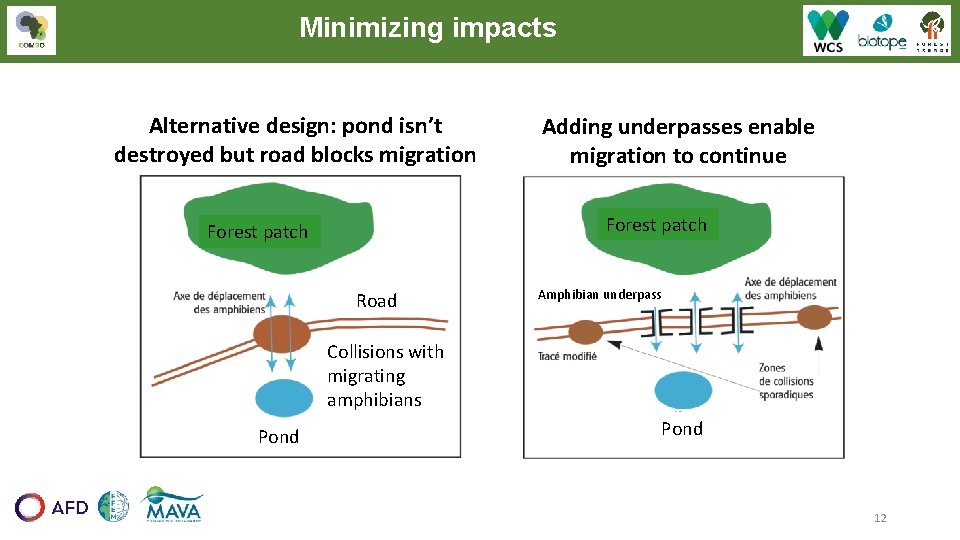
Minimizing impacts Alternative design: pond isn’t destroyed but road blocks migration Adding underpasses enable migration to continue Forest patch Road Amphibian underpass Collisions with migrating amphibians Pond 12
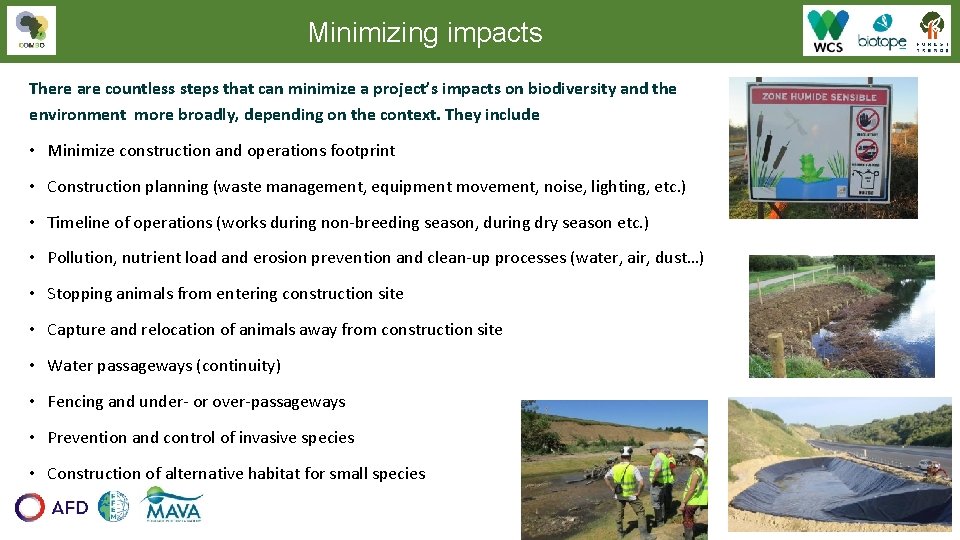
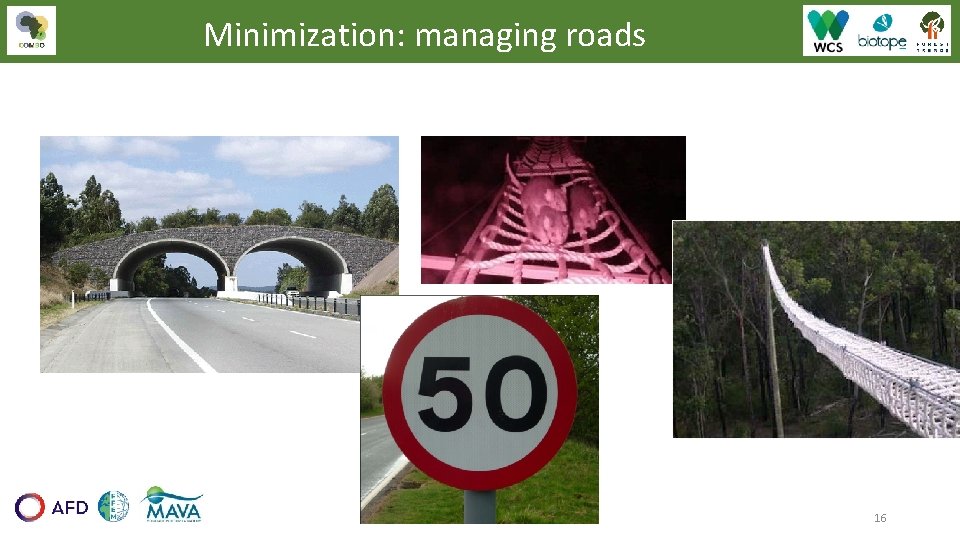
Minimizing impacts There are countless steps that can minimize a project’s impacts on biodiversity and the environment more broadly, depending on the context. They include • Minimize construction and operations footprint • Construction planning (waste management, equipment movement, noise, lighting, etc. ) • Timeline of operations (works during non-breeding season, during dry season etc. ) • Pollution, nutrient load and erosion prevention and clean-up processes (water, air, dust…) • Stopping animals from entering construction site • Capture and relocation of animals away from construction site • Water passageways (continuity) • Fencing and under- or over-passageways • Prevention and control of invasive species • Construction of alternative habitat for small species 13
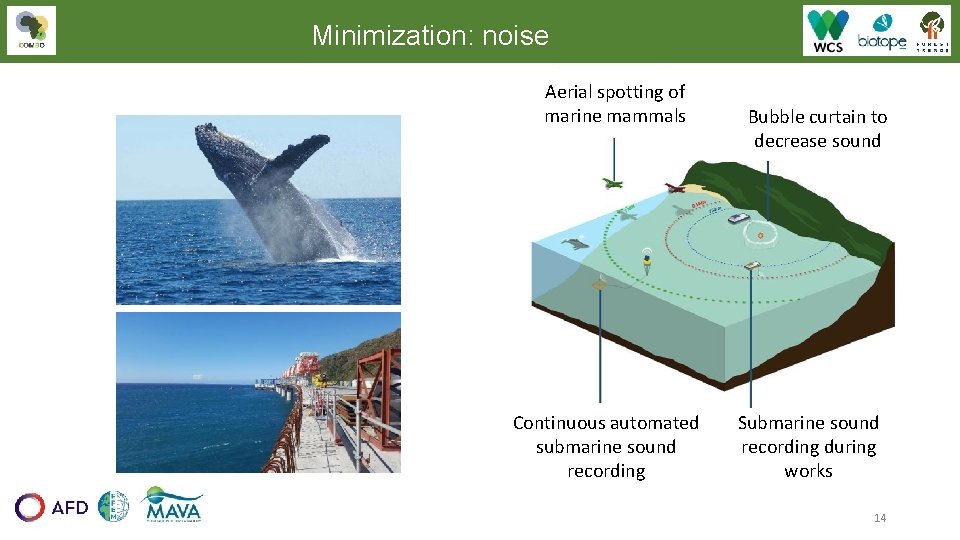
Minimization: noise Aerial spotting of marine mammals Continuous automated submarine sound recording Bubble curtain to decrease sound Submarine sound recording during works 14
Minimization ‘Measures taken to reduce the duration, intensity, significance and/or extent of impacts (including direct, indirect and cumulative impacts, as appropriate) that cannot be completely avoided, as far as is practically feasible. ’ (CSBI) 15
Minimization: managing roads 16
Mitigation hierarchy Restoration 17
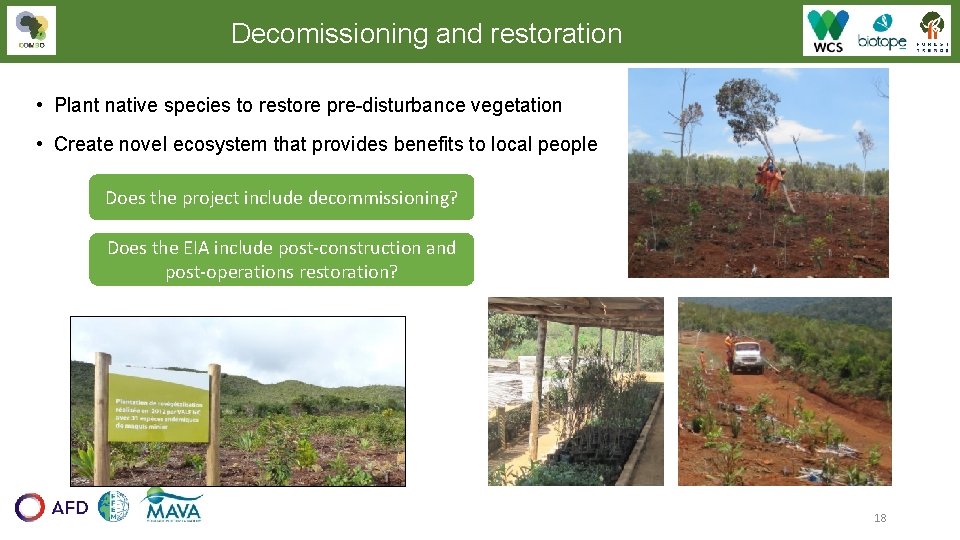
Decomissioning and restoration • Plant native species to restore pre-disturbance vegetation • Create novel ecosystem that provides benefits to local people Does the project include decommissioning? Does the EIA include post-construction and post-operations restoration? 18
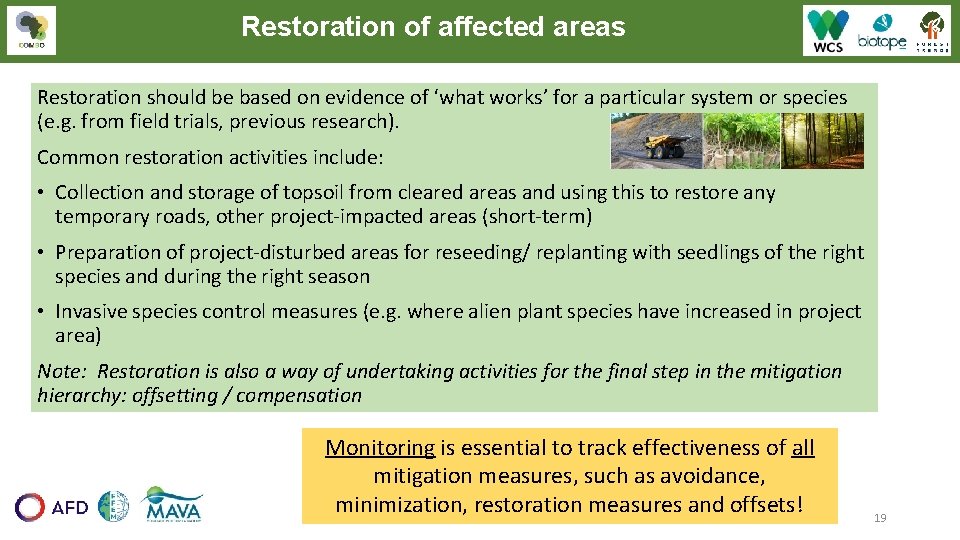
Restoration of affected areas Restoration should be based on evidence of ‘what works’ for a particular system or species (e. g. from field trials, previous research). Common restoration activities include: • Collection and storage of topsoil from cleared areas and using this to restore any temporary roads, other project-impacted areas (short-term) • Preparation of project-disturbed areas for reseeding/ replanting with seedlings of the right species and during the right season • Invasive species control measures (e. g. where alien plant species have increased in project area) Note: Restoration is also a way of undertaking activities for the final step in the mitigation hierarchy: offsetting / compensation Monitoring is essential to track effectiveness of all mitigation measures, such as avoidance, minimization, restoration measures and offsets! 19
Restoration See the module on Key Concepts, especially ‘Will restoration result in gains for biodiversity? ’ 20
Residual Impacts Residual impacts are the impacts that remain AFTER avoidance, minimisation, rehabilitation/restoration activities have been implemented. The objective of the offset or compensation is to address the residual impacts. Avoid Minimise Rehabilitate/Restore Offset Residual Impacts 21
Mitigation hierarchy Biodiversity offsets 22
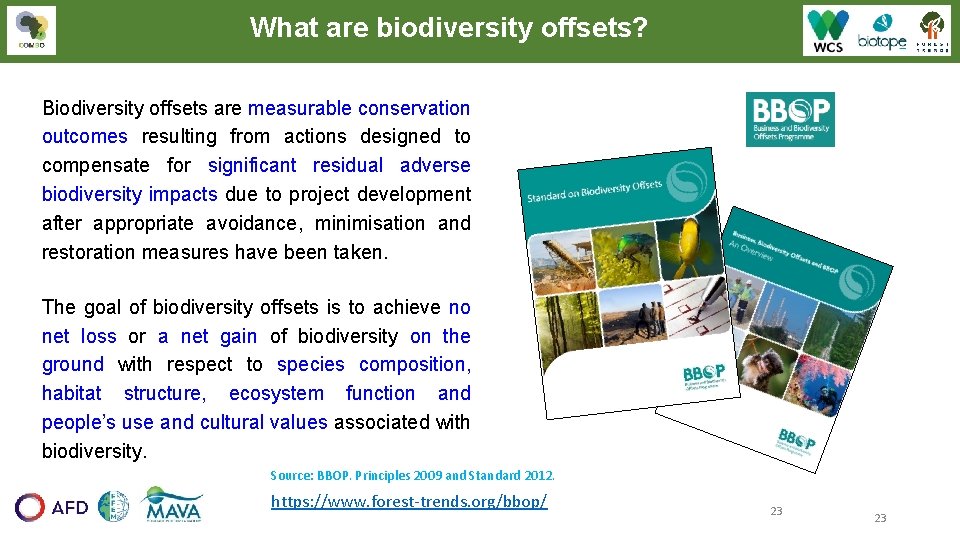
What are biodiversity offsets? Biodiversity offsets are measurable conservation outcomes resulting from actions designed to compensate for significant residual adverse biodiversity impacts due to project development after appropriate avoidance, minimisation and restoration measures have been taken. The goal of biodiversity offsets is to achieve no net loss or a net gain of biodiversity on the ground with respect to species composition, habitat structure, ecosystem function and people’s use and cultural values associated with biodiversity. Source: BBOP. Principles 2009 and Standard 2012. https: //www. forest-trends. org/bbop/ 23 23
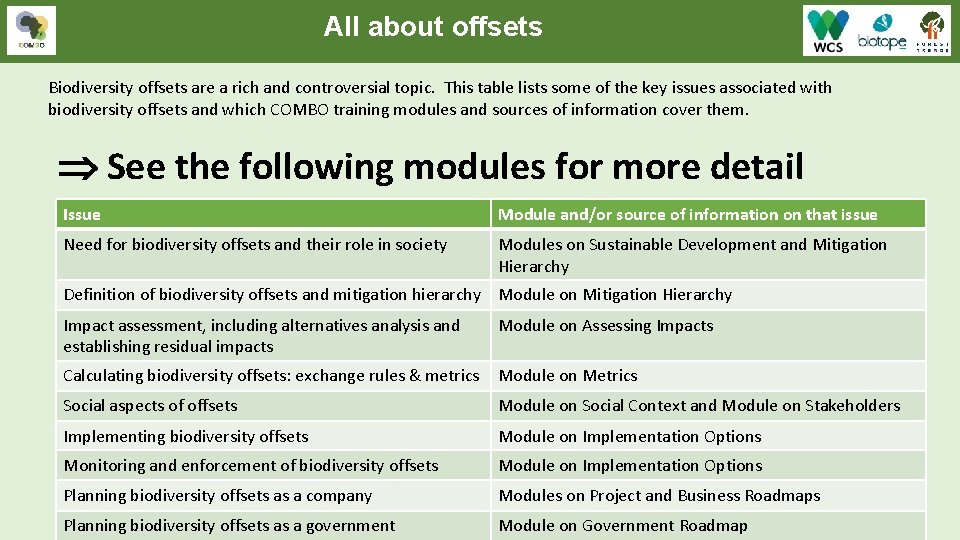
All about offsets Biodiversity offsets are a rich and controversial topic. This table lists some of the key issues associated with biodiversity offsets and which COMBO training modules and sources of information cover them. See the following modules for more detail Issue Module and/or source of information on that issue Need for biodiversity offsets and their role in society Modules on Sustainable Development and Mitigation Hierarchy Definition of biodiversity offsets and mitigation hierarchy Module on Mitigation Hierarchy Impact assessment, including alternatives analysis and establishing residual impacts Module on Assessing Impacts Calculating biodiversity offsets: exchange rules & metrics Module on Metrics Social aspects of offsets Module on Social Context and Module on Stakeholders Implementing biodiversity offsets Module on Implementation Options Monitoring and enforcement of biodiversity offsets Module on Implementation Options Planning biodiversity offsets as a company Modules on Project and Business Roadmaps Planning biodiversity offsets as a government Module on Government Roadmap 24
Mitigation hierarchy No Net Loss, Biodiversity Net Gain and Target-based compensation 25
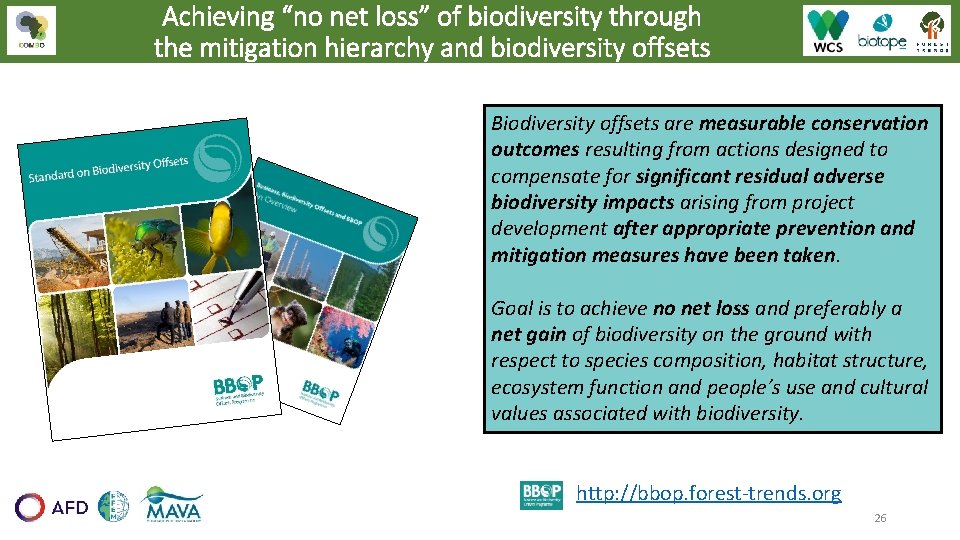
Achieving “no net loss” of biodiversity through the mitigation hierarchy and biodiversity offsets Biodiversity offsets are measurable conservation outcomes resulting from actions designed to compensate for significant residual adverse biodiversity impacts arising from project development after appropriate prevention and mitigation measures have been taken. Goal is to achieve no net loss and preferably a net gain of biodiversity on the ground with respect to species composition, habitat structure, ecosystem function and people’s use and cultural values associated with biodiversity. http: //bbop. forest-trends. org 26
Biodiversity Net Gain and No Net Loss: Meaning Simply stated, Biodiversity Net Gain (BNG), sometimes described as Net Positive Impact (NPI), means leaving biodiversity better off following development activity, compared with a clear reference scenario. No Net Loss is similar – with impacts at least balanced by the mitigation measures. For governments, the goal may be set at a national, regional or local level. For companies, the goal may be at a site, project or corporate level, or for part of the value chain. For financial institutions, the focus could be their investment strategies, based on environment, social and governance (ESG) policy that refers to BNG. • In all cases, the goal must be defined relative to an appropriate reference scenario: • • ‘Net Gain of what and compared with what? ’ 27
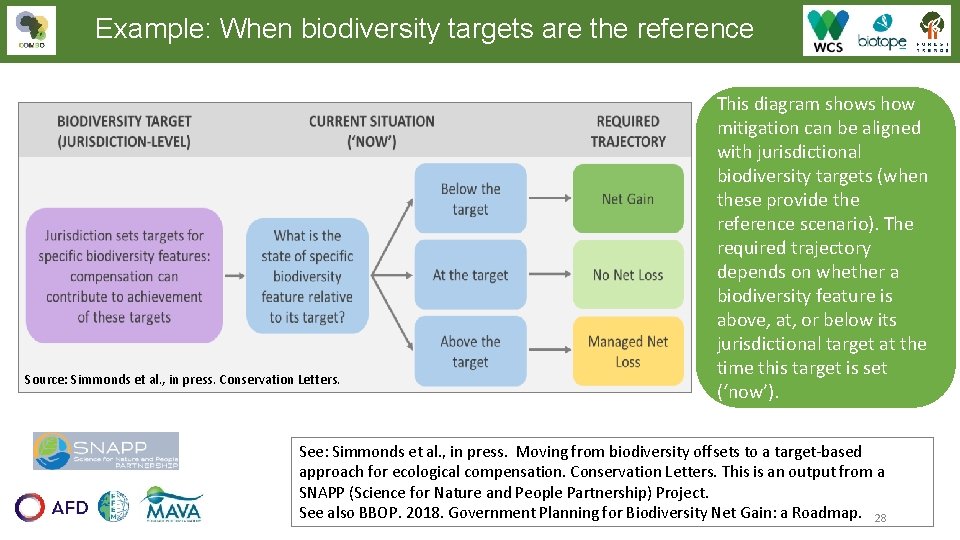
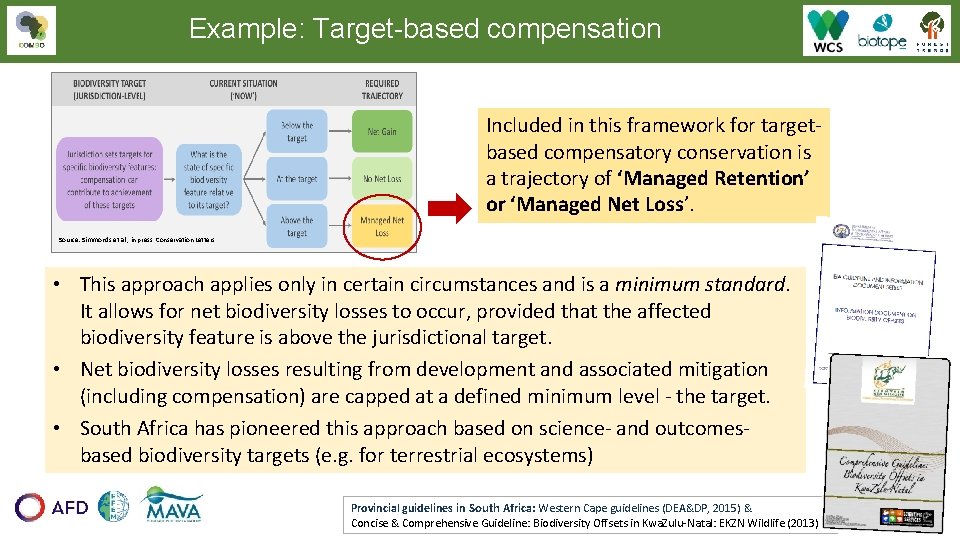
Example: When biodiversity targets are the reference Source: Simmonds et al. , in press. Conservation Letters. This diagram shows how mitigation can be aligned with jurisdictional biodiversity targets (when these provide the reference scenario). The required trajectory depends on whether a biodiversity feature is above, at, or below its jurisdictional target at the time this target is set (‘now’). See: Simmonds et al. , in press. Moving from biodiversity offsets to a target-based approach for ecological compensation. Conservation Letters. This is an output from a SNAPP (Science for Nature and People Partnership) Project. See also BBOP. 2018. Government Planning for Biodiversity Net Gain: a Roadmap. 28
Example: Target-based compensation Included in this framework for targetbased compensatory conservation is a trajectory of ‘Managed Retention’ or ‘Managed Net Loss’. Source: Simmonds et al. , in press. Conservation Letters. • This approach applies only in certain circumstances and is a minimum standard. It allows for net biodiversity losses to occur, provided that the affected biodiversity feature is above the jurisdictional target. • Net biodiversity losses resulting from development and associated mitigation (including compensation) are capped at a defined minimum level - the target. • South Africa has pioneered this approach based on science- and outcomesbased biodiversity targets (e. g. for terrestrial ecosystems) Provincial guidelines in South Africa: Western Cape guidelines (DEA&DP, 2015) & Concise & Comprehensive Guideline: Biodiversity Offsets in Kwa. Zulu-Natal: EKZN Wildlife (2013) 29
No Net Loss and Biodiversity Net Gain See the module on the No Net Loss and Biodiversity Net Gain 30
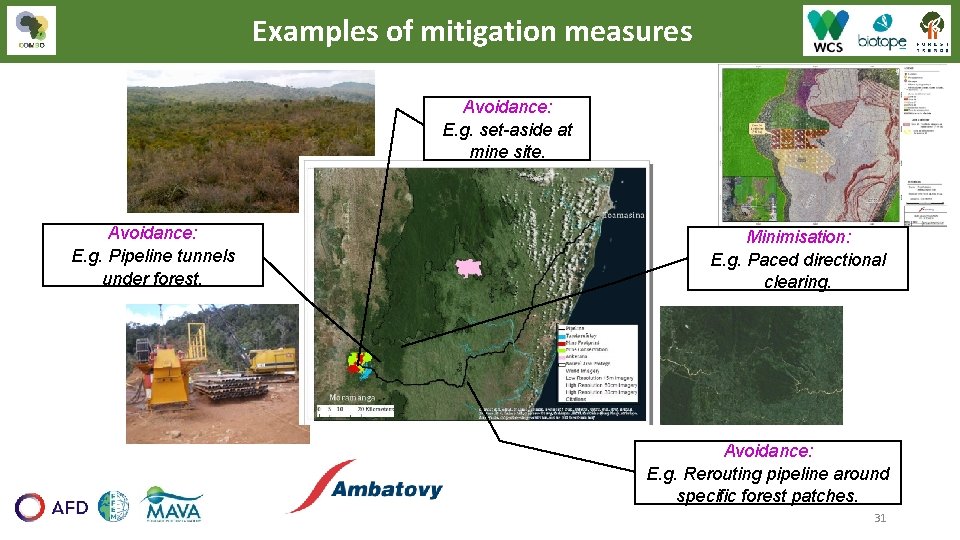
Examples of mitigation measures Avoidance: E. g. set-aside at mine site. Avoidance: E. g. Pipeline tunnels under forest. Minimisation: E. g. Paced directional clearing. Avoidance: E. g. Rerouting pipeline around specific forest patches. 31
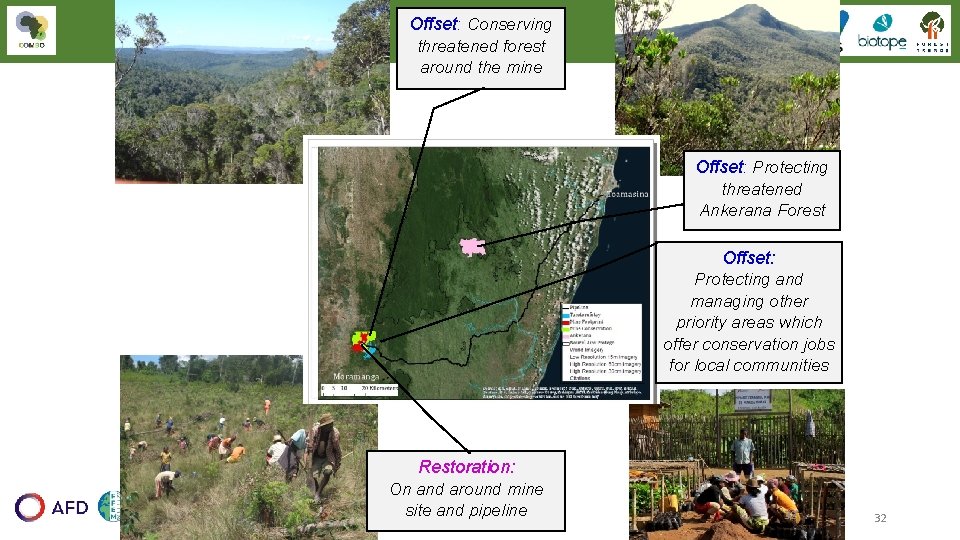
Offset: Conserving threatened forest around the mine Offset: Protecting threatened Ankerana Forest Offset: Protecting and managing other priority areas which offer conservation jobs for local communities Restoration: On and around mine site and pipeline 32 32
Mitigation hierarchy Offsets vs Compensation 33
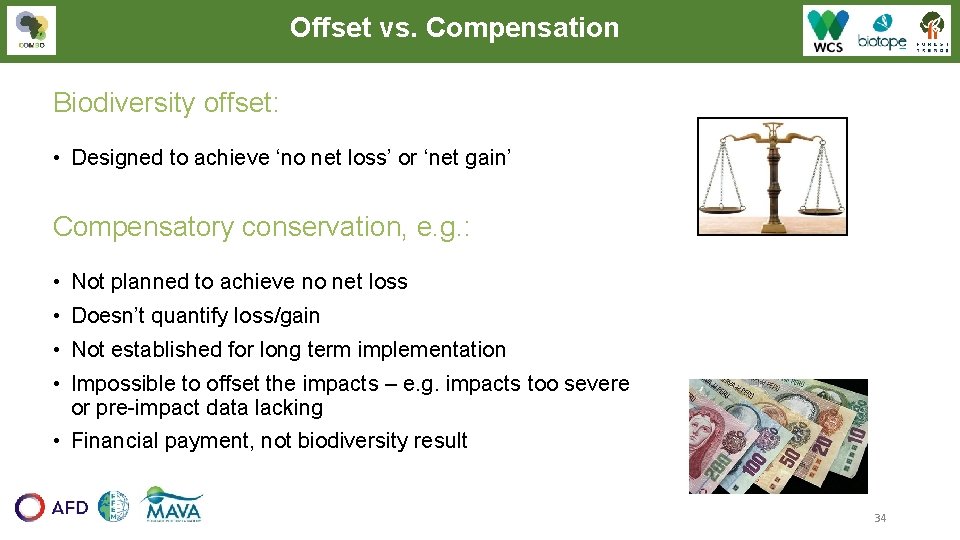
Offset vs. Compensation Biodiversity offset: • Designed to achieve ‘no net loss’ or ‘net gain’ Compensatory conservation, e. g. : • Not planned to achieve no net loss • Doesn’t quantify loss/gain • Not established for long term implementation • Impossible to offset the impacts – e. g. impacts too severe or pre-impact data lacking • Financial payment, not biodiversity result 34
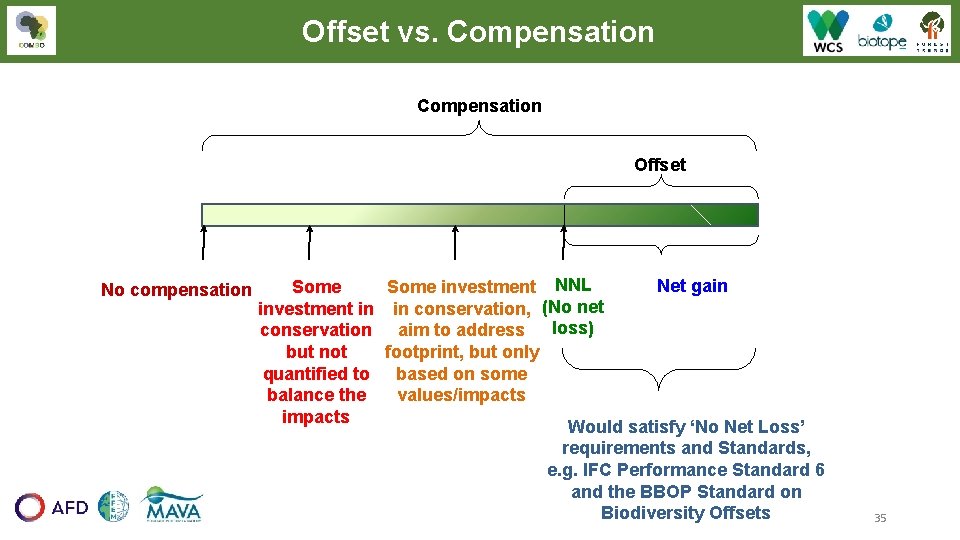
Offset vs. Compensation Offset No compensation Net gain Some investment NNL investment in in conservation, (No net conservation aim to address loss) but not footprint, but only quantified to based on some balance the values/impacts Would satisfy ‘No Net Loss’ requirements and Standards, e. g. IFC Performance Standard 6 and the BBOP Standard on Biodiversity Offsets 35
Mitigation Hierarchy Module – Take home messages Ø Following the mitigation hierarchy can help governments and companies to reconcile development and biodiversity conservation goals. Ø The first and most important step is avoidance, after which many measures can be taken to reduce and lessen impacts (minimisation). Following the impacts, the affected areas should be restored. Ø Despite best efforts with avoidance, minimisation and restoration, many projects have ‘residual impacts’, which should be addressed through biodiversity offsets, or failing that, through compensation. Ø Laws in around 100 countries, project finance conditions and voluntary corporate commitments are driving the use by developers and policy-makers of the mitigation hierarchy. So is the availability of practical tools. Ø It is important for policy and corporate commitments to be clear on the desired outcome from applying the mitigation hierarchy. The best outcome is ‘Biodiversity Net Gain’. ‘No Net Loss’ is another possible goal. An alternative approach is target-based compensation. (All of these are explained in more detail in later modules. ) 36