
Module 3 Industrial Relations 1 Prof Keren Millet




- Slides: 26
Module -3 Industrial Relations 1 Prof. Keren Millet
Meaning and definition of industrial relation �According to Dale Yoder “industrial relation is a relationship between management and employees or among employees and their organization that characterize and grow out of employment. ” �According to ILO, “industrial relation deal with either the relationships between the state and the employers and the worker organization or the relation between the occupational organization themselves. ” 2 Prof. Keren Millet
Objectives of industrial relations �To safeguard the interest of labor and management �Enhance the economic status of the workers �Eliminates strikes and lockouts. �Government control. �Participation of workers. �Avoid industrial conflict �Maintain industrial democracy �Raise productivity 3 Prof. Keren Millet
Scope of industrial relation �Establishing and maintains good personnel relation in the industry. �Making a mutual link between the management and the workers. �Ensuring manpower development. �Creating a mutual affection, respect and regard. �Creating the sense of belongingness. �Maximizing social welfare. �Development of industrial democracy. 4 Prof. Keren Millet
Three Actors of industrial relation 5 Prof. Keren Millet
Three actors of industrial relation (cont. . ) �Workers and their organization: workers plays vital role in IR. The total worker includes working age, educational background, psychological factors, social background, cultures etc. �Employers and their organization: employers employs the workers, pay the wages and various allowance, regulates working relation through various regulation. �Government: government plays the balancing role of custodian of nation. Government exerts influence on IR through its policy, industrial relation policy, implementation of laws, playing role of mediator etc. 6 Prof. Keren Millet
Main Aspects of industrial relation � Essentially, IR is concerned with the relationship between management and the workers and the role of regulatory mechanism in resolving any industrial disputes. � IR covers the following area - Collective bargaining - Role of management, union and government( participative management) - Machinery for resolution of industrial disputes (dispute settlement) - Individual grievance and disciplinary policy and practice. (grievance Redressal) - Industrial relation training(employer organization) 7 Prof. Keren Millet
Participative Management Grievance Redressal Dispute seetlment Industrial relation Employers organization 8 Prof. Keren Millet Trade Union Collective Bargaining
The main aspect of industrial relations are: �Development of Healthy Labor-Management Relation. �Maintenance of Industrial peace �Development of Industrial democracy 9 Prof. Keren Millet
Development of Healthy Labor. Management Relation �The existence of strong, well-organized, 10 democratic and responsible trade union and association of employees. These organizations enhance the job security of employees help in increased worker s participation in management. �The spirit of collective bargaining and willingness to take resources to voluntary arbitration. �Welfare work whether statutory of non- statutory, provided by the state, trade union s and employers create, maintain and improve labour management relation and thereby contribute to industrial peace. Prof. Keren Millet
Maintenance of Industrial peace �Machinery should be set up for the prevention and settlement of industrial disputes �The government should have the power to refer disputes to adjudication(mandatory settlement by courts) i. e when the situation tends to be out of the hand. �The government enjoys the power to maintain the status quo. �The provision of bipartite and tripartite forums for the settlement of disputes. 11 Prof. Keren Millet
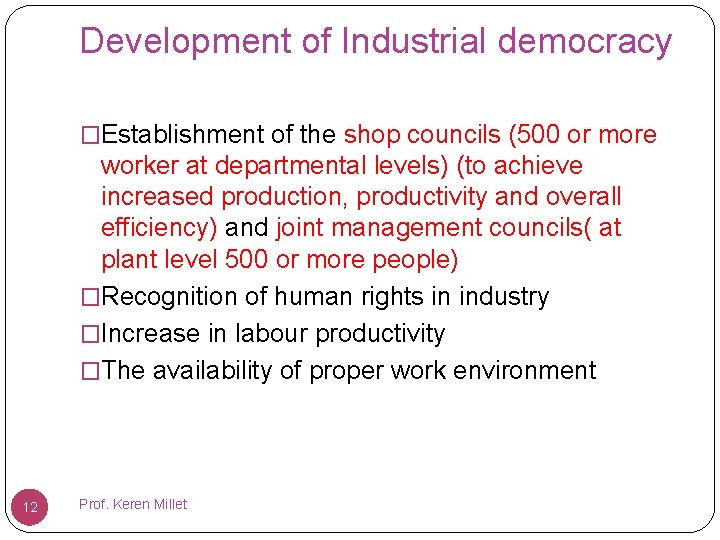
Development of Industrial democracy �Establishment of the shop councils (500 or more worker at departmental levels) (to achieve increased production, productivity and overall efficiency) and joint management councils( at plant level 500 or more people) �Recognition of human rights in industry �Increase in labour productivity �The availability of proper work environment 12 Prof. Keren Millet
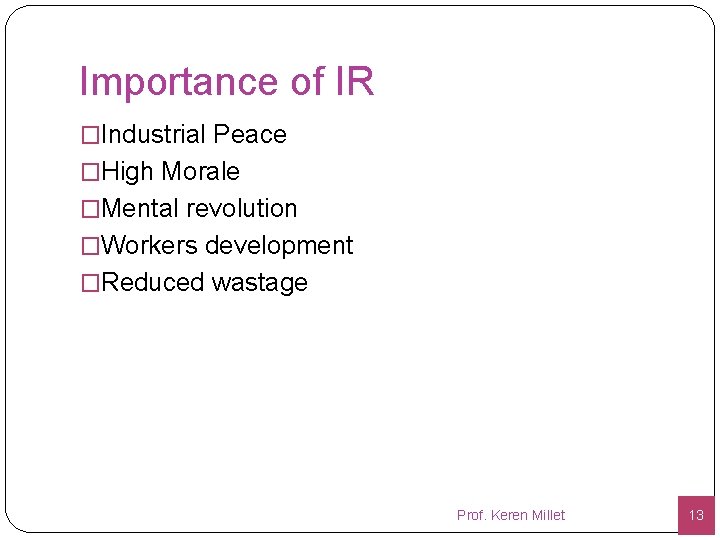
Importance of IR �Industrial Peace �High Morale �Mental revolution �Workers development �Reduced wastage Prof. Keren Millet 13
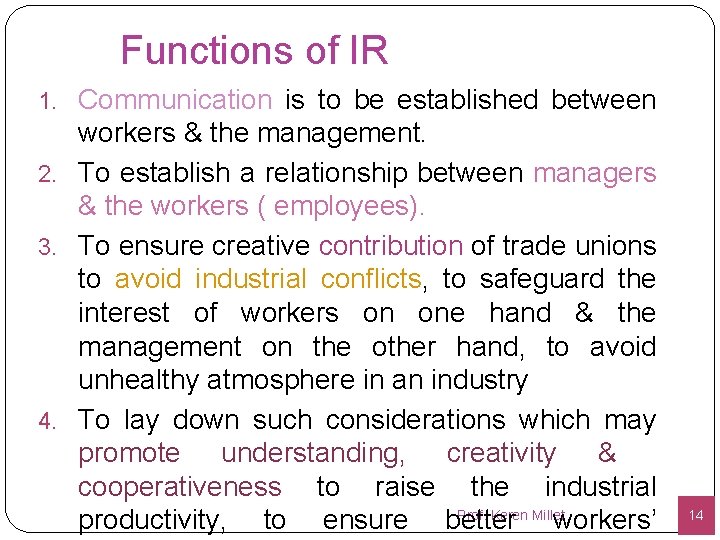
Functions of IR 1. Communication is to be established between workers & the management. 2. To establish a relationship between managers & the workers ( employees). 3. To ensure creative contribution of trade unions to avoid industrial conflicts, to safeguard the interest of workers on one hand & the management on the other hand, to avoid unhealthy atmosphere in an industry 4. To lay down such considerations which may promote understanding, creativity & cooperativeness to raise the industrial Prof. Keren Millet productivity, to ensure better workers’ 14
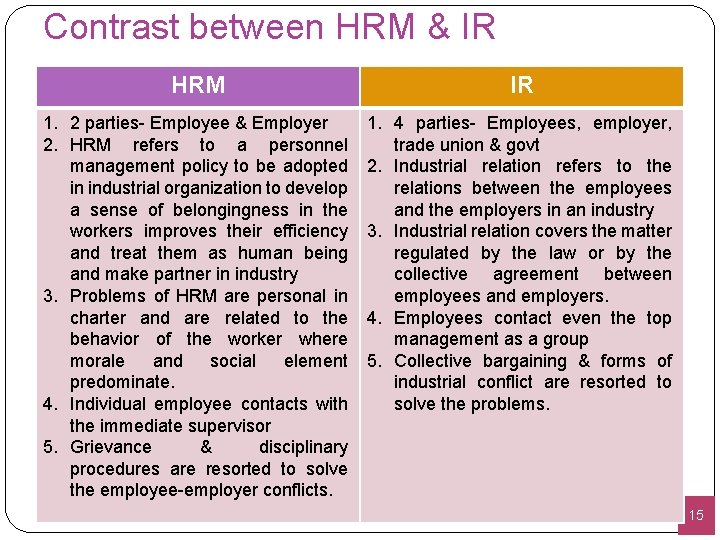
Contrast between HRM & IR HRM IR 1. 2 parties- Employee & Employer 2. HRM refers to a personnel management policy to be adopted in industrial organization to develop a sense of belongingness in the workers improves their efficiency and treat them as human being and make partner in industry 3. Problems of HRM are personal in charter and are related to the behavior of the worker where morale and social element predominate. 4. Individual employee contacts with the immediate supervisor 5. Grievance & disciplinary procedures are resorted to solve the employee-employer conflicts. 1. 4 parties- Employees, employer, trade union & govt 2. Industrial relation refers to the relations between the employees and the employers in an industry 3. Industrial relation covers the matter regulated by the law or by the collective agreement between employees and employers. 4. Employees contact even the top management as a group 5. Collective bargaining & forms of industrial conflict are resorted to solve the problems. Prof. Keren Millet 15
Causes of Poor IR �Nature of work. �Poor Wages and Working condition. �Defective Trade union system. �Occupational Instability. �Poor Behavioral Climate. Prof. Keren Millet 16
Factors affecting IR 1. Institutional Factors 2. Economic Factors 3. Technological Factors 4. Social & cultural Factors 5. Political Factors 6. Psychological Factors 7. Enterprise related Factors 8. Global Factors Prof. Keren Millet 17
Institutional Factors �It includes: �Government policy �Labor legislation, �Voluntary courts �Collective bargaining �Employee courts �Employees federation �Social institution like community, caste, joint family, creed, system of belief, attitude of works, system of power status. Prof. Keren Millet 18
Economic Factors �Capitalist �Communist �Mixed �The structure of labor force, demand for and supply of labor force etc Prof. Keren Millet 19
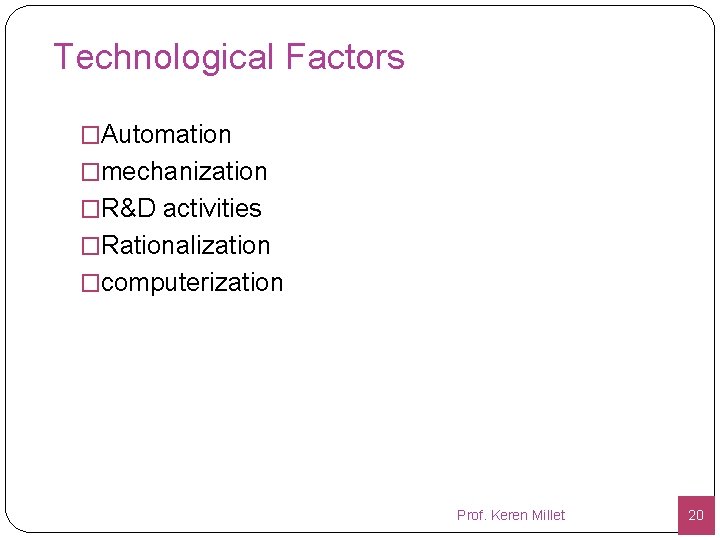
Technological Factors �Automation �mechanization �R&D activities �Rationalization �computerization Prof. Keren Millet 20
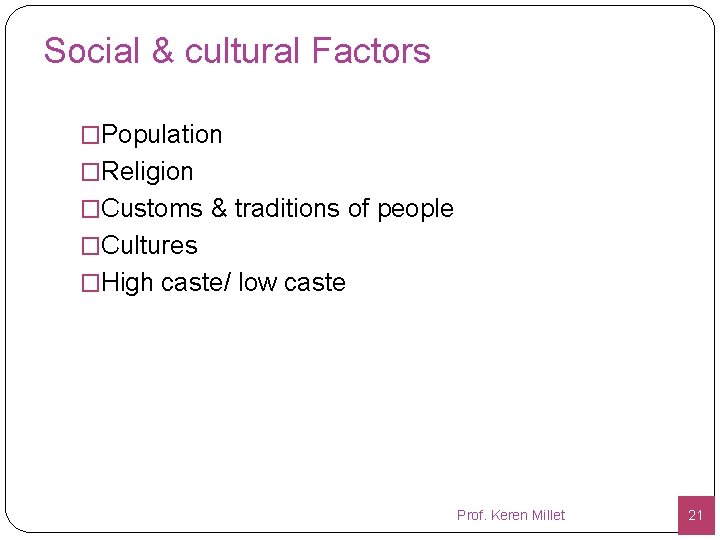
Social & cultural Factors �Population �Religion �Customs & traditions of people �Cultures �High caste/ low caste Prof. Keren Millet 21
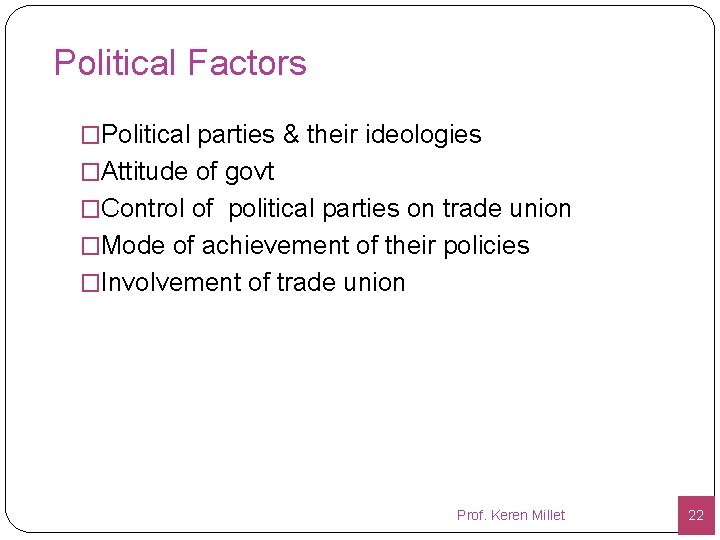
Political Factors �Political parties & their ideologies �Attitude of govt �Control of political parties on trade union �Mode of achievement of their policies �Involvement of trade union Prof. Keren Millet 22
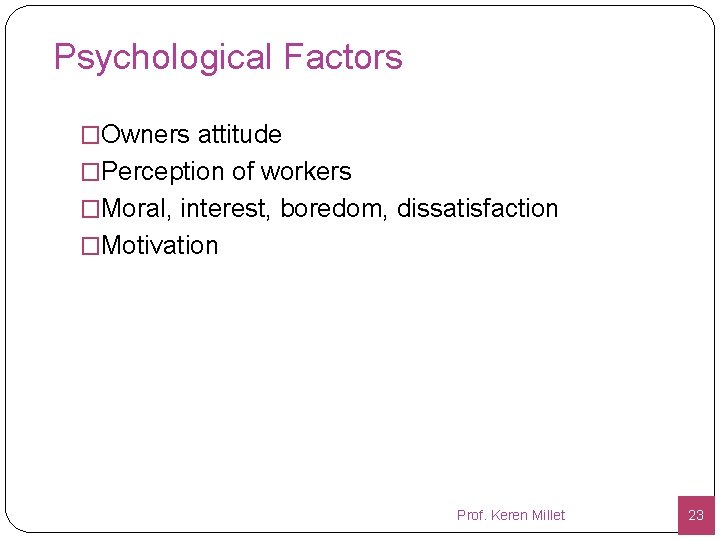
Psychological Factors �Owners attitude �Perception of workers �Moral, interest, boredom, dissatisfaction �Motivation Prof. Keren Millet 23
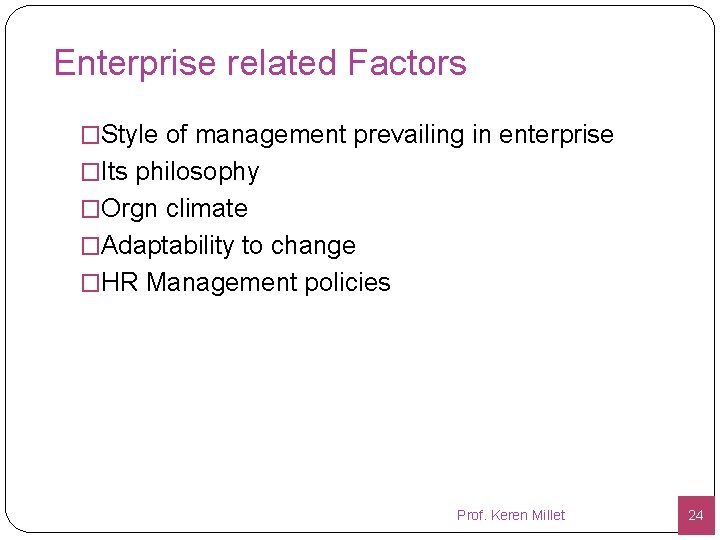
Enterprise related Factors �Style of management prevailing in enterprise �Its philosophy �Orgn climate �Adaptability to change �HR Management policies Prof. Keren Millet 24
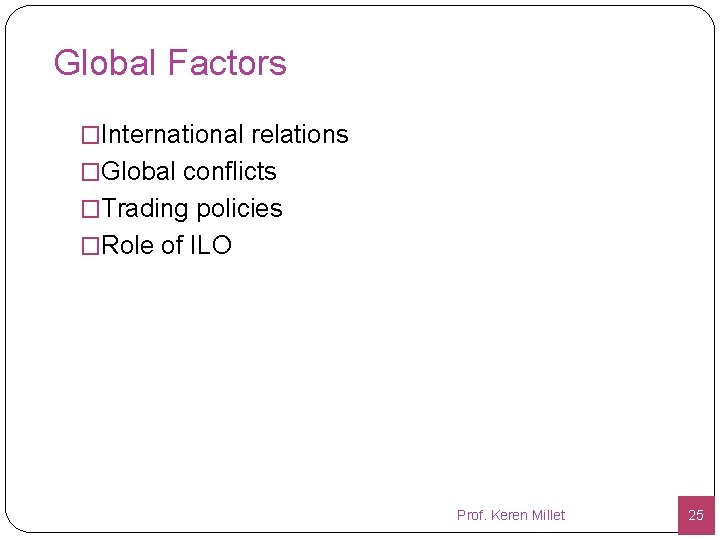
Global Factors �International relations �Global conflicts �Trading policies �Role of ILO Prof. Keren Millet 25
26