
Module 3 Ecosystem and Sustainability Glossary Ecosystem All
Module 3 Ecosystem and Sustainability
Glossary • Ecosystem – All the living organisms and non living components in a specific habitat, and their interactions • Biotic Factor – Living organisms in an ecosystem that can effect each other e. g. food supply, predation and disease • Abiotic Factor – Effects of non-living components of an ecosystem e. g. p. H, temperature, soil type • Producer – Autotrophic organisms that convert light energy into chemical energy • Consumer – Living organisms that feed on other living organisms • Decomposer – Organisms that feed on dead organic matter, make molecules, minerals and energy available to other organisms
Glossary • Trophic Level – The level at which an organism feeds in a food chain • Carrying Capacity – The maximum population size that can be maintained over a period of time in a particular habitat • Interspecific Competition – Between individuals of different species • Intraspecific Competition – Between individuals of the same species • Conservation – Maintenance of biodiversity, including diversity between species, genetic diversity within species and variety of habitats • Preservation – Protecting areas of land yet untouched by human

Ecosystems • Are
Energy • Energy is transferred through ecosystems by feeding
Energy Transfers • Energy transfers between trophic levels can be measured – Pyramid of number • Each bar proportional to the number of individuals – Pyramid of biomass • Each bar proportional to the dry mass of individuals in that trophic level • Often wet mass is used and dry mass calculated from previous data – Pyramid of energy • How much energy is released from a species individual per unit mass • Burn individual in a calorimeter, but is considered too destructive – Productivity • Rate of energy flow: productivity • Gross primary productivity: rate at which plants convert light into chemical energy • Not just a snapshot, take into accounts fluctuations over time

Human activities • Human activities can manipulate the flow of energy through the ecosystem – More light • Plant crops early • Grow under light banks – More water • Irrigating crops – Lack of nutrients • Fertiliser, crop rotation – Pests remove biomass • Pesticides, gm pest resistance – Competition for light • Use herbicides to kill weeds • Human activities can manipulate the flow of energy through the ecosystem – Young animals use energy to grow more than adults • Kill animals before adulthood • Steroids – Pathogens slow growth • Antibiotics – Use energy for heat and moving instead of growth • Pen animals • Keep indoors
Example of Primary Succession • Succession – Directional change in a community over time • Primary Succession – From bare rock • Pioneer community – First organisms to live on bare rock • Climax community – Final stable community • Example 1. Sea Rocket: • tolerate salt, lack of fresh water and unstable sand • Sand builds up around them, when they die they add nutrients 2. Sea Couch Grass: • Under ground stems that help stabilise the sand 3. Marram Grass: • More sand builds up around it 4. Bird’s foot trefoil – Legume: adds nitrate 5. Sand Fescue – Stabilises ground further 6. Woodland or Grassland
Measuring distribution and abundance of organisms • Transects – Look for change across habitat – Line transect: • Look at what is touching the tape at regular intervals – Belt transect • Place quadrat at regular intervals • Quadrats • Point quadrats – Look at what is touching the needles
Role of Decomposers • Decomposition of organic material • Saprotrophic – Secrete enzymes onto dead material – Digests the material into smaller molecules which are then absorbed
Nitrogen Cycle • Microorganisms recycle nitrogen within the ecosystem – Nitrosomonas • Oxidises ammonia to nitrite – Nitrobacter • Oxidises nitrite to nitrate – Rhizobium • Nitrogen fixing bacteria • Live in root nodules of legumes • Turns nitrogen into nitrate
Limiting Factors • Determine the final size of a population – Availability of resources • E. g. food, water, light, oxygen, nesting sites, shelter# – Effects of other species • E. g. parasites, predators, competition of resources from individuals of the same or different species • Carrying capacity – Upper limit these factors place on the population
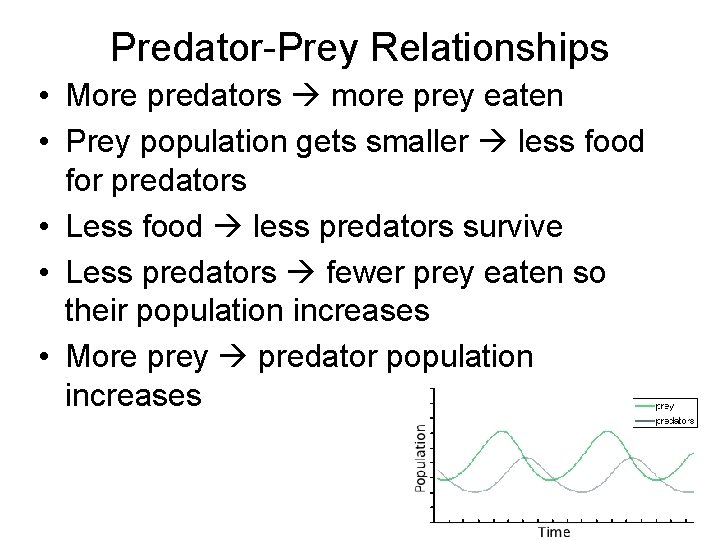
Predator-Prey Relationships • More predators more prey eaten • Prey population gets smaller less food for predators • Less food less predators survive • Less predators fewer prey eaten so their population increases • More prey predator population increases
Sustainable Management of Resources • Timber production in a temperate country – Sustainable: similar quantities of timber can be harvested year on year – Trees not planted too close together – Prevent young trees from being grazed – Plant fast growing plant – Clear felling not done as causes soil erosion – Selective felling – Strip felling – Coppicing/pollarding
Conservation • A dynamic process involving management and reclamation – Raise carrying capacity by providing extra food – Add individuals – Restrict dispersal – Control predators – Vaccinate against disease
Conservation of Biological Resources • Economic – Valuable food source – Natural predators/pests can act as control agents – Pollinators • Social – Potential beneficial resources e. g. drugs • Ethical – Species has values in their own right
Galapagos Islands • Effects of human activities on the animal and plant populations – – Habitat disturbance, fragmentation Use of resources Increased pollution Over exploitation • Giant tortoises taken for food • Over fishing for exotic species – Introduced species e. g. goats, cats, insects • Out compete native species e. g. goats outcompete tortoises • Eat native species • Bring diseases
- Slides: 17