
Module 3 Decision Theory and the Normal Distribution
Module 3 Decision Theory and the Normal Distribution Prepared by Lee Revere and John Large To accompany Quantitative Analysis for Management, 9 e by Render/Stair/Hanna M 3 -1 1
Learning Objectives Students will be able to: 1. Understand how the normal curve can be used in performing break-even analysis. 2. Compute the expected value of perfect information (EVPI) using the normal curve. 3. Perform marginal analysis where products have a constant marginal profit and loss. To accompany Quantitative Analysis for Management, 9 e by Render/Stair/Hanna M 3 -2 2

Module Outline M 3. 1 Introduction M 3. 2 Break-Even Analysis and the Normal Distribution M 3. 3 EVPI and the Normal Distribution To accompany Quantitative Analysis for Management, 9 e by Render/Stair/Hanna M 3 -3 3
Introduction The normal distribution can be used when there a large number of states of nature and/or alternatives. Note: it would be impossible to develop a decision table or tree if there were 50, 100, or even more states and/or alternatives! To accompany Quantitative Analysis for Management, 9 e by Render/Stair/Hanna M 3 -4 4
Break-Even Analysis and the Normal Distribution Break-even analysis, also called costvolume analysis, answers managerial questions relating the effect of a decision to overall revenues or costs. Break-even point (units) = Fixed Costs Price/unit – Variable Costs/unit To accompany Quantitative Analysis for Management, 9 e by Render/Stair/Hanna M 3 -5 5
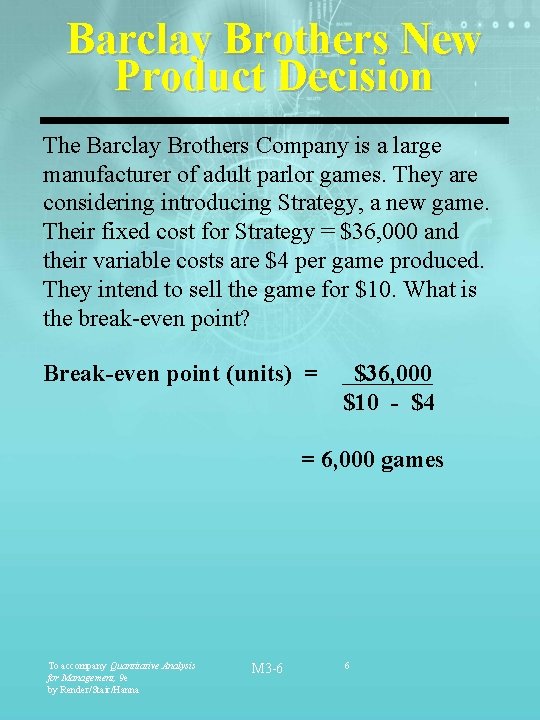
Barclay Brothers New Product Decision The Barclay Brothers Company is a large manufacturer of adult parlor games. They are considering introducing Strategy, a new game. Their fixed cost for Strategy = $36, 000 and their variable costs are $4 per game produced. They intend to sell the game for $10. What is the break-even point? Break-even point (units) = $36, 000 $10 - $4 = 6, 000 games To accompany Quantitative Analysis for Management, 9 e by Render/Stair/Hanna M 3 -6 6
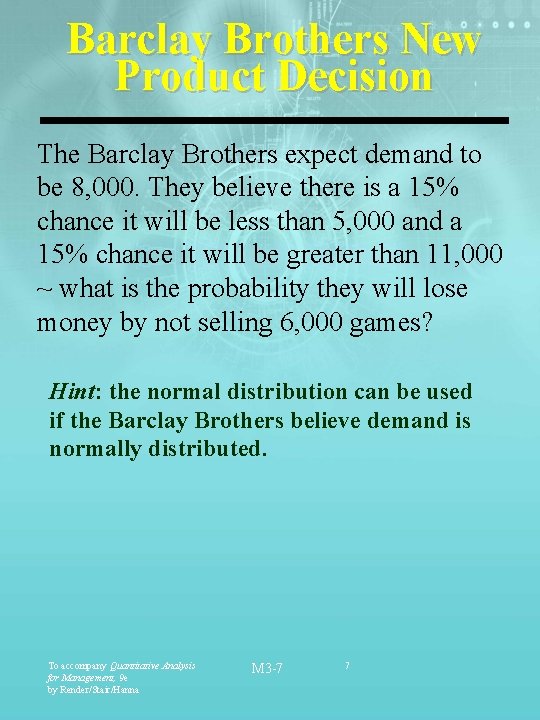
Barclay Brothers New Product Decision The Barclay Brothers expect demand to be 8, 000. They believe there is a 15% chance it will be less than 5, 000 and a 15% chance it will be greater than 11, 000 ~ what is the probability they will lose money by not selling 6, 000 games? Hint: the normal distribution can be used if the Barclay Brothers believe demand is normally distributed. To accompany Quantitative Analysis for Management, 9 e by Render/Stair/Hanna M 3 -7 7
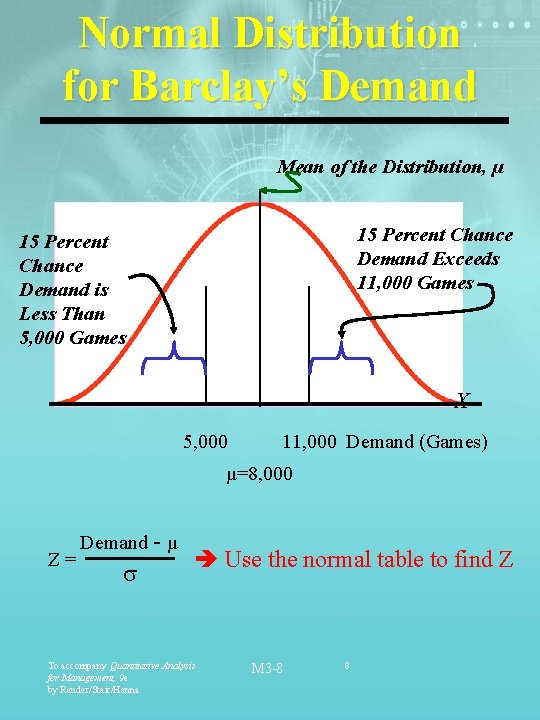
Normal Distribution for Barclay’s Demand Mean of the Distribution, µ 15 Percent Chance Demand Exceeds 11, 000 Games 15 Percent Chance Demand is Less Than 5, 000 Games X 5, 000 11, 000 Demand (Games) µ=8, 000 Z= Demand - µ Use the normal table to find Z To accompany Quantitative Analysis for Management, 9 e by Render/Stair/Hanna M 3 -8 8
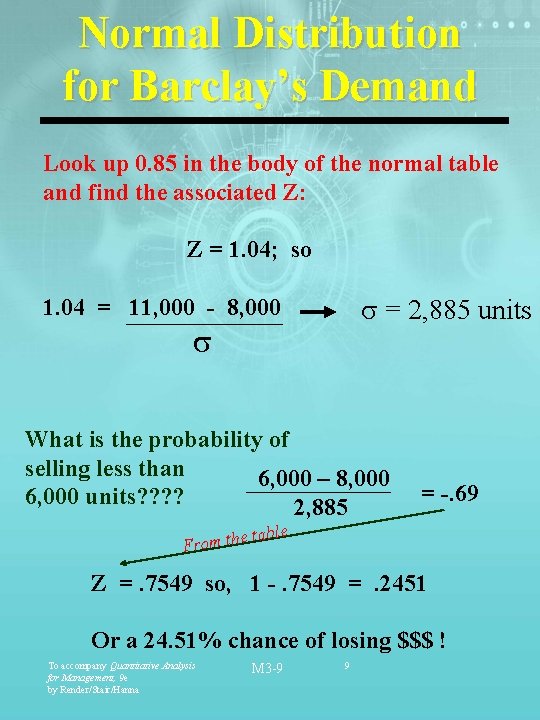
Normal Distribution for Barclay’s Demand Look up 0. 85 in the body of the normal table and find the associated Z: Z = 1. 04; so = 2, 885 units 1. 04 = 11, 000 - 8, 000 What is the probability of selling less than 6, 000 – 8, 000 6, 000 units? ? 2, 885 e From th = -. 69 table Z =. 7549 so, 1 -. 7549 =. 2451 Or a 24. 51% chance of losing $$$ ! To accompany Quantitative Analysis for Management, 9 e by Render/Stair/Hanna M 3 -9 9
Barclay’s Break-Even Analysis P(loss) = P(demand < breakeven) = 0. 2451 = 24. 51% P(profit) = P(demand > breakeven) = 0. 7549 = 75. 49% Should Barclay bring its Strategy game to the market? To accompany Quantitative Analysis for Management, 9 e by Render/Stair/Hanna M 3 -10 10

Expected Value of Perfect Information and the Normal Distribution The opportunity loss function describes the loss that would be suffered by making the wrong decision. The opportunity loss function can be computed by: Opportunity K (Break-even point - X) loss = for X < Breakeven where $0 for X > Breakeven K = the loss per unit when sales are below the break-even point X = sales in units. To accompany Quantitative Analysis for Management, 9 e by Render/Stair/Hanna M 3 -11 11
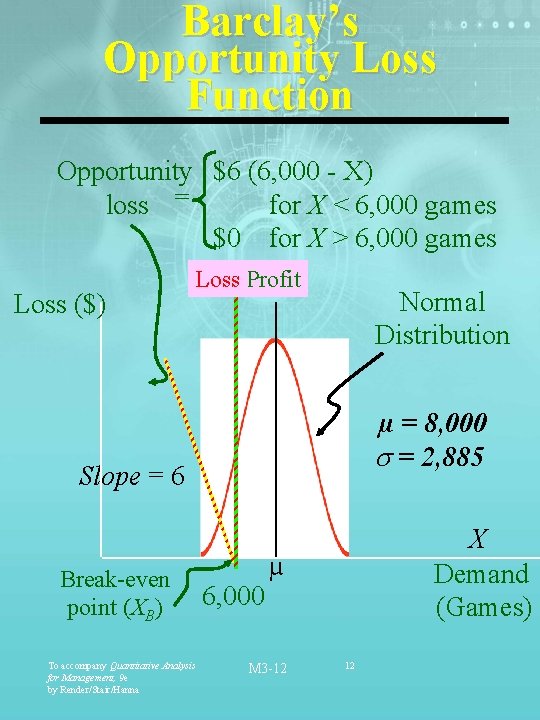
Barclay’s Opportunity Loss Function Opportunity $6 (6, 000 - X) loss = for X < 6, 000 games $0 for X > 6, 000 games Loss ($) Loss Profit Normal Distribution µ = 8, 000 = 2, 885 Slope = 6 Break-even point (XB) To accompany Quantitative Analysis for Management, 9 e by Render/Stair/Hanna 6, 000 X Demand (Games) µ M 3 -12 12

Expected Opportunity Loss The expected opportunity loss is the sum of the opportunity losses multiplied by the probability of that demand occurring. In the Barclay Brothers example, there a large number of possible sales volumes (0, 1, 2, … 5, 999), so the unit normal loss integral is used. N(D) is the table value for the normal loss integral for a given value of D. To accompany Quantitative Analysis for Management, 9 e by Render/Stair/Hanna M 3 -13 13
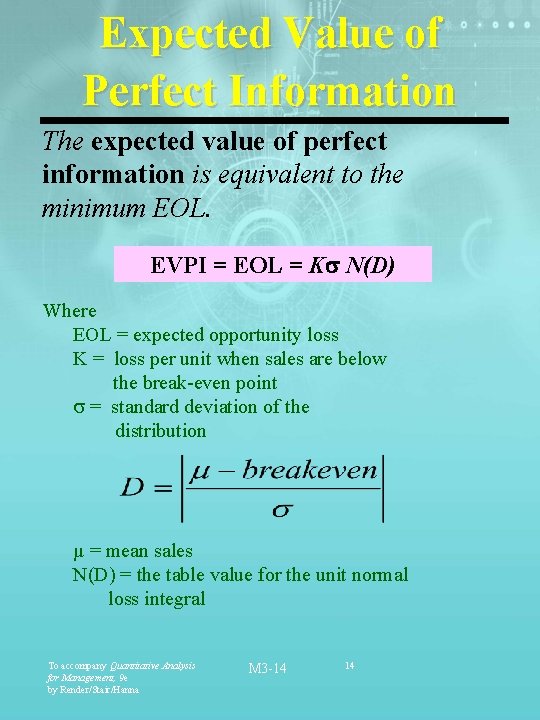
Expected Value of Perfect Information The expected value of perfect information is equivalent to the minimum EOL. EVPI = EOL = K N(D) Where EOL = expected opportunity loss K = loss per unit when sales are below the break-even point = standard deviation of the distribution µ = mean sales N(D) = the table value for the unit normal loss integral To accompany Quantitative Analysis for Management, 9 e by Render/Stair/Hanna M 3 -14 14
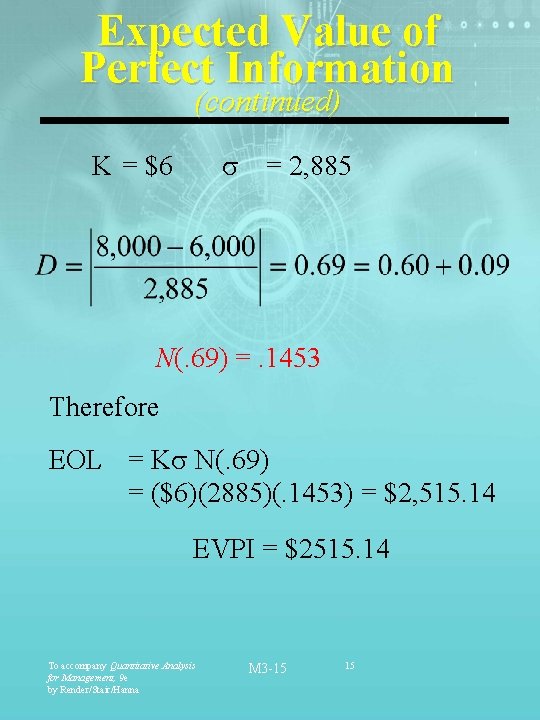
Expected Value of Perfect Information (continued) = 2, 885 K = $6 N(. 69) =. 1453 Therefore EOL = K N(. 69) = ($6)(2885)(. 1453) = $2, 515. 14 EVPI = $2515. 14 To accompany Quantitative Analysis for Management, 9 e by Render/Stair/Hanna M 3 -15 15
- Slides: 15