
MODULE 3 Change Management Process Diagnosis If you




- Slides: 64
MODULE 3 Change Management Process
Diagnosis “If you don’t ask the right questions, you don’t get the right answers. A question asked in the right way often points to its own answer. Asking questions is the A-B-C of diagnosis. Only the inquiring mind solves problems. ” Edward Hodnett (American Poet 1841 -1920)
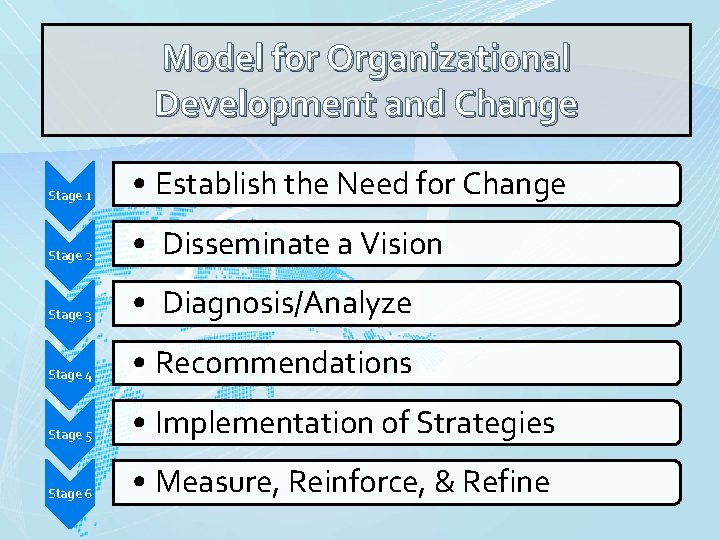
Model for Organizational Development and Change Stage 1 • Establish the Need for Change Stage 2 • Disseminate a Vision Stage 3 • Diagnosis/Analyze Stage 4 • Recommendations Stage 5 • Implementation of Strategies Stage 6 • Measure, Reinforce, & Refine
DIAGNOSIS a systematic approach to understanding and describing the present state of the organization
Diagnostic Articles • The Parable of Diagnostics What can we learn? • Diagnosing Business Problems What do we need to be careful not to do? Wolf, W. (1994). The Parable of Diagnostics. Journal of Organizational Change Management, 6 -7. Mac. Lennan, A. (2009) Diagnosing Business Problems, HR Network, p. 30 -34.
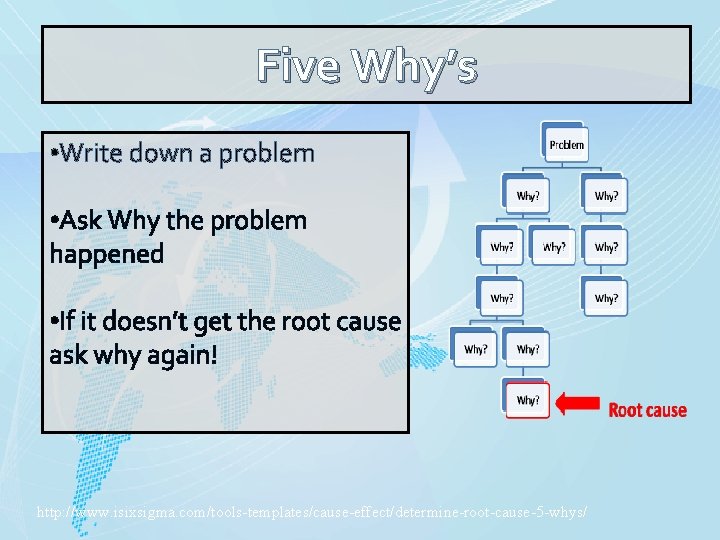
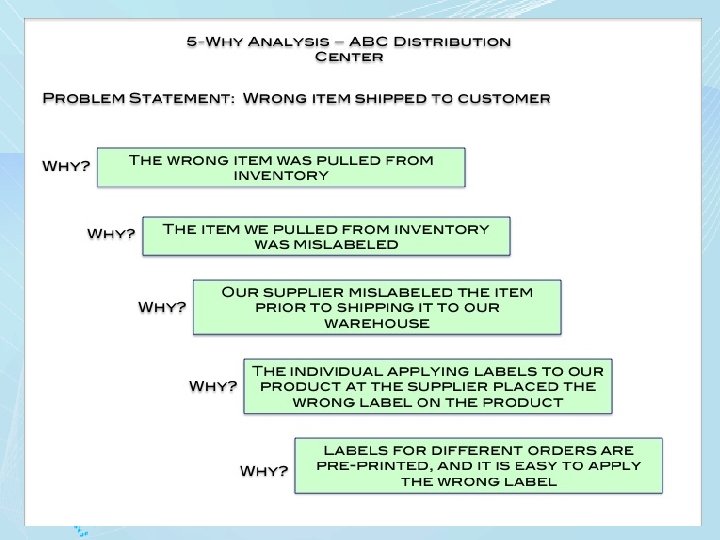
Five Why’s • Write down a problem • Ask Why the problem happened • If it doesn’t get the root cause ask why again! http: //www. isixsigma. com/tools-templates/cause-effect/determine-root-cause-5 -whys/
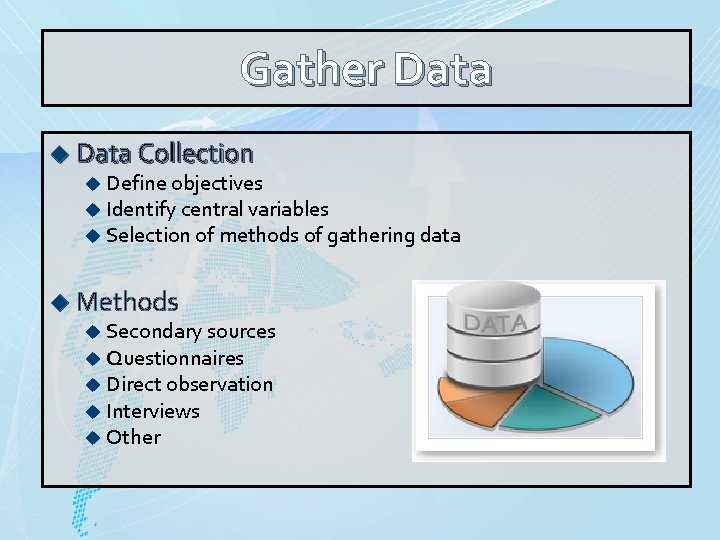
Gather Data u Data Collection u Define objectives u Identify central variables u Selection of methods of gathering data u Methods u Secondary sources u Questionnaires u Direct observation u Interviews u Other
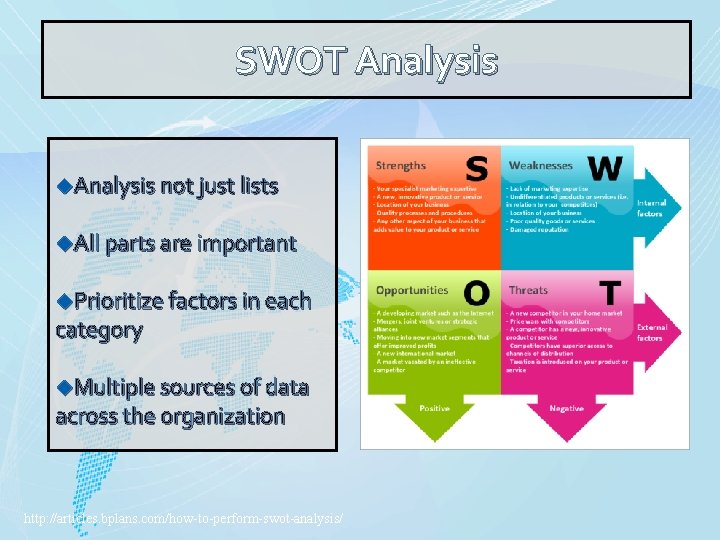
SWOT Analysis u. Analysis not just lists u. All parts are important u. Prioritize factors in each category u. Multiple sources of data across the organization http: //articles. bplans. com/how-to-perform-swot-analysis/
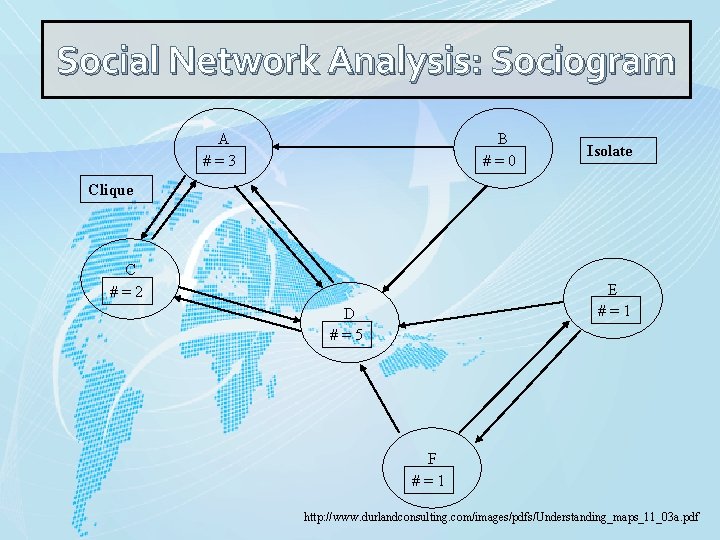
Social Network Analysis: Sociogram A #=3 B #=0 Isolate Clique C #=2 E #=1 D #=5 F #=1 http: //www. durlandconsulting. com/images/pdfs/Understanding_maps_11_03 a. pdf
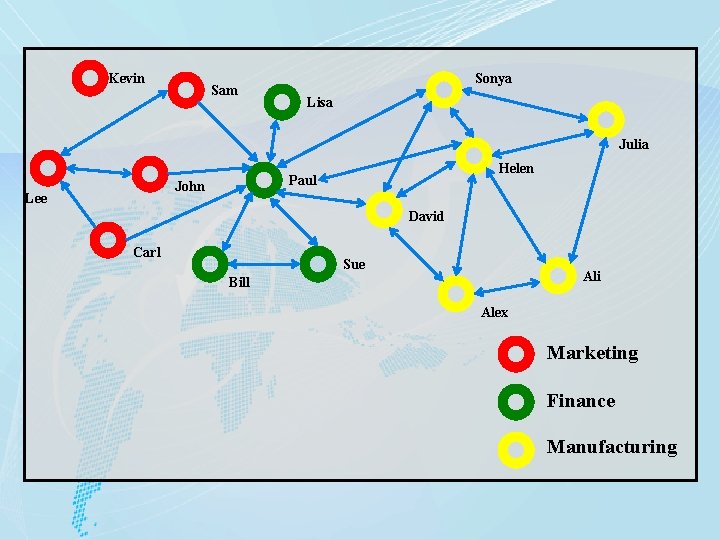
Kevin Sam Sonya Lisa Julia John Lee Helen Paul David Carl Sue Ali Bill Alex Marketing Finance Manufacturing
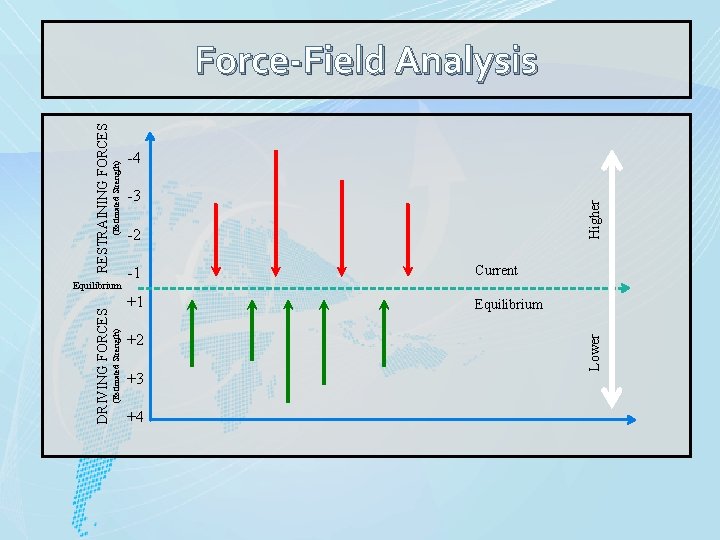
(Estimated Strength) DRIVING FORCES Equilibrium -2 +2 +3 +4 Higher -3 -1 Current +1 Equilibrium Lower (Estimated Strength) RESTRAINING FORCES Force-Field Analysis -4
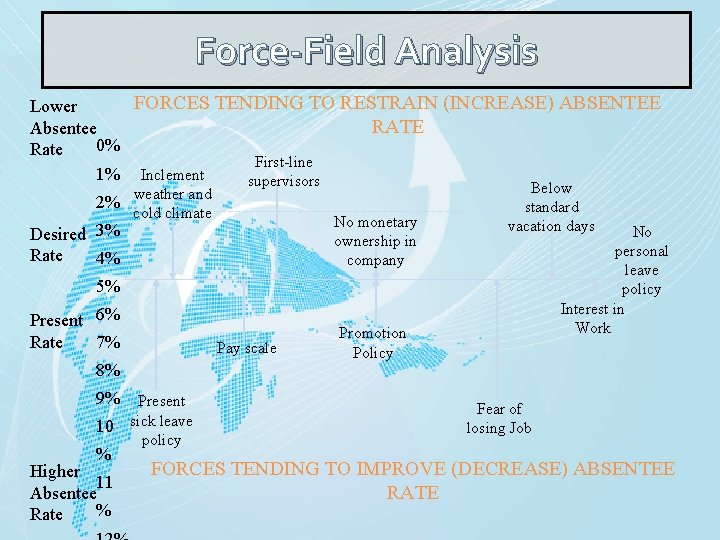
Force-Field Analysis FORCES TENDING TO RESTRAIN (INCREASE) ABSENTEE Lower RATE Absentee 0% Rate First-line 1% Inclement supervisors 2% weather and Desired 3% Rate 4% cold climate No monetary ownership in company Below standard vacation days No personal leave policy Interest in Work 5% Present 6% Rate 7% Pay scale 8% 9% 10 % Higher 11 Absentee % Rate Present sick leave policy Promotion Policy Fear of losing Job FORCES TENDING TO IMPROVE (DECREASE) ABSENTEE RATE
IMPLEMENTATION OF CHANGE STRATEGY Set of planned change activities intended to help an organization increase its effectiveness
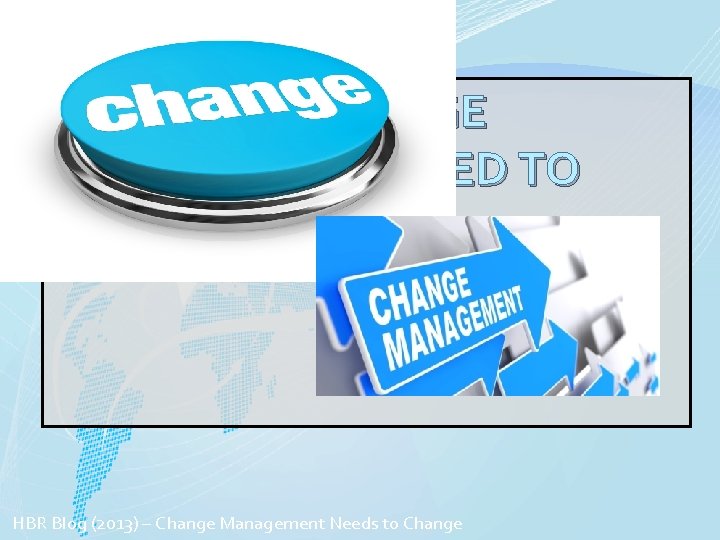
WHY DOES CHANGE MANAGEMENT NEED TO CHANGE? HBR Blog (2013) – Change Management Needs to Change
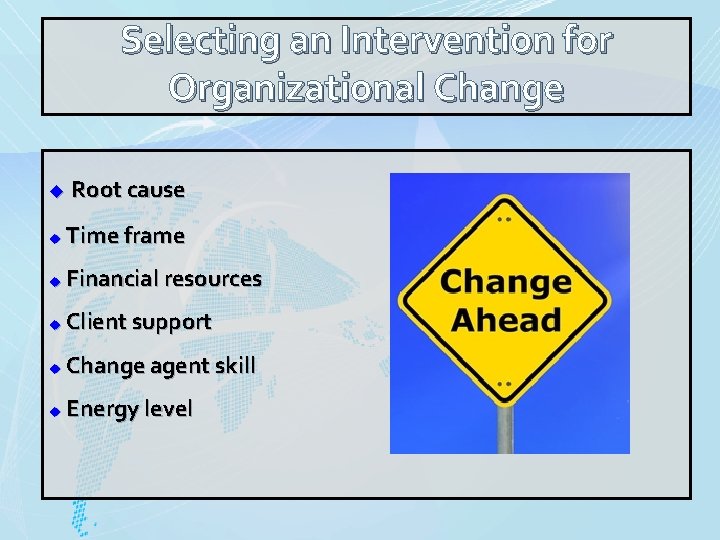
Selecting an Intervention for Organizational Change u Root cause u Time frame u Financial resources u Client support u Change agent skill u Energy level
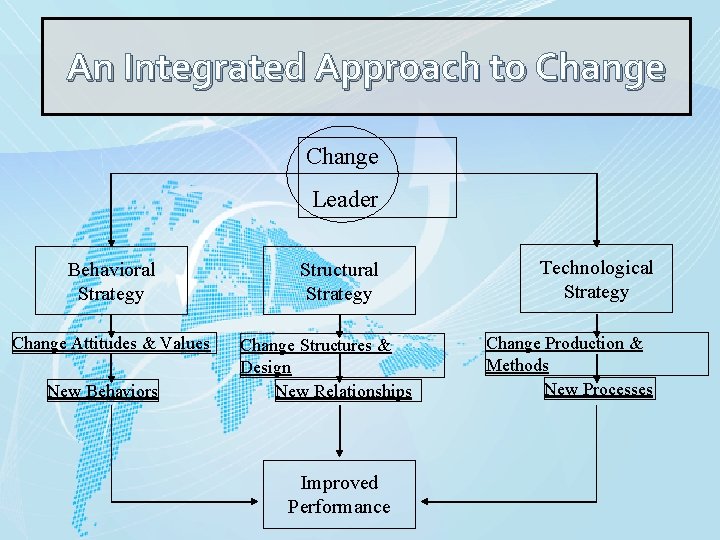
An Integrated Approach to Change Leader Behavioral Strategy Change Attitudes & Values New Behaviors Structural Strategy Change Structures & Design New Relationships Improved Performance Technological Strategy Change Production & Methods New Processes
Major OD Intervention Techniques u Individual level u Group Level u Intergroup level u Total organizational system
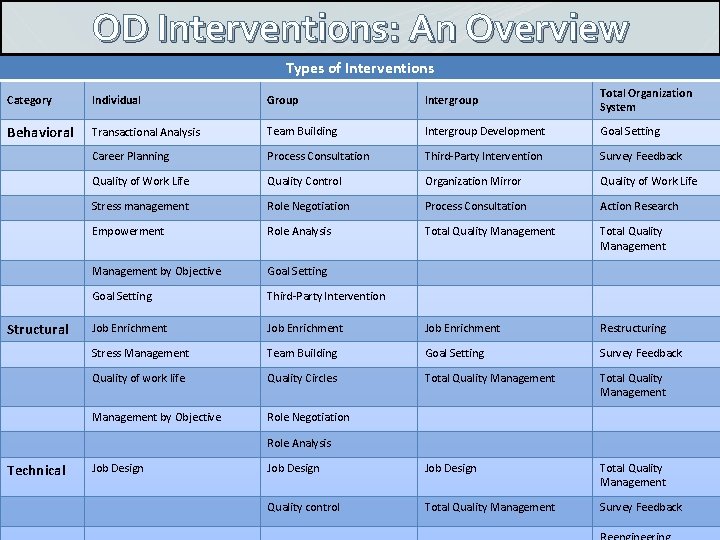
OD Interventions: An Overview Types of Interventions Category Individual Group Intergroup Total Organization System Behavioral Transactional Analysis Team Building Intergroup Development Goal Setting Career Planning Process Consultation Third-Party Intervention Survey Feedback Quality of Work Life Quality Control Organization Mirror Quality of Work Life Stress management Role Negotiation Process Consultation Action Research Empowerment Role Analysis Total Quality Management by Objective Goal Setting Third-Party Intervention Job Enrichment Restructuring Stress Management Team Building Goal Setting Survey Feedback Quality of work life Quality Circles Total Quality Management by Objective Role Negotiation Job Design Total Quality Management Quality control Total Quality Management Survey Feedback Structural Role Analysis Technical Job Design
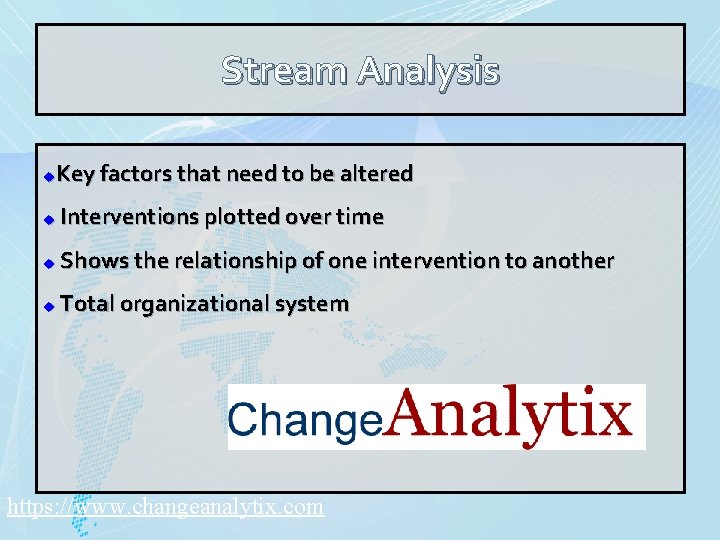
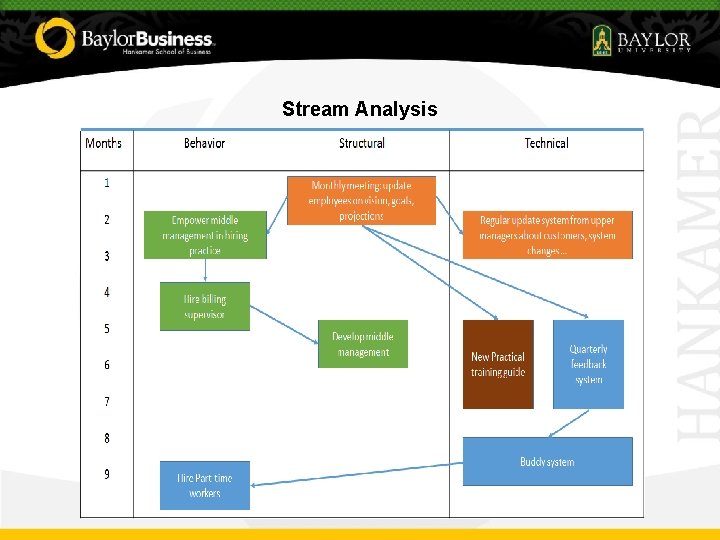
Stream Analysis Key factors that need to be altered u u Interventions plotted over time u Shows the relationship of one intervention to another u Total organizational system https: //www. changeanalytix. com
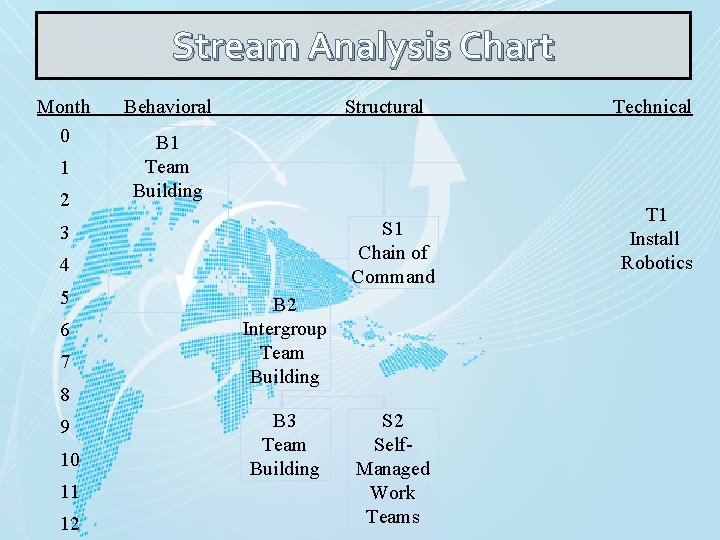
Stream Analysis Chart Month 0 1 2 Behavioral Structural B 1 Team Building S 1 Chain of Command 3 4 5 6 7 8 9 10 11 12 Technical B 2 Intergroup Team Building B 3 Team Building S 2 Self. Managed Work Teams T 1 Install Robotics
Stream Analysis
SKILLS DEVELOPMENT Energy International
Learning Points u Decision Process u Information Strategy u Leadership
“The thing I have learned at IBM is that culture is everything. ” – Louis V. Gerstner, Jr. former CEO IBM
ORGANZATIONAL CULTURE A common perception by the organization’s members; a system of shared meaning.
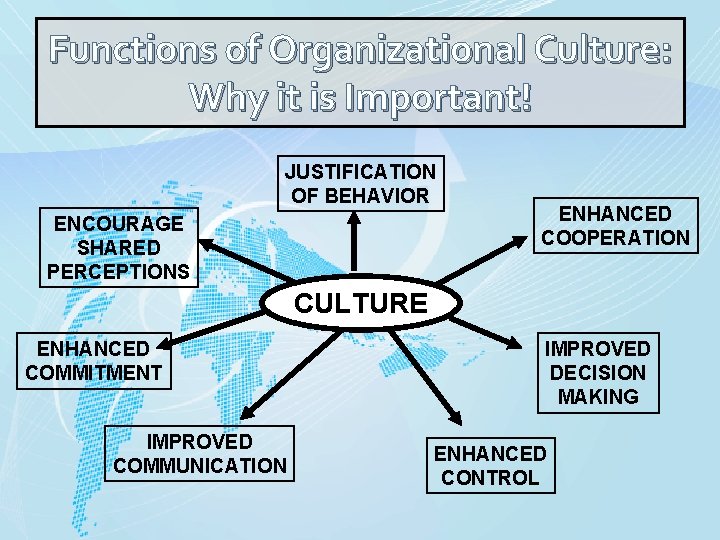
Functions of Organizational Culture: Why it is Important! JUSTIFICATION OF BEHAVIOR ENCOURAGE SHARED PERCEPTIONS ENHANCED COOPERATION CULTURE ENHANCED COMMITMENT IMPROVED COMMUNICATION IMPROVED DECISION MAKING ENHANCED CONTROL
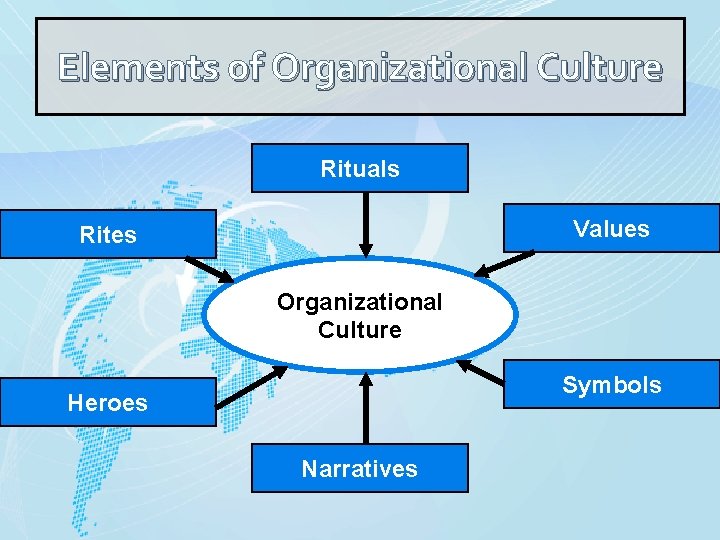
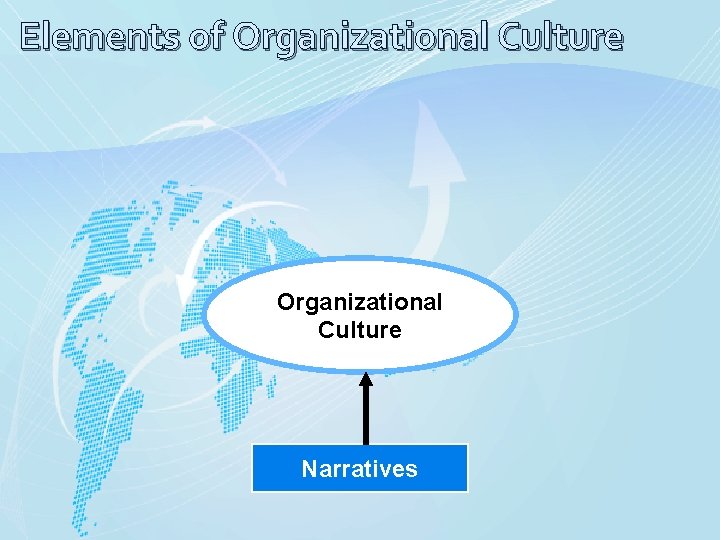
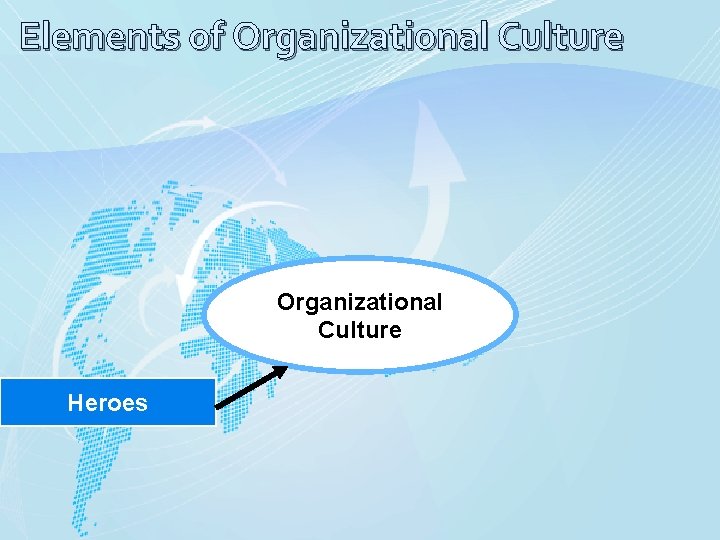
Elements of Organizational Culture Rituals Values Rites Organizational Culture Symbols Heroes Narratives
Elements of Organizational Culture Values Organizational Culture
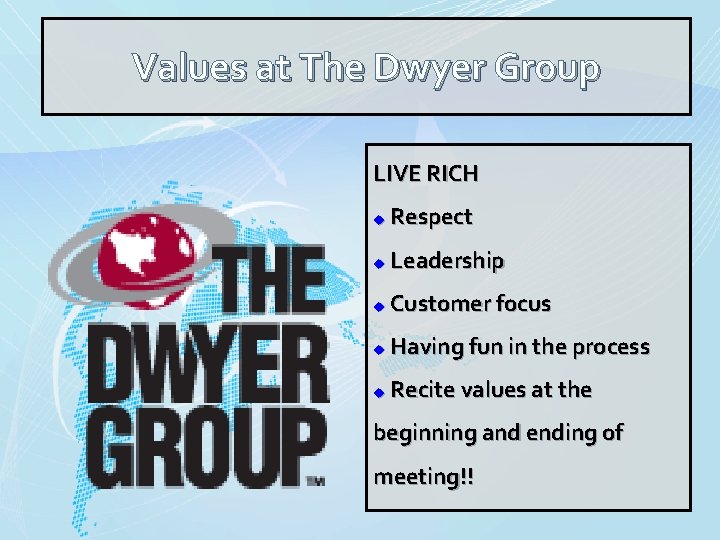
Values at The Dwyer Group LIVE RICH u Respect u Leadership u Customer focus u Having fun in the process u Recite values at the beginning and ending of meeting!!
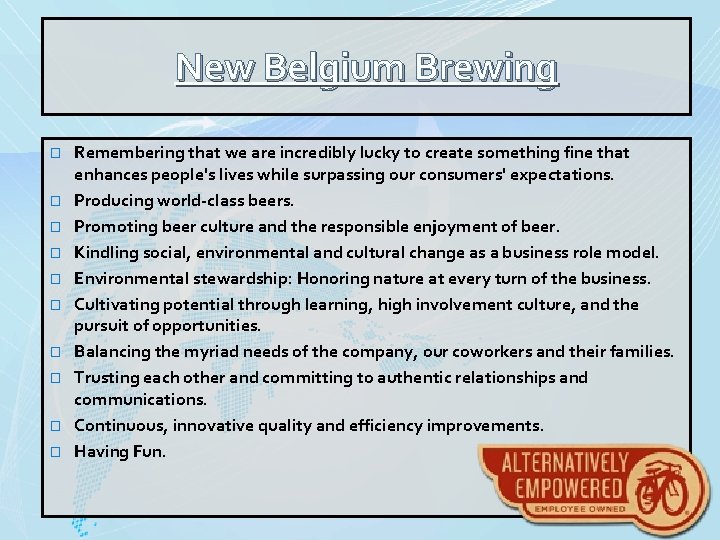
New Belgium Brewing � � � � � Remembering that we are incredibly lucky to create something fine that enhances people's lives while surpassing our consumers' expectations. Producing world-class beers. Promoting beer culture and the responsible enjoyment of beer. Kindling social, environmental and cultural change as a business role model. Environmental stewardship: Honoring nature at every turn of the business. Cultivating potential through learning, high involvement culture, and the pursuit of opportunities. Balancing the myriad needs of the company, our coworkers and their families. Trusting each other and committing to authentic relationships and communications. Continuous, innovative quality and efficiency improvements. Having Fun.
Elements of Organizational Culture Symbols
Symbols
Elements of Organizational Culture Narratives
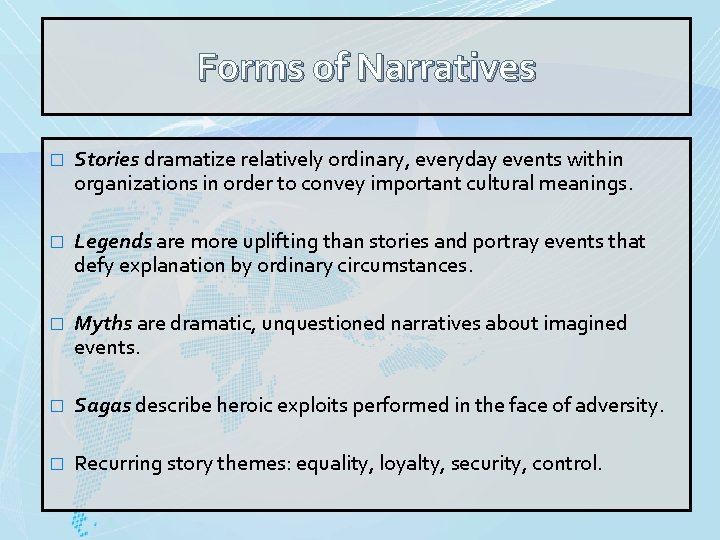
Forms of Narratives � Stories dramatize relatively ordinary, everyday events within organizations in order to convey important cultural meanings. � Legends are more uplifting than stories and portray events that defy explanation by ordinary circumstances. � Myths are dramatic, unquestioned narratives about imagined events. � Sagas describe heroic exploits performed in the face of adversity. � Recurring story themes: equality, loyalty, security, control.
Elements of Organizational Culture Heroes
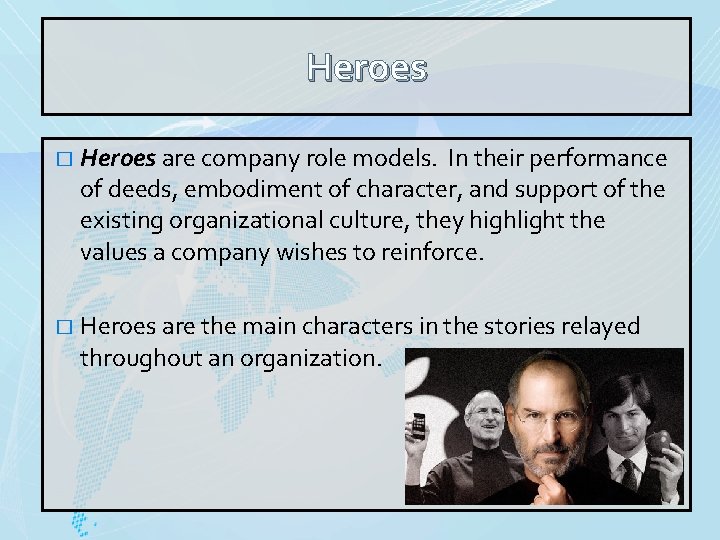
Heroes � Heroes are company role models. In their performance of deeds, embodiment of character, and support of the existing organizational culture, they highlight the values a company wishes to reinforce. � Heroes are the main characters in the stories relayed throughout an organization.
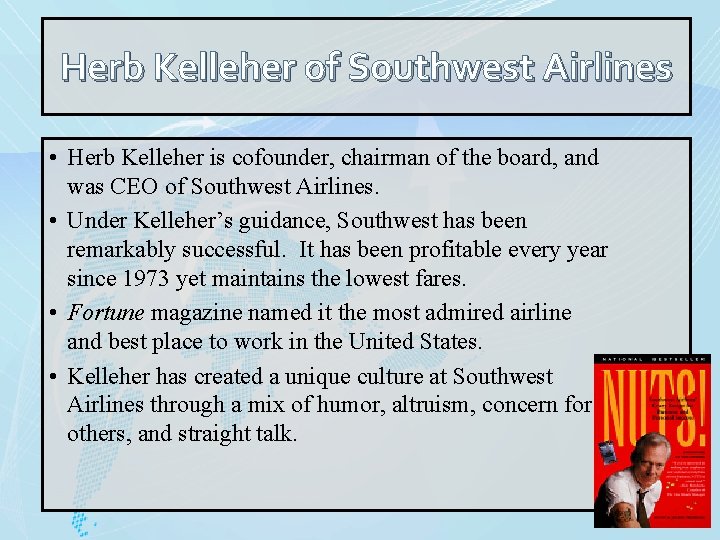
Herb Kelleher of Southwest Airlines • Herb Kelleher is cofounder, chairman of the board, and was CEO of Southwest Airlines. • Under Kelleher’s guidance, Southwest has been remarkably successful. It has been profitable every year since 1973 yet maintains the lowest fares. • Fortune magazine named it the most admired airline and best place to work in the United States. • Kelleher has created a unique culture at Southwest Airlines through a mix of humor, altruism, concern for others, and straight talk.
Elements of Organization Culture Rites Organizational Culture
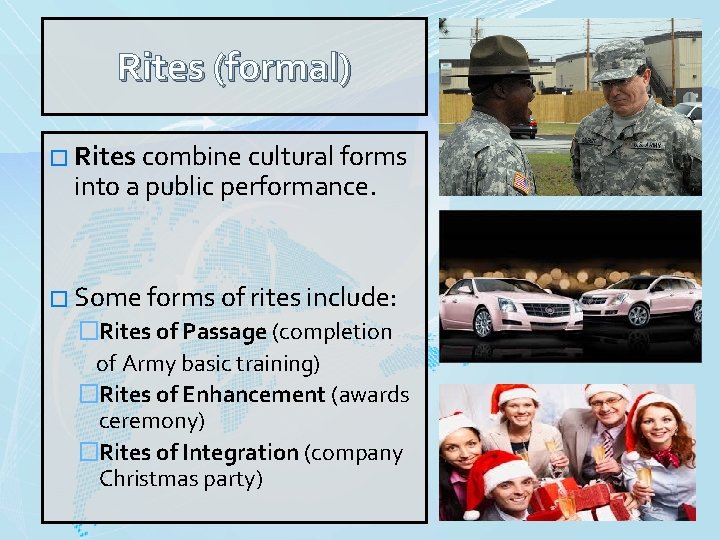
Rites (formal) � Rites combine cultural forms into a public performance. � Some forms of rites include: �Rites of Passage (completion of Army basic training) �Rites of Enhancement (awards ceremony) �Rites of Integration (company Christmas party)
Elements of Organization Culture Rituals Organizational Culture
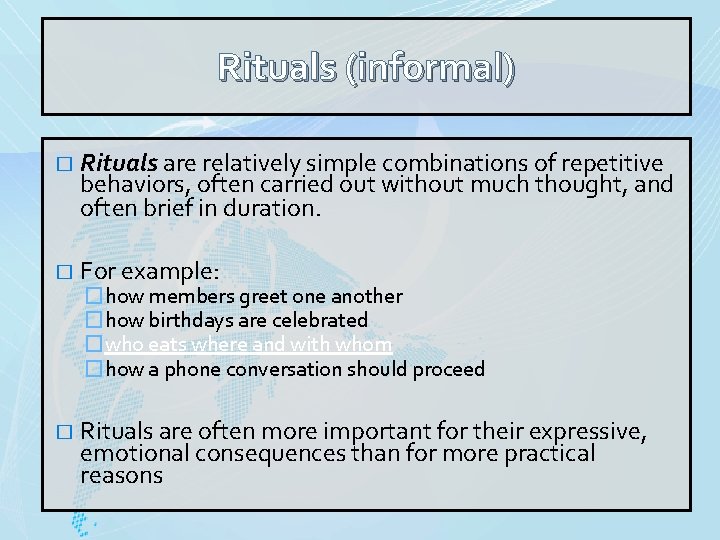
Rituals (informal) � Rituals are relatively simple combinations of repetitive behaviors, often carried out without much thought, and often brief in duration. � For example: �how members greet one another �how birthdays are celebrated �who eats where and with whom �how a phone conversation should proceed � Rituals are often more important for their expressive, emotional consequences than for more practical reasons
SKILLS DEVELOPMENT Culture Fit
CULTURE AND CHANGE Cultural Change that Sticks What do we start with when thinking about cultural change? Orange is the New Culture What is unique about this culture? Trader Joe’s Remarkable Journey How has their culture played a role in their success? Katzenbach, H. , Steffen, I. , & Kronley, C. (July-Aug 2012). Cultural Change that Sticks. Harvard Business Review, 2 -9. Orange is the New Culture (2013) Fast Company. Gustafson, M. (2008) Trader Joe’s Remarkable Journey. Retailer Extra.
SKILLS DEVELOPMENT Transforming Organizational Cultures
“In most organizational change efforts, it is much easier to draw on the strengths of the culture than to overcome the constraints by changing the culture. ” Edgar Schein, professor MIT Sloan School of Management
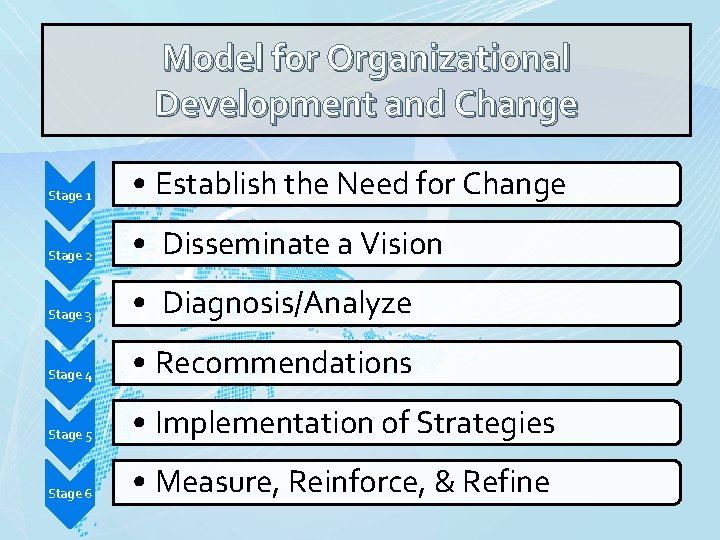
Model for Organizational Development and Change Stage 1 • Establish the Need for Change Stage 2 • Disseminate a Vision Stage 3 • Diagnosis/Analyze Stage 4 • Recommendations Stage 5 • Implementation of Strategies Stage 6 • Measure, Reinforce, & Refine
CHANGING CULTURE
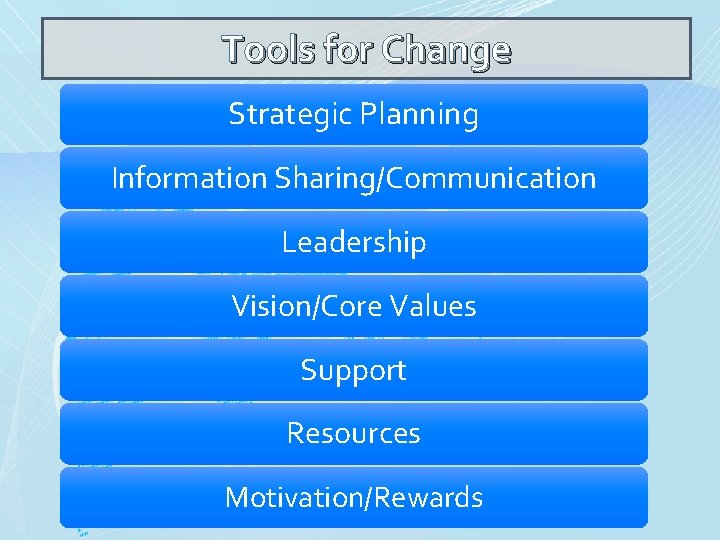
Tools for Change Strategic Planning Information Sharing/Communication Leadership Vision/Core Values Support Resources Motivation/Rewards
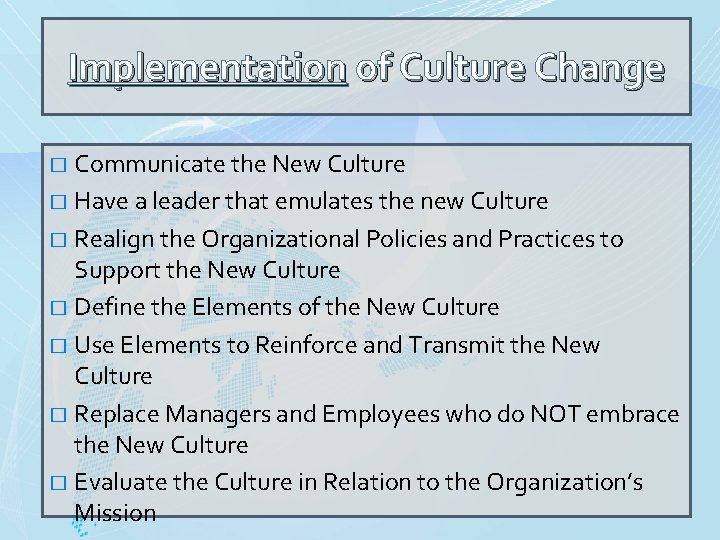
Implementation of Culture Change Communicate the New Culture � Have a leader that emulates the new Culture � Realign the Organizational Policies and Practices to Support the New Culture � Define the Elements of the New Culture � Use Elements to Reinforce and Transmit the New Culture � Replace Managers and Employees who do NOT embrace the New Culture � Evaluate the Culture in Relation to the Organization’s Mission �
EDS � What was the existing culture at EDS? � How did the new CEO go about changing culture? � Why did they choose a change leader from outside of the organization? � What is the new culture of EDS? Breen, B. (2001). How EDS Got Its Groove Back. Fast Company, 51: 10 p.
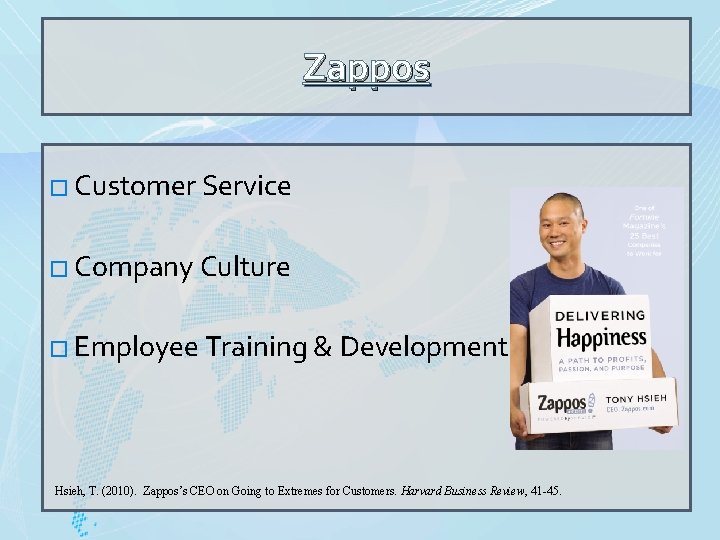
Zappos � Customer Service � Company Culture � Employee Training & Development Hsieh, T. (2010). Zappos’s CEO on Going to Extremes for Customers. Harvard Business Review, 41 -45.
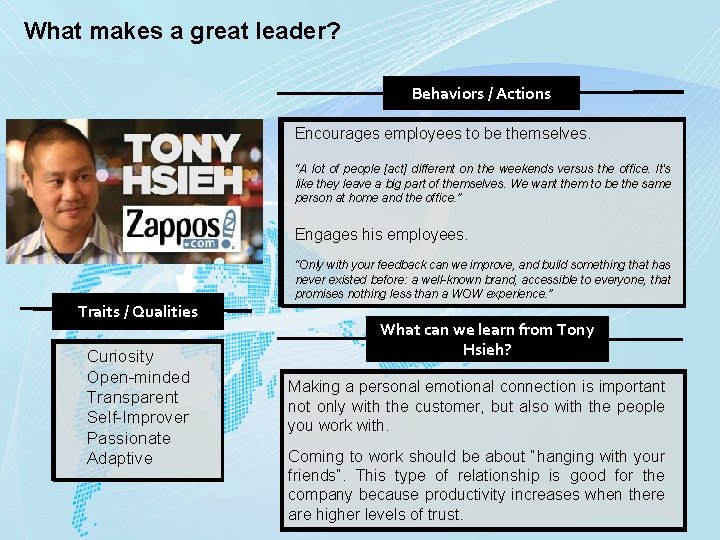
What makes a great leader? Behaviors / Actions Encourages employees to be themselves. “A lot of people [act] different on the weekends versus the office. It's like they leave a big part of themselves. We want them to be the same person at home and the office. ” Engages his employees. “Only with your feedback can we improve, and build something that has never existed before: a well-known brand, accessible to everyone, that promises nothing less than a WOW experience. ” Traits / Qualities Curiosity Open-minded Transparent Self-Improver Passionate Adaptive What can we learn from Tony Hsieh? Making a personal emotional connection is important not only with the customer, but also with the people you work with. Coming to work should be about “hanging with your friends”. This type of relationship is good for the company because productivity increases when there are higher levels of trust.
HCL � What is unique about their culture? � How did they go about transformation? � When did they start? Nayar, V. (2010). A Maverick CEO Explains How He Persuaded His Team to Leap into the Future. Harvard Business Review, 110 -113.
SKILLS DEVELOPMENT Downsizing - Stay in your role - Come to a consensus of ranking - You don’t know how many people will be fired
Learning Points � Decision Making � Culture Sources: Values, Norms, etc. � Leadership