
Module 3 Behaviour and Animal Welfare This lecture
Module 3 Behaviour and Animal Welfare This lecture was first developed for World Animal Protection by Dr David Main (University of Bristol) in 2003. It was revised by World Animal Protection scientific advisors in 2012 using updates provided by Dr Caroline Hewson. Free online resources To get free updates and additional materials, please go to www. animalmosaic. org/education/tertiary-education/ Module 3: Behaviour and Animal Welfare Concepts in Animal Welfare © World Animal Protection 2014. Unless stated otherwise, image credits are World Animal Protection.
This module will teach you How to know if performing a particular behaviour is important to animals The basics of behaviour Behavioural repertoire Motivation Some influences on motivation Measures of behavioural priority Examples of important behaviours Module 3: Behaviour and Animal Welfare Concepts in Animal Welfare © World Animal Protection 2014. Unless stated otherwise, image credits are World Animal Protection.

Animals’ experience Module 3: Behaviour and Animal Welfare Concepts in Animal Welfare © World Animal Protection 2014. Unless stated otherwise, image credits are World Animal Protection.
Responses Physiological responses Many are not visible Many are non-specific and do not indicate if the experience is positive or negative Behavioural responses (Olsson et al. , 2011) Easy to observe More complex level of functioning than physiological responses how animals change and control their environment More specific measure of emotional state and experience Module 3: Behaviour and Animal Welfare Concepts in Animal Welfare © World Animal Protection 2014. Unless stated otherwise, image credits are World Animal Protection.
Behaviour and welfare 1 Welfare includes physical functioning, feelings, and the performance of important behaviours Vets already use behaviour (‘clinical signs’) Behaviour can be used to assess each of these areas To identify and treat negative feelings (eg pain, nausea) To diagnose disrupted physical functioning (disease) Module 3: Behaviour and Animal Welfare Concepts in Animal Welfare © World Animal Protection 2014. Unless stated otherwise, image credits are World Animal Protection.
Behaviour and welfare 2 Why vets haven’t considered the performance of important behaviours Animals may function well even when they cannot perform those behaviours Owners are not aware of them and do not ask This is changing as public concern for animals grows, and research tells us more Module 3: Behaviour and Animal Welfare Concepts in Animal Welfare © World Animal Protection 2014. Unless stated otherwise, image credits are World Animal Protection.
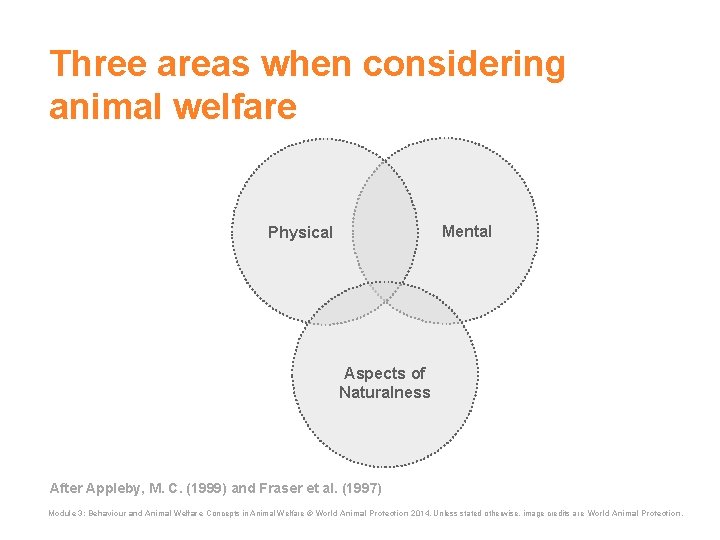
Three areas when considering animal welfare Mental Physical Aspects of Naturalness After Appleby, M. C. (1999) and Fraser et al. (1997) Module 3: Behaviour and Animal Welfare Concepts in Animal Welfare © World Animal Protection 2014. Unless stated otherwise, image credits are World Animal Protection.
Behavioural repertoire 1 Repertoire in the wild e. g. Reproductive behaviours: courtship, mating, parturient, maternal Feeding behaviours: seeking and consuming food Time budget How animals allocate their time to different behaviours Module 3: Behaviour and Animal Welfare Concepts in Animal Welfare © World Animal Protection 2014. Unless stated otherwise, image credits are World Animal Protection.
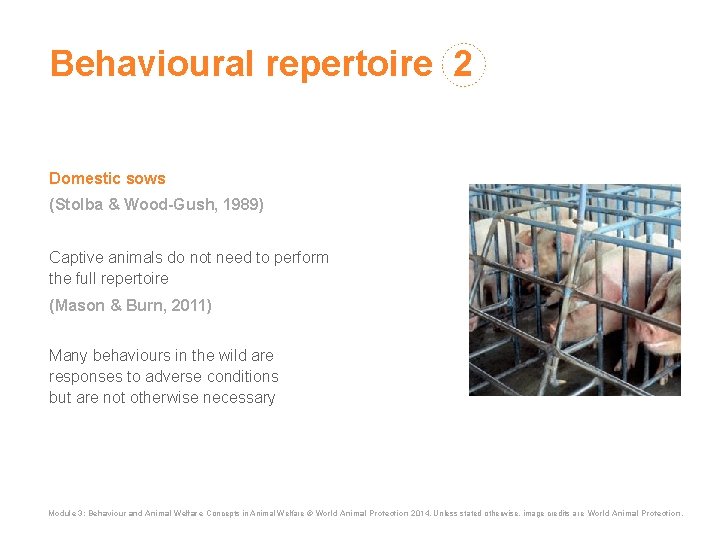
Behavioural repertoire 2 Domestic sows (Stolba & Wood-Gush, 1989) Captive animals do not need to perform the full repertoire (Mason & Burn, 2011) Many behaviours in the wild are responses to adverse conditions but are not otherwise necessary Module 3: Behaviour and Animal Welfare Concepts in Animal Welfare © World Animal Protection 2014. Unless stated otherwise, image credits are World Animal Protection.
Behaviour and motivation 1 Motivation = urge to perform behaviour (Hurnik et al. , 1995) Results from brain’s evaluation of sensory stimuli that may be internal or external Some behaviours motivated internally, others externally, others a mixture Module 3: Behaviour and Animal Welfare Concepts in Animal Welfare © World Animal Protection 2014. Unless stated otherwise, image credits are World Animal Protection.
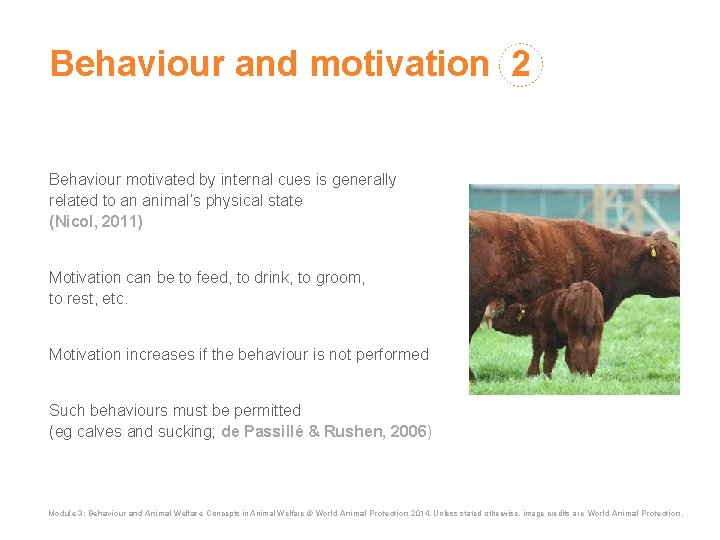
Behaviour and motivation 2 Behaviour motivated by internal cues is generally related to an animal’s physical state (Nicol, 2011) Motivation can be to feed, to drink, to groom, to rest, etc. Motivation increases if the behaviour is not performed Such behaviours must be permitted (eg calves and sucking; de Passillé & Rushen, 2006) Module 3: Behaviour and Animal Welfare Concepts in Animal Welfare © World Animal Protection 2014. Unless stated otherwise, image credits are World Animal Protection.
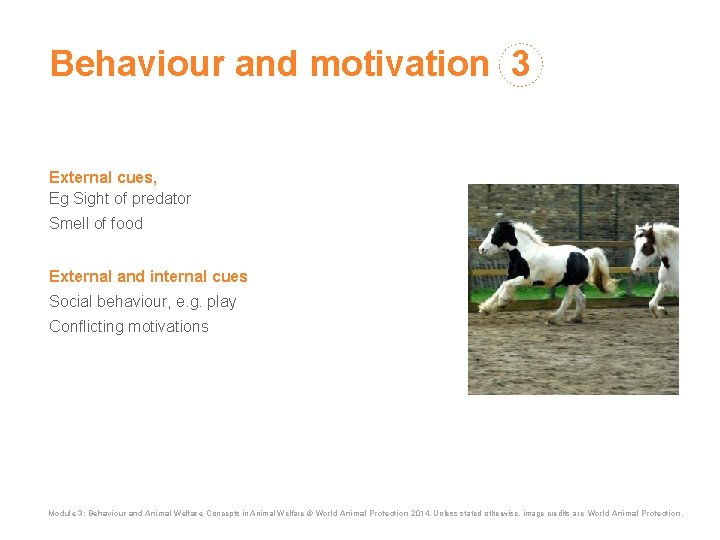
Behaviour and motivation 3 External cues, Eg Sight of predator Smell of food External and internal cues Social behaviour, e. g. play Conflicting motivations Module 3: Behaviour and Animal Welfare Concepts in Animal Welfare © World Animal Protection 2014. Unless stated otherwise, image credits are World Animal Protection.
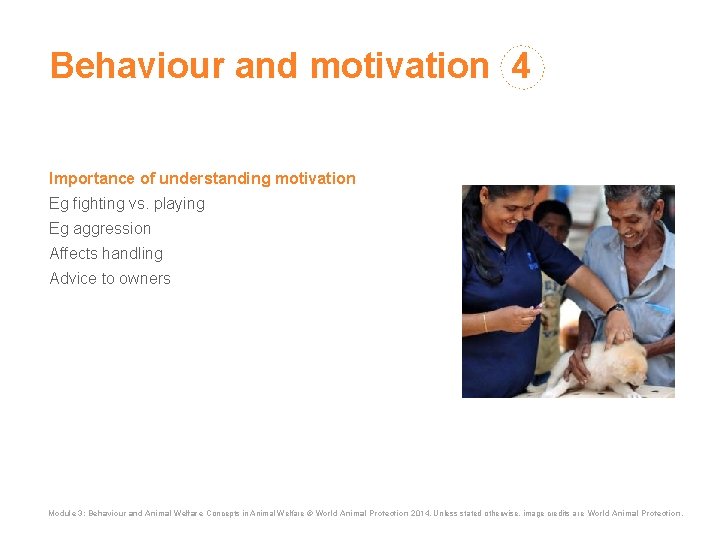
Behaviour and motivation 4 Importance of understanding motivation Eg fighting vs. playing Eg aggression Affects handling Advice to owners Module 3: Behaviour and Animal Welfare Concepts in Animal Welfare © World Animal Protection 2014. Unless stated otherwise, image credits are World Animal Protection.
Central role of brain Evaluation of sensory input Emotions, motivation, learning, expectations, anticipation Cognition: brain’s capacity to perceive, process and store information Eg sheep: spatial memory of grazing, expectations (Nicol, 2011) Module 3: Behaviour and Animal Welfare Concepts in Animal Welfare © World Animal Protection 2014. Unless stated otherwise, image credits are World Animal Protection.
Emotion and cognition 1 (Mendl et al. , 2009, 2010 a) Cognitive bias: influence of emotion on judgment, memory, etc. People in a negative emotional state focus on negative memories and make more negative judgments than people in a positive emotional state Module 3: Behaviour and Animal Welfare Concepts in Animal Welfare © World Animal Protection 2014. Unless stated otherwise, image credits are World Animal Protection.
Emotion and cognition 2 Cognitive bias in dogs (Mendl et al. , 2010 b) 24 shelter dogs Tested for separation-related behaviour Dogs who showed more separation-related behaviour also showed pessimistic-like behaviour with regard to finding food Module 3: Behaviour and Animal Welfare Concepts in Animal Welfare © World Animal Protection 2014. Unless stated otherwise, image credits are World Animal Protection.
Emotion and motivation 1 (Keeling et al. , 2011) Negative emotions pain, fear frustration Motivate relevant behaviours that meet an immediate need Eg INJURY: injury pain guarding behaviour to protect the injured area Eg SEEING A PREDATOR: predator fear running away survival Module 3: Behaviour and Animal Welfare Concepts in Animal Welfare © World Animal Protection 2014. Unless stated otherwise, image credits are World Animal Protection.
Emotion and motivation 2 (Keeling et al. , 2011) Positive emotions, eg pleasure, excitement Motivate behaviour that is not needed urgently, for survival, but brings a long-term benefit E. g. PLAY: play pleasure play again learn social and prey-catching skills Module 3: Behaviour and Animal Welfare Concepts in Animal Welfare © World Animal Protection 2014. Unless stated otherwise, image credits are World Animal Protection.
Genetics and motivation Genetics (Jensen et al. , 2008) Eg Gene mapping: behavioural differences are associated with differences in chromosomal regions Feather-pecking in poultry: lines with lower tendency to peck had higher egg production Temperament in cattle: docility in the milking parlour Module 3: Behaviour and Animal Welfare Concepts in Animal Welfare © World Animal Protection 2014. Unless stated otherwise, image credits are World Animal Protection.
Examples of other factors affecting motivation Stress response Environment, Eg Substrate Disease Module 3: Behaviour and Animal Welfare Concepts in Animal Welfare © World Animal Protection 2014. Unless stated otherwise, image credits are World Animal Protection.
Summary so far How to know if performing a particular behaviour is important to animals Behavioural repertoire Motivation Influence of emotions NEXT: measures of behavioural priority Examples of important behaviours Module 3: Behaviour and Animal Welfare Concepts in Animal Welfare © World Animal Protection 2014. Unless stated otherwise, image credits are World Animal Protection.
Measures of behavioural priority 1 (Nicol, 2011) Animal works hard for the opportunity or resources to perform the behaviour Eg hens and nest boxes Heifers and resting (13 hours) Animal develops substitute/abnormal behaviours if he or she cannot perform a desired behaviour, Eg Calves cross-sucking (de Passillé & Rushen, 2006) Behaviours indicating frustration if space/housing permits Module 3: Behaviour and Animal Welfare Concepts in Animal Welfare © World Animal Protection 2014. Unless stated otherwise, image credits are World Animal Protection.
Substitute or abnormal behaviours Stereotypies repetitive behaviours, unchanging pattern, serve no obvious purpose Redirected behaviours not abnormal but directed to an abnormal substrate, eg calves cross-sucking other calves Module 3: Behaviour and Animal Welfare Concepts in Animal Welfare © World Animal Protection 2014. Unless stated otherwise, image credits are World Animal Protection.

Examples of important behaviours “Behavioural needs” (Widowski, 2010) Animals suffer if deprived of the opportunity to perform them Examples Laying hens: nesting in a secluded place (Nicol, 2011) Pigs: rooting (Nicol, 2011) Calves: sucking (de Passillé & Rushen, 2006) Polar bears: walking long distances (Clubb & Mason, 2003) Hamsters: burrowing (Hauzenberger et al. , 2006) Module 3: Behaviour and Animal Welfare Concepts in Animal Welfare © World Animal Protection 2014. Unless stated otherwise, image credits are World Animal Protection.
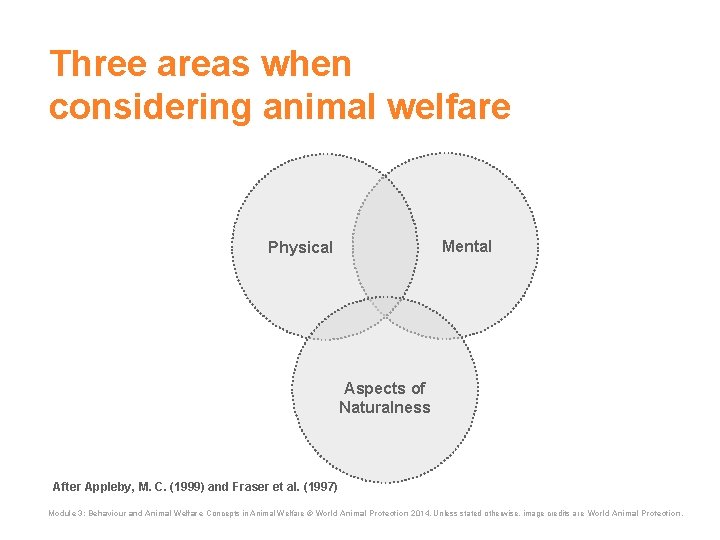
Three areas when considering animal welfare Mental Physical Aspects of Naturalness After Appleby, M. C. (1999) and Fraser et al. (1997) Module 3: Behaviour and Animal Welfare Concepts in Animal Welfare © World Animal Protection 2014. Unless stated otherwise, image credits are World Animal Protection.
Feedback: Please let us know what you think How have you used this module? What did you like about it? What did you not like? Do you have any tips to share? Please take part in our 10 minute survey here: https: //www. surveymonkey. com/s/BKP 3 D 6 H Your feedback will help other teachers like you Module 3: Behaviour and Animal Welfare Concepts in Animal Welfare © World Animal Protection 2014. Unless stated otherwise, image credits are World Animal Protection.
References Appleby, M. C. (1999). What Should We Do About Animal Welfare? Oxford, Blackwell. Clubb, R. , & Mason, G. (2003). Animal welfare: Captivity effects on wide-ranging carnivores. Nature, 425, 473 -474. Fraser, D. , Weary, D. M. , Pajor, E. A. , Milligan, B. N. (1997). A scientific conception of animal welfare that reflects ethical concerns. Animal Welfare, 6: 187 -205 Keeling, L. J. , Rushen, K. , & Duncan, I. J. H. (2011). Understanding animal welfare. In M. C. Appleby, J. A. Mench, I. A. S. Olsson, & B. O. Hughes (Eds. ), Animal welfare (2 nd ed. , pp. 13 -26). Wallingford, UK: CABI. Mason, G. J. , & Burn, C. C. (2011). Behavioural restriction. In M. C. Appleby, J. A. Mench, I. A. S. Olsson, & B. O. Hughes (Eds. ), Animal welfare (2 nd ed. , pp. 98 -119). Wallingford, UK: CABI. Mendl, M. , Burman, O. H. P. , Parker, R. M. A. , & Paul, E. S. (2009). Hauzenberger, A. R. , Gebhardt-Henrich, S. G. , & Steiger, A. (2006). Cognitive bias as an indicator of animal emotion and welfare: Emerging The influence of bedding depth on behaviour in golden hamsters evidence and underlying mechanisms. Applied Animal Behaviour (Mesocricetus auratus). Applied Animal Behaviour Science, 100, 280 Science, 118, 161 -181. 294. Mendl, M. , Burman, O. H. P. , & Paul, E. S. (2010 a). An integrative and Hurnik, J. F. , Webster, A. B. , & Siegel, P. B. (1995). Dictionary of functional framework for the study of animal emotion and mood. farm animal behaviour (2 nd ed. , p. 116). Ames: Iowa State Proceedings Royal Society, B 277, 2895 -2904. University Press. Mendl, M. , Brooks, J. , Basse, C. , Burman, O. , Paul, E. , Blackwell, E. , & Jensen, P. , Buitenhuis, B. , Kjaer, J. , Zanella, A. , Mormède, P. , & Casey, R. (2010 b). Dogs showing separation-related behaviour exhibit Pizzari , T. (2008). Genetics and the genomics of animal behaviour a “pessimistic” cognitive bias. Current Biology, 20, R 839 -R 840. and welfare: challenges and possibilities. Applied Animal Behaviour Science, 113, 383 -403. Module 3: Behaviour and Animal Welfare Concepts in Animal Welfare © World Animal Protection 2014. Unless stated otherwise, image credits are World Animal Protection.
References Nicol, C. (2011). Behaviour as an indicator of animal welfare. In J. Webster (Ed. ), Management and welfare of farm animals (5 th ed. , pp. 31 -67). Chichester, UK: Wiley-Blackwell. Olsson, I. A. S. , Würbel, H. , & Mench, J. A. (2011). Behaviour. In M. C. Appleby, J. A. Mench, I. A. S. Olsson, & B. O. Hughes (Eds. ), Animal welfare (2 nd ed. , pp. 138 -154). Wallingford, UK: CABI. de Passillé, A. M. B. , & Rushen, J. (2006). Calves’ behaviour during nursing is affected by feeding motivation and milk availability. Applied Animal Behaviour Science, 101, 264 -275. Stolba, A. , & Wood-Gush, D. G. M. (1989). The behaviour of pigs in a semi-natural environment. Animal Production, 48, 419 -425. Widowski, T. (2010). Why are behavioural needs important? In T. Grandin (Ed. ) Improving animal welfare. A practical approach (pp. 290 -308). Wallingford, UK: CABI. Module 3: Behaviour and Animal Welfare Concepts in Animal Welfare © World Animal Protection 2014. Unless stated otherwise, image credits are World Animal Protection.
- Slides: 28