
Module 27 INTRODUCTION TO PSYCHOLOGICAL DISORDERS Standards SSPVB
Module 27 INTRODUCTION TO PSYCHOLOGICAL DISORDERS
Standards *SSPVB 3: The student will identify abnormal behavior and treatment. a. Identify criteria that distinguish normal from disordered behavior; include the criteria of distress, deviance, and dysfunction. b. Describe methods used to diagnose and assess abnormal behavior; include the current version of the Diagnostic and Statistical Manual, the MMPI, and projective tests. c. Compare anxiety disorders, mood disorders, personality disorders, and schizophrenia and describe appropriate treatments for these disorders. d. Analyze the challenges associated with labeling psychological disorders and the impact of diagnosis on patients. e. Compare the biomedical, psychoanalytical, cognitive, and behavioral approaches to the treatment of psychological disorders.
Essential Question How has the labeling and diagnosis of psychological disorders changed over time?
Defining Disorder What criteria do psychologists use to diagnose psychological disorders? Maladaptive or destructive behavior Unjustifiable without a rational basis Disturbing; troubling to other people Atypical; so different that they violate a norm
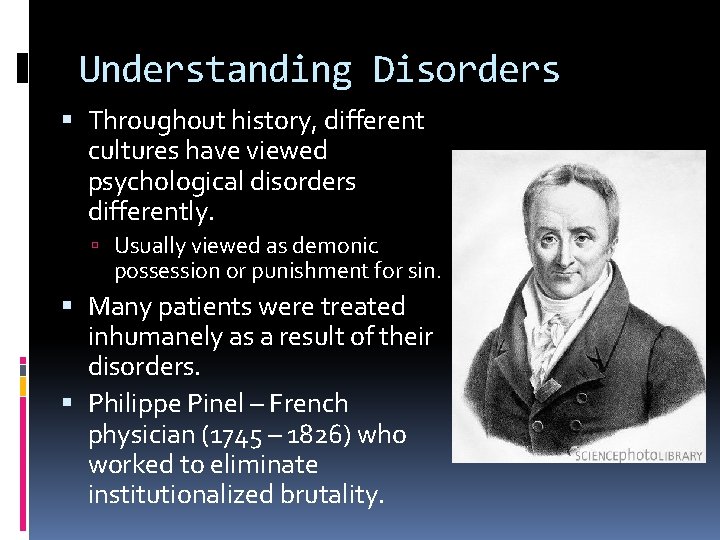
Understanding Disorders Throughout history, different cultures have viewed psychological disorders differently. Usually viewed as demonic possession or punishment for sin. Many patients were treated inhumanely as a result of their disorders. Philippe Pinel – French physician (1745 – 1826) who worked to eliminate institutionalized brutality.

The Medical Model The concept that diseases have physical causes that can be diagnosed, treated and even cured. Assumes that mental illnesses can be diagnosed on the basis of their symptoms. Through therapy (medical or psychological) these illnesses can be cured.
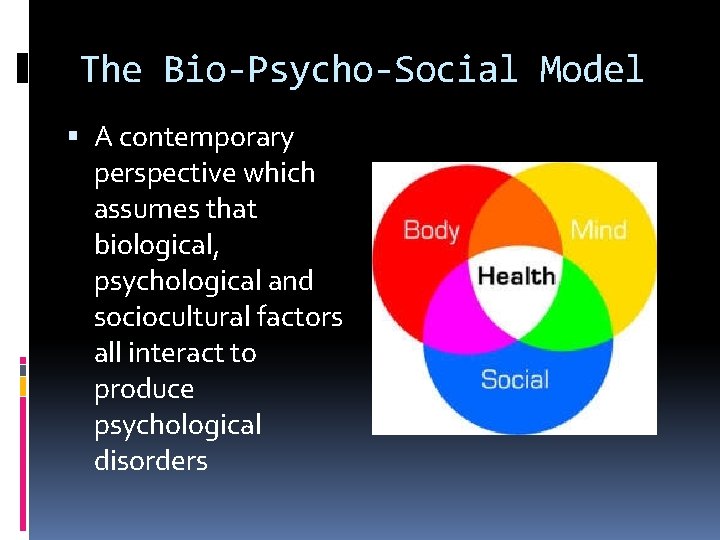
The Bio-Psycho-Social Model A contemporary perspective which assumes that biological, psychological and sociocultural factors all interact to produce psychological disorders

Classifying Disorders In order to create a sense of order within the discipline, psychologists classifying disorders according to their symptoms in order to: 1. describe the disorder 2. predict the future course of the disorder 3. treat the disorder properly 4. provide a springboard for research into the causes of the disorder.
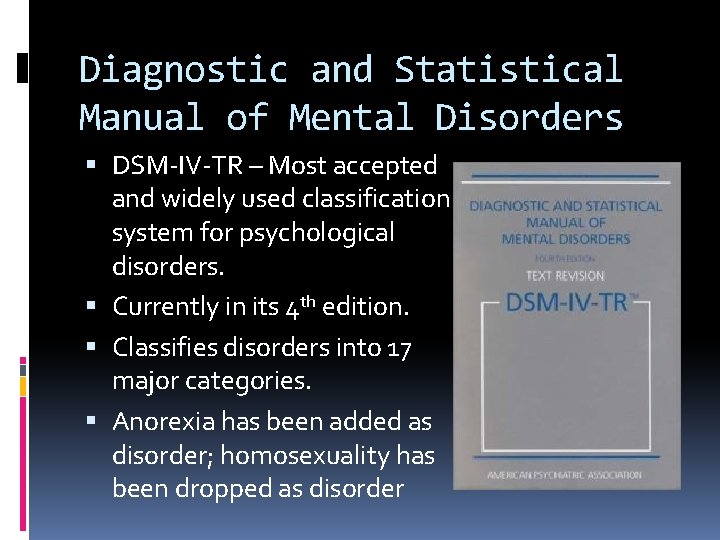
Diagnostic and Statistical Manual of Mental Disorders DSM-IV-TR – Most accepted and widely used classification system for psychological disorders. Currently in its 4 th edition. Classifies disorders into 17 major categories. Anorexia has been added as disorder; homosexuality has been dropped as disorder
Labeling Disorders What are the drawbacks and advantages in labeling psychological disorders? Questions to consider: 1. How does the labeling affect the individual? 2. How is the labeling viewed by society? 3. Is a psychological disorder the same as any other physical disorder?
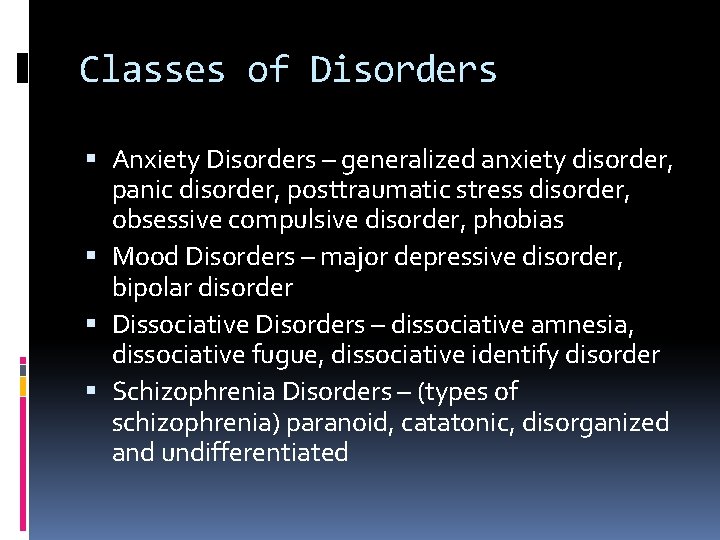
Classes of Disorders Anxiety Disorders – generalized anxiety disorder, panic disorder, posttraumatic stress disorder, obsessive compulsive disorder, phobias Mood Disorders – major depressive disorder, bipolar disorder Dissociative Disorders – dissociative amnesia, dissociative fugue, dissociative identify disorder Schizophrenia Disorders – (types of schizophrenia) paranoid, catatonic, disorganized and undifferentiated
- Slides: 11