
Module 24 Lesson Plan Content Differentiated Instructional Strategies


- Slides: 50
Module 24 Lesson Plan – Content Differentiated Instructional Strategies Formative Assessment Dr. Mei Zhu Pacific Lutheran University Zhuma@plu. edu January, 2017
Review of Grant Goals “Teachers will have increased standardbased teaching skills measured by (1) 3 lesson plans demonstrating i. standards-based instructional objectives (Oct. , Jan. Modules 17, 20 & 24), ii. Identification of common developmental approximations or misconceptions related to the learning objectives (Oct. , Jan, Modules 17 & 20), iii. iv. Using research-based instructional strategies (Jan. Modules 11, 17, 20 & 24), Following the 4 -steps formative assessment process (Oct. , Jan. Modules 20 & 24), v. Differentiating instructional strategies for students with special needs and ELLs at different English language proficiency level (Jan. Modules 11, 17, 20 & 24), vi. Establishing academic language objectives for English language learners (ELLs) and students in poverty (Jan. Modules 11, 17, 20 & 24), vii. Connecting with students’ cultural and community assets (Jan. Module 24), and viii. Designing formative assessment tasks for both language and content instructional objectives (Oct. , Jan. Modules 17, 20 & 24). (2) Peer observations, (3) Self-reflections, and (4) Peer feedback (Jan. Modules 17 & 20).
Review of Grant Goals & Previous Module Goals October Module Strengthen CCSS math content knowledge in solving equations (Part 1 – a. m. session) Discuss instructional strategies and learn the 4 -step formative assessment process (Part 2 – p. m. session): • (1) Clarify intended learning; • (2) Elicit evidence; • (3) Interpret evidence; and • (4) Act on evidence. (Focusing on the three shifts of CCSS – Focus, Coherence, Rigor (understanding, fluency and application). Lesson plan structure was explained. )
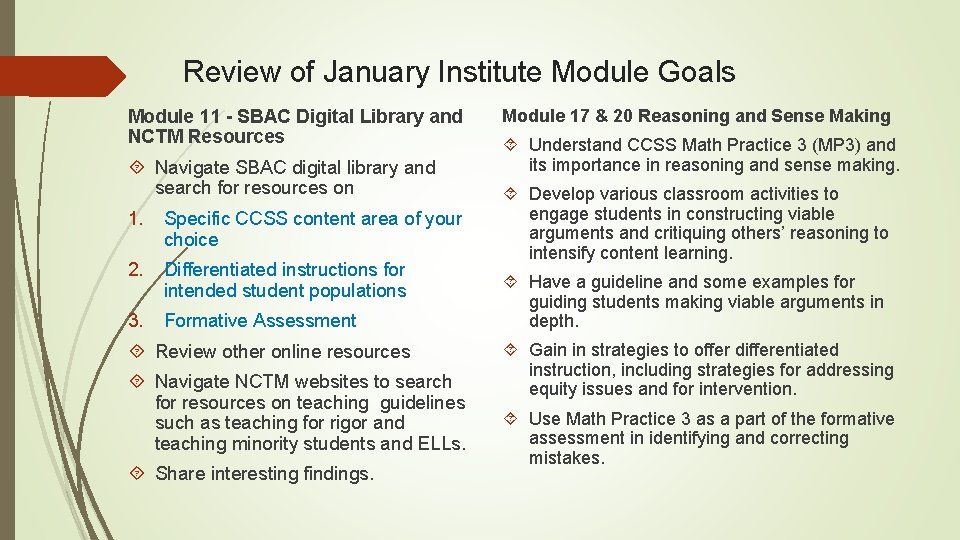
Review of January Institute Module Goals Module 11 - SBAC Digital Library and NCTM Resources Navigate SBAC digital library and search for resources on 1. Specific CCSS content area of your choice 2. Differentiated instructions for intended student populations 3. Formative Assessment Review other online resources Module 17 & 20 Reasoning and Sense Making Understand CCSS Math Practice 3 (MP 3) and its importance in reasoning and sense making. Develop various classroom activities to engage students in constructing viable arguments and critiquing others’ reasoning to intensify content learning. Have a guideline and some examples for guiding students making viable arguments in depth. Gain in strategies to offer differentiated instruction, including strategies for addressing equity issues and for intervention. Navigate NCTM websites to search for resources on teaching guidelines Use Math Practice 3 as a part of the formative such as teaching for rigor and assessment in identifying and correcting teaching minority students and ELLs. Share interesting findings. mistakes.
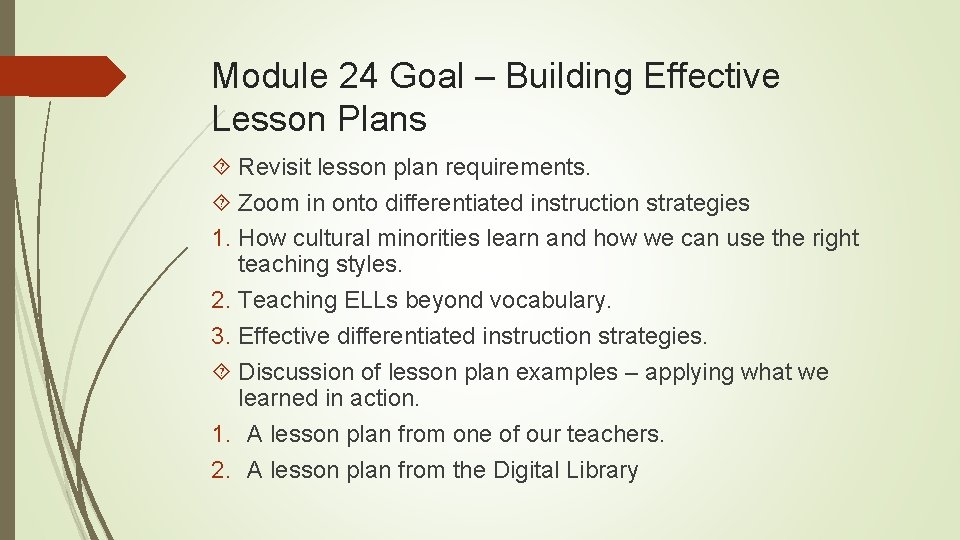
Module 24 Goal – Building Effective Lesson Plans Revisit lesson plan requirements. Zoom in onto differentiated instruction strategies 1. How cultural minorities learn and how we can use the right teaching styles. 2. Teaching ELLs beyond vocabulary. 3. Effective differentiated instruction strategies. Discussion of lesson plan examples – applying what we learned in action. 1. A lesson plan from one of our teachers. 2. A lesson plan from the Digital Library
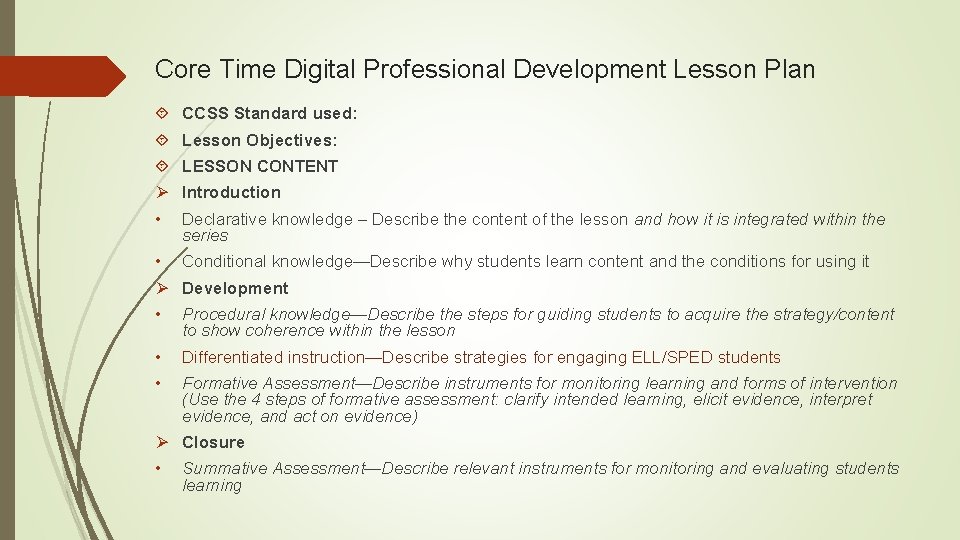
Core Time Digital Professional Development Lesson Plan CCSS Standard used: Lesson Objectives: LESSON CONTENT Ø Introduction • Declarative knowledge – Describe the content of the lesson and how it is integrated within the series • Conditional knowledge—Describe why students learn content and the conditions for using it Ø Development • Procedural knowledge—Describe the steps for guiding students to acquire the strategy/content to show coherence within the lesson • Differentiated instruction—Describe strategies for engaging ELL/SPED students • Formative Assessment—Describe instruments for monitoring learning and forms of intervention (Use the 4 steps of formative assessment: clarify intended learning, elicit evidence, interpret evidence, and act on evidence) Ø Closure • Summative Assessment—Describe relevant instruments for monitoring and evaluating students learning
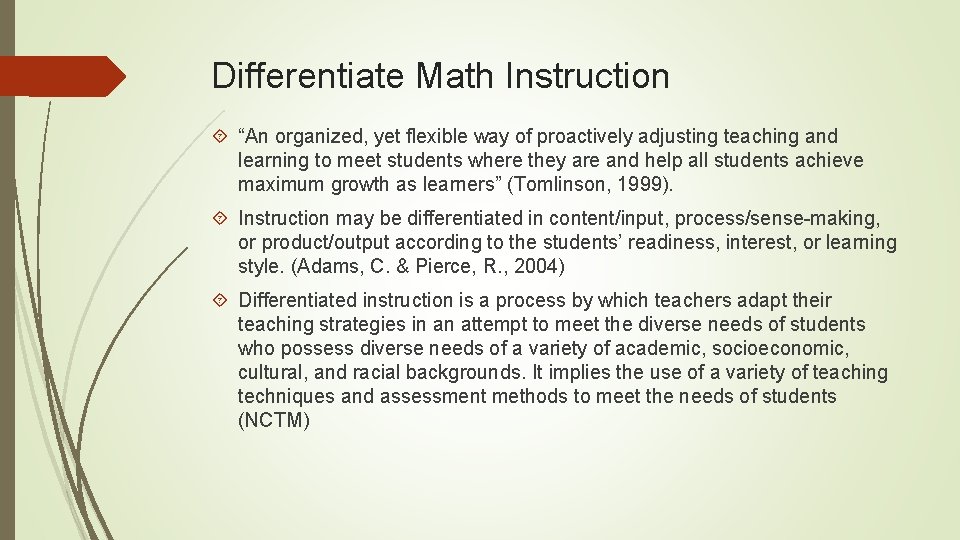
Differentiate Math Instruction “An organized, yet flexible way of proactively adjusting teaching and learning to meet students where they are and help all students achieve maximum growth as learners” (Tomlinson, 1999). Instruction may be differentiated in content/input, process/sense-making, or product/output according to the students’ readiness, interest, or learning style. (Adams, C. & Pierce, R. , 2004) Differentiated instruction is a process by which teachers adapt their teaching strategies in an attempt to meet the diverse needs of students who possess diverse needs of a variety of academic, socioeconomic, cultural, and racial backgrounds. It implies the use of a variety of teaching techniques and assessment methods to meet the needs of students (NCTM)
Example 1. Working with Minority Students (Hani Morgan, 2010) Facts about cultural of minorities. African American and Hispanic students: • The dropout rate exceeded that of white students (NCES 2007). • Students are also less-frequently identified as gifted or talented (Elhoweris et al. 2005). Students from minority groups who tend to do well academically, such as Asian Pacific American children, can also experience difficulties in American schools and having lower self-esteem (Pang, 2008).
Example 1 (continued) Steps of Helping Minority Students Step 1. Understanding minority cultures and avoiding conflicts • Example of two Hispanic students. Looking into the eyes is considered disrespectful in Hispanic culture, while Caucasian students are often taught that such behavior is respectful (Norman and Keating 1997). • Example of talking to an Arab parent. Individuals from Arab, Latin American, and Southern European countries generally stand much closer during conversations than do Americans, who usually remain at least twenty inches apart in such situations (Gollnick and Chinn 2009)
Example 1 (continued) Steps of Helping Minority Students Step 2. Understanding differences in learning style • African American, Latino and students, and Alaska Native tend to be field-dependent: they prefer working together. They tend to improve academically with cooperative learning methods of teaching (Aronson and Gonzales 1988, Pewewardy 2008). • Anglo-American students tend to be field-independent and prefer to work alone (Banks 2006). They are more likely to be detached, goal oriented, competitive, analytical, and logical (Irvine and York 1995; Pewewardy 2008). It helps the students if we break down a whole subject or topic and understand that its parts added together can reform the whole.
Example 1 (continued) Steps of Helping Minority Students Step 2. Understanding differences in learning style (continued) • • Native American cultures tend to value possessions much less than Anglo culture. Native Americans greatly respect people who share and are more likely to distrust someone with many possessions (Pewewardy 2008). They more likely to help other students and less likely to show that they know an answer if others do not. Judging them as unmotivated or learning disabled because they do not raise their hands in response to a difficult question may unknowingly discriminate against them. Asian Pacific American cultures’ emphasis on humility and modesty makes them more likely to help one another (Pang 2008). Such cultures often view the teacher as an authority figure. Asian Pacific American parents often expect their children to remain relatively quiet and to avoid discussion, which they regard as challenging the teacher’s knowledge. Likewise, many Asian Pacific American students only reluctantly express themselves. Many of them are stereotyped as nerds, teachers may not realize that some have trouble academically.
Example 1 (continued) Steps of Helping Minority Students Step 3. Correcting the misconception of treating students identically. • Treating all students the same way avoids discriminating against any group, the practice in itself is discriminatory (Banks 2006; Gollnick and Chinn 2009). Requiring all students to follow one style of teaching can inadvertently favor the students who are most comfortable with the teacher’s style of teaching. • In an NCTM 2000 journal, it was stated that, “equity does not mean that every student should receive identical instruction; instead, it demands that reasonable and appropriate accommodations are made as needed to promote access and attainment for all students. ” • America’s tremendous cultural diversity presents another difficulty for the culturally responsive teacher. It is difficult or even impossible to address each adequately. Understanding students’ cultures and learning style and using differentiated instruction will help.
Example 1 (continued) Steps of Helping Minority Students Step 4. Avoiding misusing research on cultural differences. • Do not use research on cultures of minorities to stereotype individual students within on minority group. Not all African Americans are field-dependent, and not all Asian Pacific Americans are successful academically. • Get to know each of our students. (e. g. Give choices: participants have options: to work individually, with a partner, with a subset of the group, or with the entire group - Promoting Equity through Reasoning – by Mueller and Mahet. )
Example 1 (continued) Steps of Helping Minority Students Step 5. Using culturally responsive teaching. . o Strategies: • Examine our own teaching styles and understand the learning styles of our students without making generalizations. Teachers tend to teach the way they have learned unless deliberately challenged to teach otherwise (Bennett 2007). • Use as many modes as possible: logical-mathematical, linguistic, musical, spatial, bodily kinesthetic, interpersonal, naturalistic, and intrapersonal (Howard Gardner, 1993).
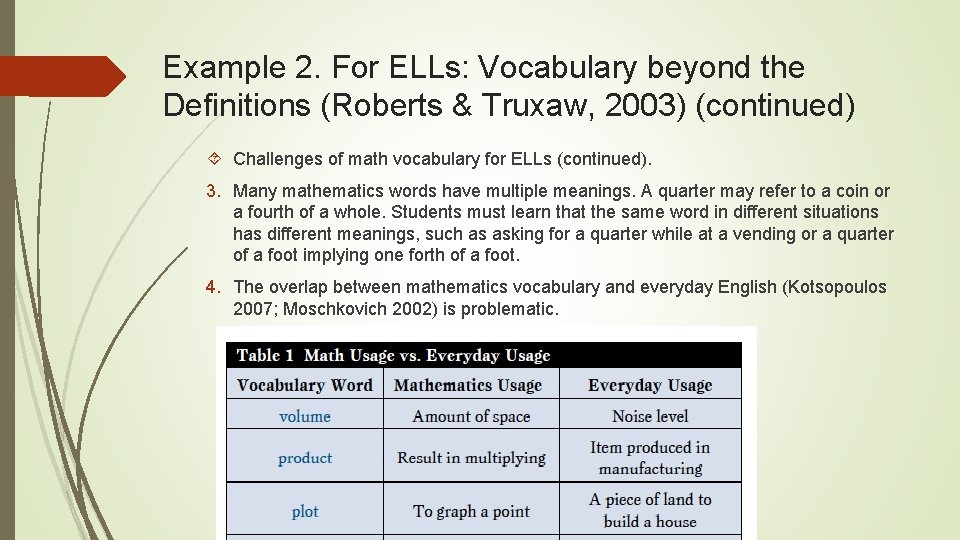
Example 2. For ELLs: Vocabulary beyond the Definitions (Roberts & Truxaw, 2003) MP 6 - Attend to Precision. Mathematically proficient students try to communicate precisely to others. They try to use clear definitions in discussion with others and in their own reasoning. Challenges of math vocabulary for ELLs. 1. Definitions are filled with technical vocabulary, symbols, and diagrams (Pimm 1987). Teachers need to explicitly help students make sense of this new language (Schlepegrell 2007). 2. Many mathematics concepts can be represented in multiple ways. Multiplication can be indicated in many ways: “ 2 times 3, ” “ 2 multiplied by 3, ” and “the product of 2 and 3. ”To add to the confusion, some words may have similar connotations but vastly different technical meanings—for example, “ 3 multiplied by 10”and “ 3 increased by 10” (Heinze 2005).
Example 2. For ELLs: Vocabulary beyond the Definitions (Roberts & Truxaw, 2003) (continued) Challenges of math vocabulary for ELLs (continued). 3. Many mathematics words have multiple meanings. A quarter may refer to a coin or a fourth of a whole. Students must learn that the same word in different situations has different meanings, such as asking for a quarter while at a vending or a quarter of a foot implying one forth of a foot. 4. The overlap between mathematics vocabulary and everyday English (Kotsopoulos 2007; Moschkovich 2002) is problematic.
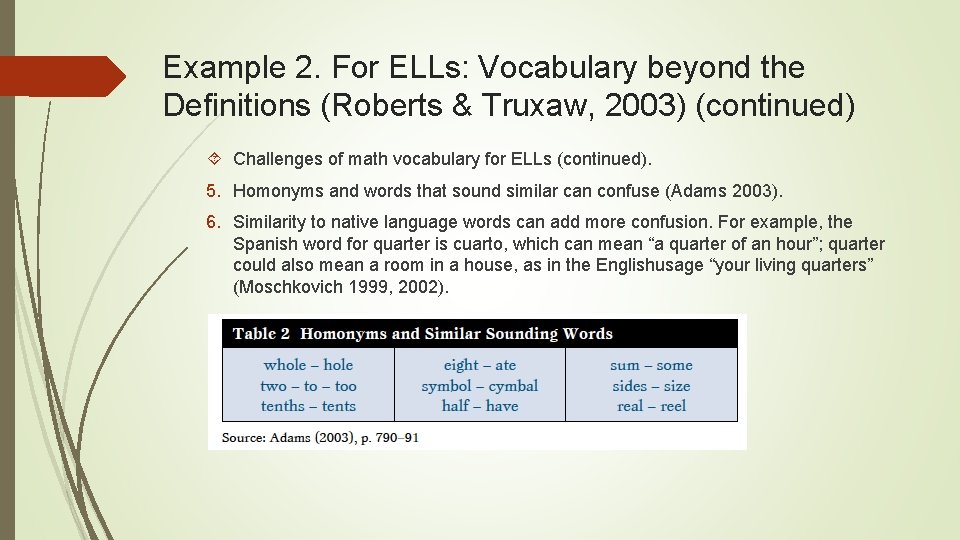
Example 2. For ELLs: Vocabulary beyond the Definitions (Roberts & Truxaw, 2003) (continued) Challenges of math vocabulary for ELLs (continued). 5. Homonyms and words that sound similar can confuse (Adams 2003). 6. Similarity to native language words can add more confusion. For example, the Spanish word for quarter is cuarto, which can mean “a quarter of an hour”; quarter could also mean a room in a house, as in the Englishusage “your living quarters” (Moschkovich 1999, 2002).
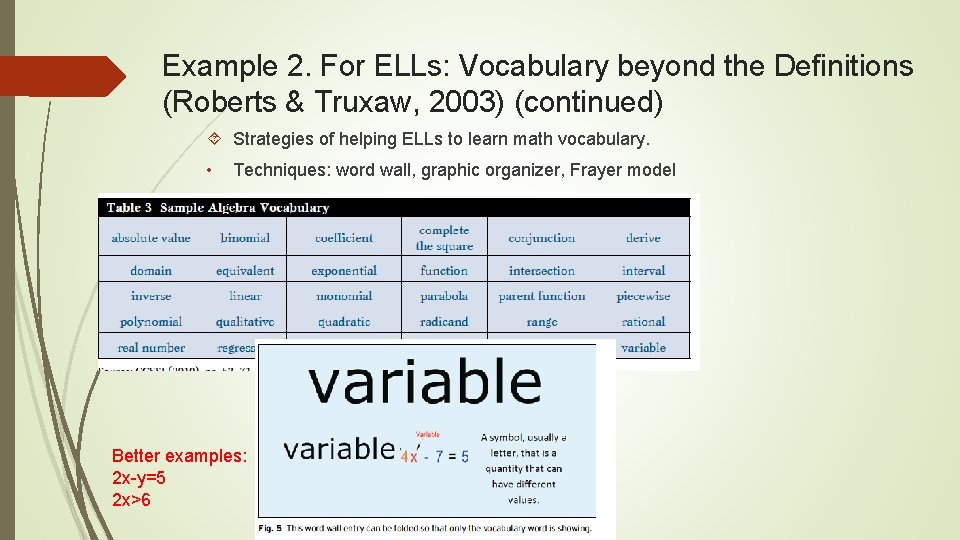
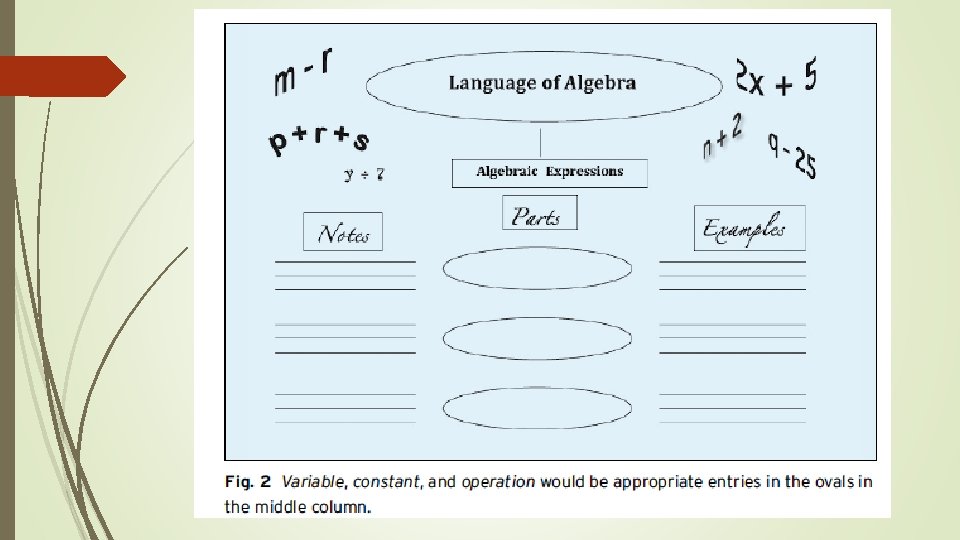
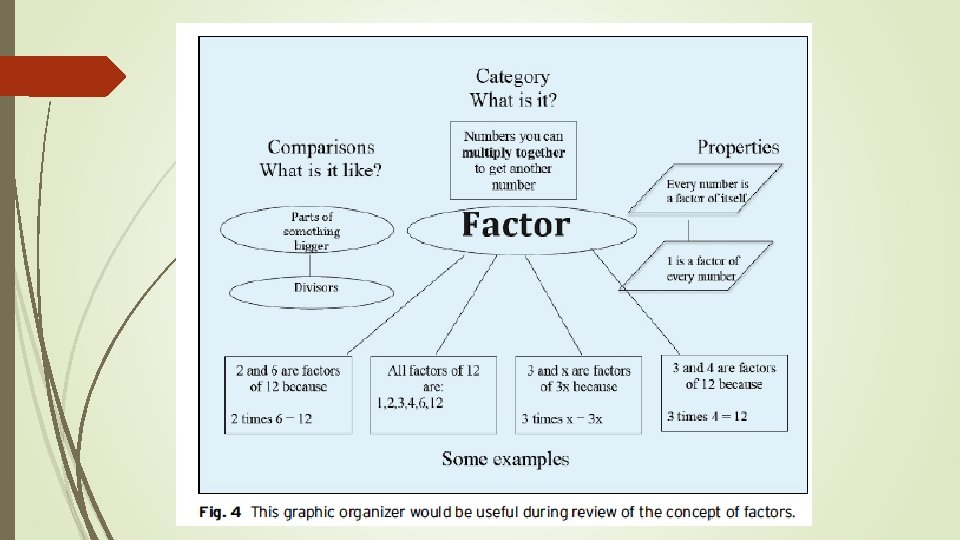
Example 2. For ELLs: Vocabulary beyond the Definitions (Roberts & Truxaw, 2003) (continued) Strategies of helping ELLs to learn math vocabulary. • Techniques: word wall, graphic organizer, Frayer model Better examples: 2 x-y=5 2 x>6
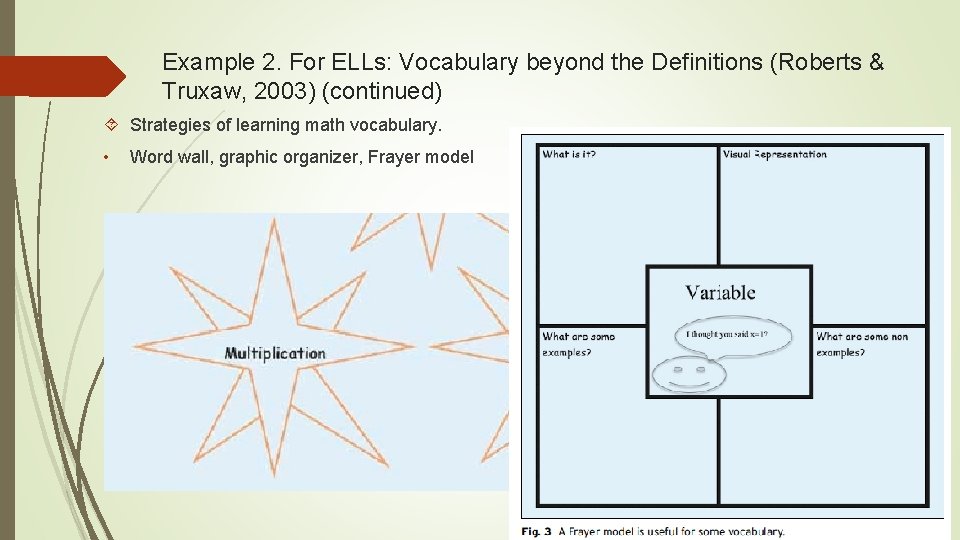
Example 2. For ELLs: Vocabulary beyond the Definitions (Roberts & Truxaw, 2003) (continued) Strategies of learning math vocabulary. • Word wall, graphic organizer, Frayer model
Example 2. For ELLs: Vocabulary beyond the Definitions (Roberts & Truxaw, 2003) (continued) Strategies of helping ELLs to learn math vocabulary (continued). • Instructional steps: 1. Develop a vocabulary list 2. Pre-teach and assess 3. Teach and reteach 4. Provide repetition and support long-term retention
NCTM Suggested Differentiated Instructional Strategies 5 -8 Use a variety of teaching techniques Emphasize critical thinking Use a variety of assessment strategies Use active teaching techniques that allow students to explore and draw their own conclusions Have students work in cooperative groups Use multiple representations to illustrate problem-solving strategies Differentiate tasks and assignments Provide extra assistance to those who need it Provide challenges for those who are high achievers See Examples from Modules 17 & 20
NCTM Suggested Differentiated Instructional Strategies 5 -8 (continued) Do not simply ask students to solve additional problems, do an extra report, or play computer games when they finish early Play into students interests Encourage individual research Provide challenges for those who are high achievers
NCTM Suggested Differentiated Instructional Strategies: HS Teach vocabulary Make use of cooperative learning and group activities Explore worthwhile, relevant tasks Use multiple representations Emphasize dialogue over lecture Use various presentation styles Communicate high expectations and have students set goals for themselves Vary assessment strategies See Examples from Modules 17 & 20
NCTM Suggested Differentiated Instructional Strategies: HS (continued) Integrate technology Make content connections between math and across subjects Involve parents and community members
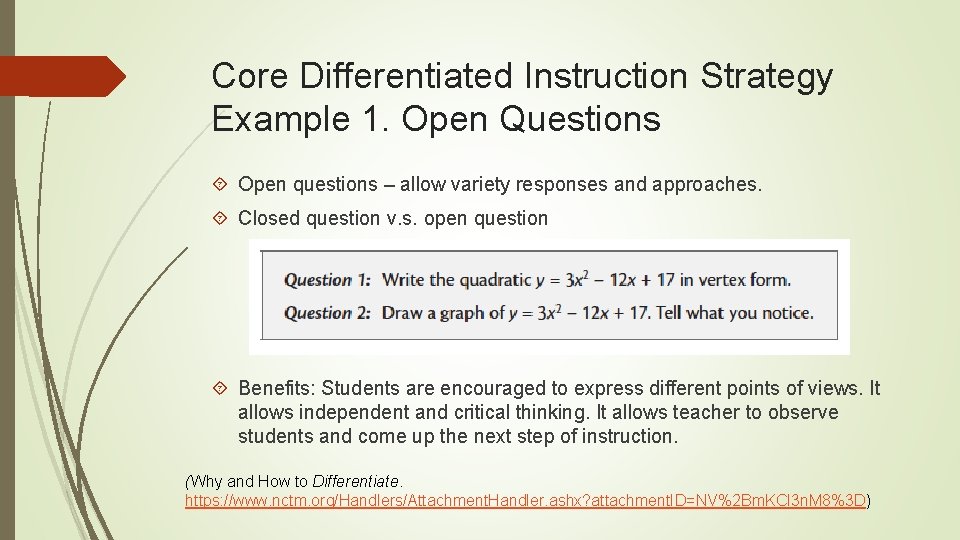
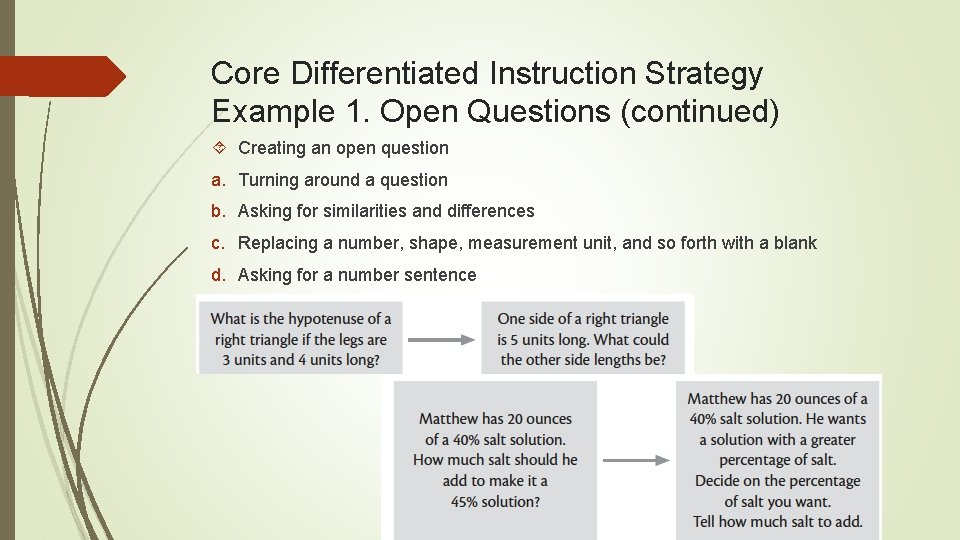
Core Differentiated Instruction Strategy Example 1. Open Questions Open questions – allow variety responses and approaches. Closed question v. s. open question Benefits: Students are encouraged to express different points of views. It allows independent and critical thinking. It allows teacher to observe students and come up the next step of instruction. (Why and How to Differentiate. https: //www. nctm. org/Handlers/Attachment. Handler. ashx? attachment. ID=NV%2 Bm. KCl 3 n. M 8%3 D)
Core Differentiated Instruction Strategy Example 1. Open Questions (continued) Creating an open question a. Turning around a question b. Asking for similarities and differences c. Replacing a number, shape, measurement unit, and so forth with a blank d. Asking for a number sentence
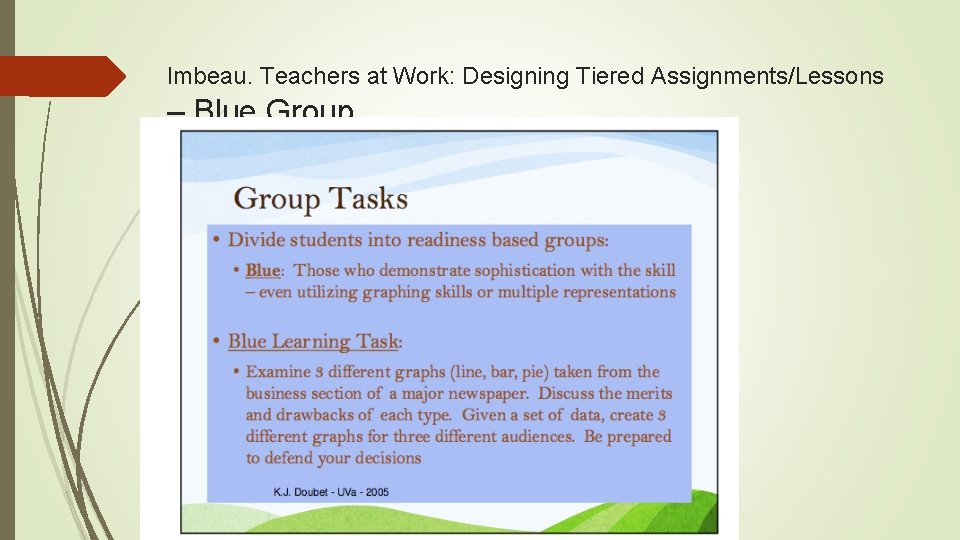
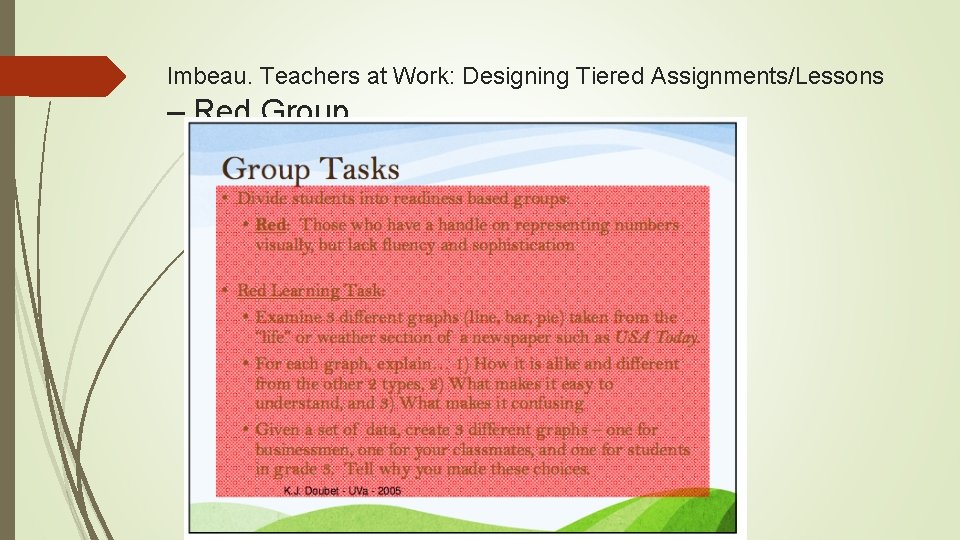
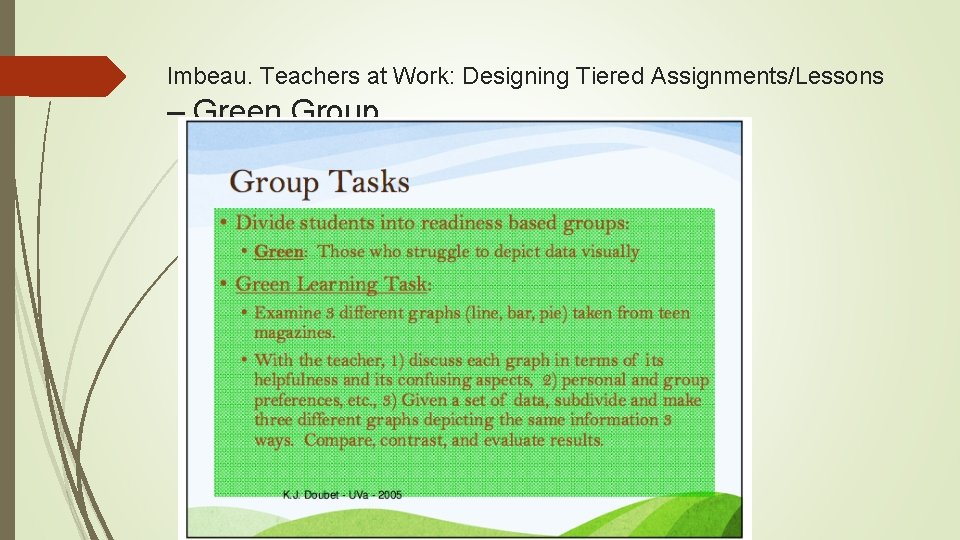
Core Differentiated Instruction Strategy Example 2. Tiered Lessons Types of tiers we can use: readiness, interest, or learning profile. Readiness: under the same content goals choose different levels and numbers of problems. Interest: create problems/projects relevant to their interests. Learning style: e. g. tier on all levels of Gardner’s multiple intelligences or Bloom’s Taxonomy in one lesson may not be a good place to start, so choose only a few, such as logical-mathematical intelligence, spatial intelligence, and linguistic intelligence. Use of directive teaching, sense making group work, algebraic steps, sense making, reading, graphs, and interactive technology whenever possible. (Cathy Weselby, 2016. Adams, C. & Pierce, R. 2004)
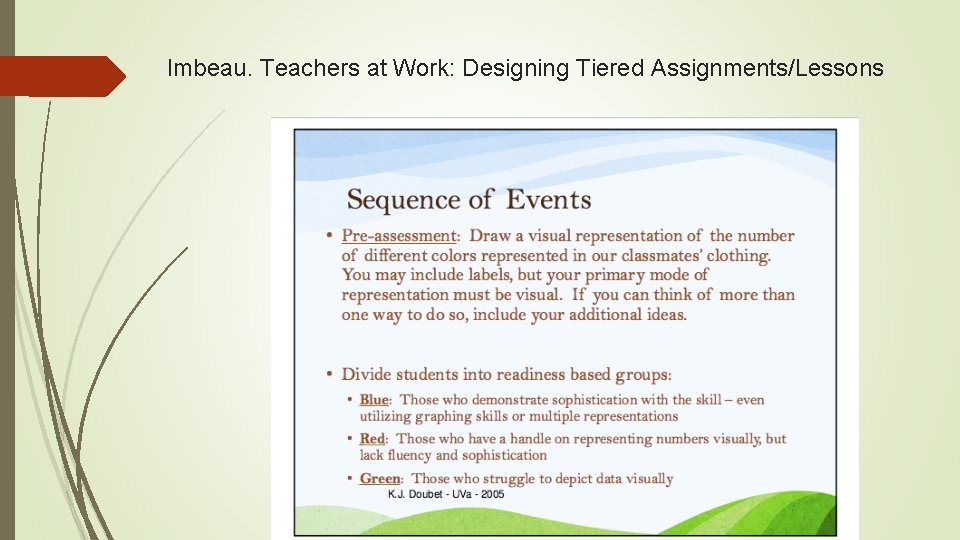
Core Differentiated Instruction Strategy Example 2. Tiered Lessons (continued) Detailed steps and lesson plan examples: Marcia B. Imbeau, Ph. D. Teachers at Work: Designing Tiered Assignments/Lessons. http: //iag-online. org/resources/2014_handouts/Imbeau_tiered. pdf
Imbeau. Teachers at Work: Designing Tiered Assignments/Lessons
Imbeau. Teachers at Work: Designing Tiered Assignments/Lessons – Blue Group
Imbeau. Teachers at Work: Designing Tiered Assignments/Lessons – Red Group
Imbeau. Teachers at Work: Designing Tiered Assignments/Lessons – Green Group
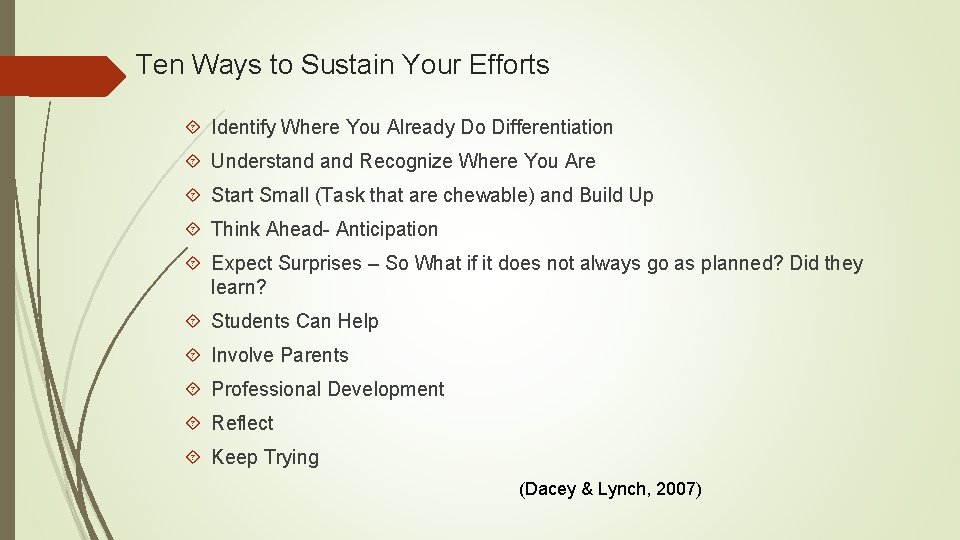
Ten Ways to Sustain Your Efforts Identify Where You Already Do Differentiation Understand Recognize Where You Are Start Small (Task that are chewable) and Build Up Think Ahead- Anticipation Expect Surprises – So What if it does not always go as planned? Did they learn? Students Can Help Involve Parents Professional Development Reflect Keep Trying (Dacey & Lynch, 2007)
Lesson Plan Discussion BIG THANKS to the Teacher Who Has Turned in a Lesson Plan. For detailed explanation of the lesson plan requirements, see my presentation in the October Institute. Review of the lesson plan: • What can you learn from it? • What could be added to the LP?
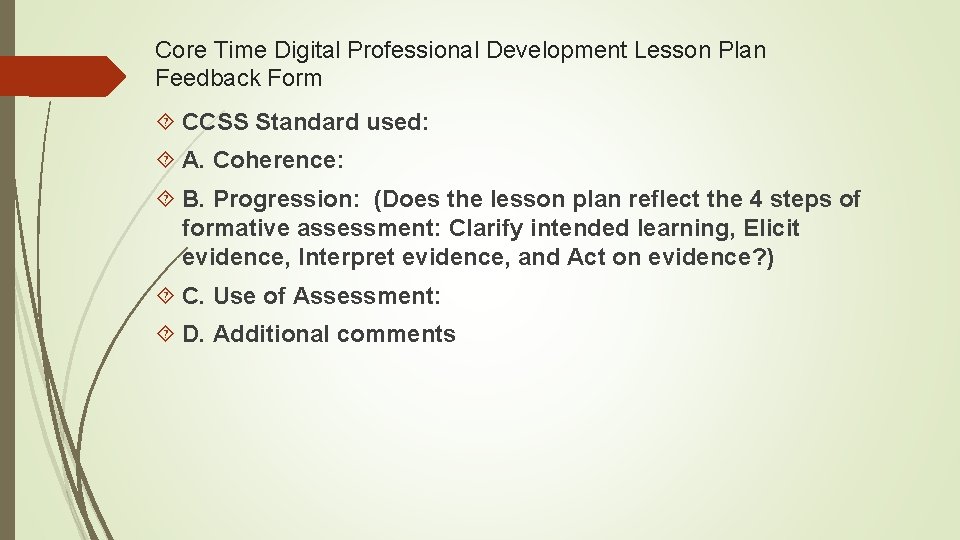
Core Time Digital Professional Development Lesson Plan Feedback Form CCSS Standard used: A. Coherence: B. Progression: (Does the lesson plan reflect the 4 steps of formative assessment: Clarify intended learning, Elicit evidence, Interpret evidence, and Act on evidence? ) C. Use of Assessment: D. Additional comments
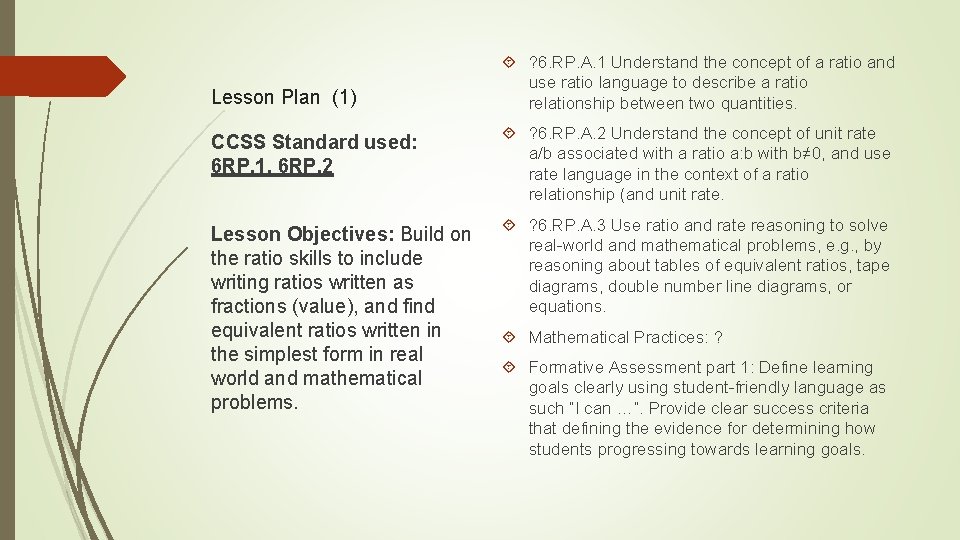
Lesson Plan (1) CCSS Standard used: 6 RP. 1, 6 RP. 2 Lesson Objectives: Build on the ratio skills to include writing ratios written as fractions (value), and find equivalent ratios written in the simplest form in real world and mathematical problems. ? 6. RP. A. 1 Understand the concept of a ratio and use ratio language to describe a ratio relationship between two quantities. ? 6. RP. A. 2 Understand the concept of unit rate a/b associated with a ratio a: b with b≠ 0, and use rate language in the context of a ratio relationship (and unit rate. ? 6. RP. A. 3 Use ratio and rate reasoning to solve real-world and mathematical problems, e. g. , by reasoning about tables of equivalent ratios, tape diagrams, double number line diagrams, or equations. Mathematical Practices: ? Formative Assessment part 1: Define learning goals clearly using student-friendly language as such “I can …”. Provide clear success criteria that defining the evidence for determining how students progressing towards learning goals.
Lesson Plan (2) LESSON CONTENT Introduction Declarative knowledge – Describe the content of the lesson Equivalent ratios have the same value
Lesson Plan (2) LESSON CONTENT Introduction Declarative knowledge – Describe the content of the lesson and how it is integrated within the series Equivalent ratios have the same value Expand more. What will the LP cover: definition, examples, table of equivalent ratios, and or applications? How does this lesson connect with the previous and the next lesson.
Lesson Plan (3) Conditional knowledge— Describe why students learn content and the conditions for using it The target and rubric are introduced. Ratios are useful in many everyday situations. Sometimes a recipe, sometimes an exercise program, sometimes—and most important to them right now—time spent at something and the grade or improved skill (reading, skateboarding, guitar…). Provide details of learning target and rubric
Lesson Plan (4) Development Procedural knowledge—Describe the steps for guiding students to acquire the strategy/content This lesson is built on prior lessons of ratios. There is a review of ratios and settings and the two ways to write a ratio that have been introduced up to this point. Then it is introduced as a fraction form. It begins with a picture representation. It is then written as a simplified fraction, as a reinforcement, for equivalent ratios. The fraction is referred to as a value. This skill is then practiced in a variety contexts. Each of these steps is introduced by me, practiced by them and checked by them, practiced by them and checked by a buddy, then practiced by them and checked by me (problem set). There is an exit slip and two homework problems
Lesson Plan (4) Development Procedural knowledge—Describe the steps for guiding students to acquire the strategy/content to show coherence within the lesson Good framework. Please provide details of math steps/contents This lesson is built on prior lessons of ratios. There is a review of ratios and settings and the (examples, picture two ways to write a ratio that have been presentation, worksheets, introduced up to this point. Then it is introduced as a fraction form. It begins with a picture problems, …) that shows representation. It is then written as a simplified conherence and fraction, as a reinforcement, for equivalent ratios. The fraction is referred to as a value. This skill is progression. then practiced in a variety contexts. Each of these steps is introduced by me, practiced by them and checked by them, practiced by them and checked by a buddy, then practiced by them and checked by me (problem set). There is an exit slip and two homework problems For a detailed example, see the lesson plan provided by Marisa Aoki & Sam Saldivar. Also see Modules 17 & 20.
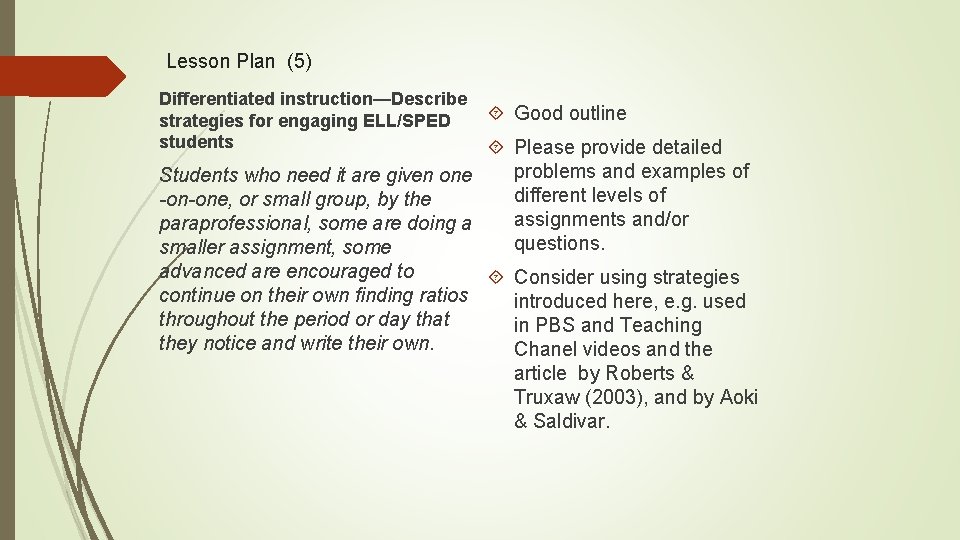
Lesson Plan (5) Differentiated instruction—Describe Good outline strategies for engaging ELL/SPED students Please provide detailed problems and examples of Students who need it are given one different levels of -on-one, or small group, by the assignments and/or paraprofessional, some are doing a questions. smaller assignment, some advanced are encouraged to Consider using strategies continue on their own finding ratios introduced here, e. g. used throughout the period or day that in PBS and Teaching they notice and write their own. Chanel videos and the article by Roberts & Truxaw (2003), and by Aoki & Saldivar.
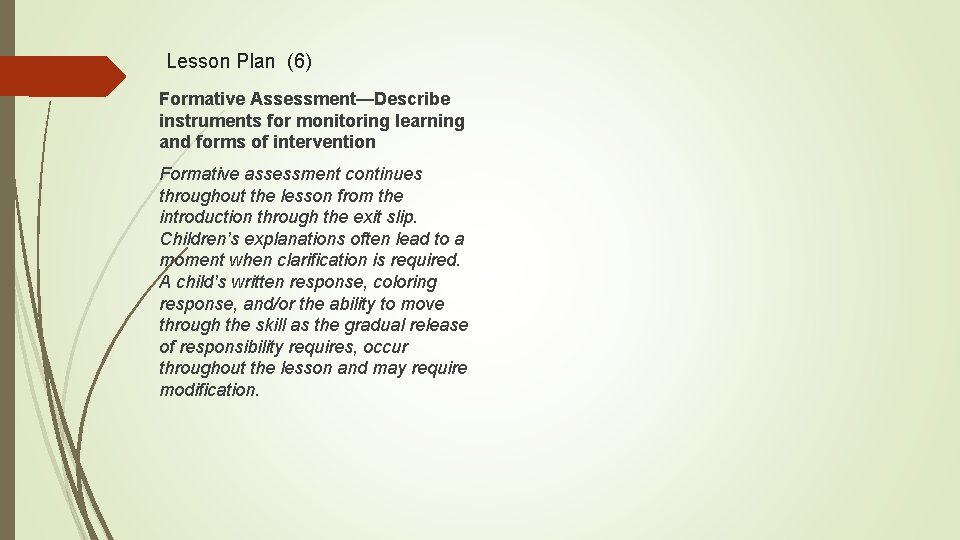
Lesson Plan (6) Formative Assessment—Describe instruments for monitoring learning and forms of intervention Formative assessment continues throughout the lesson from the introduction through the exit slip. Children’s explanations often lead to a moment when clarification is required. A child’s written response, coloring response, and/or the ability to move through the skill as the gradual release of responsibility requires, occur throughout the lesson and may require modification.
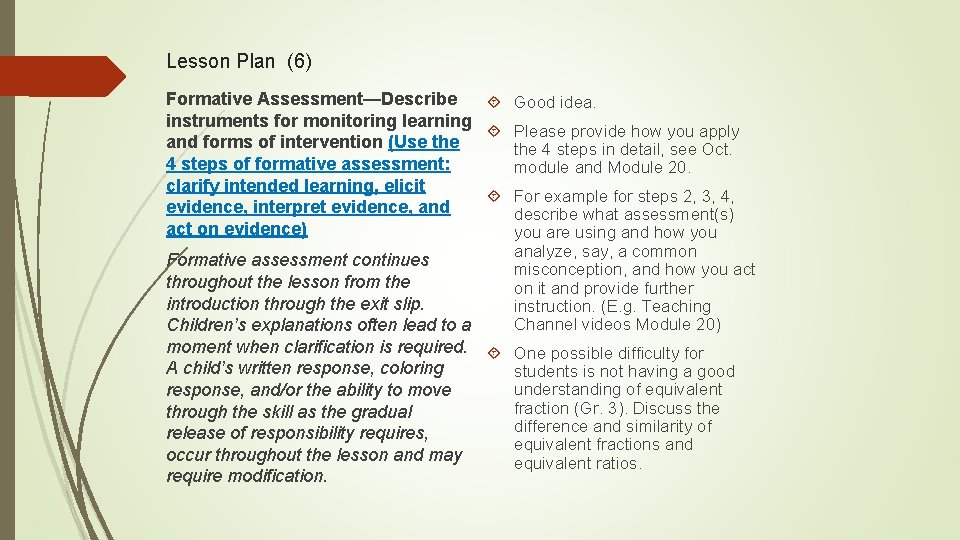
Lesson Plan (6) Formative Assessment—Describe Good idea. instruments for monitoring learning Please provide how you apply and forms of intervention (Use the 4 steps in detail, see Oct. 4 steps of formative assessment: module and Module 20. clarify intended learning, elicit For example for steps 2, 3, 4, evidence, interpret evidence, and describe what assessment(s) act on evidence) you are using and how you analyze, say, a common Formative assessment continues misconception, and how you act throughout the lesson from the on it and provide further introduction through the exit slip. instruction. (E. g. Teaching Channel videos Module 20) Children’s explanations often lead to a moment when clarification is required. One possible difficulty for A child’s written response, coloring students is not having a good understanding of equivalent response, and/or the ability to move fraction (Gr. 3). Discuss the through the skill as the gradual difference and similarity of release of responsibility requires, equivalent fractions and occur throughout the lesson and may equivalent ratios. require modification.
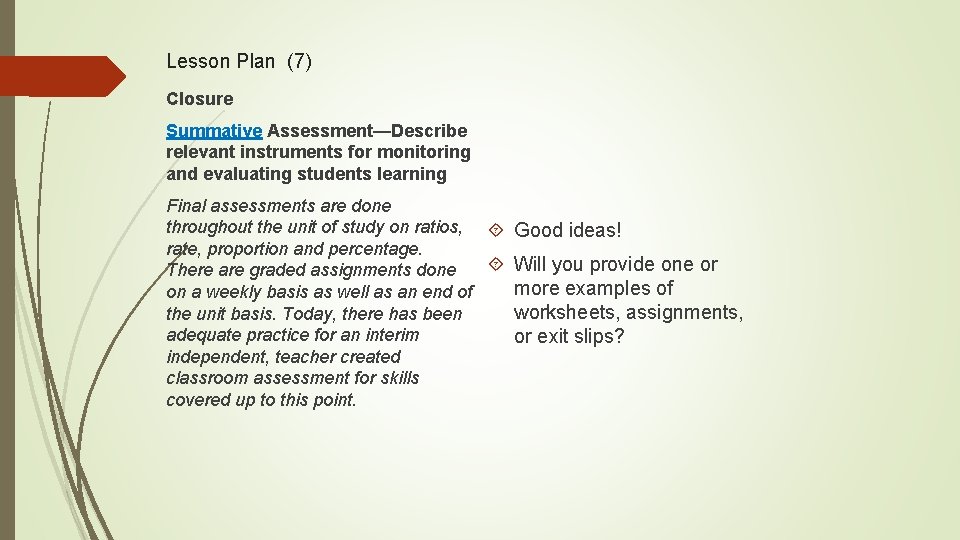
Lesson Plan (7) Closure Summative Assessment—Describe relevant instruments for monitoring and evaluating students learning Final assessments are done throughout the unit of study on ratios, Good ideas! rate, proportion and percentage. Will you provide one or There are graded assignments done more examples of on a weekly basis as well as an end of worksheets, assignments, the unit basis. Today, there has been adequate practice for an interim or exit slips? independent, teacher created classroom assessment for skills covered up to this point.
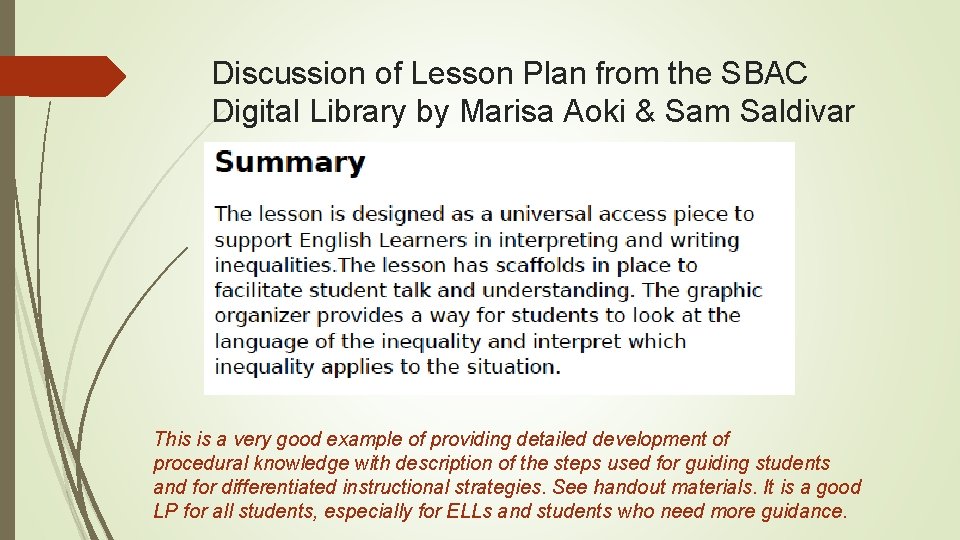
Discussion of Lesson Plan from the SBAC Digital Library by Marisa Aoki & Sam Saldivar This is a very good example of providing detailed development of procedural knowledge with description of the steps used for guiding students and for differentiated instructional strategies. See handout materials. It is a good LP for all students, especially for ELLs and students who need more guidance.
Thank you for your participation. Your hard work and dedication are much appreciated by parents like me! Please feel free to contact me for further assistance (zhuma@plu. edu).
Additional References Adams, C. & Pierce, R. , 2004. Tiered Lessons: One Way to Differentiate Mathematics Instruction. Gifted Child Today. Prufrock Press Volume Vol. 27, Issue 2, pp. 50 -65. http: //www. davidsongifted. org/Search-Database/entry/A 10513 Hani Morgan 2010. Improving Schooling for Cultural Minorities: The Right Teaching Styles Can Make a Big Difference. Educational Horizons. Winter 2010. pp 114 -120. http: //files. eric. ed. gov/fulltext/EJ 872489. pdf Cathy Weselby. 2016. What is Differentiated Instruction? Examples of How to Differentiate Instruction in the Classroom. http: //education. cuportland. edu/blog/teaching-strategies/examples-of-differentiated-instruction/