
Module 23 Thinking and Language Thinking Cognitive Abilities
Module 23: Thinking and Language Thinking
Cognitive Abilities • All the mental activities associated with thinking, knowing and remembering

Module 23: Thinking and Language Thinking: Concepts
Concept • A mental grouping based on shared similarity • Categorizing items in one’s environment
Prototype • A typical best example incorporating the major features of a concept • The closer a new object is to our concept prototype the easier it is to categorize it
Concept Hierarchy • A means to keep mental information organized from basic concepts to specific ones
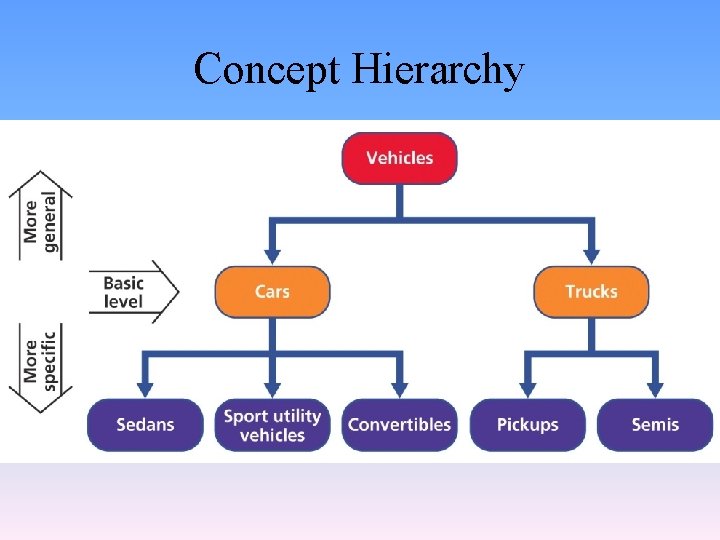
Concept Hierarchy
Module 23: Thinking and Language Thinking: Problem Solving

Algorithms • A problem solving strategy that guarantees the solution to the problem • Not always the most efficient method
Heuristics • A rule-of-thumb problem solving strategy that makes a solution more likely and efficient but does not guarantee a solution • These can be handy shortcuts, or they can get us into trouble

Insight • The sudden realization of the solution to a problem
Module 23: Thinking and Language Thinking: Problems Solving Problems
Mental Set • A tendency to approach a problem in a particular way • The set may or may not be helpful in solving a new problem
Fixation • A mental set that hinders the solution of a problem • One needs to think beyond the mental set to solve the new problem
Confirmation Bias • The tendency to focus on information that supports one’s preconceptions
Availability Heuristic • Uses information from our memory to judge the likelihood of events • Can be correct or incorrect
Overconfidence • The tendency to be more confident than correct when estimating the accuracy of one’s beliefs and judgments
Framing • The way an issue is worded or presented • Can influence decisions and judgments
Belief Perseverance • Clinging to one’s initial beliefs even after new information discredits the basis on which they were formed
- Slides: 19