
Module 23 Definition Measurement of Money Money Defined
- Slides: 14
Module 23 Definition & Measurement of Money
Money Defined • Money: any asset that is easily used to buy goods/services • Money’s 3 functions • Medium of exchange: an asset acquired to trade for goods/services, not to consume • Store of value: holds purchasing power over time • Unit of account/Standard of value: a measure used to set prices & make economic calculations
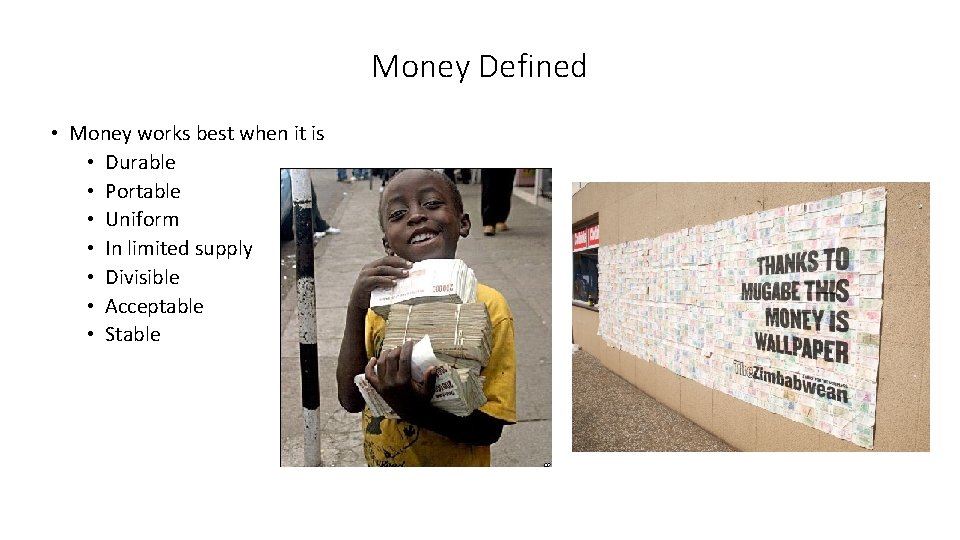
Money Defined • Money works best when it is • Durable • Portable • Uniform • In limited supply • Divisible • Acceptable • Stable
Types of Money • Commodity: good used as medium of exchange; has intrinsic value in other uses • Ex) gold & silver for most of human history • Ex) Cigarettes in WWII POW camps • Commodity-backed: medium of exchange with no intrinsic value; ultimate value guaranteed by a promise that it can be converted into valuable goods • Ex) a paper note from a bank promising to exchange the note for gold/silver on demand • Reduced amount of real resources needed • AKA representative money • Fiat: medium of exchange; derives value entirely from its official status as means of payment
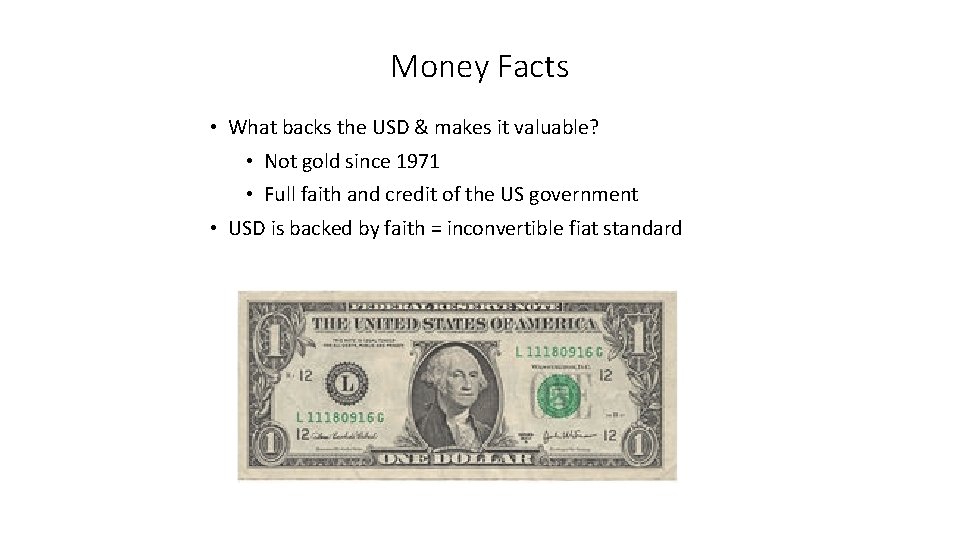
Money Facts • What backs the USD & makes it valuable? • Not gold since 1971 • Full faith and credit of the US government • USD is backed by faith = inconvertible fiat standard
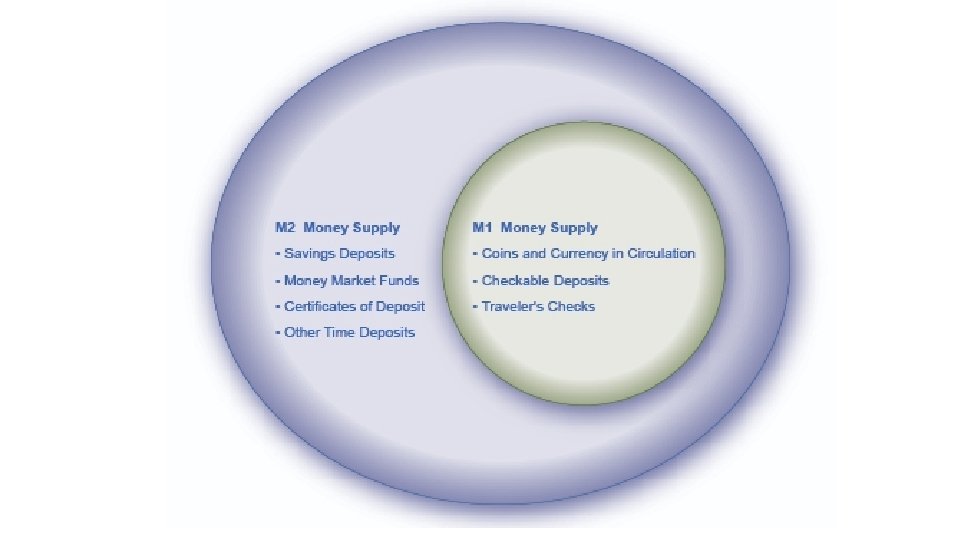
Money Supply • In the US, the Federal Reserve System (Fed) is the sole issuer of currency; it has monopoly control over the money supply • Fed calculates 2 money aggregates (overall measures of money) • M 1 • M 2
M 1 • Narrowest definition • Serves mainly as a medium of exchange • Contains • Currency in circulation (cash) • Traveler’s checks • Checkable bank deposits = demand deposits = checking accounts • February 2015 = $3 trillion
M 2 • M 1 + near-moneys • Near-moneys: financial assets that can’t be directly used as a medium of exchange but can be readily converted into cash or checkable bank deposits • Near-moneys = savings accounts, certificates of deposits (CDs), money market funds • Serves as a store of value • February 2015 = $11. 8 trillion
M 1 & M 2 • As we go from M 1 to M 2, • The measure becomes larger • Money becomes less liquid • As we go from M 2 to M 1, • The measure becomes smaller • Money becomes more liquid • Liquidity: how quickly a financial asset can be used to buy a good/ service
Assignment Please complete the following questions on slide 12 and 14 and turn into Mr. Ventura
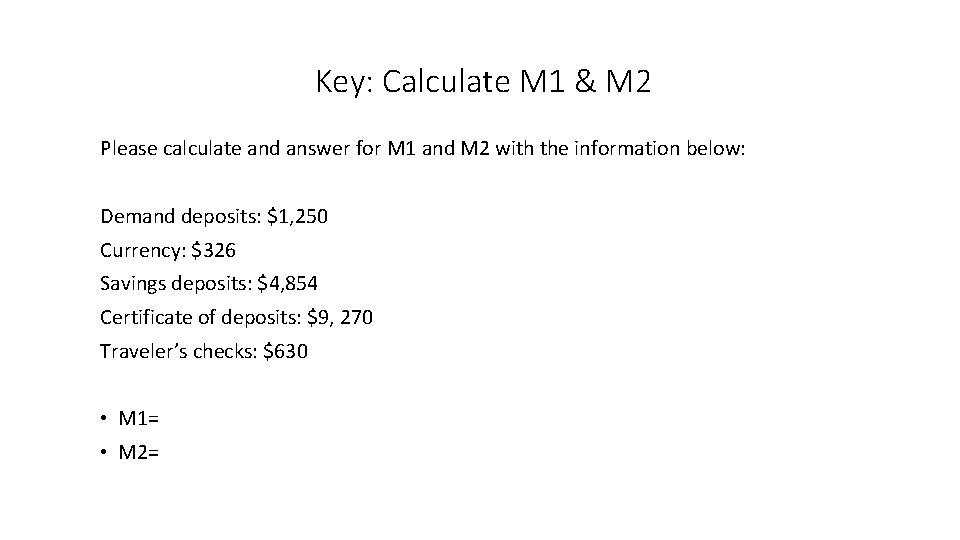
Key: Calculate M 1 & M 2 Please calculate and answer for M 1 and M 2 with the information below: Demand deposits: $1, 250 Currency: $326 Savings deposits: $4, 854 Certificate of deposits: $9, 270 Traveler’s checks: $630 • M 1= • M 2=
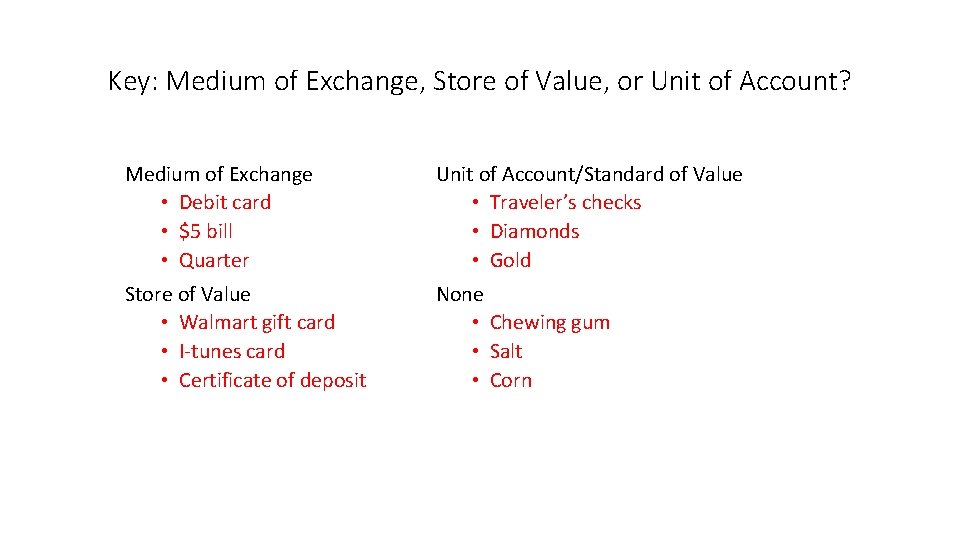
Key: Medium of Exchange, Store of Value, or Unit of Account? Medium of Exchange • Debit card • $5 bill • Quarter Unit of Account/Standard of Value • Traveler’s checks • Diamonds • Gold Store of Value • Walmart gift card • I-tunes card • Certificate of deposit None • Chewing gum • Salt • Corn
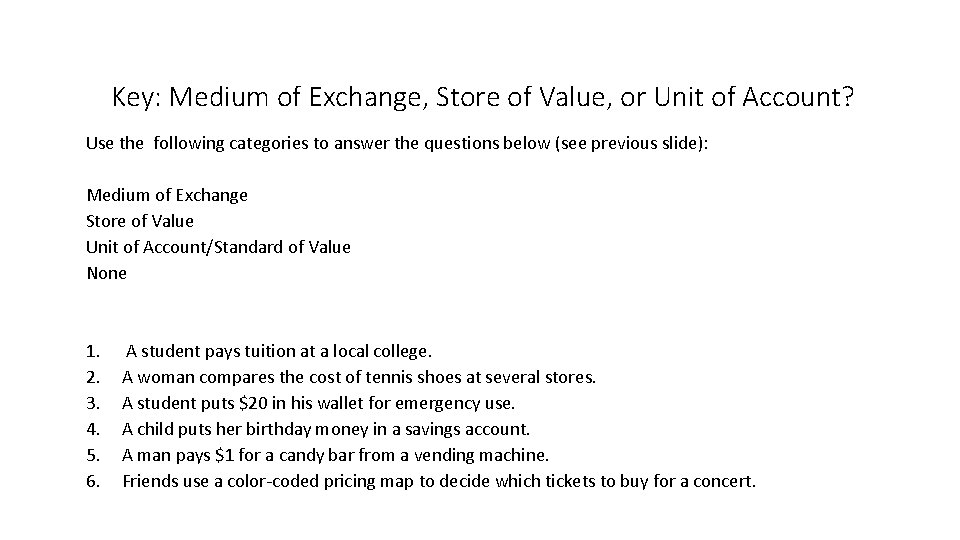
Key: Medium of Exchange, Store of Value, or Unit of Account? Use the following categories to answer the questions below (see previous slide): Medium of Exchange Store of Value Unit of Account/Standard of Value None 1. 2. 3. 4. 5. 6. A student pays tuition at a local college. A woman compares the cost of tennis shoes at several stores. A student puts $20 in his wallet for emergency use. A child puts her birthday money in a savings account. A man pays $1 for a candy bar from a vending machine. Friends use a color-coded pricing map to decide which tickets to buy for a concert.